
iPhone 12 Mini Battery Replacement: What You Need to Know
An iPhone 12 mini battery replacement can be a practical way to restore everyday usability when an aging battery causes reduced runtime, repeated charging, unexpected shutdowns, or performance limitations.
The iPhone 12 mini was introduced in 2020 with a compact 5.4-inch display. Its small form factor makes it attractive to users who prefer a lightweight phone, but it also means the battery has less physical space than those used in many larger smartphones.
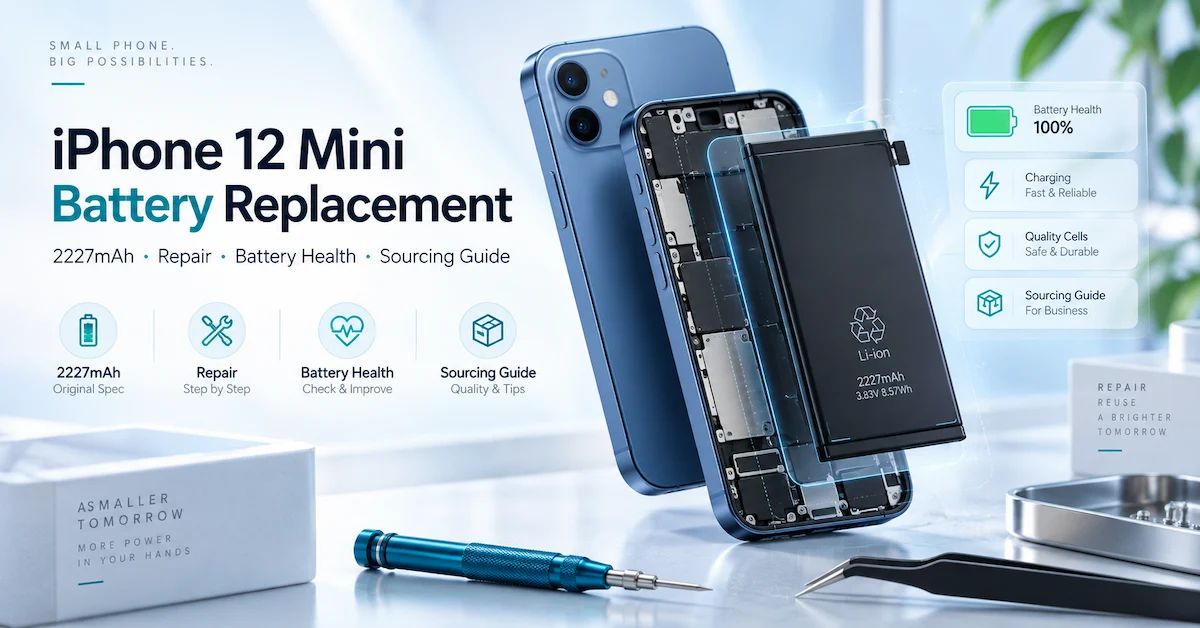
The commonly published original-capacity specification is 2227mAh, approximately 8.57Wh, with the battery reference A2471.
That specification is important because the iPhone 12 mini does not use the same replacement battery as the standard iPhone 12, iPhone 12 Pro, or iPhone 13 mini.
For individual users, the main question is usually straightforward:
Will replacing the battery make my iPhone 12 mini last longer?
For a professional repair business, the decision is more complex.
A successful replacement requires correct battery identification, safe installation, verification of charging behavior, inspection of the battery assembly, and an understanding of the information that iOS may display after the repair.
Wholesalers and refurbishment companies face additional requirements. They must verify whether approved samples can be supplied consistently across production batches, whether electrical specifications are accurate, and whether the supplier can support warranty claims and repeat orders.
The essential point is that a replacement battery should be evaluated as a complete electrical and mechanical component, not simply as a product labeled 2227mAh.
ESC supplies iPhone replacement batteries for professional repair and wholesale applications, including a dedicated iPhone 12 mini diagnosable battery configuration.
This guide explains how to evaluate replacement timing, battery specifications, repair risks, battery information, and purchasing requirements before making a decision.
Quick Answer: When Should an iPhone 12 Mini Battery Be Replaced?
Battery replacement should be considered when the existing battery's capacity or power-delivery performance no longer supports the user's practical requirements.
Common symptoms include short runtime, unexpected shutdowns, repeated low-battery warnings, and a Battery Health service recommendation.
However, the battery should not automatically be blamed for every charging or power complaint.
A useful starting point is to compare the battery's reported condition with its actual performance.
| Battery Condition | What It May Mean | Recommended Action |
|---|---|---|
| Above 90% with normal runtime | Battery still supports expected use | Replacement generally unnecessary |
| 85–90% with shorter runtime | Some capacity loss may be noticeable | Review usage and charging conditions |
| 80–85% with frequent complaints | Aging may affect practical usability | Consider replacement after diagnosis |
| Below 80% with poor runtime | Significant capacity degradation | Evaluate professional battery service |
| Unexpected shutdowns | Possible power-delivery limitation | Diagnose battery and device power system |
| Swelling or visible damage | Potential battery safety concern | Stop normal use and seek professional handling |
| Abnormal heat during charging | Several possible causes | Investigate charging and battery condition |
These ranges are practical evaluation guidance rather than mandatory replacement thresholds.
Apple explains that batteries in iPhone 14 models and earlier are designed to retain approximately 80% of their original capacity after 500 complete charge cycles under ideal conditions.
That is a battery design reference, not a guarantee that every battery will reach exactly 500 cycles or require replacement at a precise percentage.
For an iPhone 12 mini owner who prefers a compact device, battery replacement may be worthwhile even when the displayed capacity is slightly above 80%, provided the battery is confirmed as the main cause of the problem.
For a refurbishment company, the replacement decision should follow a consistent internal grading and testing policy.
iPhone 12 Mini Battery Specifications: 2227mAh, A2471, and 8.57Wh
Before purchasing any replacement battery, buyers should verify the correct electrical and mechanical specifications.
The iPhone 12 mini uses a rechargeable lithium-ion battery designed for its compact internal architecture.
ESC currently publishes a dedicated replacement battery with the following specifications.
| Specification | iPhone 12 Mini Battery Reference |
|---|---|
| Device | iPhone 12 mini |
| Year Introduced | 2020 |
| Display Size | 5.4 inches |
| Common Battery Reference | A2471 |
| Rated Capacity | 2227mAh |
| Nominal Voltage | Approximately 3.85V |
| Energy | Approximately 8.57Wh |
| Battery Chemistry | Rechargeable lithium-ion |
| Replacement Configuration | Model-specific battery assembly |
| Installation | Professional repair recommended |
The values represent the commonly published original-capacity class and the corresponding ESC replacement specification. Buyers should reconfirm the final ratings against the actual battery label and approved datasheet.
What Does 2227mAh Mean?
Battery capacity is commonly expressed in milliampere-hours.
The 2227mAh rating describes the amount of electrical charge the battery is designed to deliver under defined conditions.
However, mAh alone does not establish real-world runtime.
Battery life also depends on:
-
Processor and graphics activity
-
Display brightness
-
Cellular signal conditions
-
Background applications
-
Charging and discharging efficiency
-
Battery age
-
Operating temperature
-
Software activity
-
User behavior
Two iPhone 12 mini devices with batteries of the same rated capacity can therefore deliver different daily runtimes.
For wholesale purchasing, the printed 2227mAh value should be verified through controlled capacity testing, rather than accepted solely because it appears on the label.
Why Is the Battery Rated at 8.57Wh?
Watt-hours measure energy.
The approximate relationship is:
Energy (Wh) = Capacity (Ah) × Nominal Voltage (V)
Using the common iPhone 12 mini figures:
2.227Ah × 3.85V ≈ 8.57Wh.
This explains the relationship between the capacity, voltage, and energy specifications.
However, the nominal voltage of an aftermarket battery may vary slightly according to its approved cell design.
Buyers should always use the ratings from the exact product datasheet instead of combining figures from different batteries.
Is A2471 the iPhone Model Number?
No.
A2471 is a commonly used battery reference, not the regional model number of the iPhone itself.
That distinction matters for parts purchasing.
The iPhone 12 mini device has regional model identifiers, while the replacement battery has its own part reference and supplier SKU.
A professional inventory system should record both.
Which iPhone 12 Mini Models Use This Battery?
Apple identifies the iPhone 12 mini through four regional model numbers.
| iPhone Model Number | Market |
|---|---|
| A2176 | United States |
| A2398 | Canada and Japan |
| A2399 | Other countries and regions |
| A2400 | China mainland |
These identifiers describe the iPhone device.
They should not be confused with the A2471 battery reference.
ESC lists these iPhone 12 mini models as compatible with its corresponding replacement battery configuration.
For professional buyers, the correct procedure is to confirm the exact device model, supplier battery SKU, voltage, physical dimensions, connector layout, and intended installation method before placing an order.
Regional model coverage alone does not eliminate the need for sample validation.
iPhone 12 Mini vs. iPhone 12 vs. iPhone 13 Mini Battery
One of the most common purchasing mistakes is assuming that smartphones within the same product family use interchangeable batteries.
The iPhone 12 mini is physically smaller than the standard iPhone 12.
The iPhone 13 mini looks similar in size, but its battery specification is also different.
| Model | Common Capacity | Energy Reference | Battery Reference |
|---|---|---|---|
| iPhone 12 mini | 2227mAh | 8.57Wh | A2471 |
| iPhone 12 | 2815mAh | 10.78Wh | Model-specific reference |
| iPhone 12 Pro | 2815mAh | 10.78Wh | Model-specific reference |
| iPhone 13 mini | 2406mAh | 9.34Wh | A2660 |
The matching capacity of iPhone 12 and iPhone 12 Pro does not mean the same principle applies to the mini models.
The iPhone 12 mini battery must be sourced as a dedicated replacement configuration.
Can an iPhone 13 Mini Battery Fit an iPhone 12 Mini?
Buyers should not assume compatibility.
The iPhone 13 mini has a different battery capacity and battery assembly specification.
Even if two devices share a similar overall form factor, differences in shape, connector positioning, electrical configuration, and internal layout can prevent interchangeability.
A battery should never be forced into a device because its outside dimensions appear similar.
For buyers comparing these two generations, ESC's iPhone 13 mini battery replacement guide explains the separate 2406mAh specification and professional sourcing considerations.
Why Separate SKUs Matter
A distributor may carry batteries for the entire iPhone 12 family.
Using a generic description such as "iPhone 12 Series Battery" creates unnecessary risk.
A more reliable system assigns individual SKUs and approved specifications to each compatible battery configuration.
This makes purchasing, warehouse picking, installation, and warranty investigation more consistent.
Why Does the iPhone 12 Mini Have Shorter Battery Life?
The iPhone 12 mini was designed around compact dimensions.
Its battery is smaller than those in many larger smartphones, but everyday power consumption still depends on processing, wireless connectivity, display usage, and background activity.
This makes the device particularly sensitive to the practical effects of battery aging.
A reduction in battery capacity that might be tolerable on a phone with a much larger battery can become more noticeable on a compact device.
Battery Aging
Lithium-ion batteries gradually lose capacity through chemical aging.
The aging process is influenced by the number of charge cycles, storage conditions, temperature, and elapsed time.
After several years of use, even a physically undamaged battery may no longer deliver the runtime its owner expects.
High Power Consumption
Gaming, navigation, mobile hotspot use, video recording, and other demanding activities increase electrical consumption.
A replacement battery may improve the available stored energy, but it does not eliminate the power requirements of those activities.
Weak Cellular Signal
Poor cellular coverage can increase communication-related energy consumption.
This may cause faster battery drain even when the battery is in acceptable condition.
Background Software Activity
Software updates, cloud synchronization, photo processing, and other background tasks can temporarily increase energy use.
These factors should be considered before diagnosing the battery as defective.
Battery Internal Resistance
As batteries age, their internal electrical characteristics can change.
Increased impedance can contribute to greater voltage drop during demanding workloads.
This may affect the phone's ability to deliver peak power reliably.
For professional diagnosis, capacity and power-delivery behavior should be evaluated together.
Seven Signs an iPhone 12 Mini Needs Battery Evaluation
1. The Phone Requires Multiple Charges Per Day
Frequent charging is often the first noticeable symptom.
However, the repair technician should compare the customer's previous usage pattern with current conditions.
If the customer recently began using navigation, gaming, or hotspot functions much more frequently, the increased power demand may explain part of the change.
2. Battery Health Shows a Service Message
A service recommendation is an important indication that battery maintenance may be appropriate.
The next step is to assess whether replacement would resolve the customer's actual complaint.
3. Unexpected Shutdowns Occur
An aging battery may struggle to support sudden power demand.
A voltage drop under load can contribute to unexpected shutdowns.
Other device faults can produce similar symptoms, so battery replacement should follow a suitable diagnosis.
4. Performance Is Reduced
iOS may manage performance when battery condition limits peak power delivery.
Replacing a sufficiently degraded battery may improve practical device responsiveness.
It does not increase the phone's original processor capability.
5. Battery Percentage Behaves Unusually
A battery percentage that changes unexpectedly may indicate a battery-information or power-system problem.
Technicians should assess charging, runtime, and device behavior before making a final decision.
6. The Phone Has Charging Problems
Charging interruptions can be caused by the battery, charger, cable, Lightning connector, charging circuitry, or software conditions.
A replacement battery is not a universal solution for every charging complaint.
7. The Battery Is Swollen or Damaged
Swelling, leakage, visible deformation, smoke, unusual odor, or uncontrolled heat changes the situation from routine troubleshooting to a safety concern.
Stop ordinary charging and operation.
Do not puncture, compress, or continue testing a visibly damaged lithium-ion battery.
Use an appropriate professional battery-safety procedure.
Diagnose Battery Problems Before Replacing the Battery
A professional repair shop should establish whether the battery is the likely cause of the complaint.
Replacing a battery without diagnosis may result in an unnecessary repair and a dissatisfied customer.
Check Battery Health
Open the relevant battery settings and review available health information.
Record the reported maximum capacity and any service or performance messages.
This provides a starting point, but not a complete electrical diagnosis.
Review Battery Usage
Check which applications consume the most battery power.
Look for unusual background activity.
Compare the findings with the customer's reported usage.
Test With a Known-Good Charger
Use an appropriate charger and cable.
Observe whether charging begins normally, remains stable, and behaves consistently.
If the problem disappears when the charging equipment changes, the battery may not be responsible.
Check the Lightning Port
Contamination, mechanical damage, or connector issues can affect charging.
The inspection should follow a safe procedure.
Avoid inserting unsuitable metal objects or using aggressive cleaning methods.
Observe Temperature
A warm device during charging or high workloads does not automatically indicate a bad battery.
Persistent or abnormal heat requires further investigation.
Record the environment, activity, charger, and other conditions before making comparisons.
Document the Diagnosis
For repair chains, a short standardized diagnostic record can reduce variation between technicians.
Useful information includes the device model, repair history, symptoms, Battery Health status, charging results, and any visible damage.
This record also supports later warranty evaluation.
iPhone 12 Mini Charging: What Is Normal After Battery Replacement?
The iPhone 12 mini supports wired fast charging and wireless charging.
However, the charging method influences the temperature, charging speed, and practical user experience.
Understanding these differences prevents incorrect battery warranty claims.
Wired Charging
Apple's published technical specifications describe fast-charging capability of up to approximately 50% in 30 minutes under specified conditions using a suitable 20W-or-higher power adapter.
That is a controlled performance reference, not a guaranteed result for every battery age, ambient temperature, or software workload.
Charging slows as the battery approaches higher states of charge.
The phone also regulates power according to temperature and other operating conditions.
MagSafe Charging
The iPhone 12 mini has a notable model-specific limitation.
With a compatible MagSafe charger and suitable power adapter, Apple specifies up to 12W for the iPhone 12 mini, rather than the 15W peak associated with certain other iPhone models and configurations.
This is particularly important when explaining charging expectations to customers.
A customer should not assume that purchasing a higher-wattage adapter will force the phone to charge above its supported limit.
Qi Wireless Charging
Conventional Qi wireless charging is also supported, with Apple publishing a reference of up to 7.5W for this device.
Actual performance depends on charger compatibility, alignment, temperature, and device conditions.
Does a New Battery Make Charging Faster?
Not necessarily.
A new battery may resolve charging limitations caused by a degraded or malfunctioning old battery.
However, replacement does not change the iPhone 12 mini's fundamental charging architecture.
A battery supplier should not claim that installing a higher-capacity or aftermarket battery automatically increases the phone's charging power.
iPhone 12 Mini Battery Replacement: Professional Repair Workflow
Battery replacement involves opening a compact electronic device containing sensitive components and a lithium-ion cell.
Apple publishes an iPhone 12 mini Repair Manual with dedicated battery-safety, troubleshooting, battery-removal, and reassembly procedures.
The following is a professional workflow overview, not a substitute for the full model-specific repair instructions.
Step 1: Verify the Exact Device
Confirm that the device is an iPhone 12 mini.
Record the regional model number and any relevant repair history.
Inspect the phone for physical damage before beginning work.
Step 2: Complete a Pre-Repair Function Test
Check the battery complaint and document the current condition.
Where possible, verify charging, display, touch, cameras, Face ID, audio, and other relevant functions.
This helps distinguish existing device faults from any issues discovered after repair.
Step 3: Protect Customer Data
Discuss appropriate data backup before internal repair.
Battery replacement does not inherently require erasing the phone, but hardware service carries risks.
Professional service providers should also follow documented privacy procedures.
Step 4: Prepare the Workstation
A trained technician should use appropriate equipment, personal protective measures, and the manufacturer's current repair instructions.
Battery safety must take priority over repair speed.
Do not begin normal repair work on a swollen, leaking, or otherwise unsafe battery.
Step 5: Open the Device Safely
The iPhone 12 mini requires careful handling of its display assembly and internal connectors.
Improper force can damage the display or surrounding components.
Only technicians with appropriate training should perform internal disassembly.
Step 6: Remove the Existing Battery
The battery is secured inside the device.
The applicable manufacturer procedure should be followed when releasing it.
Do not puncture, excessively bend, compress, or crush the cell.
If removal cannot be completed safely, stop rather than improvising a forceful method.
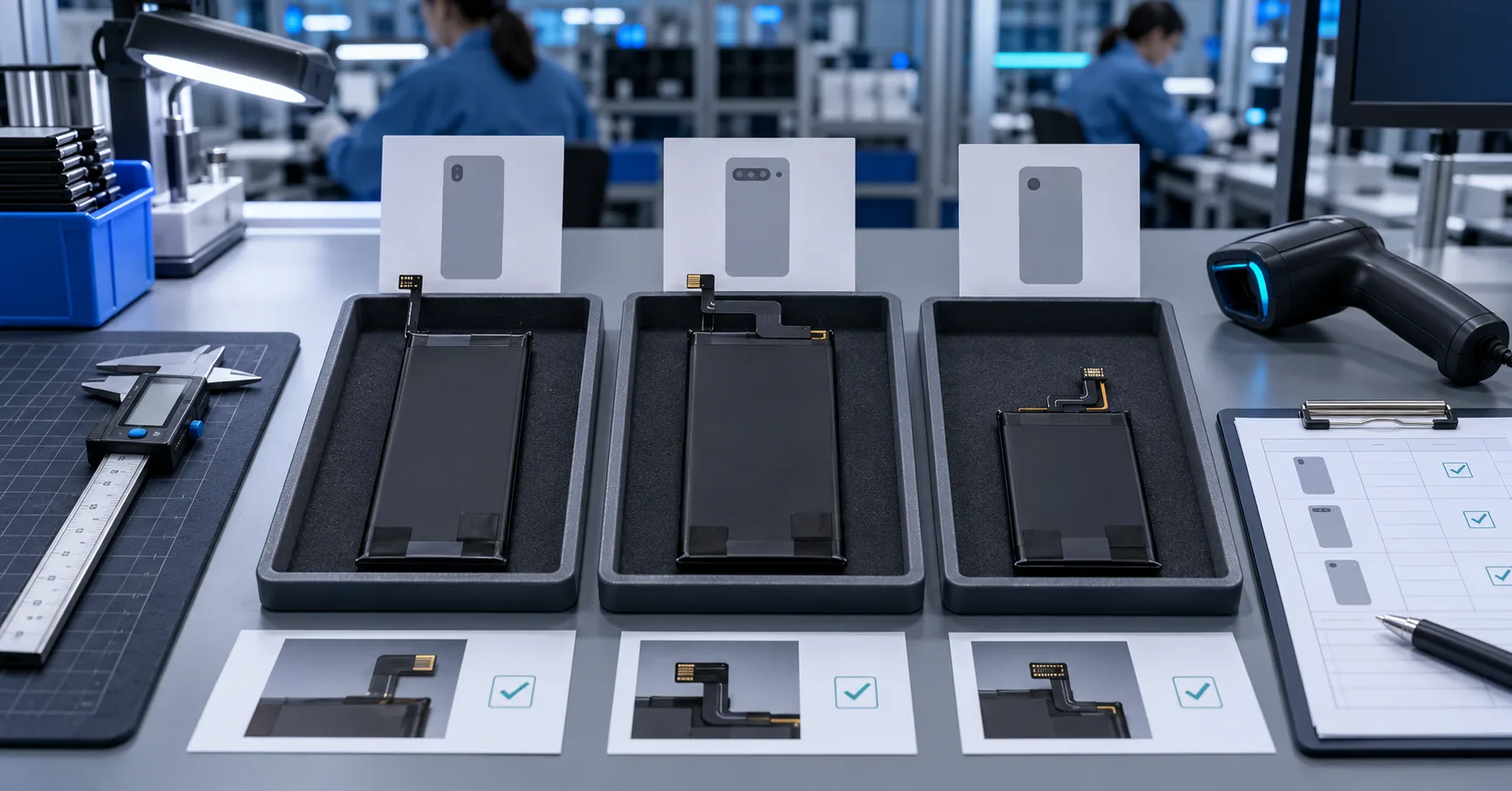
Step 7: Inspect the Replacement Battery
Before installation, verify the selected battery's identity and physical condition.
Check the label, voltage, capacity, connector, flex cable, insulation, and dimensions.
Do not install a battery showing swelling, puncture marks, deformation, or other visible damage.
Step 8: Install the Approved Battery
Position the replacement according to the applicable repair procedure.
Ensure the battery is correctly seated and that cables or connectors are not trapped or excessively stressed.
Use the appropriate adhesive and assembly components.
Step 9: Reassemble the Phone
Reassemble the device according to the relevant repair procedure.
Confirm that all required components are secured and the enclosure closes without abnormal pressure.
Opening the device affects its original sealing arrangement. The factory water-resistance rating should not automatically be assumed to remain unchanged after repair.
Step 10: Test and Document the Result
Verify power-on, charging, battery information, and the device functions affected by the repair.
If the selected part and service process require calibration, complete the supported procedure.
Record the outcome before releasing the phone to the customer.
Battery Health and Unknown Part Messages After Replacement
One of the most commercially important issues in iPhone battery replacement is how the device identifies the installed component.
Customers may expect the Battery Health screen to show 100% and the Parts and Service History to display a preferred status immediately after replacement.
These expectations must be managed carefully.
What Is Parts and Service History?
On supported iPhone models, including the iPhone 12 series, iOS provides information about certain repaired or replaced components.
The information is available through:
Settings → General → About → Parts and Service History
The displayed status depends on the relevant component, repair process, device model, and software version.
What Does Genuine Mean?
Apple uses the Genuine designation for repairs completed with genuine Apple components and the appropriate processes.
This is not the same as a third-party supplier describing a battery as original-capacity or diagnostic-compatible.
Those descriptions refer to different characteristics.
What Does Unknown Part Mean?
An Unknown Part message can appear under several circumstances.
Examples include a non-genuine component, a part that cannot be verified, an improperly functioning component, or an incomplete identification process.
The message alone does not provide a measured capacity value.
However, it may influence customer expectations and device resale value.
Does 100% Battery Health Prove the Battery Is Good?
No.
A displayed percentage does not replace independent verification of actual capacity, power delivery, physical condition, charging behavior, and batch consistency.
Similarly, the absence of a warning is not evidence that the cell has passed a complete laboratory quality evaluation.
Can Repair Assistant Be Used?
Apple's current Repair Assistant documentation includes battery calibration support for the iPhone 12 and iPhone 13 families when the relevant device, part, and repair conditions are supported.
The procedure is intended to complete eligible repairs.
It does not guarantee that every third-party battery can be calibrated or identified as a genuine Apple component.
Repair businesses should verify their actual service configuration before making customer promises.
Diagnosable iPhone 12 Mini Battery: What Buyers Should Understand
ESC currently offers a dedicated 2227mAh diagnosable battery for iPhone 12 mini.
The product is marketed for repair shops, distributors, refurbishment businesses, and other professional buyers seeking a battery configuration with enhanced compatibility for selected diagnostic workflows.
ESC describes the product as supporting compatible battery-recognition functions and reducing certain post-replacement warning messages.
The page also publishes:
-
Battery reference A2471
-
Rated capacity of 2227mAh
-
Energy rating of 8.57Wh
-
A model-specific diagnosable configuration
-
OEM and private-label support
-
A published 12-month warranty
-
A standard listed MOQ of 20 pieces
These are supplier-published product details. Final purchasing terms and actual behavior should be confirmed for the specific order.
What Should Buyers Validate?
Before approving a diagnosable replacement battery, test its behavior on the exact target device and software configuration.
Record:
Device model: The precise iPhone 12 mini variant.
iOS version: The version used during testing.
Installation method: The actual professional repair workflow.
Battery information: What the operating system displays.
Charging performance: Whether charging is stable.
Electrical performance: Whether the battery meets the approved capacity and related specifications.
Repeatability: Whether multiple tested units produce consistent results.
Why Recognition and Quality Must Be Separate Tests
A diagnostic feature and battery quality are different evaluation categories.
A battery may display expected system information but fail a capacity or workmanship test.
Another battery may meet its electrical specifications while displaying a different repair-history status.
For a professional repair program, both outcomes must be documented independently.
Third-party diagnostic compatibility should never be presented as proof of Apple authorization.
ESC's related guide, How Does an iPhone Diagnostic Battery Work?, provides more information about the intended diagnostic workflow.
Complete Replacement Battery vs. Cell Without Flex
There are two distinct repair approaches that wholesale buyers should understand.
The first uses a complete replacement battery configuration.
The second uses a replacement cell without the original battery flex or protection electronics.
These products serve different repair operations.
| Factor | Complete Replacement Battery | Cell Without Flex |
|---|---|---|
| Product configuration | Finished replacement assembly | Battery cell only |
| Flex cable | Included according to product specification | Not included |
| Protection electronics | Included according to assembly design | Not included |
| Main buyer | Repair shop or refurbishment operation | Specialist cell-level repair operation |
| Technician requirements | Professional replacement training | Additional cell-transfer and integration skills |
| Validation focus | Complete battery behavior | Cell quality plus integration process |
| Main risk | Fit, assembly, recognition, electrical performance | Cell handling and component integration |
ESC offers battery cells without flex cables for qualified repair businesses.
Its current category includes a 2227mAh cell for iPhone 12 mini.
When Is a Complete Assembly Preferable?
A complete replacement assembly is generally more appropriate when the repair business wants a defined battery configuration with fewer integration steps.
It is still necessary to verify compatibility and the expected post-repair system behavior.
When Is a Cell-Only Product Appropriate?
A cell without flex is intended for specialized repair operations with the necessary equipment, expertise, and safety procedures.
It should not be treated as a ready-to-install battery.
A buyer purchasing cell-only components must account for the required additional integration work and testing.
Why These Products Need Separate SKUs
A complete assembly and a cell-only component may both carry a 2227mAh capacity rating.
That does not make them commercially interchangeable.
Their labor requirements, assembly risks, quality tests, and warranty responsibilities differ.
A professional distributor should identify them separately in quotations, product listings, packaging, and warehouse systems.
How to Evaluate iPhone 12 Mini Replacement Battery Quality
For wholesale buyers, a successful sample installation is only the beginning of battery qualification.
The supplier must demonstrate that the approved configuration can be reproduced reliably.
Cell Quality and Grading
Incoming cells should be checked against defined acceptance requirements.
Typical inspection areas include:
-
Cell identification
-
Capacity
-
Voltage
-
Internal resistance
-
Physical dimensions
-
Appearance
-
Storage or self-discharge behavior
A-grade and premium labels should be supported by measurable specifications rather than used as substitutes for technical evidence.
Actual Capacity Testing
The stated 2227mAh capacity should be evaluated using a defined test method.
A useful test procedure identifies the charge and discharge conditions, temperature, equipment, and acceptance limits.
Without consistent test conditions, results from different suppliers or batches may not be directly comparable.
Internal Resistance
Internal resistance contributes to voltage drop and heat generation under electrical load.
A useful comparison requires matched test methods and conditions.
Buyers should not apply one arbitrary internal-resistance threshold to every battery model.
For iPhone 12 mini purchasing, compare results against the approved specification for the selected cell and configuration.
Voltage and Electrical Consistency
Voltage measurements help identify certain abnormalities.
However, voltage alone does not prove usable capacity, reliability, or protection performance.
A complete evaluation should combine multiple electrical and physical checks.
Protection and Battery Management
For finished replacement batteries, the protection electronics and associated components are important parts of the assembly.
Buyers should ask which protective functions and tests apply to the exact product.
Cell-only products require a different evaluation because relevant electronics may not be included.
Connector and Flex Quality
The battery connector and flex arrangement must be suitable for the intended iPhone.
Inspect connector condition, orientation, insulation, and mechanical stability.
Poor connector quality can create installation problems even when the battery cell itself meets its electrical specification.
Aging Tests
Aging and retention tests can help identify certain problems before shipment.
For high-volume buyers, the supplier should explain whether testing is performed on every unit or according to a defined sampling plan.
Traceability
A reliable quality system should make it possible to connect a field complaint to a product model, supplier SKU, and identifiable production or shipment batch.
Traceability supports warranty investigation and corrective action.
ESC describes cell grading, capacity testing, electrical inspection, aging, and final inspection within its phone battery quality-control process.
Build a Sample Approval Plan Before Bulk Purchasing
A repair chain or distributor should not approve a new battery SKU after testing only whether one sample powers on the phone.
A more useful qualification process has several stages.
Stage 1: Review the Technical Specification
Confirm the written product specification before testing.
For iPhone 12 mini, verify A2471 compatibility, 2227mAh capacity, the applicable voltage rating, battery dimensions, connector arrangement, and complete assembly configuration.
Clarify what is included in the product.
Stage 2: Conduct Physical Inspection
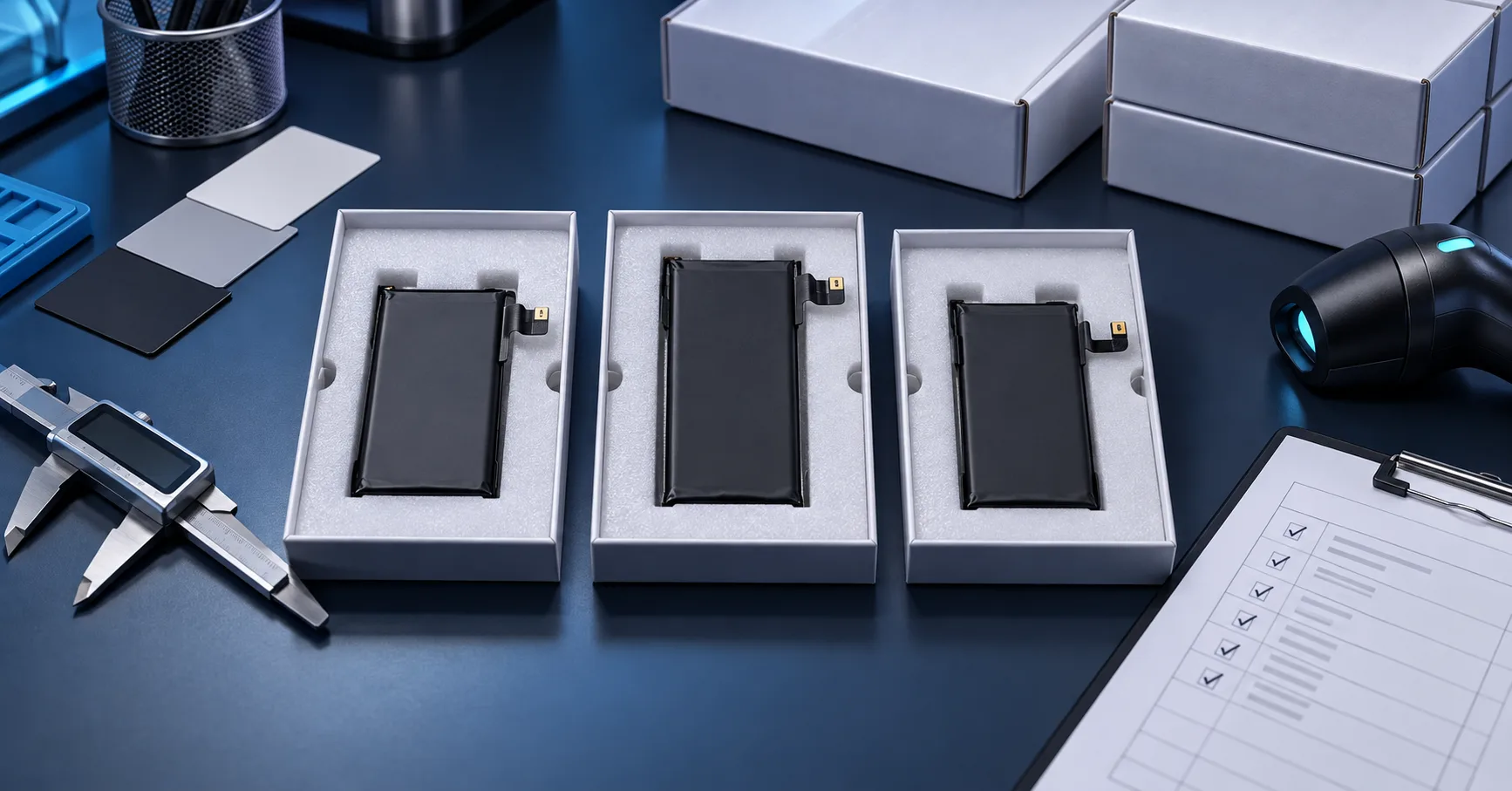
Inspect representative samples for labeling accuracy, packaging condition, connector fit, insulation, thickness, and visible defects.
Reject unsafe or physically damaged samples from normal installation testing.
Stage 3: Perform Controlled Electrical Tests
Evaluate the selected batteries according to the agreed capacity, charging, voltage, and other electrical test methods.
Record environmental and equipment conditions.
Stage 4: Conduct Device-Level Validation
Test the selected battery in appropriate iPhone 12 mini devices using the intended repair process.
Record charging behavior, temperature observations, battery information, and relevant device functions.
Stage 5: Review Repeatability
Evaluate more than one sample when the purchasing risk justifies it.
The appropriate sample size depends on order quantity, historical supplier performance, product changes, and acceptance requirements.
Stage 6: Approve a Controlled Reference
Once a configuration is approved, connect its results to the exact supplier SKU, technical revision, and approved documentation.
Future shipments can then be evaluated against the same baseline.
ESC's iPhone 12 series battery validation guide provides additional guidance on sample matrices, device-level testing, and repeat-order consistency.
Post-Replacement Testing: What Must a Repair Shop Check?
A phone that successfully starts after battery replacement has passed only one basic functional test.
The repair should also demonstrate appropriate charging behavior and an acceptable finished-device condition.
| Test Item | What to Verify | If the Result Is Abnormal |
|---|---|---|
| Power On | Device starts normally | Investigate installation and power system |
| Wired Charging | Stable charging behavior | Check charger, cable, battery, and circuit |
| Wireless Charging | Expected operation under controlled conditions | Check alignment and charging system |
| Battery Information | Expected result for approved repair configuration | Review component and service history |
| Battery Percentage | Stable behavior under normal conditions | Investigate battery and software information |
| Runtime | Consistent with relevant test conditions | Review capacity, workload, and device condition |
| Temperature | No unexplained abnormal heating | Stop and diagnose |
| Display | Normal image and touch behavior | Investigate repair-related damage |
| Face ID | Function matches documented pre-repair status | Investigate relevant device components |
| Mechanical Fit | No deformation or abnormal enclosure pressure | Correct assembly |
| Final Appearance | Properly assembled and undamaged | Reinspect before release |
Why Is Face ID Included?
Face ID does not operate as a function of the battery cell.
However, internal repair work can affect nearby components.
A professional workshop should therefore document important functions before and after repair.
This helps avoid disputes over whether a problem existed before the battery was replaced.
Why Is Temperature Monitoring Useful?
Temperature is influenced by the battery, charging system, processor load, environment, and software activity.
A thermal complaint should be investigated under controlled conditions.
Abnormal heat does not automatically prove that the replacement cell is defective.
For more detailed thermal troubleshooting, see ESC's iPhone overheating diagnosis guide.
Common Problems After iPhone 12 Mini Battery Replacement
The iPhone Does Not Turn On
A device that does not start may have a battery connection problem, insufficient charge, installation damage, or another internal fault.
Professional diagnosis should identify the cause rather than repeatedly replacing batteries without evidence.
Battery Health Does Not Show the Expected Value
The result may depend on the replacement configuration, iOS version, and repair process.
Check the relevant Parts and Service History information.
Do not assume that a preferred displayed percentage proves actual tested capacity.
The Phone Shows an Unknown Part Message
This may be associated with component identification, verification, or the selected repair configuration.
Record the exact message and compare it with the approved product specification.
Do not represent an aftermarket battery as a genuine Apple service component without appropriate evidence.
Battery Drains Quickly After Replacement
Possible explanations include background applications, cellular signal conditions, an unsuitable battery, or another device problem.
Use a controlled runtime comparison rather than immediately blaming the cell.
Charging Is Intermittent
Check the charging source, cable, connector, device condition, and battery installation.
A charging interruption can have several possible causes.
The Battery Becomes Unusually Hot
Stop ordinary testing if the battery shows severe abnormal heating or any associated safety concern.
Investigate the complete electrical and environmental conditions.
The Phone Does Not Close Properly
Do not force the enclosure closed.
Verify the battery's physical dimensions and placement.
An incorrectly sized or positioned battery can create damaging mechanical pressure.
Is iPhone 12 Mini Battery Replacement Worth the Cost?
For many owners, replacing an aging battery can be more economical than replacing the entire phone.
However, the decision depends on the phone's overall condition and the expected value of continued use.
When Replacement Is More Attractive
Battery replacement is generally more attractive when:
-
The battery is the main confirmed problem.
-
The display and enclosure remain functional.
-
The charging system is reliable.
-
The device meets the owner's software and application needs.
-
The total repair cost is reasonable.
-
The owner values the compact form factor.
When Replacement May Be Less Attractive
The decision becomes less favorable when the phone also requires expensive display, camera, charging-circuit, enclosure, or logic-board repairs.
Multiple major repairs can exceed the device's practical economic value.
A professional quotation should therefore consider the entire device condition.
How Should Repair Shops Calculate Cost?
A useful calculation is:
Total Repair Cost = Battery Cost + Labor + Consumables + Testing + Expected Warranty Cost
For wholesale buyers, the landed cost of the battery and inventory management expenses should also be included.
The lowest battery purchase price does not necessarily produce the lowest total repair cost.
A cheaper battery may become expensive if it creates additional rework or verified warranty failures.
iPhone 12 Mini Battery Wholesale: What Buyers Should Ask Suppliers
Repair chains, distributors, and refurbishment companies have different purchasing needs from individual consumers.
They require repeatable product specifications and predictable supply.
Before placing a wholesale order, ask the supplier to confirm:
-
Exact compatible iPhone models
-
Battery reference and capacity
-
Finished assembly or cell-only configuration
-
Nominal voltage and energy rating
-
Connector and flex specifications
-
Capacity test method
-
Internal-resistance acceptance criteria
-
Aging and inspection procedures
-
Available documentation
-
Minimum order quantity
-
Mixed-model ordering options
-
Packaging and OEM customization
-
Production and delivery schedule
-
Warranty terms
-
Batch identification and complaint handling
The supplier should be able to explain the approved product rather than simply quote a generic battery price.
Consider Storage and Inventory Age
Lithium-ion batteries experience calendar aging even when they are not used.
Wholesale buyers should evaluate storage conditions, inventory rotation, and the expected demand for older smartphone models.
For a specialized device such as iPhone 12 mini, ordering too much inventory may increase slow-moving stock.
Use Mixed-Model Purchasing Carefully
A distributor may source iPhone 12 mini batteries alongside batteries for other iPhone generations.
Mixed-model ordering can simplify procurement, but every battery configuration must retain a unique SKU.
The warehouse should never substitute a 12 mini battery with a 13 mini or standard iPhone 12 battery.
Battery Shipping and Documentation for B2B Buyers
Lithium-ion battery shipping involves transport requirements that differ from those for ordinary phone accessories.
Before importing replacement batteries, buyers should confirm the relevant documentation and approved shipping arrangement.
UN38.3
UN38.3 concerns lithium battery transport testing under the UN Manual of Tests and Criteria.
Buyers should request the applicable test-summary documentation for the actual battery design.
UN38.3 documentation does not by itself prove that the battery meets its advertised capacity or passes every product-quality test.
SDS or MSDS
Safety Data Sheets communicate relevant hazard, handling, and other safety information.
They serve a different purpose from capacity testing or transport test summaries.
Market-Specific Documentation
The required conformity and technical documents depend on the product, destination market, and applicable regulations.
Buyers should confirm the relevant requirements rather than assuming every battery has identical certificates.
Shipment Planning
Shipping arrangements may depend on quantity, packaging, transport classification, carrier restrictions, and destination.
ESC supports international B2B battery shipments, with the actual documentation and transport method confirmed according to the order.
For general product-handling guidance, buyers can consult the company's User Guide.
How ESC Supports iPhone 12 Mini Battery Buyers
ESC provides replacement batteries and related technical sourcing support for professional repair and wholesale markets.
Its current product portfolio includes more than 3,000 battery models across supported smartphone, tablet, and laptop categories.
For iPhone 12 mini buyers, the company's dedicated product page publishes a 2227mAh diagnosable battery configuration.
Model-Specific Product Supply
ESC offers a dedicated iPhone 12 mini diagnosable replacement battery.
This product is intended for professional repair shops, distributors, and refurbishment operations.
Battery Quality Control
ESC describes incoming inspection, cell grading, capacity testing, aging, and finished-product inspection as part of its battery quality approach.
Buyers should request model-specific acceptance criteria when evaluating samples or larger orders.
Flexible B2B Purchasing
ESC supports wholesale purchasing and selected mixed-model orders.
The current iPhone 12 mini diagnosable battery page lists a standard MOQ of 20 pieces, subject to current commercial confirmation.
OEM and Private-Label Support
Depending on the project, ESC offers customized labels, packaging, barcodes, and related branding options.
These services may be useful for regional distributors and aftermarket battery brands.
After-Sales Support
The current iPhone 12 mini diagnosable product page publishes a 12-month warranty covering manufacturing defects under its applicable conditions.
Commercial buyers should confirm the complete warranty and claim procedure before ordering.
How to Request an Accurate iPhone 12 Mini Battery Quotation
A clear request for quotation helps reduce purchasing errors and unnecessary revisions.
Instead of sending only "Need iPhone 12 mini battery price," provide the following information.
| RFQ Item | Information to Provide |
|---|---|
| Product | iPhone 12 mini replacement battery |
| Battery Reference | A2471 |
| Capacity | 2227mAh or specified approved alternative |
| Configuration | Complete battery, diagnosable, or cell-only |
| Quantity | Required number of pieces |
| Buyer Type | Repair shop, refurbisher, distributor, private-label brand |
| Target Market | Country or region |
| QC Requirements | Capacity, electrical, mechanical and functional tests |
| Packaging | Bulk or customized packaging |
| Documentation | Applicable product and shipping requirements |
| Delivery | Requested shipment schedule |
| Warranty | Required claim and support arrangements |
For special projects, include the intended repair workflow, relevant iOS versions, and any specific requirements concerning battery information or warning-message behavior.
This allows the supplier to evaluate a defined product requirement rather than an ambiguous request.
Frequently Asked Questions About iPhone 12 Mini Battery Replacement
1. What is the original iPhone 12 mini battery capacity?
The commonly published original-capacity specification is 2227mAh, approximately 8.57Wh. ESC's current iPhone 12 mini diagnosable replacement battery also uses this rated capacity. Buyers should confirm voltage, physical configuration, and the exact approved product before purchasing.
2. What is the iPhone 12 mini battery model number?
A2471 is the commonly referenced battery model number. It is different from the regional iPhone device numbers A2176, A2398, A2399, and A2400. Professional purchasing should verify both device and battery identification.
3. Can I use an iPhone 13 mini battery in an iPhone 12 mini?
No interchangeability should be assumed. The iPhone 13 mini uses a different battery capacity and configuration. Buyers should source a dedicated iPhone 12 mini replacement rather than selecting batteries based on similar device dimensions.
4. When should I replace my iPhone 12 mini battery?
Consider replacement when poor runtime, unexpected shutdowns, battery service messages, or other confirmed battery-related issues interfere with normal use. Battery Health around or below 80% can support the decision, but actual device behavior also matters.
5. Will replacing the battery improve battery life?
A suitable new battery can improve runtime when the existing battery has lost significant usable capacity. The improvement depends on the old battery's condition, the replacement's actual performance, and the user's workload. Replacement does not change the phone's processor or supported charging architecture.
6. How much does iPhone 12 mini battery replacement cost?
The cost depends on the repair provider, replacement component, labor, location, and service conditions. A professional quotation should identify the battery type, installation charge, applicable warranty, and any additional necessary repairs. There is no reliable universal price for every market.
7. Can I replace the battery myself?
Battery replacement is technically possible, but it requires appropriate knowledge, tools, and safety procedures. Lithium-ion cells can be dangerous if damaged during removal. Professional repair is recommended, particularly when the phone or battery has physical damage.
8. Will Battery Health show 100% after replacement?
The displayed result depends on the selected battery, device software, and repair configuration. A new aftermarket battery should not be assumed to provide identical identification behavior to an Apple genuine service component. Buyers should validate the exact product and installation method.
9. What does Unknown Part mean after battery replacement?
It indicates that the device cannot identify or verify the component under the relevant system conditions. Several factors may contribute. The message does not independently measure actual battery capacity, but it is important for customer expectations and resale documentation.
10. Can Repair Assistant finish an iPhone 12 mini battery repair?
Apple supports battery repair completion through Repair Assistant for eligible iPhone 12 family configurations. The procedure requires a supported device, part, and repair workflow. It does not guarantee that every aftermarket battery can be identified or calibrated as a genuine Apple component.
11. What is a diagnosable iPhone 12 mini battery?
It is a replacement configuration designed to support selected battery-identification or diagnostic workflows. ESC offers a dedicated 2227mAh diagnosable battery for professional buyers. The actual system behavior should be tested on the target device and iOS version before bulk approval.
12. What is the difference between a battery and a cell without flex?
A complete replacement battery is a finished assembly according to its product specification. A cell without flex excludes the relevant flex cable and protection electronics and is intended for qualified specialist repair work. These are different purchasing and installation configurations.
13. Why does my iPhone 12 mini drain quickly after battery replacement?
Possible causes include background applications, cellular conditions, charging-system problems, installation issues, or inadequate battery performance. A controlled diagnosis should separate the battery from other power-consuming components before making a warranty decision.
14. Does a new battery make MagSafe charging faster?
Not beyond the phone's supported charging limits. Apple specifies up to 12W MagSafe wireless charging for the iPhone 12 mini under the relevant charger and adapter conditions. A new battery may correct battery-related problems, but it does not upgrade the phone's charging architecture.
15. How can repair shops choose a reliable replacement battery supplier?
Evaluate exact model compatibility, measured capacity, voltage, internal resistance, mechanical dimensions, connector quality, aging tests, batch traceability, documentation, and warranty support. Sample approval should take place before larger orders.
16. Does ESC supply iPhone 12 mini replacement batteries in bulk?
Yes. ESC lists a dedicated 2227mAh iPhone 12 mini diagnosable battery for professional repair shops, distributors, wholesalers, and refurbishment companies. Buyers should confirm the current specification, MOQ, available documentation, warranty, and sample requirements before ordering.
17. Can I order OEM or private-label iPhone 12 mini batteries?
ESC supports suitable OEM and private-label projects, including selected labels, barcodes, and customized packaging. The specific configuration, minimum order quantity, development requirements, and commercial terms should be confirmed before production.
18. What information should I send for a wholesale quotation?
Provide the exact device model, A2471 battery requirement, desired product configuration, quantity, target market, packaging preferences, documentation requirements, and quality expectations. Include relevant diagnostic or installation requirements if the project uses a specialized battery configuration.
Conclusion
A successful iPhone 12 mini battery replacement starts with the correct A2471-compatible, 2227mAh battery specification, professional installation, and verification of charging, Battery Health information, mechanical fit, and electrical performance. For repair chains, refurbishers, and wholesalers, consistent quality control and batch traceability are just as important as the initial sample result.
ESC supplies iPhone 12 mini diagnosable replacement batteries and other mobile phone battery solutions for professional B2B buyers. To discuss samples, technical specifications, mixed-model orders, OEM packaging, or wholesale pricing, contact ESC with your required models, quantities, target market, and repair workflow.