
Cell Phone Parts Wholesale: What Professional Buyers Need to Know
Cell phone parts wholesale is the bulk procurement of smartphone replacement components and related products for repair businesses, distributors, refurbishment operations, and retail supply chains. A successful wholesale program depends on accurate device compatibility, consistent product quality, manageable inventory, reliable logistics, and clear warranty procedures—not simply the lowest quoted unit price.
The first challenge for buyers is that "cell phone parts" covers products with very different technical and commercial requirements.
A replacement battery must meet electrical, mechanical, safety, and device-compatibility requirements. A replacement display requires different inspection criteria. Charging ports, cameras, speakers, flex cables, and other components introduce additional compatibility and assembly considerations.
Even when two products serve the same smartphone model, their procurement risks may be completely different.
For a small repair shop, one incorrect part can delay a customer repair. For a distributor supplying dozens of repair stores, repeated compatibility errors can affect an entire customer network. For a refurbishment company processing hundreds of devices, inconsistent component quality can interrupt standardized production and increase rework.
That is why professional buyers need a supplier evaluation process that addresses the entire purchasing cycle.
The most useful questions are:
-
Which product categories does the supplier actually manufacture or supply?
-
How are compatible device models and part numbers verified?
-
What quality-control evidence is available?
-
Can multiple models be combined in one order?
-
How are defective products and warranty claims handled?
-
What are the real landed costs, including shipping and inspection?
-
Which certificates and shipping documents apply?
-
Can the supplier maintain the same specifications across repeat orders?
-
What customization options are available?
-
How can the buyer reduce slow-moving inventory without creating stock shortages?
These questions form the foundation of a sustainable wholesale purchasing strategy.
ESC specializes in mobile phone replacement batteries and related charging solutions for repair centers, refurbishing companies, wholesalers, distributors, and private-label projects.
Its core portfolio includes smartphone batteries, tablet and laptop replacement batteries, batteries for selected wearable and audio devices, and power banks and chargers.
For companies searching for a broader smartphone parts supplier, the first step is therefore to define the complete purchasing scope and then identify which categories are supported by each qualified supplier.
What Products Are Included in Cell Phone Parts Wholesale?
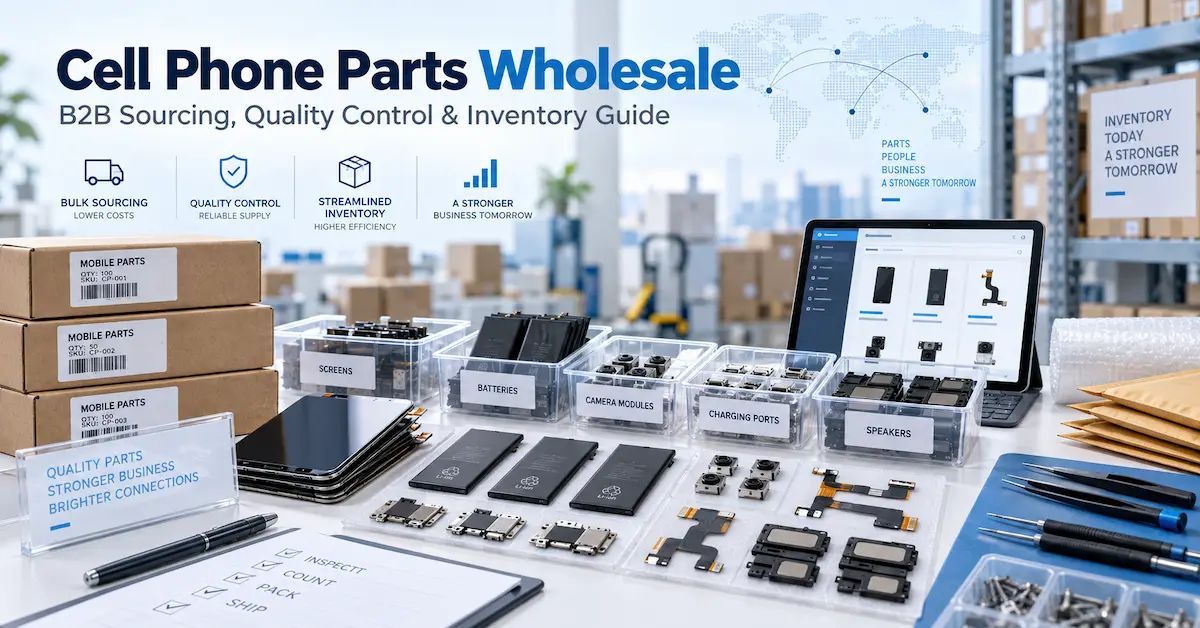
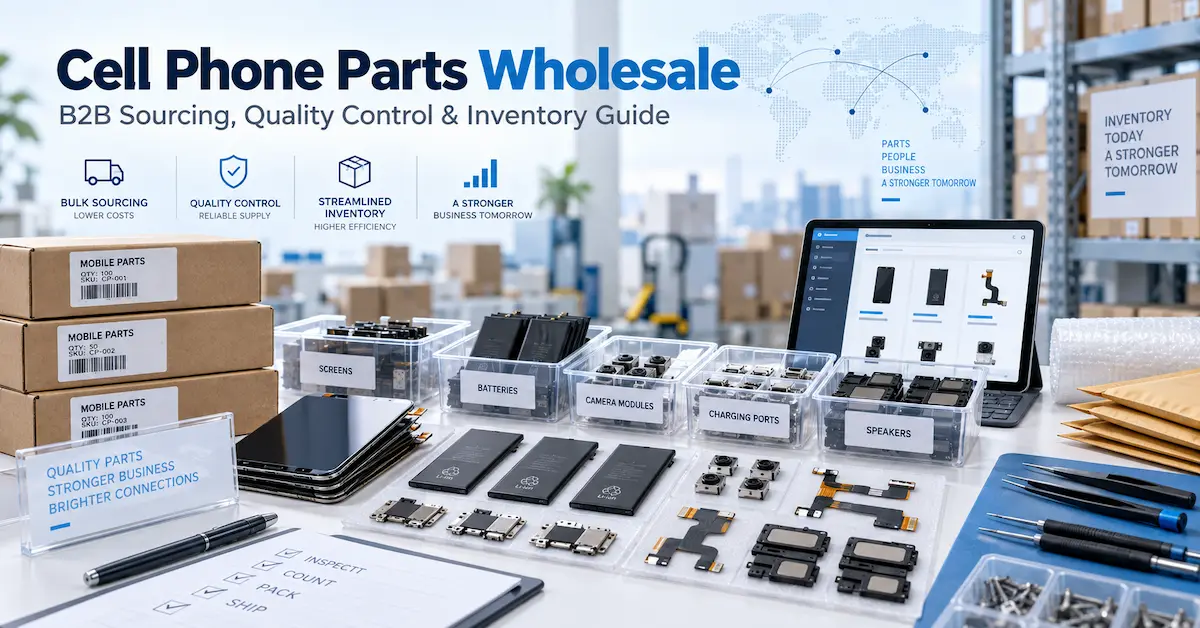
The mobile repair supply chain includes several major product categories.
Understanding these categories helps buyers avoid treating all replacement components as interchangeable commodities.
| Product Category | Common Products | Main Buyer Requirements | Typical Procurement Risks |
|---|---|---|---|
| Replacement batteries | iPhone and Android batteries | Capacity, voltage, fit, protection, safety | Low capacity, swelling, wrong model |
| Display assemblies | LCD, OLED, touch assemblies | Image quality, touch response, fit | Dead pixels, poor touch, display mismatch |
| Charging components | USB-C ports, charging flex cables | Connector accuracy, charging stability | Poor fit, intermittent charging |
| Camera components | Front and rear camera modules | Image quality, compatibility | Focus errors, calibration problems |
| Flex cables | Power, volume, connector flexes | Connector layout, assembly accuracy | Incorrect revision, installation damage |
| Speakers and microphones | Earpieces, loudspeakers, microphones | Sound quality, connector fit | Distortion, weak audio, wrong SKU |
| Small repair components | Brackets, seals, adhesives | Dimensions, material consistency | Installation failures, missing pieces |
| Charging accessories | Power banks, wall chargers, cables | Output power, protocols, safety | Compatibility, heat, performance |
These are industry-wide procurement categories. They should not be interpreted as a claim that every supplier carries every product.
Replacement Batteries: A High-Value Wholesale Category
Batteries are a recurring purchasing category because rechargeable lithium-ion cells gradually age during normal use.
Professional repair operations need replacement batteries for both recent and older smartphone models.
Unlike many cosmetic accessories, a replacement battery directly affects device runtime, power delivery, and customer experience.
This creates demand for model-specific products with consistent electrical performance.
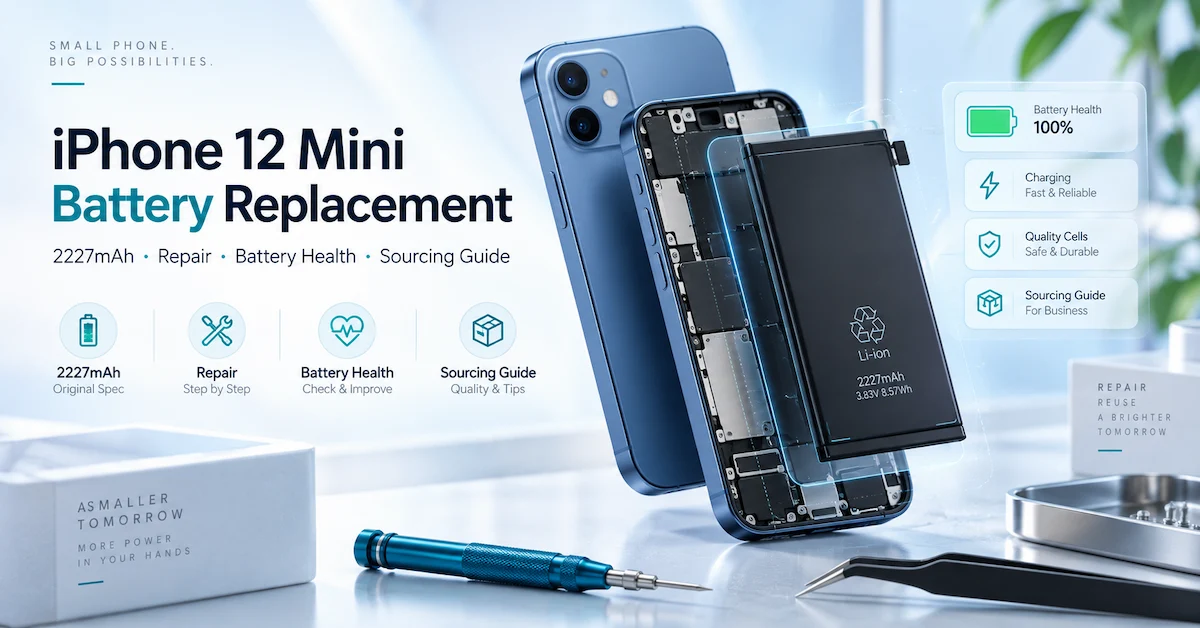
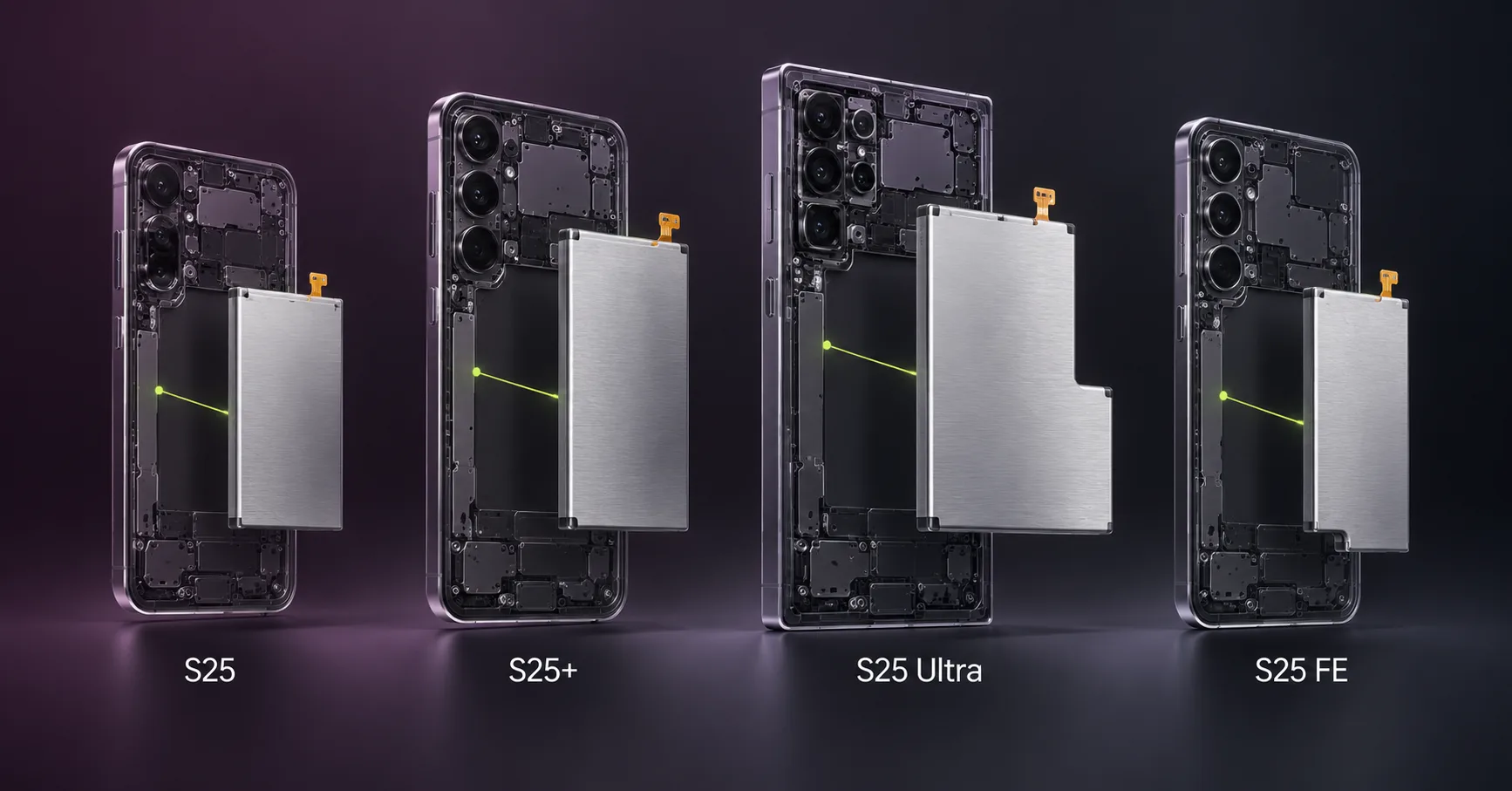
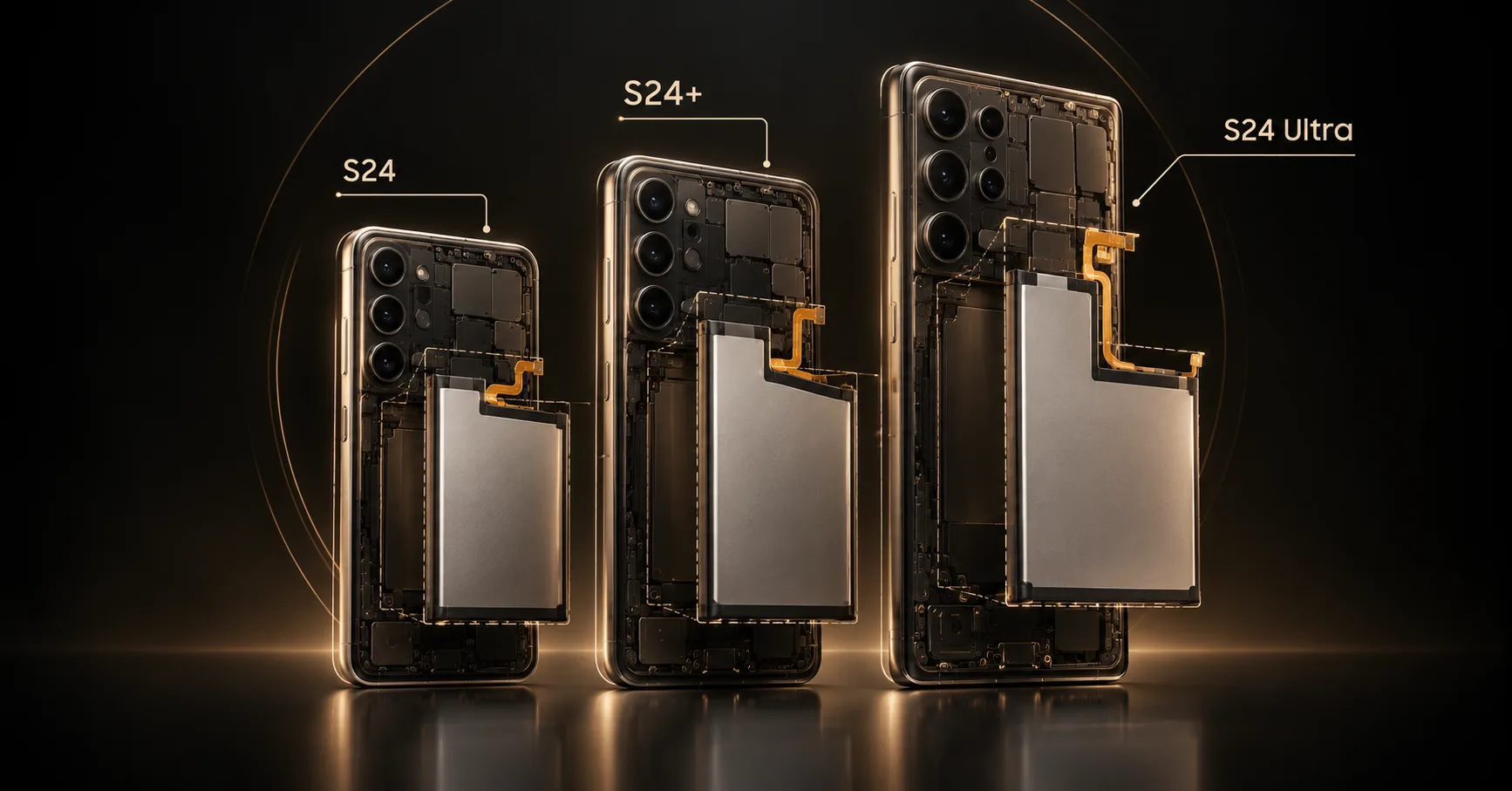
ESC's smartphone replacement battery range covers popular devices from Apple, Samsung, Xiaomi, OPPO, Huawei, vivo, and other smartphone brands.
The company also supports selected standard-capacity, high-capacity, and customized battery configurations.
Display and Camera Components
Screens and cameras are major categories in the wider phone-repair market, but they require their own specialized sourcing controls.
A display supplier should be evaluated on parameters such as panel type, image uniformity, brightness, touch responsiveness, connector fit, and the applicable device configuration.
Camera suppliers require evaluation of imaging performance, mechanical fit, and any model-specific repair or calibration requirements.
A buyer should not assume that a strong battery supplier also provides equivalent capability in displays or camera modules.
Different product families often need different manufacturing expertise and quality-control systems.
Charging Products as an Adjacent Wholesale Opportunity
Repair businesses and parts distributors may also sell charging accessories.
These can provide a complementary revenue stream without being replacement components installed inside a phone.
Relevant products include USB-C wall chargers, fast-charging power banks, wireless charging products, and portable chargers with integrated cables.
ESC supplies power banks and charging products for distributors, retailers, e-commerce sellers, and private-label brands.
This creates an opportunity for qualified buyers to develop both a replacement-battery purchasing program and an adjacent charging-product portfolio.
Who Buys Wholesale Cell Phone Parts?
Different buyers use the same products in different ways.
A supplier serving professional customers should understand the commercial model behind the order.
Independent Phone Repair Shops
Independent repair businesses often operate with limited inventory space.
They need replacement components for popular devices without committing excessive capital to slow-moving models.
Their purchasing priorities usually include compatibility, small replenishment quantities, reasonable delivery times, and dependable warranty handling.
A repair shop may accept a slightly higher component price if the supplier provides better model identification and fewer installation problems.
Multi-Location Repair Chains
Repair chains need consistency across technicians and branches.
One location should not receive a materially different battery specification from another location when both order the same approved SKU.
Their sourcing process should therefore address:
Approved component lists: Standardized parts for each device model.
Centralized purchasing: Consistent supplier terms and product specifications.
Batch traceability: The ability to investigate repeated failures.
Technician feedback: Structured information about installation and field performance.
Replenishment planning: Sufficient stock at each repair location.
For this buyer group, repeatability often matters more than the lowest price on one shipment.
Mobile Phone Parts Distributors
Distributors supply products to other businesses.
Their customers may include independent repair stores, regional wholesalers, online parts sellers, and refurbishment facilities.
They face two simultaneous challenges: maintaining enough stock to meet demand and avoiding excessive inventory of models that sell slowly.
A distributor needs suppliers capable of providing accurate product lists, consistent replenishment, and reliable product identification.
For battery-focused distribution businesses, ESC's phone battery supplier guide for parts distributors provides additional information on sourcing and supply-chain evaluation.
Smartphone Refurbishment Companies
Refurbishment businesses process used devices with different histories.
Some require batteries. Others need displays, charging components, or more extensive repairs.
Refurbishers need standardized grading, incoming inspection, defined replacement criteria, and dependable finished-device testing.
A component failure may affect more than one repair order. It can disrupt a production batch and delay product resale.
Private-Label Battery Brands
A private-label brand sells products under its own commercial identity.
The supplier's performance becomes part of the brand's reputation.
These buyers need verified product specifications, packaging consistency, model labeling, traceability, and warranty support.
They may also need custom barcodes, retail packaging, or different product-positioning options.
E-Commerce Parts Sellers
Online sellers face risks related to product descriptions, compatibility errors, customer reviews, and return rates.
Their priorities include accurate SKU information, packaging, consistent stock availability, and product documentation.
An incorrect listing can create returns even when the physical component is functioning correctly.
How to Build a Profitable Cell Phone Parts Wholesale Product Portfolio
A profitable wholesale business does not necessarily carry every available smartphone component.
It carries the right combination of products for its customers.
The first step is to identify the device models that generate actual repair demand.
A distributor might serve stores that mainly repair recent iPhones. Another may operate in a market where Samsung, Xiaomi, OPPO, and older Android devices account for a larger share of repair activity.
These businesses should not use identical inventory strategies.
Start With Customer Repair Data
Review actual order history and customer inquiries.
Useful information includes:
-
device models repaired;
-
part categories consumed;
-
monthly quantity by SKU;
-
repeat purchasing frequency;
-
stockout incidents;
-
returned products;
-
customer-requested models not currently stocked.
Search trends can help identify additional demand, but they should not replace customer purchasing data.
A keyword with high search interest is not automatically a profitable wholesale SKU.
Separate High-Volume and Long-Tail Products
Most parts distributors manage two different inventory groups.
High-volume products have predictable demand and justify regular replenishment.
Long-tail products sell less frequently but may be important to customers who service older or less common devices.
The appropriate solution is rarely to eliminate the long tail completely.
Instead, buyers can use different purchasing rules for each group.
| Inventory Group | Demand Pattern | Suggested Purchasing Approach |
|---|---|---|
| Fast-moving SKUs | Frequent, relatively predictable | Regular replenishment and safety stock |
| Medium-volume SKUs | Moderate demand | Scheduled mixed-model orders |
| Long-tail SKUs | Infrequent or irregular | Smaller quantities and supplier availability checks |
| New-model SKUs | Uncertain early demand | Sample approval followed by controlled stocking |
| Declining-model SKUs | Falling demand | Reduce replenishment and monitor remaining demand |
This approach helps protect working capital while maintaining useful product coverage.
Use ABC Inventory Analysis
ABC analysis groups products according to their contribution to inventory value, sales, or another defined business metric.
A-items are typically the most commercially important products. B-items have intermediate importance. C-items contribute less individually but may still provide essential catalog breadth.
The exact thresholds should be based on the distributor's data.
An ABC classification based on revenue may differ from one based on gross margin or repair frequency.
For batteries, the analysis should also consider storage age because unused lithium-ion products are still subject to calendar aging.
Plan Reorder Points
A basic planning relationship is:
Reorder Point = Expected Demand During Lead Time + Safety Stock
For example, suppose a distributor sells approximately 20 units of a particular replacement battery per working day.
If the replenishment period is ten working days, expected demand during that period is approximately 200 units.
Safety stock must then be estimated from demand variability, supplier reliability, and the buyer's acceptable stockout risk.
The result is not a universal inventory formula for every product. It is a starting point for a more controlled replenishment decision.
How to Verify Smartphone Replacement Part Compatibility
Compatibility errors are among the most avoidable causes of wholesale returns.
The problem is especially common when purchasing across multiple smartphone generations or regional variants.
Match the Exact Device Model
A broad description such as "iPhone 13 battery" is not adequate for every device in the iPhone 13 family.
The iPhone 13 mini, iPhone 13, iPhone 13 Pro, and iPhone 13 Pro Max use different battery configurations.
Similarly, Android devices may have different battery references across models that share similar marketing names.
The buyer must validate the precise device and component relationship.
Use Original Battery Part Numbers
For many Android battery families, original part numbers provide a useful purchasing reference.
Examples include Samsung battery identifiers beginning with EB, Xiaomi BM-series identifiers, OPPO BLP-series identifiers, and Huawei HB-series identifiers.
However, the part number should be checked against the supplier's compatibility documentation.
A similar-looking number is not sufficient evidence that two batteries are interchangeable.
Verify Electrical and Mechanical Specifications
For replacement batteries, the minimum comparison should include:
| Specification | What the Buyer Should Verify |
|---|---|
| Device model | Exact compatible device |
| Battery part number | Original reference and supplier equivalent |
| Rated capacity | Declared mAh under defined conditions |
| Nominal voltage | Correct electrical specification |
| Energy | Wh rating where applicable |
| Dimensions | Length, width, thickness |
| Connector | Physical and electrical configuration |
| Flex cable | Layout and intended installation |
| Protection components | Configuration included in the product |
| Battery identification | Expected behavior on supported devices |
| Packaging code | Exact SKU and batch traceability |
Distinguish Complete Batteries From Cell-Only Products
A complete replacement battery and a loose battery cell are not the same purchasing item.
A complete assembly may include the cell, flex cable, relevant protection electronics, and other specified components.
A cell-only product may be intended for qualified technicians performing specialized component-transfer procedures.
These products should have separate SKUs, technical specifications, and acceptance criteria.
A distributor should never assume that two items are commercially interchangeable because both display the same nominal capacity.
Phone Battery Quality Control: What Wholesale Buyers Should Demand
Battery quality has a direct relationship with repair success, customer returns, and warranty costs.
A supplier's description of a battery as "premium" or "A-grade" provides limited value unless supported by measurable evidence.
ESC's A-grade lithium-ion battery sourcing guide explains why procurement decisions should focus on verified electrical characteristics and finished-product consistency.
Incoming Cell Inspection
Battery production begins with incoming material control.
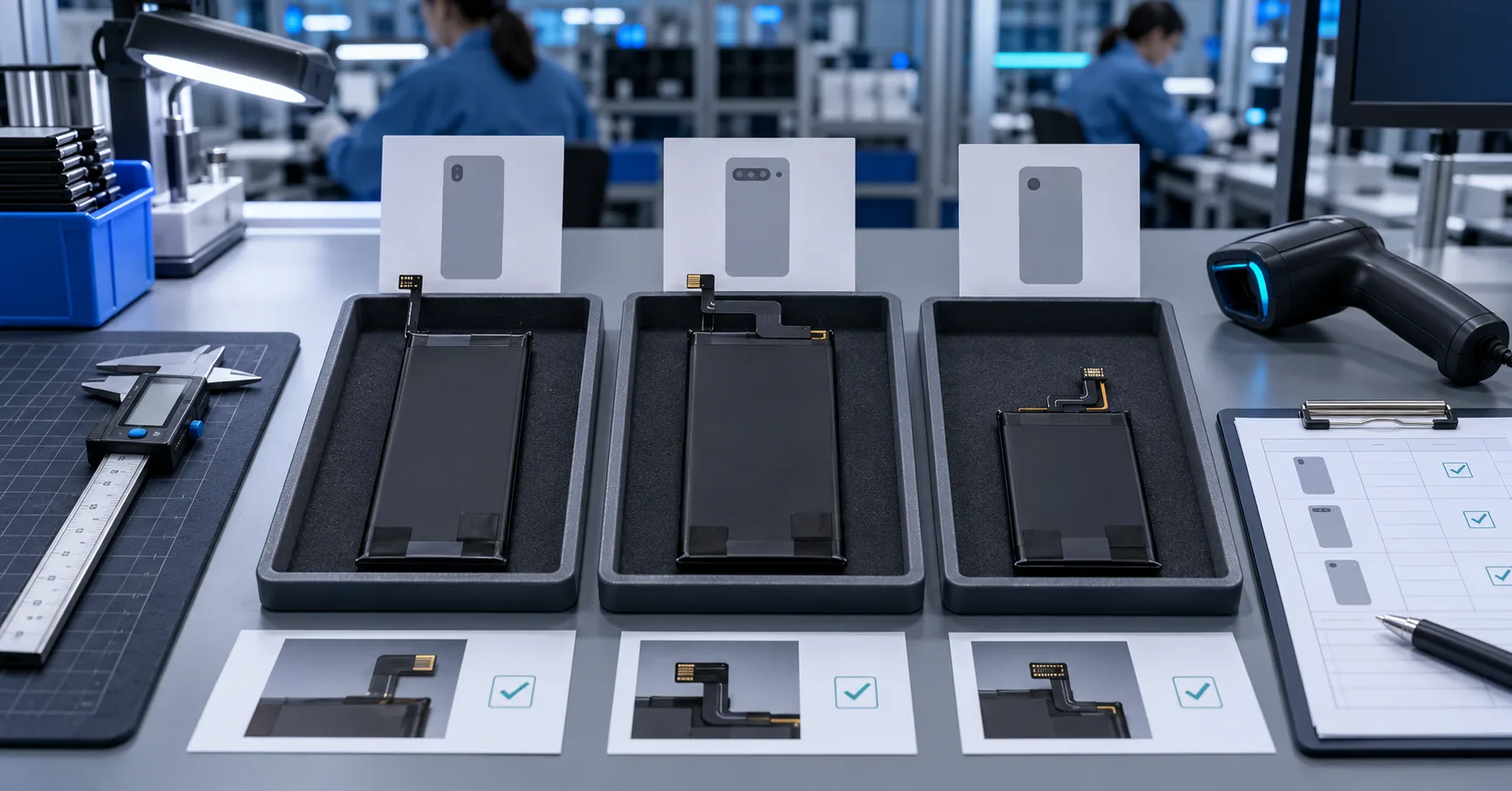
Relevant inspection items may include cell identification, appearance, voltage, dimensions, internal resistance, and signs of physical damage.
Buyers should ask how the supplier defines an acceptable cell.
The acceptance criteria should match the relevant product specification, rather than relying on an undefined industry-wide grading label.
Actual Capacity Testing
A printed capacity figure is a product claim.
Actual capacity testing provides evidence supporting that claim.
A useful capacity test should define charging and discharge conditions, measurement equipment, temperature, and the applicable voltage limits.
Two suppliers reporting different capacities under different test methods cannot be compared fairly without understanding those methods.
A buyer should ask whether the quoted product has been tested against its declared specification.
Internal Resistance and Voltage Consistency
Internal resistance contributes to battery behavior under electrical load.
It must be interpreted according to the cell type, test method, temperature, and state of charge.
There is no single internal-resistance value that can reliably approve every smartphone battery model.
The same principle applies to voltage measurements.
Voltage is useful, but it does not independently demonstrate usable capacity, protection performance, or long-term stability.
Protection Electronics and BMS
A battery management or protection system may perform functions related to charging, discharging, electrical protection, and battery information.
Its exact architecture depends on the product.
For complete replacement assemblies, buyers should confirm which electronics are included and what functions have been tested.
For cell-only components, the purchasing specification must clearly state which elements are not supplied.
Mechanical and Connector Quality
Electrical performance is not the only quality factor.
A battery with acceptable capacity may still create repair problems if its connector does not fit correctly or the assembly dimensions differ from the approved specification.
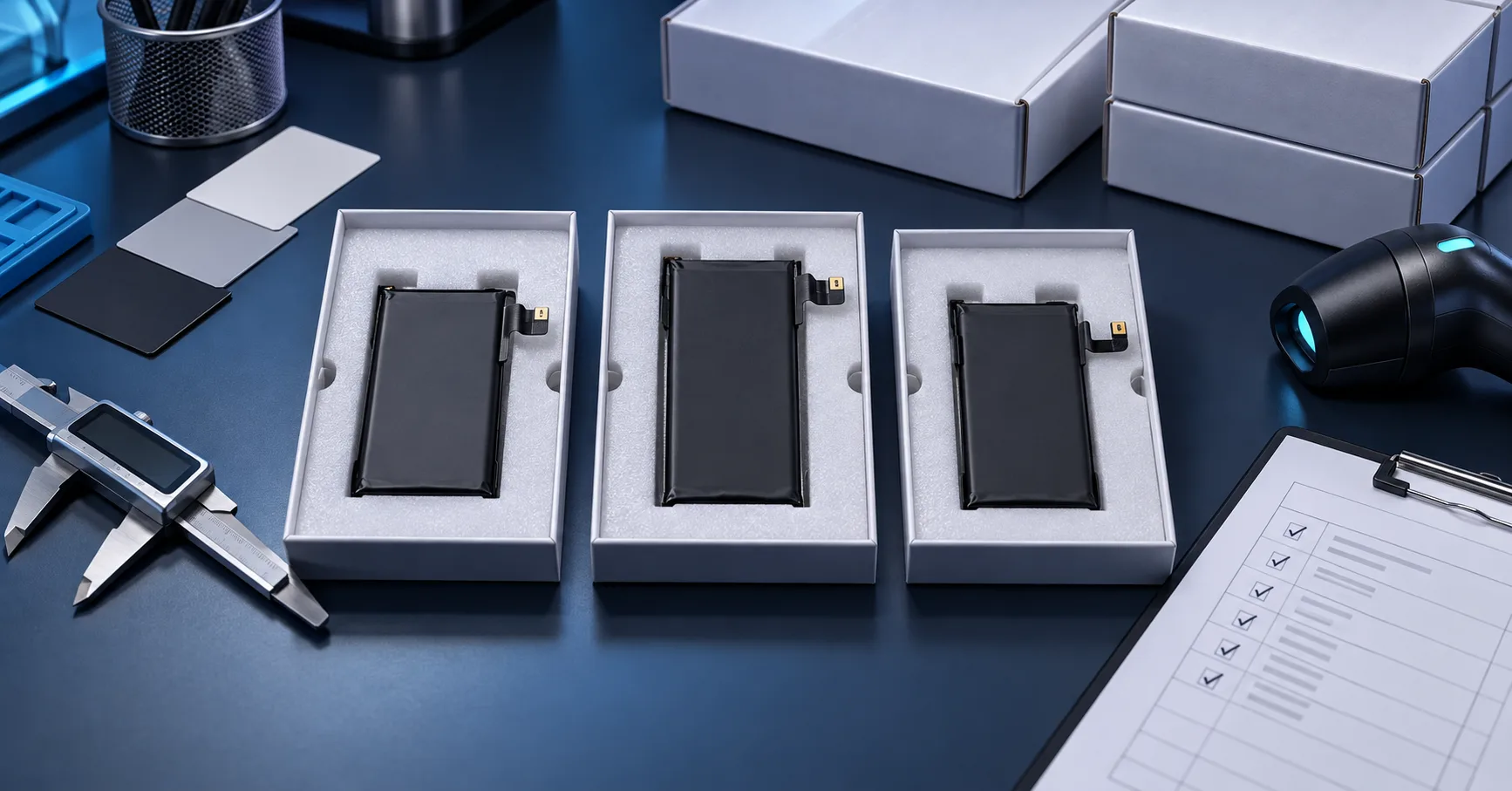
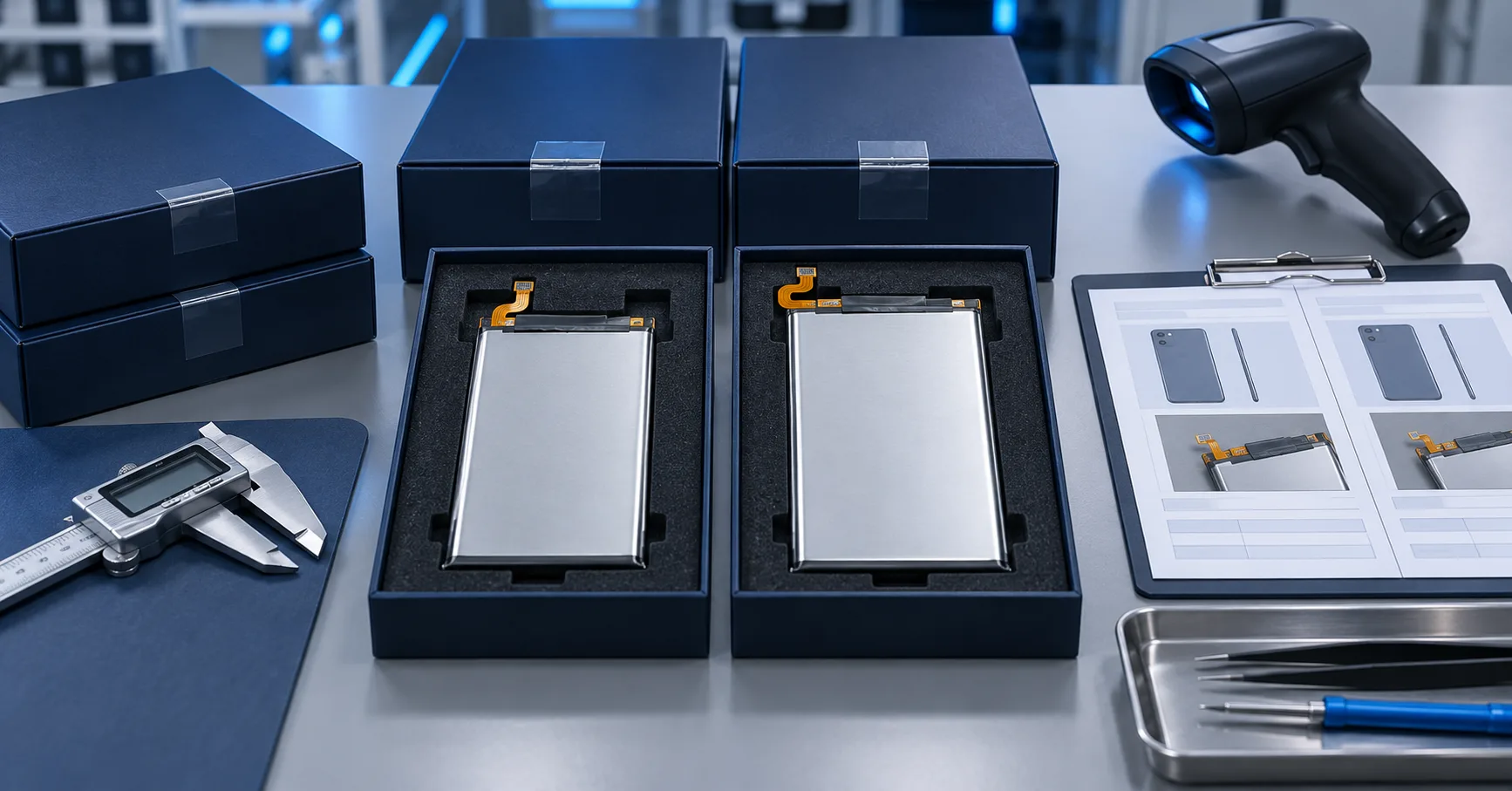
Mechanical checks should cover battery thickness, shape, insulation, connector geometry, flex layout, and visible assembly defects.
Aging and Final Inspection
Aging tests can help reveal some defects that are not immediately visible during a brief functional check.
Final inspection should also confirm labeling, packaging, quantity, and product identity.
ESC describes incoming material inspection, cell grading, capacity checks, protection-circuit inspection, charging and discharging, aging, and final inspection within its published phone battery quality-control process.
These steps provide a starting point for buyers to discuss the evidence required for a specific order.
Supplier Quality Control vs. Buyer Incoming Inspection
One common procurement mistake is assuming that a supplier's inspection eliminates the need for incoming checks.
The two processes serve different purposes.
Supplier QC determines whether the producer considers the goods acceptable before shipment.
Buyer incoming inspection verifies that the delivered products match the approved purchase specification.
A wholesale buyer should therefore inspect selected shipment characteristics independently.
These may include:
-
shipment quantity;
-
correct SKU;
-
carton labeling;
-
product identification;
-
packaging condition;
-
visible defects;
-
selected electrical measurements;
-
applicable documentation.
The inspection depth should depend on product risk and the buyer's business model.
For example, a simple accessory may need different testing from a replacement lithium-ion battery.
How Should Defective Samples Be Handled?
The procedure should be agreed before ordering.
A practical approach is to document the nonconforming item, identify its lot, isolate affected inventory where necessary, notify the supplier, and determine whether additional inspection is required.
Do not automatically reject an entire shipment because of one isolated issue.
Equally, do not ignore repeated failures from the same lot.
The correct response depends on the agreed acceptance criteria, severity of the defect, and available evidence.
AQL and Sampling Plans
Some buyers use acceptance sampling plans based on recognized quality-management methods.
Such plans can help define sample sizes and acceptance criteria.
However, an AQL value must not be interpreted as permission to ship unsafe products.
Critical safety failures require appropriate escalation regardless of an ordinary cosmetic-defect acceptance level.
The buyer and supplier should agree on the defect categories, test methods, and lot disposition rules before bulk production.
How to Evaluate a Cell Phone Parts Wholesale Supplier
A strong supplier relationship begins with scope verification.
The first question should not be "What is your lowest price?"
It should be:
Can this supplier reliably provide the exact components, documentation, production consistency, and support our business requires?
Verify the Actual Product Portfolio
Ask for current product categories and model lists.
Confirm which products are routinely supplied and which require special development or third-party sourcing.
A company may specialize in batteries, displays, charging accessories, or other categories.
The ability to describe a product does not prove that it is part of the supplier's regular commercial portfolio.
Request Technical Documentation
For a replacement battery program, useful information includes:
-
product datasheet;
-
capacity and voltage specifications;
-
dimensions;
-
connector information;
-
relevant test records;
-
packaging specification;
-
lot identification method;
-
applicable shipping documents.
These documents reduce ambiguity before the first commercial shipment.
Evaluate Repeat-Order Consistency
An approved sample is only the beginning.
Ask how the supplier controls changes to cells, electronics, connectors, materials, and production processes.
A revised component may affect performance even when the finished product retains the same commercial SKU.
Material or specification changes should be communicated and reviewed according to the purchase agreement.
Review Warranty Procedures
The supplier should explain how a failed component is investigated.
Useful questions include:
What evidence is required?
How is the batch identified?
Must the failed item be returned?
What happens if multiple units show the same problem?
How are credits, replacements, and other remedies handled?
A clear process is more valuable than an attractive warranty statement without operational details.
Evaluate Communication
Communication quality affects lead time and defect resolution.
A supplier should be able to explain technical specifications, identify missing information, and respond to quality questions without relying exclusively on marketing language.
Clear communication is particularly important for international orders involving multiple languages, time zones, and shipping requirements.
A Practical Supplier Comparison Scorecard
A standardized scorecard helps buyers compare suppliers more consistently.
The following is an illustrative internal purchasing model, not an industry certification system.
| Evaluation Factor | Suggested Weight | Key Evidence |
|---|---|---|
| Model compatibility and product scope | 20% | Verified SKU list and technical data |
| Quality control and traceability | 25% | Test methods, batch records, sample results |
| Compliance and logistics readiness | 15% | Applicable documents and shipping plan |
| Total landed cost | 15% | Detailed quotation and cost breakdown |
| Availability and replenishment | 10% | Confirmed MOQ, production and lead-time terms |
| Warranty and corrective action | 10% | Written claim and escalation process |
| OEM and packaging flexibility | 5% | Customization scope and sample approval |
| Total | 100% |
The weights should change according to the purchasing objective.
A refurbishment factory may place greater importance on repair-line consistency.
A private-label brand may assign more weight to packaging, brand protection, and product development.
A regional wholesaler may prioritize mixed-model supply and predictable replenishment.
The scorecard is useful because it forces the purchasing team to compare evidence rather than impressions.
Wholesale Pricing: Why the Lowest Unit Price Can Cost More
The quoted product price is only one component of procurement cost.
For a distributor, the more useful metric is total landed cost adjusted for quality and service risk.
What Is Landed Cost?
A practical landed-cost calculation includes the product purchase price plus the expenses required to bring it into saleable inventory.
Depending on the commercial terms, these may include freight, insurance, customs charges, duties, handling, and inspection.
Not every cost applies to every order.
Tax treatment also depends on the destination and buyer circumstances.
Account for Warranty and Return Costs
A low-priced component may cause higher overall expenses if it produces frequent verified failures.
Consider the following hypothetical comparison.
| Cost Component per Unit | Supplier A | Supplier B |
|---|---|---|
| Purchase price | $4.90 | $5.65 |
| Freight and landed charges | $0.85 | $0.85 |
| Inspection and handling | $0.20 | $0.20 |
| Assumed verified failure rate | 8% | 1.5% |
| Remedy cost per failed unit | $18.00 | $18.00 |
| Expected remedy cost per purchased unit | $1.44 | $0.27 |
| Illustrative total expected cost | $7.39 | $6.97 |
All amounts and failure rates in this table are hypothetical and are not ESC prices, defect statistics, or quotations from real suppliers.
Supplier B charges a higher unit price, but its lower assumed failure rate results in a lower expected total cost.
This example is not intended to predict actual supplier performance.
It demonstrates why buyers should measure the full economic impact of product quality.
Track Field Failures Correctly
A wholesale business should distinguish:
Customer complaint rate: How often a customer reports a problem.
Verified component failure rate: How often testing confirms the component itself caused the problem.
Return rate: How often products are returned, including incorrect orders or unrelated causes.
Warranty cost: The total commercial cost of remedying eligible claims.
These measures are related but not interchangeable.
A high return rate may originate from compatibility confusion or inaccurate listings rather than defective manufacturing.
Good purchasing data should preserve those distinctions.
MOQ, Mixed-Model Orders, and Lead Times
Minimum order quantity can determine whether a wholesale purchasing program is commercially practical.
But MOQ should be discussed at the right level.
A supplier may have different minimum quantities for standard products, customized labels, retail packaging, and new product development.
What Buyers Should Ask About MOQ
Instead of asking only "What is your MOQ?", specify:
-
exact SKU;
-
quantity per model;
-
total order quantity;
-
packaging format;
-
customization requirements;
-
destination;
-
required delivery period.
A total order of 1,000 units distributed across 50 models is operationally different from 1,000 units of one model.
Suppliers need to know that distinction.
Why Mixed-Model Orders Matter
Mixed-model sourcing allows distributors to replenish multiple SKUs within one purchasing program.
It can reduce the need to commit excessive inventory to individual low-volume models.
For repair chains, it can also simplify purchasing administration.
ESC states that it supports flexible MOQ and mixed-model battery orders, subject to product, quantity, and customization requirements.
Standard Supply vs. Custom Development
ESC's current company information indicates that standard replacement battery orders can normally be completed within seven days, depending on product availability, quantity, and customization.
This should not be treated as a universal delivery guarantee.
Customized packaging, specialized battery configurations, new product development, and international freight can require additional time.
A useful purchase agreement should distinguish production completion, shipment readiness, dispatch, transit, and final delivery.
Lithium Battery Shipping and Compliance for International Buyers
Shipping replacement batteries is not the same as shipping non-battery repair components.
Lithium-ion batteries are subject to specific transport requirements.
For international buyers, shipping readiness should be evaluated before placing a large order.
UN38.3: What Does It Mean?
UN38.3 refers to the lithium battery transport tests in Part III, subsection 38.3 of the UN Manual of Tests and Criteria.
These tests address transport-related hazards.
A buyer should request the applicable test-summary information for the battery design being shipped.
The U.S. Pipeline and Hazardous Materials Safety Administration (PHMSA), in its published Lithium Battery Test Summaries guidance, explains the requirement for manufacturers and subsequent distributors to make appropriate test summaries available.
UN38.3 is transport-related evidence. It is not a substitute for proving actual battery capacity, connector compatibility, cycle performance, or manufacturing consistency.
SDS or MSDS
Safety Data Sheets provide hazard and handling information.
They are useful for logistics and safety communication.
However, an SDS does not by itself establish that a battery has passed the relevant UN38.3 transport tests.
The buyer should understand the purpose of each document.
Air Shipment Classification
Battery transport requirements depend on whether lithium-ion batteries are shipped alone, packed with equipment, or contained in equipment.
Different classifications and packing instructions may apply.
For example, IATA's Guidance Document for Lithium Batteries and Sodium Ion Batteries – 2026 specifies that lithium-ion batteries shipped by themselves under UN3480 and Packing Instruction 965 are subject to a maximum 30% state-of-charge requirement, except under the relevant approved arrangements.
Such standalone batteries are generally prohibited as cargo on passenger aircraft without the applicable authority approval.
This distinction is important for companies comparing air-cargo quotations.
A quotation described only as "air shipping" is not enough to confirm that a proposed lithium battery shipment is compliant.
EU Market Requirements
Buyers importing batteries into the European Union should evaluate the applicable requirements under Regulation (EU) 2023/1542 concerning batteries and waste batteries.
The regulation includes phased obligations affecting different battery types, market participants, and implementation periods.
Importers should confirm which conformity, labeling, producer-responsibility, and documentation obligations apply to their specific products and transactions.
Do not assume that a CE-related document, transport summary, or SDS satisfies every market requirement.
Documentation Checklist
| Document or Information | Main Purpose | Buyer Action |
|---|---|---|
| Product datasheet | Defines electrical and physical specifications | Match to approved SKU |
| UN38.3 test summary | Supports transport-related verification | Confirm applicable battery design |
| SDS/MSDS | Communicates relevant safety information | Review for shipment and handling |
| Applicable conformity records | Support specific market requirements | Verify product and regulatory scope |
| Invoice and packing list | Commercial shipment identification | Reconcile product and quantity |
| Battery labeling | Product and transport information | Check required details |
| Shipping classification | Determines applicable transport process | Confirm with qualified logistics provider |
| Lot records | Supports traceability | Retain for quality and warranty review |
The final document set should be confirmed with the supplier, carrier, customs professionals, and other responsible parties as applicable.
OEM and Private-Label Opportunities in Phone Parts Wholesale
OEM and private-label programs allow businesses to develop products under their own commercial identity.
For replacement batteries, the opportunity is not simply to print a logo on an existing product.
A serious program needs consistent product specifications, quality standards, packaging, and after-sales procedures.
Define the Product Positioning
A brand may offer standard-capacity replacement batteries, validated higher-capacity variants, or specialized configurations intended for particular repair workflows.
Each product should have a clear intended application.
Do not present different assembly formats as equivalent simply because their labels contain similar technical terms.
Establish Packaging Requirements
Wholesale and retail packaging may need different characteristics.
A bulk repair-chain package may prioritize efficient storage, accurate identification, and easy picking.
A retail package may additionally require branding, instructions, barcodes, and consumer-facing information.
Packaging should protect the component while remaining consistent with the intended distribution channel.
Control Label Accuracy
For iPhone and Android batteries, the label should support correct model identification.
It should not make misleading claims regarding original manufacturer authorization or component identity.
A compatible third-party replacement battery should be described transparently.
Protect Product Specifications
If an approved battery configuration changes, buyers should know.
A new cell supplier, revised protection circuit, changed connector, or different capacity specification may affect the approved product.
Private-label buyers should therefore define change-notification requirements.
ESC OEM and Customization Support
ESC supports suitable battery customization and private-label projects alongside its broader OEM/ODM charging solution services.
The exact customization scope should be confirmed for the relevant product category.
Battery labels and packaging are different from developing a custom high-power charging system, and the two projects should not be quoted as though they require identical engineering work.
Build a More Efficient Wholesale Ordering Process
The most reliable way to purchase wholesale phone components is to divide the process into clear approval stages.
Stage 1: Define the Product Scope
List the exact component categories required.
Identify which are batteries, charging accessories, displays, cameras, or other repair parts.
Separate the supplier categories when necessary.
Stage 2: Build the RFQ
Prepare a request for quotation containing complete product information.
For a battery-focused RFQ, include:
| RFQ Field | Example of Required Information |
|---|---|
| Buyer type | Distributor, repair chain, refurbisher, private-label brand |
| Target market | Country or region |
| Product family | iPhone or Android replacement battery |
| Device models | Exact model list |
| Battery references | Original part numbers where available |
| Product configuration | Standard, high-capacity, diagnostic, cell-only |
| Quantity | Quantity by SKU |
| Quality requirements | Required tests and acceptance criteria |
| Packaging | Bulk, retail, or private label |
| Documentation | Destination and shipping requirements |
| Delivery | Requested shipment schedule |
| Warranty | Expected claim and remedy process |
A detailed RFQ helps suppliers provide more accurate quotations.
Stage 3: Review Supplier Documentation
Compare technical specifications, product scope, QC capabilities, available documentation, and commercial terms.
Resolve obvious discrepancies before ordering samples.
Stage 4: Approve Samples
Test the product against the intended device and purchasing specification.
For batteries, evaluate the electrical and mechanical factors that matter to the actual repair workflow.
Record the test results and approved sample reference.
Stage 5: Confirm Bulk Order Specifications
The approved specification should be reflected in the purchase order.
Identify critical characteristics that cannot be changed without buyer approval.
Stage 6: Inspect the Shipment
Use an appropriate inspection method to verify the received goods.
Stage 7: Monitor Field Performance
Record warranty claims, compatibility problems, and verified quality failures.
Use that information to improve subsequent purchasing decisions.
This is a continuous improvement process, not simply a one-time supplier selection exercise.
Battery Wholesale, Finished Products, and SKD: Which Purchasing Model Is Right?
Businesses entering the mobile accessories market may choose between replacement parts, finished charging products, and semi-knocked-down assembly components.
These models support different commercial objectives.
| Purchasing Model | Main Business Activity | Typical Buyer | Main Evaluation |
|---|---|---|---|
| Replacement battery wholesale | Supply repair parts | Repair chains and parts distributors | Compatibility, capacity, QC |
| Finished power bank wholesale | Resell charging products | Retailers and wholesalers | Performance, packaging, demand |
| OEM/private-label products | Sell under buyer's brand | Accessory brands | Specifications, branding, repeatability |
| SKD power bank program | Assemble products locally | Local assembly businesses | PCBA, housing, assembly, testing |
Finished Charging Products
A finished-product buyer may prefer ready-to-sell power banks and chargers.
Evaluation criteria include output power, capacity, charging protocols, thermal behavior, packaging, and compliance.
ESC's power bank and charger portfolio includes multiple charging configurations for retail and distribution applications.
SKD Power Bank Programs
An SKD program supplies semi-finished or separate components for subsequent assembly.
ESC's SKD power bank solution covers items such as housings and PCBA modules, with available configurations depending on the project.
This model may be relevant to businesses developing local assembly capabilities.
However, SKD purchasing introduces additional responsibilities for component integration, testing, assembly quality, and applicable market compliance.
It should not be treated as a simpler version of ordinary finished-product wholesale.
How ESC Supports Professional Replacement Battery Distributors
ESC's primary relevance within the broader phone parts market is its replacement-battery and charging-product specialization.
According to its published company information, ESC has focused on replacement batteries for the global B2B market since 2016.
The company describes a portfolio covering more than 3,000 self-developed battery models across major device brands.
This breadth can be valuable to businesses that need to consolidate battery purchasing across multiple smartphone generations and brands.
Smartphone Battery Coverage
ESC supplies batteries for iPhone and major Android device families.
Product selection can be based on device model, original battery reference, capacity, and intended repair workflow.
Buyers can review the current mobile phone replacement battery catalog before preparing a purchasing list.
Additional Battery Categories
Distributors serving broader repair markets may also require tablet and notebook replacement batteries.
ESC's tablet and laptop battery range covers selected models from Apple, Samsung, Huawei, Microsoft, Dell, HP, Lenovo, ASUS, Acer, and other brands.
This can help qualified buyers combine related battery categories in their supply planning.
Flexible Wholesale Supply
ESC publishes flexible MOQ and mixed-model purchasing options.
Standard battery order timing depends on model availability, quantity, and customization.
Buyers should request confirmation for their exact SKU mix rather than applying a general lead-time statement to every product.
Quality-Control Support
The company describes incoming material inspection, cell grading, capacity testing, protection-circuit checks, aging, and final inspection.
ESC also reports a customer-feedback-based defect rate below 1% as a current company-level claim.
That statement should not be interpreted as a guaranteed failure rate for every model or purchase lot.
Professional buyers should still establish product-specific acceptance criteria and verify sample performance.
Distributor Cooperation
Businesses interested in growing a regional charging-product distribution network can review the ESC distributor and agent program.
Program support includes wholesale pricing, marketing materials, account management, and other cooperation arrangements for qualified partners.
The exact market rights, quantities, and commercial obligations should be discussed directly.
Common Wholesale Purchasing Mistakes
Choosing Suppliers Based Only on Price
A low quotation does not establish model compatibility, quality consistency, or reliable warranty support.
Evaluate expected total cost.
Ordering Without Exact SKU Identification
Generic model descriptions create unnecessary compatibility risk.
Verify original references and complete product specifications.
Treating Every Supplier as a Full-Line Parts Manufacturer
A supplier may specialize in only one product family.
Confirm the actual scope before promising customers a one-stop catalog.
Approving a Single Sample Without Follow-Up Controls
A good sample does not guarantee unchanged future production.
Maintain specifications and change-control expectations.
Ignoring Buyer-Side Incoming Inspection
Supplier QC and receiving inspection perform different functions.
Both contribute to supply-chain control.
Using Certificates as Substitutes for Product Tests
Transport or conformity documents do not prove actual battery capacity or connector fit.
Match evidence to the risk being evaluated.
Purchasing Too Much Slow-Moving Inventory
Excess stock can tie up cash and increase exposure to storage aging.
Use demand-based replenishment.
Failing to Record Warranty Root Causes
A returned part is not always a defective part.
Investigate installation, compatibility, charging equipment, and device condition where relevant.
Mixing Complete Batteries and Cell-Only SKUs
These products have different assembly responsibilities.
They need distinct labeling and ordering controls.
Making Unsupported Customer Claims
Statements such as "genuine," "100% compatible," or "zero defects" should not be used without appropriate substantiation.
Accurate product information builds more durable relationships than exaggerated claims.
Frequently Asked Questions About Cell Phone Parts Wholesale
1. What is cell phone parts wholesale?
Cell phone parts wholesale is the commercial supply of replacement smartphone components in quantities intended for businesses.Buyers include repair shops, distributors, refurbishers, and online parts retailers. Product categories may include batteries, screens, cameras, charging components, connectors, and other repair parts.
2. Where can I buy wholesale cell phone batteries?
Replacement batteries can be sourced from manufacturers and specialized B2B suppliers. ESC supplies wholesale smartphone replacement batteries for repair centers, distributors, and private-label projects. Buyers should verify exact compatibility, technical specifications, sample performance, order requirements, and shipping documentation before purchasing.
3. What is the minimum order quantity for wholesale phone parts?
MOQ varies by supplier, component category, model, packaging, and customization requirements. Some suppliers offer mixed-model orders, while others require larger quantities per SKU. ESC supports flexible battery purchasing, but the applicable MOQ must be confirmed for the selected product and order configuration.
4. How do I choose a reliable wholesale phone parts supplier?
Check the supplier's actual product portfolio, model compatibility records, technical specifications, quality-control methods, sample results, documentation, repeat-order consistency, shipping capability, and warranty process. Compare total procurement cost rather than relying only on the quoted unit price.
5. Are aftermarket replacement batteries safe?
Battery safety depends on design, component quality, manufacturing controls, compatibility, condition, and proper installation. A battery should not be judged safe solely because it fits or powers on a phone. Professional buyers should evaluate relevant test evidence and use appropriately trained technicians for installation.
6. What is the difference between OEM and aftermarket phone parts?
OEM terminology can refer to different manufacturing relationships and is often used inconsistently in the replacement-parts market. An aftermarket component is generally supplied outside the original device manufacturer's genuine service-parts channel. Buyers should confirm the actual manufacturer, specifications, authorization claims, and applicable warranty rather than relying on terminology alone.
7. How can I reduce returns in phone parts wholesale?
Use exact SKU identification, verified compatibility lists, incoming inspection, approved samples, technician feedback, lot traceability, and documented warranty procedures. Classify returns by confirmed cause so compatibility mistakes and installation issues are not automatically recorded as manufacturing defects.
8. Can I buy different phone battery models in one wholesale order?
Some suppliers support mixed-model purchasing. ESC offers flexible battery orders across multiple models, subject to product availability and commercial requirements. Buyers should provide quantities per SKU and confirm pricing, packaging, and shipment timing for the complete model mix.
9. What certifications are needed for wholesale lithium-ion batteries?
Requirements depend on the battery, destination, application, and shipping method. UN38.3 transport test summaries, applicable safety documentation, and relevant market conformity records serve different purposes. Importers should verify the specific obligations that apply to their products rather than assuming one certificate satisfies every requirement.
10. How should wholesalers calculate their profit margins?
Start with actual selling price and landed cost. Include freight, inspection, handling, expected warranty expenses, and other directly relevant costs. Gross margin should reflect the full cost of providing the product, not only the factory purchase price. Use actual company data instead of assuming an industry-wide margin.
11. Can I create my own phone battery brand?
Yes. Qualified manufacturers and suppliers may support private-label battery programs. Depending on the project, customization can include packaging, labels, barcodes, and product configurations. ESC supports suitable OEM and private-label battery projects, with details confirmed through the quotation and sample-development process.
12. What information should I send a supplier for a wholesale quotation?
Provide the device models, original part numbers where available, product configuration, quantity per SKU, destination market, packaging requirements, quality expectations, relevant documentation needs, and target shipment schedule. More complete requests generally result in fewer quotation revisions and compatibility misunderstandings.
13. Is it better to use one supplier or several suppliers?
The right approach depends on product scope and risk. A specialized supplier can simplify purchasing within a category such as replacement batteries. Multiple suppliers may be necessary for screens, camera modules, charging-port assemblies, and other distinct product families. Buyers should balance purchasing efficiency with technical specialization and supply continuity.
14. How often should wholesale replacement battery inventory be replenished?
Replenishment frequency depends on actual demand, product age, lead time, inventory costs, and acceptable stockout risk. Fast-moving models may justify frequent orders, while long-tail products may be better managed through smaller mixed-model purchases. Monitor storage age and supplier availability as part of inventory planning.
15. What is the biggest risk in buying phone batteries wholesale?
There is no single risk that dominates every purchasing situation. Compatibility errors, poor electrical performance, inadequate quality control, physical damage, storage conditions, unsupported product claims, and shipping-document problems can all create costs. The most effective approach is to define product specifications and verify them through sample approval, receiving inspection, and field-performance monitoring.
Conclusion
Successful cell phone parts wholesale purchasing depends on choosing the right product scope, verifying compatibility, evaluating measurable quality standards, and managing inventory and total procurement costs. For replacement battery buyers, actual capacity, electrical consistency, connector accuracy, traceability, shipping documentation, and after-sales support are especially important.
ESC supports professional wholesalers, repair chains, refurbishers, and private-label businesses through its mobile phone replacement battery portfolio and related charging solutions. To evaluate a sourcing project, contact ESC with your device-model list, required battery configurations, quantities, target market, and packaging requirements to discuss compatible products, sample validation, and wholesale supply options.