
Quick answer: a Galaxy S24 series battery should be purchased as a model-specific finished assembly, not as one universal S24 item. Galaxy S24, S24+ and S24 Ultra differ in device identity, physical envelope and official capacity reference. A B2B buyer should approve each version through its own document set, sample matrix, installed-device tests and repeat-lot controls before releasing normal volume.
A listing labeled only “S24 battery” is not enough for procurement. The RFQ and purchase order should identify the target device family, complete model code, sales region, battery cross-reference, drawing revision, connector and flex geometry, label data, accessory scope and acceptance plan. That discipline is more useful than broad claims about fit, runtime or reliability that are not tied to a test method.
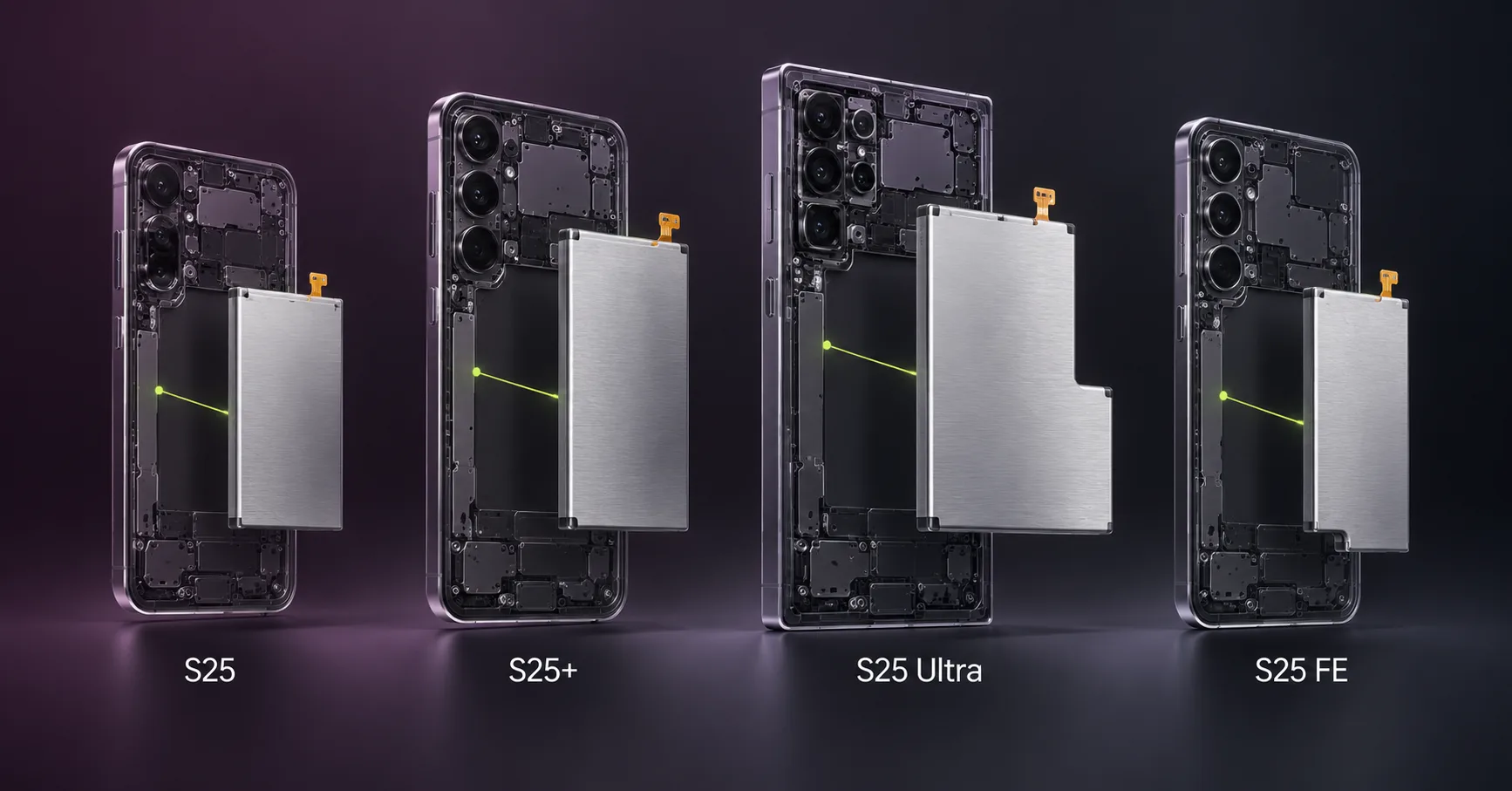
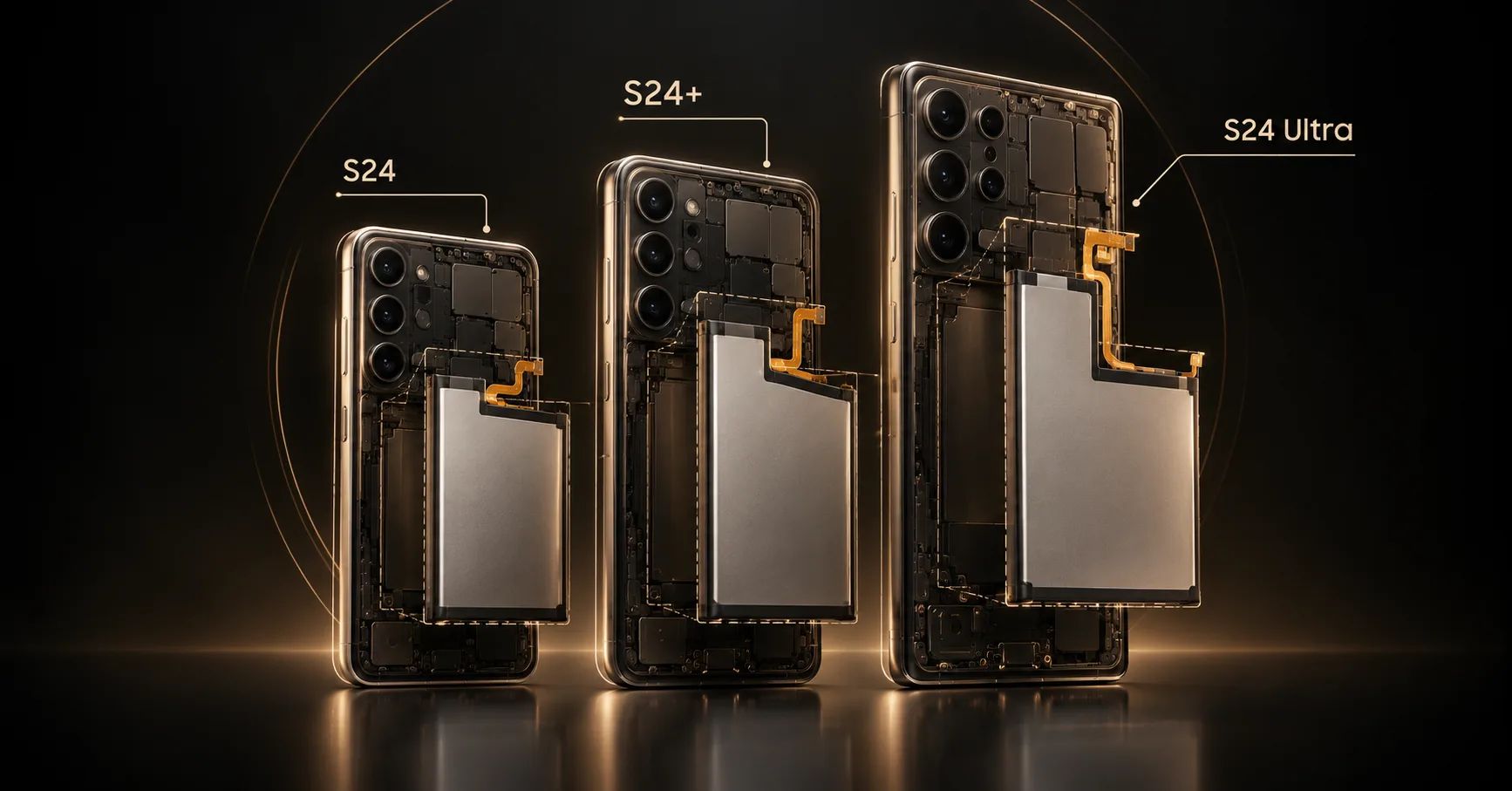
Separate S24, S24+ and S24 Ultra Into Three Approval Paths
The first control is device identity. Samsung's repair and product materials distinguish the base Galaxy S24 as SM-S921, the S24+ as SM-S926 and the S24 Ultra as SM-S928. Regional suffixes may extend those families, so buyers should capture the complete code from the device, carton or system record rather than approve a pack from the retail name alone.
| Sales model | Official model family | Official typical capacity reference | Rated minimum reference | Procurement treatment |
|---|---|---|---|---|
| Galaxy S24 | SM-S921 | 4,000 mAh | 3,880 mAh | Independent SKU and approval record |
| Galaxy S24+ | SM-S926 | 4,900 mAh | 4,755 mAh | Independent SKU and approval record |
| Galaxy S24 Ultra | SM-S928 | 5,000 mAh | 4,855 mAh | Independent SKU and approval record |
These figures are device references, not automatic specifications for a third-party replacement product. Samsung explains in its Galaxy S24 series specification announcement that typical capacity is tested under third-party laboratory conditions. Samsung describes typical value as “the estimated average value considering the deviation in battery capacity among the battery samples.” That distinction matters: a supplier label, declared minimum, typical value and measured discharge result are different fields and should not be substituted for one another.
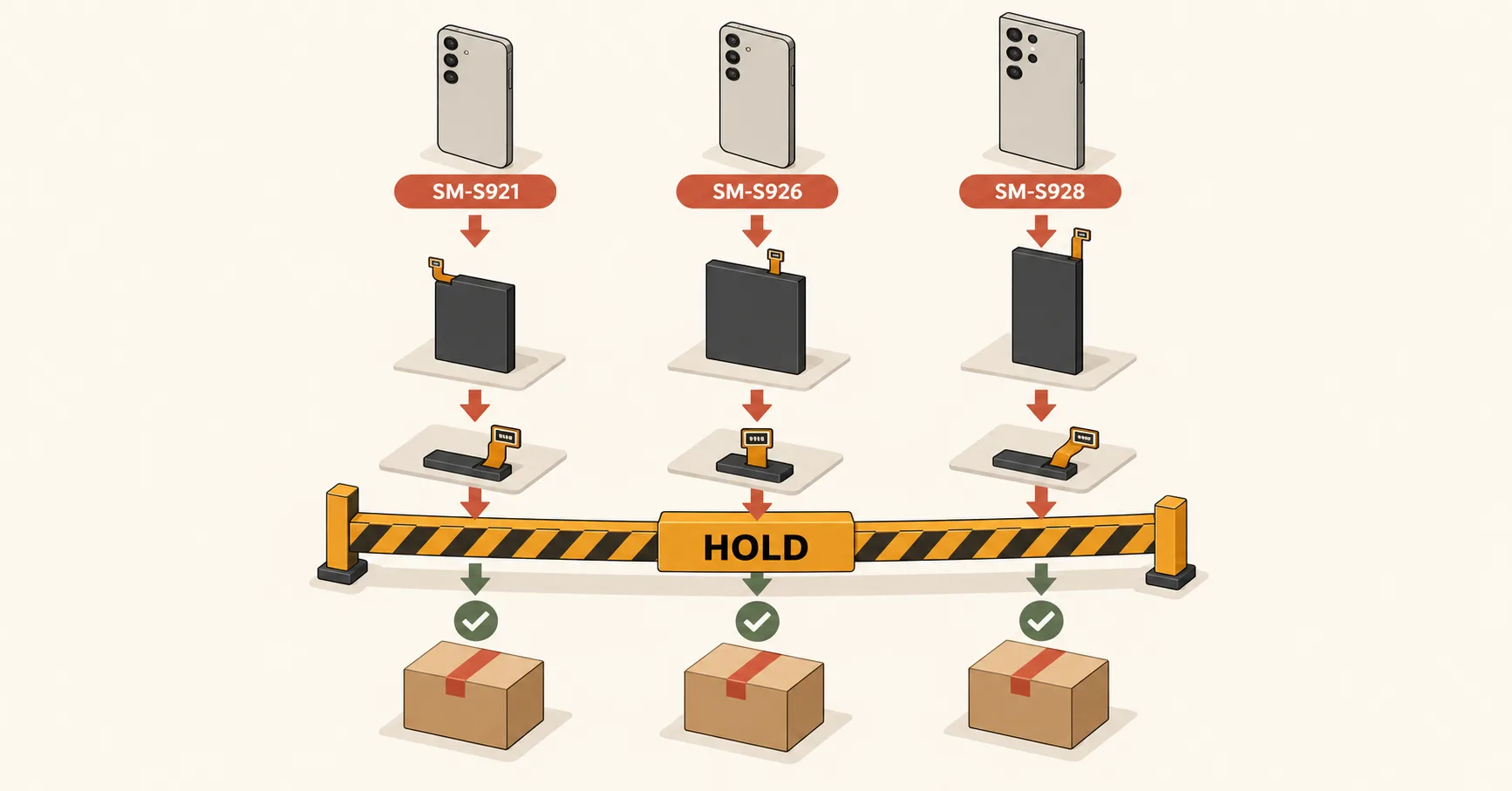
Channel catalogs may use battery references such as EB-BS921ABY, EB-BS926ABY and EB-BS928ABY. Treat these as cross-reference inputs, not conclusive compatibility evidence. The supplier should connect each reference to a controlled drawing, sample label, bill of materials and target-device test record. A familiar code printed on a pouch cannot prove dimensions, connector position, protection-board configuration or installed behavior.
What a Samsung Galaxy S24 Battery Replacement Sample Must Prove
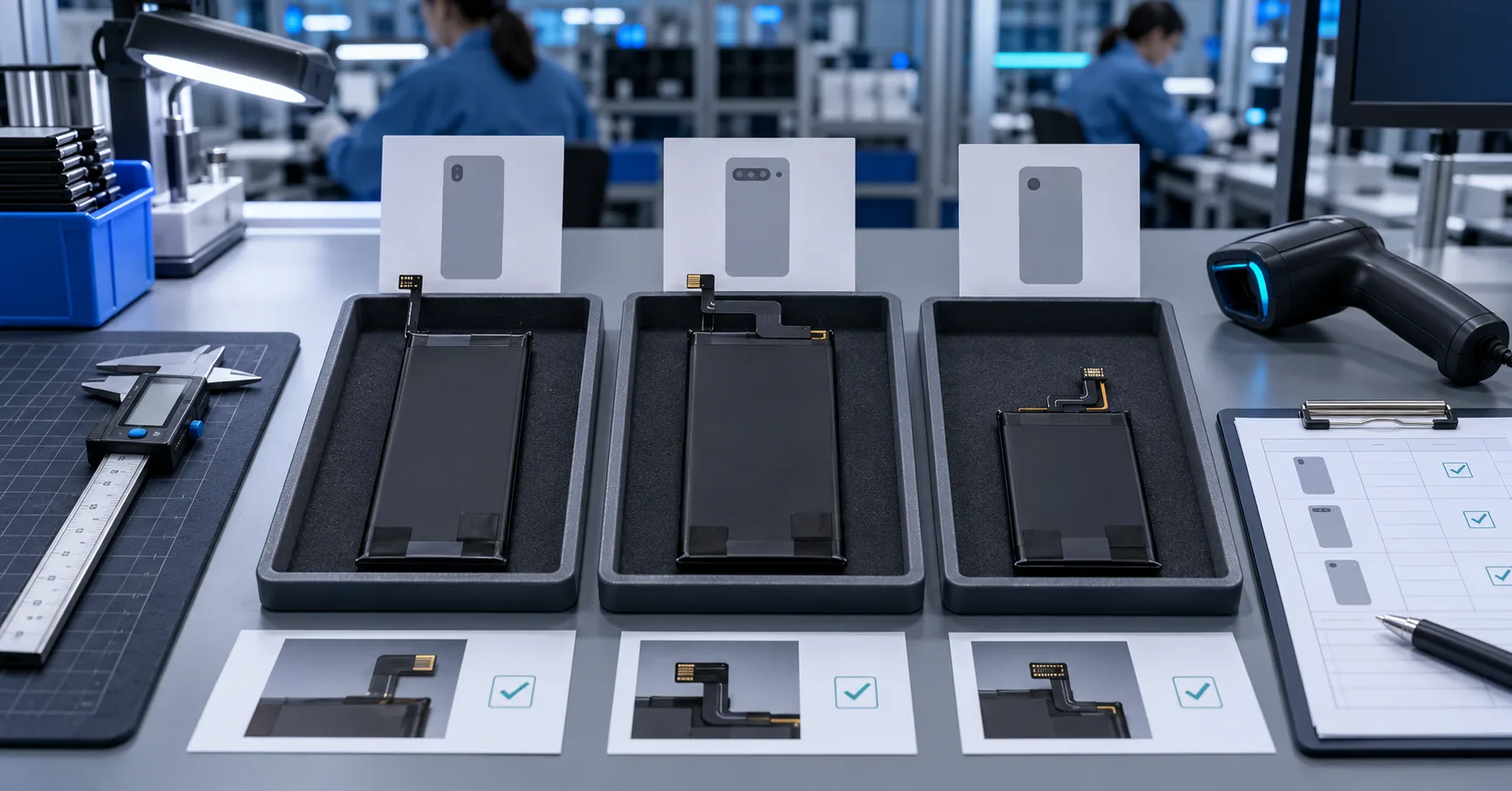
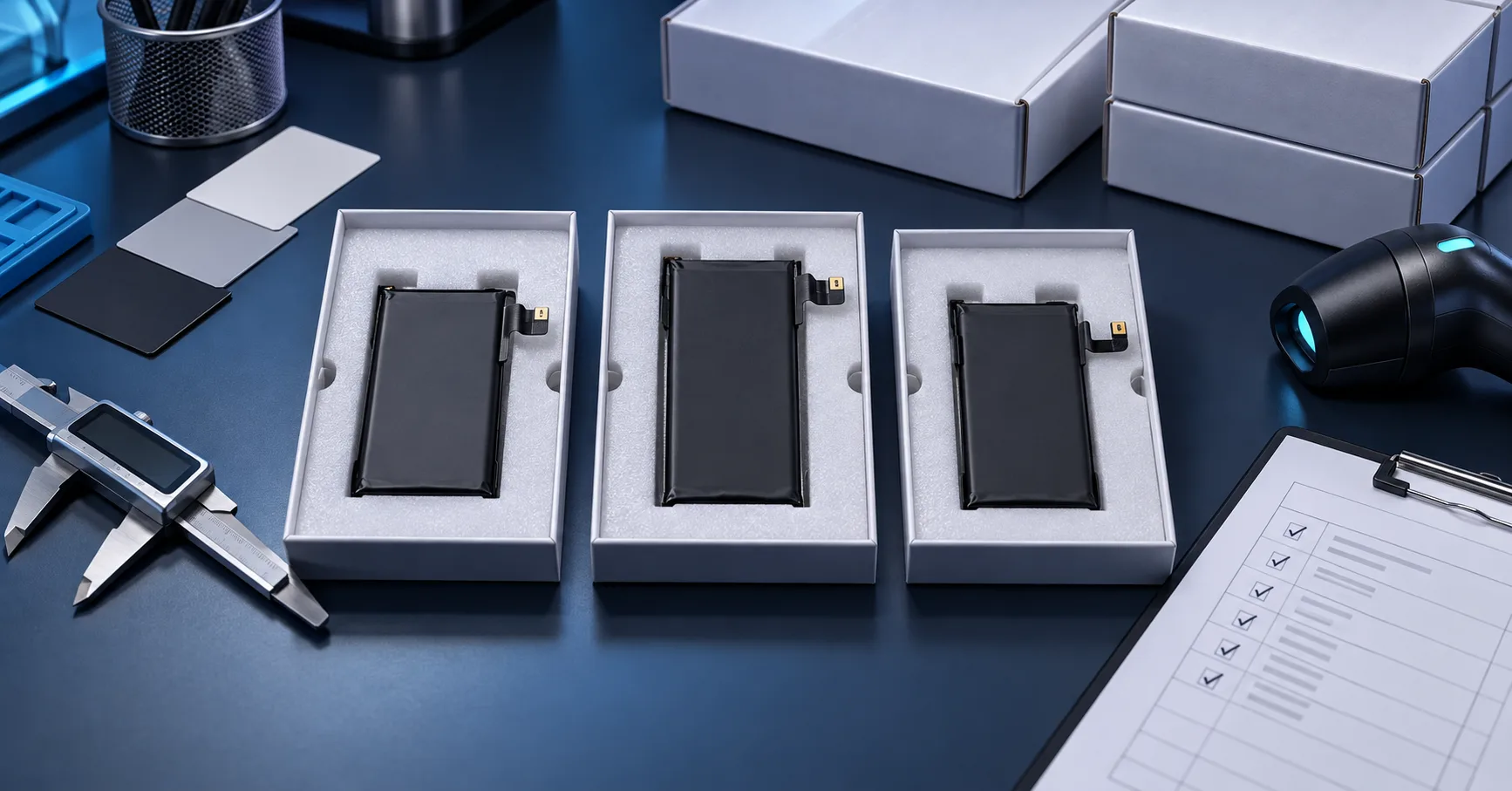
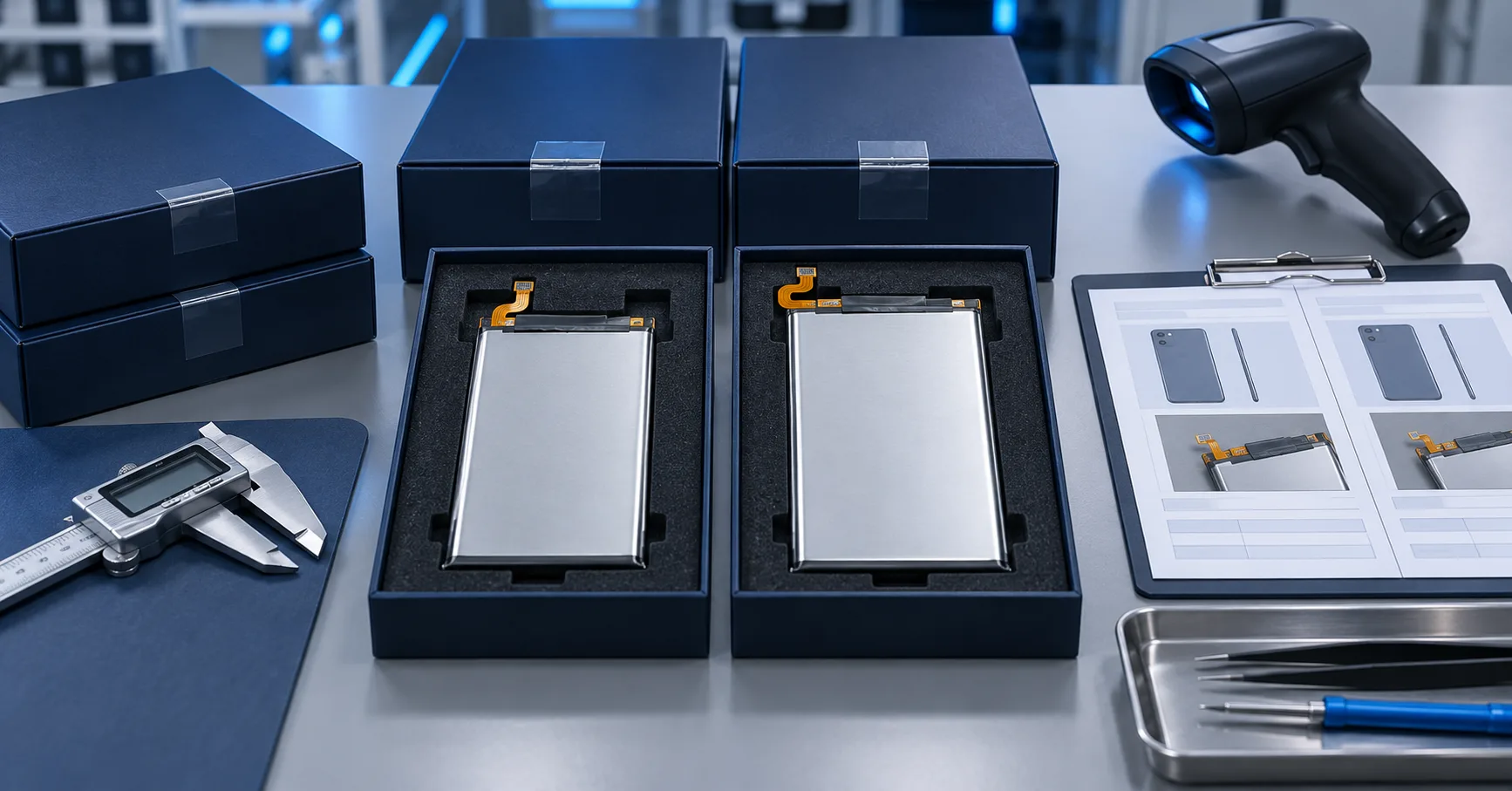
A sample should prove more than the ability to power on one handset. Approval should cover identity, construction, electrical behavior, installation, charging, usable capacity and traceability. Define the test method before samples arrive so the team does not change acceptance rules after seeing results.
1. Identity and document match
- Record the full target device code and region.
- Match the sample label, supplier SKU, battery cross-reference and drawing revision.
- Record cell lot, pack lot and production date in a traceable format.
- Confirm whether adhesive, pull tabs, liners, tools or other kit items are included.
- Require written notice before changes to the cell, protection board, flex, connector, adhesive or label.
2. Mechanical fit without forced installation
Measure length, width and thickness using an agreed method and sampling plan. Inspect pouch edges, fold zones, flex exit, connector orientation, insulation, label placement and adhesive alignment. Then install samples in known target devices under the repair team's approved process. A pack that requires bending, pressure, connector strain or improvised adhesive adjustment should not pass merely because the phone starts.
3. Electrical and protection-path checks
Confirm polarity, terminal voltage under the agreed receiving condition, connector engagement and expected protection behavior using qualified procedures. Do not use hazardous improvised short-circuit, forced-overcharge or deep-discharge tests at a repair bench. Any abnormal-condition validation belongs in a qualified laboratory or controlled engineering environment with documented limits and stop criteria.
4. Installed-device charging and load behavior
Run a repeatable installed test that includes initial boot, charging recognition, charge progression, idle observation, representative workload and controlled cool-down. Use the same charger, cable, software state, network conditions, ambient range and workload for comparisons. Samsung states that “actual battery life may vary depending on network environment, usage patterns and other factors” in its official Galaxy S24 specifications. Procurement teams should therefore compare samples under controlled conditions rather than promise a universal number of hours.
If a sample charges slowly, becomes unusually warm or drains quickly, separate battery, installation and device causes before rejecting the lot. ESCCharge's guides to battery capacity testing and mobile phone battery incoming inspection provide useful control principles that can be adapted to the S24 program with model-specific fixtures and limits.
Do Not Turn a Capacity Label Into a Performance Guarantee
The official device capacities provide a useful baseline, but they do not replace measured evidence for the offered pack. Ask the supplier to define whether its capacity is nominal, typical or minimum, together with nominal voltage, watt-hours, test temperature, charge procedure, discharge rate, cutoff voltage, rest periods, sample count and equipment. Without these conditions, two capacity claims may not be comparable.
For a samsung galaxy s24 ultra battery replacement, the 5,000 mAh official device reference can guide specification review, while the actual supplied assembly still needs its own declared minimum and test record. Likewise, an s24 ultra battery marketed with an “extended” figure should not be accepted from the printed number alone. Buyers should verify the physical envelope, mass, electrical limits and repeatable discharge data. A higher claim that cannot fit the controlled design or survive installed testing creates return risk rather than extra sellable value.
Include Repair-System Behavior in the Approval Record
Post-repair behavior can depend on the device, software version, installed part and service workflow. Samsung's Self Repair service guidance says its official assistant can “pair the serial number of your new battery to your phone and re-calibrate your device.” This statement applies to Samsung's supported self-repair process and should not be converted into a promise that every third-party replacement pack will pair, recalibrate or display identical status information.
The sample report should record the phone model, region, software build, observed battery menus, diagnostics, charging messages and any service application used. Keep observations factual. Terms such as “recognized,” “normal” or “fully compatible” are too vague unless the report defines exactly what appeared and under which conditions.
Release a Pilot Lot Before Normal Wholesale Volume
Golden-sample approval is necessary but insufficient. A polished engineering sample may not represent ordinary production. Before a larger order, release a pilot lot and compare it with the approved reference across packaging, label, dimensions, connector, flex, voltage condition, appearance and installed tests.
- Freeze the approved sample: photograph it, assign an approval ID and retain its drawing and measured results.
- Define receiving sampling: state lot definition, sample size, acceptance limits and escalation rules before shipment.
- Run visual and dimensional inspection: inspect swelling, deformation, contamination, torn insulation, connector damage and drawing deviations.
- Check electrical condition: use calibrated equipment and model-specific receiving windows.
- Install representative units: include each device and regional variant within the intended sales scope.
- Record failures by lot: preserve device code, battery lot, symptom, photos and test conditions.
- Release, hold or reject: do not blend suspect stock with accepted inventory while an investigation is open.
The same logic should govern repeat orders. Compare each new shipment with the frozen sample and prior accepted lots. If the cell source, board, flex, adhesive, firmware-related behavior or label changes, determine whether targeted or full requalification is required.
Prevent S24 Series Warehouse and Picking Errors
The three device names look similar, so warehouse control deserves as much attention as sample testing. Use distinct internal SKUs, scannable labels and separate bin locations. Avoid a parent label that says only “Galaxy S24 Series Battery.” The pick record should expose the exact variant before an operator confirms the shipment.
| Control point | Required record | Risk reduced |
|---|---|---|
| RFQ | Full device code, region and battery cross-reference | Wrong product quoted |
| Sample | Drawing revision, label photos and test report | Uncontrolled approval |
| Purchase order | Separate line for S24, S24+ and S24 Ultra | Mixed production or packing |
| Incoming inspection | Lot ID, sample result and disposition | Unverified stock release |
| Warehouse | Barcode, dedicated bin and scan validation | Mis-picks |
| Warranty | Device code, pack lot, symptom and evidence | Untraceable claims |
A samsung galaxy s24+ battery replacement should never be substituted with the base or Ultra item because a sales description appears similar. For the same reason, an s24 ultra battery replacement needs its own barcode and claim category. Separate records let the buyer identify whether returns follow one pack lot, one device variant, one installation team or a broader process issue.
Use a consistent battery warranty-claims workflow to connect field evidence with supplier investigation. Store unopened inventory under documented conditions and rotate it using the controls described in the mobile phone battery storage SOP. These practices reduce the chance that inventory age or handling is confused with a manufacturing defect.
Send an RFQ That Produces Comparable Offers
A useful RFQ should request evidence, not just unit price. Include:
- target Galaxy S24 device names, complete model codes and sales regions;
- battery cross-reference and controlled dimensional drawing;
- declared typical or minimum capacity, nominal voltage and watt-hours;
- capacity test conditions and sample-level results;
- cell, protection board, flex, connector, insulation and adhesive scope;
- label, barcode, packaging and private-label requirements;
- sample quantity, pilot-lot quantity and forecast by SKU;
- target market and required model-level documents;
- change-notification expectations and traceability format;
- warranty evidence, investigation and corrective-action process.
MOQ, lead time, warranty and compliance support should be confirmed for the exact configuration, quantity and destination rather than assumed from a general supplier profile. The Samsung replacement-battery supplier guide can support broader vendor qualification, while this S24 page controls the model-specific approval decision.
Frequently Asked Questions
Can one replacement battery fit the Galaxy S24, S24+ and S24 Ultra?
No assumption of interchangeability should be made. The three devices have different model families and capacity references. Approve separate finished assemblies using controlled drawings and target-device tests.
Is the printed battery cross-reference enough to approve compatibility?
No. It is a useful lookup field, but approval also requires dimensions, flex and connector verification, label review, installed testing and traceable lot evidence.
Should buyers request the official device capacity or an extended-capacity claim?
Use the official device reference as context, then evaluate the supplier's declared minimum, test conditions and measured sample results. Do not approve an extended claim without physical, electrical and capacity evidence.
How many samples are required?
There is no universal quantity. The plan should reflect SKU count, device variants, order size, supplier history, test destructiveness and acceptable risk. Define the sample and pilot-lot stages before ordering.
Does Samsung's repair application guarantee the same result with third-party packs?
No. Samsung's statement describes its supported repair process. Record actual behavior on the target handset and software version, and do not promise pairing, recalibration or a particular status display without verified evidence.
Build the S24 Program Around Evidence, Not Listing Claims
The safest sourcing decision is to treat every S24 variant as a controlled SKU and connect the quote, drawing, sample, pilot lot, incoming result and warranty record. That approach turns samsung galaxy s24 battery replacement sourcing into a repeatable approval system instead of a one-time product-page comparison.
Request a model-specific sourcing review: send ESCCharge the complete device codes, destination market, annual forecast, packaging requirements and preferred test plan. The team can review the requested replacement-battery configuration and propose a sample-to-batch approval path. Final capacity, MOQ, lead time, warranty and document scope remain subject to the confirmed model and order conditions.