
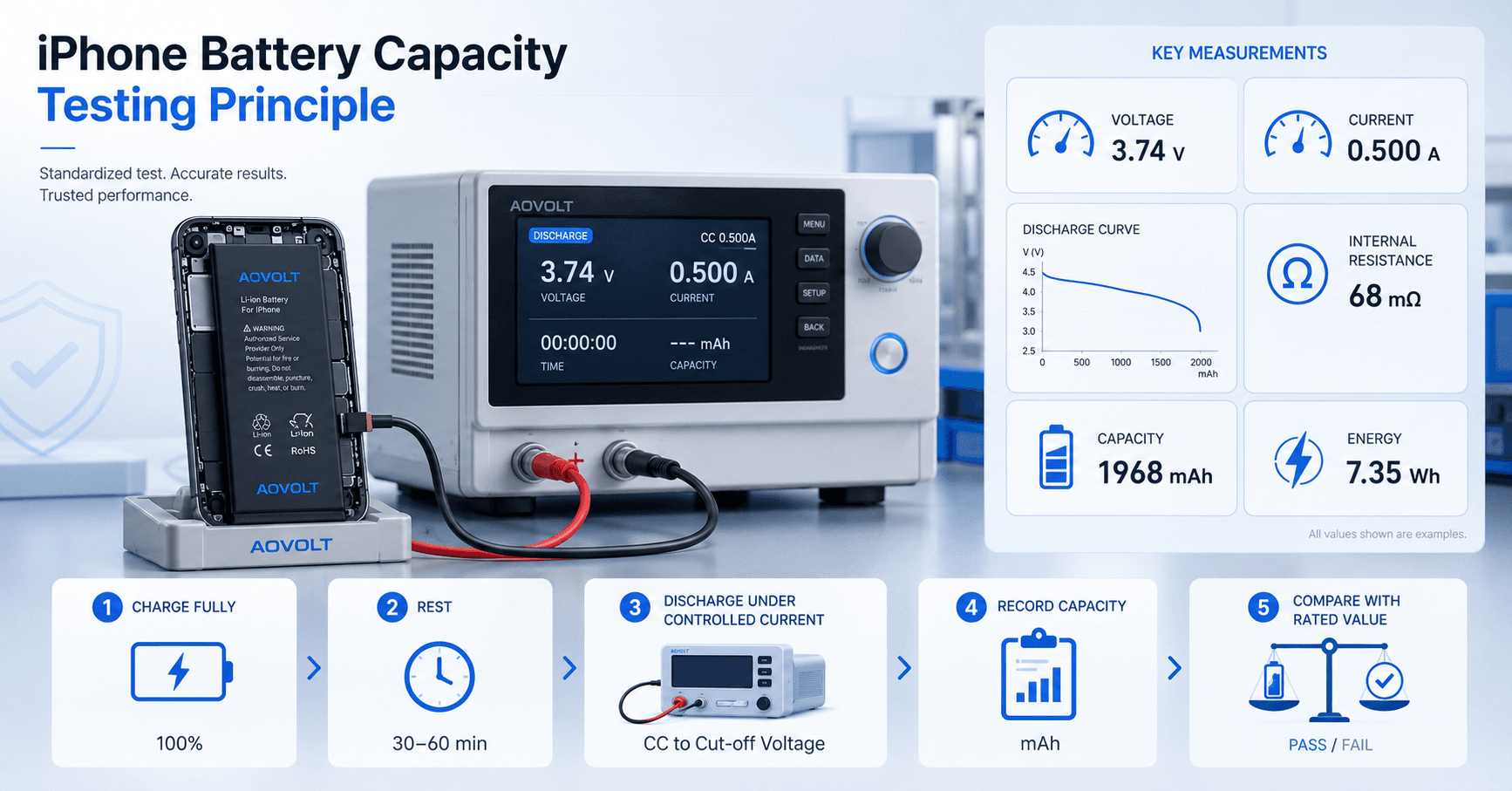
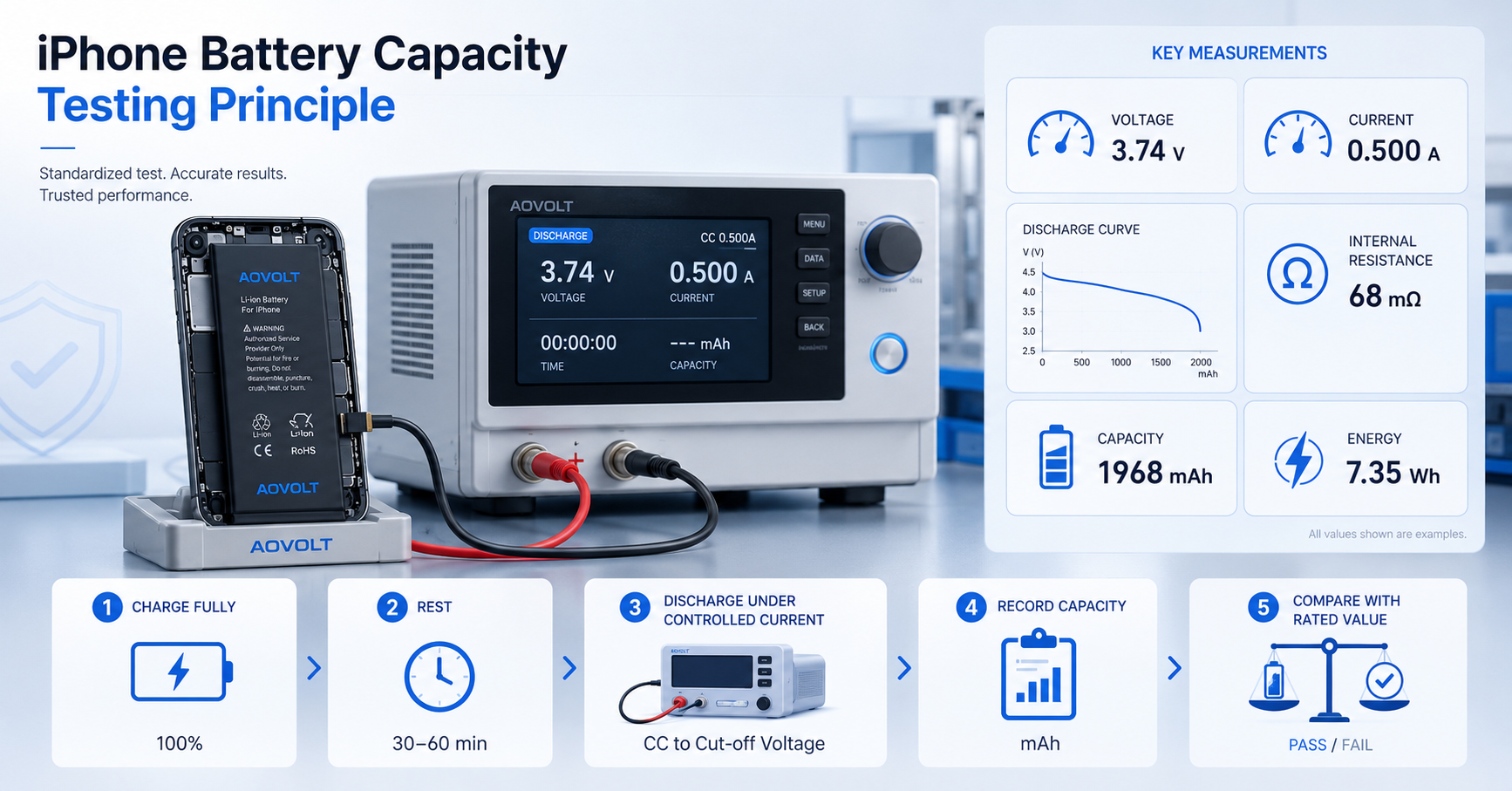
How to Test iPhone Battery Capacity Before Bulk Orders
Knowing how to test iPhone battery capacity is critical for repair shops, wholesalers, refurbished phone suppliers and private label battery brands before placing bulk orders. A replacement iPhone battery may look correct from the outside, but the printed mAh value does not always represent real usable capacity, stable discharge performance or long-term reliability. Apple explains that iPhone battery maximum capacity is connected with chemical aging and peak performance capability, and Apple also notes that battery health reporting may need recalibration in some cases, which means professional buyers should not rely on one single screen reading when evaluating battery quality.
Product Pain Points: Why Capacity Claims Can Mislead B2B Buyers
For B2B buyers, iPhone battery capacity problems usually appear after installation, not during visual inspection.
A battery label may show a high mAh value, but the customer may still complain that the phone drains quickly, shuts down at low percentage, heats during charging, or shows unstable battery percentage after restart. For repair shops, this creates customer disputes. For wholesalers, it creates warranty claims from local repair customers. For e-commerce sellers, it becomes negative reviews and return requests.
The real issue is that capacity is not only a label number. It is affected by the cell’s usable energy, internal resistance, discharge curve, protection board behavior, storage condition, cycle condition and test environment.
A low-grade iPhone battery may pass a basic power-on test but fail during actual use. That is why buyers who know how to test iPhone battery capacity can avoid many after-sales problems before ordering large quantities.
Testing Principle: What iPhone Battery Capacity Really Means
iPhone battery capacity usually refers to how much electric charge the battery can store and deliver, commonly expressed in mAh. However, for professional battery testing, mAh alone is not enough. Buyers should also consider voltage, watt-hours, discharge current, cutoff voltage, temperature and internal resistance.
A simple way to understand battery capacity is this:
Capacity tells you how much charge the battery can deliver.
Voltage tells you the electrical potential during operation.
Watt-hours show usable energy more directly.
Internal resistance affects heat, voltage drop and power delivery.
Discharge curve shows whether the battery output is stable.
Apple states that iPhone batteries are lithium-ion batteries and that chemical aging reduces the amount of charge a battery can hold. Apple also explains that iPhone battery health includes maximum capacity and peak performance capability, which are two different but related indicators.
For B2B buyers, the key point is simple: Battery health shown on a phone is useful, but it should not replace real capacity testing during supplier evaluation.
Comparison: Battery Health Reading vs Professional Capacity Test
Many repair shops first check iPhone battery health in the phone settings. This is useful for basic customer communication, but it is not enough for wholesale purchasing or supplier qualification.
Battery health reading shows an estimate of maximum capacity compared with the original design reference. It is easy to access and helpful for end users. However, it can be affected by software reporting, recalibration, model differences and battery data behavior.
A professional capacity test measures what the battery can actually deliver under controlled conditions. It usually uses test equipment to record discharge capacity, voltage behavior, internal resistance and sometimes temperature behavior.
The two methods serve different purposes.
Battery health reading is suitable for quick user-facing checks.
Professional capacity testing is suitable for supplier evaluation.
Internal resistance testing is useful for judging power delivery and heat risk.
Charge-discharge testing is useful for comparing real performance between samples.
Aging observation is useful for finding early failure risk.
Apple has stated that iOS 14.5 included recalibration of battery health reporting for certain iPhone 11 models because inaccurate estimates could show symptoms such as unexpected battery drain behavior or reduced peak performance capability. This shows why B2B buyers should treat software readings as one reference, not the only proof of battery quality.
Solution: How to Test iPhone Battery Capacity Step by Step
A professional capacity evaluation should combine physical inspection, electrical testing, full charge preparation, controlled discharge testing and result comparison.
Step 1: Check Battery Appearance and Label Information
Before electrical testing, inspect the sample visually.
Check the battery model, rated capacity, nominal voltage, charge voltage, warning label, production batch, connector, flex cable, pouch surface, edge sealing and packaging protection.
Do not skip this step. A battery with poor pouch sealing, bent flex cable, unclear label or weak packaging may create problems even if the capacity test looks acceptable.
Step 2: Measure Open-Circuit Voltage
Open-circuit voltage helps buyers judge battery storage condition and whether the battery is within a normal voltage range before testing.
If the voltage is too low, the battery may have been stored too long or self-discharged abnormally. If voltage varies too much between samples from the same batch, batch consistency may be poor.
Step 3: Test Internal Resistance
Internal resistance is one of the most useful indicators for professional battery buyers. A battery with high internal resistance may show voltage drop under load, heat more easily, drain faster under heavy use or shut down unexpectedly.
For iPhone replacement batteries, internal resistance should be checked across multiple samples, not only one piece. The consistency between samples is often more important than one perfect test result.
Step 4: Fully Charge the Battery Under Controlled Conditions
Before discharge testing, the battery should be fully charged according to its specified charge voltage and current range. After full charge, let it rest for a controlled period so the voltage can stabilize.
This rest period helps avoid inaccurate results caused by surface charge or unstable immediate readings.
Step 5: Run a Controlled Discharge Test
This is the core step when evaluating how to test iPhone battery capacity properly.
Use professional battery test equipment to discharge the battery under controlled current and cutoff voltage. Record the delivered capacity in mAh and, if possible, the delivered energy in Wh.
The test should not be performed randomly. Current level, ambient temperature, cutoff voltage and test time all affect the result. If two suppliers are compared under different conditions, the comparison is meaningless.
Step 6: Compare Tested Capacity with Rated Capacity
After testing, compare the measured capacity with the rated capacity on the label.
For B2B purchasing, one sample is not enough. Buyers should test multiple samples from the same batch and compare average capacity, lowest capacity, variation range and discharge curve stability.
If the label claims unusually high capacity but test results are unstable, the product may create after-sales problems later.
Step 7: Install and Observe Real Phone Performance
Lab testing is important, but installation testing is also necessary.
Install the battery into a compatible iPhone and check charging behavior, battery percentage stability, heat during use, standby drain, battery health display behavior and whether any warning message appears after replacement.
For repair shops, real installation performance matters as much as lab data.
Step 8: Record Results Before Bulk Orders
A good sample test should produce records.
Useful records include sample model, batch number, voltage, internal resistance, tested capacity, discharge curve, charging behavior, installation result, battery health behavior and any abnormal findings.
These records help buyers compare suppliers fairly and reduce disputes after bulk orders.
AOVOLT Solution: Capacity Testing as Part of Supplier Qualification
AOVOLT treats iPhone battery capacity as a technical and commercial issue, not only a label claim.
For B2B customers, AOVOLT can support sample evaluation, model selection, standard capacity options, high-capacity options, battery health display solutions, decoded battery options, OEM packaging and quality-control discussions before bulk orders.
AOVOLT’s testing logic can include appearance inspection, voltage check, internal resistance check, capacity test, PCM protection board function test, charge-discharge observation, aging test, connector inspection, flex cable inspection, label inspection and final random inspection before shipment.
This helps customers avoid three common mistakes:
Buying batteries based only on printed mAh.
Testing only one sample and assuming the whole batch is stable.
Ignoring internal resistance, discharge curve and installation behavior.
For serious B2B buyers, the question is not only how to test iPhone battery capacity. The better question is how to build a repeatable testing process that protects the buyer’s repair business, wholesale reputation or private label brand.
Core Advantages: Why Professional Capacity Testing Improves Business Stability
The first advantage is lower after-sales risk. When capacity, internal resistance and discharge behavior are checked before bulk orders, buyers can identify weak samples earlier.
The second advantage is better supplier comparison. Instead of comparing only price and label capacity, buyers can compare actual performance data.
The third advantage is stronger customer communication. Repair shops can explain battery performance more professionally when customers ask about battery health, runtime or replacement quality.
The fourth advantage is better product positioning. Wholesalers can separate standard capacity batteries, high-capacity batteries and premium repair solutions with more confidence.
The fifth advantage is private label protection. If a customer builds a battery brand, unstable capacity directly damages brand trust. Capacity testing helps protect long-term reputation.
IEC 62133-2 specifies safety requirements and tests for portable sealed secondary lithium cells and batteries under intended use and reasonably foreseeable misuse. For buyers, this reinforces a key point: professional battery sourcing should be based on testing, not only appearance, price or packaging claims.
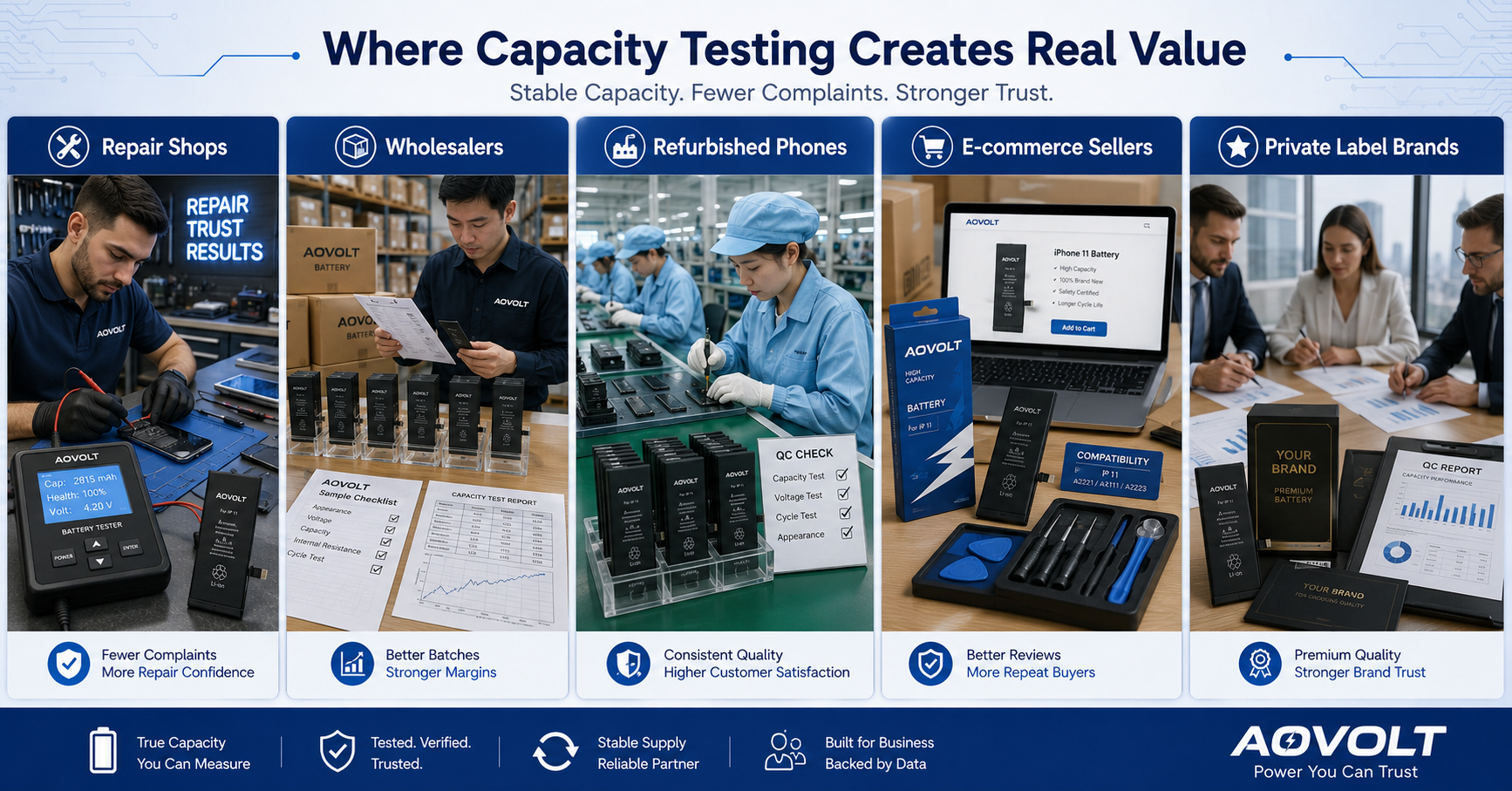
Application Scenarios: Where Capacity Testing Creates Real Value
Repair shops use iPhone battery capacity testing to reduce customer complaints and improve confidence before offering battery replacement services.
Wholesalers use testing to compare suppliers, verify samples and reduce warranty claims from local repair stores.
Refurbished phone factories use testing to standardize battery replacement quality before used phones are resold.
E-commerce sellers use testing to reduce return risk and avoid negative reviews caused by exaggerated capacity claims.
Private label brands use capacity testing to protect brand reputation and build a more credible product line.
For each customer type, the purpose is different, but the business logic is the same: stable capacity means fewer complaints, better trust and more repeat orders.
Selection Advice: How to Choose Batteries Based on Capacity Testing Results
Repair shops should choose batteries with stable real-world installation performance, not only high rated capacity. A battery that tests well but creates warning messages, unstable percentage or heat problems is not a good repair solution.
Wholesalers should test multiple samples and focus on consistency. The best supplier is not the one with the highest claimed capacity, but the one with stable batch performance.
E-commerce sellers should avoid unrealistic capacity claims. Online buyers may be attracted by large mAh numbers, but returns and negative reviews will damage long-term sales.
Refurbished phone factories should choose standardized batteries with predictable performance and easy installation. For refurbishment, consistency is more valuable than marketing exaggeration.
Private label brands should create clear product tiers. Standard capacity batteries can serve daily repair demand, while high-capacity batteries can be positioned as premium options only if the tested capacity and safety behavior support the claim.
Buyers should ask suppliers for sample support, testing guidance, rated capacity explanation, internal resistance data, quality inspection process and after-sales response plan before placing bulk orders.
FAQ
What is the most accurate way to test iPhone battery capacity?
The most reliable method is a controlled charge-discharge test using professional battery test equipment. The battery should be fully charged, rested, discharged under controlled current and cutoff voltage, and then compared with its rated capacity.
Is iPhone Battery Health the same as real capacity testing?
No. iPhone Battery Health is a useful software-based estimate for users, but professional buyers should also use electrical testing such as voltage, internal resistance and discharge capacity testing. Apple has documented battery health recalibration for certain iPhone models, which shows software readings can sometimes be adjusted.
Why does a battery with high capacity still drain fast?
A battery may drain fast because of high internal resistance, unstable discharge curve, poor cell quality, inaccurate percentage behavior, PCM mismatch, phone motherboard leakage, software power consumption or improper installation. Capacity alone does not guarantee good runtime.
How many samples should wholesalers test before bulk orders?
Wholesalers should test multiple samples from the same batch instead of relying on one piece. They should compare voltage, internal resistance, capacity, discharge curve and installation behavior to judge batch consistency.
Can high-capacity iPhone batteries be reliable?
Yes, but only when the capacity claim is realistic and supported by proper cell structure, thickness control, internal resistance control, safety protection and testing. Unrealistic high-capacity labels can create after-sales risk.
What equipment is used for iPhone battery capacity testing?
Professional testing may use a battery capacity tester, internal resistance meter, multimeter, controlled charging equipment, temperature observation tools and real-device installation checks.
What should repair shops check after installing a tested battery?
Repair shops should check charging behavior, battery percentage stability, standby drain, heat during use, battery health display behavior, warning messages and general runtime performance.
Does AOVOLT support sample testing before bulk orders?
Yes. AOVOLT can support B2B customers with sample options, model recommendations, standard capacity and high-capacity choices, battery health display solutions, decoded options and OEM packaging discussions before bulk orders.
Conclusion
Understanding how to test iPhone battery capacity helps B2B buyers avoid fake capacity claims, unstable batches and after-sales complaints. A professional evaluation should include appearance inspection, voltage test, internal resistance test, controlled discharge test, installation check and sample result recording.
AOVOLT supports repair shops, wholesalers, refurbished phone suppliers, e-commerce sellers and private label brands with replacement iPhone battery solutions, sample evaluation, quality-control support and OEM packaging options.
Contact AOVOLT to request iPhone battery samples, capacity testing support, model recommendations and wholesale pricing for your battery business.