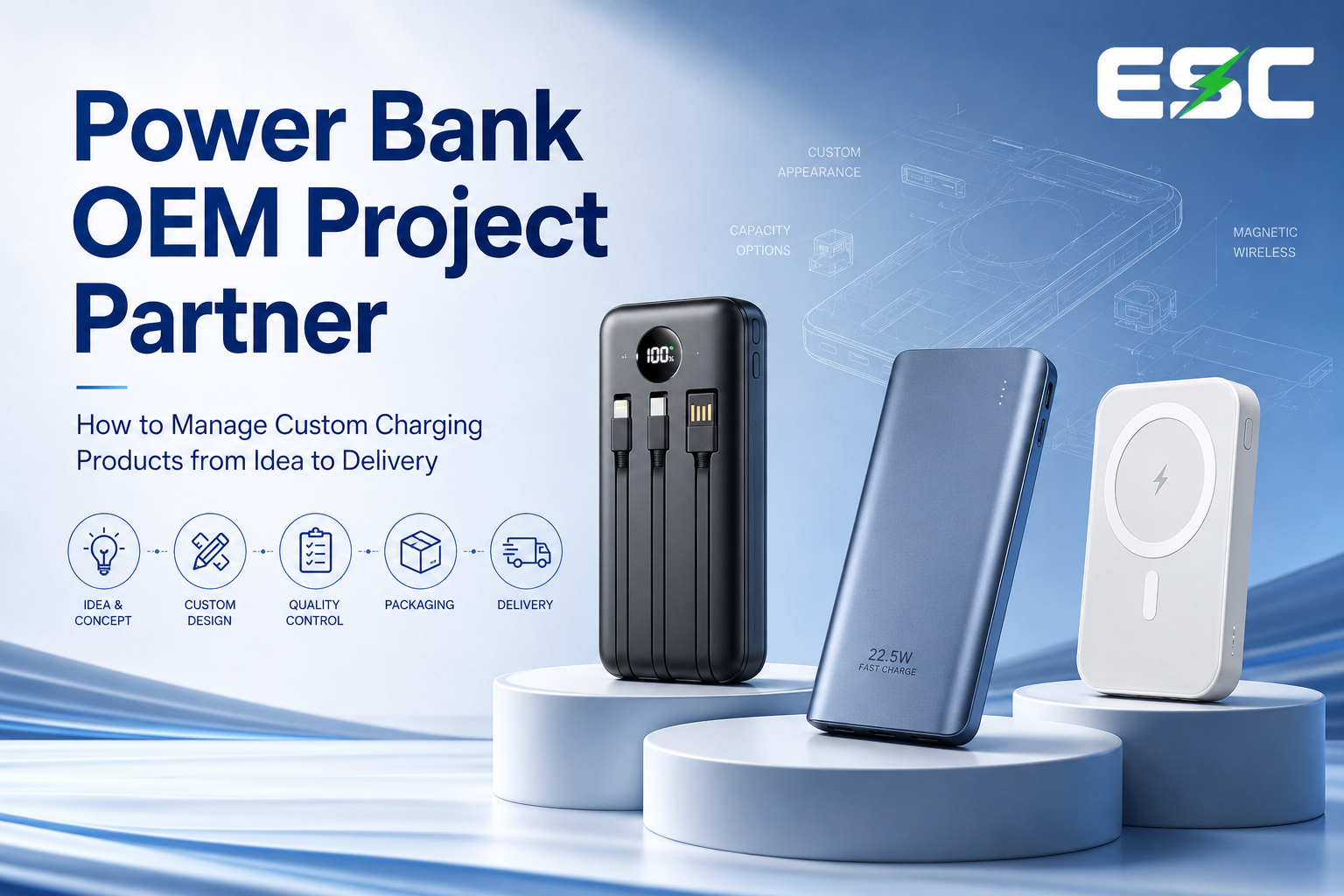

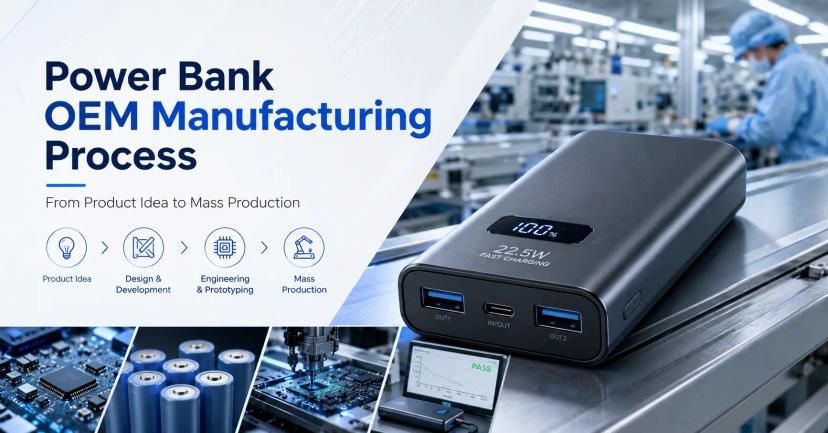
For brands, importers, distributors, and e-commerce sellers, understanding the power bank OEM manufacturing process is important before starting a custom charging product project. A power bank may look simple from the outside, but its production involves battery cells, PCBA design, fast charging protocols, housing structure, assembly control, safety testing, packaging, and shipment preparation.
A reliable OEM manufacturer should not only produce finished goods. They should help buyers manage each step from product idea to sample confirmation and mass production.
If you are still comparing suitable product models, ESC’s Power Bank product category can help you review different options, including built-in cable power banks, high-capacity models, wireless charging models, and fast charging power banks.
What Is the Power Bank OEM Manufacturing Process?
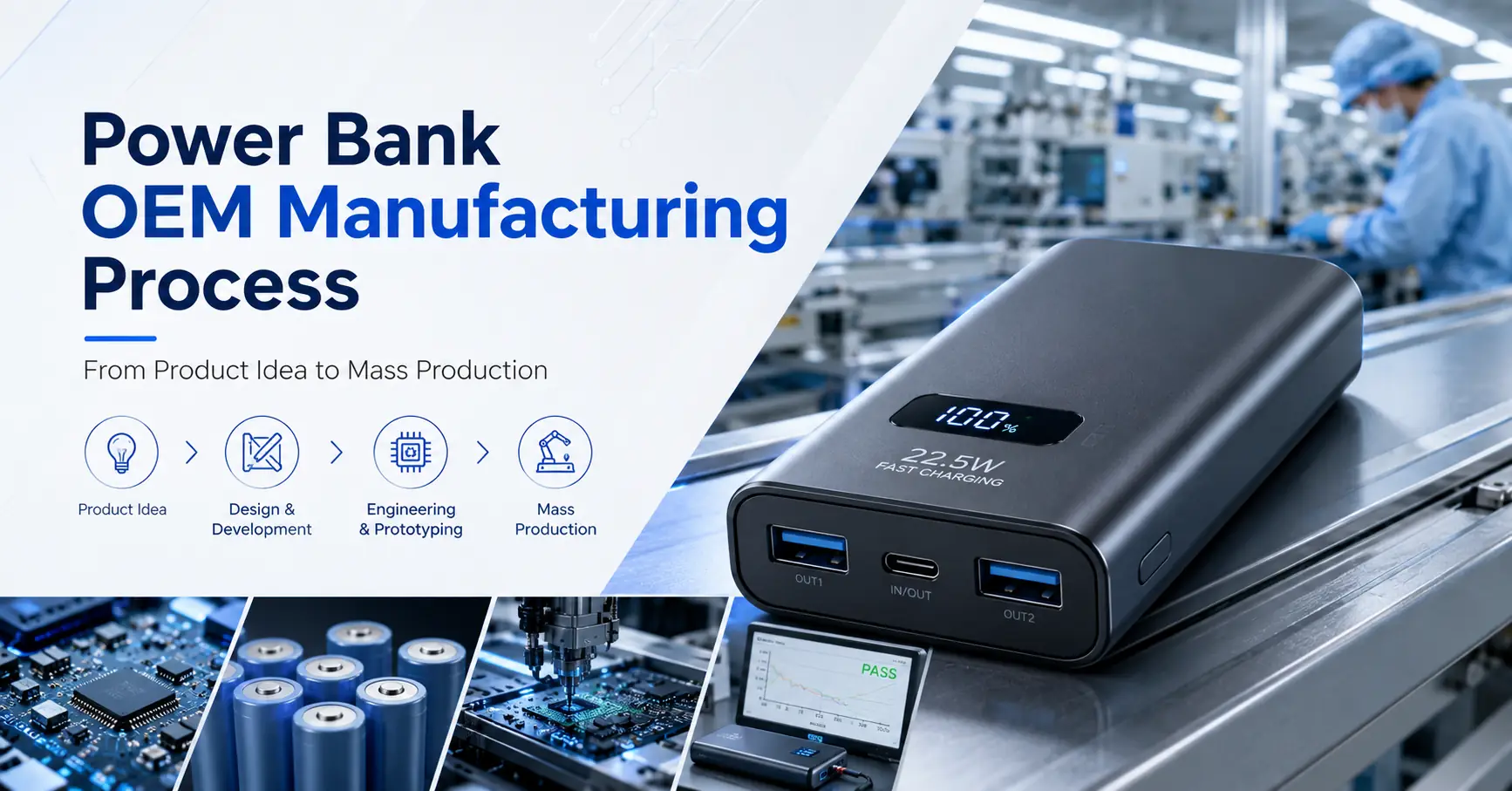
The power bank OEM manufacturing process refers to the complete production workflow for custom or private-label power banks. It usually starts with product requirements and ends with finished goods ready for shipment.
A typical OEM process includes:
| Stage | Main Work |
|---|---|
| Product planning | Define capacity, charging power, market, features, and price range |
| Design confirmation | Confirm housing, color, logo, packaging, and product style |
| Sample development | Build samples for function and appearance approval |
| Material preparation | Prepare battery cells, PCBA, housing, cables, and packaging |
| PCBA testing | Test charging protocol, output power, and protection functions |
| Battery testing | Test capacity, voltage, safety, and consistency |
| Assembly | Assemble battery, PCBA, housing, cables, and display |
| Aging test | Test product stability before shipment |
| Final inspection | Check function, appearance, packaging, and accessories |
| Shipment | Prepare cartons, labels, documents, and delivery |
A clear process helps buyers avoid wrong specifications, unstable quality, delayed production, and packaging mistakes.
Product Requirement Confirmation
The first step is confirming what kind of power bank the buyer needs. This includes target market, end users, product function, branding, price range, and sales channel.
Buyers should prepare:
- Target capacity
- Charging power
- Built-in cable requirement
- Wireless charging requirement
- Logo and color preference
- Packaging style
- Certification needs
- Order quantity
- Target delivery schedule
For projects requiring special capacity, power, color, appearance, logo, or packaging, ESC’s Customized Solution can support broader OEM/ODM customization.
Product Design and Model Selection
After requirements are confirmed, the manufacturer helps select an existing model or develop a custom design.
There are usually two directions:
| Development Type | Best For | Advantage |
| Existing model customization | Fast launch, lower cost | Shorter lead time |
| New model development | Unique brand product | Stronger differentiation |
For many buyers, customizing an existing model with logo, color, and packaging is the most practical option. For brands that need exclusive design, a new mold or deeper structural customization may be required.
If your project includes magnetic wireless charging or watch charging products, ESC’s Wireless Charging product page can support related product planning.
Sample Development and Approval
Sample development is a key part of the power bank OEM manufacturing process. Buyers should not approve mass production based only on pictures.
A sample should be checked for:
- Product appearance
- Logo position
- Color accuracy
- Charging speed
- Battery capacity
- Cable function
- Wireless charging performance
- Display accuracy
- Heat control
- Packaging fit
For custom packaging projects, buyers should also confirm the box structure, printing color, manual, barcode, product image, and accessory placement before mass production.
Battery Cell Preparation
Battery cells are the core component of a power bank. They affect capacity, safety, weight, product size, and cycle life.
Buyers should confirm:
| Battery Factor | Why It Matters |
| Rated capacity | Determines product positioning |
| Real output capacity | Affects user experience |
| Cell quality | Impacts safety and cycle life |
| Battery consistency | Reduces batch quality issues |
| Safety protection | Prevents overcharge and over-discharge risks |
| Transport documents | Important for lithium battery shipping |
A professional manufacturer should test battery cells before assembly instead of relying only on supplier documents.
PCBA Testing and Fast Charging Verification
PCBA is the control center of the power bank. It manages charging speed, input/output power, protocol compatibility, temperature control, and safety protection.
Important PCBA checks include:
- USB-C PD output stability
- QC or PPS compatibility
- Multi-port power distribution
- Over-current protection
- Short-circuit protection
- Temperature protection
- Display accuracy
- Input charging performance
If your product line also includes fast chargers or travel charging accessories, ESC’s Charger Plug product category can help build a more complete charging product system.
Housing, Cable, and Structural Assembly
After battery cells and PCBA pass inspection, the production team starts assembly. This step includes installing the battery, PCBA, ports, cable modules, buttons, screens, and outer housing.
For built-in cable power banks, cable structure is especially important. Poor cable grooves or weak cable connectors can cause durability problems after repeated use.
For wireless power banks, magnetic alignment and coil position must be checked carefully. If alignment is inaccurate, wireless charging efficiency may be poor.
For high-power power banks, housing design should also consider heat dissipation and structural durability.
Aging Test and Functional Inspection
Aging testing helps confirm product stability before shipment. During this stage, products are charged, discharged, or tested under working conditions to detect unstable units.
Common inspection items include:
- Charging function
- Output power
- Input power
- Battery percentage display
- Built-in cable performance
- Wireless charging function
- Temperature rise
- Button function
- Port stability
- Appearance condition
This step is important because some problems only appear after continuous operation.
Packaging and Accessory Preparation
Packaging is part of the OEM manufacturing process, not a final decoration. The packaging should protect the product, communicate key information, and match the sales channel.
Common packaging items include:
- Retail box
- Gift box
- User manual
- Charging cable
- Warranty card
- Barcode label
- Certification icons
- Carton label
For e-commerce sellers, packaging should also protect the product during shipping. For retail buyers, the packaging should clearly show capacity, charging power, cable type, and key features.
Final Quality Control Before Shipment
Before delivery, the manufacturer should perform final quality inspection.
A standard final inspection may include:
| Inspection Item | Purpose |
| Appearance check | Prevent scratches, stains, color issues |
| Function test | Confirm charging and output work normally |
| Capacity check | Verify battery performance |
| Packaging check | Avoid wrong box, wrong label, or missing manual |
| Quantity check | Match order requirement |
| Carton check | Confirm carton strength and shipping labels |
| Document check | Confirm required certificates or reports |
Buyers can review ESC’s company and manufacturing information through the About Us page before starting an OEM production project.
Shipment and Delivery Management
After inspection, the goods are packed for shipment. For power banks, logistics planning is important because lithium battery products may require specific shipping documents and handling.
Buyers should confirm:
- Shipping method
- Carton quantity
- Gross weight and volume
- Battery transport documents
- Destination market requirements
- Delivery schedule
- After-sales contact process
A reliable manufacturer should help buyers prepare shipment information clearly and avoid last-minute delivery problems.
OEM Manufacturing vs SKD Assembly
Some buyers may not need finished products. They may prefer SKD components for local assembly.
| Option | Best For | Advantage |
| Finished OEM power bank | Brands and distributors | Ready to sell after delivery |
| SKD power bank solution | Local assembly buyers | Flexible assembly and regional customization |
| PCBA + housing supply | Semi-finished product projects | Cost and process flexibility |
For local assembly or semi-finished product needs, ESC’s SKD Powerbank Solution can support housing and PCBA-related project planning.
Common Risks in OEM Manufacturing
Risk 1: Sample and mass production are inconsistent
Buyers should confirm pre-production samples and require consistent materials, color, logo, and packaging.
Risk 2: PCBA performance is unstable
Weak PCBA design may cause poor fast charging, overheating, or device compatibility issues.
Risk 3: Battery capacity is not accurate
Battery testing should be done before assembly and during finished product inspection.
Risk 4: Packaging is confirmed too late
Packaging should be planned early to avoid size mismatch and printing mistakes.
Risk 5: Certification documents are incomplete
Power bank products may require safety and transport-related documents depending on the market.
Why Work with ESC for Power Bank OEM Manufacturing?
ESC supports fast charging power banks, wireless charging power banks, charger plug products, customized solutions, and SKD power bank services.
For OEM manufacturing projects, ESC can support:
- Product model selection
- Capacity and charging power customization
- Logo and color customization
- Fast charging protocol configuration
- Built-in cable and wireless charging options
- Packaging customization
- Sample confirmation
- Production and quality inspection
- SKD housing and PCBA solutions
A strong OEM manufacturing partner should help buyers reduce risk at every step, from product planning to mass production and delivery.
FAQ
What is the power bank OEM manufacturing process?
It is the complete workflow from product requirements and sample development to material preparation, assembly, quality testing, packaging, and shipment.
How long does OEM power bank production take?
Production time depends on customization level, order quantity, material availability, and packaging requirements.
Can I customize logo and packaging?
Yes. Logo, color, packaging, user manual, and product appearance can be customized depending on the selected model and order quantity.
What should be tested before mass production?
Buyers should test battery capacity, charging speed, PCBA stability, heat performance, cable function, wireless charging, appearance, and packaging.
What certifications may be needed?
Common documents may include CE, RoHS, FCC, MSDS, UN38.3, IEC62133, or other market-specific requirements.
Can ESC support SKD power bank projects?
Yes. ESC can support SKD housing, PCBA-related solutions, and semi-finished power bank projects for local assembly buyers.
What is the difference between OEM and ODM?
OEM usually follows buyer requirements or brand specifications, while ODM uses manufacturer-developed models with customization options.
How can buyers reduce OEM production risk?
Confirm samples, review specifications, approve packaging artwork, check certification needs, and choose a supplier with stable quality control.
Conclusion
Understanding the power bank OEM manufacturing process helps buyers control quality, reduce delays, and manage custom charging product projects more effectively.
A reliable OEM manufacturer should support product planning, battery testing, PCBA inspection, fast charging verification, assembly control, packaging, certifications, and shipment preparation.
Whether you need a built-in cable power bank, wireless charging model, high-capacity power bank, custom packaging, or SKD assembly support, ESC can help manage your project from idea to delivery.
Contact ESC to discuss your OEM power bank manufacturing project and request a tailored quotation.