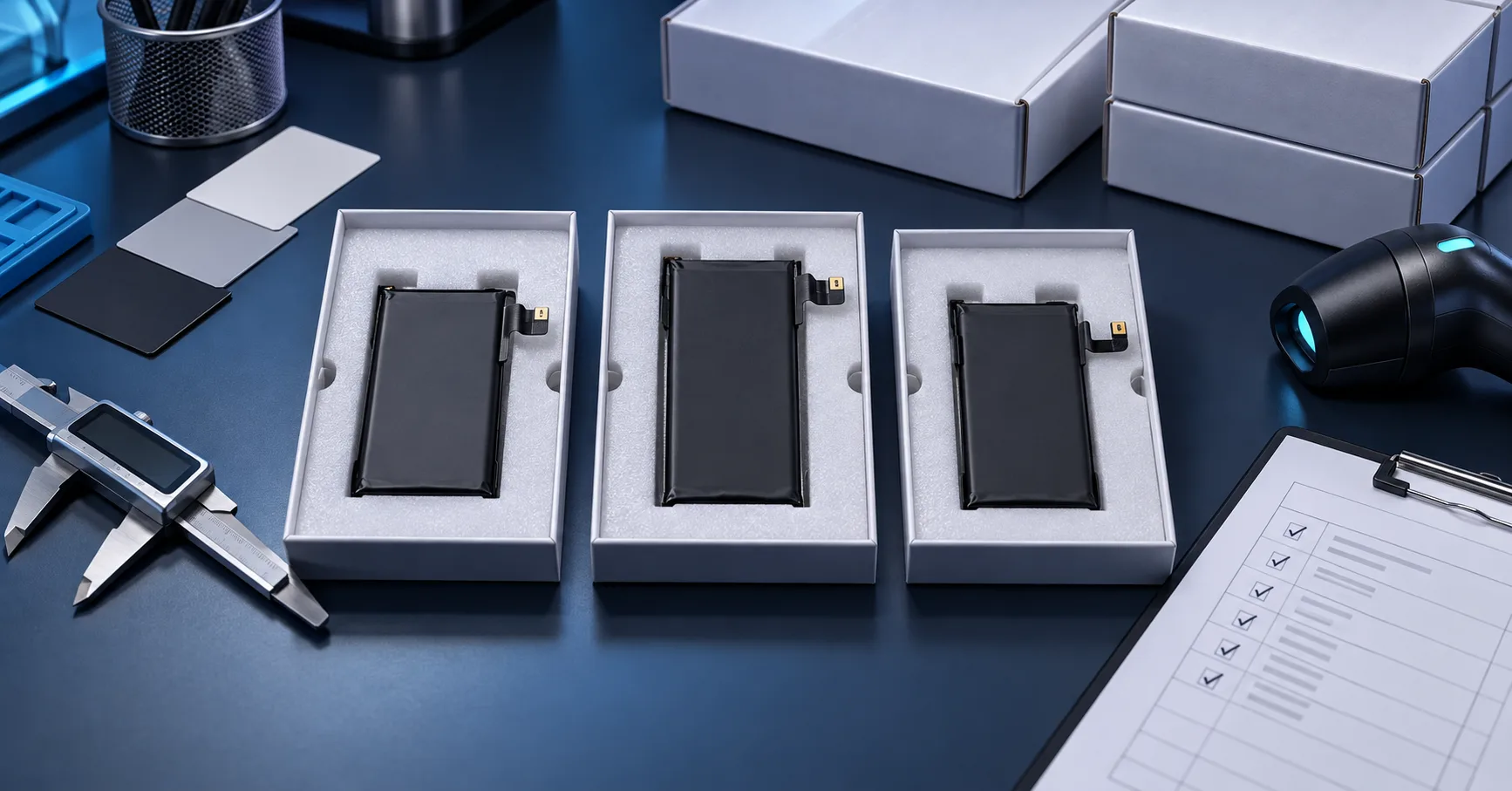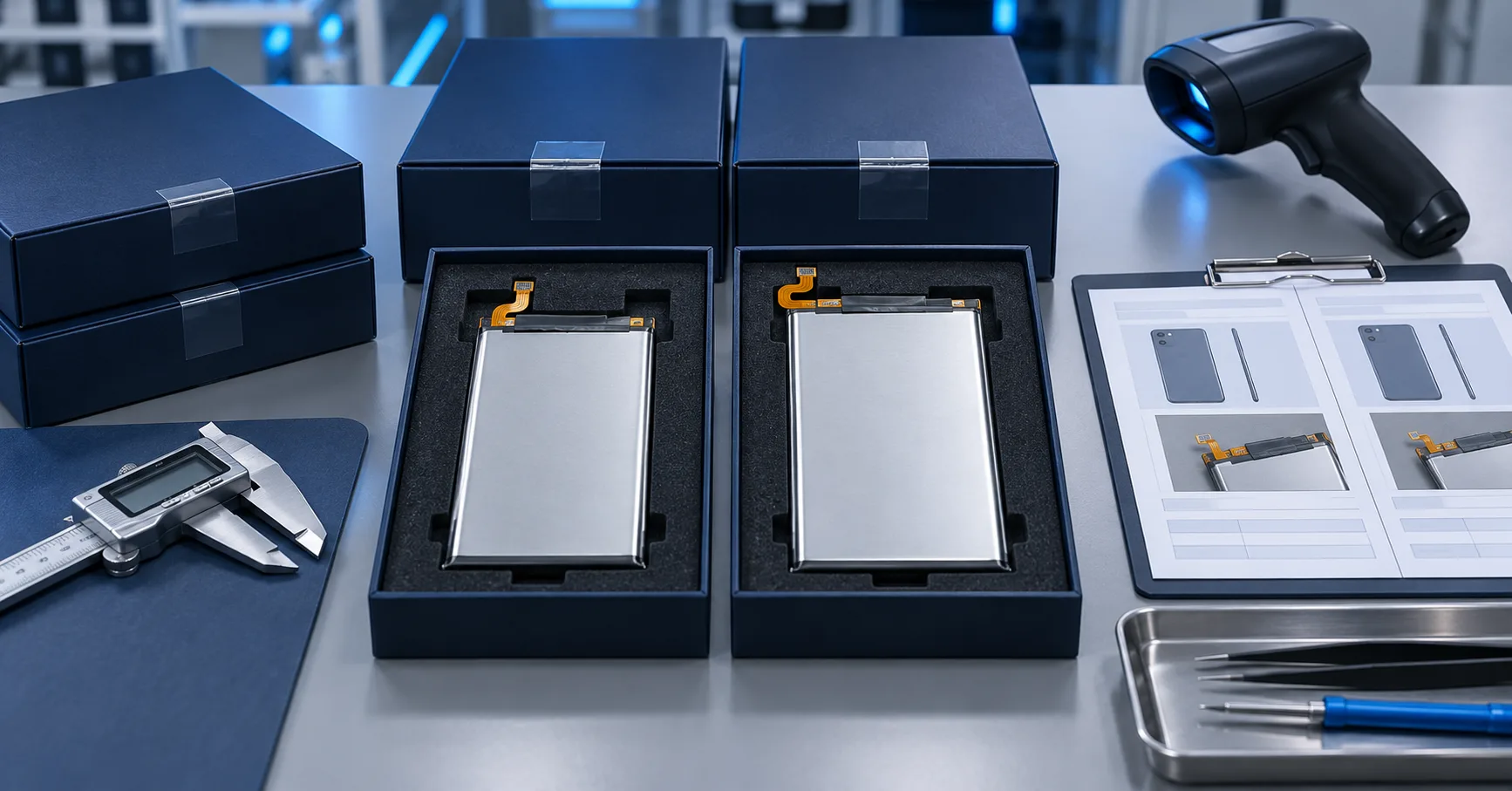

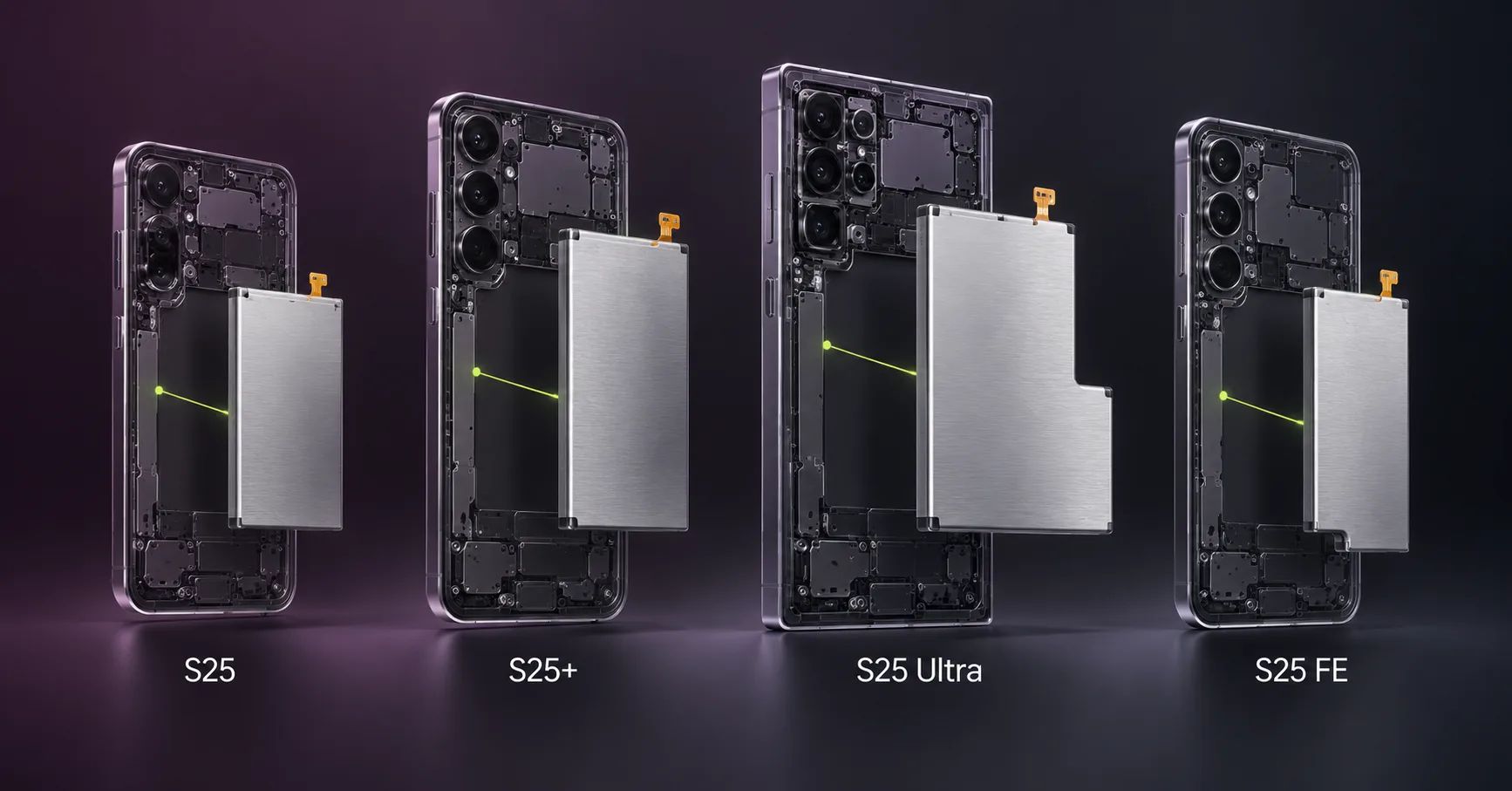
Quick answer: a Galaxy S25 series replacement battery should be approved as a model-specific finished assembly, not purchased from the series name or capacity figure alone. Galaxy S25, S25+, S25 Ultra and S25 FE have different model families, physical layouts and approval paths. A B2B buyer should connect every offered pack to a controlled drawing, target device, sample report, pilot lot and traceable repeat-order record.
The phrase samsung galaxy s25 battery replacement describes a search need, not one universal SKU. An RFQ should state the exact handset code and region, battery cross-reference, drawing revision, flex and connector orientation, label format, adhesive scope, capacity definition and acceptance method. Without those fields, buyers may compare prices for products that are not technically equivalent.
Separate the Four S25 Models Before Requesting Samples
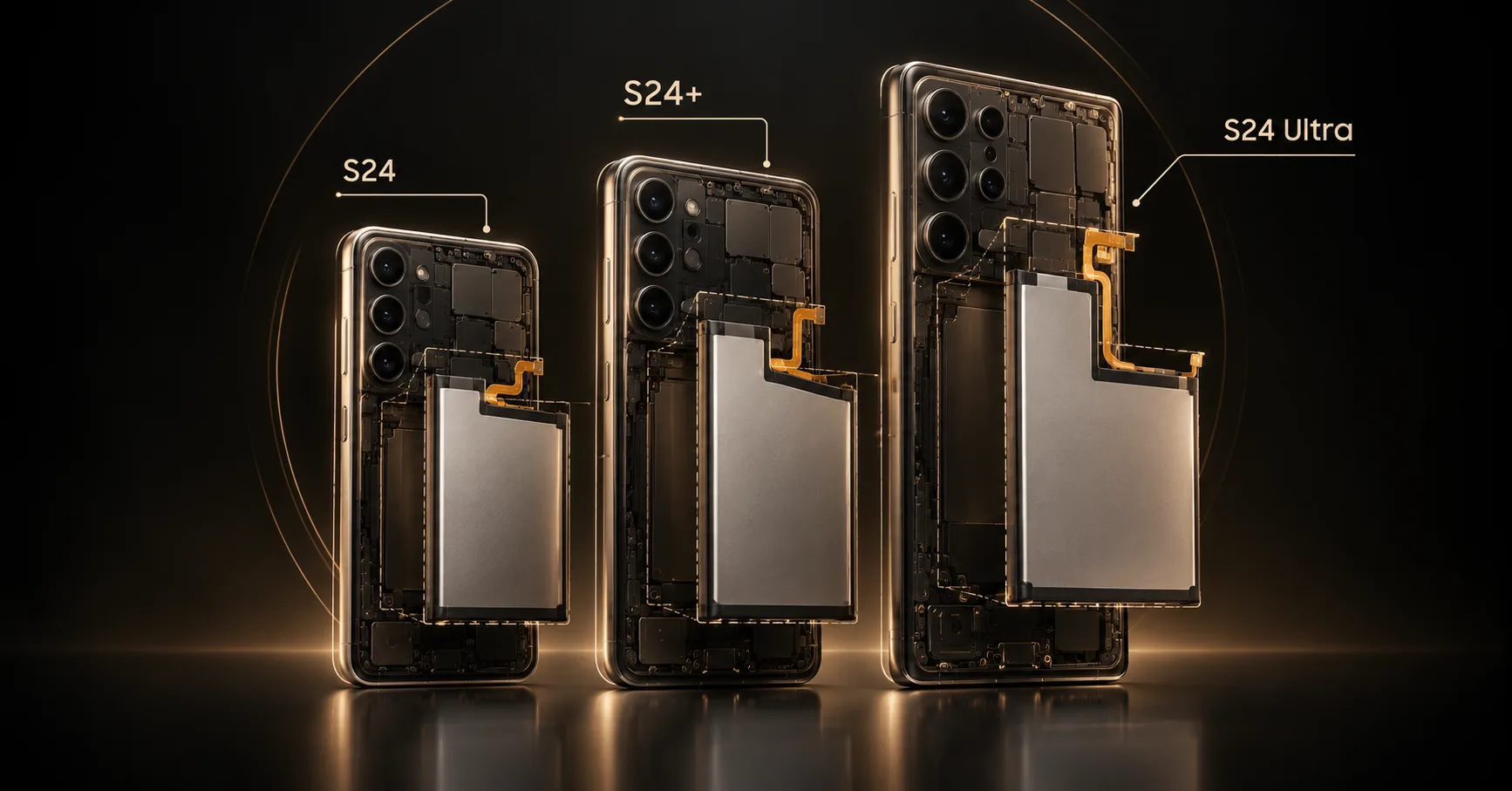
Official product materials distinguish four device families: SM-S931 for Galaxy S25, SM-S936 for Galaxy S25+, SM-S938 for Galaxy S25 Ultra and SM-S731 for Galaxy S25 FE. Regional suffixes can extend those identifiers. Record the complete code from the device, carton or service record instead of approving stock from a shortened retail name.
| Sales model | Model family | Official typical capacity | Rated minimum stated in cited launch specification | B2B treatment |
|---|---|---|---|---|
| Galaxy S25 | SM-S931 | 4,000 mAh | 3,885 mAh | Independent SKU and approval record |
| Galaxy S25+ | SM-S936 | 4,900 mAh | 4,755 mAh | Independent SKU and approval record |
| Galaxy S25 Ultra | SM-S938 | 5,000 mAh | 4,855 mAh | Independent SKU and approval record |
| Galaxy S25 FE | SM-S731 | 4,900 mAh | Confirm against the offered pack and applicable document | Independent SKU and approval record |
These figures describe official device references; they are not automatic specifications for a third-party replacement assembly. In its Galaxy S25 series announcement, Samsung defines typical value as “the estimated average value considering the deviation in battery capacity among the battery samples.” Procurement records should therefore keep typical capacity, rated minimum, supplier claim and measured result as separate fields.
Why the Same 4,900 mAh Figure Does Not Prove Interchangeability
Galaxy S25+ and Galaxy S25 FE both have an official typical capacity reference of 4,900 mAh. That numerical match does not establish the same cell outline, thickness, flex route, connector position, board design, adhesive pattern, label or installed behavior. Capacity expresses stored charge under defined test conditions; it is not a mechanical drawing or compatibility certificate.
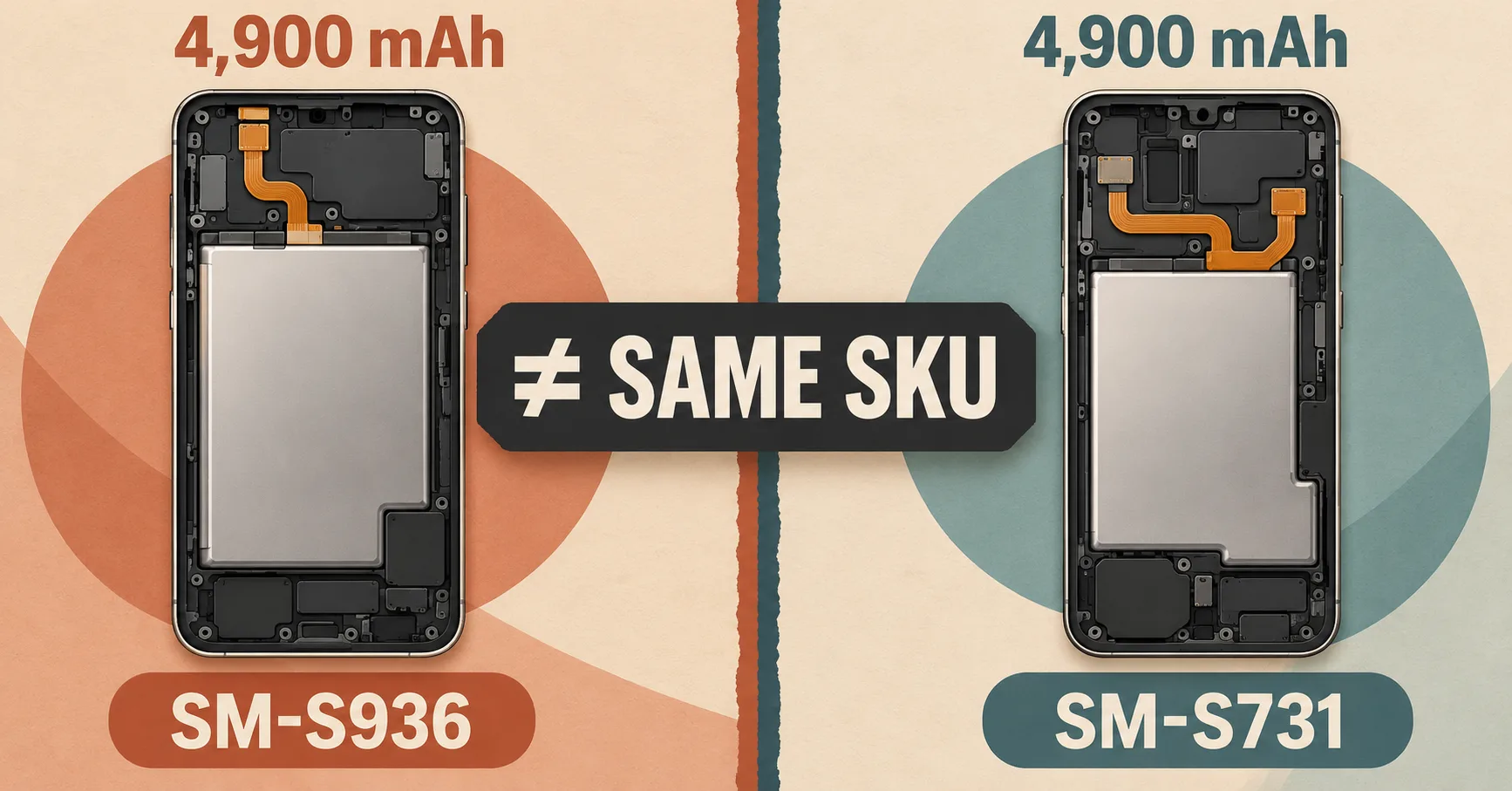
A catalog may place both phones in one product title. Treat that as a compatibility claim requiring evidence, not as approval. Ask for a revision-controlled drawing for each application, photographs of both installed assemblies and test records from both target devices. If one assembly is proposed for two model families, the supplier should identify which construction features are genuinely common and show why every fit, electrical and functional criterion passes independently.
What Each Sample Approval Package Should Prove
1. Identity and document control
- Complete target device code, sales region and internal buyer SKU.
- Supplier SKU, battery cross-reference, label artwork and drawing revision.
- Cell lot, finished-pack lot and production-date traceability.
- Included adhesive, liners, tabs or kit items.
- Written change-notification rules for cell, protection board, flex, connector, insulation, adhesive and label.
A label that says only s25 battery is insufficient. The receiving team must be able to match the physical item to the approved document set without interpreting a marketplace title.
2. Mechanical fit and repairability
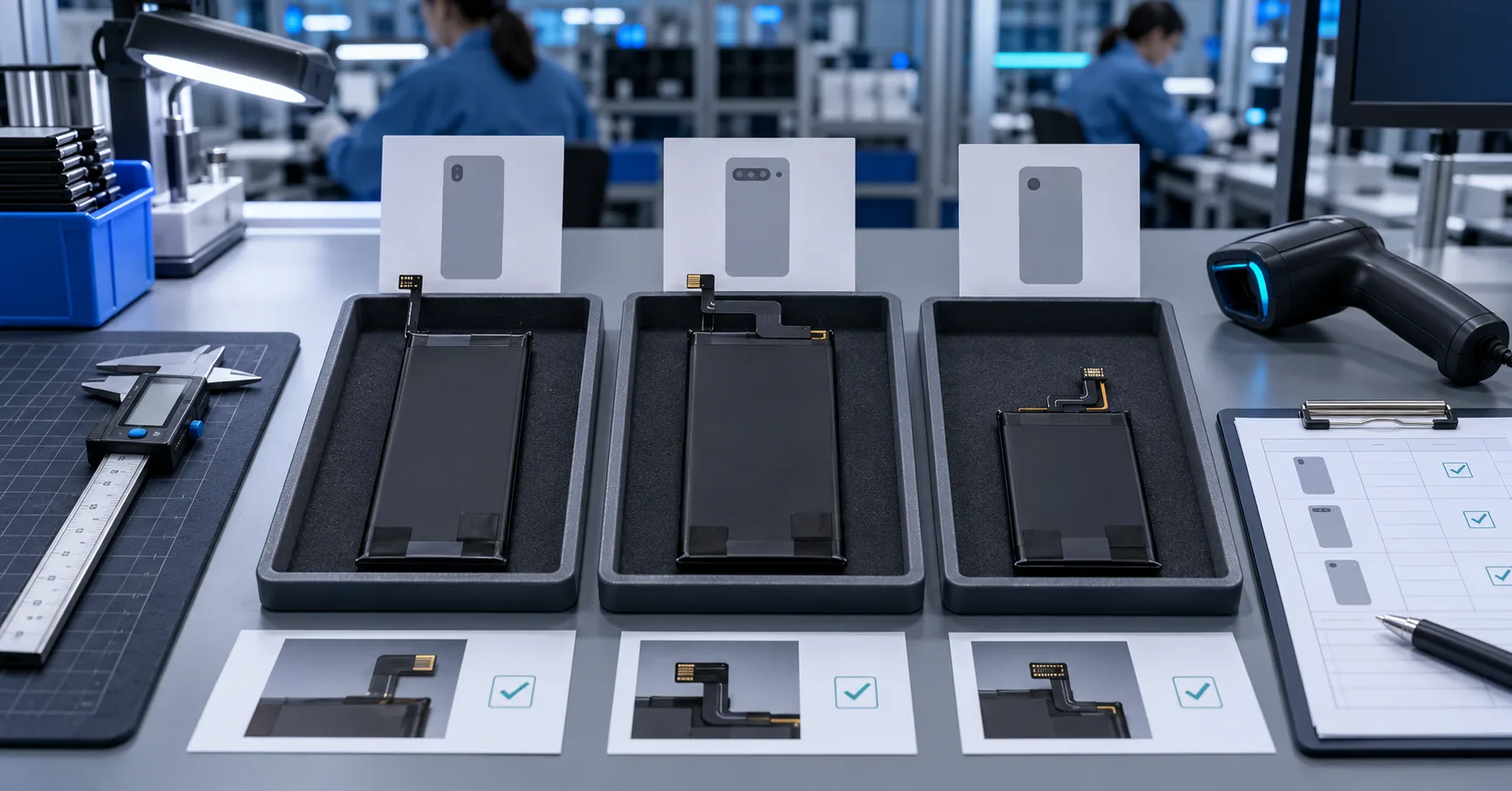
Measure length, width and thickness using an agreed method. Inspect pouch edges, fold zones, flex exit, connector orientation, insulation and adhesive alignment. Install samples into known target devices using the repair team's controlled process. Reject any design that requires pouch bending, unusual pressure, connector strain or improvised adhesive modification, even if one phone boots.
3. Electrical condition and protection path
Confirm polarity, receiving voltage condition, connector engagement and the agreed protection behavior with qualified equipment and documented limits. Abnormal-condition testing must use a controlled engineering or qualified laboratory procedure. Do not improvise short-circuit, forced-overcharge or deep-discharge tests at a repair bench.
4. Installed-device behavior
Use a consistent sequence: initial boot, charging recognition, charge progression, idle observation, representative workload, temperature observation and controlled cool-down. Record the charger, cable, ambient conditions, software build, network state and workload. A samsung galaxy s25 ultra battery replacement should pass in the intended SM-S938 device population; a single successful startup does not prove charging stability, usable runtime or repeatability.
Samsung's self-repair portal tells users to “Select your device to find the self-repair manual.” That model-specific structure supports a practical rule for B2B approval: use the correct device procedure and record actual post-repair behavior rather than applying one generic S25 assumption.
Turn Capacity Claims Into Comparable Test Evidence
Ask whether a quoted capacity is typical or minimum, then require nominal voltage, watt-hours, charge procedure, discharge rate, cutoff voltage, test temperature, rest periods, sample count and equipment. Without those conditions, two printed mAh figures are not a fair comparison.
For an s25 ultra battery, the official 5,000 mAh typical and 4,855 mAh rated minimum device references provide context, but the offered pack still needs its own controlled specification and test data. An “extended-capacity” claim requires extra scrutiny: confirm that the physical envelope and mass are credible, then verify the declared minimum through repeatable discharge tests. A larger label number is not evidence of more usable energy.
The same discipline applies to an s25 plus battery. Its 4,900 mAh device reference should not be copied into purchasing documents as a guaranteed third-party result. ESCCharge's guide to battery capacity testing explains the broader principles of controlled charge, discharge and result comparison; the actual S25 program still needs model-specific fixtures, limits and engineering review.
Approve a Pilot Lot, Not Only a Golden Sample
An engineering sample can differ from routine production. After sample approval, order a defined pilot lot and compare it with the retained golden sample. Freeze photographs, drawings, label files and measured results under one approval ID, then state the lot definition, sample size, acceptance limits and escalation rules before shipment.
- Quarantine on receipt: do not release stock before identity and condition checks.
- Verify packaging and labels: match SKU, model, lot and quantity to the purchase order.
- Inspect construction: check deformation, swelling, insulation, flex, connector and drawing conformity.
- Measure electrical condition: apply the approved receiving window with calibrated equipment.
- Install representative units: cover every model and regional variant in the order scope.
- Record disposition: release, hold or reject the lot with traceable evidence.
The mobile phone battery incoming-inspection guide provides a useful framework for turning these checks into a repeatable receiving process. If the cell, board, flex, connector, adhesive, label or performance changes, decide whether targeted or full requalification is required before accepting the next lot.
Prevent Mixed-SKU and Warranty Errors
Use separate internal SKUs, barcodes and bin locations for S25, S25+, S25 Ultra and S25 FE. A warehouse label that says only “S25 Series Battery” invites picking mistakes. The scanner or order record should display the precise model before shipment confirmation.
| Control point | Required evidence | Main risk reduced |
|---|---|---|
| RFQ | Complete device code, region and drawing request | Wrong item quoted |
| Sample approval | Controlled documents and installed-test record | Approval from description alone |
| Purchase order | Separate line for every approved model | Mixed production or packing |
| Incoming inspection | Lot ID, sampling result and disposition | Unverified inventory release |
| Warehouse | Dedicated barcode and bin | Mis-picks |
| Warranty | Device code, battery lot, symptom and test evidence | Untraceable claims |
Use a consistent battery warranty-claims workflow so field reports can be grouped by model, lot, repair site and symptom. Store unopened stock under documented conditions and rotate it with the controls in the mobile phone battery storage SOP. This helps distinguish production issues from aging, transport, storage, installation or handset faults.
Keep Series-Level and Ultra Supplier Intent Separate
This page controls the four-model compatibility and approval process. Buyers focused only on supplier evaluation for the flagship model can use the existing Samsung S25 Ultra battery supplier guide. Keeping the two purposes separate avoids repeating one article under multiple URLs while still giving procurement teams the correct depth.
Send an RFQ That Produces Comparable Offers
- target device names, complete model codes, regions and forecast by SKU;
- battery cross-reference and revision-controlled dimensional drawing;
- declared typical or minimum capacity, voltage and watt-hours;
- capacity-test method and sample-level results;
- cell, protection board, flex, connector, insulation and adhesive scope;
- label, barcode, packaging and private-label requirements;
- sample and pilot-lot quantities;
- target market and required model-level documents;
- traceability, change notice and warranty-investigation expectations.
MOQ, lead time, warranty and compliance support depend on the confirmed model, configuration, quantity, destination and agreement. Request those terms for each approved SKU instead of treating a general supplier statement as a universal commitment.
Compare Suppliers With an Evidence Matrix
Do not let a polished listing or low unit price decide the shortlist. Score each offer against the same evidence matrix: exact model coverage, drawing control, capacity definition, sample traceability, installed-device results, pilot-lot support, change notification, packaging control and warranty investigation. Mark unsupported claims as open items rather than awarding an assumed pass.
A useful matrix separates three states: documented, verified by the buyer and not yet verified. A supplier document may support initial review, but buyer verification is still required for critical fit and performance criteria. Record the date, document revision, sample ID, test owner and result for every approval decision. If a quotation changes after approval, compare the new offer with the frozen record before issuing a repeat purchase order.
This approach also improves commercial comparison. One quote may include adhesive, individual protective packaging, model-level barcode labels and lot reports, while another may cover only the bare assembly. Normalize the scope before comparing landed cost. The cheapest unit can become the more expensive program when rework, mixed picks, repeat testing, returns and investigation time are included.
Frequently Asked Questions
Can one battery be used for every Galaxy S25 model?
No universal fit should be assumed. The four device families require model-specific drawing review, installation and functional testing.
Are the Galaxy S25+ and S25 FE batteries interchangeable because both are 4,900 mAh?
No. Equal typical capacity does not prove equal dimensions, flex, connector, board, adhesive or device behavior. Approve each application independently.
Is an official device capacity a guaranteed replacement-battery result?
No. It is a reference for the original device specification. The offered replacement pack needs its own declared capacity type, test method, minimum acceptance limit and measured evidence.
How many samples should a buyer test?
There is no universal number. Define it from the SKU count, device variants, order size, supplier history, test destructiveness and acceptable risk, then add a pilot-lot stage before normal volume.
What should trigger requalification?
A change to the cell, protection board, flex, connector, insulation, adhesive, label, dimensions or observed device behavior should trigger documented review and, where necessary, renewed testing.
Build the S25 Program Around Traceable Evidence
The most reliable program connects the quotation, exact device code, controlled drawing, approved sample, pilot lot, incoming result and warranty record. That turns S25 series sourcing into a repeatable quality system instead of a one-time comparison of listing titles and capacity numbers.
Request a model-specific sourcing review: send ESCCharge the complete device codes, destination markets, forecast by SKU, packaging requirements and proposed acceptance plan. The team can review the requested configuration and propose a sample-to-batch approval route. Final capacity, MOQ, lead time, warranty and documentation remain subject to the confirmed model and order conditions.