
What Should an A Grade Lithium Ion Phone Battery Supplier Actually Prove?
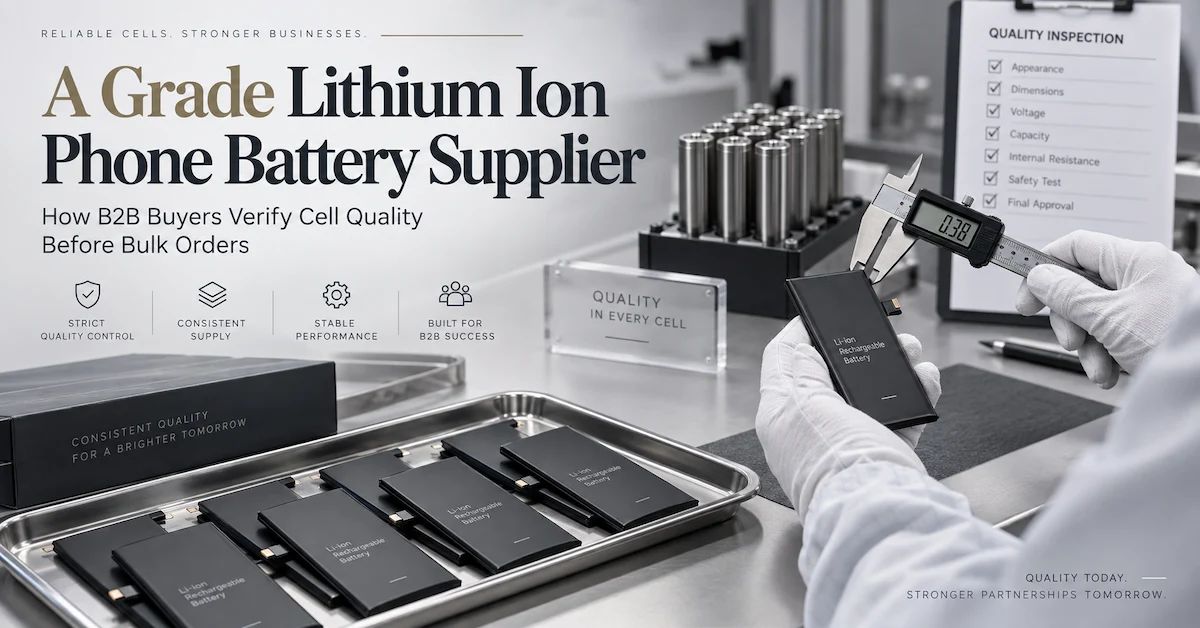
An A grade lithium ion phone battery supplier should be able to turn the phrase “A-grade” into measurable purchasing criteria. The buyer should know how incoming cells are identified and graded, how capacity is verified, how internal resistance and voltage are controlled, which cells are rejected before assembly, and how the approved cell specification remains consistent through repeat production. ESC’s published phone battery quality control process describes incoming inspection, cell grading, capacity testing, protection-circuit checks, charging and discharging, aging and final shipment inspection as separate QC stages.
For B2B purchasing, that process matters more than an isolated “A-grade cell” statement. The term itself is commonly used in the battery supply chain, but it does not replace a controlled specification or a model-specific test record. A serious buyer should therefore ask: What does this supplier mean by A grade, what characteristics are measured, and what evidence connects those criteria to the battery I am actually buying?
“A Grade” Should Be a Purchasing Standard, Not Just a Marketing Label
There is no useful procurement value in accepting the phrase “A-grade cell” without a supplier-defined acceptance process. One seller may use the term to mean a new production cell, another may focus on capacity consistency, and another may combine several electrical and dimensional criteria. Unless those criteria are written down, two suppliers can use the same term while delivering very different products.
A stronger sourcing approach is to convert the label into a specification. At minimum, buyers should understand the cell condition, nominal capacity, voltage, internal resistance range or control method, dimensional tolerance, self-discharge or aging expectations, physical appearance requirements and lot identification. The precise limits should be defined for the selected battery model rather than copied from an unrelated phone battery.
This is also why ESC’s recent QC guidance states that a supplier who says it uses “A-grade cells” but cannot explain its internal acceptance checks provides limited purchasing value.
Who Needs a More Detailed A-Grade Cell Verification Process?
Repair chains need batteries that install consistently and behave similarly across multiple stores. Smartphone refurbishment companies need stable cell quality because even a small change in thickness, capacity or internal resistance can disrupt a standardized production line. Wholesalers and distributors need repeat-order consistency so customers do not receive materially different batteries under the same SKU. Private-label brands must go one step further because the technical product sits behind their own packaging and warranty promise.
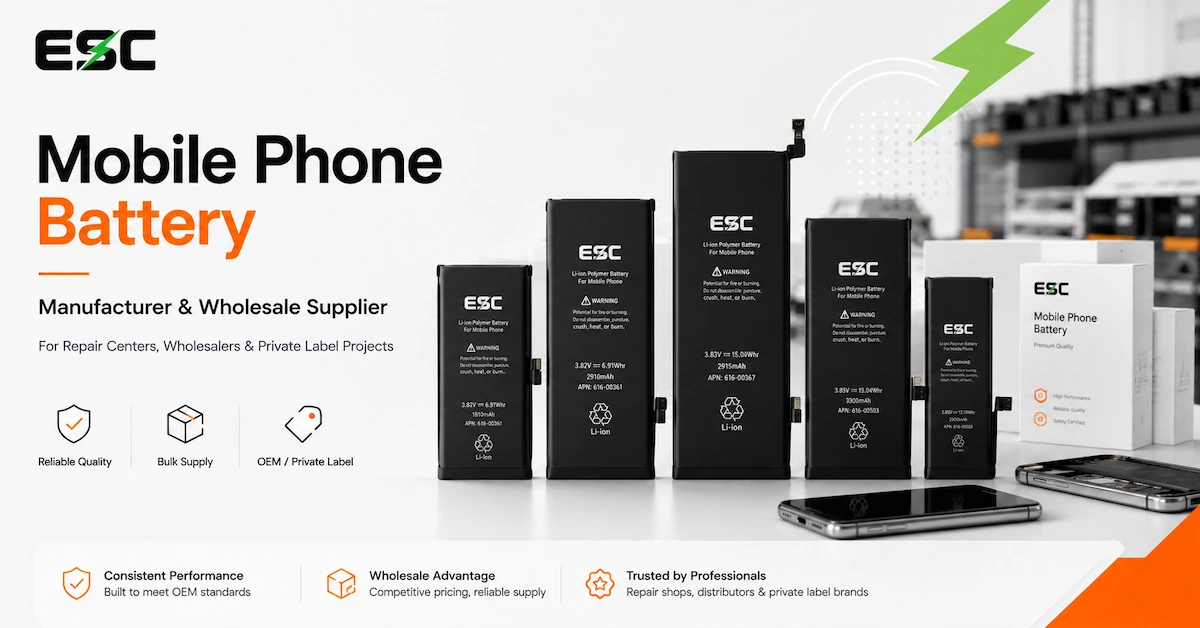
An A grade lithium ion phone battery supplier is therefore most valuable when the buyer is purchasing at scale and needs repeatability, not simply one good sample. Buyers can first review ESC’s mobile phone battery range and then build their sample and QC requirements around the exact models they intend to stock.
Start with Incoming Cell Grading Before Evaluating the Finished Battery
Cell grading takes place before the battery becomes a finished replacement product. ESC describes its cell-grading process around factors including voltage, capacity, internal resistance, dimensions and overall consistency. Its phone-battery QC content also notes that thickness and self-discharge can be relevant to cell evaluation.
These characteristics matter because a finished battery may appear normal even when the underlying cell is not well matched to the production specification. A buyer does not need every confidential factory parameter, but the supplier should be able to explain which characteristics are controlled and how out-of-range cells are separated.
A useful buyer checklist is:
| Cell grading item | What to ask the supplier | Why it matters |
|---|---|---|
| Cell condition | Is the cell new production, and how is its lot identified? | Helps control product consistency |
| Voltage | What incoming voltage range is accepted? | Identifies abnormal or inconsistent cells |
| Capacity | How is rated capacity verified? | Prevents reliance on the printed mAh number |
| Internal resistance | What method and conditions are used? | Helps compare electrical consistency |
| Dimensions | What thickness and dimensional tolerances are controlled? | Important for phone fit and assembly |
| Appearance | What physical defects cause rejection? | Supports incoming material screening |
| Self-discharge / aging | How are unstable cells identified? | Helps screen early abnormalities |
| Lot traceability | How is the cell batch linked to production? | Supports repeat-order and complaint analysis |
Capacity Testing Is More Important Than the Printed mAh Number
A capacity label is easy to print. A professional buyer needs to know how the value is measured. ESC’s current iPhone 11 battery QC content uses its published 3110mAh specification as an example of why measured discharge capacity should be compared with an approved value rather than accepted from the label alone.
Before approving a bulk order, ask four questions:
- What rated capacity is being approved?
- Under what discharge conditions is capacity measured?
- What tolerance is accepted?
- Can the result be connected to the production batch?
For a distributor comparing quotations, this is more useful than asking which supplier advertises the largest capacity. A higher number is not automatically a higher-quality battery. The correct comparison is whether the battery consistently delivers the agreed specification under a defined test method.
Internal Resistance Helps Buyers Evaluate Cell Consistency
Internal resistance is another useful QC indicator when it is measured under controlled conditions. It can influence voltage drop and heat generation under load, but it should not be interpreted in isolation. ESC’s phone battery internal resistance testing guide recommends standardizing measurement conditions and using a model-specific baseline rather than applying one universal resistance limit to every phone battery.
For purchasing teams, the main value is comparison within the same model and process. A single resistance result may be less informative than the distribution across a sample or batch. Large variation can indicate inconsistent cells, measurement conditions or assembly differences.
Internal resistance should also not replace capacity testing. A battery can show an acceptable resistance value while still failing another specification. Use it as one part of the approval process, together with capacity, voltage, physical dimensions and functional checks.
“Brand-New Cell” and “A Grade” Should Not Be Treated as Identical Claims
A cell can be described as brand new without automatically proving every characteristic that your company associates with “A grade.” Likewise, the A-grade label alone does not show the buyer the source, actual capacity, resistance distribution or production consistency.
For example, ESC’s iPhone 12 / 12 Pro 2815mAh battery cell is currently described as a brand-new pure-cobalt lithium-ion cell supplied without flex or BMS. The page lists a rated capacity of 2815mAh and a standard voltage of 3.83V. These are specific product statements that can be included in a purchase specification; they are more useful than relying only on an “A-grade” description.
The purchasing rule is straightforward: convert every quality adjective into a parameter, document or inspection item wherever possible.
Finished Replacement Batteries Need More Than Good Cells
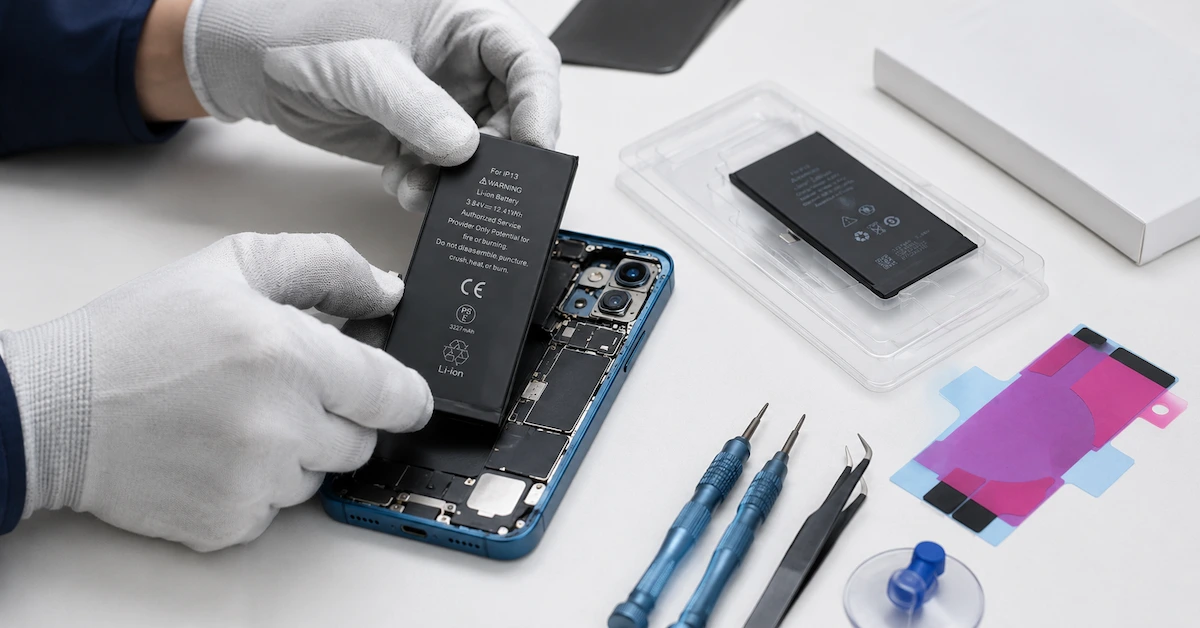
An excellent cell can still become a poor finished replacement battery if the protection electronics, flex cable, connector, insulation or assembly quality are inconsistent. This is why an A grade lithium ion phone battery supplier should control both the incoming cell and the completed battery.
ESC’s published QC system includes cell inspection, BMS or protection-circuit checks, charging and discharging, aging and final inspection. The company also describes flexible and connector checks in its phone-battery QC content.
For B2B buyers, the distinction is critical:
Cell quality answers: Is the electrochemical cell consistent with the agreed specification?
Finished-battery quality answers: Does the complete replacement battery fit, connect, charge, discharge and operate as required?
Do not allow a supplier to use a premium-cell claim as a substitute for validating the complete product.
Compare Finished Batteries and Cell-Only Products Correctly
ESC sells both complete replacement batteries and cells without flex or BMS. These products serve different purchasing and repair workflows and should not be evaluated with an identical QC checklist.
| Comparison item | Finished iPhone 12 / 12 Pro battery | iPhone 12 / 12 Pro cell without flex |
|---|---|---|
| Product link | Finished replacement battery | 2815mAh cell-only product |
| Published capacity | 2815mAh | 2815mAh |
| Published nominal voltage | 3.83V | 3.83V |
| Product format | Complete replacement-battery configuration | Cell supplied without flex cable or BMS |
| Buyer QC priority | Complete battery fit, electronics, functionality and specification | Cell quality plus buyer-side assembly responsibility |
| Protection electronics | Included as part of finished product architecture | Not included in the supplied cell |
| Typical buyer | Repair shops, distributors, refurbishers | Technically capable repair and refurbishment operations |
The two products may share the same nominal capacity and voltage, but their supply scope is not the same. ESC explicitly identifies the cell-only version as a professional component without flex or BMS.
Sample Approval Should Use a Written Battery Specification
A purchasing sample should represent a defined technical revision, not simply a battery that looked good during one installation. Before approval, record:
- Device model
- Supplier battery model
- Original battery reference where available
- Rated capacity
- Nominal voltage
- Finished battery or cell-only configuration
- Cell specification
- Dimensions
- Flex and connector configuration
- Protection-board configuration
- Label revision
- Packaging revision
- Required documents
- Sample ID and approval date
Then validate the battery against that reference. If the supplier later changes an important component or cell specification, determine whether a new sample is required.
This process helps prevent a common sourcing problem: the sample performs well, but the production order uses a slightly different configuration that was never formally approved.
Use Pilot Lots to Test Repeatability Before Large Orders
One or two successful samples show that the supplier can make an acceptable product. They do not prove that the same result can be reproduced across normal production.
For higher-volume programs, a pilot lot can bridge the gap between sample approval and full-scale purchasing. The buyer can examine capacity distribution, internal resistance, dimensions, assembly, charging behavior, labels and packaging across a broader group.
This is especially useful when qualifying a new A grade lithium ion phone battery supplier for a repair chain or private-label program. The objective is not to make every initial order unnecessarily complicated; it is to test the supplier’s repeatability before the commercial exposure becomes large.
Production QC Should Continue After Cell Grading
A well-graded cell still needs controlled assembly and final inspection. ESC’s company service information states that its replacement-battery QC includes incoming inspection, cell grading, capacity testing, BMS performance checks, charging and discharging, aging and final shipment inspection.
A practical production-control sequence can be organized like this:
| QC stage | Main purpose | Buyer question |
|---|---|---|
| Incoming inspection | Control cells and components before assembly | What causes incoming material rejection? |
| Cell grading | Separate inconsistent cells | Which variables are used for grading? |
| Capacity verification | Check actual performance against specification | What method and tolerance are used? |
| BMS/PCM check | Verify applicable protection functions | Which functions apply to this model? |
| Flex/connector inspection | Control installation-related assembly | How are orientation and workmanship checked? |
| Charge/discharge test | Screen electrical abnormalities | What constitutes a pass or fail? |
| Aging | Identify unstable or abnormal products | How are failures handled? |
| Final inspection | Confirm model, appearance and packaging | How is the shipment reconciled with the order? |
The purpose is not to demand identical numerical limits for every ESC battery. The buyer should confirm which limits apply to the selected model.
Internal QC and Buyer Incoming Inspection Should Work Together
A supplier’s factory inspection does not remove the need for buyer-side incoming QC. Factory testing determines whether the manufacturer considers the shipment acceptable. Incoming inspection confirms that the buyer received what was ordered.
For a wholesaler, incoming QC may focus on quantity, SKU, labeling, packaging and selected technical sampling. A refurbishment factory may add dimensions, voltage, internal resistance and capacity checks. A repair chain may also evaluate installation and device behavior on selected units.
The methods should be agreed before a dispute arises. Define what happens when a sampled battery fails: quarantine, expanded inspection, supplier analysis, replacement or another agreed corrective action.
Do Not Let Compliance Documents Replace Cell-Quality Verification
A UN38.3 test summary, SDS/MSDS and product specification answer different questions. They should not be used as substitutes for capacity or cell-grading evidence. Likewise, an excellent capacity result does not eliminate the need for applicable transport or market documentation.
ESC’s certified mobile phone battery manufacturer guide follows the same principle: buyers should connect each type of evidence to the specific decision it is intended to support.
For an A-grade sourcing project, keep at least three review streams separate:
Technical quality: cell and finished-battery performance.
Production quality: process consistency and batch acceptance.
Documentation: applicable safety, transport and market records.
A supplier becomes easier to audit when those categories are clearly separated.
OEM and Private-Label Brands Need Stronger Traceability
Private-label buyers add another layer of risk because the supplier’s battery is sold under the buyer’s own SKU and packaging. If the underlying cell or battery configuration changes without proper control, the commercial product may remain visually identical while its technical characteristics change.
A private-label quality file should therefore connect:
Buyer SKU → supplier model → cell specification → approved sample → packaging revision → relevant documents.
ESC supports branding and packaging customization through its customized solution service. Before printing terms such as “A Grade Cell,” “Premium Cell” or “High Capacity,” the buyer should make sure the technical specification and evidence support the wording.
The packaging should describe the approved product—not create a technical claim that the production team is then expected to justify after printing.
How Should Buyers Compare Two A-Grade Battery Suppliers?
Do not compare suppliers by how confidently they use the word “premium.” Compare their ability to answer the same technical and commercial questions.
| Evaluation area | Weak supplier answer | Stronger supplier answer |
|---|---|---|
| Cell grade | “We only use A-grade” | Explains measurable incoming acceptance criteria |
| Capacity | “Capacity is real” | Provides test method and approved specification |
| Internal resistance | “Low resistance” | Uses model-specific measurement conditions and limits |
| Cell condition | “100% new” | Provides controlled cell specification and lot identification |
| Assembly | “High quality” | Controls flex, connector, insulation and protection electronics |
| Sample approval | Sends one sample | Links sample to a written specification |
| Batch QC | “100% QC” | Explains relevant inspection stages and records |
| Repeat orders | Same product name | Maintains controlled revisions and change notification |
| OEM | Can print logo | Keeps private-label SKU linked to technical product |
| Problem handling | Replaces defective units | Can classify failures and investigate root causes |
This comparison is more useful than simply choosing the supplier with the lowest price or the largest number of quality adjectives.
Cost Should Be Compared Against Verified Quality, Not Only Unit Price
A lower battery price can become expensive when it increases incoming inspection, technician rework, warranty claims, model-mismatch problems or customer returns. B2B buyers should therefore compare total procurement risk rather than only the quotation.
Ask whether the quoted price includes the approved cell configuration, specified capacity, protection electronics, packaging, quality requirements and requested documents. If two suppliers are quoting fundamentally different technical products, the unit prices are not directly comparable.
MOQ should also be reviewed by model and project type. A standard battery, mixed-model wholesale order and private-label project may have different commercial requirements. ESC discusses flexible MOQ and mixed-model purchasing in its low-MOQ battery sourcing guide.
What Should You Send an A Grade Lithium Ion Phone Battery Supplier?
A useful RFQ should include the exact phone models, original battery references where available, quantity per SKU, target capacity, required product configuration, destination market and packaging requirements.
If A-grade cell quality is a critical purchasing requirement, also request:
- Supplier definition of A-grade
- Cell condition
- Cell-grading criteria
- Capacity-test method
- Internal-resistance control method
- Relevant dimensional checks
- Sample approval process
- Aging or stability screening
- Production QC scope
- Change-notification procedure
- Requested MSDS / UN38.3 or other applicable documents
- Warranty and complaint-handling process
Do not send only “Need A-grade battery, best price.” The more clearly the requirement is defined, the easier it is to compare suppliers against the same standard. Buyers can send the model list through the ESC Contact Us page.
Frequently Asked Questions
1. What is an A-grade lithium-ion phone battery?
In B2B sourcing, “A grade” should be treated as a supplier-defined quality description rather than a complete specification. Buyers should ask which characteristics—such as capacity, voltage, internal resistance, dimensions and stability—are used to accept or reject the cell.
2. Is A grade an official lithium-battery certification?
The term should not be used as a substitute for a product, transport or market-compliance document. Evaluate the technical cell specification separately from UN38.3, SDS/MSDS and other applicable documentation.
3. How can I verify whether an A-grade battery has real capacity?
Request capacity testing under defined conditions and compare the result with the approved specification. Ask about tolerance, sampling or production coverage and how the results are associated with the batch.
4. Is low internal resistance proof of an A-grade battery?
No single measurement should define the whole quality grade. Internal resistance is useful when measured consistently and compared with a model-specific baseline, but it should be reviewed together with capacity, voltage, physical condition and other QC results.
5. Are brand-new cells automatically A grade?
Not necessarily. “Brand new” describes cell condition, while a purchasing-grade definition may include additional electrical, dimensional and consistency requirements. Ask the supplier to define both terms in the specification.
6. Should repair chains approve the finished battery or only the cell?
The finished battery should be approved if that is what the repair chain purchases. Cell quality is important, but the flex, connector, protection electronics, assembly and device behavior also affect the final product.
7. Are cell-only batteries suitable for every repair business?
No. ESC’s cell-only products exclude flex and BMS and are intended for professional workflows requiring appropriate equipment and expertise. Buyers needing ready-to-install products should request a finished battery configuration.
8. How should private-label brands control A-grade claims?
Connect the claim to a defined technical specification and approved product. Keep the buyer SKU linked to the supplier model, cell specification and production revision so repeat orders remain traceable.
9. Should each repeat order be requalified from the beginning?
Not necessarily, but buyers should verify that critical specifications and approved components have not changed. Define which changes require notification, a new sample or additional testing.
10. What information should I send ESC before requesting a quote?
Send the phone models, battery references, quantities, capacity requirements, finished-battery or cell-only preference, target market, packaging needs and quality requirements. If A-grade sourcing is important, specify the cell and QC evidence you expect to review.
Conclusion
Choosing an A grade lithium ion phone battery supplier should be a process of defining and verifying measurable quality—not accepting a label at face value. For distributors, repair chains, refurbishment factories and private-label brands, the most useful evidence comes from controlled cell grading, verified capacity, model-specific internal-resistance evaluation, consistent assembly, aging, final inspection and repeat-order change control. ESC publishes a multi-stage phone-battery QC process and offers both finished replacement batteries and professional cell-only configurations for different B2B workflows. Review the ESC mobile phone battery range and contact ESC with your model list, quantities, target market and quality requirements to discuss samples, specifications and bulk-order supply.