
What Does iPhone Battery Capacity Upgrade Wholesale Actually Mean?
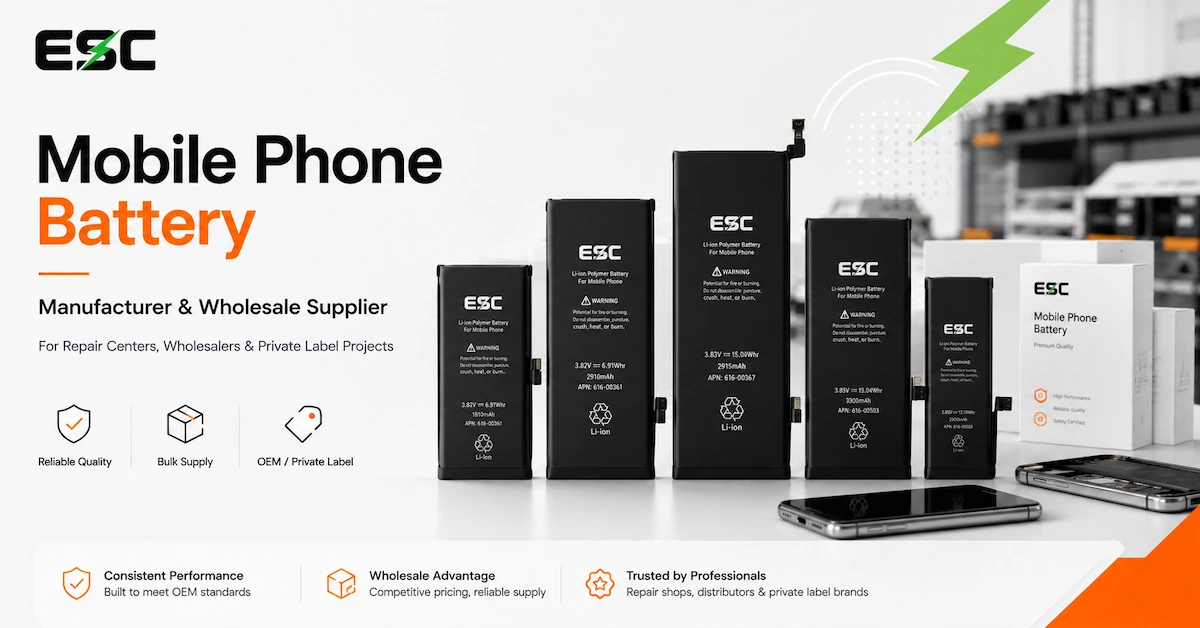
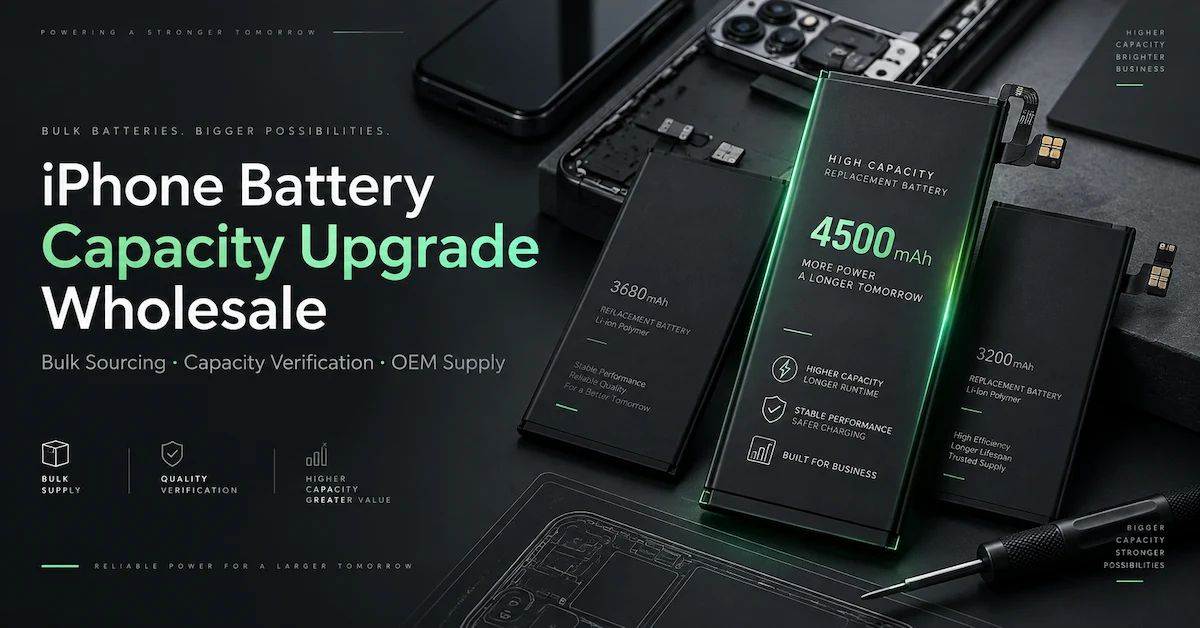
iPhone battery capacity upgrade wholesale refers to sourcing aftermarket iPhone replacement batteries positioned with a higher rated capacity than the corresponding standard-capacity configuration for a particular device. For B2B buyers, however, the phrase should not simply mean “the largest mAh number printed on the label.” A professional capacity-upgrade program needs to confirm the exact iPhone model, physical battery dimensions, flex and connector configuration, nominal voltage, rated capacity, measured capacity, energy rating, protection electronics and production consistency before the upgraded battery is approved. ESC currently maintains a dedicated High Capacity iPhone Battery range for repair shops, wholesalers, distributors, refurbishers and private-label programs, with published models including higher-capacity options for iPhone 16, 16E, 16 Plus, 16 Pro, 16 Pro Max and earlier generations.
The commercial value of a higher-capacity battery comes only when the additional rated capacity can be delivered within a battery that remains suitable for the target phone and professional repair workflow. Printed mAh alone does not establish runtime, fit, thermal stability or repeat-order consistency.
Who Should Source Higher-Capacity iPhone Batteries in Bulk?
Repair chains can use higher-capacity replacement batteries as a differentiated service option for customers who want more usable battery capacity from an aging device. Refurbishment companies may use capacity-upgrade batteries to create defined device grades or aftermarket configurations, provided the upgraded battery has been validated for fit, electrical performance and production consistency. Wholesalers and regional distributors can add both standard-capacity and higher-capacity variants to their portfolio, allowing downstream repair businesses to select by application rather than forcing one product configuration on every customer. Private-label brands can use ESC’s customized solution service to discuss labels, barcodes and packaging for an approved battery configuration.
Capacity-upgrade wholesale is less suitable when the buyer does not yet know the exact device models, when the supplier cannot provide a model-specific specification, or when the purchasing decision is based only on a claimed capacity increase without sample testing. In those cases, the buyer should first establish the correct technical baseline.
Start with the Exact iPhone Model Before Comparing Capacity
Two batteries can both be marketed as “high capacity” and still be completely unrelated products. An iPhone 16, iPhone 16 Plus and iPhone 16 Pro Max use different internal battery configurations, so buyers should never build a wholesale order using only model-family names such as “iPhone 16 series battery.”
ESC currently lists a 3800mAh high-capacity battery for iPhone 16, a 4800mAh high-capacity battery for iPhone 16 Plus, and a separate 4800mAh high-capacity battery for iPhone 16 Pro Max. Although two products can share the same printed mAh figure, that does not make their shapes, flex assemblies, connector positions or electrical specifications interchangeable.
For each SKU, the purchasing file should therefore begin with the exact phone model and the approved battery specification.
Build a Capacity-Upgrade Specification Before Requesting Bulk Pricing
A professional iPhone battery capacity upgrade wholesale order should use one controlled specification per battery model. This creates a common reference for purchasing, quality control, warehouse receiving and after-sales teams.
| Specification item | What the buyer should confirm | Why it matters |
|---|---|---|
| Compatible device | Exact iPhone model | Prevents model-family mix-ups |
| Supplier model | Manufacturer SKU or model number | Supports repeat-order traceability |
| Battery format | Complete replacement battery or cell-only product | Defines included electronics and assembly scope |
| Rated capacity | Approved mAh value | Establishes the commercial capacity claim |
| Nominal voltage | Model-specific voltage | Confirms electrical platform |
| Energy | Wh value where specified | Provides another check on the battery rating |
| Dimensions | Length, width and thickness | Higher capacity cannot ignore physical fit |
| Flex/connector | Position, orientation and configuration | Affects installation compatibility |
| Protection electronics | PCM/BMS and relevant chip configuration | Defines the complete battery assembly |
| Capacity-test method | Test conditions and tolerance | Separates measured performance from label printing |
| Temperature behavior | Approved evaluation conditions | Helps identify abnormal thermal behavior |
| Packaging/SKU | Label, barcode and carton information | Controls mixed-model wholesale orders |
| Change control | Which changes require reapproval | Protects repeat-order consistency |
The exact numerical acceptance limits should come from the approved product specification rather than being copied from another iPhone model.
Compare Published High-Capacity Options by Model, Not by mAh Alone
The ESC high-capacity range illustrates why buyers need a model-by-model comparison. The values below are current published specifications and should be reconfirmed in the final quotation and approved production specification.
| ESC higher-capacity product | Published capacity | Published voltage | Main B2B use |
|---|---|---|---|
| iPhone 16 high-capacity battery | 3800mAh | 3.886V | Repair, refurbishment and wholesale |
| iPhone 16 Plus high-capacity battery | 4800mAh | 3.875V | Repair shops, distributors and OEM supply |
| iPhone 16 Pro Max high-capacity battery | 4800mAh | Model-specific published configuration | Professional repair and wholesale |
| iPhone XS Max higher-capacity battery | 3700mAh | 3.83V | Repair chains, refurbishers and private label |
| iPhone SE 2020 / SE2 higher-capacity battery | 2200mAh | 3.88V | Repair, refurbishment and distribution |
ESC’s category page lists additional high-capacity models beyond these examples.
How Much of a Capacity Upgrade Is Actually Being Offered?
The correct comparison requires a verified baseline. Do not calculate a percentage increase against a random internet value or a capacity figure from a different phone generation. The baseline should be the relevant standard or original-capacity specification for the exact model being discussed.
ESC’s iPhone XS Max product page provides a useful published example. Its higher-capacity replacement battery is listed at 3700mAh, compared on the page with a commonly documented 3174mAh original-capacity reference, producing a stated printed-capacity increase of approximately 16.6%. Importantly, the same page also warns that actual runtime depends on measured capacity, device condition, display use, network activity, applications, temperature and charging habits.
That is the correct way to position a capacity upgrade: the mAh increase is a specification difference, not a guaranteed equal-percentage increase in daily runtime.
Printed Capacity Is Only the Starting Point
When purchasing high-capacity batteries, the biggest technical question is whether the production battery can consistently deliver the agreed capacity. ESC’s existing iPhone 12 wholesale sourcing guide makes the same distinction for standard-capacity products: a larger printed number is not automatically a better battery, and wholesalers should verify actual capacity, voltage, internal resistance, charging behavior, discharge performance and batch consistency.
This principle becomes even more important for capacity-upgrade products because “higher capacity” is one of the main reasons the buyer is paying for the product. If the supplier cannot explain its capacity-test method or connect results to the approved battery SKU, the marketing claim provides limited B2B value.
A buyer should therefore ask what discharge equipment is used, what test conditions apply, what tolerance is accepted and how sample or batch results are recorded.
Higher Capacity Must Still Fit Inside the Original Battery Space
An upgraded-capacity battery still has to fit inside the target phone without creating inappropriate mechanical pressure. A larger mAh value cannot justify uncontrolled thickness, altered connector geometry or an assembly that interferes with device closure.
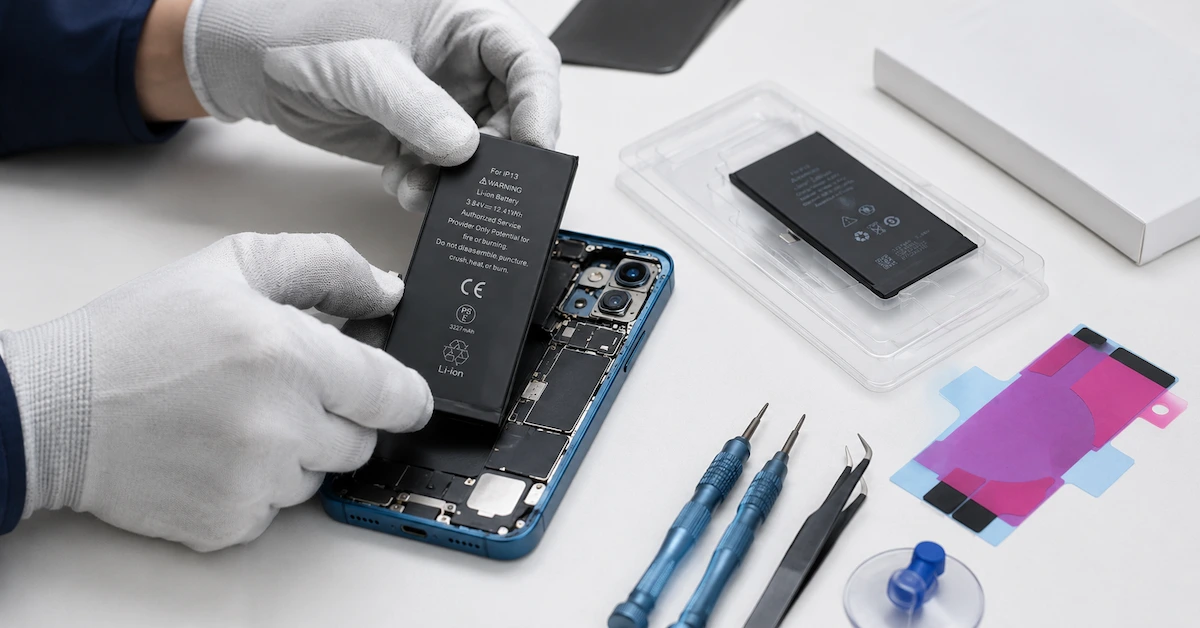
During sample approval, measure relevant battery dimensions and install the product using the intended professional repair process. Check flex position, connector alignment, adhesive area and enclosure closure. Compare the battery with the approved reference rather than relying only on an external photograph.
This is especially important for older iPhone models where wholesalers may source both standard-capacity and upgraded variants under similar packaging. The receiving team needs enough SKU information to avoid installing the wrong configuration.
Internal Resistance Should Be Evaluated Alongside Capacity
Capacity alone does not describe how a battery behaves under load. Internal resistance contributes to voltage drop and heat generation, which is why it should be reviewed together with capacity and voltage when qualifying a new high-capacity product.
ESC’s phone battery internal resistance testing guide recommends using controlled measurement conditions and model-specific baselines rather than declaring one universal resistance threshold for every battery. That approach is particularly useful when evaluating an upgraded battery because buyers can compare samples from the same model and production specification instead of comparing unrelated batteries.
For bulk purchasing, distribution across a pilot lot can be more informative than one isolated measurement. Excessive variation can indicate inconsistent cells, assembly differences or uncontrolled measurement conditions.
Do Not Ignore Thermal Behavior When Capacity Increases
An upgraded battery should also be evaluated for charging and operating temperature under controlled conditions. Higher nominal capacity does not automatically mean the battery will run hotter, but neither should buyers assume thermal behavior is unchanged simply because the battery fits physically.
ESC’s quality-control information for higher-capacity batteries includes voltage, internal-resistance, capacity and aging checks, and its current iPhone 16 Plus product page specifically lists these inspection categories.
For sample validation, define the test device, charger, starting state of charge, workload, ambient conditions and measurement method. Compare multiple samples under the same conditions. Avoid claiming that an upgraded battery is “cooler,” “safer” or “heat-proof” unless model-specific testing supports that statement.
Battery Runtime Should Be Tested Separately from Capacity
A battery can have a verified higher discharge capacity without delivering an identical percentage increase in real-world operating time. Device age, screen brightness, cellular signal, background applications, processor load, temperature and user behavior all influence runtime.
For professional qualification, separate two tests:
Capacity test: measures the battery under defined electrical test conditions.
Device runtime test: measures the battery inside the target phone under a controlled usage profile.
This distinction helps wholesalers avoid overpromising to repair shops and end customers. A technically credible sales description can say that a battery has an approved higher rated capacity; it should not guarantee a particular number of extra hours unless a repeatable test supports that statement.
Cell Quality Matters More as the Capacity Claim Becomes More Aggressive
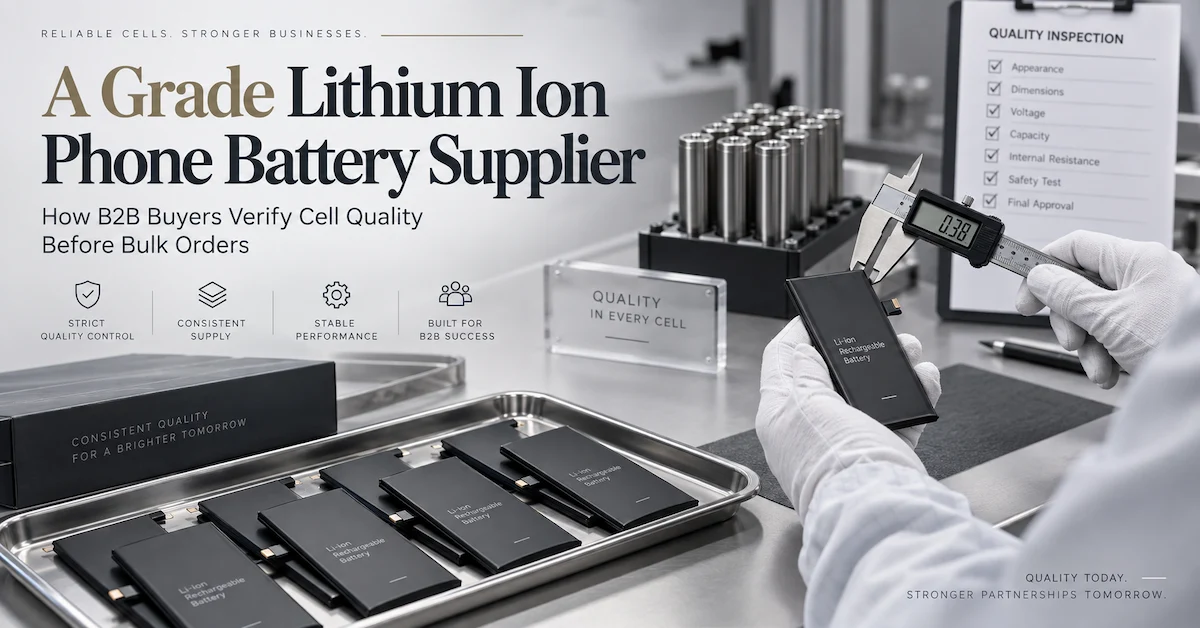
Buyers should ask what cell-grading process sits behind the higher-capacity product. ESC’s A-grade lithium-ion phone battery guide emphasizes converting broad terms such as “A-grade cell” into measurable criteria such as capacity, voltage, internal resistance, dimensions, stability and lot traceability.
A strong wholesale program should combine a realistic capacity target with stable cell quality. An aggressive printed figure combined with weak grading can create inconsistent runtime, returns and warranty disputes.
The purchasing question is therefore not simply “Which supplier offers the highest mAh?” It is “Which supplier can repeatedly deliver the approved capacity, size and electrical behavior for this particular iPhone model?”
Finished High-Capacity Batteries and Cell-Only Upgrades Are Different Products
ESC supplies both complete replacement batteries and iPhone battery cells without flex. The latter are intended for professional technicians and refurbishment operations with the capability to handle cell-level repair and BMS or flex transfer where required.
A finished high-capacity replacement battery may include the cell, model-matched flex, protection electronics and other required assembly components. A cell-only upgrade leaves more integration responsibility with the buyer or technician.
These two sourcing routes should therefore have different approval plans. Repair chains wanting fast, repeatable replacement may prefer an approved complete battery. Technically capable refurbishment facilities may choose cell-level solutions where their process is designed for that work.
Protection Electronics and Device Functions Must Be Validated Separately
Capacity upgrade does not automatically define how battery health information, system messages or diagnostic features will behave. ESC’s iPhone XS Max higher-capacity page, for example, notes that battery-health information and system messages can depend on the selected chip and flex configuration, iOS version and installation process.
For buyers, this means a higher-capacity battery should have separate approval criteria for:
- Actual capacity
- Physical fit
- Protection electronics
- Charging and discharging
- Temperature behavior
- Device recognition
- Battery-health display where relevant
- System messages where relevant
Do not combine these into one statement such as “100% compatible.” Record what was actually tested on the intended device and software environment.
Use Sample Approval Before Accepting a Capacity-Upgrade SKU
A sample should represent the exact technical configuration the buyer intends to purchase. Record the battery model, capacity, voltage, dimensions, flex and chip option where applicable, packaging revision and sample ID.
A useful sample-validation sequence is:
Specification review → visual and dimensional inspection → installation → charging/discharging → capacity measurement → internal-resistance evaluation → temperature observation → device-function checks → approval or corrective action.
ESC’s iPhone 12 replacement battery validation guide follows a similar principle of controlled device identification, sample inspection, mechanical fit, electrical/runtime testing and repeatable pilot-lot review.
One successful battery should not automatically approve a large mixed-model order.
Move from Samples to a Pilot Lot Before Large Wholesale Orders
Capacity-upgrade products can benefit from a pilot-lot step because the buyer’s primary concern is not whether the supplier can produce one good battery but whether the factory can reproduce the specification across a normal batch.
A pilot review can examine:
- Capacity distribution
- Voltage
- Internal resistance
- Dimensions
- Flex and connector consistency
- Charging/discharging behavior
- Thermal observations
- Label accuracy
- Packaging
- SKU separation
If the pilot is stable, the same acceptance framework can support larger repeat orders. If variation appears, the buyer and supplier can investigate before large inventory and warranty exposure develop.
Quality Control Should Continue Through Final Shipment
ESC’s phone battery quality control process describes a multi-stage approach including incoming material inspection, cell grading, capacity testing, protection-circuit checks, charging/discharging testing, aging and final inspection.
For iPhone battery capacity upgrade wholesale orders, these stages should connect to the higher-capacity specification. Capacity testing is particularly important because the marketed product differentiation depends on it. Final inspection should also confirm that the correct capacity variant is packed under the correct SKU; shipping a standard-capacity unit inside a high-capacity package would be a product-control failure even if the battery itself worked normally.
How Should Buyers Compare Standard and Capacity-Upgrade Batteries?
The most useful comparison focuses on purchasing consequences rather than simply labeling one option “better.”
| Comparison area | Standard-capacity replacement | Higher-capacity replacement |
|---|---|---|
| Main objective | Match conventional replacement specification | Offer increased rated capacity |
| Capacity validation | Required | Especially important because capacity is a primary selling point |
| Physical-fit review | Required | Required; added capacity must not compromise fit |
| Runtime expectation | Establish through testing | Do not assume runtime increases by the same percentage as mAh |
| Internal resistance | Model-specific QC | Model-specific QC |
| Thermal validation | Required when relevant | Important during upgrade qualification |
| Chip/flex validation | Configuration dependent | Configuration dependent |
| Market positioning | Conventional repair option | Premium or differentiated repair option |
| Warranty risk | Depends on quality consistency | Capacity claims add another potential dispute point |
| Best buyer | General repair and distribution | Repair brands wanting a validated upgrade option |
Neither configuration is automatically right for every customer. The goal is to offer clearly defined alternatives rather than turning capacity into a universal quality ranking.
OEM and Private-Label Buyers Should Control Capacity Claims Carefully
Capacity is one of the first numbers customers see on battery packaging. Private-label buyers should therefore finalize the technical specification before printing labels or cartons.
ESC supports OEM labels, customized packaging and private-label supply across its high-capacity iPhone battery category.
A controlled private-label file should connect:
Buyer SKU → ESC product model → approved capacity → voltage → sample revision → label artwork → barcode → packaging revision → quality requirements.
Avoid adding claims such as “50% more runtime,” “double battery life” or other quantified performance benefits unless they have been validated for the actual product and use case. A more defensible package states the approved capacity and lets supporting product information explain how it was verified.
MOQ and Mixed-Model Purchasing Should Be Evaluated Together
Wholesalers rarely need only one iPhone battery model. The practical purchasing question is whether high-capacity SKUs can be combined with other models in a commercially workable order.
ESC’s high-capacity product pages describe wholesale, OEM and mixed-model supply options, but actual MOQ should be confirmed for the selected product mix. The iPhone XS Max page, for example, currently publishes separate single-model and mixed-model MOQ information, illustrating why buyers should not assume that every product follows one universal minimum.
Ask for MOQ by:
- Individual battery SKU
- Total mixed order
- Capacity variant
- Chip/flex option where relevant
- Private-label packaging
- Custom printed materials
This helps prevent a buyer from accepting a battery MOQ and later discovering that the customized packaging requires a much larger quantity.
Compare Total Procurement Cost, Not Only the Higher-Capacity Unit Price
A capacity-upgrade battery may carry a different unit price from a standard-capacity replacement, but the purchasing decision should consider more than the difference per piece.
Relevant costs include sample testing, incoming QC, packaging, inventory complexity, warranty handling, returns, technical support and obsolete stock. A battery that costs slightly less but produces inconsistent capacity or poor fit can create a higher total cost for a repair chain.
Conversely, a higher-capacity product does not automatically justify a premium price unless its specification and supply consistency can be verified. Compare quotations only after the technical scope is aligned.
Keep Compliance and Transport Documentation Separate from Capacity Claims
UN38.3 information, SDS/MSDS and other applicable documents have purposes separate from verifying a higher-capacity performance claim. A battery can have transport documentation and still fail the buyer’s capacity specification; a battery that passes capacity testing still needs the appropriate documentation for its intended market and shipment.
ESC’s certified mobile phone battery manufacturer guide and UN38.3 phone battery guide explain this separation between technical product approval and document review.
For capacity-upgrade projects, ask whether the relevant documentation applies to the exact higher-capacity design rather than assuming that a standard-capacity battery’s file automatically covers another configuration.
Control Repeat Orders So the Upgrade Does Not Change Silently
The most successful first batch still needs change control. Record the approved cell, capacity, battery model, flex/chip configuration, dimensions, label and packaging. Define which changes require notification and which require a new sample.
A capacity-upgrade SKU can remain commercially unchanged while its underlying cell or electronics change. Without revision control, the buyer may continue selling a product under the same label even though the configuration is no longer the one originally approved.
For a long-term wholesale program, ask the supplier to confirm the current product revision before repeat production and maintain a reference sample or approved technical file.
What Should You Send an iPhone Battery Capacity Upgrade Wholesale Supplier?
A useful RFQ should include the exact iPhone models, quantity per model, whether you need standard or higher capacity, intended sales channel, target market, packaging requirements and any device-function requirements.
For a capacity-upgrade project, also request:
- Published and approved rated capacity
- Nominal voltage and energy
- Battery dimensions
- Capacity-test method
- Internal-resistance control
- Sample quantities
- Chip/flex configuration where relevant
- Thermal and charging validation
- QC process
- Pilot-lot option
- MOQ by model
- OEM/private-label requirements
- Applicable documents
- Warranty and complaint process
- Change-notification requirements
Buyers can review ESC’s High Capacity iPhone Battery range and send the required model list through Contact Us.
Frequently Asked Questions
1. What does iPhone battery capacity upgrade wholesale mean?
It refers to bulk sourcing aftermarket iPhone replacement batteries positioned with a higher rated capacity than the corresponding standard-capacity configuration. Buyers should verify model compatibility, measured capacity and complete battery construction rather than relying only on the printed mAh value.
2. Does higher mAh always mean proportionally longer runtime?
No. A higher verified capacity can provide more stored energy, but actual device runtime also depends on phone condition, software, screen usage, network activity, temperature and other operating factors. Runtime should be tested separately.
3. How can wholesalers verify a higher-capacity claim?
Request an approved specification and capacity-test method, then evaluate samples under controlled conditions. For larger programs, a pilot lot can help show whether the supplier reproduces the capacity consistently.
4. Can an upgraded-capacity battery be thicker than the original battery?
A capacity-upgrade battery still needs to fit the target device safely. Buyers should verify dimensions, enclosure closure, flex position and mechanical pressure during sample approval rather than assuming that extra thickness is acceptable.
5. Does ESC offer high-capacity batteries for multiple iPhone models?
Yes.ESC currently lists higher-capacity products for multiple iPhone generations, including iPhone 16-series models and earlier devices such as XS Max, XS, XR and X. Current model availability should be confirmed before ordering.
6. Is a high-capacity iPhone battery an original Apple battery?
No. The ESC products discussed here are aftermarket replacement batteries for professional repair, refurbishment and wholesale applications. They should not be marketed as original Apple service batteries.
7. Should a buyer test battery health and system messages separately?
Yes. Capacity, device recognition, battery-health display and system messages are separate approval items. Their behavior can depend on battery electronics, device model, software and repair process.
8. Can ESC provide OEM packaging for higher-capacity batteries?
ESC states that OEM labels, private-label packaging and customized packaging are available for its high-capacity battery supply. Exact MOQ, artwork requirements and product configuration should be confirmed for the project.
9. Should wholesalers stock both standard and higher-capacity iPhone batteries?
That depends on the buyer’s customers and inventory strategy. Standard-capacity and higher-capacity products can serve different market positions. The important point is to keep their SKU, labeling, technical specifications and customer expectations clearly separated.
10. What should I ask ESC before placing a bulk capacity-upgrade order?
Provide the exact iPhone models, quantities, required capacity, target market and packaging needs. Ask for model-specific specifications, samples, QC information, MOQ, document availability and confirmation of any chip, flex or device-function requirements before approving mass production.
Conclusion
Successful iPhone battery capacity upgrade wholesale sourcing depends on proving that the capacity upgrade exists in a battery that also fits the phone, operates correctly and can be reproduced consistently. B2B buyers should compare real measured capacity rather than printed mAh alone, verify dimensions and flex configuration, evaluate internal resistance and temperature behavior, approve device-level samples, and use a pilot lot when commercial risk justifies it. For private-label and repeat-order programs, the approved battery specification should remain connected to the SKU, packaging and change-control process. ESC currently offers a dedicated high-capacity iPhone battery range for professional repair, refurbishment, wholesale and OEM applications. Review the available models and contact ESC with your model list, quantities, capacity requirements and target market to discuss samples, pricing and a controlled bulk-supply plan.