
What Does “Low MOQ” Really Mean in Phone Battery OEM?
When a buyer asks for a low MOQ, it does not usually mean they plan to buy tiny quantities forever.
More often, they are testing something.
Maybe it is a new country. A new repair-parts brand. Ten battery models instead of one. A new packaging design. Or a distributor wants to see whether iPhone, Samsung and Xiaomi batteries actually move before putting several thousand dollars into inventory.
That is the real value of a low MOQ phone battery OEM supplier.
The supplier gives the buyer enough flexibility to validate the business without forcing a large first production run.
There is an important distinction, though:
Low MOQ should reduce inventory risk. It should not reduce product standards.
A serious OEM project still needs clear specifications, sample approval, battery testing, labeling control and a defined claims process.
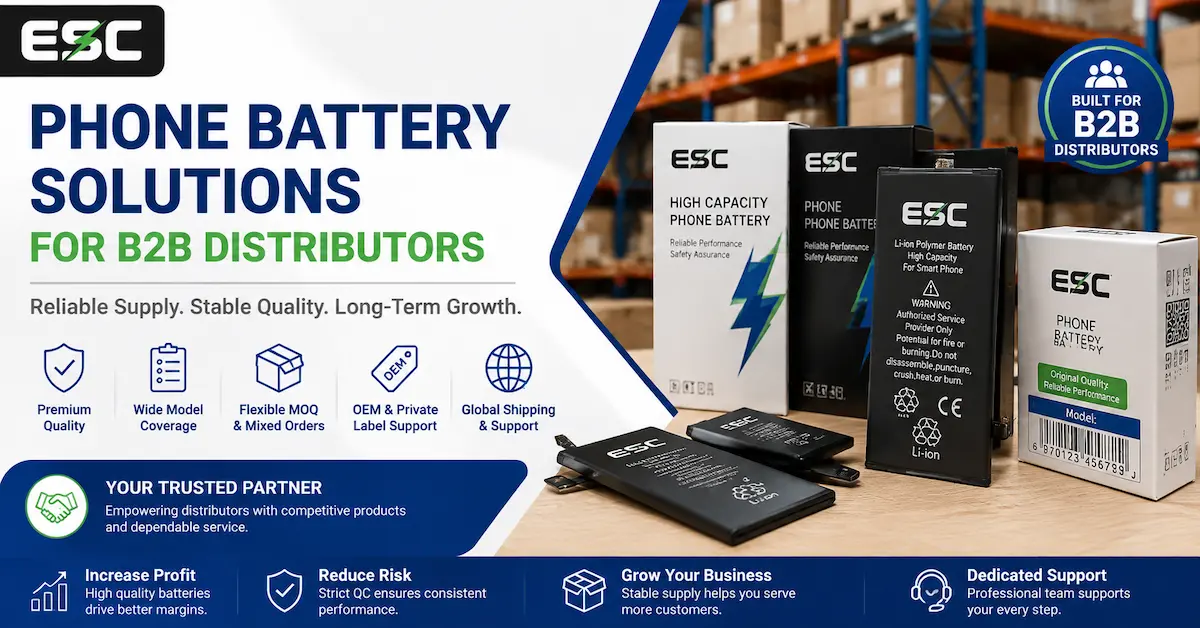
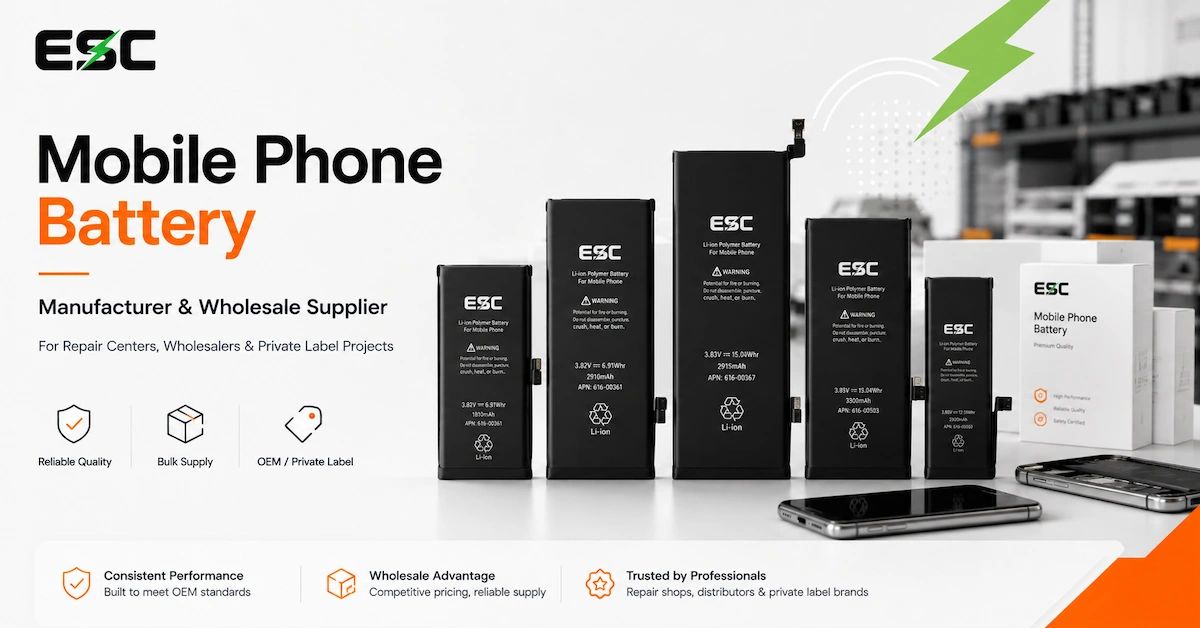
ESC states that its mobile battery business supports flexible MOQs and mixed-model purchasing across a portfolio of more than 3,000 replacement battery models. Standard battery orders are normally completed within seven days, depending on the project.
That model is particularly useful for wholesalers and brands that need broad SKU coverage rather than 1,000 pieces of a single battery.
Browse ESC Mobile Phone Batteries
Who Benefits Most From a Low MOQ Battery Program?
Low MOQ is not automatically better for every buyer.
It is most useful when the commercial risk of overstocking is higher than the unit-price saving from a large order.
New Private-Label Battery Brands
A new brand may want its own:
- battery label;
- logo;
- barcode;
- retail box;
- warranty information.
But ordering thousands of units before knowing which models sell is risky.
A smaller launch lets the brand test product-market fit first.
Mobile Parts Distributors Expanding Their Range
A distributor may already sell iPhone batteries but want to add:
- Samsung;
- Xiaomi;
- Huawei;
- OPPO;
- Vivo;
- Google;
- other Android models.
The difficulty is obvious: Android battery demand is spread across many SKUs.
A mixed-model order is often more useful than an extremely low MOQ on only one model.
Repair Chains Testing a New Supplier
A repair company may not want to move its entire battery program to a new factory immediately.
A controlled first order allows technicians to test:
- installation;
- fitment;
- charging;
- capacity;
- return rate;
- real customer feedback.
Only then does the purchasing team increase volume.
Refurbishment Businesses
Refurbishers frequently process changing device mixes.
One month may have strong demand for iPhone 11 and 12 batteries. The next batch of used phones may contain more Samsung devices.
Flexible model quantities reduce stock that sits unused.
Who Is Low MOQ OEM Not Designed For?
A low-MOQ program is less important for a buyer already consuming 10,000 units of the same battery every month.
At that point, the purchasing priorities shift toward:
- production capacity;
- contractual pricing;
- forecasting;
- reserved materials;
- stable monthly schedules;
- batch traceability.
The buyer may obtain better economics through larger scheduled orders.
Low MOQ is therefore best viewed as a market-entry and purchasing-risk tool, not the final goal of every OEM relationship.
How Low Can the MOQ Actually Be?
There is no honest universal answer.
MOQ depends on the battery model and, even more importantly, on what the buyer wants customized.
Across ESC's current catalog, minimums vary by product. Some listings show 20-piece quantities for individual models, while its Xiaomi replacement battery category currently displays a 10-unit minimum. Other battery programs use mixed-model minimums.
That is why buyers should not ask only:
“What is your MOQ?”
A better question is:
“What is the MOQ per SKU, and what is the minimum total quantity if I combine several models?”
Those are two different numbers.
Example
Suppose a distributor wants to launch ten phone battery SKUs.
| Purchasing Structure | Example |
|---|---|
| Models | 10 |
| Quantity per model | 20 pcs |
| Total batteries | 200 pcs |
| Label | Custom brand label |
| Packaging | Standard or shared private-label box |
This may be much easier to test than ordering 500 pieces of each SKU.
The buyer gets ten opportunities to discover which products sell instead of making one large inventory bet.
Low MOQ Is Not the Same as Low-Cost Customization
This is where many first-time OEM buyers misunderstand the process.
Printing a custom battery label is relatively simple.
Developing an entirely new battery structure is not.
The more you change, the more likely MOQ and development cost will increase.
What Can Usually Be Customized at Lower Quantities?
Common private-label requests include:
- brand logo;
- battery label;
- SKU code;
- barcode;
- warranty card;
- carton marking;
- shared retail packaging.
ESC's battery pages describe support for custom logos, labels, barcodes, private packaging, warranty cards and outer-carton markings depending on the project.
These are commercially useful changes because they help a distributor build a recognizable product range without redesigning the battery itself.
What Usually Pushes MOQ Higher?
The conversation changes when the buyer requests:
- a new battery size;
- custom flex construction;
- special electronics;
- unusual capacity specifications;
- dedicated molded packaging;
- market-specific certification work;
- unique cell sourcing.
Those requests may require dedicated material purchasing, engineering work or new production arrangements.
A good supplier should explain which part of the project is increasing the MOQ.
If the only answer is “factory rule,” the buyer still does not understand the cost structure.
Standard Packaging First or Private Packaging First?
For a new brand, standard packaging is often underrated.
Imagine that a distributor has not yet proven whether 30 battery models will sell.
Putting every model into expensive model-specific printed boxes creates two inventories:
- battery inventory;
- packaging inventory.
The batteries may sell while the wrong boxes remain in the warehouse.
A more cautious first launch can use:
custom battery label + barcode + standardized branded packaging
Then move fast-selling SKUs into dedicated boxes after sales data exists.
That is often more sensible than trying to make a first order look like a mature global product line.
How Should Buyers Plan a Mixed-Model OEM Order?
For a low-MOQ project, SKU planning matters as much as manufacturing.
Do not select models simply because the supplier has them.
Use your own demand data where possible.
A Practical Three-Tier SKU Plan
Tier A — Proven sellers
These are models already requested regularly by your customers.
Hold deeper inventory.
Tier B — Growth models
Demand exists, but you still need sales data.
Use moderate quantities.
Tier C — Test models
New models or long-tail demand.
Keep the first order deliberately small.
A distributor might allocate a trial order like this:
| SKU Type | Quantity Strategy | Purpose |
|---|---|---|
| Tier A | Higher | Prevent stock-outs |
| Tier B | Medium | Validate repeat demand |
| Tier C | Low | Test market response |
This is one reason a supplier with thousands of models and mixed-model ordering can be more useful than one offering an extremely cheap price on only a few SKUs. ESC's current mobile battery range includes replacement batteries for iPhone, Samsung, Xiaomi, Huawei, OPPO, Vivo and other smartphone brands.
What Should Never Be Compromised Because the MOQ Is Small?
Quality control.
A buyer ordering 30 batteries should not accept a different definition of “good battery” from a buyer ordering 3,000.
The specification should still be clear.
At minimum, the buyer should know:
- compatible phone model;
- battery reference;
- rated capacity;
- nominal voltage;
- physical configuration;
- flex type;
- protection design;
- labeling requirement.
Then the product needs to be checked against that specification.
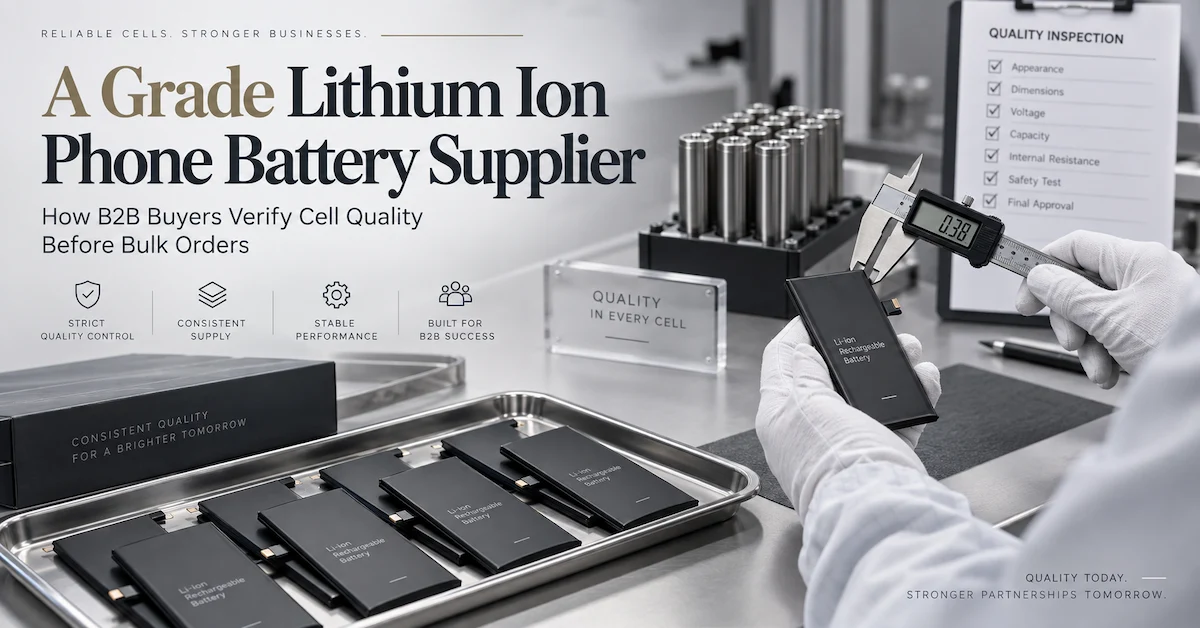
What Battery QC Should an OEM Buyer Ask About?
Cell Inspection
Useful checks include:
- appearance;
- voltage;
- capacity;
- internal resistance;
- lot consistency.
Assembly Inspection
Look at:
- flex placement;
- weld quality;
- insulation;
- connector alignment;
- battery dimensions.
Electrical Testing
Finished batteries should be checked for normal charging and discharge behavior as well as the applicable protection functions.
Capacity Verification
Capacity deserves special attention because the number on a label is easy to print.
Ask:
- How is capacity tested?
- What test conditions are used?
- What tolerance is accepted?
- How many samples are tested?
- Can results be connected to a production batch?
Aging and Final Inspection
Aging helps screen for early abnormalities.
Final inspection should also verify the less glamorous details that create expensive mistakes:
- correct label;
- correct SKU;
- barcode;
- package;
- quantity.
ESC states that its battery production uses voltage, capacity, internal-resistance, charging and aging checks, with individual product inspection on applicable battery products.
Why Should You Approve Samples Before Printing Your Brand?
Because branded packaging makes a bad product more expensive, not better.
A sensible project sequence is:
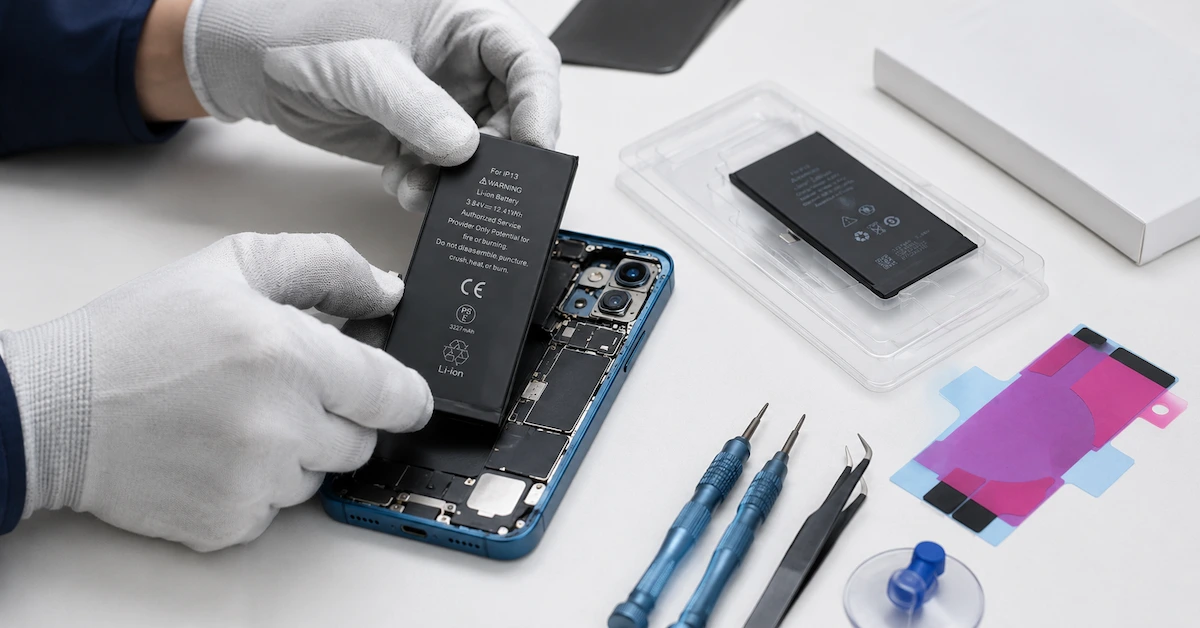
battery sample → technical test → device installation → approval → label artwork → packaging approval → production
Not:
logo → box → payment → hope
For the sample stage, test more than one unit whenever possible.
One perfect sample is not evidence of batch consistency.
Compare several pieces for:
| Test | What You Learn |
|---|---|
| Voltage | Basic electrical consistency |
| Capacity | Whether rating is realistic |
| Internal resistance | Variation between cells |
| Charging | Basic operating behavior |
| Discharge | Usable performance |
| Fitment | Mechanical compatibility |
| Flex / connector | Installation quality |
| Device test | Real repair performance |
| Appearance | Assembly consistency |
Save the approved product details.
That document becomes far more useful six months later when somebody asks why the latest batch feels different.
Low MOQ Supplier vs High MOQ Factory: Which Is Better?
Neither model is automatically better.
They solve different purchasing problems.
| Factor | Low MOQ OEM Supplier | Large MOQ Program |
|---|---|---|
| Initial inventory | Lower | Higher |
| Model testing | Easier | More expensive |
| SKU variety | Often more flexible | Depends on factory |
| Unit cost | May be slightly higher | Usually stronger at scale |
| Packaging flexibility | Good for staged launches | Better economics at volume |
| Cash tied in stock | Lower | Higher |
| Best fit | New brands / new markets | Mature high-volume programs |
The key issue is not finding the smallest possible MOQ.
It is finding a quantity that lets you make a useful commercial test.
Five batteries may be too few to learn anything.
Five thousand may be too many to correct a mistake.
What Determines the Price of a Low MOQ OEM Battery Order?
A low MOQ quote can look confusing because buyers often compare only the battery unit cost.
OEM pricing can also be influenced by:
- battery model;
- capacity specification;
- quantity per SKU;
- number of SKUs;
- custom label;
- packaging;
- barcode requirements;
- test requirements;
- documentation;
- destination;
- shipping method.
The useful calculation is:
Total landed trial cost ÷ sellable units
Then add the costs that appear later:
claims + replacement freight + technician time + customer support
A battery that costs a little less but produces more claims can easily be the more expensive purchase.
How Should You Compare Two Low MOQ Battery Suppliers?
Ask both suppliers to quote the same thing.
Otherwise the price comparison is meaningless.
One supplier may be offering:
- standard label;
- neutral box;
- no barcode;
- basic battery configuration.
Another may include:
- private branding;
- custom packaging;
- barcode;
- additional testing;
- export documentation.
Those are not equivalent quotations.
Use a simple supplier scorecard:
| Evaluation Point | What to Compare |
|---|---|
| Product match | Exact models and configuration |
| MOQ | Per SKU + total mixed order |
| Sample results | Actual tested performance |
| Batch QC | Inspection process |
| OEM | Label / barcode / packaging |
| Lead time | Sample + production |
| Warranty | Scope and claim method |
| Shipping | Available battery channels |
| Documents | Exact SKU / destination |
| Communication | Speed and technical clarity |
Price belongs in the comparison, but it should not replace the comparison.
How Long Should a Low MOQ OEM Order Take?
A small order does not always mean instant delivery.
The production side may be quick while packaging artwork, label confirmation or shipping creates the delay.
ESC states that standard battery orders are normally completed within seven days, while actual timing depends on the product and customization.
For your quotation, separate three dates:
Sample date
When can samples ship?
Production date
When will the approved bulk order be finished?
Delivery date
When is the shipment expected to reach your destination?
These dates should not be treated as one number.
What Documentation Should an International Buyer Ask For?
Phone batteries are lithium batteries, so international transport requires more care than shipping ordinary phone cases or cables.
The UN Manual of Tests and Criteria includes subsection 38.3 for lithium cells and batteries, and Amendment 1 to Revision 8 includes changes affecting subsection 38.3.
UNECE Manual of Tests and Criteria Rev.8
For an actual shipment, buyers should confirm what is required for the specific:
- battery SKU;
- configuration;
- country;
- shipping method;
- carrier.
ESC states that its iPhone models have individual CE certification and that applicable products are available with documents including RoHS, FCC, MSDS and UN38.3.
Do not ask only:
“Do you have certificates?”
Ask:
“Please send the documents applicable to these exact SKUs for this destination and shipping method.”
That one sentence is far more useful.
What Should a Low MOQ OEM RFQ Include?
The weakest inquiry is:
“Need phone batteries with my logo. Best price?”
The supplier has to guess nearly everything.
A qualified RFQ could look like this:
| RFQ Field | Example |
|---|---|
| Buyer Type | Mobile parts distributor |
| Market | Germany |
| Brands | iPhone / Samsung / Xiaomi |
| Models | Attach SKU list |
| Quantity | 20–100 pcs per SKU |
| Total Quantity | 500 pcs |
| Battery Type | Standard capacity |
| Label | Custom logo |
| Barcode | Required |
| Packaging | Branded universal box |
| Samples | Required before order |
| Documents | Confirm for EU shipment |
| Delivery | Target month |
| Future Volume | Estimated repeat demand |
There is one field in that table that suppliers pay close attention to:
Future Volume
If the current order is small because you are testing a market, say so.
A first order of 300 batteries is a very different opportunity from a buyer whose total annual requirement is 300 batteries.
What Questions Should You Ask Before Paying a Deposit?
A serious buyer should be able to get clear answers to these questions:
- What is the MOQ per battery model?
- Can different phone models be combined in one order?
- Which customizations are available at this quantity?
- What needs a higher MOQ?
- Can we test normal production samples first?
- How do you verify capacity and batch consistency?
- What is the confirmed production lead time?
- Which documents apply to our SKUs and destination?
- How are warranty claims handled?
- Can the same approved specifications be maintained for repeat orders?
If those answers remain vague, lowering the MOQ does not lower the sourcing risk.
Why Consider ESC for a Low MOQ Phone Battery OEM Project?
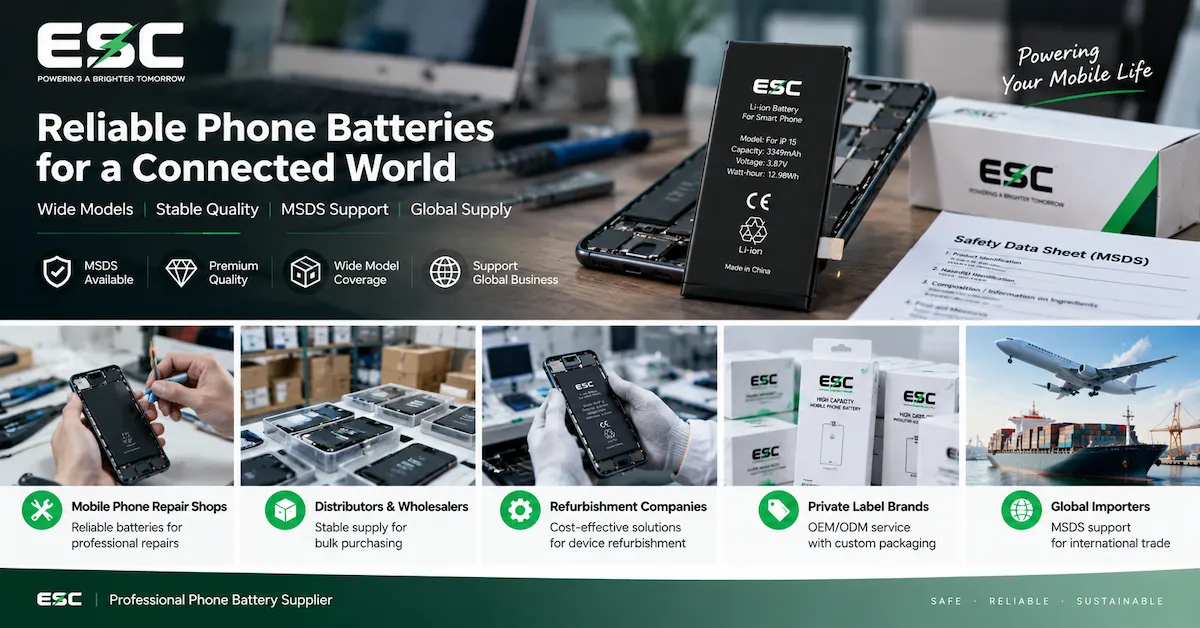
ESC positions its battery business around repair centers, refurbishers, wholesalers, distributors and private-label buyers rather than consumer retail. Its current mobile phone battery portfolio includes standard-capacity, high-capacity and customized battery solutions with OEM packaging support.
The company also states that it supports:
- more than 3,000 battery models;
- flexible MOQ;
- mixed-model purchasing;
- OEM/ODM;
- standard battery orders normally completed within seven days;
- model-related certification and shipping documentation depending on the product.
For a buyer starting a new battery line, the important point is flexibility.
You can begin by discussing the models that actually matter to your market instead of committing to a large quantity of every available battery.
FAQ About Low MOQ Phone Battery OEM Suppliers
What is a low MOQ phone battery OEM supplier?
It is a supplier that supports smaller initial production quantities for customized mobile phone battery projects, such as branded labels, packaging or mixed-model orders.
The exact MOQ normally varies by model and customization.
What is considered a low MOQ for phone batteries?
There is no universal number. ESC's current catalog shows that certain products may start at around 10 or 20 pieces, while other programs use mixed-model minimums. Always request the MOQ for the exact SKU and OEM requirement.
Can I mix different phone battery models in one OEM order?
Some suppliers support mixed-model purchasing. ESC states that mixed-model orders are available as part of its B2B battery program.
Confirm both the quantity per model and total order requirement.
Can I put my logo on a small battery order?
Brand labels may be possible at relatively low quantities, but the requirement depends on the model and production method.
Custom molded packaging or significant product engineering generally requires a different MOQ discussion.
Should I order custom packaging for my first order?
Not always.
A new brand can often reduce risk by starting with a custom label and standardized branded packaging, then developing model-specific boxes for proven high-volume SKUs.
How do I verify phone battery quality before OEM production?
Test several samples for capacity, voltage, internal resistance, charging, discharge, fitment, connector quality and real-device installation.
Approve the battery before finalizing branded packaging.
Does a low MOQ mean the price will be higher?
It can.
Smaller orders spread setup, packaging and administrative costs across fewer units. The correct comparison is total landed cost and expected claim cost, not unit price alone.
Can a low MOQ supplier support larger orders later?
That should be verified before the first order.
A useful supplier for a growing brand needs both low-volume flexibility and the ability to maintain the approved specification when purchasing volume increases.
What information should I send for an OEM quotation?
Send your:
phone brands + exact models + quantity per SKU + total quantity + target country + label requirement + packaging requirement + sample needs + shipping requirements
The more specific the inquiry, the less time both sides spend guessing.
Conclusion: Low MOQ Should Help You Test the Market, Not Test Your Luck
Finding a low MOQ phone battery OEM supplier is valuable when you are launching a brand, entering a new market or expanding a product range.
But the best low-MOQ offer is not necessarily the one with the smallest number.
A useful OEM program should give you enough flexibility to test:
the product, the market and the supplier
without giving up:
specification control, sample testing, batch QC, traceability and after-sales support.
Start with the models your customers already ask for. Add a smaller group of test SKUs. Approve the batteries before printing large amounts of packaging. Track sell-through and claims. Increase quantities where the data supports it.
That is a healthier way to grow a battery brand than buying a warehouse full of inventory because the unit price looked attractive.
For a current ESC OEM proposal, send your model list, quantity per SKU, target market, branding and packaging requirements.