
What Should a Phone Battery Supplier with MSDS Provide?
A phone battery supplier with MSDS support should provide more than a file carrying the words “Material Safety Data Sheet.” For a B2B buyer, the useful question is whether the document can be connected to the battery actually being quoted, sampled and shipped. Check the manufacturer or supplier identification, product or battery description, chemical system, document issue or revision information, handling and storage guidance, emergency information, and transport-related content. Then compare those details with the purchase specification and packaging records. ESC states that MSDS and UN38.3 documentation can be provided for applicable battery products, but document availability and scope should still be confirmed against the selected product and shipment rather than assumed across the whole catalog.
This distinction matters because wholesale phone battery orders frequently contain multiple device models, capacity variants and product configurations. A supplier may sell standard-capacity batteries, high-capacity batteries, diagnosable products and cell-only solutions under the same broad mobile battery category.Your document-control process therefore needs to answer a specific question: does the safety information you received describe the products included in this order closely enough for the purpose for which you are using the document?
Who Needs MSDS Support When Purchasing Phone Batteries?
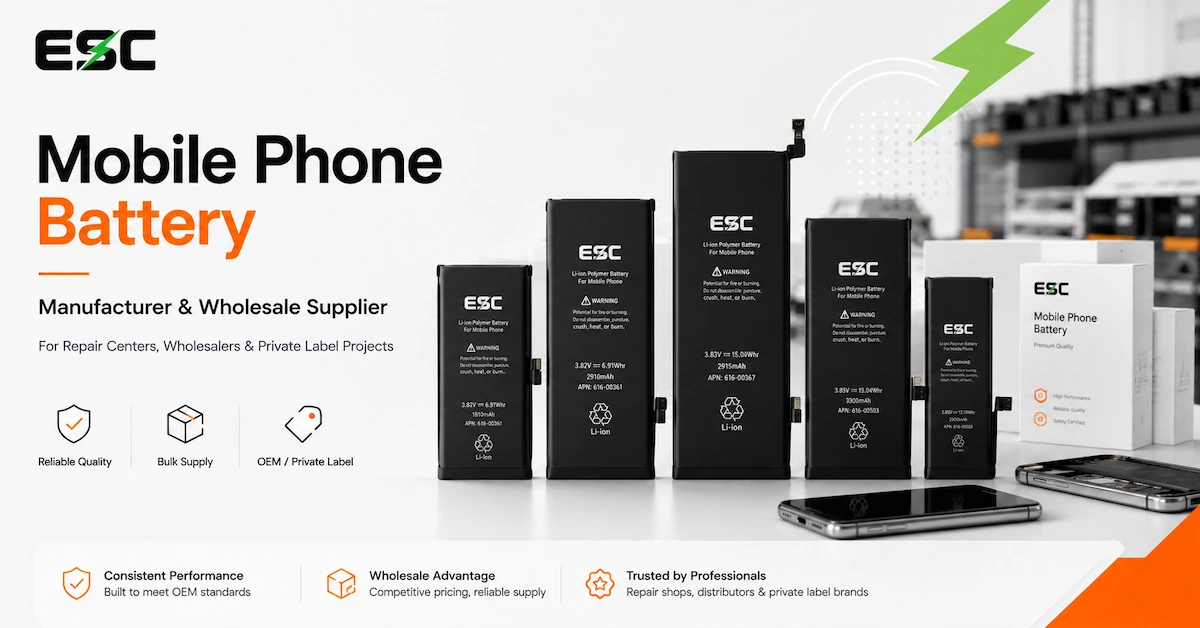
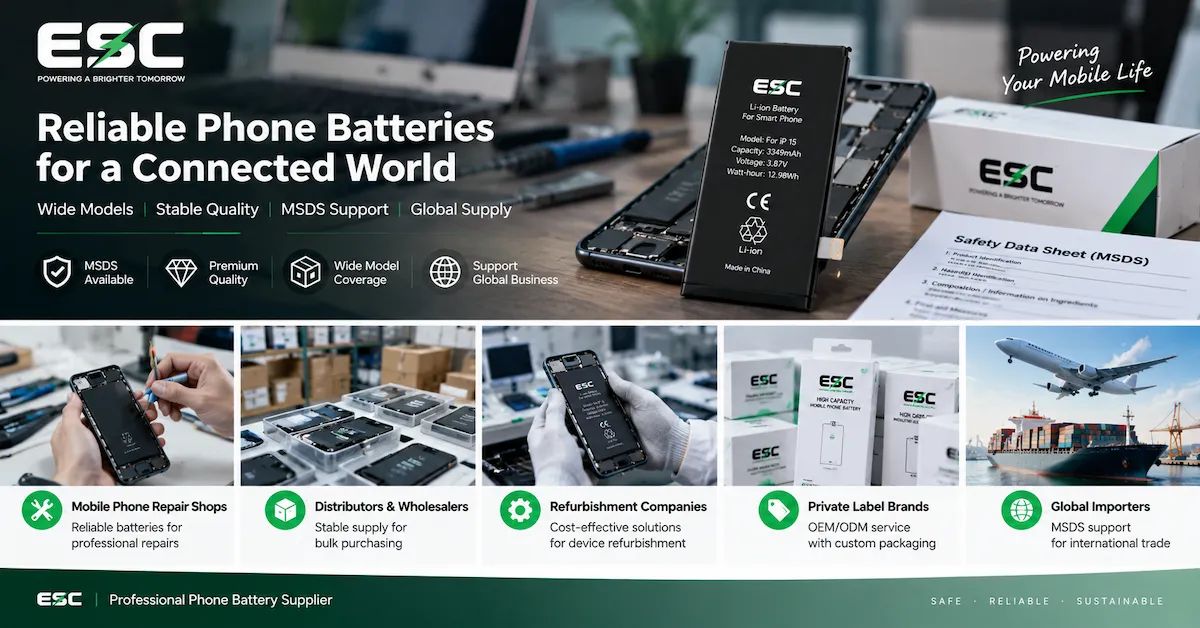
Importers and distributors often request an MSDS because logistics providers, customers, warehouse teams or internal compliance procedures ask for battery safety information. Repair chains may need safety documentation for purchasing records, storage procedures and downstream business customers. Refurbishment companies purchasing large mixed-model quantities may need a controlled document library linked to approved battery configurations. Private-label brands have an additional challenge because their commercial SKU or brand name may differ from the supplier’s internal battery designation. ESC’s mobile phone battery range is positioned for repair centers, refurbishers, wholesalers, distributors and private-label projects, which makes document matching particularly important when one buyer is managing many replacement battery SKUs.
An MSDS request should therefore be treated as part of supplier qualification rather than as a box to tick after the purchase order has been placed. The document may support a particular purchasing, handling or logistics decision, but it does not automatically answer every question about product safety certification, transport testing, market access or shipment acceptance.
What Does an MSDS Tell a Phone Battery Buyer?
The term MSDS remains common in international sourcing conversations, although many current documents are titled SDS, or Safety Data Sheet. The purpose is to communicate safety-related information about a material or product.Depending on the document and applicable requirements, it can contain identification information, hazard information, composition or ingredient information, first-aid measures, fire-fighting guidance, accidental-release procedures, handling and storage recommendations, exposure-control information, stability and reactivity information, disposal considerations, transport information and other regulatory or safety details.
For a battery buyer, the most useful sections are usually those that help identify the product, understand handling and storage precautions, plan emergency response and support communication with logistics or downstream business partners. ESC’s existing mobile phone battery certificates and shipping documents guide explains the role of SDS/MSDS separately from transport testing and other compliance documents. It also emphasizes that buyers should first determine what decision a requested document is expected to support instead of asking generically for “a battery certificate.”
What an MSDS Does Not Prove
A professional phone battery supplier with MSDS support should not present the document as evidence for claims that it was not designed to establish.An MSDS does not by itself prove that a battery has passed UN38.3 design-type testing, does not establish actual battery capacity, does not prove compatibility with a specific smartphone, and does not automatically authorize a shipment on a particular route. It is also not a substitute for checking model-specific product certification or destination-market requirements.
This distinction is especially important because battery buyers often receive several files at once and treat them as interchangeable “certificates.” ESC’s own shipping-document guidance separates the SDS/MSDS from the UN38.3 test summary and from product safety or market documents. The recently published UN38.3 phone battery supplier guide likewise explains that an MSDS is not a substitute for the UN38.3 test summary.
MSDS vs UN38.3 vs Product Specification: What Should Buyers Request?
A strong procurement file normally contains different documents for different decisions. Do not expect one PDF to replace the others.
| Document or record | Main purchasing purpose | What it can help verify | What it should not automatically be used to prove |
|---|---|---|---|
| MSDS / SDS | Safety and handling information | Product identity, safety information, handling, storage and relevant transport data | UN38.3 testing, measured capacity or universal shipment approval |
| UN38.3 test summary | Lithium battery design-type transport testing evidence | Tested battery or cell design and relevant test-summary information | Daily production quality or phone compatibility |
| Product specification | Commercial and technical product definition | Model, capacity, voltage, configuration,dimensions and agreed features | Independent regulatory approval |
| QC / inspection record | Batch or production quality control | Agreed inspection and test results | Transport design-type testing |
| Product certificate or report | Specific conformity or market requirement | Scope stated in the actual certificate or report | Automatic coverage of every SKU or customization |
| Packing list / shipment record | Actual order identification | SKU, quantity, cartons and shipped configuration | Technical performance of the battery |
The purpose of this table is not to require every document for every order. Requirements vary by product, market, buyer, transport method and commercial contract.It provides a framework for asking a supplier the right question instead of treating “MSDS available” as the end of the compliance review.
How to Review an MSDS Before Approving a Supplier
When a supplier sends an MSDS, first identify the document revision and the party responsible for it. Then compare the product description with the battery category being purchased. Review whether the chemistry, voltage or energy-related information—where stated—is reasonable for the offered product family, and check that contact information, handling guidance and emergency information are complete enough for your intended use. If the document refers to a broad battery family rather than one SKU, ask the supplier to explain which products are included in that scope.
| MSDS review item | What the buyer should check | Common sourcing risk |
|---|---|---|
| Document title and revision | Current file name,issue/revision date and language | An outdated file is reused without review |
| Supplier/manufacturer identity | Name and contact information | Entity cannot be connected to the supplied product |
| Product identification | Battery/product description and applicable family | Generic description with unclear model scope |
| Chemistry information | Chemistry consistent with the supplied battery | Document belongs to another battery type |
| Safety information | Hazards and precautions clearly described | File used only for logo checking |
| Handling and storage | Conditions relevant to warehousing and normal handling | Buyer has no warehouse procedure |
| Emergency information | First aid,fire and incident response information | Staff receive no usable safety guidance |
| Transport section | Relevant classification information where provided | Buyer mistakes transport information for carrier approval |
| Revision control | How new versions are communicated | Old and new documents coexist in the purchasing system |
| SKU relationship | Supplier model or family mapped to buyer SKU | Private-label code cannot be traced back to source product |
Match the MSDS to the Battery Specification, Not Just the Phone Brand
A battery sold for an iPhone and a battery sold for a Samsung Galaxy phone can differ in capacity, nominal voltage, energy, flex design, protection electronics and physical construction.Even within one phone brand, two models may use substantially different batteries. This is why “MSDS for Samsung batteries” or “MSDS for iPhone batteries” may be too broad as a purchasing description unless the supplier explains the scope of the file.
For example, ESC’s Samsung Galaxy A51 EB-BA515ABY replacement battery is published as a 4000mAh, 3.83V rechargeable lithium-ion replacement battery with a model-matched flex connector and PCM. The page lists MSDS and UN38.3 among available documents while also noting that final document availability, commercial terms and shipment arrangements should be confirmed for the relevant order.
By comparison, ESC’s published iPhone 15 diagnosable replacement battery is listed at 3349mAh, 3.87V and 12.98Wh and is a different product configuration intended for professional repair and diagnostic applications. Its product information also lists MSDS and UN38.3 among the available documentation. These differences illustrate why a buyer should create a model-to-document relationship rather than store one anonymous “phone battery MSDS” in the purchasing folder.
Product Comparison: Why Document Matching Matters
| Buying item | Samsung Galaxy A51 battery | iPhone 15 diagnosable battery |
|---|---|---|
| Internal product type | Aftermarket replacement battery | Diagnosable aftermarket replacement battery |
| Published capacity | 4000mAh | 3349mAh |
| Published voltage | 3.83V | 3.87V |
| Product configuration | Flex connector and PCM | Diagnosable replacement configuration |
| Intended professional use | Repair, refurbishment and wholesale | Repair shops, distributors and diagnostic applications |
| Published document support | MSDS, UN38.3 and other documents listed as available | MSDS, UN38.3 and related documentation listed |
| Buyer action | Match EB-BA515ABY and order configuration to applicable documents | Match iPhone 15 product configuration and revision to applicable documents |
These published specifications are starting points for procurement, not substitutes for an approved specification, current MSDS or shipment review. Final values and document applicability should be reconfirmed with the supplier for the actual order.
Battery Quality Control Must Be Reviewed Separately from MSDS
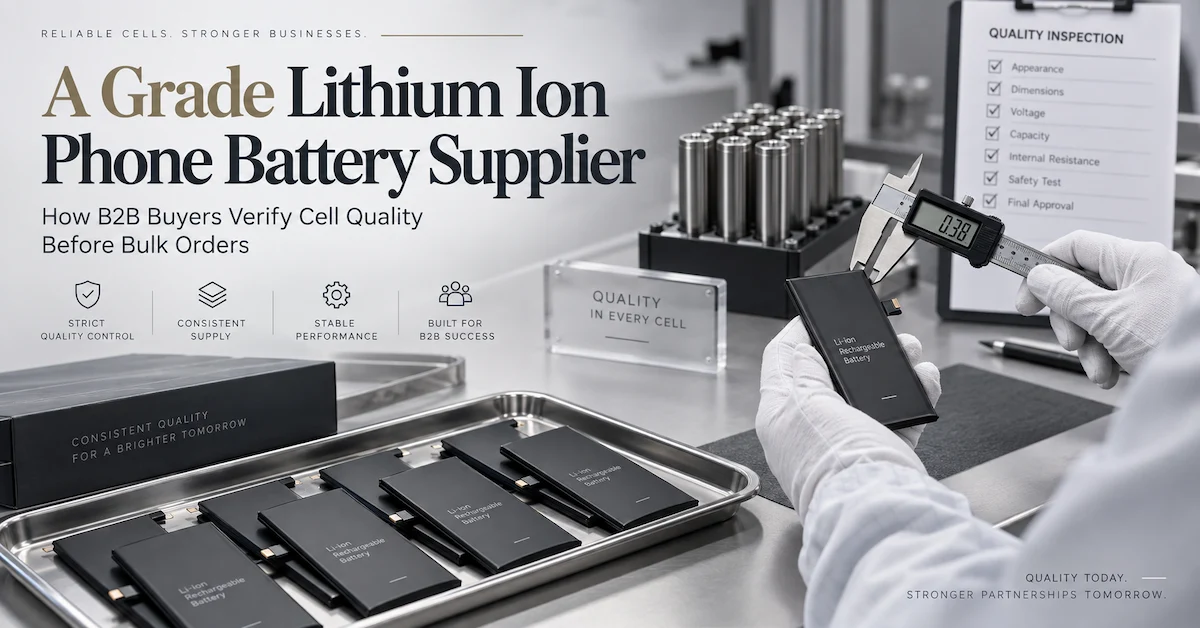
A supplier can provide an MSDS and still need to demonstrate that production batteries meet the technical requirements agreed with the buyer. For bulk phone battery sourcing, quality control should address issues such as appearance, model identification, voltage, capacity, charging and discharging behavior, protection functions, self-discharge where relevant, flex and connector condition, packaging and final shipment checks. ESC’s current product and distributor content describes capacity testing, voltage testing, charging and discharging checks, aging inspection and final shipment inspection as parts of battery quality management.
The correct purchasing sequence is therefore not “MSDS received = battery approved.” Document approval and product approval should be separate gates. A buyer can accept the document format while still rejecting a battery sample for incorrect capacity, poor fit or another technical problem. Likewise, a technically acceptable sample should not cause the purchasing team to ignore missing or mismatched documentation.
Review Cell, PCM, Flex and Product Configuration Before Bulk Approval
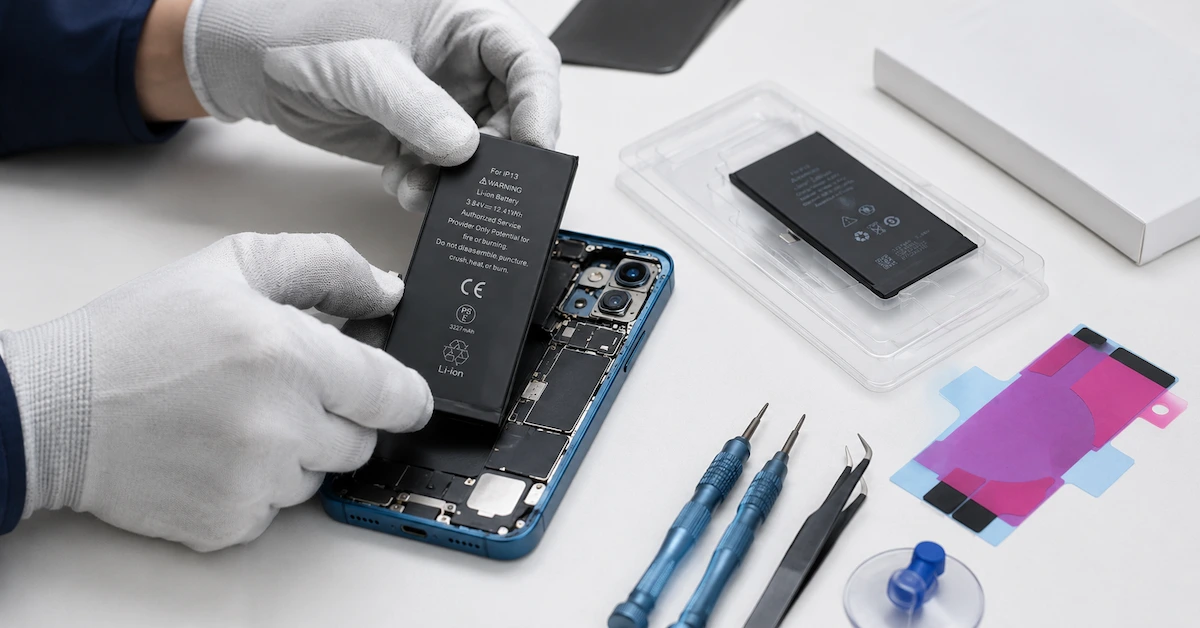
Replacement phone batteries are assemblies, not merely printed pouches with a capacity number. Depending on the product, critical elements can include the lithium-ion cell, protection electronics or PCM, flex cable, connector, insulation and model-specific mechanical geometry. Cell-only products have a different configuration from finished replacement batteries with flex and protection electronics. A document used for a cell should not automatically be assumed to describe a completed battery assembly, and vice versa.
ESC’s mobile phone battery portfolio separates standard replacement batteries, high-capacity batteries, diagnosable batteries, no-pop-up products and iPhone battery cells without flex.That product structure is a useful reminder for buyers to identify the exact configuration before requesting safety documents.
Use MSDS Information to Improve Warehouse and Handling Procedures
The practical value of an MSDS goes beyond submitting a file to a freight forwarder. Purchasing and warehouse teams can use applicable safety information to develop receiving, handling, storage and incident-response procedures. Staff should know how battery cartons are identified, where normal stock is stored, how damaged or abnormal batteries are isolated, and who is responsible for escalation. Warehouses handling multiple phone battery models should also prevent product labels and safety files from becoming disconnected as stock moves between master cartons and smaller downstream orders.
Do not convert general safety wording into an unsupported warehouse rule. The actual procedure should consider the product, local requirements, facility conditions and qualified safety guidance. The supplier’s role is to provide accurate and current product information; the buyer remains responsible for using that information appropriately within its own operation.
MSDS Does Not Replace Shipment-Specific Lithium Battery Review
One of the biggest B2B sourcing risks is assuming that an MSDS alone makes a battery ready for international shipping. Actual transport arrangements depend on factors including the battery configuration, whether batteries are shipped alone or with equipment, watt-hour rating, quantity, packaging, route, transport mode, carrier and applicable dangerous-goods requirements. ESC’s battery certificates and shipping documents guide explicitly separates SDS/MSDS information from UN38.3 evidence and shipment-specific documentation.
Before freight is booked, ask the responsible logistics or dangerous-goods specialist to review the actual shipment configuration. Confirm what the selected carrier requires, which documents need to be available, how cartons should be prepared, and whether the quotation is based on express, air, sea or another method. ESC’s terms of service also notes that available documentation and shipping arrangements depend on product and shipment conditions.
Protect Batteries with Packaging Designed for the Actual Supply Chain
Phone replacement batteries are thin components that can be damaged by pressure, flex deformation, connector impact or poor carton control. Packaging should therefore be assessed for both product identification and physical protection. For mixed-model orders, the receiving team needs to distinguish SKUs quickly without opening every package. For repair chains, unit packaging may be different from consumer retail packaging. Private-label brands may need additional barcode, label and artwork controls.
ESC supports OEM packaging for phone battery projects and discusses battery identification, inserts, labels and cartons in its custom packaging phone battery manufacturer guide. The final packaging solution should still be approved against the actual battery configuration and planned distribution method rather than selected only for appearance.
How OEM and Private-Label Buyers Should Control MSDS Files
Private-label projects introduce an extra documentation layer because the buyer may sell the battery under a commercial name that does not appear on the supplier’s original technical files. Before production, create a mapping table containing the buyer SKU, retail product name, supplier model, battery reference, capacity, voltage, packaging revision and applicable MSDS/SDS file. Keep the source-product identity available internally even if the consumer-facing packaging uses a different brand.
Do not edit an MSDS simply to insert a private-label logo unless the responsible party has approved the change and remains accountable for the document. Branding artwork, product labels and safety documents serve different purposes. ESC provides OEM and private-label services covering custom battery labels, barcodes and packaging, but those commercial changes should remain connected to the original technical product definition.
MOQ, Lead Time and Document Readiness Should Be Quoted Separately
A supplier may have stock available while a buyer is still waiting for a document review, customized packaging proof or logistics confirmation.Conversely, an MSDS may already exist while the requested battery configuration requires production. This is why a serious RFQ should separate product availability, sample lead time, packaging approval, bulk-production timing and shipping-document readiness.
ESC discusses mixed-model purchasing and flexible wholesale sourcing in its existing B2B battery content. Published individual product pages may show example MOQ, lead-time and logistics information, but those figures should not automatically be applied to every model or private-label order. Ask for current terms for your actual SKU mix and destination.
How to Compare Phone Battery Suppliers with MSDS Support
Do not rank potential suppliers by whether their quotation email contains an attachment named “MSDS.pdf.” Compare how they control the relationship between the product, specification, safety document, production batch and shipment. A stronger supplier should be able to explain which MSDS applies, identify its revision, clarify product-family coverage, provide appropriate technical specifications and answer questions when a buyer finds an inconsistency.
A useful supplier review can include six areas: product matching, document traceability, technical QC, packaging control, change management and shipment coordination.Ask who is responsible for each area and what happens when a battery model or critical product configuration changes. This approach turns documentation from a paperwork exercise into part of supply-chain risk management.
What Should Be Included in a Phone Battery RFQ?
When contacting a phone battery supplier with MSDS support, send enough information for the supplier to evaluate the actual project. Include the smartphone brand and model, original battery reference where available, required battery configuration, desired capacity, quantity per SKU, target market, private-label requirements, packaging requirements and intended shipping destination. If your customer, freight forwarder or internal compliance team has specific document requirements, identify them at the beginning rather than after the goods are finished.
For mixed-model orders, send a spreadsheet rather than an unstructured list in email or messaging software. Add one column for the MSDS/SDS status, one for the applicable UN38.3 test summary and one for other required documents. ESC buyers can review the mobile phone battery range first and then submit the model list through the Contact Us page.
Frequently Asked Questions
1. What is a phone battery supplier with MSDS?
It is a supplier that can provide applicable safety data documentation for relevant phone battery products. Buyers should still verify what product or product family the document covers, its revision and whether additional documents are needed for the intended market or shipment.
2. Are MSDS and SDS the same thing?
MSDS is an older term that remains widely used in international sourcing, while SDS is the terminology commonly used for current safety data sheets. When purchasing batteries, focus on the actual document content, responsible party, revision and product scope rather than only the title.
3. Is MSDS a battery certification?
It should not be treated as a general product certification. Its purpose is safety-information communication.Product certifications, transport testing and shipment documents should be reviewed separately according to the battery and intended use.
4. Can an MSDS replace a UN38.3 test summary?
No. ESC’s phone battery shipping-document guide treats them as different documents serving different purposes. Request the applicable UN38.3 information separately when required for the shipment or procurement review.
5. Does every phone battery model need a separate MSDS?
Not necessarily. A document may apply to a product family when its scope supports that use. The buyer should ask the supplier to explain which models are covered instead of assuming that every SKU requires its own document or, conversely, that one generic file automatically covers the whole catalog.
6.What information should I compare between an MSDS and a battery specification?
Check the product description, chemistry, supplier or manufacturer information and any relevant electrical or energy information appearing in the document. Then verify that the document can reasonably be linked to the battery specification and supplier model being purchased.
7. Does having an MSDS mean a phone battery is approved for air shipping?
No. Shipment acceptance depends on the actual battery, packaging, transport configuration, route, applicable rules and carrier requirements. MSDS is only one possible part of the wider documentation and safety-information process.
8. Can ESC provide MSDS for replacement phone batteries?
ESC states that MSDS documentation is available for applicable battery products. Availability should be confirmed for the exact model, configuration and order rather than assumed for every item.
9.Should private-label batteries use the same MSDS as the supplier's standard product?
That depends on whether the underlying battery design and the document scope remain applicable. Maintain a clear cross-reference between your private-label SKU and the supplier’s technical product, and request confirmation when the battery configuration changes.
10. What should I send ESC when requesting MSDS-supported phone batteries?
Provide the phone models, battery references where available, desired capacity and configuration, quantity per model, target market, packaging requirements and shipping destination. Also specify which documents your customer or logistics provider has requested so the applicable files can be reviewed before the order progresses.
Conclusion
Choosing a phone battery supplier with MSDS support is not about collecting the largest number of certificates or downloading a generic safety file. The real procurement task is to connect the correct safety information to the battery being purchased, keep the document revision under control, separate MSDS from UN38.3 and product-certification evidence, and make sure technical quality, packaging and shipment preparation are reviewed independently. For distributors, repair chains, refurbishers and private-label brands managing many SKUs, this document-to-product relationship becomes especially important during mixed-model and repeat orders. To evaluate an ESC order, prepare your model list, quantities, battery configuration, target market, packaging needs and requested documents, then contact ESC to confirm applicable MSDS support, samples and commercial terms before bulk production.