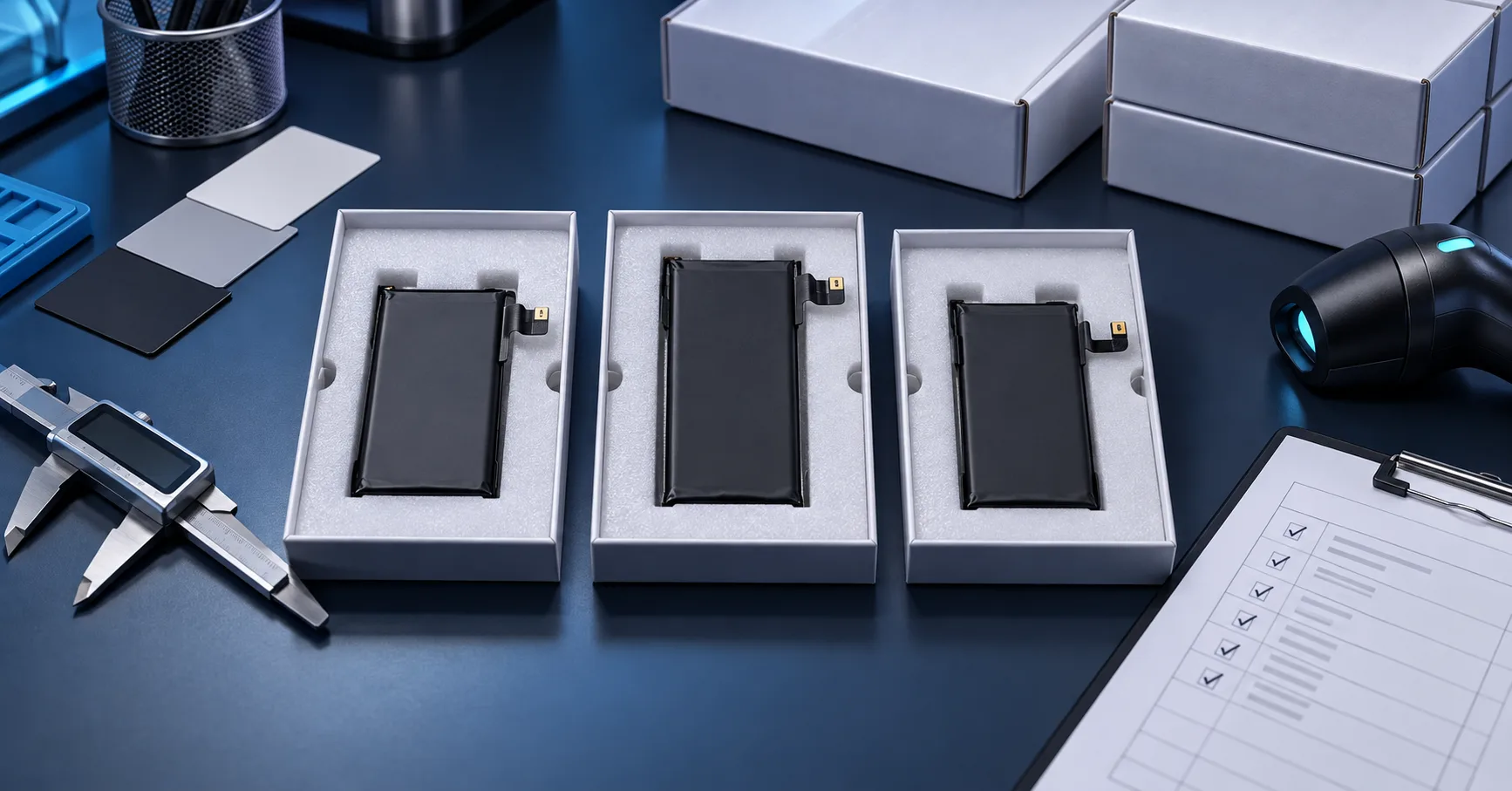

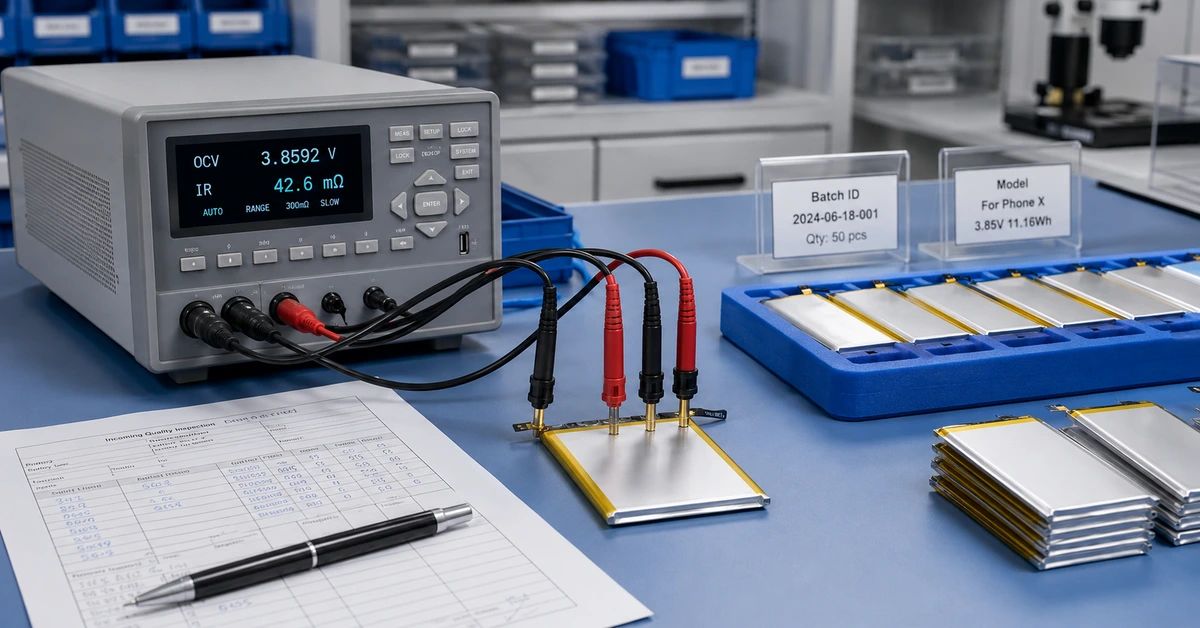
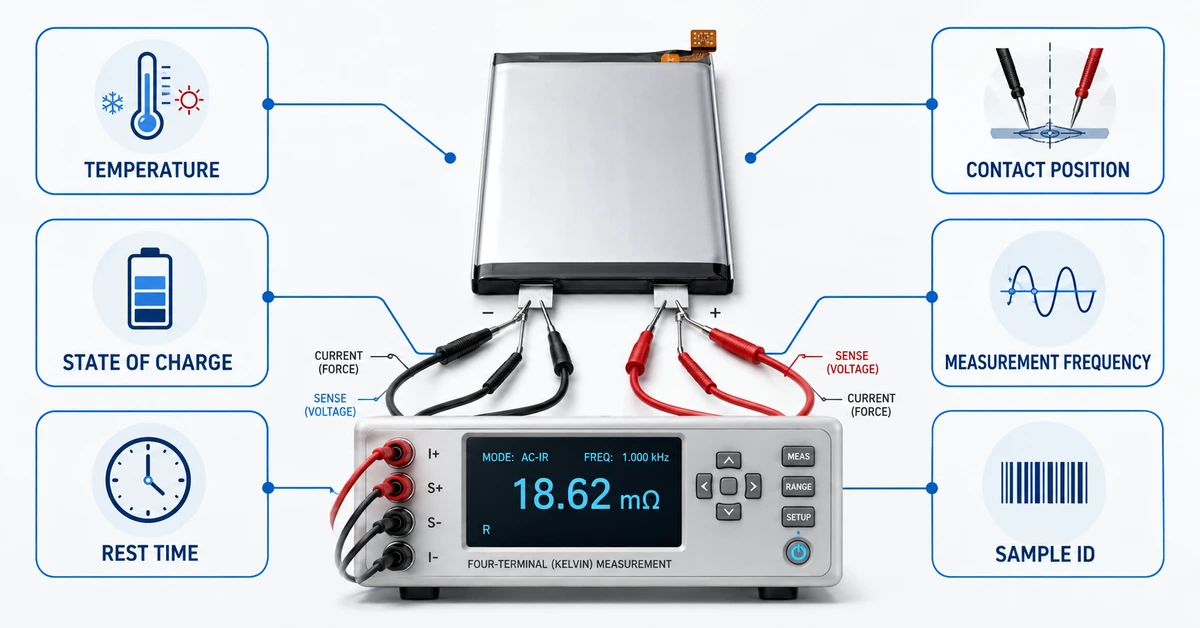
Internal resistance is useful for screening replacement phone batteries, but an isolated milliohm value does not prove capacity, runtime, safety or remaining life. Results can change with battery design, temperature, state of charge, rest time, measurement frequency, probe pressure, contact position and protection circuitry.
A reliable phone battery internal resistance testing program therefore compares like with like. It uses one approved method, known-good reference samples, controlled environmental conditions and batch-level trend analysis. The goal is to identify unusual units and process shifts early—not to turn one electrical reading into a universal quality grade.
This guide is intended for mobile-parts wholesalers, repair chains, refurbishment facilities, distributors and private-label buyers. Every acceptance limit must be established for the actual battery model and instrument. ESC should not publish one resistance threshold for all phone batteries.
Understand What Internal Resistance Represents
A battery behaves as more than an ideal voltage source. Its observed resistance includes contributions from electrochemical reactions, ionic transport, current collectors, tabs, connections and—in a finished replacement pack—the protection circuit and flex assembly.
Different methods observe different parts of that behavior. Hioki’s battery resistance measurement guidance explains that production-oriented testers commonly apply a constant 1 kHz AC current and calculate resistance from the measured AC voltage. A four-terminal method helps reduce the influence of lead and contact resistance.
DC pulse resistance is calculated from the voltage response to a defined current change. Electrochemical impedance spectroscopy evaluates behavior across multiple frequencies. These methods are related but are not interchangeable. A limit approved for 1 kHz AC-IR should not be applied automatically to DCIR or another frequency.
Define the Purpose Before Selecting the Method
Incoming inspection may use resistance data to:
- identify abnormal units within a batch;
- compare a shipment with an approved reference lot;
- detect poor connections or assembly variation;
- monitor storage or aging changes;
- select samples for capacity or device testing;
- support investigation of shutdown, voltage sag or heat complaints.
It should not be used alone to certify rated capacity, cycle life or safety. Hioki notes that lithium-ion pack measurements can include protection-circuit resistance and that resistance changes may be small even as a battery deteriorates. This is why OCV, capacity, physical inspection and functional tests remain necessary.
Standardize the Measurement Conditions
| Variable | Why it matters | Control method |
|---|---|---|
| Temperature | Electrochemical resistance changes with temperature | Condition samples in a defined environment and record battery temperature |
| State of charge | Resistance and OCV vary across the charge range | Measure within an approved SoC or voltage window |
| Rest time | Voltage and polarization change after charge or discharge | Use the same rest period before measurement |
| Instrument and frequency | Different methods produce different values | Freeze model, range, frequency and averaging settings |
| Probe position and pressure | Contact variation can dominate a low-resistance result | Use a fixture or documented contact method |
| Battery configuration | Protection boards and flex cables add resistance | Compare the same finished-pack design |
| Sample history | Storage, cycling and transport can affect results | Record batch, date, conditioning and prior tests |
NREL battery modeling work also treats resistance as dependent on temperature and state of charge. Although a production inspection is not the same as a research model, the principle supports controlling both variables when comparing samples.
Use an Appropriate Four-Terminal Measurement Setup
Phone battery resistance is low enough that test-lead and contact resistance can distort a simple two-wire measurement. A four-terminal or four-terminal-pair configuration separates current application from voltage sensing and reduces this error.
The fixture should contact the approved electrical points without damaging the connector or flex cable. Operators should not improvise by pressing handheld probes at different angles. Establish:
- probe model and maintenance interval;
- contact location and polarity;
- fixture pressure or mechanical stop;
- instrument warm-up and zero-adjustment procedure;
- measurement range and frequency;
- averaging or stabilization settings;
- contact-error response;
- daily verification sample.
Hioki’s lithium-ion production testing guidance describes AC instruments designed to measure low resistance while also recording open-circuit voltage.
Pair Resistance With Open-Circuit Voltage
Battery OCV inspection adds a second screening dimension. OCV can help identify incorrect charge condition, abnormal self-discharge, wrong chemistry, reversed connection or inconsistent sample history.
Resistance and OCV should be recorded in the same row with the model, batch and sample ID. Useful patterns include:
- normal resistance but unusually low OCV;
- high resistance with normal OCV;
- a group of samples shifted from the approved reference;
- wide variation across units from one carton;
- voltage decline after a controlled storage interval;
- different distributions among production dates.
An abnormal pattern is a trigger for quarantine and investigation, not an automatic technical diagnosis.
Create a Model-Specific Baseline
Do not begin by searching for a universal pass/fail number online. Build the baseline from approved, traceable batteries measured under the same conditions.
- Measure retained golden samples and an approved pilot lot.
- Confirm that baseline units also pass capacity, fit and functional tests.
- Calculate the distribution, median, range and variation.
- Repeat measurements to estimate instrument and fixture repeatability.
- Compare different operators and test stations.
- Propose warning and rejection limits based on process capability and product risk.
- Approve limits with engineering, quality and purchasing.
Limits should distinguish an individual outlier from a batch shift. One unit above a threshold may require retesting and segregation; a population shift may indicate a material, assembly, storage or measurement change.
Design the Incoming Sampling Process
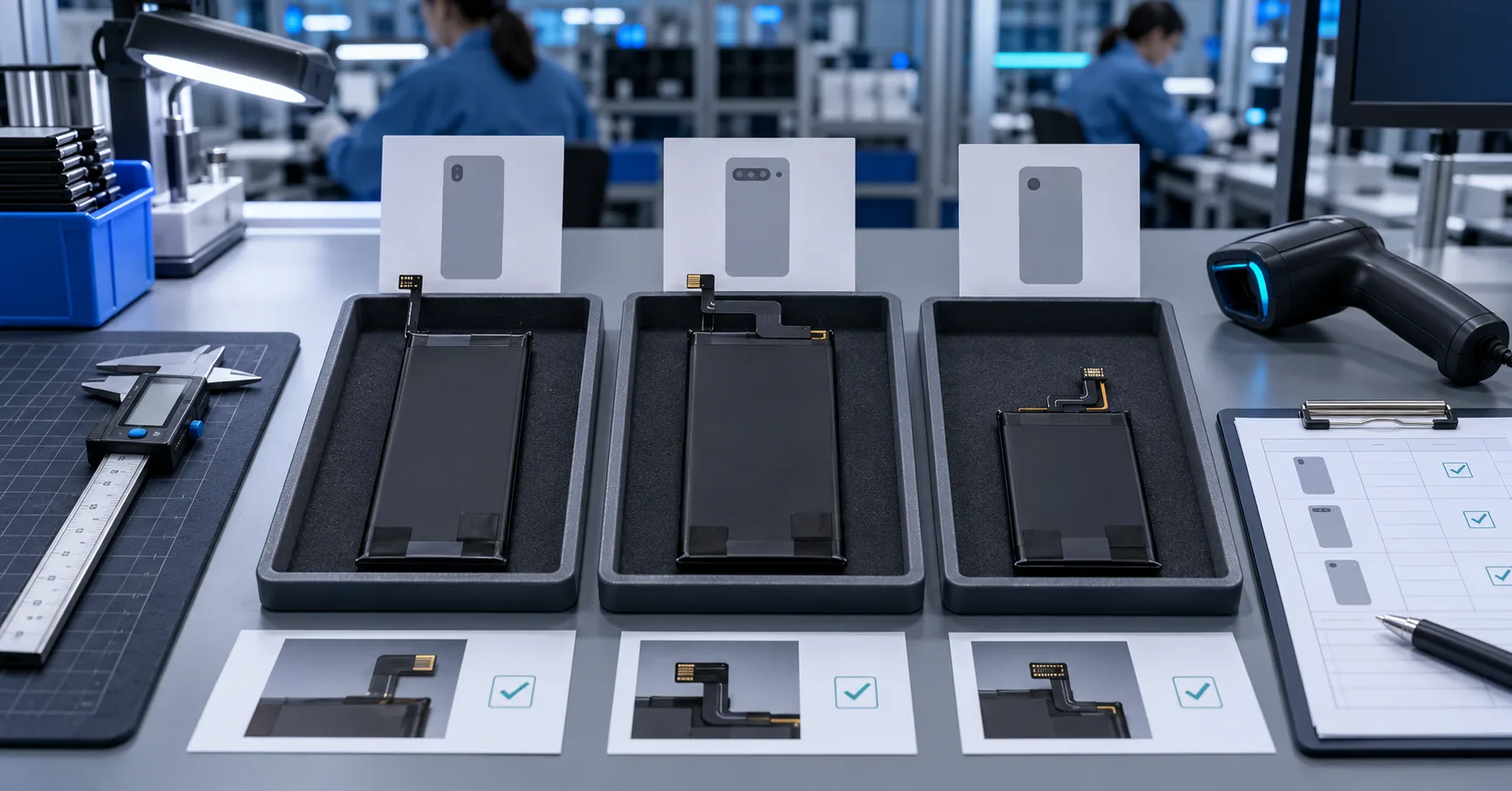
The sampling plan should reflect lot size, supplier history, model risk, complaint history and whether the design has changed. Define the lot before opening cartons: model, production date, supplier batch, cell source where approved, protection-board revision and shipment quantity.
A practical workflow is:
- Review documents and batch identity.
- Inspect packaging, labels, flex cables and connectors.
- Condition samples at the specified temperature.
- Confirm the required rest time and voltage window.
- Measure OCV and AC-IR using the approved fixture.
- Retest contact-related or unstable readings once under a documented rule.
- Compare results with individual and batch limits.
- Select representative and worst-case samples for capacity and device testing.
- Release, hold or reject the lot with recorded authorization.
This module should be integrated into ESC’s broader mobile phone battery incoming inspection process, not operated as a separate certificate exercise.
Interpret High, Low and Unstable Readings Carefully
A high reading can be associated with the cell, protection circuit, weld, flex cable, connector, contact contamination, low temperature, charge condition or measurement error. A low reading is not automatically better; it may be valid for the design, or it may result from an incorrect range, bypassed component or wrong contact point.
Unstable readings often indicate poor probe contact, movement, contaminated terminals, damaged connectors, instrument-range problems or insufficient settling. Require operators to record the reason for a retest. Do not allow repeated measurements until a favorable value appears.
When a sample remains abnormal:
- quarantine it with its original identification;
- repeat the test on a verified station;
- inspect the connector and flex assembly;
- compare with reference samples;
- perform controlled capacity and load testing;
- review temperature response;
- open the pack only under an authorized failure-analysis procedure;
- check whether nearby samples show the same trend.
Use Batch Distributions Instead of Single Averages
Averages can hide a mixed population. Record individual results and review distribution shape, spread and position relative to the baseline.
Examples requiring investigation include:
- a normal average with several extreme units;
- two distinct groups within one claimed batch;
- progressive drift by carton or production date;
- higher variation than the approved pilot lot;
- resistance and OCV moving together unexpectedly;
- a sudden shift after a supplier process change.
Trend charts are more useful than isolated pass/fail totals. Keep raw data so later warranty complaints can be traced back to the incoming distribution.
Do Not Use Resistance as a Substitute for Capacity Testing
Resistance affects voltage drop and heat under load, but it does not directly equal ampere-hour capacity. Two batteries can show similar AC-IR values and deliver different measured capacity. They can also show different resistance because of pack architecture while both remain within their respective specifications.
Use resistance to screen and prioritize samples. Use a controlled charge-discharge test to verify capacity. Use device runtime tests to examine real operating behavior. ESC’s runtime acceptance process and existing battery-capacity guidance can support those separate decisions.
Connect Incoming Data to Warranty Analysis
Store the incoming result with the serial, batch, supplier lot and purchase order. When a claim occurs, compare:
- original incoming OCV and resistance;
- current readings under the same method;
- capacity and runtime results;
- device and installation evidence;
- storage duration and conditions;
- charging and incident history;
- other claims from the same batch.
A resistance change may support the investigation, but it should not be presented as conclusive proof of misuse or aging without additional evidence.
Common Internal-Resistance Testing Errors
- Using a two-wire multimeter for milliohm screening.
- Comparing AC-IR with DCIR values.
- Testing hot and cold batteries in one dataset.
- Ignoring SoC and rest time.
- Changing probe location or pressure.
- Comparing bare cells with protected finished packs.
- Using one universal limit across models.
- Deleting outliers without investigation.
- Judging capacity or safety from resistance alone.
- Keeping only batch averages instead of individual data.
Frequently Asked Questions
What internal resistance should a replacement phone battery have?
There is no universal value. The correct range depends on cell design, capacity, protection circuit, flex assembly, charge condition, temperature and measurement method.
Is lower resistance always better?
No. Results must be evaluated against the approved design and baseline. An unexpectedly low value can also indicate a method, contact or configuration problem.
Can a normal resistance result prove full capacity?
No. Capacity requires a controlled charge-discharge test. Resistance is a complementary screening measurement.
Should batteries rest before measurement?
Yes, when the approved method requires it. A consistent rest period helps reduce differences caused by recent charging, discharging and polarization.
Why should OCV and resistance be measured together?
The combined pattern provides more useful screening information about charge condition, consistency and abnormal units than either value alone.
What happens when a batch shifts but remains inside the limit?
Investigate the trend before release if the change is meaningful relative to the approved baseline. It may indicate a material, assembly, storage or instrument change.
Make the Measurement Repeatable Before Making It Strict
Phone battery internal resistance testing creates value only when the method is repeatable. Control the instrument, frequency, probes, temperature, charge condition, rest time and data format before tightening acceptance limits.
Send ESC your target models, approved sample data, order quantity and inspection requirements. ESC can help prepare model-level samples and batch records. Final limits should be approved from verified reference batteries and correlated with capacity, fit and device-performance results.
External Source References
- Hioki — How to Measure a Battery’s Internal Resistance
- Hioki — Lithium-Ion Battery Internal Resistance Testing
- Hioki — Measuring Lithium-Ion Batteries and Protection-Circuit Resistance
- National Renewable Energy Laboratory — Modeling Lithium-Ion Battery Resistance as a Function of Temperature and State of Charge