
A phone that loses charge quickly after battery replacement does not automatically prove that the new battery is defective. Runtime depends on the battery, phone hardware, software, display, signal strength, applications, background processes, temperature, charging history, installation, and test method.
For repair chains and refurbishment facilities, subjective statements such as “this battery drops too fast” cannot support a supplier claim or batch-release decision. One technician may test at full brightness on cellular data. Another may leave the device idle on Wi-Fi. A third may judge the result immediately after a software update.
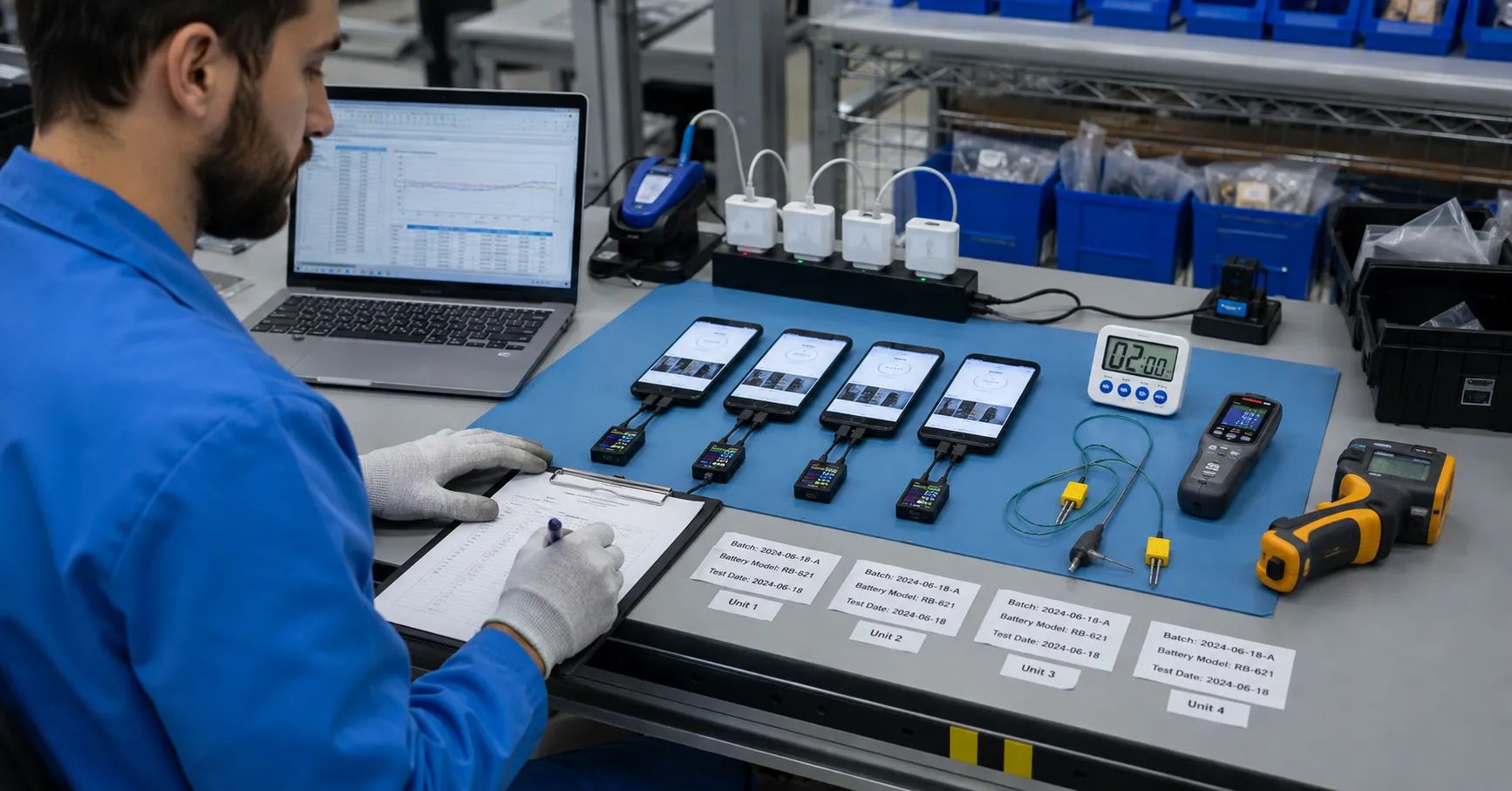
A controlled phone battery runtime acceptance test creates comparable evidence. It defines the phone, battery, initial condition, software state, network, workload, duration, measurement points, and acceptance limits before testing begins.
The objective is not to recreate every customer’s daily use. It is to identify obvious abnormal drain, compare samples under repeatable conditions, separate device-related consumption from battery-related variation, and decide whether a lot can be released.
Fast Drain Is a Symptom, Not a Root Cause
A reported replacement battery fast drain case may involve:
-
lower-than-approved usable capacity;
-
high internal resistance;
-
unstable battery data;
-
poor connection;
-
charging not reaching the expected condition;
-
abnormal standby current;
-
damaged charging or power-management circuitry;
-
liquid or corrosion damage;
-
high display brightness;
-
weak cellular signal;
-
background applications;
-
location services;
-
active synchronization;
-
recent setup or software update;
-
unsuitable temperature;
-
an unrealistic customer expectation.
The same visible percentage drop can therefore represent different technical conditions.
Apple’s official guidance on iPhone or iPad batteries draining too quickly explains that battery life depends on how the device is used and which applications are active. Apple also points to screen brightness, background activity, network conditions, device setup, and ongoing software-update work as factors that can affect battery life.
That guidance is specific to Apple devices, but the diagnostic principle applies broadly: investigate device activity before assigning every short runtime result to the battery.
Define the Test Question
A useful test answers one clearly written question.
Examples include:
-
Does the sample meet the approved runtime range under a specified workload?
-
Is standby loss materially different from the approved sample?
-
Do samples from one lot show unacceptable variation?
-
Does the symptom follow the battery or remain with the phone?
-
Does the device lose charge abnormally after restart?
-
Does the battery reach the approved charged condition?
-
Is a customer complaint reproducible under controlled conditions?
Do not combine every question into one unstructured test. A capacity test, runtime test, standby test, charging test, and customer-use reproduction may require different equipment and acceptance criteria.
Create a Written Test Specification
The specification should identify:
-
phone brand and exact model;
-
hardware or regional variant;
-
operating-system version;
-
device storage and account condition;
-
battery SKU;
-
battery lot;
-
approved sample or reference lot;
-
installation procedure;
-
charger and cable;
-
charging preparation;
-
test environment;
-
screen brightness;
-
network condition;
-
cellular or airplane mode status;
-
Bluetooth and location settings;
-
selected workload;
-
background-app state;
-
start and stop levels;
-
test duration;
-
recording interval;
-
temperature observation;
-
stop conditions;
-
acceptance criteria;
-
retest and escalation rules.
Acceptance limits should come from validated samples, product specifications, and the intended business use. Do not invent one universal hourly percentage-drop limit for all phones.
Standardize the Test Device Before Testing the Battery
A battery comparison is unreliable when the phones are not comparable.
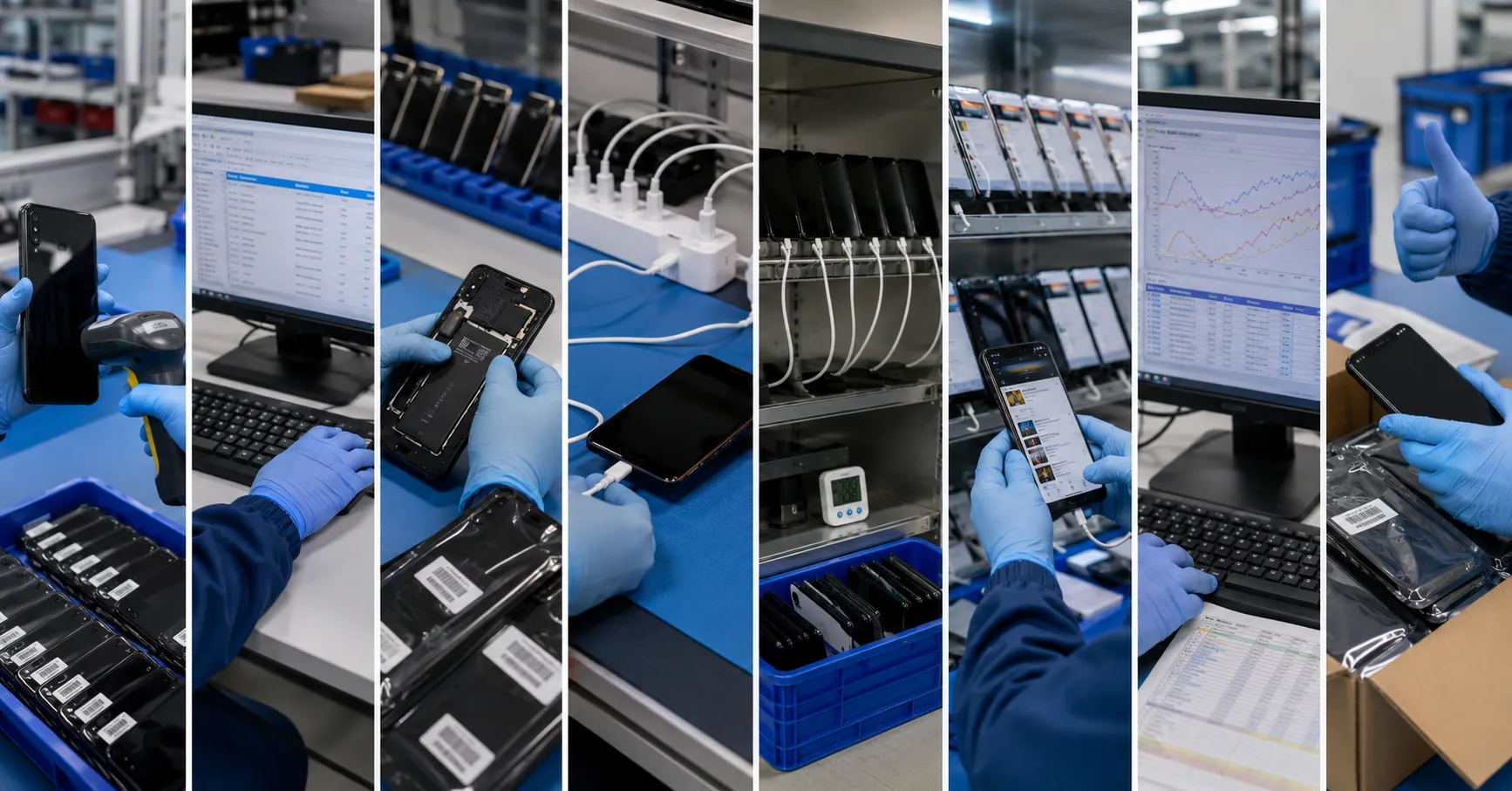
Record the device identity and inspect its condition.
Check:
-
exact model;
-
display type and condition;
-
charging port;
-
board repair history;
-
liquid indicators;
-
frame damage;
-
camera or sensor faults;
-
abnormal heat;
-
cellular performance;
-
battery connector;
-
charging circuit;
-
previous fast-drain history.
A phone with board-level current leakage is not a suitable reference unit. A device with a replacement display may also consume power differently from another device.
For lot comparison, use one validated reference device where possible, or a controlled group of devices with documented baseline behavior.
Control Software and Background Activity
Software conditions can dominate short runtime tests.
Before testing, record:
-
operating-system version;
-
recent update status;
-
device setup status;
-
account synchronization;
-
application installation;
-
background refresh;
-
email synchronization;
-
cloud photo activity;
-
location services;
-
notifications;
-
cellular signal;
-
Wi-Fi signal;
-
Bluetooth devices;
-
screen brightness;
-
auto-lock setting;
-
active power-saving mode.
Apple’s battery-usage guidance explains how device settings can show battery use by applications and system activity. Review this information when investigating an abnormal result.
Do not delete customer data or change settings without authorization. For production testing, use dedicated test devices or controlled refurbishment images rather than customer-owned phones whenever practical.
Verify Installation Before Runtime Testing
Check the battery model, connector, flex routing, insulation, adhesive, and physical fit. Confirm that the pack lies flat and has not been bent or compressed.
A partially seated connector may cause intermittent behavior. Damage to surrounding components may create additional current consumption. Incorrect screws or trapped debris can introduce repair-related faults.
The mobile phone battery incoming inspection guide can help buyers verify identity, appearance, electrical condition, and sample installation before a lot enters production.
Do not continue ordinary testing if the battery is swollen, leaking, unusually hot, punctured, crushed, or otherwise unsafe.
Prepare a Consistent Starting Condition
Runtime results are not comparable when samples begin under different conditions.
The preparation procedure should define:
-
approved charger and cable;
-
starting battery state;
-
charging duration or completion rule;
-
rest period after charging;
-
phone temperature before testing;
-
restart procedure;
-
network connection;
-
background-task condition;
-
beginning timestamp;
-
beginning percentage and other approved measurements.
Do not assume that the displayed percentage alone proves equal stored energy across every battery and phone. The purpose of a consistent preparation method is to reduce variation, not claim perfect measurement.
If the phone or battery becomes unusually warm during charging, stop and investigate before beginning the runtime test.
Separate Standby and Active-Use Tests
Standby and workload tests answer different questions.
Standby Test
A standby test can help identify abnormal background consumption, connection problems, device leakage, or software activity.
Control:
-
screen-off condition;
-
Wi-Fi or airplane mode;
-
cellular signal;
-
Bluetooth;
-
notifications;
-
synchronization;
-
test duration;
-
starting and ending condition;
-
device temperature.
A short standby test with uncontrolled notifications or poor signal is not meaningful.
Active-Use Test
An active-use test evaluates performance under a repeatable workload.
Possible controlled workloads include:
-
locally stored video playback;
-
standardized screen-on navigation;
-
defined application sequence;
-
web browsing on stable Wi-Fi;
-
call simulation where authorized;
-
mixed workload designed for the target market.
Keep brightness, volume, network, application version, and duration consistent. Avoid streaming content that may change bitrate or network behavior unless the network itself is part of the test.
Record More Than Percentage Drop
Displayed battery percentage is useful, but it is not the only observation.
Record:
-
beginning and ending percentage;
-
elapsed time;
-
intermediate readings;
-
unexpected jumps;
-
shutdown point;
-
restart behavior;
-
device temperature;
-
battery-area temperature observation;
-
charging behavior before the test;
-
warnings or system messages;
-
application or system usage;
-
phone resets;
-
network interruptions;
-
test operator;
-
test-device identity;
-
battery SKU and lot.
Where approved equipment is available, additional measurements may include open-circuit voltage, internal resistance, charging data, controlled discharge capacity, or device current behavior.
Do not use uncalibrated tools or unclear methods to reject a batch.
Compare Samples, Not Just One Battery
One sample cannot characterize a production lot.
A sampling plan should consider:
-
order quantity;
-
supplier history;
-
model criticality;
-
new or changed materials;
-
previous complaint rate;
-
inspection severity;
-
destructive versus non-destructive testing;
-
cost of failure;
-
target market.
Compare multiple samples from the new lot with an approved reference. Review both average performance and variation.
A lot with one excellent result and several weak results may be less reliable than a lot with consistently acceptable results.
The mobile phone battery sampling-plan guide can support broader inspection planning, while the runtime method should remain technically defined for the exact model.
Investigate Abnormal Results in a Fixed Sequence
When a sample fails, do not immediately replace the battery and close the record.
Use a sequence:
-
verify the raw record;
-
check device and test settings;
-
inspect charging preparation;
-
review installation;
-
repeat the test when the retest rule permits;
-
compare with the reference battery in the same device;
-
compare the suspect battery in an approved reference device when safe;
-
inspect battery identity and lot;
-
perform authorized electrical checks;
-
review other samples from the lot;
-
classify the likely cause;
-
place affected stock on hold where necessary.
Changing one factor at a time produces better evidence than swapping phones, chargers, batteries, and software simultaneously.
Distinguish Device Drain from Battery Weakness
A battery-related issue is more likely when the abnormal behavior follows the battery across controlled devices and is supported by capacity, resistance, voltage, charging, or lot evidence.
A device-related issue is more likely when abnormal drain remains with one phone across approved comparison batteries.
Software or usage is more likely when the result changes after background activity, network condition, update completion, or settings are controlled.
Installation is more likely when the issue changes after correcting a connector, flex, insulation, or assembly problem.
These are investigation directions, not automatic conclusions. Record the evidence and uncertainty.
Build a Lot-Release Decision
Define clear dispositions:
Pass
Samples meet the approved runtime and functional requirements with acceptable consistency.
Conditional Pass
The lot meets essential requirements but requires an agreed action such as increased inspection, limited release, or customer-specific approval.
Hold
Evidence is incomplete, samples are inconsistent, or an unresolved device or test issue prevents a reliable decision.
Rework
A documented and approved action can correct packaging, labeling, connection, charging preparation, or another controlled condition.
Reject
The lot fails the approved specification and the result is supported by valid testing.
Safety Isolation
A battery is swollen, leaking, abnormally hot, damaged, or otherwise unsuitable for normal testing.
No sales deadline should override a safety isolation or unresolved technical hold.
Use Runtime Data for Supplier Corrective Action
A supplier claim should include:
-
purchase order;
-
battery model and lot;
-
tested quantity;
-
phone model;
-
software version;
-
installation process;
-
test method;
-
device controls;
-
raw results;
-
photographs;
-
comparison sample;
-
failure rate;
-
remaining stock;
-
requested containment;
-
requested corrective action.
“Customers say the battery is bad” gives the supplier little evidence. A controlled comparison showing repeated abnormal results from one lot supports a more useful investigation.
The phone battery manufacturer guide explains why battery sourcing should consider cell quality, protection-board matching, batch testing, packaging, and after-sales analysis.
Prevent Customer Expectation Problems
A repaired phone may not reproduce its original new-device runtime. Device age, display replacement, software, signal, applications, board condition, and usage pattern all affect the result.
Repair businesses should communicate:
-
what was replaced;
-
how the replacement was tested;
-
what warranty applies;
-
what runtime claim is supported;
-
which device conditions may affect use;
-
how to submit a complaint;
-
which evidence is needed.
Avoid promising a fixed number of hours unless the exact test method and conditions support it.
Frequently Asked Questions
How long should a phone battery runtime test run?
There is no universal duration. Use a validated method long enough to distinguish acceptable from abnormal behavior for the target model and workload.
Is percentage drop enough to reject a battery?
No. Check device activity, settings, software, temperature, charging preparation, installation, and comparison results.
Should every battery in a bulk order receive a runtime test?
Not necessarily. Use a documented sampling plan based on quantity, risk, supplier history, model, and test cost. Safety and basic inspection may use different coverage.
Can one phone be used to compare multiple batteries?
A validated reference device can reduce device variation, but repeated opening and installation must be controlled to avoid connector or assembly damage.
Why does a phone drain quickly after a software update?
Background update and setup activity may temporarily increase energy use. Record update status and allow the approved stabilization period before judging battery performance.
What should happen when samples from one lot vary widely?
Place the lot on hold, verify the test method, expand sampling where appropriate, compare with approved references, and request supplier investigation.
Can a higher printed capacity guarantee longer runtime?
No. Printed capacity alone does not prove usable capacity, consistency, device efficiency, installation quality, or runtime under the target workload.
Make Fast-Drain Decisions Repeatable
A customer complaint about rapid battery loss should start an investigation, not predetermine the conclusion. Controlled testing helps a business distinguish battery weakness from device faults, software activity, installation problems, and inconsistent expectations.
A documented phone battery runtime acceptance test gives buyers evidence for lot release, supplier claims, technician training, and customer communication. It turns an argument about percentage drop into a traceable quality decision.
ESC supports repair chains, refurbishment facilities, wholesalers, distributors, e-commerce sellers, and private-label buyers with compatible mobile phone batteries, sample evaluation, batch planning, packaging, inspection requirements, and after-sales analysis.
External Source References
-
Apple Support — If the Battery in Your iPhone or iPad Drains Too Quickly — 2026
-
Apple Support — Check Battery Usage on Your iPhone — 2026
-
Apple Support — Understand Your iPhone Battery Usage and Health — accessed 2026