
For bulk Samsung Galaxy S25 battery replacement, specify standard S25 and S25+ as separate applications and require an approved assembly for each. Treat a supplier's Plus/FE compatibility statement as a proposal that needs technical evidence. Capacity, physical fit and installed behavior should all be defined before the purchase order is released.
This guide focuses on standard and Plus procurement for repair chains, refurbishers and parts wholesalers. Ultra sourcing has a separate role in the product range; buyers working on that model can use ESCCharge's S25 Ultra supplier guide. Keep Edge and FE applications outside the standard/Plus approval list unless separately validated.
Resolve the device name before accepting a shared-part offer
Collect the full device code, region and original battery-label photographs through a qualified technician. Keep original assembly markings, supplier reference and internal SKU in separate fields. A broad “S25” description can otherwise move from the customer enquiry to the warehouse label without identifying which phone was intended.
A listing may use a short Plus title while a longer description also mentions FE. That inconsistency needs clarification before ordering. Ask which exact devices and assembly revision the supplier is proposing, and request evidence for each application rather than assuming the title and description have equal technical scope.
Maintain an application matrix with requested, sampled and approved status. One shared warehouse SKU becomes reasonable only after the proposed assembly has the necessary records for every intended device. Until then, preserve separate stock controls and block unsupported substitutions.
For an S25 Plus battery proposal that includes FE, request the assembly drawing, original-part comparison and installed results for both devices. A single successful Plus installation cannot close an FE approval item, even if the supplier uses one product code.
Compare typical and rated capacity using the right definitions
Samsung's official S25 series specifications distinguish typical from rated minimum capacity. Use those values as device references, then specify what the replacement supplier must declare and demonstrate.
| Device | Typical capacity | Rated minimum capacity | Approval scope |
|---|---|---|---|
| Galaxy S25 | 4,000mAh | 3,885mAh | Standard-model assembly and installed record |
| Galaxy S25+ | 4,900mAh | 4,755mAh | Plus assembly and installed record |
The Samsung S25 business product page explicitly states: “Rated capacity is 3885 mAh for Galaxy S25”. That figure should not be confused with the typical value or treated as a measured result for an aftermarket pack.
Require a clear replacement-capacity definition, tolerance, nominal voltage and acceptance method. Where watt-hours are declared, check consistency with the voltage and ampere-hour values. Resolve differences across label, drawing, quotation and test report before approving the sample.
The Plus typical reference is 900mAh above the standard model's reference, a 22.5% difference relative to 4,000mAh. This is a comparison of declared device capacities. It does not prove a 22.5% runtime improvement or establish that the larger pack can be installed in the smaller phone.
For an S25 Plus battery size enquiry, clarify whether the buyer needs capacity or physical measurements. Request pack length, width, thickness, connector position and cable routing from the assembly drawing. Handset dimensions and mAh values cannot replace that evidence.
Refresh-rate settings change the meaning of a runtime result
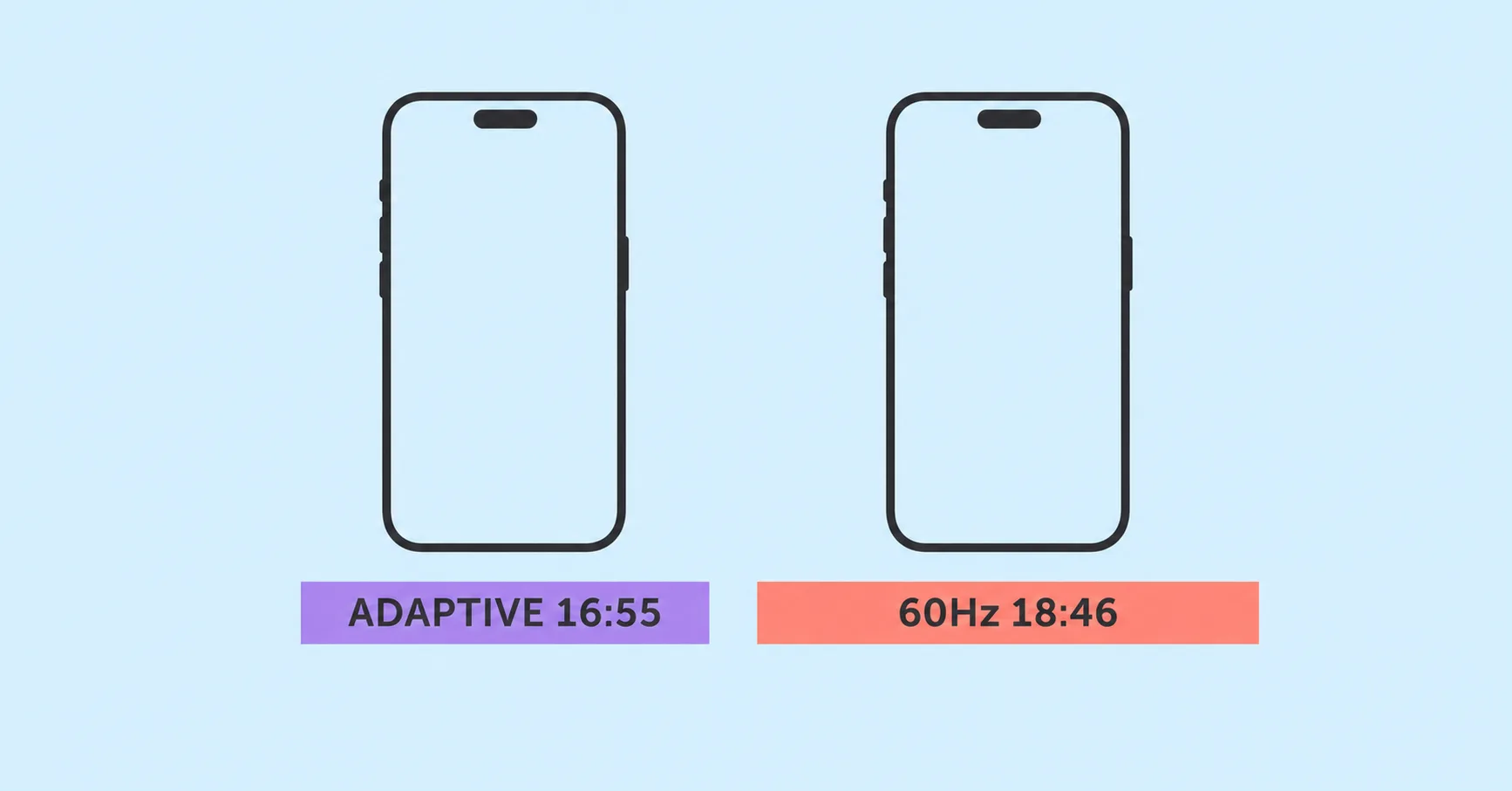
In his Tom's Guide Galaxy S25 Plus review, updated September 4, 2025, John Velasco reported 16 hours and 55 minutes in the publication's battery benchmark “with the display set to adaptive mode”. The review reported 18 hours and 46 minutes in standard 60Hz mode.
Those two reported times differ by 111 minutes. They illustrate why a test record needs the display setting, even when the device model is unchanged. They describe the original review handset and test context, not an ESCCharge replacement sample or a guaranteed repaired-phone result.
For purchasing acceptance, define brightness, refresh-rate setting, connectivity, software build and workload before comparing batteries. If a technician changes a display setting between runs, flag the comparison for review rather than presenting it as a pack-quality difference.
Separate local playback, cellular use and idle observations. A controlled workload helps identify whether the repair meets the agreed service requirement; an unrestricted day of personal use is harder to compare across devices or suppliers.
Inspect fit before closing the assembly approval
A Samsung S25 battery sample should match the complete application, including locating features, insulation, connector orientation and cable path. Confirm electrical assignment and sensing requirements from reliable technical evidence. Similar-looking connectors do not establish electrical equivalence.
Qualified technicians should check that the enclosure closes without pressure on the pack, stretched cables or improvised spacers. Record the fitted assembly and connector area. A phone that starts while open has completed only an intermediate functional check.
Define whether the order contains the bare pack, pack with installation adhesive or a repair kit. Keep the bill of materials attached to the approved revision. A supplier's change to installation contents can affect throughput even when the electrical specification stays the same.
If the proposed fit requires bending, trimming or forcing the battery or connector, stop the application approval and obtain clarification. Do not turn an installation workaround into an undocumented production instruction.
Use separate charging setups for standard and Plus
Samsung's launch specifications use a 25W adapter for the standard model's charging reference and a 45W adapter for Plus. The source describes laboratory conditions with a pre-release device starting at zero charge and its screen, services and features turned off. Keep that context attached to any manufacturer charging-time claim.
For a Galaxy S25 Plus battery test, record charger, cable, starting charge state, ambient temperature, software and active workload. A charger rating is not proof of continuous phone input. Measure an agreed interval and preserve progression, interruptions and thermal observations.
If charging is slow, investigate cable capability, charger compatibility, port condition, settings and device temperature before assigning fault to the pack. Preserve protective behavior. A peak input reading cannot substitute for a normal charging profile.
Where the repair service includes wireless functions, test them separately with known accessories and controlled placement. A wired pass does not establish wireless performance, and a wireless-only problem needs investigation of the complete charging path.
Keep capacity testing separate from phone runtime
Bench capacity evaluates the identified battery under defined electrical conditions. Installed runtime evaluates a phone, battery, software and workload together. Link both records through the sample ID, while retaining their distinct methods and acceptance limits.
For capacity, specify charge termination, discharge current, cutoff voltage, temperature and rest periods. Compare reports only when procedures align. Retain individual results alongside the batch summary so a weak unit remains visible.
USB input energy includes handset consumption and conversion losses. Use it as charging evidence with its measurement method stated, rather than automatically converting it into a direct battery mAh result. A voltage reading or successful startup also cannot establish usable capacity.
Investigate swelling, leakage, damage or abnormal heating under the site's qualified isolation process. Routine performance testing should not continue simply to obtain a completed report from an abnormal unit.
ESCCharge's incoming battery-inspection guide supplies the broader receiving framework. Attach the standard/Plus application matrix and inspection findings to the actual lot decision.
Control shared inventory through revision and application records
Freeze the supplier assembly code, revision, capacity declaration, label and approved application list before the first bulk order. Require review when cell, protection circuit, connector, cable or manufacturing source changes. A retained approved sample is useful only when its identity remains connected to replenishment.
Use a pilot across the device variants represented in the project. Define production lots and select samples under an agreed method. ESCCharge's sampling-plan guide can help organize lot identity and escalation without substituting a generic sample count for the project's risk assessment.
For illustration, suppose 120 packs are allocated to Plus repairs and a supplier proposes another 40 for FE applications under the same stock code. If FE approval is incomplete, those 40 remain restricted. This hypothetical allocation explains application control; it is not a field failure rate or evidence of actual compatibility.
Warehouse labels should show the approved application range and revision. Keep pending or quarantined items apart from released stock. Forecast standard and Plus demand separately, even if a later technical review allows some inventory consolidation.
For returns, retain the pack lot, device identity, symptoms, software build, charging accessories and technician findings. Distinguish selection errors, installation damage, measured capacity issues and handset faults before negotiating corrective action or changing the approved specification.
FAQ for S25 and Plus buyers
Does a Plus/FE listing prove the same battery fits both?
No. Obtain application-specific evidence for the proposed assembly and revision. A commercial grouping is a verification lead rather than a release decision.
Can the Plus capacity be used as a standard-model upgrade?
Do not infer that from the higher mAh value. The exact assembly needs physical, electrical and installed-device approval for the intended handset.
Should runtime results be compared across refresh modes?
Record the difference and repeat the agreed mode where a direct comparison is required. Display configuration is part of the tested system.
What should a first RFQ contain?
Provide full device identities, original pack photographs, quantities by application, target capacity definition, destination market, kit scope and required test evidence.
Request an application matrix with the quotation
Send those requirements through ESCCharge's mobile phone replacement-battery enquiry channel. Request confirmation of actual standard and Plus model availability, proposed assembly revision and sampling scope.
Agree model-specific documents, packaging, commercial terms, delivery arrangements and warranty handling for the project. Release purchasing against the approved application matrix so the repair channel receives a part it can identify, test and trace.
External Source References