
What Should a Phone Battery Quality Control Process Actually Control?
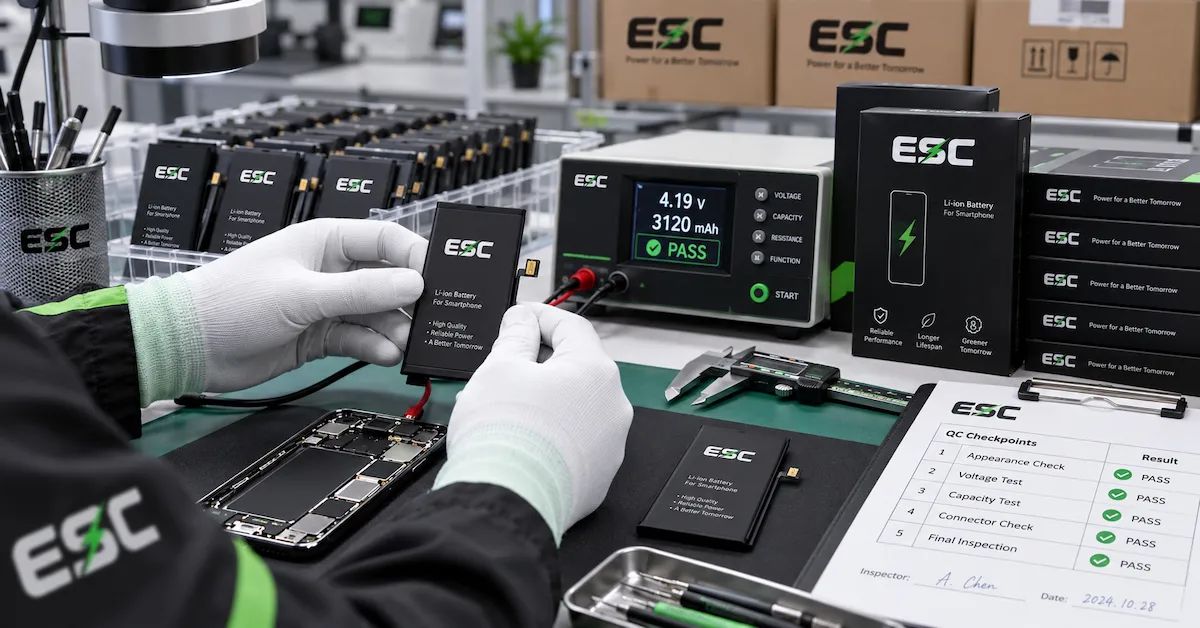
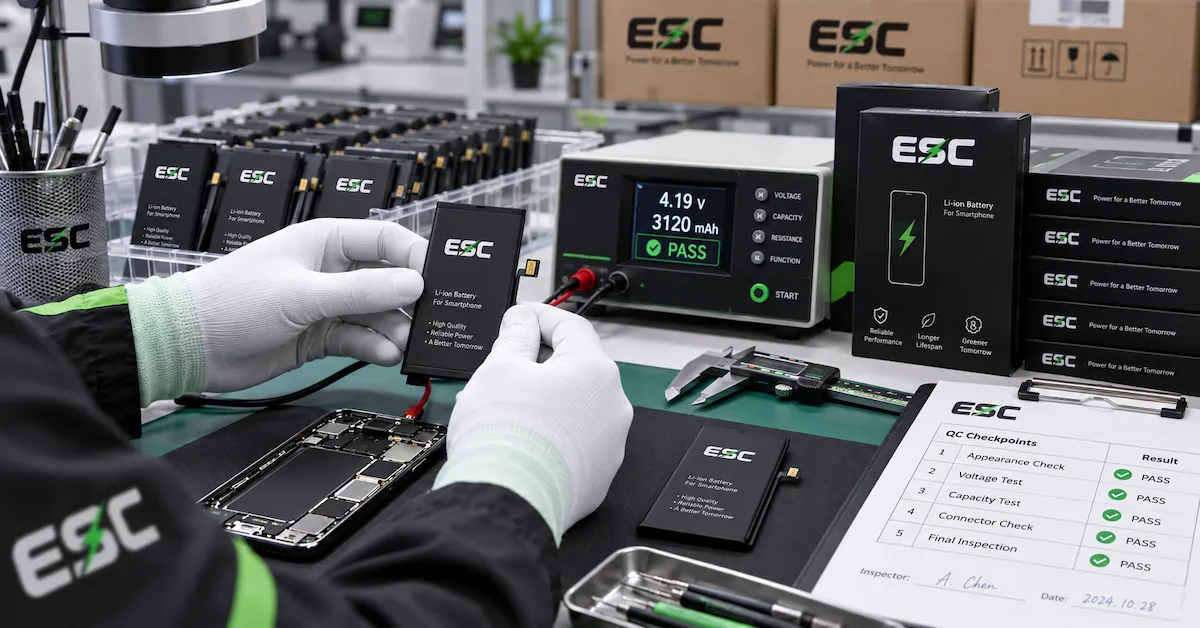
A phone battery quality control process should do more than inspect the finished battery for scratches and confirm that it powers on. For a B2B buyer, quality has to be controlled across several connected stages: incoming battery cells and components, cell consistency, capacity, protection electronics, flex and connector assembly, charging and discharging behavior, aging, identification, packaging and final shipment release. ESC describes a process covering incoming material inspection, cell grading, capacity testing, BMS or protection-circuit performance, charging and discharging, aging and final shipment inspection in its quality-control service information. Its individual battery product pages add checks for flex position, connector orientation, welding quality, dimensions, labels and packaging.
For wholesalers, repair chains and refurbishment businesses, the important point is that these stages should connect to an approved product specification. A battery can pass a visual inspection but still have the wrong capacity, connector orientation or product configuration. It can also meet its electrical specification while being packed under the wrong SKU.A useful QC system therefore needs both technical testing and product-identification control. Buyers should ask not only “Do you test your batteries?” but also “What is tested, at which production stage, against which limit, and how is a failed unit or batch handled?”
Why Phone Battery Quality Control Matters More in B2B Purchasing
Consumer purchases usually involve one battery. A distributor may purchase dozens of device models in one shipment, while a refurbishment facility may install hundreds or thousands of batteries under a standardized workflow. Small inconsistencies become operational problems at scale. Incorrect labels create inventory errors; unstable capacity can increase warranty cases; poor connector positioning slows installation; inconsistent battery thickness can affect fit; and an uncontrolled specification change may cause a previously approved product to behave differently during a repeat order.
ESC’s mobile phone battery range includes standard-capacity, high-capacity, diagnosable and other replacement-battery configurations for professional markets.That product diversity is useful for distributors, but it also means QC should remain model- and configuration-specific rather than relying on a single generic “phone battery inspection.”
A good quality system therefore has two objectives. The first is to remove defective products. The second is to maintain repeatability—making sure the battery approved during sample evaluation remains identifiable and reproducible when the buyer orders it again.
Stage 1: Incoming Material Inspection Starts Before Battery Assembly
Quality control begins before assembly. ESC states that incoming battery cells, PCM boards, flex cables, connectors and supporting materials are inspected before production.
For buyers, incoming inspection is important because the final battery depends on more than the cell. A complete replacement battery may contain a lithium-ion cell, protection circuit, flex cable, connector, insulation and model-specific mechanical components. If one of those parts changes or is outside specification, a finished battery may still look correct while creating installation or performance problems.
A practical incoming-material review should define what matters for the approved product. For cells, this may include physical condition, dimensions, voltage and internal resistance.For flex assemblies and connectors, relevant checks can include physical geometry, orientation and electrical continuity. For protection electronics, buyers should understand whether the approved production configuration is linked to a specific product revision. The point is not to demand every possible measurement, but to identify the characteristics that could change fit, electrical behavior or repeatability.
Stage 2: Cell Grading Controls Consistency Before Production
Cell grading is one of the most important steps in a phone battery quality control process because batteries with the same printed model can still vary in voltage, measured capacity, internal resistance, thickness and self-discharge behavior. ESC describes cell grading based on factors including voltage, capacity, internal resistance, dimensions and consistency; its cell-only product information also references thickness and self-discharge performance as grading considerations.
For B2B buyers, grading matters because consistency affects more than an individual battery. A repair chain wants technicians in different branches to receive products that install and behave similarly.A wholesaler wants one batch to match the previous approved batch closely enough that customers are not effectively receiving a new product under the same SKU.
This does not mean every buyer needs access to every internal cell-grading parameter. It means the supplier should be able to explain the characteristics it controls and how outliers are separated before assembly. If a supplier can only state that it uses “A-grade cells” but cannot explain what the internal acceptance process checks, that statement provides limited purchasing value.
Stage 3: Capacity Testing Should Verify the Specification, Not the Printed Label
A capacity number is easy to print. The value that matters to a professional buyer is the capacity measured under a defined test method. ESC’s iPhone 11 battery page states that battery testers are used to verify actual discharge capacity against the approved 3110mAh specification.
That distinction is important when comparing battery suppliers. Two products can both be labeled “3110mAh,” but the label does not tell the buyer what discharge conditions were used, what cutoff voltage applied, what tolerance was accepted or whether the result refers to a sample or the finished production lot. Before bulk purchasing, buyers should ask how capacity is evaluated and which specification becomes part of sample approval.
For example, ESC currently publishes its iPhone 11 replacement battery at 3110mAh and 3.83V. The value provides a clear purchasing specification that can be reviewed during sample evaluation instead of relying on vague descriptions such as “high capacity.”
A useful capacity-control discussion should answer four questions: what capacity is approved, how it is measured, what tolerance is accepted, and how a buyer can investigate a result that appears inconsistent during incoming inspection.
Stage 4: Protection Circuit Testing Is Separate from Capacity Testing
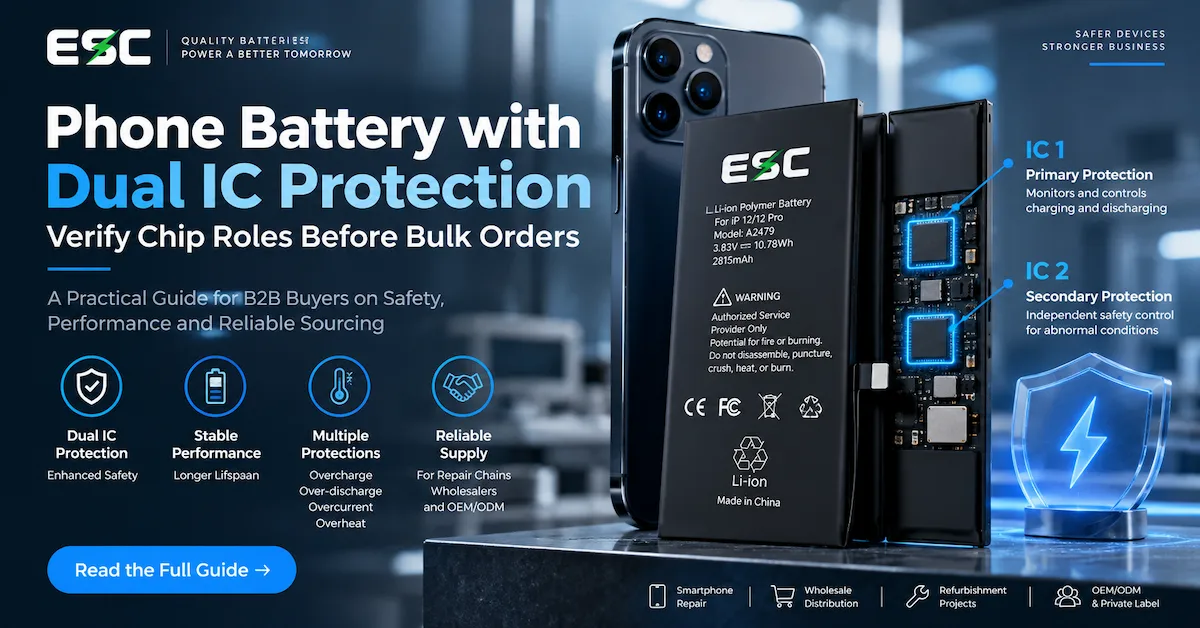
Capacity tells you how much charge a battery can deliver under the test conditions. It does not show whether the battery’s protection electronics operate as required. ESC lists PCM or BMS performance checks as a separate part of its battery quality-control process, including protection against conditions such as overcharge, over-discharge and short circuit on relevant replacement batteries.
A professional buyer should therefore avoid using one successful capacity result as proof that the entire finished battery is acceptable. Capacity verification, electrical protection, device compatibility and physical assembly are different approval questions.
The exact electronics also matter when purchasing different phone battery configurations.A complete replacement battery with integrated electronics has a different QC scope from a cell-only product. ESC’s iPhone 12 / 12 Pro battery cell without flex, for example, is published as a cell without a pre-installed flex cable or BMS, so its inspection and professional repair workflow differ from those of a complete battery assembly.
Stage 5: Flex Cable, Connector and Welding Inspection Prevent Installation Problems
Some battery failures are not cell failures. A battery may have acceptable electrical performance but still create problems because of flex position, connector orientation, welding quality, dimensions or assembly condition. ESC specifically lists flex and connector inspection within its iPhone battery QC information.
For repair shops and refurbishment facilities, these details directly affect technician efficiency. If a connector is poorly positioned or the flex is unstable, installation may take longer or require additional handling. In a high-volume operation, small assembly inconsistencies can become a significant labor cost.
Sample approval should therefore include a physical installation review.Confirm that the product fits the intended device, the flex and connector align correctly, protective materials do not interfere with installation, and the battery can be handled using the buyer’s normal repair procedure. Where software-related or diagnostic functionality is important, test that separately rather than assuming good mechanical fit proves the electronic function.
ESC’s iPhone 11 decode battery validation guide follows this more structured approach by separating physical inspection, fit, software behavior, charging, capacity, temperature and pilot-lot approval instead of treating one successful installation as full validation.
Stage 6: Charging and Discharging Tests Check Finished-Battery Behavior
After assembly, charging and discharging tests can identify problems that a visual check cannot. ESC describes finished-battery checks covering charging behavior, discharge performance, voltage stability and abnormal current.
For buyers, the key is to define what “passed charging test” means for the approved product. A vague test name provides limited information.Ask whether the test is performed on every unit or according to a sampling plan, what parameters are evaluated, and how nonconforming units are handled. If the buyer has a particular repair workflow or device condition that is commercially important, include that in sample evaluation rather than assuming the supplier’s production test reproduces every field condition.
The goal of production testing is repeatability and screening. It should not be confused with a claim that one short charge/discharge check proves long-term battery life. Long-term behavior requires different evidence and operating conditions.
Stage 7: Aging Testing Helps Screen Unstable Batteries Before Shipment
Aging testing is another distinct step in ESC’s published phone battery quality control process. The company describes aging inspection as a way to help identify abnormal self-discharge and unstable batteries before shipment.
From a procurement perspective, buyers should ask what the aging stage is intended to screen and how its result connects to shipment approval. Do not treat the presence of an aging test as proof of a guaranteed lifetime or exact number of future charging cycles. Production aging is primarily a screening and consistency-control activity.
When comparing suppliers, it is more useful to understand the test conditions and failure-handling logic than simply count how many times the word “aging” appears in marketing materials. If a product is rejected during aging, the supplier should have a defined disposition rather than returning it to normal stock without investigation.
Stage 8: Final Inspection Must Include Product Identity and Packaging
A technically acceptable battery can still become a purchasing problem if the wrong model, label or quantity is packed. ESC states that final inspection covers appearance, dimensions, labeling, battery model, packaging and order quantity before shipment.
This stage is especially important for mixed-model wholesale orders. A distributor may receive batteries for different phone generations with similar exterior dimensions. The receiving team should be able to match unit labels, buyer SKUs, carton marks and packing-list quantities without opening or electrically testing every product.
For private-label projects, final QC should also confirm the correct artwork revision and barcode relationship. ESC’s custom packaging phone battery guide discusses linking the approved battery, unit label, packaging and carton identification rather than treating packaging as an independent printing project.
Phone Battery QC Stages and What B2B Buyers Should Verify
| QC stage | ESC-published control direction | What the buyer should verify |
|---|---|---|
| Incoming inspection | Cells, PCM/BMS, flex, connectors and supporting materials | Approved component configuration and visible/material acceptance criteria |
| Cell grading | Voltage, capacity, internal resistance,dimensions and consistency | How cells outside the defined range are separated |
| Capacity testing | Measured discharge capacity against approved specification | Test conditions, approved capacity and tolerance |
| PCM/BMS testing | Protection-circuit performance | Which functions apply to the selected finished battery |
| Flex/connector inspection | Position, orientation, welding and continuity | Installation fit and production consistency |
| Charge/discharge testing | Charging, discharge,voltage stability and abnormal behavior | Pass/fail criteria and production test coverage |
| Aging | Screening for instability and abnormal self-discharge | Conditions, duration and failure handling |
| Final inspection | Appearance, dimensions, labels, model, packaging and quantity | SKU accuracy, artwork version and shipment reconciliation |
The middle column summarizes process information currently published by ESC; the buyer-verification column is a procurement framework rather than a claim that every order automatically includes identical acceptance limits.
Finished Battery QC and Cell-Only QC Are Not the Same
Not every phone battery product should pass through an identical finished-product inspection plan. A complete replacement battery and a cell supplied without flex or BMS have different structures and intended users.
| Quality-control area | Finished replacement battery | Cell without flex/BMS |
|---|---|---|
| Cell appearance and dimensions | Required | Required |
| Voltage/internal resistance | Relevant | Relevant |
| Capacity verification | Relevant | Relevant |
| Integrated protection check | Applicable to supplied finished configuration | May depend on later assembly |
| Flex/connector inspection | Applicable | Not applicable when not supplied |
| Installation verification | Complete-battery fit and connection | Professional cell-transfer/assembly workflow |
| System-related behavior | Depends on electronics,device and repair process | Cannot be determined by cell alone |
| Final label/packaging | Finished SKU and configuration | Must clearly identify cell-only format |
| Suitable buyer | Repair shops, distributors, refurbishers | Technically capable repair/refurbishment operations |
This distinction is visible in ESC’s iPhone 12 / 12 Pro finished replacement battery and its separate 2815mAh cell-only version. The finished product is published with integrated replacement-battery functionality, while the cell-only product explicitly excludes the flex cable and BMS.
Sample Approval Should Happen Before Bulk QC Becomes the Main Focus
Quality control works best when the supplier and buyer first agree on what the correct product is. Before a bulk order, approve a sample against a written specification that identifies model, capacity, voltage, configuration, relevant electronics, physical fit, label and packaging requirements.
The buyer’s sample check should reflect the actual use case. A distributor may focus on SKU accuracy, capacity and packaging. A refurbishment facility may add installation efficiency and device testing. A private-label brand may need all of those checks plus artwork and barcode verification.
Record the exact approved sample or revision. If the sample is modified after testing, do not continue referring to both versions as the same approved product. This prevents the common problem where the supplier and buyer each have a different physical reference when a quality issue appears months later.
Use Pilot-Lot Approval to Bridge Samples and Mass Production
A handful of samples can demonstrate that the product design is promising, but they do not show whether the manufacturing process can reproduce it consistently.For higher-risk or larger purchasing programs, a pilot lot creates an intermediate approval stage.
The pilot lot can be checked for capacity consistency, assembly, fit, appearance, labeling and selected functional characteristics using agreed criteria. The purpose is not to create a complicated inspection system for every order. It is to detect differences between development samples and normal production before the buyer commits to a larger inventory.
ESC’s existing iPhone 11 battery wholesale guide similarly recommends asking about capacity test conditions, sample coverage and batch records rather than relying only on the printed mAh figure.
How Should Buyers Build Incoming QC After Delivery?
Supplier QC does not eliminate the buyer’s need for incoming inspection. The two processes have different purposes. Factory QC determines whether the manufacturer considers the order acceptable before shipment. Incoming QC confirms that the delivered goods correspond to the buyer’s purchase requirements.
A practical incoming plan can start with carton quantity and SKU verification, then inspect labels and packaging condition, physical appearance, product dimensions or connector position where relevant, and selected electrical or capacity characteristics based on purchasing risk. The buyer should also define what happens when a sample fails: expand inspection, quarantine the lot, request supplier analysis, or apply another agreed disposition.
Avoid changing the inspection rules only after a disagreement occurs. Acceptance criteria should be part of the purchase specification or quality agreement before production.
Defect Categories Should Be Specific Enough to Support Corrective Action
A single “defect rate” cannot explain what is going wrong. Buyers gain more useful information by separating defects into categories such as wrong SKU, physical damage, capacity issue, charging problem, connector or flex issue, compatibility issue, packaging error and customer handling damage.
This makes supplier improvement more practical. If most complaints involve labels, the corrective action belongs in packaging and final inspection. If they involve installation fit, the team should investigate mechanical specifications and assembly. If measured capacity is the issue, cell grading and capacity-control records become more relevant.
ESC states that its replacement-battery quality program uses cell grading, capacity testing, BMS inspection, aging and shipment checks and reports a customer-reported defect rate below 1%. Buyers should treat this as an ESC company claim and still establish their own order-specific acceptance criteria and complaint categories.
Change Control Is Part of Quality Control, Not Just Engineering
A repeat order can create new risk even when the first batch performed well. A supplier may need to change a cell source, component, flex, label material or process. Some changes are insignificant to the buyer; others can affect fit, performance, documentation or customer experience.
A mature phone battery quality control process should therefore include change control. Define which changes require customer notification and which require a new sample or document review. Keep the product specification, buyer SKU, manufacturer model, approved sample, artwork and packaging revision connected.
This is especially important for private-label battery programs because the same commercial SKU may remain on the market for years. Customers expect the product behind that SKU to remain consistent even if manufacturing conditions evolve.
QC Documents Should Be Separated from Transport and Compliance Documents
Production quality records, MSDS/SDS and UN38.3 information are not substitutes for one another. A capacity test helps evaluate the supplied battery’s performance against specification. An MSDS/SDS communicates safety information. A UN38.3 test summary concerns the applicable lithium battery design and transport-testing information.
ESC has separate internal resources on phone battery UN38.3 documentation and MSDS-supported sourcing. For buyers, the practical lesson is to maintain separate approval lanes for product quality and documentation rather than assuming that a battery with transport paperwork automatically meets the buyer’s batch-quality requirements.
OEM and Private-Label Orders Need Additional QC Gates
Custom branding adds another set of failure possibilities. A technically correct battery can still be commercially unacceptable if the wrong logo, barcode, language or model information appears on the packaging.
For private-label projects, add artwork approval, barcode verification, label-to-battery matching, packed-sample approval and carton-mark confirmation before mass production. ESC supports customized battery labels, logos, barcodes and private packaging for relevant B2B projects.
Do not allow packaging approval to overwrite product approval. The battery specification should be frozen first, then the packaging should be connected to that specification. If the underlying battery changes, determine whether the product, document or artwork needs to be reviewed again.
How to Audit a Phone Battery Supplier’s QC Process
A buyer does not need to reproduce the manufacturer’s entire internal quality system. Instead, audit the control points most closely connected to purchasing risk. Ask to see how the supplier defines the product, controls incoming cells and critical components, grades cells, verifies capacity, tests protection functions, checks flex and connector assembly, conducts aging, releases final shipments and handles nonconforming products.
Then ask a second set of questions about records and responsibility.Who approves a failed batch? How is the production lot identified? How are customer complaints linked back to an order? Which product changes trigger a new sample? What information can be supplied when the buyer reports a capacity or compatibility problem?
These questions reveal much more than a generic factory presentation because they show whether the supplier can explain how quality decisions are made.
A Practical Buyer Checklist Before Releasing a Bulk Order
Before mass production, confirm that the following items are resolved:
- Exact device and battery model
- Approved capacity and nominal voltage
- Finished-battery or cell-only configuration
- Flex, connector and electronics requirements where applicable
- Sample approval status
- Capacity-test expectations
- Relevant protection and functional checks
- Aging and final-inspection expectations
- Label and packaging revision
- Buyer SKU and supplier-model relationship
- Requested MSDS, UN38.3 or other applicable documents
- MOQ, quantity and model mix
- Warranty and complaint process
- Change-notification requirements
- Shipment and final-release requirements
ESC’s production flow information and service page can provide the starting point for discussing which controls apply to a particular battery order.
What Information Should You Send ESC for Quality Evaluation?
A useful inquiry should identify the smartphone model, original battery reference where available, preferred battery configuration, target capacity, quantity per SKU, destination market and whether the order is standard wholesale or private label. If you already use incoming inspection, provide the key acceptance items that matter to your operation. Repair chains should mention installation or diagnostic requirements, while refurbishers should explain whether the battery will enter a standardized production line.
Do not send only “Need best quality battery, please quote.” A detailed request enables the manufacturer to evaluate the product and quality requirements before price becomes the only point of comparison. Buyers can review ESC’s mobile phone battery products and then submit the model list through the Contact Us page.
Frequently Asked Questions
1. What is a phone battery quality control process?
A phone battery quality control process is the set of inspections and tests used to control components, battery performance, assembly and final shipment. ESC’s published process includes incoming inspection, cell grading, capacity testing, protection-circuit checks, charging/discharging, aging and final inspection.
2.Why is cell grading important for replacement batteries?
Cell grading helps group cells according to characteristics such as voltage, capacity, internal resistance and physical consistency. For B2B buyers, this supports more consistent production batches rather than relying solely on the capacity printed on the battery.
3. Is capacity testing the same as battery quality testing?
No. Capacity is one important performance characteristic, but complete QC may also include protection electronics, charging/discharging, physical assembly, connector condition, aging, identification and packaging checks.
4. Should every phone battery be capacity tested?
The appropriate test coverage depends on the manufacturer’s production plan, product risk and buyer agreement. Buyers should ask whether a test is performed on every unit or by sampling and define the acceptance method before bulk purchasing rather than assuming a universal rule.
5. What does an aging test check?
ESC describes aging inspection as a method for identifying abnormal self-discharge and unstable batteries before shipment.It should be treated as a production-screening activity, not as automatic proof of a specific lifetime.
6. How should repair chains approve a phone battery sample?
Check the written specification, appearance, physical fit, connector and flex condition, capacity and relevant charging or device behavior. Where special diagnostic or software-related functionality is required, evaluate it separately under the intended repair process.
7. Is QC different for a cell without flex?
Yes. A cell-only product does not include all the electronics and flex components found in a complete replacement battery. Its QC and professional installation requirements therefore differ. ESC clearly separates these configurations in its product range.
8. How should private-label buyers add packaging to the QC process?
Approve the battery specification first, then approve the label, barcode, retail package and carton markings against that battery. Final inspection should verify that the correct product and packaging revision are matched before shipment.
9. Does UN38.3 replace production QC?
No. UN38.3 documentation and production quality inspection serve different purposes. Buyers should keep transport-document review separate from capacity, assembly, functional and batch-quality acceptance.
10. What should I ask ESC before placing a bulk battery order?
Provide the device models, battery references, desired configurations, capacity requirements, quantities, destination, packaging needs and quality priorities. Then confirm samples, applicable QC steps, relevant documents, commercial terms and final shipment requirements for the selected order.
Conclusion
A reliable phone battery quality control process is not one final test performed after production. It is a chain of controls beginning with incoming materials and cell grading, continuing through capacity verification, protection electronics, assembly, charging and discharging, and aging, and ending with model identification, packaging and final shipment inspection.For distributors, repair chains, refurbishers and private-label brands, the strongest purchasing approach is to connect these factory controls to an approved specification, a controlled sample, clear acceptance criteria and a repeat-order change process. ESC publishes a multi-stage replacement-battery QC approach and provides model-specific battery supply for professional B2B customers. Review the ESC mobile phone battery range and contact ESC with your model list, quantities, target market and QC requirements to discuss sample approval and bulk-order specifications.