
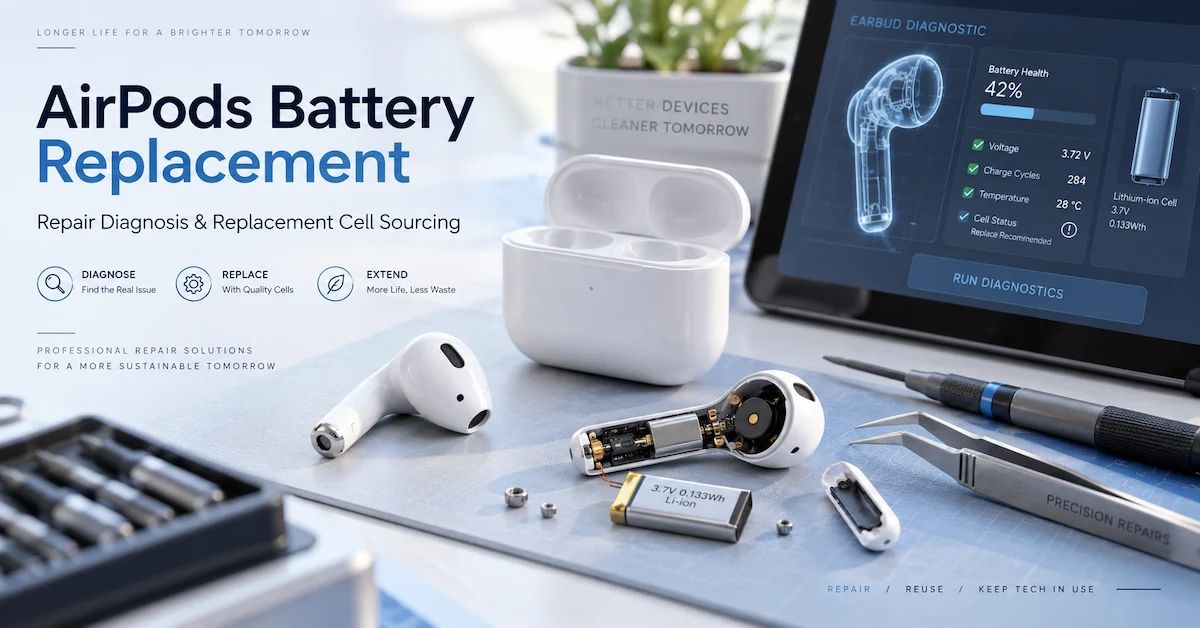
What Does AirPods Battery Replacement Actually Involve?
An AirPods battery replacement project is more complex than simply replacing one battery inside one device. A typical true-wireless earbud system contains separate power-storage components in the left earbud, right earbud and charging case. When a customer says “my AirPods battery is bad,” the repair shop first needs to determine which part of that system is actually creating the complaint.
One earbud may discharge much faster than the other. Both earbuds may still work normally while the charging case can no longer store enough energy for repeated recharging. A charging-contact problem may also prevent one earbud from receiving power even though its internal cell remains usable. Pairing, firmware, contamination and previous mechanical damage can create additional symptoms that resemble battery degradation.
For repair businesses, the correct first question is therefore not “Which replacement battery should I order?” but “Which battery or charging path has actually failed?”
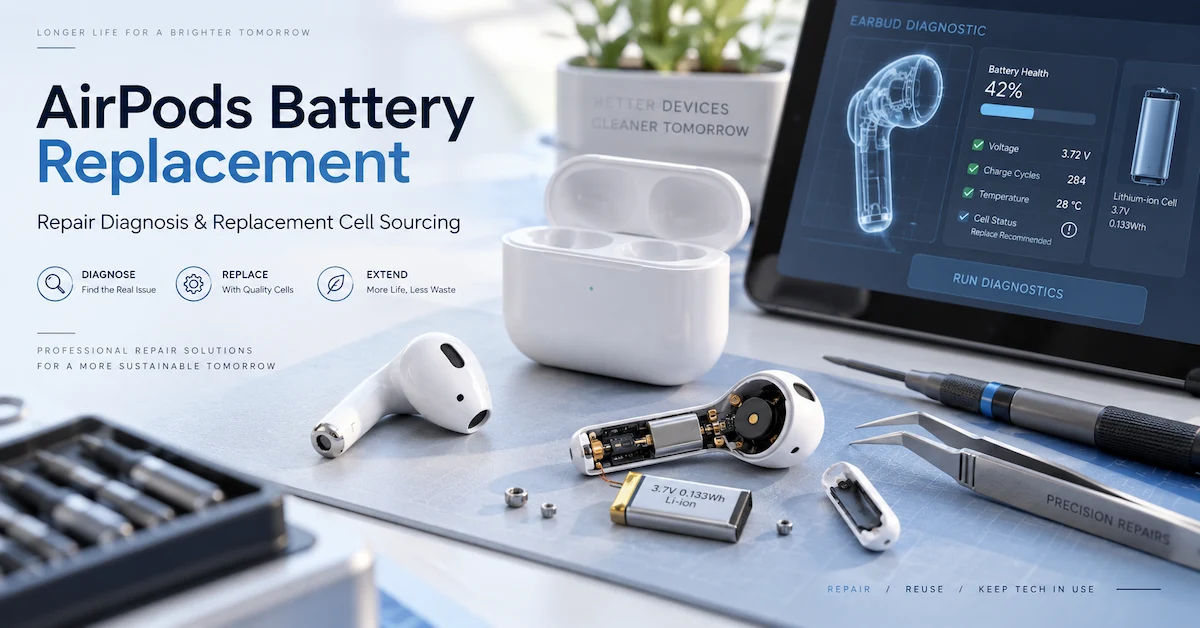
Separate Earbud Battery Problems From Charging Case Problems
The charging case and the earbuds serve different electrical and mechanical roles, so they should not be diagnosed as one component.
| Customer complaint | Possible battery-related cause | Other issues to check |
|---|---|---|
| Left AirPod dies much faster | Left earbud cell degradation | Charging contact, usage imbalance, connection issue |
| Right AirPod dies much faster | Right earbud cell degradation | Case contact, contamination, device behavior |
| Both earbuds have short runtime | Both cells may be aged | Usage pattern, charge state, device settings |
| Earbuds work but case drains quickly | Charging case battery degradation | Case charging input or electronics |
| One earbud will not charge | Earbud battery possible | Dirty contact, case contact, alignment issue |
| Case will not charge | Case battery possible | Cable, connector, charging electronics |
| Earbud disconnects at low charge | Cell may struggle under load | Communication or device issue |
| Percentage changes unexpectedly | Battery or reporting behavior | Pairing/software state |
A structured repair intake should record the left earbud, right earbud and case separately. Treating the entire system as one battery makes warranty analysis much less useful.
How Repair Shops Should Diagnose Short AirPods Runtime
Battery runtime should be measured under repeatable conditions rather than estimated from one customer comment. Ask how long each earbud operates, whether the user normally uses one side more than the other and whether the charging case reaches and maintains a normal charge state.
For a repair shop, a basic comparison can record the starting charge state, use pattern, operating time and left/right behavior. If one earbud consistently shuts down significantly earlier under comparable conditions, that provides stronger evidence than a general statement such as “the battery is weak.”
The same diagnostic principle appears throughout ESC's repair-oriented content: preserve the symptom, control variables and compare suspect components against known-good references before declaring a battery defective. ESC Battery and Charging Troubleshooting Guide ESC
Why One AirPod Can Lose Battery Faster Than the Other
Unequal runtime does not automatically prove that one cell is defective. The left and right earbuds can experience different usage histories. One side may have accumulated more discharge cycles because the user frequently wears only that earbud for calls or listening.
Before planning an AirPods battery replacement, check whether the difference remains under a controlled test. Also inspect whether the shorter-running earbud actually reaches a reliable full charge in the case. A poor charging contact can create the appearance of rapid battery drain when the real problem is incomplete charging.
For a professional repair process, separate three questions: Did the earbud charge correctly? How long did it operate? Did it shut down normally or unexpectedly? Recording those answers makes the repair decision more defensible.
Check Charging Contacts Before Opening the Earbud
True-wireless earbuds depend on small charging interfaces between the earbud and case. Contamination, misalignment, damaged contacts or mechanical wear can prevent reliable charging.
Before opening a compact earbud enclosure, inspect the charging interface and confirm whether the earbud consistently enters a charging state. The technician should avoid replacing an internal battery when the real fault sits outside the sealed earbud assembly.
This step is particularly important because small wireless-earbud battery repair can be labor-intensive. A diagnostic error can destroy a usable enclosure and still leave the original problem unresolved.
Why AirPods Battery Replacement Is More Technically Demanding Than Phone Battery Replacement
Phone replacement batteries are comparatively large assemblies with more accessible connectors and service space. Wireless earbuds place the battery inside a much smaller mechanical structure containing audio components, wireless electronics, microphones and compact interconnections.
Depending on the generation and construction, battery service may involve tight adhesive, delicate housings and small electrical connections. Opening the enclosure without damaging surrounding components can therefore be a significant part of the repair challenge.
For that reason, an AirPods battery replacement should be considered a professional micro-repair task rather than a simple consumer battery swap. Repair facilities need appropriate tools, cell-handling procedures and technician skills before adding this service to their repair menu.
Do Not Use Heat, Puncture or Force as a Battery Removal Shortcut
Small lithium batteries should not be treated as ordinary mechanical components. Improvised removal methods can damage the cell or nearby electronics.
A battery that appears swollen, physically deformed, punctured or unusually hot should not be subjected to routine repair experimentation. Avoid deliberately shorting terminals, piercing the cell, compressing it or using uncontrolled heat to force removal.
For repair businesses, safety procedures should be defined before accepting this type of work. The technician needs a clear point at which the repair stops and the damaged battery moves into an appropriate handling process.
Earbud Battery and Charging Case Battery Need Different Specifications
A replacement battery should be specified according to its actual location and function.
| Specification area | Earbud battery | Charging case battery |
|---|---|---|
| Main priority | Extremely compact fit | Energy storage for repeated earbud charging |
| Mechanical constraint | Very tight internal space | Larger but still enclosure-specific |
| Electrical matching | Must suit earbud power architecture | Must suit case charging electronics |
| Connection design | Small tabs/leads or integrated connection | Case-specific connection |
| Repair difficulty | Usually high | Can differ by case design |
| Sample validation | Earbud runtime and fit | Case charging cycles and capacity behavior |
| Major purchasing risk | Wrong dimensions or connection | Wrong size, voltage or interface |
Buyers should therefore never request only “AirPods battery” when sending an RFQ. The supplier needs the exact generation and whether the requirement concerns the earbud or charging case.
Build a Model-Specific Replacement Battery Specification
Before sourcing small replacement cells, prepare a specification that can be used by purchasing, engineering and QC.
| Specification item | What the buyer should confirm |
|---|---|
| Device | Exact AirPods generation/model |
| Battery location | Left bud, right bud or charging case |
| Cell format | Exact physical construction |
| Nominal voltage | Match the original electrical design |
| Capacity | Confirm rated capacity for the selected configuration |
| Dimensions | Maximum diameter/length/thickness as applicable |
| Connection | Tabs, leads, polarity and interface |
| Internal resistance | Establish model-specific sample baseline |
| Weight | Useful as an additional identity check |
| Lot identification | Required for complaint traceability |
| Packaging | Protect small cells and terminals during transport |
| Sample revision | Record the exact approved cell |
| Change control | Define which changes require reapproval |
Do not fill missing values with specifications from another AirPods generation. Similar product names do not prove that the cells are interchangeable.
Capacity Should Be Verified, Not Inferred From the Printed Label
For small earbud cells, physical space is extremely limited. Buyers should therefore be cautious when a supplier advertises a dramatically higher capacity in the same physical envelope without supporting data.
Capacity should be evaluated using an appropriate controlled method and compared against the approved specification. A larger printed mAh number does not automatically mean better runtime, particularly if the cell's dimensions, resistance, stability or usable capacity are inconsistent.
ESC applies the same principle to its broader replacement-battery quality process: capacity testing is treated as a separate QC stage rather than relying solely on product labeling. ESC Phone Battery Quality Control Process
Internal Resistance Matters in a Very Small Battery
Small cells operate with limited energy reserves, so voltage drop under load can become important as the battery ages. Internal resistance can help buyers compare samples when the measurement method, charge state and temperature are controlled.
However, there should not be one universal resistance threshold for every earbud generation. Build a reference range around the approved cell and compare future samples against the same conditions.
For a wholesale repair program, distribution across several samples is more informative than one particularly good measurement. Large variation can indicate inconsistent cell production or measurement control.
Validate the Replacement Cell Inside the Actual Earbud
Bench measurements are useful, but the final repair application is the earbud itself. A sample-validation program should therefore combine electrical checks with device-level operation.
Useful observations include whether the repaired earbud charges consistently in the case, pairs normally, operates for an acceptable period and remains mechanically stable after reassembly.
Record the sample identity, technician, device generation and observed runtime. If the replacement battery is changed during development, treat the new version as a new sample rather than silently carrying forward the old approval.
This follows the broader B2B validation principle in your uploaded framework: a successful sample should represent a controlled technical revision, not merely “one unit that worked.”
Do Not Promise Original Water or Sweat Resistance After Opening
Opening a compact earbud enclosure can alter adhesives, seals and mechanical construction. Repair shops should therefore be careful about guaranteeing that the unit retains exactly the same resistance to moisture after battery service unless their process and validation specifically support that claim.
Customer communication should distinguish between successfully restoring battery operation and restoring every original enclosure property.
This is an important warranty issue because an apparently successful battery repair may later fail because of moisture or enclosure damage unrelated to the replacement cell itself.
Use a Pilot Lot Before Buying Replacement Earbud Batteries in Volume
One working sample is not enough evidence for a large repair program.
A small pilot lot can help evaluate:
- Cell dimensions
- Connection consistency
- Capacity distribution
- Internal resistance
- Installation yield
- Charging behavior
- Earbud runtime
- Failure during reassembly
- Packaging quality
- Lot identification
This is particularly important for a repair chain because technician labor can exceed the value of the battery itself. A cell that saves a small amount on unit cost but causes difficult installation or inconsistent runtime can create a higher total repair cost.
Separate Battery Quality From Repair Yield
A damaged earbud after service is not always evidence of a defective cell. Repair yield depends on the battery and the installation process.
Track at least three failure categories:
Battery-related defects
Examples include abnormal capacity, instability or physical battery defects.
Installation-related defects
Examples include damaged wiring, housing damage or assembly problems.
Host-device defects
Examples include charging electronics, audio electronics or previous physical damage.
This classification helps the repair business give useful feedback to the supplier instead of reporting every unsuccessful repair as “bad battery.”
How B2B Buyers Should Evaluate a Small-Battery Supplier
A supplier for an AirPods battery replacement program should be evaluated by evidence rather than by a general claim such as “premium earbuds battery.”
Important criteria include:
| Evaluation area | Buyer question |
|---|---|
| Model identification | Is the cell mapped to an exact AirPods generation? |
| Physical consistency | Are dimensions controlled across lots? |
| Capacity | What method verifies rated capacity? |
| Electrical consistency | How are voltage and resistance evaluated? |
| Traceability | Can the cell lot be identified later? |
| Sample support | Can the buyer evaluate samples before volume purchase? |
| Change control | Are important cell changes communicated? |
| Packaging | Are cells protected during handling and shipment? |
| Documentation | What applicable product/shipping files are available? |
| Complaint support | Can the supplier investigate batch-level problems? |
ESC's broader battery portfolio describes cell grading, capacity testing, charging/discharging, aging and shipment checks as core quality-control directions. ESC Company and Quality Information ESC
How AirPods Battery Sourcing Differs From ESC's Current Public Product Range
ESC's current public catalog includes mobile-phone batteries, tablet and laptop batteries, and a Speaker & Smart Watch Batteries category with JBL and smartwatch-related battery products. I did not find a dedicated AirPods battery SKU in the currently indexed product pages reviewed for this article. ESC Speaker & Smart Watch Batteries ESC
That means buyers should not assume a particular AirPods generation, battery capacity or inventory is available from ESC simply because ESC manufactures other compact replacement batteries. If you are evaluating an AirPods or wireless-earbud battery project, send the exact device generation, original cell information, dimensions, connection details and expected quantities for confirmation.
ESC also provides project-based customization services for battery and charging products, but any AirPods-specific cell project should be confirmed separately rather than inferred from the general customization page. ESC Customized Solutions
What Should an AirPods Battery RFQ Include?
For a serious B2B inquiry, avoid sending only “Need AirPods battery price.”
A useful RFQ should identify:
- Exact AirPods generation/model
- Left/right earbud or case battery
- Original battery markings or photos where available
- Cell dimensions
- Nominal voltage
- Required capacity
- Tab/lead/connection structure
- Quantity per battery type
- Target repair volume
- Destination market
- Packaging requirements
- Sample quantity
- Incoming QC requirements
- Requested shipping documentation
If the current product is not already available, this information helps determine whether the request is technically feasible rather than producing an inaccurate quotation.
Frequently Asked Questions
Can AirPods batteries be replaced?
Battery replacement is technically possible in some professional repair workflows, but the small enclosure and compact electrical construction can make the procedure difficult. Repair feasibility should be evaluated by exact generation and technician capability.
Why does one AirPod lose battery faster than the other?
Possible causes include unequal battery aging, different usage histories, incomplete charging, contact problems or other device conditions. Compare both earbuds under similar conditions before deciding that one cell needs replacement.
Does the charging case have a separate battery?
Yes, the charging case stores energy separately from the earbuds. A case that loses capacity quickly should be diagnosed independently from short earbud runtime.
Should both AirPods batteries be replaced at the same time?
Not automatically. Compare the condition and runtime of both earbuds. Some repair businesses may replace both for consistency, while others repair only the failed side; the appropriate policy depends on service goals and measured condition.
Can I install a higher-capacity AirPods battery?
Do not choose a replacement solely because it advertises more mAh. The battery must remain electrically compatible and physically suitable for the enclosure, and claimed capacity should be validated.
How should repair shops test an AirPods replacement battery?
Check physical fit and connection first, then evaluate charging behavior and earbud runtime under controlled conditions. Record the exact cell and device generation so results remain traceable.
Why will one AirPod not charge after battery replacement?
Possible causes include the battery connection, charging contacts, assembly damage or another earbud/case fault. Confirm the complete charging path before classifying the replacement battery as defective.
Is AirPods battery replacement suitable for DIY repair?
Because the cells and surrounding electronics are very small and lithium batteries can be damaged by heat, puncture or short circuit, this type of work is better suited to trained technicians with appropriate tools and handling procedures.
Does ESC currently list AirPods replacement batteries?
In the current public product catalog reviewed for this article, I did not find a dedicated AirPods replacement battery SKU. ESC currently publicly lists other compact battery categories including speaker and smartwatch batteries. AirPods-specific availability should therefore be confirmed before quoting or ordering. ESC
What should I send ESC to ask about an AirPods battery project?
Provide the exact AirPods generation, original cell markings or photos, battery location, dimensions, electrical specifications, connection structure and expected quantity. Use the ESC Contact Us page to confirm whether the requested configuration can be supported.
Conclusion
A successful AirPods battery replacement starts with diagnosis rather than immediately opening the earbud. Repair shops should determine whether the problem belongs to the left earbud, right earbud, charging case, charging contacts or another device condition before deciding which battery needs replacement. Once a battery fault is supported by evidence, the replacement cell should be evaluated by exact model, physical dimensions, electrical specification, capacity, internal resistance, connection design and installation behavior.
For B2B repair programs, pilot-lot validation, traceability and repair-yield tracking are especially important because technician time and assembly difficulty can outweigh small differences in cell price. ESC's current public catalog does not establish a dedicated AirPods replacement-battery range, so AirPods-specific sourcing should be treated as a model-by-model inquiry rather than assumed availability. Buyers evaluating compact replacement batteries or a potential custom project can review ESC's Speaker & Smart Watch Battery range and contact ESC with the exact device, cell specification, sample quantity and purchasing requirements.