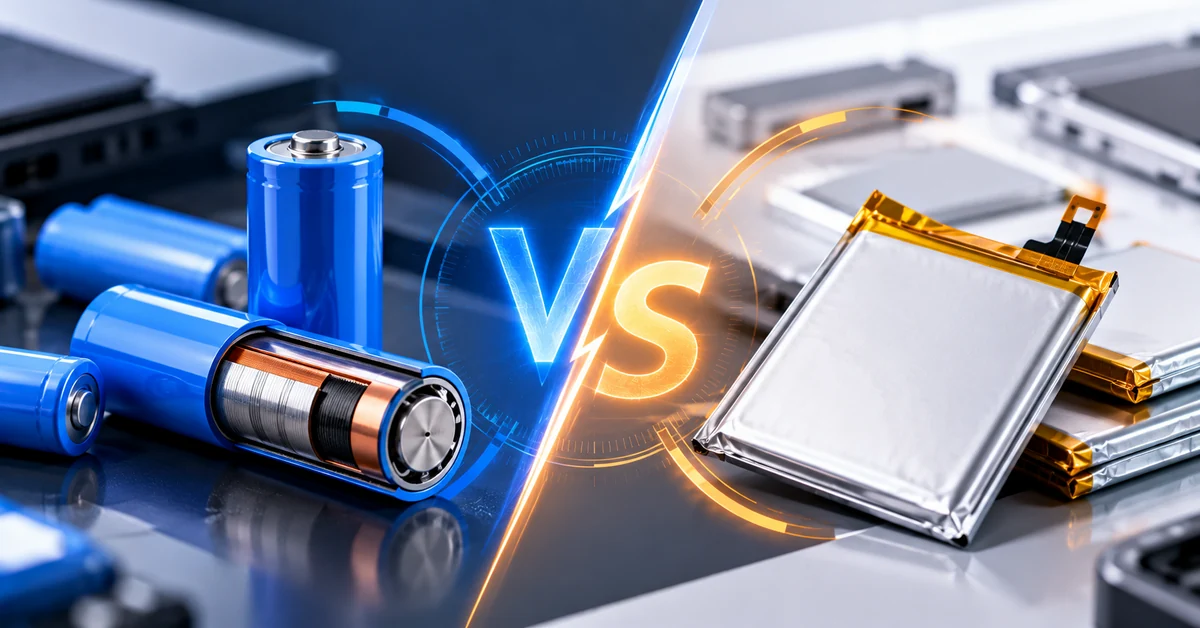

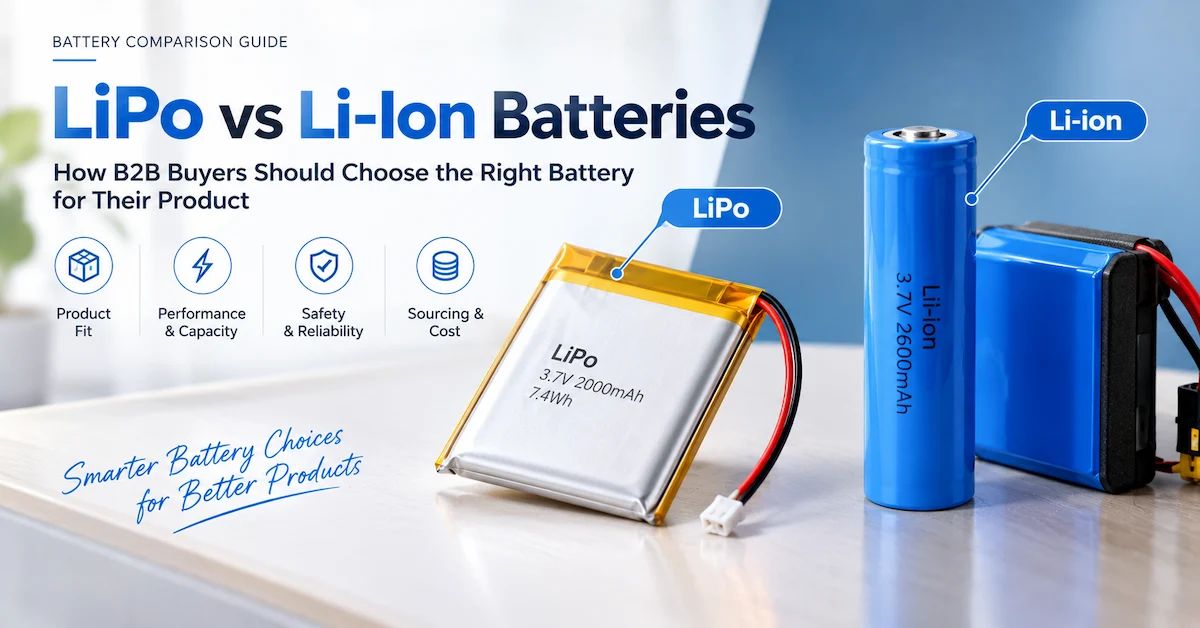
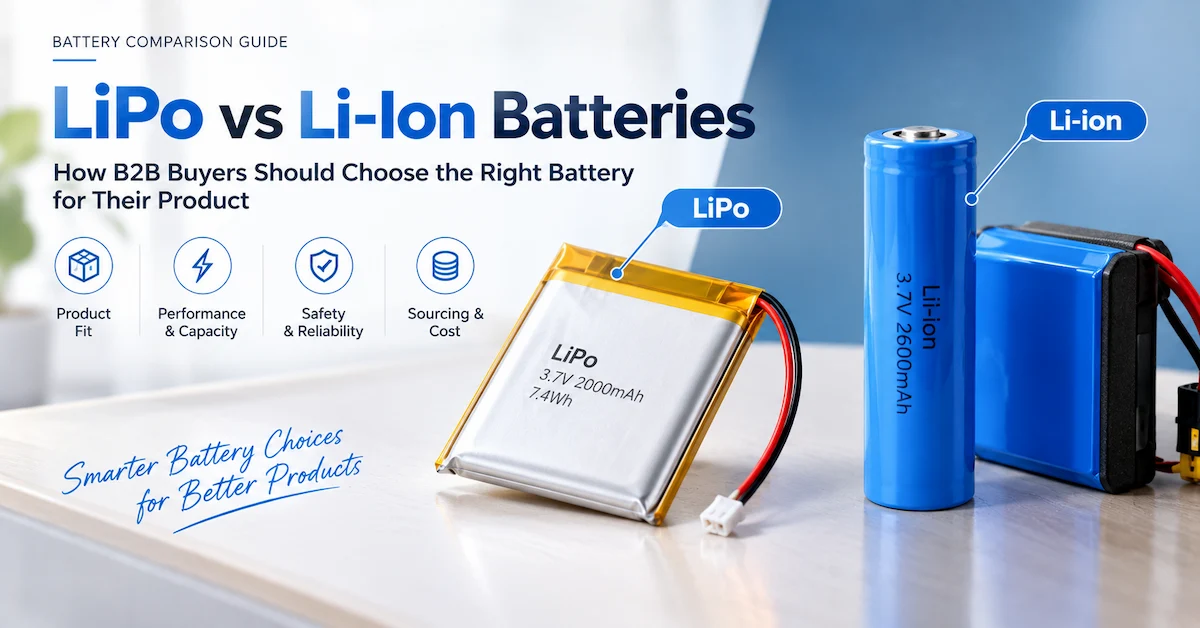
When choosing a rechargeable battery for a new electronic product, buyers often compare LiPo vs Li-Ion batteries as if they were two completely unrelated technologies. In practice, lithium polymer batteries are part of the broader lithium-ion battery family, but their construction, packaging, and available form factors can differ significantly.
For OEM manufacturers, electronics brands, product engineers, and battery distributors, the right choice depends on more than the battery label. Product dimensions, required capacity, discharge current, operating temperature, protection circuitry, charging requirements, and procurement cost must all be considered.
Quick answer: LiPo batteries are often selected for slim, lightweight, or space-constrained products because they are commonly available in pouch formats. Conventional lithium-ion batteries, including cylindrical and prismatic cells, may be more suitable when standardized cell formats, mechanical protection, or established pack designs are priorities. Neither type is universally safer, cheaper, or more energy-dense; the actual cell specification and pack design determine performance.
This guide explains the technical differences, compares common applications, and provides a practical checklist for sourcing lithium batteries for commercial products.
1. What Is the Difference Between LiPo and Li-Ion Batteries?
The most important distinction is that LiPo describes a type of lithium-ion battery construction, while Li-Ion is a broader category of rechargeable batteries that use lithium-ion electrochemistry.
The term LiPo, short for lithium polymer, is commonly used in the commercial battery market for lithium-ion cells supplied in flexible pouch packaging. These cells may use polymer-containing or gel-like electrolyte systems, but many commercial products marketed as LiPo also use liquid electrolyte held within a pouch-cell structure.
Therefore, the term polymer does not automatically mean that a battery contains a completely solid polymer electrolyte.
How LiPo Batteries Work
A LiPo battery stores and releases energy through the movement of lithium ions between its electrodes during charging and discharging.
Many LiPo products use a flexible multilayer pouch rather than a rigid metal cylindrical can.
This construction can help battery designers create thin or customized shapes for devices with limited internal space.
Typical applications include:
-
Smartphones and portable electronics.
-
Smartwatches and wearable devices.
-
Bluetooth speakers and wireless accessories.
-
Compact medical or monitoring electronics, where the complete product design permits.
-
Customized rechargeable battery packs.
The suitability of a particular battery depends on its chemistry, dimensions, electrical characteristics, and safety requirements.
How Conventional Li-Ion Batteries Work
Conventional lithium-ion batteries use the same fundamental principle of reversible lithium-ion movement.
They are available in several formats, including cylindrical cells, rigid prismatic cells, and pouch cells.
Cylindrical formats such as 18650 and 21700 are widely used in applications including portable power equipment, energy storage assemblies, and battery packs. Prismatic cells can also support applications requiring a different mechanical arrangement.
The label Li-Ion alone does not identify the cell chemistry, capacity, discharge capability, or expected service life.
Buyers must obtain the actual technical specification before comparing products.
2. LiPo vs Li-Ion: Technical Comparison Table
The following table summarizes common commercial differences. These are general tendencies, not guaranteed properties of every battery.
|
Comparison factor |
LiPo batteries commonly sold in pouch format |
Conventional cylindrical or prismatic Li-Ion cells |
|---|---|---|
|
Packaging |
Flexible multilayer pouch |
Usually rigid metal casing |
|
Shape flexibility |
Often available in thin or customized dimensions |
Format depends on standardized or selected cell geometry |
|
Space utilization |
Useful for slim or irregular product spaces |
Useful when the design accommodates the selected cell format |
|
Mechanical protection |
Requires appropriate support and protection in the product |
Rigid casing provides additional cell-level mechanical protection |
|
Energy density |
Depends on chemistry, cell design, and packaging |
Depends on chemistry, cell design, and packaging |
|
Discharge capability |
Model-specific |
Model-specific |
|
Cycle life |
Depends on cell chemistry and operating conditions |
Depends on cell chemistry and operating conditions |
|
Safety |
Requires suitable cell design, protection, charging, and handling |
Requires suitable cell design, protection, charging, and handling |
|
Procurement considerations |
Dimensions, pouch protection, custom specifications |
Cell format, pack configuration, holder or enclosure requirements |
|
Best selection method |
Match the cell to the product's space and electrical needs |
Match the cell to the product's space and electrical needs |
A common procurement mistake is to assume that a LiPo battery is always thinner, lighter, or higher-capacity than every conventional Li-Ion alternative.
Actual performance depends on the complete design. Compare documented values at the cell or pack level rather than relying on category names.
3. Which Battery Is Better for Your Product?
The better option is the battery that meets the product's electrical, mechanical, safety, and commercial requirements with the lowest acceptable total cost.
When a LiPo Battery May Be the Better Choice
A pouch-format LiPo battery may be appropriate when a product requires a slim profile, low package thickness, or a specific battery outline.
For example, a wearable device may have limited internal height and a curved housing. A suitably engineered pouch cell may fit the available space more effectively than a cylindrical cell.
Similarly, a compact wireless accessory may benefit from a battery shape that allows the manufacturer to use the internal enclosure efficiently.
However, custom dimensions do not eliminate engineering constraints. The design must still provide appropriate protection against puncture, compression, bending, heat, and swelling.
When a Conventional Li-Ion Cell May Be More Suitable
Cylindrical or rigid prismatic cells may be preferable when the product design accommodates their shape and benefits from an established cell format.
A manufacturer developing a battery-powered tool, portable power system, or larger equipment enclosure may prioritize standardized dimensions, mechanical integration, and a well-defined pack architecture.
The actual decision should consider the complete assembly, including cell holders, wiring, protection electronics, cooling requirements, and enclosure volume.
Decision Matrix for OEM Buyers
|
Product requirement |
Initial option to evaluate |
What must be verified |
|---|---|---|
|
Slim wearable device |
Pouch-format LiPo |
Thickness, capacity, swelling allowance |
|
Compact Bluetooth accessory |
LiPo or another suitable Li-Ion format |
Runtime, peak current, available space |
|
Product using 18650 cells |
Cylindrical Li-Ion |
Cell compatibility, series/parallel design |
|
Custom-shaped portable device |
Pouch or suitable prismatic cell |
Dimensions, production feasibility, protection |
|
High-power application |
Application-qualified cell or pack |
Continuous and peak discharge, thermal behavior |
|
Long-service commercial equipment |
Qualified Li-Ion solution |
Cycle life, calendar aging, maintenance needs |
These are starting points for engineering evaluation, not automatic product recommendations.
4. Energy Density, Capacity, and Battery Size
Energy density is one of the most misunderstood aspects of the LiPo vs Li-Ion comparison.
Energy density describes how much energy a battery stores relative to its mass or volume.
-
Gravimetric energy density is commonly expressed in watt-hours per kilogram (Wh/kg).
-
Volumetric energy density is commonly expressed in watt-hours per liter (Wh/L).
A higher value can help a product achieve longer runtime or reduce battery size, but only if the comparison uses equivalent measurement boundaries and comparable operating conditions.
Battery Capacity Is Not the Same as Energy
Battery capacity is commonly expressed in ampere-hours (Ah) or milliampere-hours (mAh).
Energy is expressed in watt-hours (Wh).
For a battery with a nominal voltage of 3.7 V and a capacity of 2,000 mAh:
This is an illustrative calculation, not a specification for a particular ESC battery.
When comparing two batteries, buyers should consider nominal voltage and watt-hour capacity alongside physical dimensions and mass.
A battery with a higher mAh rating does not necessarily provide more energy if the nominal voltage differs.
How to Compare Battery Specifications Fairly
Request the following information for each candidate:
-
Nominal voltage.
-
Rated capacity and its test conditions.
-
Rated energy in watt-hours.
-
Dimensions and dimensional tolerances.
-
Weight.
-
Continuous and peak discharge limits.
-
Charging voltage and current limits.
-
Operating temperature limits.
-
Expected cycle life and the conditions used to measure it.
A meaningful comparison requires equivalent test conditions and clearly defined product boundaries.
5. Charging Speed, Discharge Rate, and Power Requirements
Battery chemistry and construction influence performance, but the permitted charging and discharging rates are specific to each cell and battery pack.
A product developer should never assume that every LiPo battery supports fast charging or high-current discharge.
Charging Current
Charging current must follow the battery manufacturer's specification.
Excessive charging current can cause overheating, accelerated degradation, swelling, or more serious battery failure.
The charging circuit must be designed for the actual cell chemistry, rated voltage, and charging limits.
Continuous and Peak Discharge
Continuous discharge describes the current a battery can deliver within its specified operating limits over the defined period.
Peak discharge describes a higher current that may be permitted for a limited time under specified conditions.
A battery used in a wireless speaker may have different current demands from one used in a motor-driven device.
Buyers should clarify both continuous and peak requirements rather than asking only for capacity.
Battery Protection and Power Management
Depending on the application, a battery pack may require protection against:
-
Overcharge.
-
Overdischarge.
-
Overcurrent.
-
External short circuits.
-
Abnormal temperature conditions.
The exact protection architecture depends on the product, cell configuration, applicable requirements, and system design.
A protection circuit does not make an unsuitable cell appropriate for an application. Cell selection, charger design, wiring, thermal management, and enclosure design must work together.
6. LiPo vs Li-Ion: Safety, Swelling, and Service Life
Neither LiPo nor conventional Li-Ion batteries should be treated as inherently safe under all conditions.
Both can experience thermal runaway if severely abused or damaged, and both require appropriate charging, protection, manufacturing quality, and transport controls.
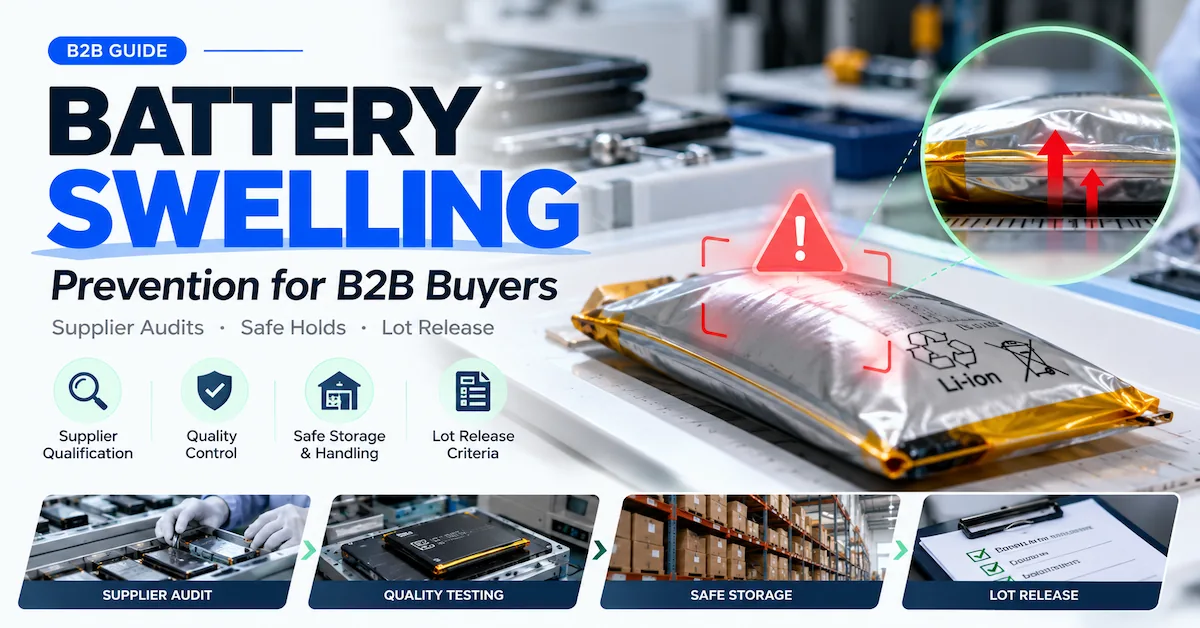
Why Can a LiPo Battery Swell?
Pouch-cell swelling may result from gas generation associated with cell aging, abnormal operating conditions, or degradation.
A swollen battery should not be punctured, compressed, forcibly flattened, or returned to normal use.
For commercial products, swelling allowance and enclosure design should be considered during product development. The enclosure must not impose damaging pressure on the cell.
Do Li-Ion Batteries Have a Longer Cycle Life?
Not necessarily.
Cycle life depends on factors such as electrode chemistry, charging limits, discharge depth, temperature, current, and the criteria used to define end of life.
Some lithium-ion chemistries are designed to prioritize long cycle life, while others prioritize energy density or power delivery.
The same principle applies to batteries marketed as LiPo.
Buyers should request cycle-life data that identifies the tested model, operating conditions, and capacity-retention threshold. A generic cycle-life claim is not sufficient for a product qualification decision.
Battery Safety Questions for Suppliers
Before approving a battery for production, request information on the exact cell model, protection design, charging limits, temperature limits, traceability, and relevant safety documentation.
Applicable requirements depend on the battery configuration and destination market. Transport testing, such as UN 38.3 where applicable, is separate from the question of whether a battery is suitable for a specific end product.
Do not assume that one report automatically covers every cell, pack, or modified design.
7. How OEM Buyers Should Specify a LiPo or Li-Ion Battery
For manufacturers and distributors, a clear technical request reduces unsuitable quotations and delays.
Instead of asking for a generic LiPo battery or Li-Ion battery, define the battery's intended role in the finished product.
Battery Specification Checklist
|
Specification |
Information to provide |
|---|---|
|
Application |
Product type and operating environment |
|
Battery format |
Pouch, cylindrical, or prismatic |
|
Nominal voltage |
Required system voltage |
|
Capacity |
Target Ah or mAh |
|
Energy |
Target Wh, where relevant |
|
Maximum dimensions |
Length, width, and thickness |
|
Weight limit |
Maximum permitted battery mass |
|
Discharge requirements |
Continuous and peak current |
|
Charging requirements |
Charger design and allowed charging current |
|
Temperature |
Expected operating and charging range |
|
Protection |
Required protection and monitoring functions |
|
Connector |
Type, polarity, cable length, and position |
|
Quantity |
Prototype, pilot, and forecast production volume |
|
Documentation |
Applicable test reports and technical documents |
|
Customization |
Labels, wiring, packaging, or pack configuration |
For custom battery projects, confirm whether the proposed solution requires new tooling, a custom protection board, cable changes, or additional validation.
These factors can influence both the initial development cost and the final unit price.
8. How Should Buyers Compare Battery Supplier Quotes?
The lowest quoted unit price does not always provide the lowest total procurement cost.
Two offers may differ in cell grade, capacity tolerance, protection components, connectors, documentation, packaging, or testing scope.
Compare Equivalent Specifications
Before evaluating price, make sure each supplier is quoting the same nominal voltage, capacity, dimensions, discharge requirements, and protection configuration.
Request clarification whenever a specification is missing.
Check Sample-to-Production Consistency
A sample should be approved against a documented specification.
For repeat orders, establish a process to confirm that the delivered battery matches the approved design and relevant performance requirements.
Review Documentation
Ask for applicable technical data sheets, safety information, test documentation, and transport-related records.
The required documents depend on the product, configuration, and destination market. A certificate or report for one battery model should not be assumed to cover a different model.
Calculate Total Cost of Ownership
A practical comparison should include:
-
Unit price.
-
Customization and tooling costs.
-
Sample and validation costs.
-
Packaging and shipping.
-
Incoming inspection.
-
Expected product yield.
-
Warranty and replacement exposure.
-
Inventory and obsolescence risk.
A lower purchase price can be outweighed by additional testing, unsuitable dimensions, inconsistent performance, or increased warranty costs.
9. What Applications Commonly Use LiPo and Li-Ion Batteries?
The battery format should be selected according to the requirements of the finished product.
|
Application |
Possible battery approach |
Key selection criteria |
|---|---|---|
|
Smartphones |
Application-specific lithium-ion pouch or other approved cell design |
Dimensions, energy, charging, protection |
|
Smartwatches |
Compact pouch-format lithium-ion battery |
Thickness, weight, connector, shape |
|
Bluetooth speakers |
Pouch or cylindrical lithium-ion cells |
Runtime, peak current, enclosure |
|
Power banks |
Qualified lithium-ion cells and pack architecture |
Capacity, charging, output power, thermal design |
|
Portable tools |
Suitable cylindrical, prismatic, or engineered pack |
Discharge current, thermal performance, cycle life |
|
Industrial electronics |
Application-qualified cell or battery pack |
Environmental conditions, reliability, service life |
|
Custom OEM devices |
Format selected through engineering evaluation |
Mechanical, electrical, safety, and commercial requirements |
These are general application examples. The appropriate format must be verified for the specific product and operating conditions.
Sourcing Batteries for Mobile Devices
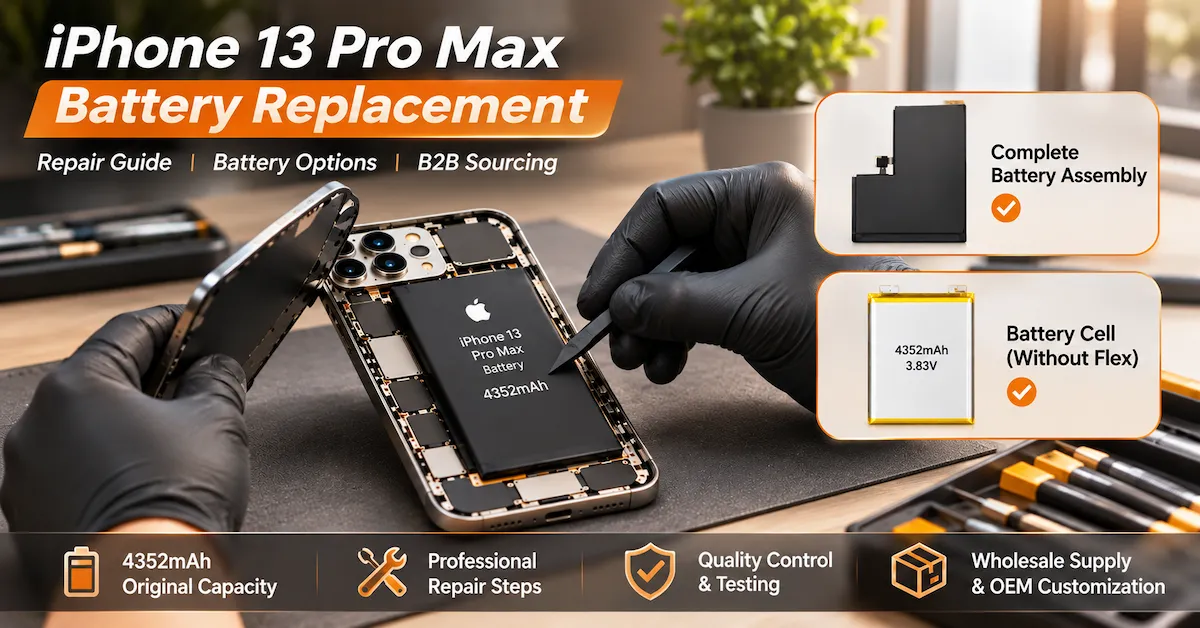
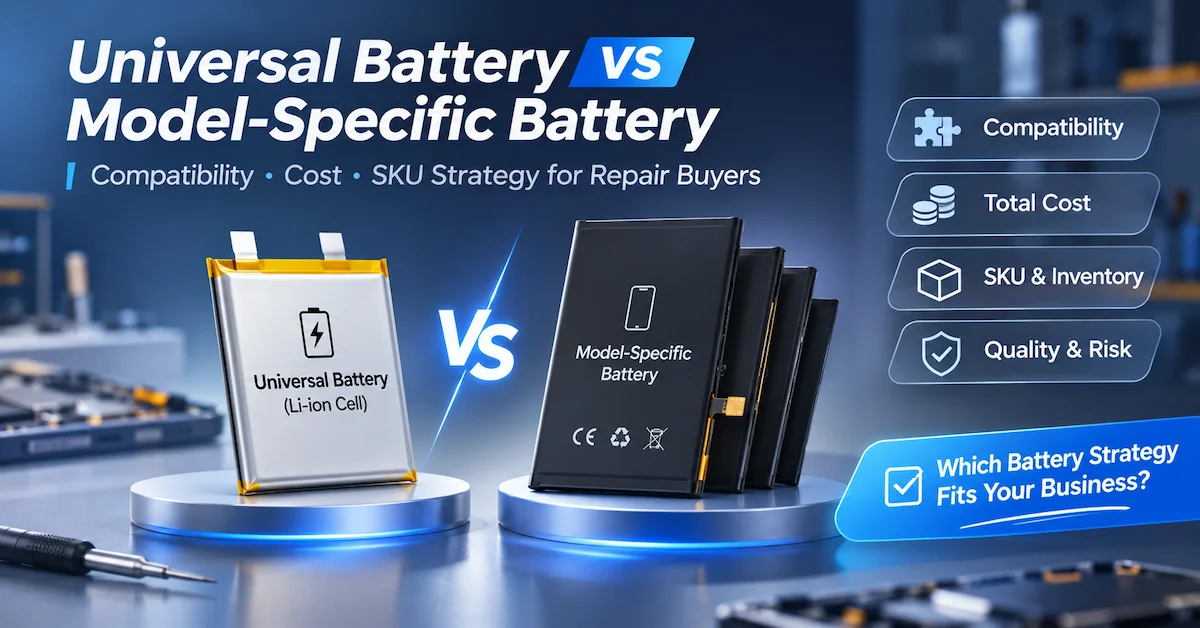
Mobile repair businesses and distributors often need batteries that match specific device models rather than a general chemistry category.
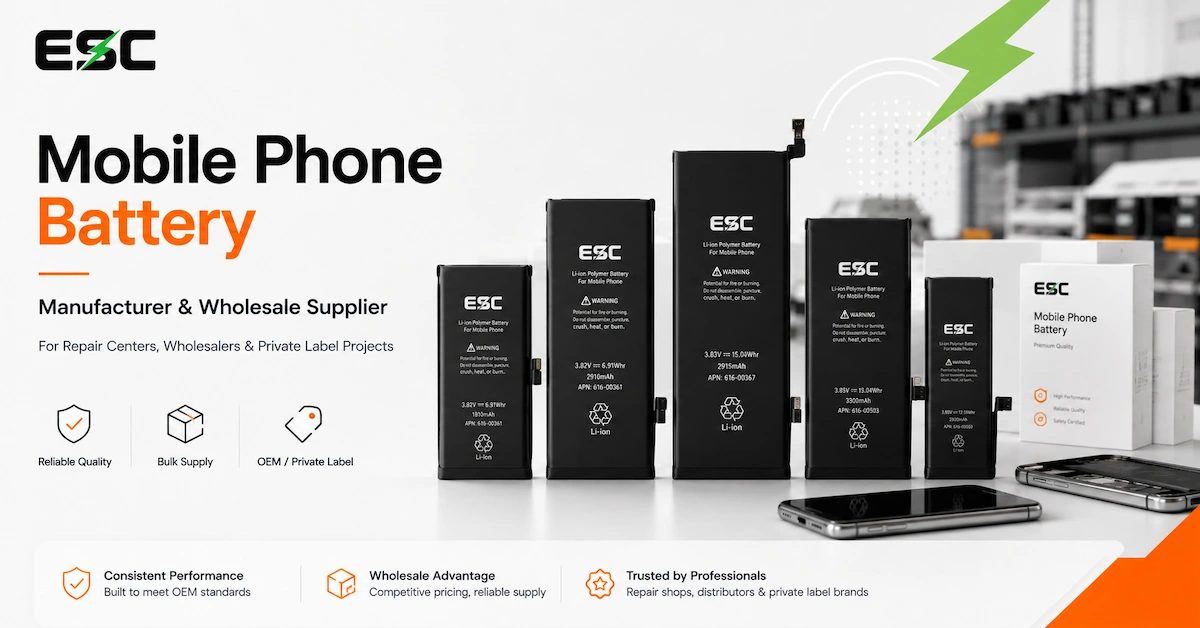
For this purchasing requirement, buyers can explore ESC's mobile phone battery collection and review the wearable and audio device battery collection.
The correct product must still be selected by its actual model compatibility and published specifications.
Sourcing Batteries for Power Banks
Power-bank manufacturers and distributors need to consider both the internal battery and the complete power-management system.
ESC's power bank product category provides a starting point for reviewing its published power-bank offerings.
For OEM projects, clarify the required capacity, charging inputs, output interfaces, protection functions, packaging, and destination-market requirements before requesting a quotation.
10. OEM and Custom Battery Development: What Should Be Confirmed?
When a standard battery does not meet a product's requirements, an OEM buyer may need a customized battery configuration or pack.
Customization can involve dimensions, wiring, connectors, protection electronics, labeling, or packaging. Feasibility depends on the battery design, production process, minimum order requirements, and engineering resources.
Before beginning a project, buyers should confirm:
-
Whether the required cell format is available.
-
Whether the target dimensions and capacity are technically feasible together.
-
Whether custom wiring or connectors are required.
-
Whether a protection circuit or battery-management system is needed.
-
Which samples and validation tests must be approved.
-
Which technical documents are available for the final configuration.
-
The quoted MOQ, sample cost, lead time, and production schedule.
A custom shape does not guarantee that every desired electrical specification can be achieved within the same dimensions. Engineering feasibility should be established before commercial commitments are made.
For battery procurement enquiries, buyers can contact ESC with their target specifications and intended application. Product availability, customization scope, and commercial terms should be confirmed directly.
11. Frequently Asked Questions About LiPo vs Li-Ion Batteries
Is LiPo the same as Li-Ion?
LiPo batteries are generally part of the broader lithium-ion battery family. The terms are often used to distinguish pouch-style commercial products from conventional cylindrical or rigid-cell formats, although terminology varies by supplier.
Which is better, LiPo or Li-Ion?
Neither is universally better. LiPo pouch cells may be suitable for thin or space-constrained products, while cylindrical or prismatic cells may suit products designed around rigid cell formats. The correct choice depends on actual specifications and application requirements.
Does LiPo have a higher energy density than Li-Ion?
Not always. Energy density depends on cell chemistry, electrode design, packaging, and whether the comparison is made at the cell or complete-pack level. Compare documented Wh/kg and Wh/L values for the specific models.
Which battery lasts longer?
Service life depends on the specific cell and how it is used. Temperature, charging voltage, discharge depth, current, and aging conditions can all affect cycle life.
Are LiPo batteries more dangerous?
Neither category should be considered inherently safe under all conditions. Both require appropriate cell selection, charging controls, protection, mechanical design, and handling procedures.
Can LiPo and Li-Ion batteries use the same charger?
Only when the charger is compatible with the specific battery chemistry, voltage, charging profile, and protection requirements. A charger should never be selected based on the LiPo or Li-Ion label alone.
Can a LiPo battery replace a conventional Li-Ion battery?
Not automatically. The replacement must match the required voltage, dimensions, capacity, discharge characteristics, connector, protection requirements, and charging system.
What should a buyer request from a battery supplier?
Request a model-specific data sheet, dimensional drawing, rated capacity, voltage, charging and discharging limits, protection details, applicable safety documentation, MOQ, lead time, and quotation terms.
Is a higher-capacity battery always better?
No. A higher capacity may increase size or weight and may not be compatible with the original charging or protection system. Confirm mechanical and electrical compatibility before approving a higher-capacity alternative.
What is the best battery for an OEM project?
The best battery is the one that meets the product's electrical, mechanical, safety, lifecycle, and commercial requirements. A defined specification and sample-validation process are more reliable than choosing by chemistry name alone.
Conclusion
The choice between LiPo vs Li-Ion batteries is fundamentally an engineering and procurement decision, not a simple comparison between two unrelated technologies. LiPo pouch cells can offer useful packaging flexibility for compact electronics, while cylindrical and prismatic lithium-ion cells may suit products built around established rigid formats.
OEM buyers should compare actual capacity, energy density, dimensions, discharge capability, charging limits, safety controls, service life, and total procurement cost. A clear technical specification, model-specific documentation, and sample qualification process can help reduce sourcing errors and improve product consistency.
For businesses sourcing batteries for mobile phones, wearables, audio products, and power banks, ESC's published product categories provide a starting point for identifying relevant battery solutions. Confirm the exact model, specifications, availability, and customization requirements before placing an order.