
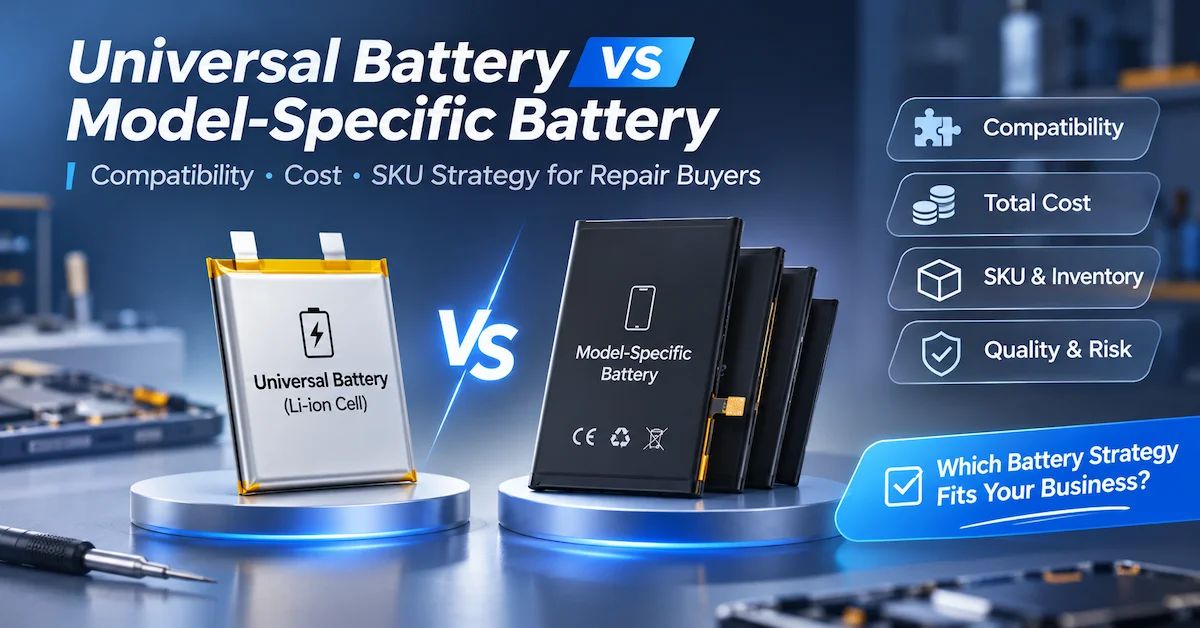
TL;DR: A universal battery platform may simplify cell sourcing, but a model-specific finished battery is generally the more straightforward choice for repair businesses that need an approved, ready-to-install component. Universal cells require additional verification of voltage, dimensions, connectors, protection electronics, and assembly. The best sourcing decision depends on qualified cost, production capability, device coverage, and the buyer's ability to control substitutions.
For smartphone repair chains, refurbishment companies, and replacement battery wholesalers, maintaining inventory across multiple device models can be expensive and operationally complex.
A universal battery appears attractive because it suggests fewer SKUs, simplified purchasing, and wider device coverage.
However, broad compatibility claims can conceal important technical differences.
Two batteries may share similar dimensions or capacity while using different connectors, voltage limits, protective electronics, or installation configurations.
A universal cell platform may be useful for qualified assembly operations, but it does not automatically provide a finished battery suitable for multiple smartphones.
The purchasing challenge is therefore to determine when universal-format battery sourcing makes sense and when model-specific replacement batteries provide better overall value.
This article compares both approaches using technical, commercial, and quality-control criteria. It also explains how ESC's replacement battery product portfolio can support professional multi-model sourcing.
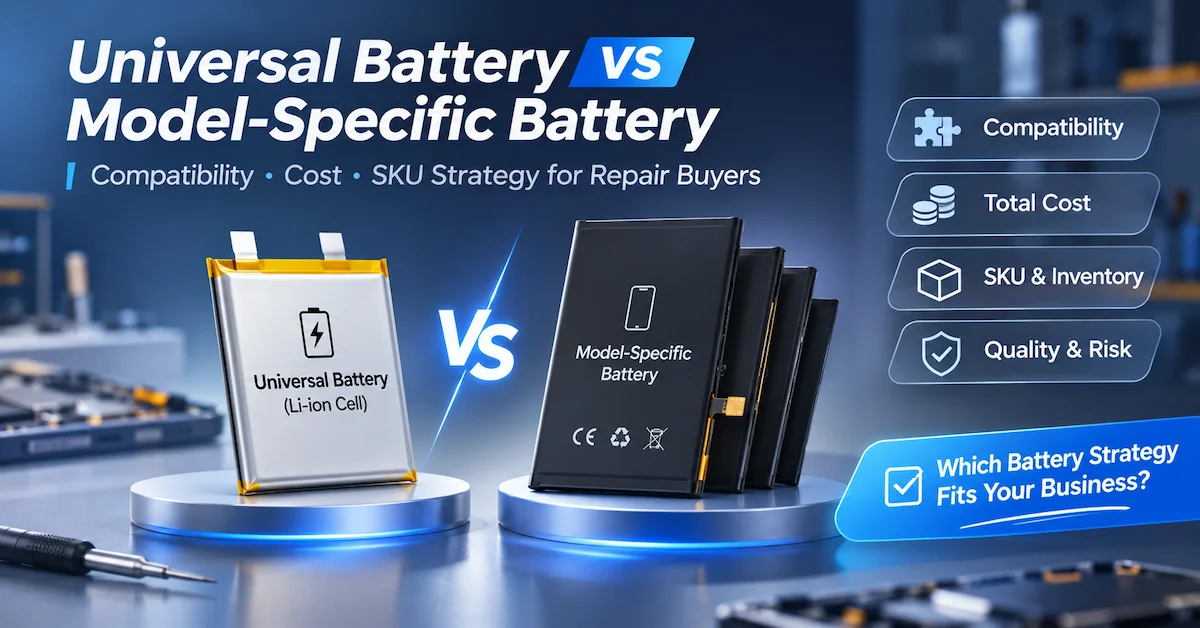
Quick Reference: Universal Battery vs Model-Specific Battery
The following four-dimensional comparison helps buyers identify the more suitable purchasing model.
| Evaluation dimension | Universal cell platform | Model-specific finished battery | Recommended decision |
|---|---|---|---|
| Device compatibility | Requires engineering validation for each application | Designed for identified compatible devices | Choose finished batteries for direct professional replacement |
| Electrical and mechanical integration | May require additional electronics, connections, and assembly | Supplied as an identified assembly | Universal platforms require qualified integration capability |
| Total qualified cost | May reduce some component costs but adds integration expenses | Includes more finished-assembly content | Compare cost per accepted installed unit |
| Procurement and lead time | Depends on conversion, testing, and component availability | Depends on approved SKU availability | Choose according to validated supply continuity |
Key conclusion: Universal battery platforms offer potential component flexibility, while model-specific finished batteries generally simplify repair procurement.
Neither approach should be approved solely on the basis of price, capacity, or product naming.
Key Takeaways
-
Universal does not mean interchangeable. Device compatibility requires verified electrical, mechanical, and assembly specifications.
-
Model-specific finished batteries reduce integration responsibilities for repair businesses without specialized battery assembly capabilities.
-
Total qualified cost matters more than unit price. Assembly, inspection, rework, and warranty expenses can change the economics.
-
Inventory consolidation should not compromise compatibility. Approved model-specific SKUs may remain necessary even when procurement is centralized.
-
Supplier evidence and lot traceability are essential. Each replacement configuration needs clear identification, testing, and change control.
-
A hybrid sourcing strategy can be useful. Finished batteries may cover popular devices while qualified cell-platform projects serve selected specialized applications.
Which Battery Option Provides More Reliable Device Compatibility?
Direct answer: Model-specific finished batteries generally simplify compatibility management because their connections and assembly are intended for defined devices. A universal battery cell requires additional validation before it can become part of a compatible finished assembly.
Compatibility is the first engineering constraint.
A battery should never be considered suitable merely because its size, advertised capacity, or commercial description resembles an existing product.
Electrical compatibility
Buyers need to verify nominal voltage, charging limits, discharge requirements, and applicable protection and monitoring functions.
A 4,000mAh battery is not necessarily interchangeable with another 4,000mAh product.
Capacity describes charge under specified conditions. It does not determine whether the device's charging system can safely operate with the proposed cell.
Mechanical compatibility
A compatible battery must fit within the available device space without improper pressure.
Important parameters include length, width, thickness, corner shape, connection position, insulation, and assembly tolerances.
Mechanical clearance must be assessed for the complete assembly, not only the bare cell.
Connector and electronics compatibility
Modern smartphone batteries may include device-specific flex cables, connectors, sensors, and protection or monitoring electronics.
A universal cell may require additional components before it becomes a usable replacement.
These requirements should be verified by qualified personnel using an approved design and validation process.
Four essential approval gates
| Approval gate | Verification requirement | Stop condition |
|---|---|---|
| Electrical | Voltage limits, capacity specification, protection design | Unverified electrical requirements |
| Mechanical | Dimensions, tolerances, installation clearance | Incorrect fit or enclosure pressure |
| Interface | Connector, polarity, flex, sensing and communication where applicable | Unverified connection or electronics |
| Device validation | Safe installation and intended operating behavior | Failed or incomplete qualification |
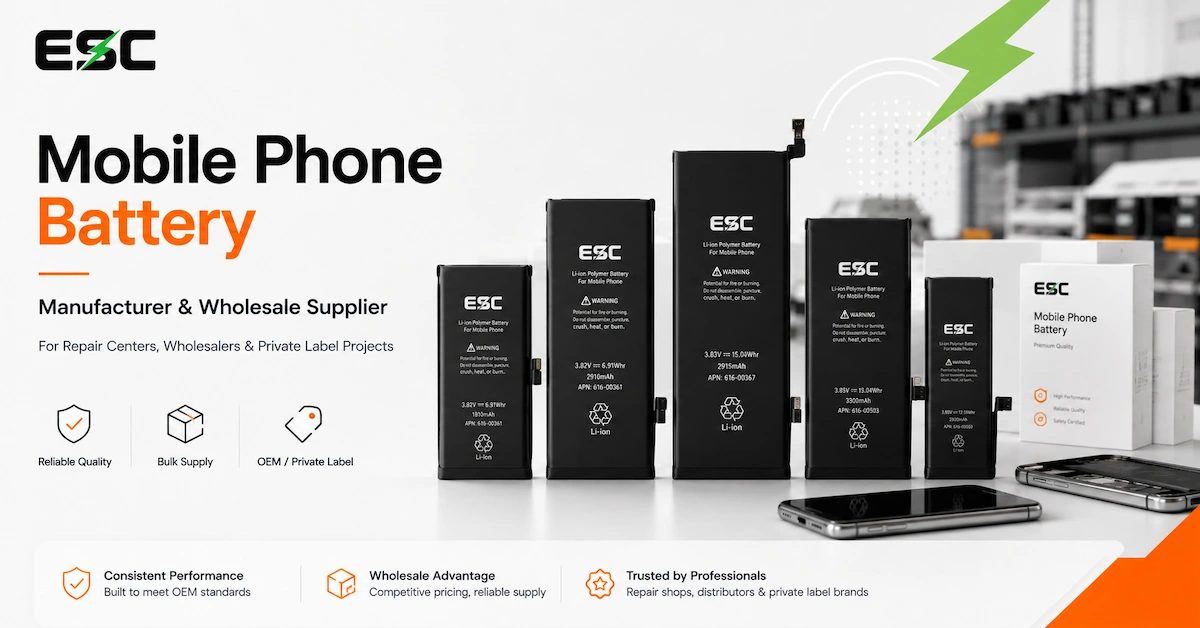
For regular repair shops, ESC's model-specific mobile phone batteries provide a more relevant purchasing starting point than assuming a single battery can replace unrelated device models.
When Does a Universal Battery Become More Cost-Effective?
Direct answer: Universal cell sourcing can be commercially attractive when component standardization benefits exceed the additional costs of engineering, assembly, testing, and inventory control. There is no universal break-even quantity that applies to every battery project.
The initial cell price is only one part of the total purchasing cost.
A supplier may offer a standardized cell at a lower price than a finished replacement battery.
However, the buyer may need to account for protection electronics, flex assemblies, insulation, specialized production equipment, inspection, and integration labor.
Total qualified cost comparison
Universal cell platform:
Total Cost = Cell Purchase + Additional Components + Assembly + Qualification + Inspection + Logistics + Rework + Warranty Allowance
Model-specific finished battery:
Total Cost = Finished Battery Purchase + Incoming Inspection + Logistics + Installation Rework + Warranty Allowance
Both approaches may also involve inventory carrying costs.
Why lower component prices can be misleading
Suppose a universal cell is less expensive than a finished replacement assembly.
If the buyer lacks qualified assembly equipment, the cost of converting the cell into an approved replacement may exceed the initial saving.
Conversely, an experienced assembly operation working with a stable design may achieve a favorable cost structure through controlled component sourcing.
The correct comparison is the cost per accepted, compatible finished battery, not the price of the cell alone.
What determines the break-even point?
The important variables include production volume, design stability, component costs, assembly yield, engineering expenses, and testing requirements.
Buyers should calculate these factors using actual supplier quotations and production data.
A cost advantage should not be claimed without comparable evidence.
How Do Device Design and Battery Format Affect Feasibility?
Direct answer: Device construction determines whether a universal-format cell can be adapted into an approved battery assembly. A standardized cell shape does not guarantee that the finished pack will fit or operate correctly.
Modern smartphones, tablets, laptops, and wearables use different internal layouts.
Smartphone batteries
Many smartphone batteries use compact pouch-cell constructions with device-specific connectors and flexible circuits.
The finished assembly must match the target device's electrical and mechanical requirements.
A bare cell is not equivalent to a complete ready-to-install battery.
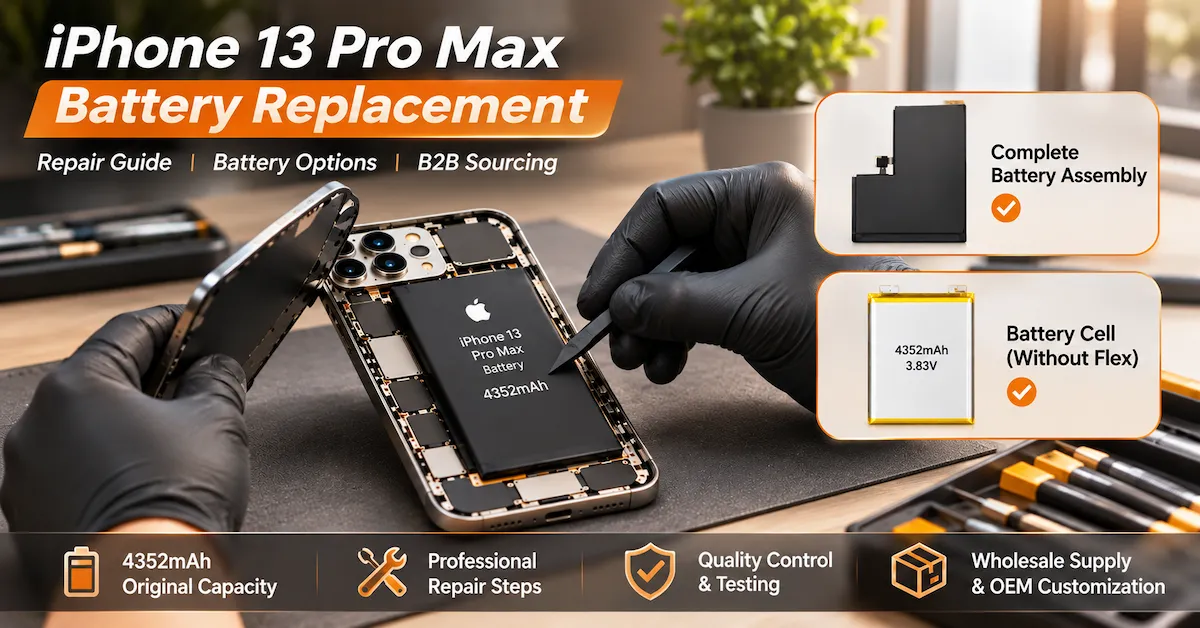
ESC also lists iPhone battery cells without flex assemblies, which serve specialized professional repair workflows rather than ordinary battery-only replacement.
Tablet and laptop batteries
Tablet and laptop battery configurations may have different capacities, mechanical shapes, electronic interfaces, and pack designs.
Some laptop batteries contain multiple cells integrated into a monitored assembly.
For these products, the complete pack specification is especially important.
Buyers can review ESC's tablet and laptop replacement battery range for model-specific sourcing.
Wearable and audio device batteries
Smartwatches, wireless earbuds, and portable audio devices often impose strict size and connection requirements.
Small differences in thickness or connector configuration may prevent installation.
ESC's wearable and audio battery category covers these specialized applications.
External portable batteries
An external power bank may support several devices through compatible charging interfaces.
However, it does not replace their internal batteries.
ESC's power bank and charger range should therefore be evaluated as a separate product category.
Why Do Battery Sourcing Risks Differ Between the Two Approaches?
The main difference lies in the number of responsibilities involved in making the battery usable.
Universal cell platform risks
Potential risks include incorrect cell selection, inadequate assembly validation, incompatible protection electronics, and inconsistent conversion processes.
An assembly operation must control the complete design and verify that it meets the intended application requirements.
Finished replacement battery risks
Potential risks include incorrect SKU identification, inconsistent supplier revisions, unsuitable connectors, batch variation, and inadequate incoming inspection.
A model-specific product reduces certain integration requirements but does not eliminate the need for quality control.
Recommended risk-control matrix
| Potential failure | Universal cell platform | Finished replacement battery | Control method |
|---|---|---|---|
| Incorrect electrical specification | Cell selection or integration mismatch | Wrong or substituted SKU | Approved specification |
| Mechanical interference | Cell or completed assembly does not fit | Incorrect dimensions or configuration | Drawing and sample inspection |
| Connector incompatibility | Additional connection integration required | Wrong flex or connector | Device-specific compatibility check |
| Protection mismatch | Missing or incompatible electronics | Incorrect assembly revision | Functional and document verification |
| Batch inconsistency | Cell or assembly process variation | Finished-product variation | Lot testing and traceability |
| Warranty disputes | Unclear responsibility between parties | Unclear supplied configuration | Defined contractual responsibilities |
How should suppliers demonstrate quality control?
ESC describes quality-control activities covering capacity, voltage, internal resistance, aging, and final inspection.
These are relevant topics for supplier qualification, but buyers should request the methods and records applicable to the actual quoted product.
A supplier should be able to identify its approved configuration, inspection criteria, and process for handling nonconforming products.
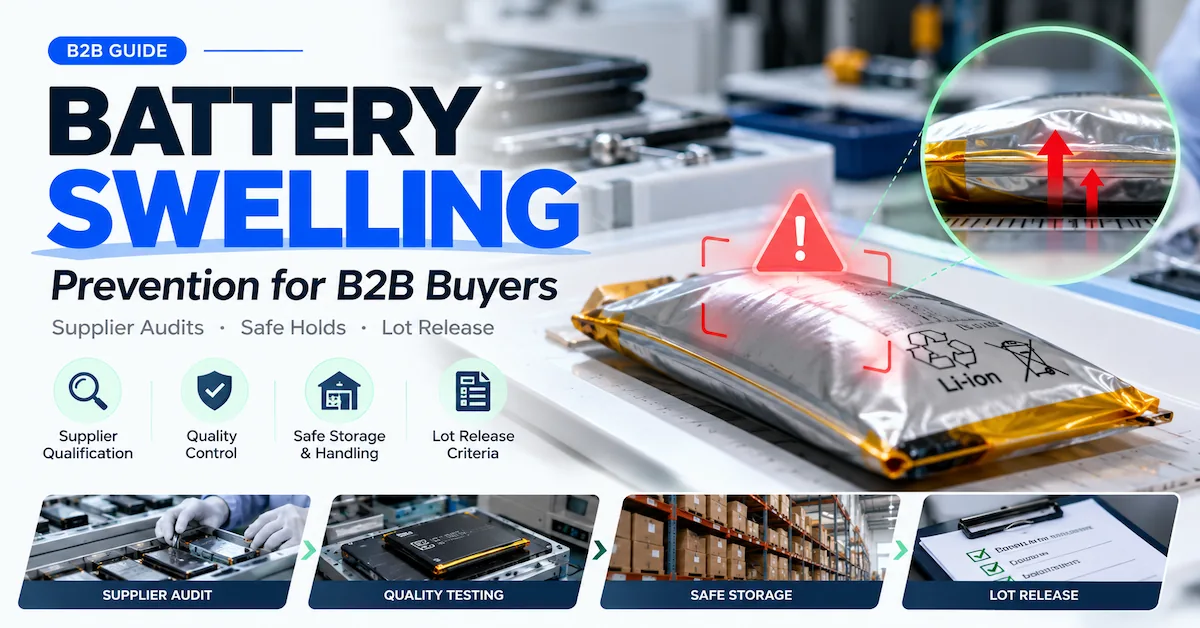
Safety consideration: A visibly swollen, leaking, unusually hot, or physically damaged lithium-ion battery must not undergo routine charging or installation testing. Follow an appropriate trained-personnel safety procedure.
How Do MOQ, Lead Time, and Production Volume Affect Sourcing?
Sourcing economics also depend on the time required to deliver usable components.
For model-specific replacement batteries, buyers should ask about existing stock, mixed-model order support, and repeat-order consistency.
For universal cell projects, lead time may include additional engineering review, assembly preparation, and qualification.
Procurement planning considerations
Sample stage: Establish the correct configuration and obtain representative samples.
Qualification stage: Verify electrical, mechanical, and functional requirements.
Pilot stage: Evaluate production-representative material.
Bulk supply stage: Confirm the approved product revision, quantity, delivery schedule, and inspection requirements.
A supplier's quoted production lead time should not be confused with the total time required for a new product qualification.
Similarly, a small pilot order should not be treated as proof of long-term production capacity.
ESC supports mixed-model purchasing within its replacement battery business, but MOQ, availability, and lead time must be confirmed for each order.
When Does a Hybrid Battery Sourcing Strategy Make Sense?
Direct answer: A hybrid sourcing strategy can combine model-specific finished battery purchasing for common repairs with separately qualified cell-platform sourcing for specialized applications. It should not involve mixing unverified cells or components within an approved assembly.
This approach allows a business to serve different customer segments without forcing every product into one supply model.
Recommended sourcing portfolio
| Demand category | Suggested strategy | Main benefit |
|---|---|---|
| High-volume common smartphone models | Model-specific finished batteries | Simplified replenishment |
| Medium-demand repair models | Approved model-specific batteries with controlled stock | Balanced coverage and inventory |
| Specialized professional assembly projects | Qualified universal cell platforms | Potential component flexibility |
| Low-demand legacy devices | Order-based or limited approved stock | Reduced inventory exposure |
| External portable charging needs | Compatible power banks | Multi-device external charging |
The portfolio should be reviewed periodically using actual demand and supplier performance.
A broad product range does not mean every component should be physically interchangeable.
Universal Battery Sourcing Decision Tree
Use the following five-step framework before requesting quotations.
Step 1: Is the requirement internal replacement or external charging?
If the product only needs external charging, evaluate an appropriate power bank or charger.
If the battery must be installed inside a device, continue to Step 2.
Step 2: Does the buyer need a ready-to-install assembly?
Yes: Prioritize an approved model-specific replacement battery.
No: A professional cell-platform project may be evaluated if the buyer has suitable engineering and assembly capability.
Step 3: Has electrical and mechanical compatibility been validated?
No: Do not approve the substitute. Obtain the required technical evidence.
Yes: Continue to sample qualification and controlled testing.
Step 4: Does the universal platform provide a verified cost advantage?
Compare the total qualified costs, including assembly, inspection, rework, and warranty exposure.
If the benefit is not established, a finished replacement assembly may be the more practical purchasing option.
Step 5: Can the supplier maintain repeatable quality and traceability?
Approve the selected strategy only when specifications, samples, product revisions, and incoming inspection requirements are controlled.
Final decision rule: Technical suitability comes before purchasing convenience. Cost optimization should occur only after compatibility and quality requirements are satisfied.
Illustrative Case: Planning Battery Inventory for a 500-Device Refurbishment Batch
Consider a hypothetical refurbishment company receiving 500 smartphones from several manufacturers.
The devices include popular models, less common variants, and a small group requiring specialized repair.
The purchasing team initially considers using a universal battery platform to reduce the number of replacement SKUs.
However, its compatibility review identifies three different purchasing requirements.
Initial sourcing challenges
Common models: Approved finished replacement batteries are readily suitable for standard repair workflows.
Less common models: Stock requirements are smaller, making demand forecasting important.
Specialized devices: Certain configurations require additional engineering review and cannot be substituted using capacity alone.
Recommended purchasing allocation
For common models, the company selects approved finished replacement batteries and manages stock according to actual refurbishment demand.
For less common models, it limits inventory and orders against forecast or confirmed repair requirements.
For specialized projects, it considers a universal cell platform only after the responsible engineers establish a validated finished-assembly configuration.
What should the company measure?
| Performance indicator | Commercial purpose |
|---|---|
| Approved SKU coverage | Measures whether demanded models are supported |
| Incorrect-part receipts | Detects purchasing and supplier identification problems |
| First-pass repair yield | Measures successful repairs without rework |
| Average qualified battery cost | Compares real purchasing economics |
| Inventory turnover | Identifies excess or slow-moving stock |
| Battery-related warranty claims | Tracks confirmed after-sales issues |
This is an illustrative planning scenario, not a measured ESC customer project.
The business should compare actual results before claiming savings from either sourcing strategy.
How Should B2B Buyers Qualify a Universal Battery Supplier?
Supplier qualification should focus on the exact product configuration rather than general compatibility claims.
A useful request for quotation should include the target device models, battery part numbers, required assembly type, nominal voltage, capacity, dimensions, connector information, quantities, destination market, and applicable documentation.
Buyers should also request:
-
A model-specific compatibility matrix
-
Approved technical specifications
-
Sample and pilot qualification conditions
-
Quality-control methods and acceptance criteria
-
Product revision and traceability information
-
Mixed-model purchasing terms
-
OEM labeling and packaging requirements
-
Warranty and corrective-action procedures
For international lithium battery shipments, transport documentation must correspond to the actual cell or battery configuration.
IATA's 2026 battery guidance distinguishes cells, batteries, and external power banks for transport purposes. This classification does not establish device compatibility or replace applicable shipping requirements.
How ESC Supports Multi-Model Battery Procurement
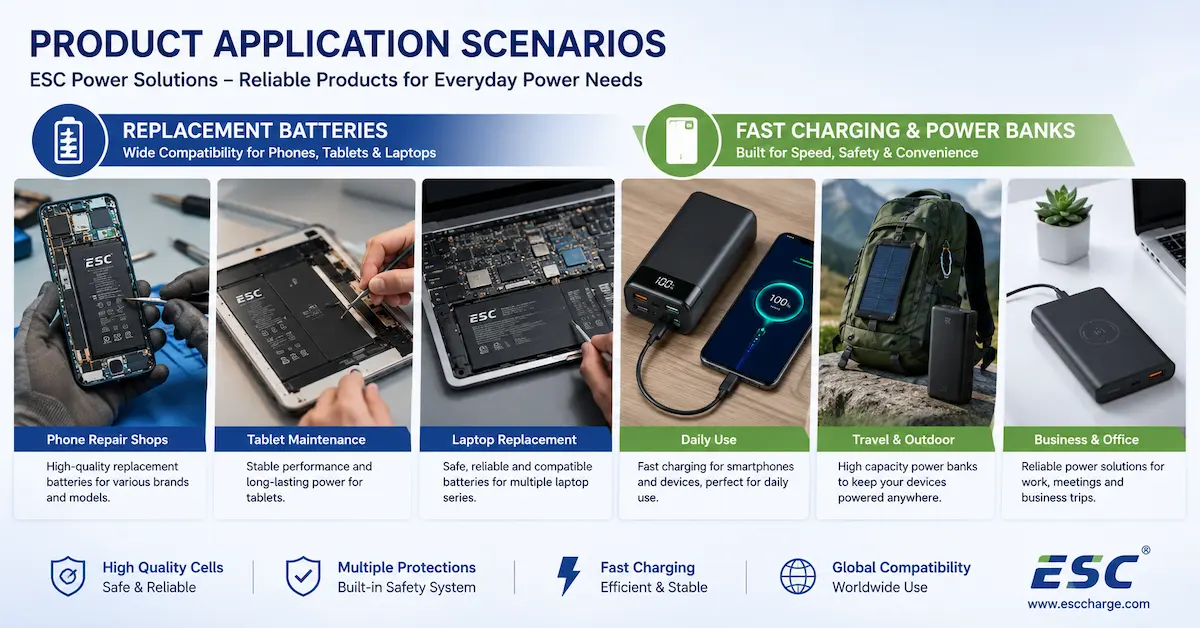
ESC supplies replacement batteries for smartphones, tablets, laptops, wearables, and portable audio devices.
Its product range supports professional repair shops, refurbishment companies, wholesalers, and private-label buyers.
ESC also publishes OEM labeling, packaging customization, and mixed-model purchasing services for relevant product categories.
However, buyers should not interpret broad product coverage as proof of one finished universal battery compatible with every device.
For sourcing, explore the ESC replacement battery catalog and contact ESC with your device list, expected order quantities, technical requirements, and target market.
Ask for model-specific quotations and sample conditions before approving bulk purchases.
Frequently Asked Questions
1. What is a universal battery?
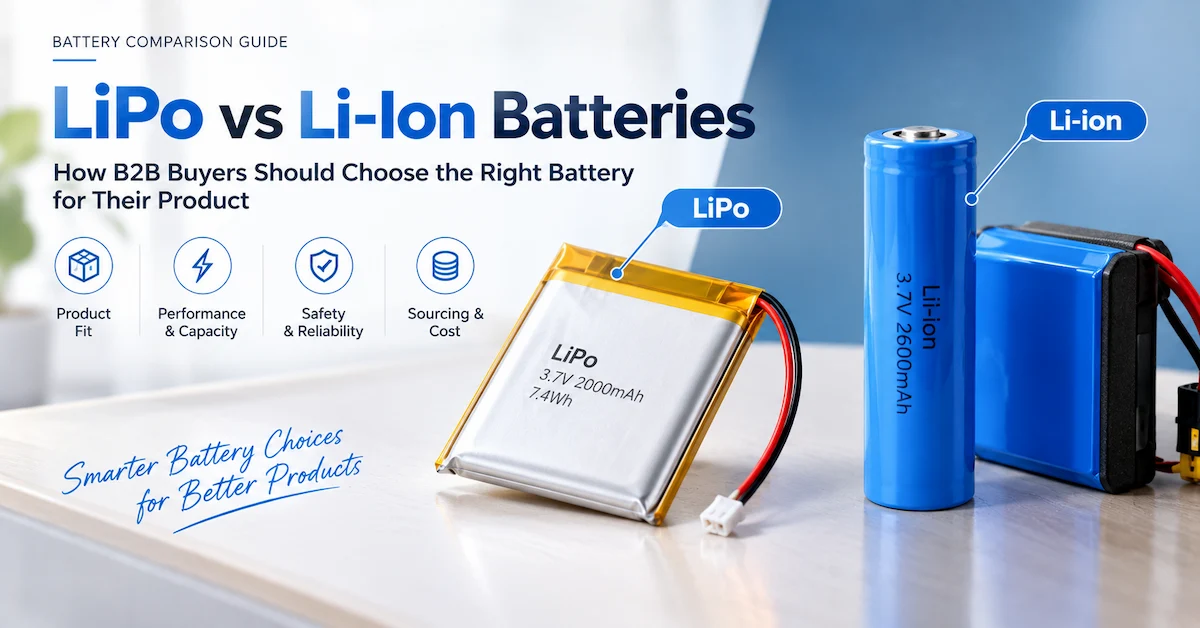
A universal battery is a broad commercial term describing a battery intended for multiple applications. It may refer to a standardized cell platform, a multi-model replacement assembly, or an external power source. The actual configuration must be identified before purchasing.
2. Can one universal battery replace all smartphone batteries?
No. Smartphones use different electrical requirements, dimensions, connectors, and battery electronics. A finished replacement battery must be verified for each supported device. Similar capacity or appearance does not establish interchangeability.
3. Is a universal battery cheaper than a model-specific battery?
Not necessarily. A universal cell may have a lower component cost but require additional electronics, assembly, testing, and quality control. Buyers should compare the total cost per accepted finished battery.
4. Are universal lithium batteries compatible with every Android phone?
No. A standardized cell may support selected professionally engineered applications, but complete assembly compatibility requires individual validation. Android devices use different battery configurations, so one generic label is insufficient.
5. Is matching battery capacity enough to confirm compatibility?
No. Buyers must also verify voltage limits, dimensions, connectors, polarity, protection electronics, and device requirements. Two batteries with the same mAh rating can still be incompatible.
6. What is the difference between a universal cell and a finished replacement battery?
A cell is an electrochemical component. A finished replacement battery assembly may include additional connections, insulation, and protective or monitoring electronics. The complete assembly requires separate qualification for its intended use.
7. How can wholesalers reduce battery SKU inventory costs?
Use demand-based stock planning, approved model-specific compatibility records, mixed-model purchasing, and clear replenishment rules. Reducing unnecessary inventory is safer than consolidating technically different products under one unverified SKU.
8. Which battery sourcing option is better for repair chains?
Model-specific finished batteries are generally more practical for repair chains without specialized battery assembly capabilities. Universal cell platforms may suit qualified engineering operations with controlled assembly and validation processes.
9. What documents should buyers request for bulk battery purchasing?
Depending on the product and destination, buyers should request specifications, applicable test and transport information, product identification, quality-control evidence, and relevant commercial documentation. Documents must correspond to the actual product configuration.
10. Does ESC sell one universal battery for every device?
ESC publishes a broad portfolio of model-specific replacement batteries and portable charging products. A single finished battery compatible with every device has not been verified. Buyers should submit exact device models and battery references when requesting quotations.
Conclusion
The choice between a universal battery platform and a model-specific replacement battery should be based on technical compatibility, qualified cost, supply continuity, and the buyer's manufacturing or repair capabilities.
Universal cell platforms may offer component flexibility for specialized professional operations, but they require additional engineering and validation before becoming approved replacement assemblies.
Model-specific finished batteries generally provide a more straightforward purchasing route for repair shops, refurbishers, and wholesalers that need identifiable, compatible products.
The best sourcing strategy is not necessarily the one with the fewest SKUs. It is the one that supports the required device coverage while maintaining accurate specifications, reliable quality, traceability, and commercially sustainable inventory.
A structured compatibility matrix, supplier qualification process, and cost comparison can help businesses avoid purchasing mistakes and unnecessary warranty exposure.
ESC supports professional battery procurement through its mobile phone battery range, tablet and laptop batteries, and wearable battery portfolio.
For a multi-model wholesale program, contact ESC with your battery references, target devices, expected quantities, and technical requirements to discuss compatible products, sample evaluation, OEM packaging, and order-specific purchasing terms.