
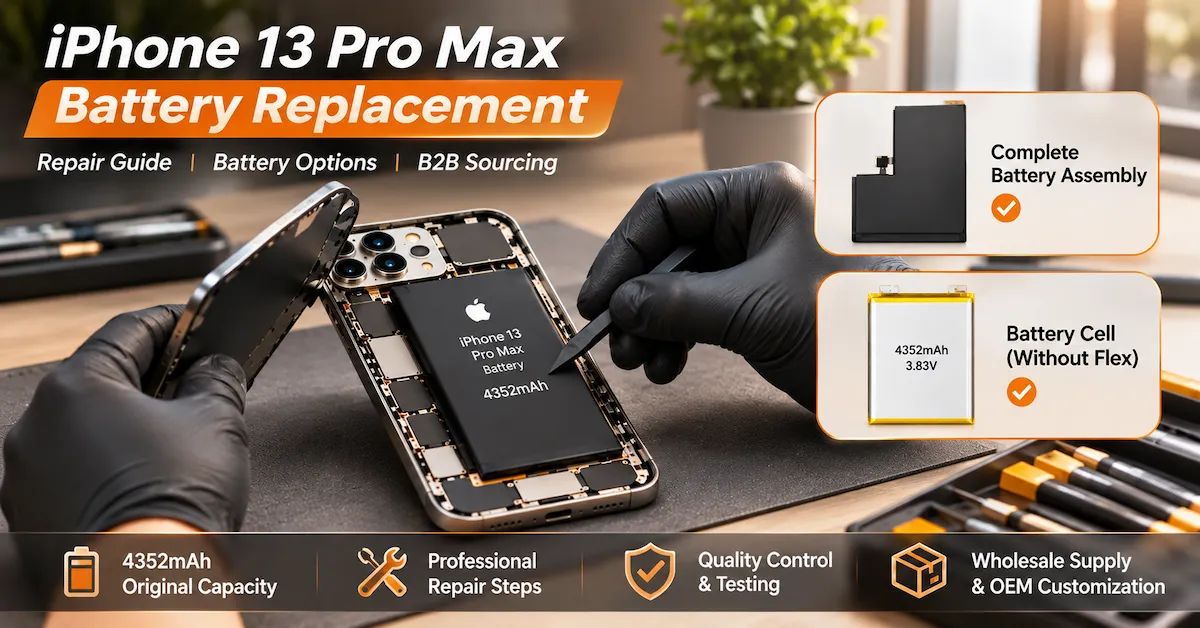
TL;DR: iPhone 13 Pro Max battery replacement should begin with accurate device identification and the correct battery configuration. The original-capacity reference is 4352mAh, but buyers must distinguish a complete replacement assembly from a cell-only product without flex or battery management electronics. For repair chains and refurbishers, successful replacement also requires safe installation, Battery Health verification, controlled sample testing, and documented batch acceptance before wholesale purchasing.
An iPhone 13 Pro Max battery replacement can help restore usable battery performance when the existing battery has degraded. However, for professional repair businesses, choosing a compatible battery is only the beginning.
A replacement battery must meet the device's electrical requirements, fit its internal structure, support the intended repair workflow, and provide consistent performance after installation.
Different aftermarket battery products may have similar capacities but very different configurations.
Some are complete replacement assemblies, while others contain only the battery cell and require specialized assembly work.
These differences affect technician training, purchasing costs, repair success rates, and warranty management.
For B2B buyers, the central question is:
Which battery configuration delivers the required repair outcome with acceptable quality, safety, total cost, and supply consistency?
This guide compares battery replacement options, explains technical and software-related considerations, and provides a practical purchasing framework for professional repair shops, refurbishment facilities, wholesalers, and private-label battery brands.
ESC supplies aftermarket replacement batteries, including an iPhone 13 Pro Max 4352mAh battery cell without flex, alongside its wider smartphone battery portfolio.
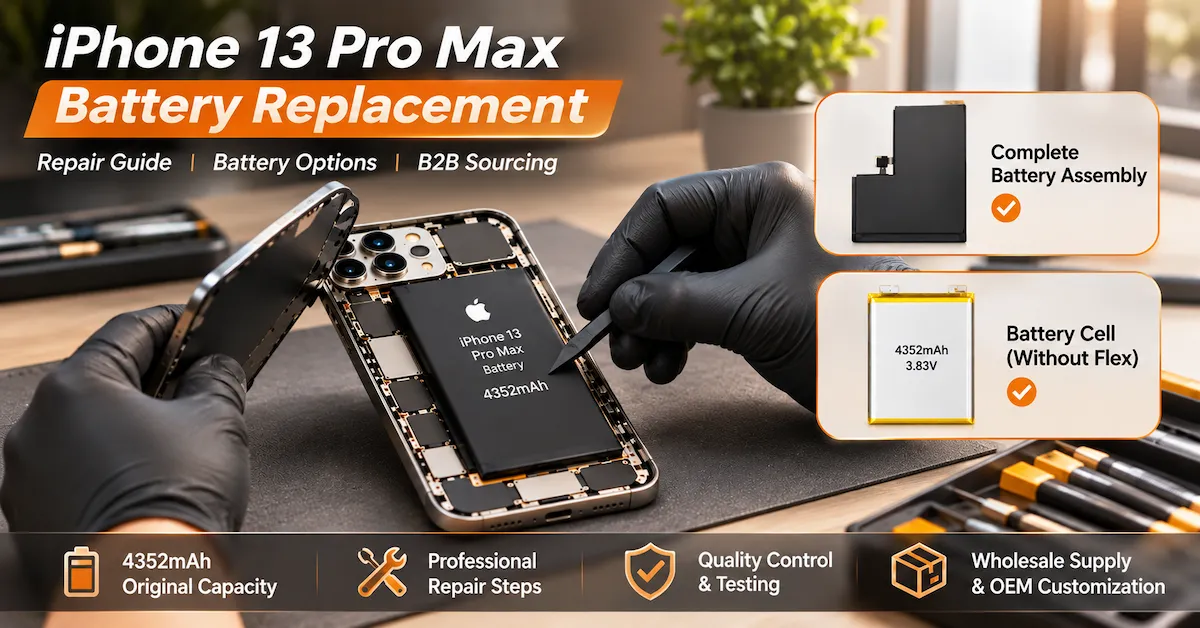
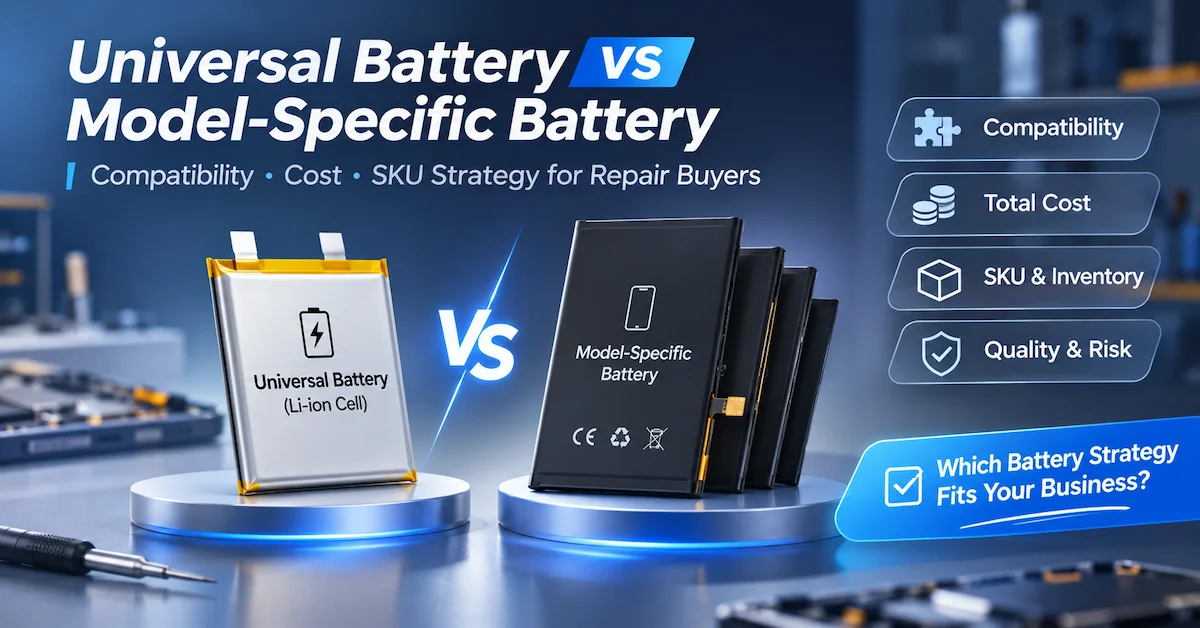
Quick Comparison: Complete Battery Assembly vs Cell-Only Replacement
Not every iPhone 13 Pro Max battery product is intended for the same repair process.
| Comparison | Complete replacement battery | Battery cell without flex |
|---|---|---|
| Product configuration | Finished battery assembly | Replacement cell only |
| Flex cable | Included as specified by supplier | Not included |
| Battery management electronics | Supplied as part of approved assembly | Not included |
| Main application | Standard professional battery replacement | Specialized cell-transfer or assembly work |
| Technician requirements | Professional device repair skills | Advanced battery assembly qualifications |
| Installation complexity | Generally lower | Generally higher |
| Quality-control focus | Finished assembly and device compatibility | Cell plus final rebuilt assembly |
| Battery Health behavior | Depends on parts and repair conditions | Depends on additional electronics and repair process |
| Typical buyer | Repair shops, refurbishers, distributors | Specialist repair facilities |
| Purchasing priority | Fit, reliability, installation efficiency | Cell specifications, integration, and process control |
Recommendation: General repair businesses should prioritize a qualified, complete replacement assembly. Cell-only products are more appropriate for organizations equipped to carry out specialized battery assembly and validation.
ESC's published iPhone 13 Pro Max 4352mAh product is specifically a cell without flex or BMS, not a ready-to-install complete battery.
Key Takeaways
-
4352mAh is the commonly referenced original battery capacity for the iPhone 13 Pro Max.
-
Battery configuration matters as much as capacity. A cell without flex is not interchangeable with a finished battery assembly.
-
Battery Health and actual capacity are different measurements. A displayed percentage does not independently verify electrical performance.
-
Parts and Service History should be checked after repair. Genuine, Used, Unknown, and other applicable statuses have specific meanings.
-
Replacement requires professional precautions. The display must be opened, and the original battery is secured with adhesive.
-
Wholesale approval needs more than one sample. Buyers should verify specifications, finished-device performance, and production-lot consistency.
-
The lowest battery price is not necessarily the lowest repair cost. Labor, testing, rework, and warranty expenses must be considered.
What Are the iPhone 13 Pro Max Battery Specifications?
The iPhone 13 Pro Max is a 6.7-inch smartphone introduced by Apple in 2021.
Its battery is a rechargeable lithium-ion design commonly identified with a capacity of 4352mAh and nominal energy of approximately 16.75Wh for the original battery platform.
However, aftermarket products may publish different nominal voltage values or other specifications.
Technical specification comparison
| Parameter | Original battery reference | ESC cell-only product |
|---|---|---|
| Compatible device | iPhone 13 Pro Max | iPhone 13 Pro Max |
| Capacity | 4352mAh | 4352mAh |
| Nominal voltage | Approximately 3.85V | 3.83V published |
| Nominal energy | Approximately 16.75Wh | Confirm against current product documentation |
| Battery chemistry | Rechargeable lithium-ion | Rechargeable lithium-ion |
| Product construction | Integrated battery assembly | Cell without flex or BMS |
| System integration | Original device battery electronics | Additional assembly required |
| Product origin | Original Apple battery platform | Aftermarket ESC product |
| Application | Factory-installed or supported service replacement | Professional cell-level repair |
These values are reference specifications, not independently measured results for an ESC production lot.
Why do the voltage specifications differ?
ESC's cell-only product page states a nominal voltage of 3.83V, while commonly published original iPhone 13 Pro Max battery specifications use approximately 3.85V.
Buyers should not silently treat these values as identical or assume the difference establishes incompatibility.
Instead, request the complete approved electrical specification, including charging limits, discharge conditions, energy rating, and relevant integration requirements.
How should battery energy be calculated?
The approximate relationship is:
Battery Energy (Wh) = Capacity (Ah) × Nominal Voltage (V)
Using ESC's published values:
4.352Ah × 3.83V ≈ 16.67Wh
This arithmetic result should not replace the energy rating on the approved product label or technical documentation.
It also does not establish the measured capacity or runtime of the completed battery assembly.
Which iPhone 13 Pro Max Models Are Compatible?
The iPhone 13 Pro Max is available under several regional model identifiers.
| Device model | Main market or region |
|---|---|
| A2484 | United States |
| A2641 | Canada, Japan, Mexico, Saudi Arabia |
| A2643 | Other countries and regions |
| A2644 | China mainland, Hong Kong, Macao |
| A2645 | Selected Eurasian markets |
The proposed battery must be verified for the exact device and supplier-approved configuration.
Important: The iPhone 13, iPhone 13 mini, iPhone 13 Pro, and iPhone 13 Pro Max use different battery assemblies.
Their batteries should not be considered interchangeable simply because they belong to the same generation.
For businesses sourcing multiple iPhone models, ESC's iPhone 13 series battery SKU planning guide provides a related framework for separating models, forecasting demand, and managing repeat orders.
When Should an iPhone 13 Pro Max Battery Be Replaced?
Battery replacement should follow a diagnostic assessment rather than an arbitrary device age.
Common signs include reduced usable runtime, unexpected shutdowns, charging-related complaints, and battery service notifications.
Battery Health below 80%
Apple states that batteries in iPhone 14 models and earlier were designed to retain 80% of their original capacity after 500 complete charge cycles under ideal conditions.
This is a design reference, not a guarantee that every device reaches exactly the same condition after 500 cycles.
For repair businesses, a Battery Health reading below 80% can be a useful service trigger, depending on the customer's needs and the applicable repair policy.
However, it is not the only reason to recommend replacement.
Short battery runtime
Reduced battery endurance may result from chemical aging, but other factors also matter.
High display brightness, background activity, software settings, network conditions, and demanding applications can influence energy consumption.
Technicians should distinguish a battery-related problem from unusual device power usage.
Unexpected shutdowns
An aging battery may become less able to deliver the required power under demanding conditions.
However, unexpected shutdowns can also indicate other hardware or software problems.
A replacement should not be approved until the diagnostic evidence supports it.
Swollen or physically damaged batteries
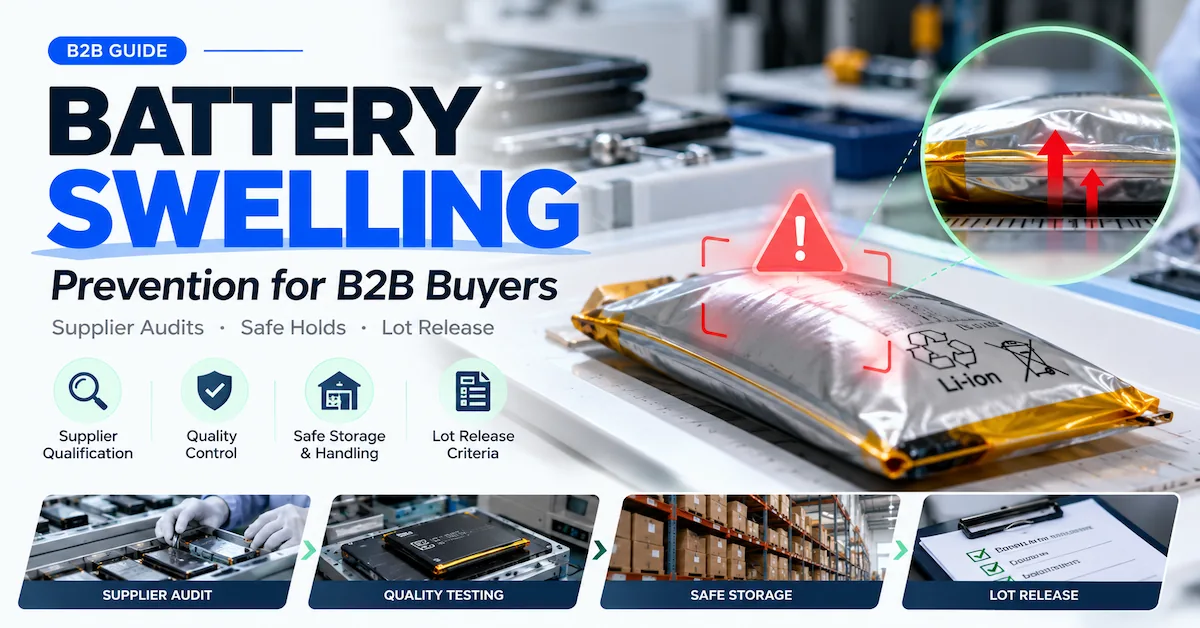
Battery swelling is a safety concern.
If a device shows visible expansion, abnormal heating, leakage, or battery-related physical damage, stop ordinary charging and repair activity.
Do not puncture, compress, bend, or force a damaged battery out of its enclosure.
The device requires appropriate assessment and handling by qualified personnel.
Why Does Battery Construction Affect Repair Difficulty?
iPhone 13 Pro Max battery replacement involves accessing internal components through the display side of the device.
The display is secured with adhesive, and delicate internal cables must be protected during professional disassembly.
The battery itself is retained using stretch-release adhesive strips.
Main repair considerations
Display opening: Opening the enclosure can affect its original sealing system.
Battery adhesive: Removal requires an approved procedure to avoid excessive mechanical stress.
Internal connections: Connectors and surrounding components require careful handling.
Replacement configuration: The new battery must provide the correct electrical and mechanical interfaces.
Reassembly: Adhesive, component placement, and final device function must be verified.
These considerations make the repair more complex than replacing a removable consumer battery.
Does a replacement restore water resistance?
Not automatically.
The iPhone 13 Pro Max originally carried an IP68 rating under specified laboratory conditions.
Opening the device can compromise its seals.
Replacement adhesive does not independently prove that the original water-resistance performance has been restored.
Repair businesses should avoid unsupported waterproof claims.
Battery Health, Parts and Service History, and Repair Assistant
Modern iPhone battery repair involves both electrical performance and system-related information.
Apple provides Parts and Service History so owners can review information about certain repaired components.
For supported devices and software versions, the system may show statuses including Genuine, Used, or Unknown.
What does Genuine mean?
Genuine indicates that the repair used genuine Apple parts and applicable processes.
An aftermarket battery should not be marketed as genuine Apple merely because a supplier claims it can produce a favorable battery-information display.
What does Used mean?
Used identifies a component previously installed in another iPhone when that status is supported.
Its availability and presentation depend on the model, software, and repair conditions.
What does Unknown mean?
An Unknown Part status can appear when a component is non-genuine, cannot be verified, has been modified, or is not functioning as expected.
The status alone does not establish the measured electrical capacity of the replacement battery.
What is Repair Assistant?
Repair Assistant is Apple's software process for completing supported repairs and relevant calibration.
Its available functions depend on the component, device model, iOS version, and repair configuration.
Buyers should not assume that every aftermarket battery can complete the same verification process as a genuine Apple service part.
Why cell-only products need additional verification
A replacement cell without flex or battery management electronics cannot, by itself, determine the phone's final battery-information behavior.
That behavior depends on the complete assembled configuration and repair conditions.
ESC discusses these distinctions in its iPhone battery cell transplant and flex guide.
For B2B refurbishment, record Battery Health information separately from actual capacity testing and component-origin documentation.
What Should Repair Shops Test After Battery Replacement?
A successful repair requires more than confirming that the phone powers on.
Professional repair operations should use an approved inspection process.
| Inspection item | Recommended acceptance requirement |
|---|---|
| Device startup | Normal power-on behavior |
| Charging | Stable charging under defined conditions |
| Battery identification | Record relevant system information |
| Battery Health | Check displayed information where available |
| Parts and Service History | Record applicable status |
| Battery performance | Evaluate against the approved test plan |
| Physical fit | No abnormal enclosure pressure |
| Display | Normal image and touch behavior |
| Face ID | Confirm relevant functionality |
| Temperature behavior | No unexplained abnormal heating |
| Reassembly | Correct component placement and enclosure fit |
| Final condition | Meets the agreed repair or resale standard |
A displayed 100% Battery Health figure should not be treated as proof that a replacement cell has passed an independent capacity test.
Similarly, an operating phone does not establish that every charging, safety, or performance requirement has been satisfied.
How Should B2B Buyers Evaluate Battery Quality?
For wholesale purchasing, battery quality should be assessed at the cell, assembly, and finished-device levels.
Cell qualification
ESC states that its replacement battery cells are inspected for capacity, voltage, internal resistance, dimensions, and appearance.
Buyers should request the actual test methods and acceptance requirements relevant to the quoted product.
Assembly verification
For complete replacement batteries, inspection should include the cell, connectors, flex cable, protection electronics, insulation, and mechanical construction.
For cell-only purchasing, the buyer must separately qualify the final assembled battery.
Sample approval
A successful sample demonstrates that a particular configuration can meet an agreed requirement.
It does not prove that every future production lot will perform identically.
Professional buyers should evaluate representative samples and maintain the approved configuration as a reference for repeat purchasing.
Incoming lot acceptance
| Quality-control stage | Evidence required |
|---|---|
| Product identification | Exact model, SKU, revision |
| Packaging inspection | Correct labels and physical condition |
| Appearance | No unacceptable deformation or damage |
| Electrical checks | Results against defined specifications |
| Capacity testing | Approved measurement method and criteria |
| Connector verification | Correct assembly configuration |
| Functional testing | Applicable device-level results |
| Traceability | Lot or batch identification |
| Documentation | Required product and transport information |
| Release decision | Authorized acceptance or hold record |
The number of samples and permitted defect limits should be determined by the buyer's risk-based inspection plan.
How Does Battery Replacement Affect Refurbishment Profitability?
For refurbishment companies, battery replacement is both a technical and commercial decision.
The cost of the battery itself is only one part of the total repair expense.
Total replacement cost
Total Repair Cost = Battery Purchase + Consumables + Labor + Inspection + Rework + Warranty Allowance
For resale projects, device acquisition and other refurbishment expenses should also be included.
Illustrative cost comparison
The following amounts are hypothetical and do not represent ESC quotations.
| Cost component | Complete assembly | Cell-only workflow |
|---|---|---|
| Purchased battery component | $18 | $10 |
| Additional assembly materials | $2 | $5 |
| Professional labor | $16 | $28 |
| Inspection and testing | $5 | $9 |
| Total illustrative cost | $41 | $52 |
The example shows why a lower cell price does not necessarily result in a lower total repair cost.
A specialized cell-transfer operation may have different economics, particularly when it uses qualified equipment and achieves consistent production results.
The correct comparison is the cost per accepted, functional device.
Measure first-pass repair yield
First-Pass Yield = Devices Passing Final Inspection Without Rework ÷ Devices Entering Final Inspection × 100%
Track the result by battery configuration, technician workflow, and supplier lot.
This helps identify whether a particular sourcing decision improves overall refurbishment performance.
How Should Buyers Plan MOQ, Lead Time, and Repeat Orders?
A professional battery procurement program should begin with an accurate model and configuration list.
ESC's iPhone 13 Pro Max cell-only product page publishes a 20-piece single-model MOQ and states that mixed-model wholesale orders may begin at 100 pieces.
These are published commercial terms for that offering, not guaranteed conditions for every battery configuration.
The actual MOQ, sample availability, delivery schedule, warranty, and documentation must be confirmed in the written quotation.
Standard versus customized orders
A standard cell-only order may have different purchasing conditions from a complete battery assembly or a private-label project.
Customized labels and packaging may require additional preparation and approval.
Inventory management
Repair chains should track actual repair demand, forecast quantities, supplier lead times, and lot age.
Avoid merging the iPhone 13 Pro Max with other iPhone 13 models under one warehouse SKU.
Change control
If the supplier changes the cell, connector, electronics, or another controlled component, the buyer should determine whether renewed qualification is required.
Repeat orders should remain traceable to their approved product revision.
OEM and Private-Label Opportunities for Battery Wholesalers
ESC publishes OEM and private-label support for professional replacement battery customers.
Available customization discussions include battery labels, logos, barcodes, retail packaging, instruction cards, and export cartons.
The exact options depend on the selected configuration and purchasing agreement.
Recommended private-label checklist
-
Approved battery model and SKU
-
Electrical specifications
-
Battery configuration
-
Compatible device information
-
Brand logo and packaging artwork
-
Product warnings and required labels
-
Barcode and lot identification
-
Quality-control records
-
Warranty conditions
-
Destination-market documentation
Private-label packaging should accurately describe the product's aftermarket origin.
A customized brand does not establish Apple manufacture, Apple authorization, or compatibility with unrelated iPhone models.
iPhone 13 Pro Max Battery Replacement RFQ Checklist
A detailed request for quotation helps avoid confusion between complete batteries and cell-only products.
| RFQ field | Buyer information |
|---|---|
| Target device | iPhone 13 Pro Max |
| Device identifiers | Applicable regional models |
| Product configuration | Complete battery or cell without flex |
| Capacity | 4352mAh reference or separately evaluated alternative |
| Electrical requirements | Approved voltage and charging specifications |
| Quantity | Pilot and expected bulk volume |
| Samples | Required quantity and test conditions |
| Quality control | Required acceptance criteria |
| Software observations | Desired Battery Health and repair-history checks |
| Packaging | Standard, OEM, or private label |
| Documentation | Relevant product and transport documents |
| Destination | Country and preferred shipping terms |
| Warranty | Required coverage and claim procedures |
ESC's 4352mAh iPhone 13 Pro Max battery cell is a confirmed option for professional cell-level replacement projects.
For buyers requiring a complete battery assembly, the exact product configuration must be confirmed separately.
To discuss samples, wholesale quantities, documentation, and customization, contact ESC with your technical requirements.
Frequently Asked Questions
1. What is the original iPhone 13 Pro Max battery capacity?
The commonly referenced original capacity is 4352mAh, with approximately 16.75Wh nominal energy. Actual replacement battery specifications should be verified against the chosen product documentation and test method.
2. Is iPhone 13 Pro Max battery replacement worth it?
Replacement may be worthwhile when battery degradation affects device performance and the remaining device condition supports repair. Refurbishment businesses should evaluate battery cost, labor, other faults, and expected resale value before approving the work.
3. Can I use an iPhone 13 Pro battery in an iPhone 13 Pro Max?
No interchangeability should be assumed. These models use different battery configurations. Buyers must verify the exact compatible device, physical dimensions, electrical specifications, and connector arrangement.
4. Does ESC offer a 4352mAh iPhone 13 Pro Max battery?
Yes. ESC publishes a 4352mAh aftermarket iPhone 13 Pro Max battery cell with a stated nominal voltage of 3.83V. The confirmed product is supplied without flex or BMS.
5. Does ESC's cell-only battery include a flex cable?
No. Its published cell-only product does not include a pre-installed flex cable or battery management electronics. It requires a suitable specialized assembly workflow performed by qualified personnel.
6. Will Battery Health display 100% after replacement?
A displayed result depends on the complete battery configuration, electronics, repair process, and software. A new cell alone does not guarantee a particular battery-health display or system status. Capacity must be evaluated independently.
7. Will iPhone 13 Pro Max show an Unknown Part message?
It may, depending on the replacement component, verification, and repair conditions. Parts and Service History should be checked on the actual device. An aftermarket battery should not be represented as genuine Apple based solely on its displayed status.
8. Can a replacement battery restore the original water resistance?
Not automatically. Opening the phone can disturb its seals. Replacement adhesive does not independently prove that the original IP68 rating has been restored.
9. What should wholesalers test before buying batteries in bulk?
Verify the product identity, compatible device, capacity, voltage, assembly configuration, dimensions, physical condition, applicable electrical tests, and traceability. Approve representative samples before committing to production quantities.
10. How can I request an ESC iPhone 13 Pro Max battery quotation?
Provide the exact model, required battery configuration, quantity, destination, sample requirements, packaging preferences, and quality standards. Confirm whether you need a complete battery or the published cell-only product before requesting final pricing.
Conclusion
iPhone 13 Pro Max battery replacement should be evaluated as a complete repair and purchasing process—not simply a battery-capacity comparison.
For repair shops, refurbishment companies, and wholesale distributors, the most important decisions involve device compatibility, battery construction, electrical specifications, installation requirements, software-related information, and consistent quality control.
A complete replacement battery assembly and a cell without flex serve different professional applications.
The cell-only approach requires additional expertise and validation, while a qualified complete assembly may provide a more straightforward workflow for general repair businesses.
Battery Health, Parts and Service History, and measured electrical capacity should also be evaluated separately. A favorable system display does not substitute for accurate product identification or performance testing.
For B2B procurement, supplier qualification, sample approval, batch traceability, and clear commercial agreements help reduce sourcing uncertainty and prevent avoidable rework.
ESC supplies an iPhone 13 Pro Max 4352mAh aftermarket battery cell without flex, alongside a wider range of replacement battery products for professional customers.
Explore the ESC iPhone replacement battery portfolio and contact ESC to discuss compatible product configurations, sample evaluation, wholesale quantities, OEM packaging, and order-specific quality requirements.
By selecting the correct battery configuration and maintaining a controlled repair and purchasing process, B2B buyers can improve refurbishment consistency, manage warranty risks, and build more reliable long-term replacement battery supply programs.