
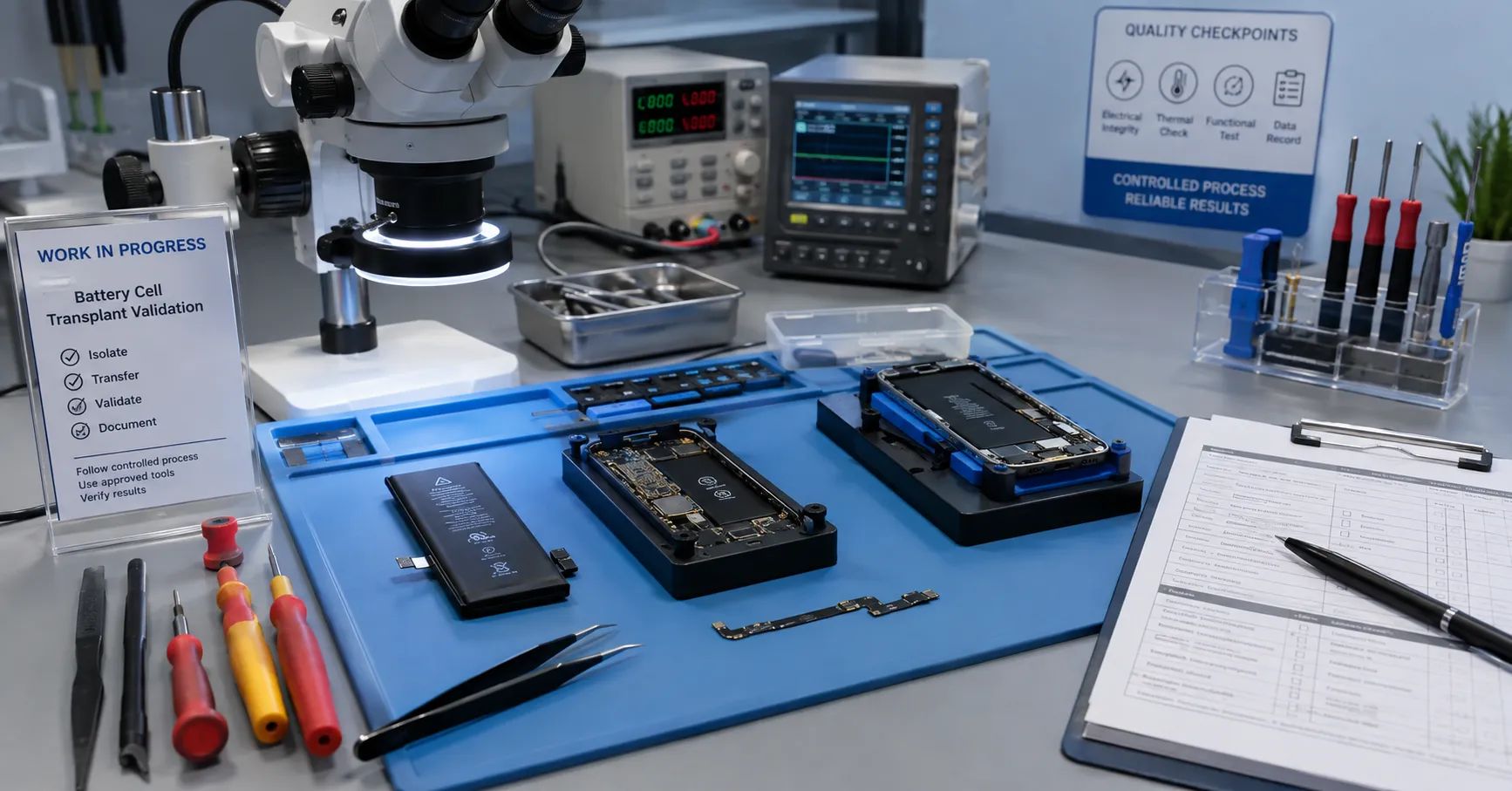
An iPhone battery cell transplant is a controlled rebuilding process, not merely a cheaper cell swap. A technician retains or adapts selected battery electronics, integrates a replacement cell, restores insulation and mechanical protection, and then validates the completed assembly in a specific device. For repair chains and refurbishers, the real decision is whether this workflow can produce repeatable, traceable and commercially acceptable results across operators and lots.
Some repair-market solutions use an added flex assembly to support data handling or the presentation of battery information. The outcome can vary with the exact phone model, iOS version, retained components, interface revision and workmanship. A visible percentage, the absence of an immediate notification and a particular Parts and Service History status are separate observations. None should be promised without evidence from the intended configuration.
Define the Product Before Comparing Solutions
Market terms such as “cell transplant,” “original flex,” “zero cycle,” “no popup” and “health display” are not complete engineering specifications. A buyer should request an exploded drawing or clearly labeled photographs showing the replacement cell, retained board or flex, added interface, insulation, adhesive and final connector. The specification should state what the supplier delivers and what the repair operator must reuse, transfer, program or assemble.
Build one configuration code for each combination of phone model, cell specification, retained electronics and interface revision. Record the target sales region and iOS build used during approval. This prevents a result from one device or one technician from being treated as evidence for an entire iPhone generation.
Understand What Tag-on Flex Can and Cannot Prove
A tag-on flex battery configuration should be evaluated as a complete system component. Buyers need the supported-model list, dimensions, connection method, electrical interface, insulation design, any programming requirement and revision history. The added part must not interfere with adhesive placement, bend beyond its intended radius, create a conductive exposure or press against the cell or enclosure.
Its presence does not prove battery origin, cell quality, capacity or safety. It also does not by itself prove that a phone will display health information or avoid an Unknown message under every software version. Treat the supplier's screen claims as acceptance-test hypotheses. Require photographs, device identifiers, software builds and repeatable results from production-representative samples.
Map the Complete Transplant Workflow
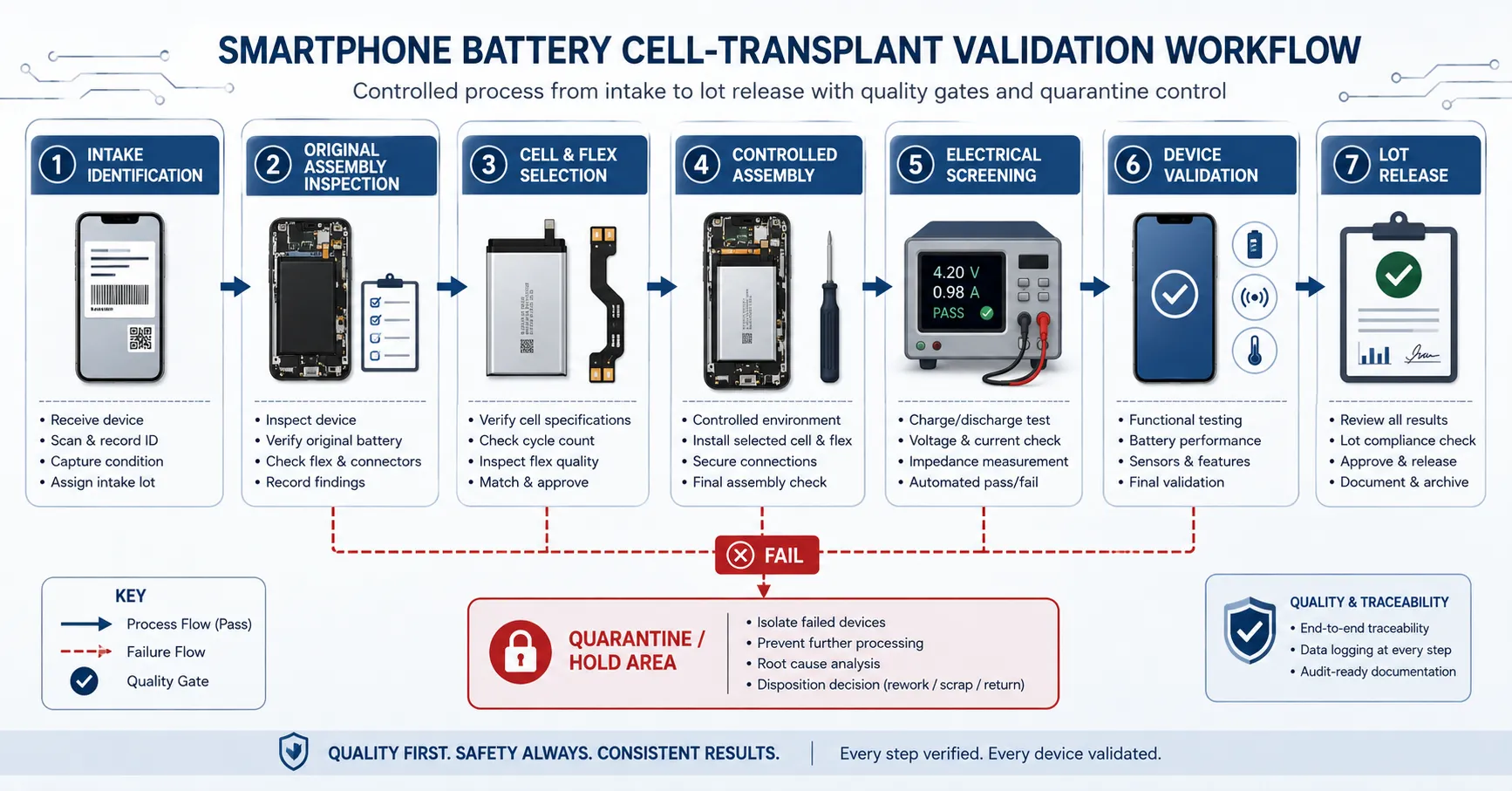
- Device and donor identification: capture the phone model, region, iOS build, battery identifier, donor condition and service history available to the technician.
- Incoming inspection: examine the cell, retained electronics, interface, connector, insulation and packaging before work begins.
- Compatibility confirmation: compare drawings, dimensions, polarity, tab positions, flex routing and electrical limits.
- Controlled assembly: follow a documented process using trained operators, appropriate fixtures and lithium-battery safety controls.
- Bench screening: inspect workmanship and check the defined electrical characteristics before the assembly enters a phone.
- Device validation: test fit, boot, charging, discharge, temperature, battery-information screens, notifications, restart and planned software updates.
- Pilot and lot release: confirm that production reproduces the approved sample and that changes remain controlled.
Each stage needs a Pass, Hold or Reject rule. A unit placed on Hold should remain physically separated and linked to its evidence until the cause is classified. This prevents questionable assemblies from being mixed back into accepted inventory.
Screen Donor Components Before Reuse
Not every removed assembly is suitable for transplantation. Establish rejection rules for swelling, deformation, corrosion, damaged tabs, torn insulation, evidence of overheating, previous uncontrolled repair, contamination or missing identity. Do not rely only on whether the donor phone powered on before disassembly.
The retained component should have a traceable source and inspection result. If the business mixes retained components from customer devices, used inventory and newly supplied subassemblies, identify those routes separately. Their condition, warranty responsibility and process risk are not identical.
Confirm Cell and Mechanical Compatibility
Capacity claims must be verified for the specific model and test method, but fit comes first. Measure pouch length, width and thickness at defined points; inspect edge seals, tab geometry and cable route; and check enclosure clearance. A nominally thin cell can still create a local pressure point at a folded tab or stacked flex.
Install the assembly without forcing the connector, compressing the pouch or changing the intended cable path. Photograph the open-device fit before closure. After reassembly, inspect display seating and enclosure gaps. Any lift, rocking, pressure mark or abnormal closing force is a failure even when the device boots.
Control Electrical and Insulation Risks
Define safe checks for polarity, open-circuit voltage and connection integrity. Inspect tab joints, insulation barriers, protection components and exposed conductive areas. The exact equipment and limits must come from the approved product and process specification; generic internet values should not be copied into a lot-release plan.
Operators should stop work when they observe physical damage, leakage, unusual odor, smoke, abnormal heat or unstable electrical behavior. Suspect material needs an isolation and escalation process. A successful first boot cannot rule out a latent insulation, joint or mechanical defect.
Build a Software-Aware Validation Matrix
Apple's Parts and Service History guidance explains that a repaired iPhone may show Genuine, Used, Unknown or Finish Repair depending on the model, part and repair process. Apple says an Unknown result can occur when a part is nongenuine, is not functioning as expected, has not been verified and linked after repair, or has been modified. A modified assembly must therefore never be described as an Apple genuine or Apple-authorized battery merely because one information screen looks favorable.
For iPhone battery health display testing, record the exact device, iOS build, sample code and observation time. Capture the first unlock, Settings notifications, Battery Health page and Parts and Service History. Repeat after restart, wired charging, an agreed number of operating cycles and a defined waiting period. Test a planned iOS update first on non-production devices.
Apple also notes in its battery-support information that health information may not be accurate when a battery cannot be verified. A screen result is therefore a repair-experience metric, not proof of measured cell capacity, remaining life or safety.
Validate Charging, Capacity, Runtime and Temperature
Functional testing should cover boot, stable operation, wired charging, wireless charging where applicable, controlled discharge, unexpected restart and shutdown. Record charger, cable, ambient temperature, starting state of charge, device settings, network condition and test duration. Without controlled conditions, two runtime results are not meaningfully comparable.
Verify capacity with an agreed charge-discharge method and suitable calibrated equipment. Retain individual sample values and dispersion instead of reporting only an average. Temperature should be measured at defined locations and intervals under the same workload. An unusual or repeatable difference from the approved reference is a reason to stop release and investigate; a single surface measurement is not a complete safety assessment.
Use a documented mobile phone battery sampling plan to separate engineering samples, pilot units and production-lot checks. Do not mix different models or component revisions into one sample pool.
Control Operator and Process Variation
Transplantation transfers part of product quality control into the repair operation. Operator skill, fixture setup, preparation, alignment, insulation placement and final inspection can influence the result. Create visual work instructions with acceptable and unacceptable examples. Train and qualify operators on test material before they handle saleable devices.
Record critical process checks without publishing unsupported universal parameters. Use first-piece approval at shift start or after setup changes. Track results by operator, equipment, component lot and work-instruction revision. If one operator or station produces a different failure pattern, investigate the process before blaming the cell.
Measure Yield and Rework Before Scaling
A process is commercially useful only when accepted output is repeatable. During the pilot, record first-pass yield, rework time, device reopening, rejected donor components, damaged interfaces and final failures. Classify each issue as cell, retained component, interface, workmanship, device, software or undetermined.
Do not hide reworked units inside the pass total. Compare the process with the current replacement method using the same device mix and operator experience. The companion total-cost analysis can then include materials, labor, fixtures, rejected units, rework, throughput, inventory and warranty exposure instead of relying on the lower price of a bare cell.
Move From Sample Approval to Production Release
Sample approval should freeze the cell specification, retained-component criteria, interface revision, connector, insulation, adhesive, label, work instruction and test method. The pilot lot should demonstrate that normal production can reproduce the approved result. Apply the site's incoming-inspection framework to cells and added components before they reach the assembly station.
Lot release should state the model, component revisions, quantity inspected, failures, deviations and disposition. Define escalation triggers for mixed labels, dimensional drift, abnormal voltage distribution, installation interference, heat, charging faults, inconsistent screen results or elevated rework. Conditional release needs a named quantity, market, limitation and corrective action.
Require Change Notification and Revalidation
Changes to the cell, tabs, protection electronics, added flex, connector, insulation, adhesive, firmware, equipment, manufacturing site or work method may affect prior evidence. Require the supplier or production team to identify the change before shipment or use. Review the risk and repeat the affected document, bench, device or software tests.
Maintain a revision-controlled compatibility matrix. Do not overwrite an older approval, because field returns may need to be traced to the configuration that was actually installed. Link warranty claims to the device, battery record, operator and lot using the battery warranty evidence workflow.
Define the Commercial Claim Carefully
A product listing should state the target model and validated conditions. Avoid “100% compatible,” “always shows health,” “permanently no popup” and similar absolute language. Safer wording explains that displayed behavior is subject to model, software, installed components and validation results.
Sales teams should distinguish a replacement cell from a finished pack and from a transplant service. Packaging should identify the supplied contents, required process and traceability code. Warranty responsibility should define whether it covers the supplied component, the completed assembly, the installation service or a combination under agreed conditions.
Prepare a Decision-Ready RFQ
Provide target iPhone models and regions, current and planned iOS builds, monthly device mix, intended transplant workflow, retained-component source, available tools, operator skill level and desired interface method. State the required observations for health information, notifications and Parts and Service History separately.
Also provide the capacity method, charging and temperature tests, sampling plan, traceability, packaging and change-notification requirements. ESCCharge can review a proposed sample and pilot structure after these inputs are available. Compatibility, screen behavior, capacity, MOQ, lead time, certification availability, warranty and performance limits must be confirmed for the exact product, target market and agreement.
Frequently Asked Questions
Does added flex guarantee that no Unknown Part message will appear?
No. That outcome depends on the complete configuration, device, software and repair state. It requires model-level and version-level evidence.
Does a visible health percentage prove that the new cell meets capacity?
No. Displayed information and measured electrochemical performance are different acceptance categories.
Can a transplanted assembly be marketed as genuine Apple?
No. A favorable display result does not establish part origin, Apple authorization or Apple calibration.
How many samples should a buyer test?
Use a risk-based plan that reflects model count, component revisions, order size and failure consequences. Development samples alone should not release a production lot.
When is revalidation necessary?
Revalidate when a change can affect mechanical fit, electrical behavior, insulation, software presentation, capacity, temperature, workmanship or traceability.