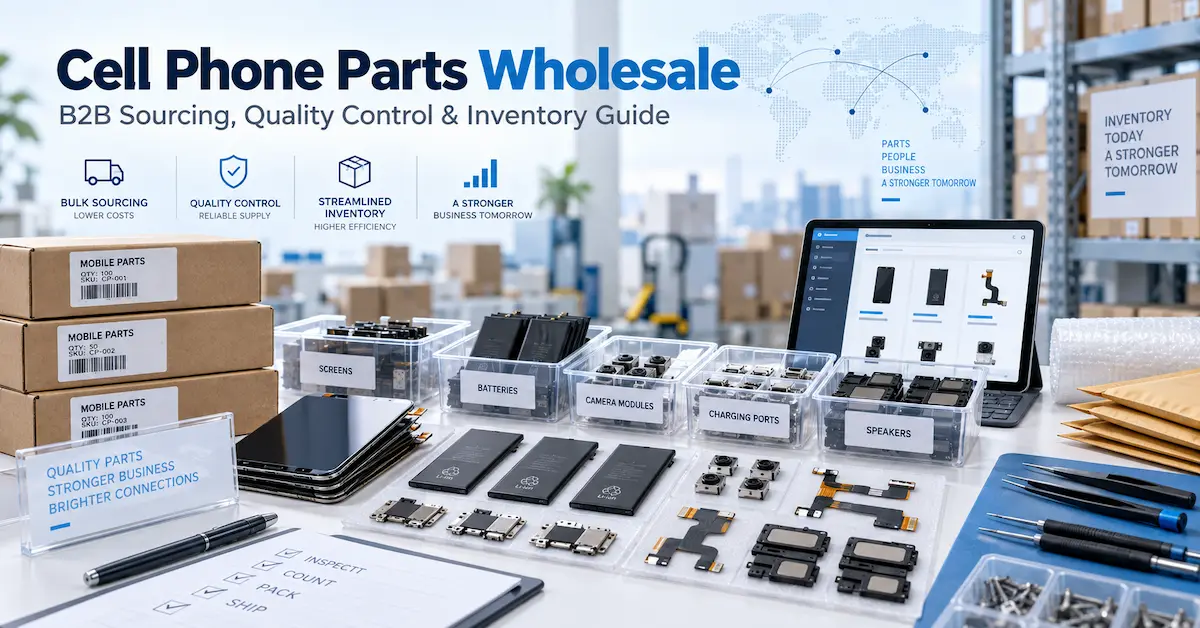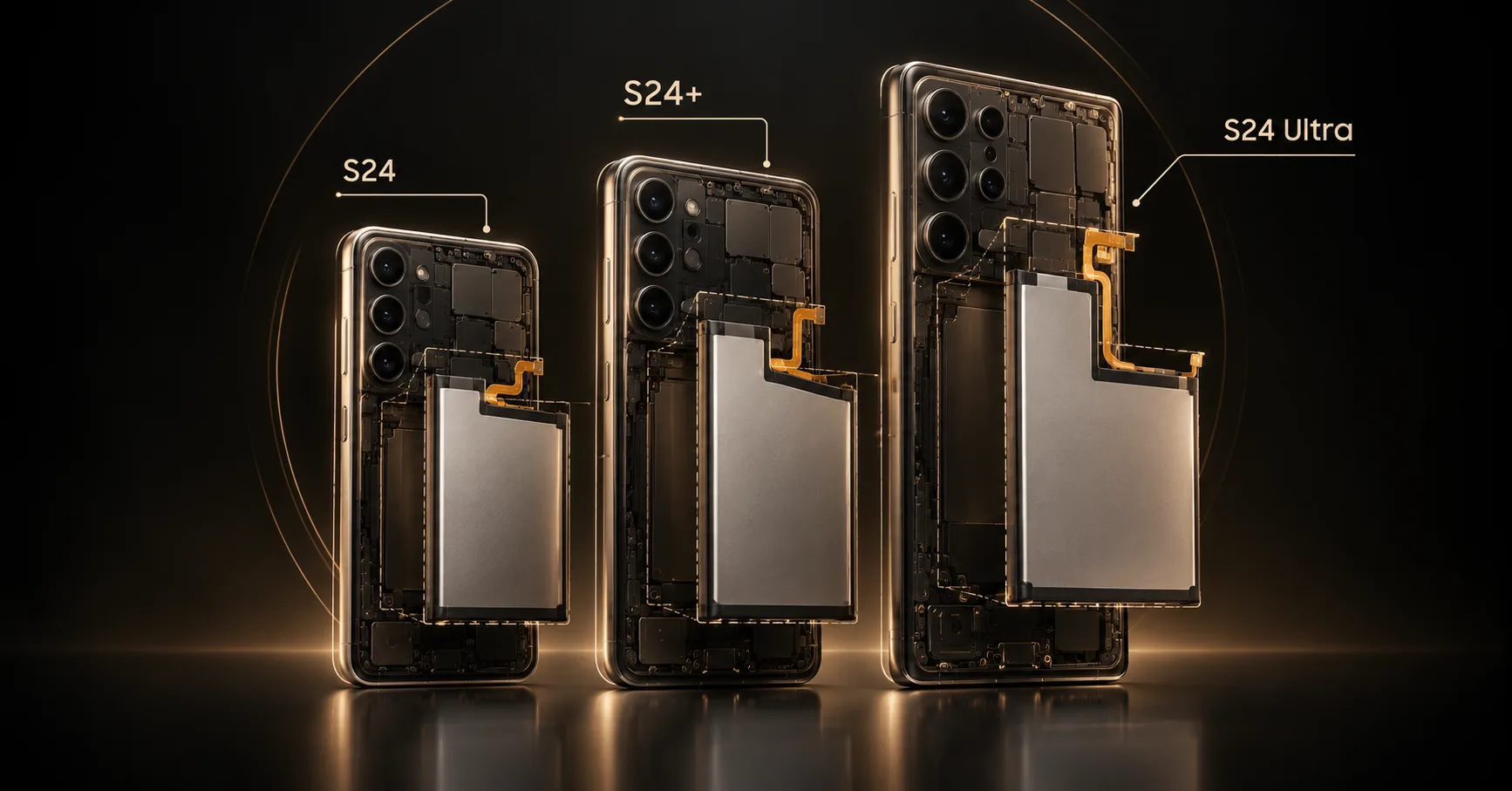

An Android phone with a worn-out battery does not necessarily need to be replaced. For many devices, a correctly matched replacement battery can restore usable runtime and extend the phone's service life. However, for repair chains, refurbishment facilities, and mobile phone parts distributors, the challenge is more complicated than finding a battery with the right capacity printed on its label.
A replacement battery for Android phone repair must satisfy several requirements simultaneously: electrical compatibility, physical fit, connector accuracy, protection-circuit performance, consistent capacity, and appropriate quality documentation.
When purchasing hundreds or thousands of batteries, a small mistake in any of these areas can create unnecessary warranty claims, installation failures, customer complaints, and unsold inventory.
This guide explains how professional buyers should evaluate Android replacement batteries, compare model-specific specifications, qualify suppliers, organize mixed-model orders, and prepare for international procurement.
It also introduces the Android battery solutions available from ESC, a B2B replacement battery supplier serving repair businesses, refurbishers, wholesalers, distributors, and private-label brands.
1. What Is a Replacement Battery for Android Phone Repair?
A replacement battery for an Android phone is a rechargeable battery assembly designed to replace an aging, damaged, or underperforming battery in a compatible Android smartphone.
Most modern Android smartphones use rechargeable lithium-ion batteries, including products commonly described as lithium-polymer batteries.
A finished smartphone battery assembly may include a battery cell, protection electronics, a flexible printed circuit or connector, insulation materials, identification components, and other model-specific parts.
The exact construction varies by phone model.
Unlike a generic external power bank, an internal replacement battery must fit within the physical and electrical design of the smartphone.
A battery intended for one Samsung Galaxy model cannot automatically be installed in another Galaxy phone. The same applies to Xiaomi, OPPO, Motorola, Google Pixel, Huawei, and other Android devices.
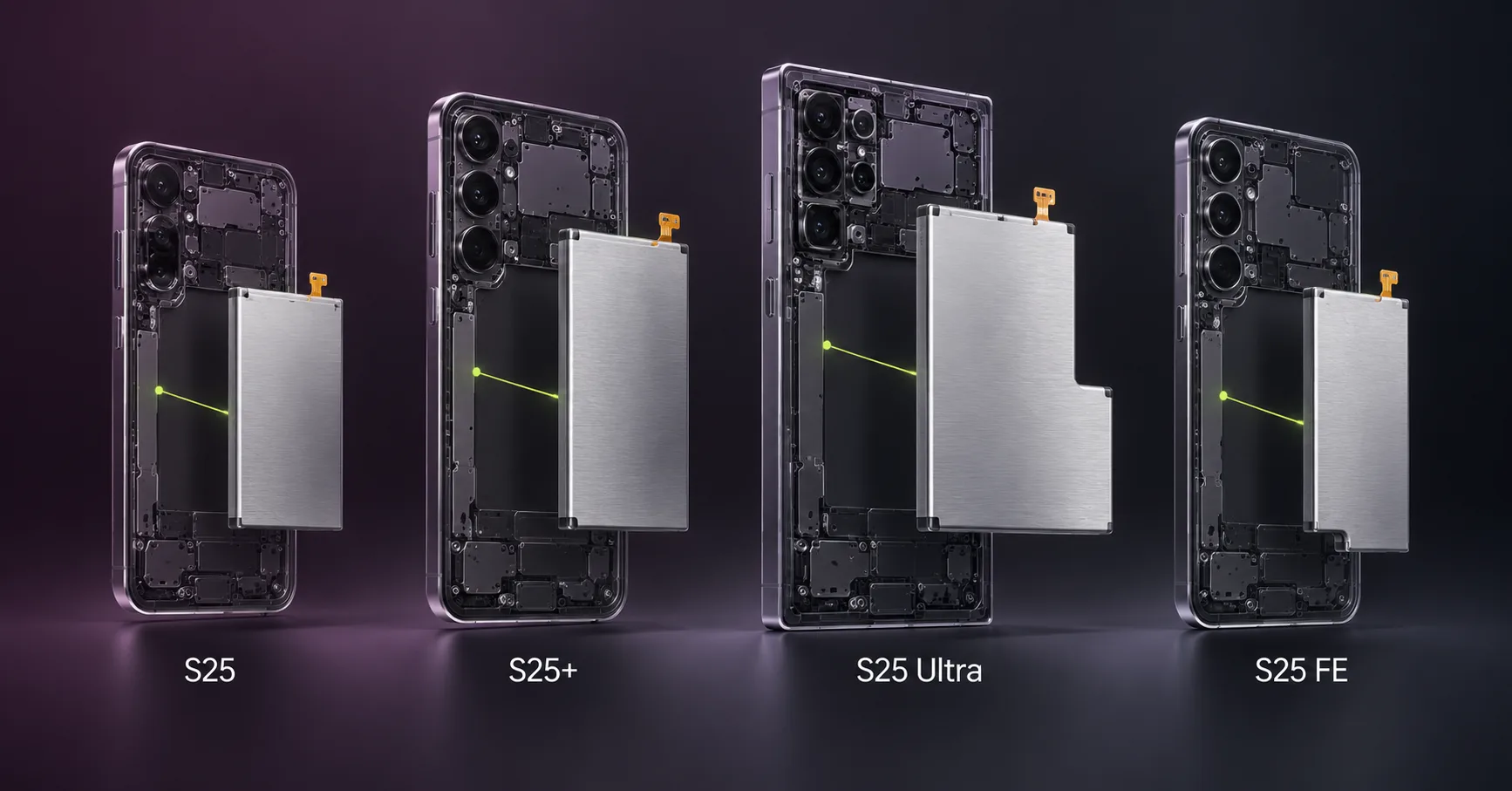
Even when two batteries have similar capacities, their dimensions, connector positions, voltage limits, and internal configurations may be different.
For professional buyers, this leads to a fundamental sourcing rule:
An Android replacement battery should be selected by its verified device compatibility and battery part number, not by smartphone brand or capacity alone.
Why Android Replacement Batteries Remain Important to the Repair Industry
Rechargeable lithium-ion batteries gradually lose usable capacity as they age.
Battery deterioration depends on multiple factors, including operating temperature, charging conditions, time at elevated states of charge, and accumulated charge-discharge cycles.
As the battery ages, its internal resistance may increase and its ability to support demanding power loads may deteriorate.
A customer may notice that the phone requires more frequent charging, shuts down unexpectedly, or delivers much less runtime than it did when new.
Replacing the battery can be economically attractive when the rest of the device remains functional.
For businesses purchasing batteries in volume, this creates demand across several channels:
-
Professional smartphone repair workshops.
-
Mobile phone service chains.
-
Used-phone refurbishment factories.
-
Mobile phone spare parts wholesalers.
-
Electronics importers and distributors.
-
Private-label replacement battery brands.
-
E-commerce sellers serving professional repair markets.
These buyers are not simply purchasing a component. They are purchasing a product that affects repair reliability, customer satisfaction, and after-sales costs.
2. Who Should Buy Android Replacement Batteries Wholesale?
Different B2B buyers have different operating models. A supplier that works well for a small repair workshop may not automatically satisfy the requirements of a refurbishment factory processing hundreds of phones every day.
Mobile Phone Repair Chains
Repair chains need repeatable repair procedures across multiple locations.
They typically prioritize accurate compatibility information, consistent battery performance, dependable replenishment, and standardized after-sales handling.
A wrong connector or unexpected battery thickness can interrupt repair work and increase technician labor costs.
Smartphone Refurbishment Companies
Refurbishment companies purchase batteries according to the devices entering their processing facilities.
One week, demand may focus on Samsung Galaxy A-series devices. Another week, the available inventory may contain more Google Pixel or Xiaomi smartphones.
These businesses benefit from mixed-model purchasing and flexible replenishment rather than being forced to buy the same quantity of every battery type.
Mobile Phone Parts Wholesalers
Wholesalers need a broad product portfolio that can support many downstream repair shops.
Their priorities often include SKU accuracy, manageable minimum order quantities, stable packaging, barcode identification, and efficient order fulfillment.
For these companies, a supplier's ability to manage a complex battery catalog may be as important as an attractive unit price.
Private-Label Battery Brands
Private-label businesses require more than a functional replacement battery.
They also need accurate product labels, retail-ready packaging, consistent branding, traceability information, and clear warranty terms.
ESC supports OEM branding and packaging customization within its mobile phone replacement battery range.
When Wholesale Purchasing May Not Be Appropriate
Wholesale supply is not necessarily the right solution for an individual consumer replacing one battery.
A consumer who lacks the necessary repair skills may be better served by a qualified repair technician, particularly when the phone has a damaged, swollen, or deeply discharged battery.
Professional battery procurement should be connected to appropriate installation capabilities and safe handling procedures.
3. How Do You Choose the Correct Android Phone Replacement Battery?
Compatibility is the most important consideration before discussing price.
For a repair shop, an incorrectly matched battery can cause installation delays. For an importer, the same mistake can affect hundreds of units and lead to costly returns.
A reliable compatibility assessment should verify five separate elements.
3.1 Exact Smartphone Model
Start with the complete device model rather than the marketing name alone.
A manufacturer may sell several regional versions of a smartphone under similar commercial names.
Some variants share battery configurations, while others may have different internal components or revisions.
Record the exact device identification and, where possible, compare it with the original battery installed in the phone.
3.2 Original Battery Part Number
Battery identification codes are frequently more useful than generic device descriptions.
Examples from ESC's published product catalog include:
-
EB-BG988ABY for compatible Samsung Galaxy S20 Ultra devices.
-
BM4N for Xiaomi Mi 10 and Mi 10S battery applications.
-
BLP805 for selected OPPO smartphones.
-
GZE8U for Google Pixel 7.
-
NH50 for certain Motorola battery applications.
These references should be matched against the actual device and original battery information.
A battery code alone does not eliminate the need to verify the full assembly.
3.3 Physical Dimensions and Connector Position
Two batteries may share a similar capacity while having different physical structures.
Verify length, width, thickness, connector design, flex-cable direction, and relevant mounting or adhesive requirements.
A thicker battery can create pressure inside the device enclosure. An incompatible flex cable may prevent proper connection or become damaged during installation.
Never approve a battery based solely on photographs or a supplier's general statement of compatibility.
3.4 Electrical Specifications
Compare the nominal voltage, charging limits, battery configuration, and protection requirements.
A nominal voltage difference should never be dismissed simply because the batteries appear to have similar shapes.
The charging system and battery electronics are designed around specific electrical characteristics.
3.5 Installed-Device Verification
The final compatibility test should be performed by a trained technician using the intended smartphone model.
The technician should check device recognition, stable startup, charging behavior, temperature reporting where available, and abnormal operating symptoms.
A connector fitting into the socket is not sufficient evidence of full compatibility.
Procurement recommendation: Require suppliers to provide a written compatibility record for each SKU, including the battery reference, supported device models, technical specifications, and any known compatibility restrictions.
4. Android Replacement Battery Model Comparison: Samsung, Xiaomi, OPPO, and Google Pixel
The following comparison uses specific products published by ESC. These are supplier-listed specifications, not independent laboratory measurements.
|
Brand and device |
Battery reference |
Published capacity |
Nominal voltage |
|---|---|---|---|
|
Samsung Galaxy S20 Ultra 5G |
EB-BG988ABY |
5,000mAh |
3.83V |
|
Xiaomi Mi 10 / Mi 10S |
BM4N |
4,780mAh |
3.85V |
|
Selected OPPO A-series devices |
BLP805 |
5,000mAh typical |
3.87V |
|
Google Pixel 7 |
GZE8U |
4,355mAh typical |
3.86V |
These models illustrate why Android battery sourcing requires precise SKU records.
The published capacities and voltages differ, and the batteries should not be treated as interchangeable.
Samsung Galaxy S20 Ultra: EB-BG988ABY
ESC lists a 5,000mAh replacement battery for the Samsung Galaxy S20 Ultra platform under the EB-BG988ABY reference.
The product page describes a complete aftermarket battery assembly with a matching flex connection and protection electronics.
For repair chains servicing this device, the key purchasing questions include connector accuracy, measured capacity, electrical protection, and consistent fit across batches.
Buyers can examine the Samsung Galaxy S20 Ultra EB-BG988ABY battery or browse the broader Samsung replacement battery collection.
Xiaomi Mi 10 and Mi 10S: BM4N
ESC publishes the BM4N replacement battery with a listed capacity of 4,780mAh and nominal voltage of 3.85V.
This example demonstrates how the battery reference can help connect specific smartphone models with a replacement product.
However, buyers should still confirm the actual device variant and connector configuration before approving a bulk purchase.
See the Xiaomi BM4N 4,780mAh replacement battery and the Xiaomi replacement battery category.
OPPO A-Series: BLP805
ESC lists the BLP805 battery for selected OPPO devices, including A16, A16s, A32, A33, A53, A54, A74 5G, and A93 5G variants.
Its published specifications distinguish between 5,000mAh typical capacity and 4,890mAh rated capacity.
This distinction is important because typical and rated capacities are not always identical.
Even when a supplier lists several compatible smartphone models, the buyer should verify the exact device and original battery reference.
Explore the OPPO BLP805 replacement battery or compare products within the OPPO replacement battery range.
Google Pixel 7: GZE8U
For Google Pixel 7 repair requirements, ESC offers the GZE8U replacement battery.
The published specifications include 4,355mAh typical capacity, 4,270mAh rated capacity, and 3.86V nominal voltage.
This provides a useful reference for businesses building a dedicated Google Pixel repair inventory.
Buyers can review the Google Pixel 7 GZE8U battery and the Google Pixel replacement battery category.
What This Comparison Means for Wholesalers
The products above are not competing alternatives for the same phone. Each is designed for a different compatibility requirement.
A wholesaler should therefore organize these batteries around device demand rather than selecting the product with the largest capacity.
The most valuable comparison is not necessarily which battery has the highest mAh rating.
It is whether the supplier can consistently provide the correct battery for the correct smartphone at the required quality level.
5. What Technical Specifications Matter Most When Buying Android Replacement Batteries?
Professional buyers should understand how battery specifications relate to actual performance.
A battery label is an important starting point, but it cannot replace technical verification.
Capacity: Typical, Rated, and Measured Values
Battery capacity is commonly expressed in milliampere-hours (mAh).
It describes how much electrical charge a battery can deliver under defined test conditions.
Three capacity terms require particular attention.
Typical capacity generally represents a characteristic capacity value determined under specified conditions.
Rated capacity is a declared capacity value associated with the manufacturer's applicable specifications and test basis.
Measured capacity is the capacity obtained during an actual test using defined charging, discharge, and environmental conditions.
For example, ESC's OPPO BLP805 product page lists 5,000mAh typical capacity and 4,890mAh rated capacity.
Neither figure should be confused with an independently measured result from a particular production batch.
A professional buyer should request the test conditions used to substantiate the declared values.
Energy Rating: Why Wh Also Matters
Watt-hours (Wh) describe energy rather than electrical charge alone.
For a simplified nominal-energy estimate:
For a battery listed at 5,000mAh and 3.87V:
This result is a nominal calculation, not a measured discharge-energy result.
Energy ratings are also relevant to transportation documentation and should be checked against the approved product specification.
Internal Resistance
Battery internal resistance affects voltage behavior under load and contributes to heat generation.
A battery with excessive resistance may exhibit greater voltage drop during demanding operating conditions.
Internal resistance measurements should be interpreted using a consistent test method, instrument, temperature, and state of charge.
Different test methods can produce different results, so buyers should not compare unrelated resistance figures without understanding how they were obtained.
Charging Voltage Limits
Charging voltage limits are critical electrical parameters.
A battery should be compatible with the device's charging system and the intended cell chemistry.
Do not assume that two batteries with similar nominal voltages have identical charging requirements.
The correct limits should be obtained from the approved battery specifications and device design requirements.
Temperature Behavior
Lithium-ion battery performance is affected by temperature.
High operating temperatures can accelerate aging and increase safety risks. Low temperatures can temporarily reduce available power and capacity.
For bulk procurement, ask how the supplier evaluates temperature behavior and what storage and operating limits apply to the actual product.
Avoid treating general industry temperature ranges as verified specifications for every ESC battery model.
6. What Components Determine Android Replacement Battery Quality?
The external appearance of a smartphone battery provides limited information about its internal quality.
Several engineering elements influence how well the finished assembly functions.
Lithium-Ion Cell
The cell is the primary energy-storage component.
Its characteristics affect capacity, internal resistance, cycle aging, and temperature behavior.
Cell quality should be evaluated through measurable specifications rather than undefined marketing grades.
Terms such as A-grade, premium cell, or original quality should be supported by a documented acceptance standard.
Protection Circuit
A completed battery assembly may include a protection circuit module or other battery-management electronics.
Depending on the design, these components may support protection against overcharge, overdischarge, excessive current, and short-circuit conditions.
The precise protection functions must be confirmed for each battery assembly.
A supplier's claim that a battery has a BMS or PCM does not, by itself, establish the effectiveness of its protection system.
Flex Cable and Connector
The flex cable and connector interface are critical to repair success.
A poorly aligned connector can create intermittent electrical contact or make installation difficult.
For multi-model procurement, this is a common reason to require physical sample approval.
Temperature Sensing and Identification
Some battery assemblies contain temperature-sensing and identification-related components.
These help the host device monitor or manage battery operation.
The specific electronics and communication requirements vary among smartphone manufacturers and models.
A replacement battery should be evaluated as a complete assembly, not merely as a lithium-ion cell attached to a connector.
Mechanical Protection and Insulation
Insulation materials, protective films, tabs, and mechanical tolerances also matter.
Defects in these components may create problems during installation or subsequent use.
For repair businesses, good mechanical design can reduce installation difficulty, but safe repair procedures remain essential.
7. How Should Buyers Verify Android Replacement Battery Quality Before Bulk Orders?
A professional supplier evaluation should use a documented inspection process.
ESC describes incoming material inspection, cell grading, capacity testing, protection-circuit checks, charging and discharging, aging tests, and final shipment inspection within its published company capabilities.
For buyers, the following quality-control framework can help translate such process descriptions into verifiable purchasing requirements.
|
Quality-control stage |
What to verify |
Why it matters |
|---|---|---|
|
Incoming inspection |
Cell identity, appearance, dimensions |
Prevents unsuitable materials entering production |
|
Voltage testing |
Open-circuit voltage and consistency |
Helps identify electrical abnormalities |
|
Internal resistance |
Defined measurement results |
Supports consistency assessment |
|
Capacity testing |
Measured capacity under agreed conditions |
Checks declared capacity |
|
Protection testing |
Relevant protection-circuit functions |
Evaluates electrical protection |
|
Connector inspection |
Layout, flex orientation, contact condition |
Reduces installation problems |
|
Charge-discharge evaluation |
Electrical behavior under controlled conditions |
Identifies abnormal performance |
|
Aging and storage checks |
Stability and abnormal self-discharge |
Helps identify early defects |
|
Final inspection |
Labels, quantities, packaging and traceability |
Reduces shipment and SKU errors |
Define the Acceptance Criteria Before Testing
A quality-control report is most useful when both buyer and supplier agree on what constitutes an acceptable product.
For example, the purchase specification should explain:
-
Which battery reference and device model are being tested.
-
Which capacity value must be achieved.
-
What testing equipment and procedure will be used.
-
Which electrical and mechanical tolerances apply.
-
How defects will be classified.
-
How failed products will be handled.
-
What records must accompany the shipment.
Numerical limits should come from the approved product specification and applicable requirements, rather than arbitrary numbers copied from another battery model.
Conduct a Pilot Order
Before placing a large recurring order, consider a controlled pilot lot.
Select representative SKUs and test them under realistic repair conditions.
Record each battery's model reference, production batch, installation result, charging behavior, measured performance, and any unexpected symptoms.
A pilot lot helps identify problems that may not become obvious during a short supplier demonstration.
Monitor Quality Across Repeat Orders
One approved sample does not establish that every future batch will perform identically.
Wholesalers should compare later batches with the approved sample and maintain records of defects, customer returns, and corrective actions.
Where production materials or components change, ask the supplier to communicate the change and determine whether requalification is necessary.
For a repair business, consistent quality across repeat orders is often more valuable than an impressive result from a single sample.
8. Standard-Capacity vs High-Capacity Android Replacement Batteries
Some suppliers offer standard-capacity and higher-capacity replacement options for selected smartphone models.
However, a higher printed capacity does not automatically mean that the battery is a better choice.
Standard-Capacity Batteries
A standard-capacity replacement generally aims to provide a capacity specification comparable to the original battery class.
These products can be appropriate for businesses seeking straightforward replacement and predictable compatibility.
The actual fit, electrical characteristics, and measured capacity still require verification.
High-Capacity Batteries
Higher-capacity configurations may be attractive to aftermarket brands seeking product differentiation.
However, the buyer must establish whether the additional capacity is technically credible within the available battery space.
A high-capacity claim should be supported by measured capacity data, appropriate physical dimensions, compatible charging behavior, and relevant safety information.
Comparison for Professional Buyers
|
Buying factor |
Standard-capacity battery |
High-capacity battery |
|---|---|---|
|
Main objective |
Conventional replacement |
Potential additional energy capacity |
|
Capacity validation |
Required |
Especially important |
|
Physical compatibility |
Must be verified |
Must be verified carefully |
|
Technical documentation |
Required |
Required |
|
Target application |
General repair and refurbishment |
Selected aftermarket programs |
|
Principal risk |
Inconsistent quality or incorrect fit |
Unsupported capacity claims or incompatible design |
It is not technically sound to promise a specific percentage of additional runtime based only on the capacity difference printed on a label.
Actual runtime depends on the device, workload, temperature, battery condition, and usable energy delivered.
A buyer should compare measured results under controlled conditions before advertising performance improvements.
9. How Can Repair Chains Reduce Battery Replacement Failures?
Not every problem observed after a battery replacement is caused by a defective battery.
A device may also have charging-circuit faults, damaged connectors, liquid damage, software-related issues, or problems created during repair.
For professional service centers, a structured diagnostic process can prevent unnecessary battery returns.
Before Installation
The technician should confirm the device model, inspect the phone for damage, identify the original battery reference, and evaluate whether battery replacement is an appropriate repair.
A visibly swollen, punctured, leaking, or excessively hot battery requires special handling.
Do not attempt unsafe testing or ordinary installation procedures on a damaged battery.
During Installation
Qualified technicians should follow an appropriate device-specific repair procedure.
Care must be taken to avoid puncturing, bending, crushing, or short-circuiting lithium-ion batteries.
Connector alignment and the positioning of internal components should be checked before the device is reassembled.
After Installation
A functional check should examine startup, charging, indicated battery level, unusual temperature behavior, and stability under normal device use.
If a problem occurs, the repair team should separate the possible causes before classifying the battery as defective.
Record Repair Outcomes
For a repair chain with multiple stores, it is useful to record the battery SKU, supplier batch, technician, device model, installation date, and subsequent service result.
These records make warranty investigations more useful.
They also help distinguish genuine product defects from installation errors or unrelated device faults.
10. What Should Wholesalers Look for in an Android Battery Supplier?
A reliable Android replacement battery supplier should be evaluated as a long-term sourcing partner rather than solely as a quotation provider.
Model Coverage
The supplier should provide accurate compatibility information for the brands and devices that matter to the buyer's market.
ESC lists replacement battery solutions for Samsung, Xiaomi, OPPO, Google Pixel, Motorola, Huawei, vivo, and other Android devices.
Buyers can begin with ESC's Android-inclusive mobile battery catalog and request a confirmed SKU list.
Quality Management
Ask how incoming materials are inspected and how completed batteries are tested.
Request sample inspection records where available.
The existence of a QC process is useful, but the buyer should verify that it applies to the product being purchased.
Mixed-Model Purchasing
A supplier that supports mixed-model orders may help distributors maintain broad coverage without committing to excessive quantities of slow-moving products.
However, MOQ requirements can differ by battery reference, packaging configuration, and customization level.
Always request a written MOQ breakdown.
Production and Delivery Planning
Separate stock availability, manufacturing lead time, quality inspection, and international transportation.
A supplier may prepare an existing standard battery relatively quickly while a private-label order requires more time for artwork approval and packaging.
ESC describes flexible order support and standard battery production timelines on its website, but final delivery commitments should be confirmed for the selected products and quantities.
After-Sales Support
Ask whether the supplier provides a defined warranty, how quality claims are evaluated, what evidence is required, and how approved replacements or credits are handled.
A warranty period has limited commercial value without a clear claims process.
Supplier Evaluation Scorecard
A buyer can use the following illustrative weighting system to compare shortlisted suppliers.
|
Evaluation criterion |
Suggested weight |
|---|---|
|
Compatibility accuracy |
25% |
|
Quality-control evidence |
25% |
|
Product and batch traceability |
15% |
|
Supply reliability |
15% |
|
Total procurement cost |
10% |
|
OEM service and after-sales support |
10% |
This is a recommended procurement framework, not an industry-mandated scoring standard.
The weights can be adjusted depending on whether the buyer operates a repair chain, wholesale warehouse, or private-label battery business.
11. Why Is the Lowest Wholesale Battery Price Not Always the Best Deal?
The purchase price is only one part of the total cost of supplying replacement batteries.
A low unit price may appear attractive until additional expenses are considered.
These can include shipping, customs handling, inspection, packaging, warranty replacements, technician labor, and inventory write-offs.
A more useful procurement calculation is:
Total Procurement Cost = Product Cost + Logistics + Inspection + Duties and Handling + Warranty-Related Costs + Inventory Losses
The exact cost categories depend on the buyer's market and accounting practices.
Illustrative Cost Comparison
Consider two hypothetical supply offers for 1,000 batteries.
|
Cost component |
Supplier A |
Supplier B |
|---|---|---|
|
Unit purchase price |
$4.00 |
$4.50 |
|
Product purchase total |
$4,000 |
$4,500 |
|
Assumed warranty-related cost |
$600 |
$150 |
|
Combined example cost |
$4,600 |
$4,650 |
In this example, the lower-priced supplier offers only a small combined-cost advantage once the assumed warranty expense is included.
If Supplier A also generates extra technician labor, delays, or customer refunds, that advantage could disappear.
These figures are purely illustrative and do not represent ESC's pricing, defect rates, or actual customer results.
The lesson is that procurement teams should compare commercial offers on consistent terms.
Consider the Cost of a Failed Repair
For a repair chain, a failed battery replacement may require a second technician appointment, replacement inventory, customer communication, and additional diagnostic work.
If the customer has already returned to the store, the direct battery cost may be only a small part of the overall loss.
This is why repeatability, compatibility, and batch quality deserve substantial weight in supplier selection.
12. How Should Distributors Plan Mixed-Model Android Battery Inventory?
Android replacement battery demand is fragmented across device brands, generations, regions, and repair markets.
A distributor purchasing every battery model in equal quantities can quickly accumulate slow-moving inventory.
A more efficient approach is to group products according to actual sales and repair demand.
Tier A: High-Turnover Battery Models
These are products with consistent demand in the distributor's existing customer base.
They may justify deeper stock levels and regular replenishment.
Tier B: Moderate-Demand Battery Models
These products generate recurring sales but require more controlled inventory levels.
Purchasing can be based on recent demand, lead time, and expected service requirements.
Tier C: Long-Tail and Trial Models
These products serve older, less common, or newly introduced devices.
Small initial quantities can help the distributor determine whether demand supports continued stocking.
Add Inventory Age to the Decision
Battery storage conditions and storage duration matter.
A distributor should avoid keeping lithium-ion batteries in inventory indefinitely without appropriate storage controls and condition monitoring.
Track receipt date, manufacturing or batch date where available, and stock rotation.
Older inventory should be reviewed according to the supplier's storage recommendations rather than automatically being treated as equivalent to newly received stock.
Use a Consistent SKU Identification System
A useful internal SKU record should include:
|
Field |
Example |
|---|---|
|
Brand |
OPPO |
|
Device family |
A-Series |
|
Battery reference |
BLP805 |
|
Capacity class |
5,000mAh typical |
|
Supplier |
ESC |
|
Packaging type |
Wholesale or private label |
|
Batch number |
Actual production identifier |
|
Compatibility status |
Approved models and revisions |
This type of record reduces the risk of confusing batteries with similar descriptions.
ESC's support for mixed-model wholesale battery purchasing can be relevant to distributors managing multiple Android brands.
13. OEM and Private-Label Android Replacement Batteries: What Can Buyers Customize?
For some distributors, selling batteries under a consistent private label is an important part of their market strategy.
OEM customization can help establish standardized packaging, improve product identification, and support a recognizable commercial identity.
However, customization should not obscure technical information or create misleading claims about manufacturer authorization.
Custom Battery Labels
A private-label program may require the buyer's brand name, product identification, battery specifications, warning information, and batch traceability.
The final label must remain accurate and comply with applicable market requirements.
Retail Packaging
Options may include custom cartons, printed instructions, barcode labels, and brand-specific packaging artwork.
Packaging must also protect the product appropriately during storage and transportation.
Barcode and Inventory Integration
Distributors with larger product portfolios may need SKU-specific barcodes and outer-carton identification.
These details are especially useful when different Android batteries have similar physical appearances.
OEM Quality Agreements
Private labeling should be accompanied by an approved product specification and documented expectations for repeat-order consistency.
An OEM agreement can address permitted material substitutions, quality records, artwork approval, packaging, batch identification, and warranty handling.
ESC supports OEM and private-label services for replacement battery projects, including labels and packaging, as described in its company service profile.
For an accurate quotation, buyers should explain which customization elements are required rather than simply asking for an OEM price.
Planning an Android replacement battery line under your own brand? Contact ESC to discuss battery specifications, compatible models, packaging, sample evaluation, and OEM requirements.
14. What Safety Documents and Standards Should Android Battery Importers Verify?
Battery importers should distinguish between product safety standards, regulatory documentation, test reports, and transportation requirements.
These are related but not interchangeable.
UN 38.3
UN 38.3 refers to lithium battery testing requirements described in the United Nations Manual of Tests and Criteria, subsection 38.3.
For relevant lithium battery shipments, buyers should request documentation corresponding to the actual cell or battery type.
A test summary should contain identifying information sufficient to associate the documented tests with the product.
The model reference and report details should match the supplied configuration.
UN 38.3 is a transportation testing framework, not a guarantee that a battery will perform well in every smartphone.
IEC 62133-2
IEC 62133-2 addresses safety requirements and tests for portable sealed secondary lithium cells and batteries under intended use and reasonably foreseeable misuse.
Its relevance depends on the particular product and applicable market requirements.
A supplier claiming compliance should be able to identify the report, product model, applicable edition, and test organization.
CE and RoHS
For products entering relevant European markets, CE-related conformity obligations and RoHS restrictions must be assessed according to the actual product and applicable legislation.
The CE mark is not a universal certificate proving every aspect of battery safety.
Likewise, RoHS addresses specified hazardous substances and does not establish battery capacity or smartphone compatibility.
SDS or MSDS
A Safety Data Sheet provides information about hazards, handling, storage, and related safety considerations.
An SDS is not itself a battery performance certificate or a substitute for required transportation test documentation.
Documentation Checklist for Importers
Before confirming an international order, ask for:
-
Exact battery model and approved specification.
-
Applicable lithium battery test summary.
-
Relevant safety and conformity documents.
-
Appropriate Safety Data Sheet where required.
-
Battery classification and declared energy information.
-
Packaging and marking details.
-
Relevant transport and customs documentation.
-
Destination-market requirements applicable to the product.
Requirements vary by shipping mode, destination, battery configuration, and current dangerous-goods rules.
Standalone replacement batteries are not necessarily handled in the same way as batteries installed inside equipment.
The freight forwarder or dangerous-goods specialist should confirm the applicable shipping classification and route.
ESC describes product-related documentation support, including UN38.3 and other documents for applicable products. Buyers should request the exact documents for the selected battery models before shipment.
15. How to Build a Reliable Android Replacement Battery RFQ
A Request for Quotation should contain enough technical and commercial information for a supplier to evaluate the actual purchasing requirement.
An RFQ that says only "Send your best price for Android batteries" provides little useful direction.
Include a Model-Specific Product List
Prepare a spreadsheet with the smartphone model, original battery reference, requested quantity, target capacity, and any required configuration details.
Where compatibility is uncertain, mark the item for technical verification rather than assuming it is correct.
Specify the Quality Requirements
Identify the tests and acceptance criteria the buyer expects.
These may include capacity measurement, voltage inspection, internal resistance, connector inspection, protection testing, and installed-device evaluation.
Define the Commercial Requirements
State the destination country, preferred packaging, expected order volume, target delivery schedule, and any branding needs.
Ask whether different models may be combined and how pricing changes with quantity.
Request Samples Before a Large Order
Samples are particularly valuable for first-time suppliers, newly introduced models, and products involving nonstandard configurations.
A sample should be compared with the agreed specification and tested in a compatible device by a qualified technician.
Ask About Repeat-Order Consistency
A supplier should explain how model identity, materials, and production records are maintained between orders.
This is particularly important for private-label distributors who intend to sell a stable product line over several years.
Practical Android Battery RFQ Template
|
RFQ field |
What the buyer should provide |
|---|---|
|
Company and country |
Business name and destination |
|
Smartphone brands |
Samsung, Xiaomi, OPPO, Pixel, etc. |
|
Battery references |
Exact part numbers |
|
Quantities |
Units per SKU |
|
Capacity requirements |
Approved model-specific values |
|
QC requirements |
Testing and acceptance criteria |
|
OEM requirements |
Logo, labels, cartons, barcodes |
|
Documents |
Applicable safety and transport records |
|
Delivery |
Target date and destination |
|
Samples |
Models and quantities for evaluation |
|
Commercial terms |
Requested quotation and warranty details |
For example, a refurbishment company purchasing Samsung, OPPO, and Google Pixel batteries should submit three separate device-and-battery compatibility records, even if the order will be shipped as one mixed-model consignment.
This helps the supplier avoid quoting a broad product category without confirming actual SKUs.
Need a model-specific quotation? Send your Android battery list to ESC with battery references, quantities, destination, and any OEM packaging requirements.
16. Why Consider ESC for Android Replacement Battery Wholesale Supply?
ESC, Shenzhen ESC Technology Co., Ltd., focuses on replacement batteries and portable charging products for professional B2B customers.
Its published product portfolio covers multiple smartphone brands as well as tablet and laptop replacement batteries.
For buyers seeking an Android battery supplier, several aspects of its business are relevant.
Multiple Android Battery Categories
ESC maintains separate product categories for:
Its company profile also identifies vivo and other Android device families within its wider replacement battery portfolio.
Actual availability should always be confirmed against the requested device list.
Broad Battery Model Coverage
ESC states that its replacement battery portfolio contains more than 3,000 developed models across smartphone, tablet, and laptop categories.
For a wholesaler managing multiple device families, broad catalog coverage can reduce the administrative burden of dealing with numerous suppliers.
However, total portfolio size is not the same as current stock availability.
Buyers should request an updated model list and lead times for the SKUs they need.
Quality-Control Process
ESC's published quality-control workflow includes cell grading, capacity checks, BMS-related inspection, charging and discharging, aging tests, and final inspection.
These processes are relevant to professional battery procurement, but buyers should still request model-specific evidence and sample approval.
Wholesale and OEM Support
ESC describes flexible purchasing, mixed-model orders, packaging customization, and private-label services.
These options can be useful for distributors developing regional battery portfolios or repair chains consolidating procurement.
Buyer-Specific Technical Evaluation
A suitable sourcing discussion should begin with the customer's device list and operating requirements.
A distributor may need mixed-model logistics, while a repair chain may prioritize consistent installation and low after-sales workload.
An OEM brand may place greater emphasis on labels, packaging, barcode control, and repeat-order specifications.
ESC is a potential fit for these specialized battery procurement projects, not a substitute for independent sample verification or market-specific compliance checks.
Explore ESC's company capabilities or contact the team for Android replacement battery sourcing.
17. What Are the Most Common Android Battery Procurement Mistakes?
Several purchasing mistakes are avoidable with a disciplined qualification process.
Mistake 1: Buying by Brand Instead of Battery Reference
A battery described as compatible with Samsung or Xiaomi is not necessarily suitable for the buyer's exact phone.
Request the original battery reference and detailed compatibility record.
Mistake 2: Trusting the Printed Capacity Without Testing
A high printed mAh value does not prove the stated capacity.
Agree on test conditions and verify representative samples.
Mistake 3: Comparing Prices Without Comparing Specifications
Two quotations may cover batteries with different cells, protection electronics, packaging, test procedures, or commercial terms.
Compare equivalent configurations.
Mistake 4: Approving Only One Sample
One successful installation cannot demonstrate full production consistency.
Consider pilot-lot approval and repeat-batch checks.
Mistake 5: Ignoring Storage and Inventory Age
Overstocking slow-moving battery models can increase inventory and quality risks.
Use demand-based replenishment and appropriate storage controls.
Mistake 6: Assuming Every Document Applies to Every SKU
A test report for one battery type may not establish compliance for another configuration.
Match documents to the correct battery model and production specification.
Mistake 7: Treating Warranty Terms as Sufficient Quality Assurance
A 12-month warranty may be valuable, but it does not remove the cost of failed repairs or customer dissatisfaction.
A clear inspection agreement and effective supplier communication are also necessary.
18. Frequently Asked Questions About Replacement Batteries for Android Phones
FAQ 1. Can one replacement battery fit several Android phone models?
Sometimes, but compatibility must be verified.
Some Android models may use the same battery part reference, while others require different assemblies despite having similar names or capacities.
Professional buyers should verify the original battery code, physical dimensions, connector, and electrical specifications before ordering.
FAQ 2. Is a higher-capacity Android replacement battery always better?
No.
A higher advertised capacity does not guarantee better performance or longer runtime.
The buyer should verify measured capacity, physical compatibility, voltage limits, cell quality, and thermal behavior before approving a higher-capacity option.
FAQ 3. How do wholesalers check whether an Android battery has genuine capacity?
Use a controlled capacity test under documented charge-discharge conditions.
The test should specify current, voltage limits, temperature, equipment, and acceptance criteria.
Compare results against the approved rated specification rather than relying only on the label.
FAQ 4. What is the difference between an original battery and an aftermarket replacement battery?
An original battery is supplied through the original manufacturer's authorized manufacturing or service system.
An aftermarket replacement battery is produced for compatibility with the relevant device, but it is not necessarily an original manufacturer-authorized part.
ESC's compatible Android replacement batteries should not be represented as original Samsung, Xiaomi, OPPO, Motorola, or Google service parts unless that status is independently established.
FAQ 5. How many Android batteries should a wholesaler order initially?
There is no universal quantity.
Initial orders should reflect device demand, model availability, the buyer's testing needs, working capital, and the supplier's SKU-specific MOQ.
A mixed-model trial order can be useful when the distributor is introducing several battery references.
FAQ 6. What tests should be performed before purchasing Android batteries in bulk?
Typical buyer checks include capacity, voltage, internal resistance, appearance, connector accuracy, protection functionality, charging and discharging, and installed-device performance.
The specific tests and acceptance limits should be agreed upon in the purchase specification.
FAQ 7. Does UN 38.3 mean an Android battery is high quality?
No.
UN 38.3 addresses prescribed transportation tests for lithium cells and batteries.
It does not independently verify smartphone compatibility, actual runtime, long-term cycle performance, or the consistency of every production batch.
FAQ 8. Can ESC supply Samsung, Xiaomi, OPPO, and Google Pixel batteries in one order?
ESC states that mixed-model purchasing is supported.
The exact SKU availability, MOQ, lead time, pricing, and packaging conditions must be confirmed when preparing the order.
Buyers can submit a consolidated model list through the ESC contact page.
FAQ 9. Does ESC offer OEM Android replacement battery packaging?
Yes. ESC publishes OEM and private-label capabilities including product labels, logos, packaging, and barcode-related customization.
The available options and required quantities depend on the specific battery products and customization scope.
FAQ 10. How can distributors reduce Android replacement battery warranty claims?
Start with accurate compatibility records and approved product specifications.
Use sample qualification, incoming inspections, batch traceability, documented repair outcomes, and a clear supplier claims process.
Warranty claims should be analyzed by cause rather than assuming that every post-installation problem originated in the battery itself.
FAQ 11. How long does international Android replacement battery delivery take?
Delivery depends on stock availability, production requirements, packaging, destination, shipping route, and customs procedures.
Buyers should distinguish production lead time from international transport time.
Lithium battery shipments may also require specialized handling and documentation.
FAQ 12. What information should I send to request an Android battery wholesale quotation?
Provide the smartphone models, original battery references, quantities per SKU, destination country, required specifications, packaging preferences, quality expectations, and any OEM branding requirements.
The more precise the RFQ, the easier it is for the supplier to confirm the correct products and prepare a meaningful commercial offer.
Conclusion
Choosing a reliable replacement battery for Android phone repair is ultimately a compatibility, quality-control, and supply-chain decision.
For repair chains and refurbishment companies, the priority is installing the correct battery and obtaining consistent performance across repeated repairs. For wholesalers and distributors, the challenge extends to model coverage, accurate SKU identification, inventory turnover, shipping documentation, warranty exposure, and dependable replenishment.
A professional buying process should begin with the exact smartphone and battery reference. It should then verify electrical and mechanical compatibility, confirm the battery's technical specifications, evaluate representative samples, examine relevant quality and transportation documentation, and establish clear order and after-sales terms.
Price matters, but a low quotation cannot compensate for recurring installation failures, unsupported capacity claims, or inconsistent batches.
ESC provides Android replacement battery solutions covering Samsung, Xiaomi, OPPO, Google Pixel, Motorola, Huawei, and other smartphone families, alongside mixed-model wholesale purchasing and OEM/private-label support. Its published product range provides a starting point for businesses seeking a specialized battery supply partner.
If your company is planning to source Android replacement batteries for repair shops, refurbishment operations, distribution, or private-label resale, the next step is to prepare your target model list and technical requirements.