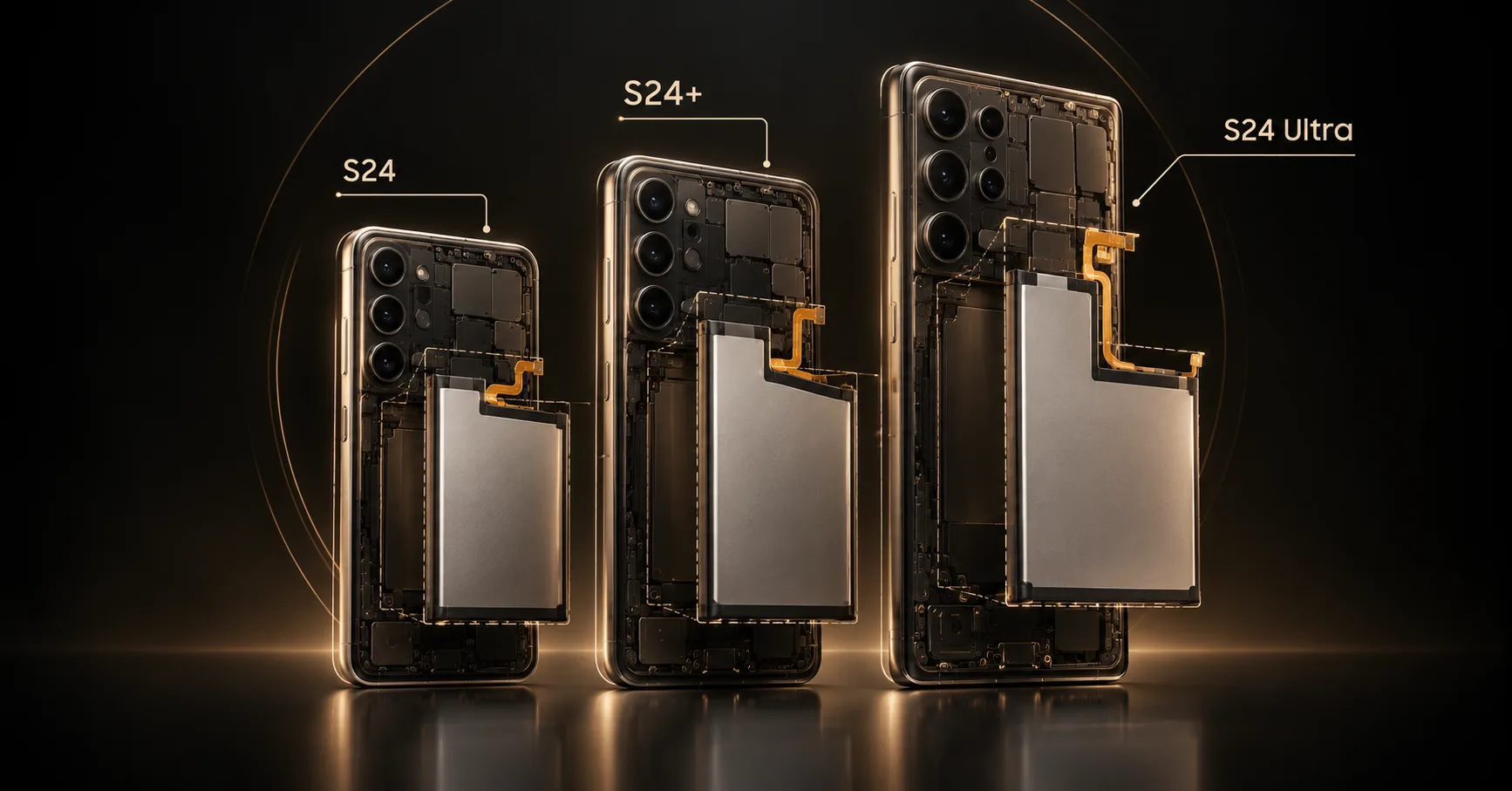

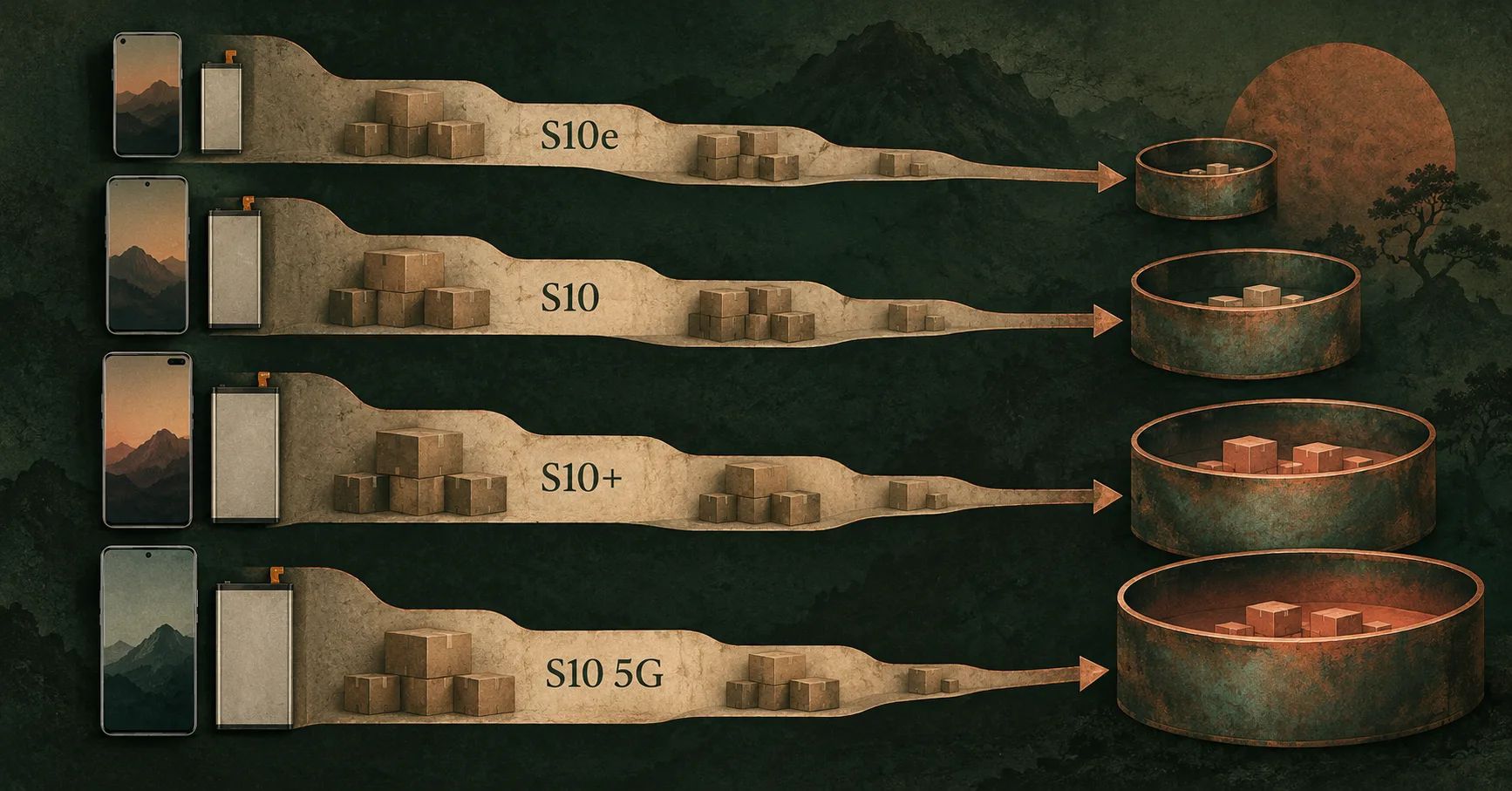
Quick answer: Galaxy S10-series batteries should be managed as four separate legacy SKUs: S10e, S10, S10+ and S10 5G. The devices have different model families, battery envelopes and official capacity references. For B2B buyers, the difficult question is no longer only “does it fit?” It is whether current demand, inventory age, sample evidence and expected warranty cost justify stocking each SKU.
A samsung galaxy s10 battery replacement program should start with exact handset identification and end with an explicit replenish, hold or retire decision. A familiar model name or battery number is useful for catalog search, but it cannot replace a controlled drawing, physical inspection, installed-device test and lot record.
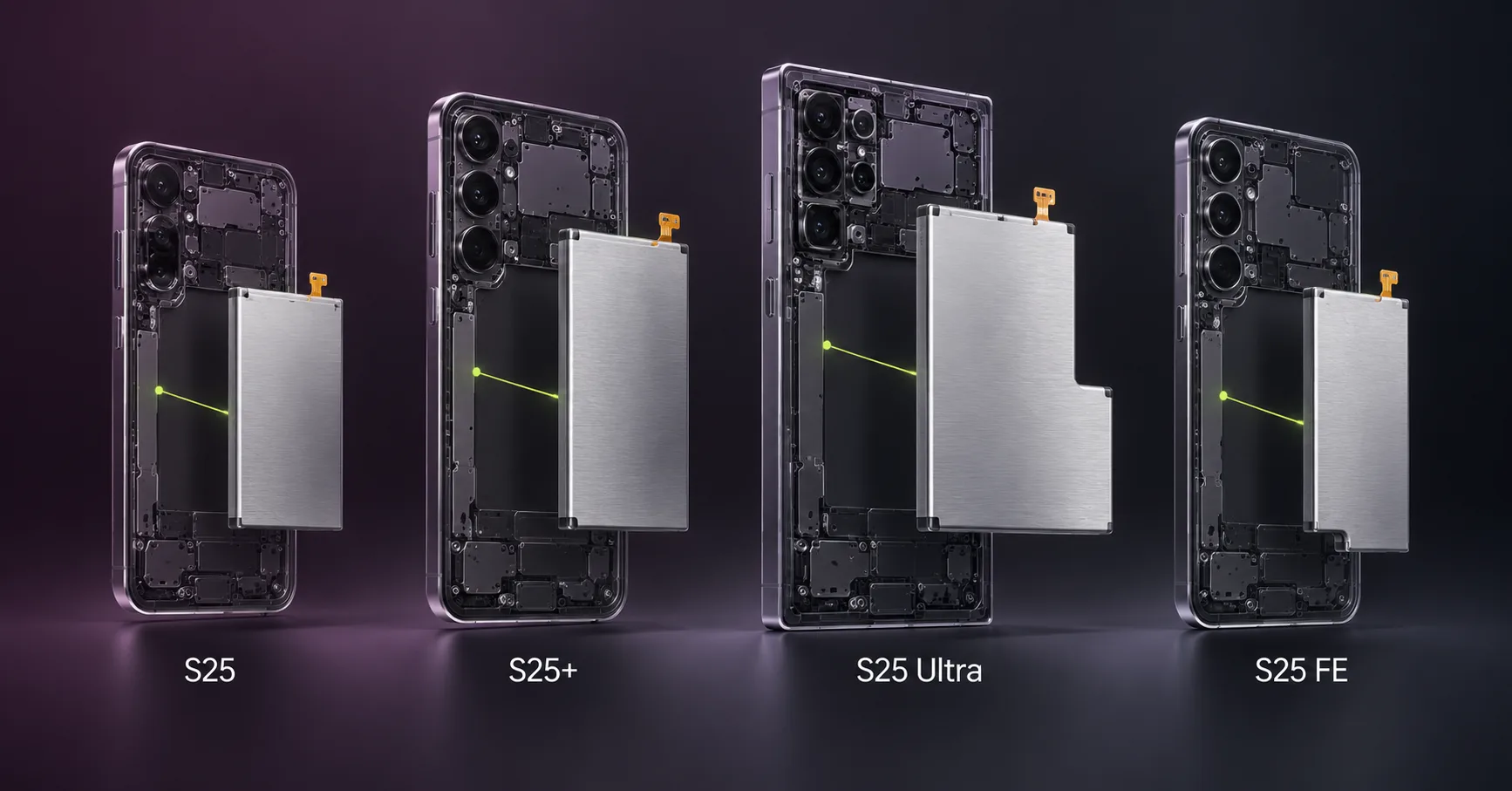
Separate Four Similar Names Into Four Controlled SKUs
The Galaxy S10 generation includes several phones that are easy to confuse in a parts catalog. Samsung identifies S10e, S10, S10+ and S10 5G as distinct devices. Regional and carrier suffixes can extend the base model family, so buyers should record the complete code from the handset, carton or service record.
| Device | Common model family | Official typical capacity reference | Recommended inventory treatment |
|---|---|---|---|
| Galaxy S10e | SM-G970 | 3,100 mAh | Independent compact-model SKU |
| Galaxy S10 | SM-G973 | 3,400 mAh | Independent base-model SKU |
| Galaxy S10+ | SM-G975 | 4,100 mAh | Independent plus-model SKU |
| Galaxy S10 5G | SM-G977 | 4,500 mAh | Independent 5G-model SKU |
Samsung's Galaxy S10 launch specifications distinguish the models and note that configurations “may differ by market and mobile operator.” That warning matters in parts procurement. A shortened sales name is not enough to approve regional coverage, and a capacity number does not prove mechanical or electrical interchangeability.
The capacity figures are device references, not automatic specifications for every replacement pack. Samsung's Galaxy S-series capacity guide describes typical capacity as an average estimate that considers variation among tested samples. Keep official typical capacity, supplier-declared minimum and buyer-measured discharge result as separate fields.
Why Legacy S10 Demand Requires a Different Buying Strategy
New-model sourcing usually focuses on launch demand and rapid scale. Legacy sourcing is different: demand can be smaller, less predictable and spread across repair sites, while old inventory carries a greater chance of unknown storage history. The goal is not maximum stock depth. It is sufficient coverage with controlled age, evidence and exit rules.
Classify each SKU by rolling repair demand, available device population, historic sell-through, gross margin after returns and the operational cost of holding stock. A high search volume does not automatically equal wholesale demand. Consumer research, DIY interest and parts-shop demand can appear in the same keyword cluster.
| Demand class | Suggested purchasing pattern | Review trigger |
|---|---|---|
| Core legacy | Small, regular replenishment from a validated source | Sell-through slows or claim rate changes |
| Intermittent | Limited batch or consolidated order | Stock age exceeds internal review point |
| Rare | Order against confirmed demand where practical | Carrying cost exceeds service value |
| Retirement candidate | No automatic reorder | Final stock disposition and customer notice |
This classification should be revised from actual orders and claims, not left as a permanent label. S10e demand may behave differently from S10 5G demand in the same market, so the series should not share one reorder threshold.
Grade Legacy Inventory Before It Enters Repair Stock
Production date alone does not determine whether a battery is acceptable, but missing age and storage history increase uncertainty. On receipt, record the manufacturing or lot date, packaging condition, label consistency, physical appearance and receiving electrical condition. Quarantine swollen, deformed, punctured, contaminated, leaking or otherwise damaged items; do not install them for exploratory testing.
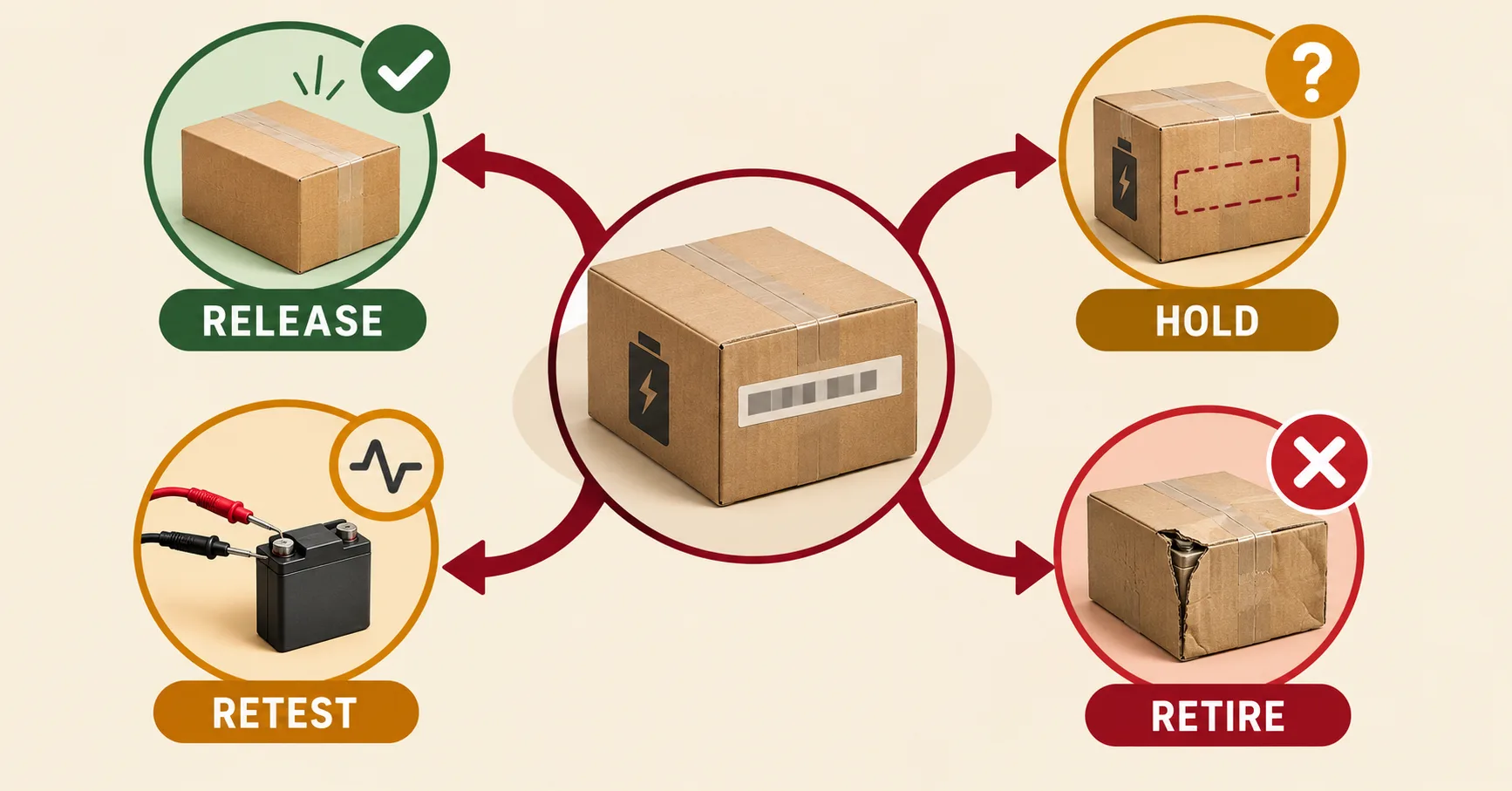
Use a written disposition rule with four outcomes: release, hold, retest or retire. Release requires traceable identity and passing evidence. Hold applies when records or conditions are incomplete. Retest uses an approved sampling and capacity procedure. Retire applies when damage, performance, traceability or economics make further use unjustified.
Store accepted inventory under documented conditions and use first-expire-first-out logic where the business defines an expiry or review date. ESCCharge's mobile phone battery storage SOP explains stock rotation, condition checks and separation practices that can be adapted to a legacy S10 program.
What an S10-Series Sample Must Prove
Identity and document match
- Complete target handset code, region and buyer SKU.
- Supplier SKU, battery cross-reference, drawing revision and label artwork.
- Cell lot, finished-pack lot and production date.
- Included adhesive, pull tabs, liners or kit components.
- Change-notification rules for cell, board, flex, connector, insulation and adhesive.
A samsung galaxy s10e battery replacement kit may include more than the battery assembly. The buyer should identify which items are part of the approved configuration and which are optional tools or consumables. Do not allow a kit title to hide an uncontrolled adhesive or missing liner.
Mechanical installation
Measure length, width and thickness using an agreed method. Inspect pouch edges, fold areas, flex routing, connector orientation, insulation and adhesive alignment. Install samples in known target phones using a documented repair process. A pack that requires bending, pressure, connector strain or improvised adhesive changes should not pass because it can power on once.
Electrical and capacity evidence
Confirm polarity, receiving voltage condition, connector engagement and agreed protection behavior with qualified equipment. For capacity, define whether the supplier claim is typical or minimum and record nominal voltage, watt-hours, charge process, discharge rate, cutoff voltage, temperature, rest periods and sample count.
A generic s10 battery label cannot establish which device or capacity reference applies. Likewise, an extended-capacity claim needs physical plausibility and repeatable test evidence. Use the principles in the battery capacity testing guide, adapted to the approved S10 fixture and limits.
Installed-device behavior
Run first boot, charging recognition, charge progression, idle observation, representative workload and cool-down. Record the phone code, software state, charger, cable, ambient condition and observed messages. A galaxy s10 battery replacement should not be released from a single successful boot; intermittent shutdown, abnormal heat, charge interruption or rapid percentage movement needs investigation.
Samsung's current disassembly and reassembly guidance says phone repair requires “the right tools, proper safety gear, and careful preparation.” It also warns that product composition can vary by country, region or carrier. Use trained technicians and model-specific procedures, and stop work when a battery is damaged or conditions are unsafe.
Move From Sample Approval to a Small Pilot Lot
A good sample does not prove routine-production consistency. Freeze the approved unit with photographs, drawing revision, label file and measured results. Then receive a small pilot lot under a defined inspection plan.
- Quarantine the lot until identity and condition checks pass.
- Match carton, label, SKU, model and lot records to the purchase order.
- Inspect packaging, pouch, insulation, flex and connector condition.
- Measure representative dimensions and receiving electrical condition.
- Install samples in every handset variant included in the purchase scope.
- Release, hold or reject with a recorded reason and responsible reviewer.
The mobile phone battery incoming-inspection guide provides a practical receiving framework. For legacy stock, tighten controls when production dates are older, traceability is incomplete, packaging has changed or the supplier proposes a new cell or board.
Control Picking and Warranty Evidence
Give S10e, S10, S10+ and S10 5G separate barcodes and bins. A parent label that says only “Galaxy S10 Series” invites mis-picks. The repair ticket should connect device code, installed battery SKU, pack lot, technician, date and post-repair result.
If a claim occurs, preserve the symptom, battery lot, phone code, photos, charging conditions and test result. Use the battery warranty-claims workflow to distinguish likely battery, installation, device, storage and evidence-insufficient cases. This prevents one vague complaint from condemning an entire lot and also prevents repeated failures from being dismissed.
Set a Replenishment and Phase-Out Rule
Review every legacy SKU on a fixed cadence. Track units sold, months of cover, oldest lot, returns, no-fault-found claims and open customer commitments. Replenish only when expected demand can consume a new batch within the business's approved holding period.
Pause automatic reorder when demand falls below the economic batch size, stock age rises, evidence quality declines or claim handling consumes the remaining margin. A phase-out decision should specify the last-buy quantity, final inspection, customer communication, warranty reserve and safe disposition of unusable batteries.
The broader Samsung replacement-battery supplier guide supports vendor qualification. This page owns the legacy S10 assortment decision. A samsung s10 battery replacement offer can be commercially attractive only when the exact model, evidence and stock age remain controlled.
Send an RFQ That Produces Comparable Offers
- target devices, complete model codes, regions and forecast by SKU;
- battery cross-reference and revision-controlled dimensional drawing;
- production-date range and storage-history expectations;
- declared minimum or typical capacity and full test conditions;
- cell, board, flex, connector, insulation and adhesive scope;
- label, barcode, packaging and private-label requirements;
- sample quantity, pilot-lot quantity and receiving plan;
- change-notification, traceability and warranty-investigation rules;
- small-batch reorder and end-of-life arrangements.
MOQ, lead time, warranty, capacity and compliance support depend on the exact model, quantity, destination and agreement. Request terms by SKU rather than assuming that one series-level quotation applies equally to all four products.
Frequently Asked Questions
Can S10e, S10, S10+ and S10 5G batteries be combined under one SKU?
No. Their device families and official capacity references differ. Use separate drawings, samples, barcodes and approval records.
Does an old production date automatically mean a battery must be rejected?
No single date answers the question. Apply the buyer's documented age policy together with traceability, storage history, physical condition, electrical checks and sampled performance.
Should a buyer accept an extended-capacity S10 battery?
Only after confirming physical plausibility, declared minimum capacity, complete test conditions and repeatable sample results. The printed figure alone is insufficient.
How should repair businesses buy low-volume legacy SKUs?
Use smaller replenishment lots, consolidate demand where practical and review stock age and sell-through before every reorder. Avoid deep purchases based only on old search demand.
What should trigger SKU retirement?
Persistent weak demand, uneconomic batch size, aging inventory, poor traceability, rising claims or unavailable compliant supply can justify a documented phase-out.
Keep Legacy Coverage Without Letting Inventory Control You
The strongest S10 program separates the four models, approves current production evidence and connects every lot to its storage, sales and warranty record. This preserves useful repair coverage while preventing slow-moving inventory from becoming an open-ended quality and cash-flow risk.
Request a legacy-SKU review: send ESCCharge the target handset codes, destination markets, recent demand, preferred batch size, packaging needs and acceptance plan. The team can review the requested configurations and propose a sample-to-pilot path. Final capacity, MOQ, lead time, warranty and documentation remain subject to confirmed model and order conditions.
External Source References
- Samsung US Newsroom — Galaxy S10 Interactive Press Release
- Samsung Gulf — Galaxy S Series Battery Capacity Guide
- Samsung UK Newsroom — Galaxy S10 5G Launch Specifications
- Samsung Support — Disassembly and Reassembly Information
```