
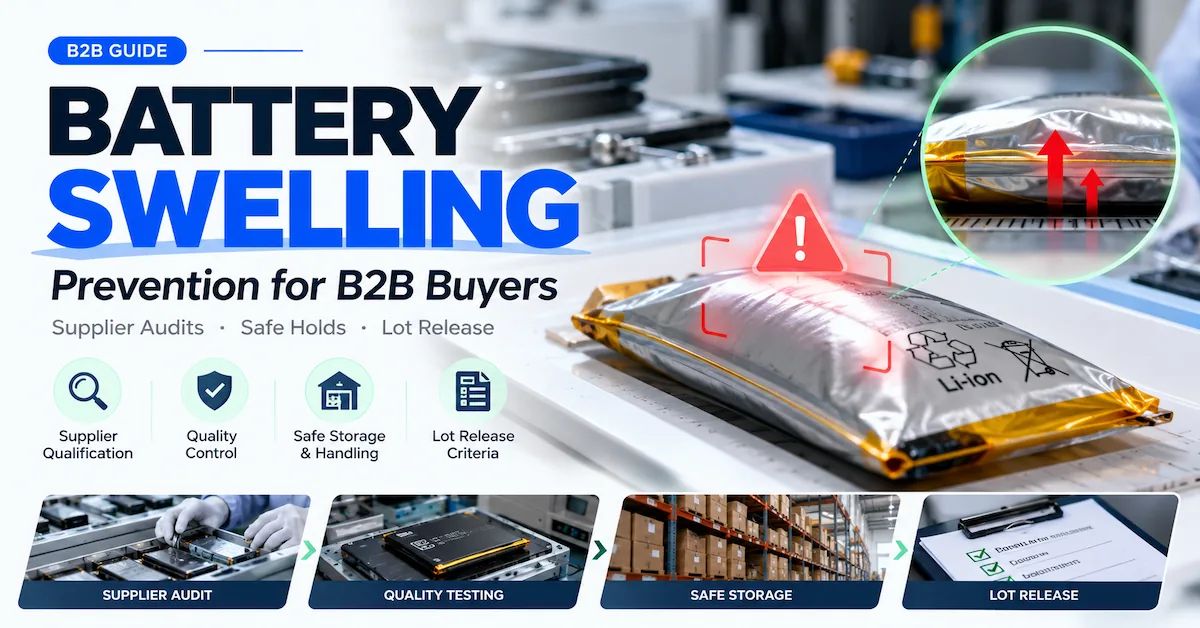
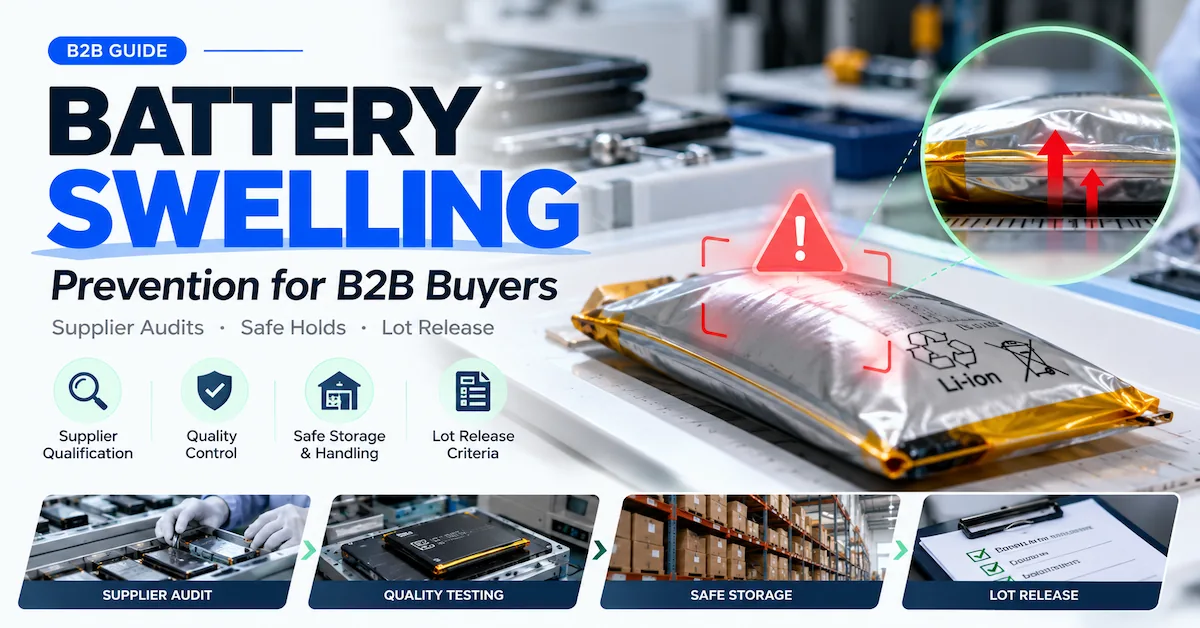
A dependable battery swelling prevention program starts before a replacement battery is purchased. B2B buyers should qualify the exact battery construction, agree on measurable acceptance criteria, protect inventory from unsuitable handling and storage, and keep each lot traceable through installation and after-sales service. If swelling is suspected, the immediate priority is safety: stop charging and using the affected product, restrict access, and follow the site's trained-personnel escalation procedure—not normal testing or ordinary returns.
For a mobile-parts wholesaler, a visibly swollen unit can interrupt warehouse operations and raise questions about neighboring stock. For a refurbishment business, it may also result in a damaged display, unfinished production, an unsellable device, or a costly warranty investigation. Even when only one unit is affected, the buyer needs to know which lot it came from and whether other units share a credible common risk.
That is why the purchasing question should not be limited to “What causes a swollen phone battery?” A more commercially useful question is: “What evidence should a replacement battery supplier provide before our company approves samples, receives stock, and releases lots for sale?”
ESC supplies aftermarket replacement batteries for smartphone, tablet, laptop, and selected wearable-device repair markets. Its mobile phone battery portfolio serves repair businesses, refurbishers, wholesalers, distributors, and private-label buyers. This guide uses those purchasing environments to build a practical, safety-led quality framework. It does not claim that any supplier can guarantee zero swelling, or that a particular test eliminates all future battery risk.
1. Understand What Battery Swelling Signals—and What It Does Not Prove
In a lithium-ion pouch cell, abnormal gas generation and internal chemical reactions can produce visible expansion. In a phone, that expansion may create a raised screen, pressure against the enclosure, or a distorted battery outline. In laptops or tablets, a similar physical change may appear as a lifted trackpad, separated case, or deformation near the battery compartment.
Visible expansion is a warning sign, not a routine sign of normal aging. Ordinary capacity loss and swelling should be classified separately. A battery may lose usable capacity without changing shape; conversely, a visibly deformed battery requires safety attention regardless of what a device's battery-health screen reports.
Swelling is also not a standalone root-cause diagnosis. One observation cannot establish whether the primary contributor was cell manufacturing, prolonged heat exposure, incorrect charging, mechanical damage, component design, storage history, or another factor. Several contributors may interact.
Buyers should distinguish four terms in their incident records:
| Observation | What it describes | What should not be assumed |
|---|---|---|
| Capacity degradation | Reduced measured energy or operating time | It does not, by itself, prove swelling |
| Battery swelling | Visible expansion, bulging, or enclosure pressure | It does not identify a single root cause |
| Suspected leakage | Material or residue possibly escaping from the cell or pack | Appearance alone does not establish its chemistry |
| Thermal event | Abnormal heat, venting, smoke, or ignition | It must not be treated as an ordinary warranty test |
A repair-oriented discussion of the physical causes is available in ESC's existing iPhone battery swelling guide. The focus here is different: purchasing specifications, prevention measures, lot decisions, and supplier accountability across a B2B replacement-battery program.
2. Put a Safety Stop Ahead of Every Inspection Plan
The safety rule is straightforward: never continue normal charging, cycling, installation, or powered diagnostics on a visibly swollen, leaking, unusually hot, or otherwise damaged lithium-ion battery. Do not puncture it, press it flat, open the cell, squeeze a lifted screen shut, or attempt to discharge it using an improvised method.
Health Canada and the London Fire Brigade both advise discontinuing use of swollen or damaged lithium-ion batteries. The London Fire Brigade also recommends turning off the affected device and contacting the manufacturer or an appropriate technician rather than tampering with it. These are public safety principles, not evidence that a specific ESC model has been independently evaluated by either authority.
For a business, the immediate response should be defined by a written site procedure:
-
Stop the task and, if it can be done without increased danger, stop the affected device's charging or operation.
-
Keep people from handling or approaching the suspect unit unnecessarily.
-
Notify the trained safety lead and record the unit's location without touching or moving it just for photographs.
-
Apply the company's damaged-battery isolation and emergency arrangements; qualified personnel decide whether movement is safe.
-
Do not return the unit to usable stock or hand it to ordinary parcel transport.
-
If there is smoke, fire, escalating heat, or venting, activate the emergency plan, evacuate as appropriate, and contact emergency services.
“Quarantine” may first mean an electronic inventory block and restricted physical access. It does not mean an untrained warehouse worker must pick up a dangerous battery and carry it to a normal returns shelf.
The site's procedures must reflect local fire, workplace, waste, and transport rules. For suspected liquid escape, ESC has a separate phone battery leakage and quarantine guide. The present article addresses preventive qualification and business controls rather than hands-on disposal or dangerous battery repair.
3. Map Battery Swelling Risk Across the Replacement-Battery Supply Chain
A quality program becomes stronger when it asks where a risk could be introduced or detected. Blaming every field complaint on the cell manufacturer is not sound engineering. Nor is assuming every complaint was caused by the end user.
For wholesale replacement batteries, there are at least six relevant stages:
Cell sourcing. Material consistency, cell manufacturing controls, incoming evaluation, and traceable cell references may influence the finished assembly.
Pack and flex assembly. Electrical connections, insulation, protection electronics, sealing integrity, component layout, and mechanical workmanship can affect reliability and fit.
Factory inspection. Testing needs an approved method and an identified configuration. A generic “100% tested” statement is not a substitute for knowing what was measured and how abnormal units were handled.
Transport and warehousing. Exposure to crushing, excessive heat, moisture, inappropriate stacking, terminal damage, and prolonged uncontrolled storage may introduce risk after production.
Installation and device integration. Incorrect model selection, pressure from enclosure components, improper adhesive handling, damaged connectors, or device charging faults can compromise an otherwise acceptable replacement.
Use and after-sales handling. Operating conditions, unsuitable accessories, device damage, and service history can influence field performance and complicate attribution.
For each stage, assign an owner and an evidence source. Cell information may come from the battery supplier; receiving records from the warehouse; installation observations from a repair partner; and customer outcomes from the warranty team. A claim without a timeline across these stages is harder to investigate accurately.
4. Define the Buyer, the Product, and the Non-Applicable Use Cases
A repair chain buying complete phone batteries has different requirements from a specialist buying bare cells or a company replenishing laptop packs. A single generic supplier questionnaire is rarely sufficient.
Repair chains need approved compatible SKUs, clear installation boundaries, lot labeling, and a repeatable escalation route when technicians notice abnormal appearance or fit.
Refurbishment factories need a defined release gate before device assembly, production-lot traceability, and finished-device inspection records.
Wholesalers and distributors need mixed-model inventory control, packaging and storage rules, customer complaint coding, and purchase terms covering nonconforming lots.
Private-label brands also need controlled artwork, appropriate safety warnings, packaging versions, documentation and a warranty workflow that can trace their own SKU back to the supplier's approved configuration.
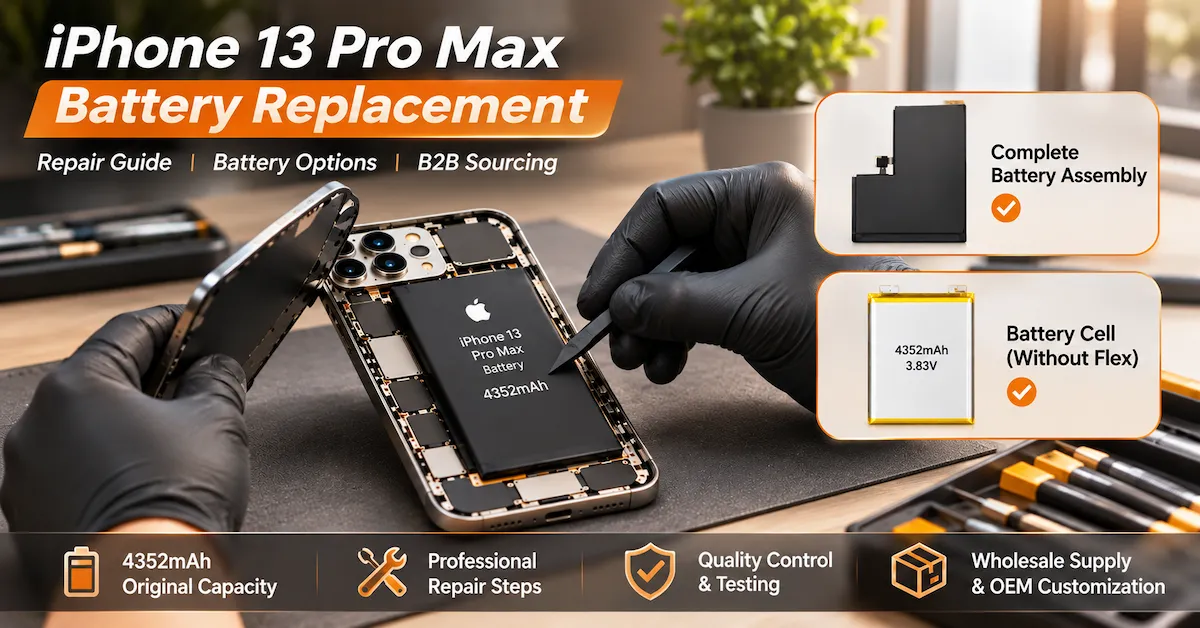
Specialist repair operations may purchase component-level solutions such as iPhone battery cells without flex. These are not interchangeable with complete ready-to-install assemblies and should not be routed through ordinary repair processes without the required engineering competence.
A replacement-battery purchase is not appropriate if the buyer's contract requires genuine original-manufacturer service parts and the offered product is aftermarket. Nor should a buyer accept a battery whose fit, electrical limits, documentation, or intended repair process cannot be established for the target device.
5. Write a Technical Specification That Can Actually Be Audited
A supplier audit starts with the exact SKU and controlled drawing. Broad words such as “high quality,” “safe cell,” or “premium protection” cannot serve as acceptance limits.
Use a product-specific specification with clearly assigned data sources. The following table is a recommended procurement template, not a universal ESC product specification or a claim that every listed test applies to all designs.
| Specification field | What the buyer should require | Evidence or decision rule |
|---|---|---|
| Battery identity | Device application, battery part number, supplier SKU, revision | Approved drawing and label reference |
| Cell and assembly type | Cell format, supplied electronics, flex and connector scope | Controlled configuration / bill of materials scope |
| Nominal electrical values | Voltage, rated and typical capacity where applicable, Wh | Published model specification with test conditions |
| Mechanical dimensions | Length, width, thickness, critical tolerances | Approved drawing and representative sample results |
| Electrical screening | Voltage, resistance, charging/discharging characteristics as applicable | Approved instrument, method and limits |
| Protection features | Claimed overcharge, over-discharge, short-circuit and thermal functions where relevant | Design-specific documentation or test evidence |
| Thickness and appearance | Baseline shape, deformation and workmanship criteria | Non-destructive checks on intact, safe samples |
| Storage requirements | Approved temperature, humidity, state of charge and review intervals | Product-specific written instructions |
| Packaging and identification | Terminal protection, lot code, carton mapping, warnings | Approved packaging and traceability standard |
| Transport documents | Applicable classification and evidence for the actual configuration | Current, relevant shipping document package |
| Release authority | Sampling, defect classification, stop conditions and sign-off | Written incoming quality plan |
Do not create a universal “acceptable swelling percentage” for unrelated products. Different cell formats and constructions require different measurements and acceptance criteria. A non-destructive thickness test on an intact engineering sample is not permission to compress, remeasure under load, or electrically stress a visibly swollen battery.
Require data to identify measurement conditions. Temperature, state of charge, rest time, equipment, test fixture, and sample selection can all matter. If a supplier provides an attractive performance chart without a test method or product revision, its value for lot acceptance is limited.
6. Audit Supplier Controls That Affect Battery Swelling Risk
Supplier qualification should test whether the company can explain and maintain the offered configuration. A factory tour or marketing video may be informative, but purchasing decisions require product-specific evidence, change control, and traceable results.
Cell screening and incoming materials
Ask how incoming cells are identified and screened before pack assembly. Relevant questions include whether the supplier reviews appearance, voltage, capacity, internal resistance, and dimensional consistency, and whether nonconforming material is kept out of usable stock. If suppliers refer to “cell grade,” ask what that term means in their actual purchasing specification.
The buyer need not demand confidential formulation details to conduct a useful audit. Instead, request enough evidence to understand that the selected cell design and process are controlled and suitable for the approved application.
Protection electronics and assembly workmanship
A battery assembly may include a protective circuit, sensors, flex cable, and other components depending on the device. Ask which functions are built into the offered part and how they are validated. Do not assume every protection board offers identical safeguards or that a protection circuit can compensate for physical cell damage.
Examine whether the assembly process has clear work instructions and inspection checkpoints. Connection integrity, insulation, connector orientation, and flex routing are particularly important for compact smartphone designs. Where a laptop battery contains multiple cells, the scope of cell balancing or monitoring functions should be verified for the exact pack rather than assumed.
In-process and outgoing quality control
ESC describes capacity, voltage, internal resistance, charging, aging, and appearance checks in its published replacement-battery materials. Buyers can use those claimed activities as a starting point for asking about specific methods, records, and acceptance criteria—not as independent proof that every unit is free from future swelling risk.
A professional audit should determine:
-
Which checks are performed on incoming cells and which on completed assemblies?
-
Are inspections performed on every unit, sampled units, or both?
-
How are equipment calibration and test versions controlled?
-
Which failures trigger containment, rework, rejection, or a broader investigation?
-
Can test records be connected to the shipped batch and SKU revision?
-
How are customers notified when a relevant component or process changes?
A supplier should be able to distinguish process controls from outcome claims. “We perform aging tests” is a process statement; “our batteries never swell” is an unsupported absolute promise. Purchase agreements should use the former only when the stated process can be evidenced, and avoid the latter entirely.
7. Validate Intact Engineering Samples Before Approving a Purchase Lot
A good sample plan evaluates the complete battery in its intended application, not merely its label. Importantly, routine electrical qualification applies to visually intact, safety-screened samples only. Suspect or deformed batteries must leave the normal testing workflow.
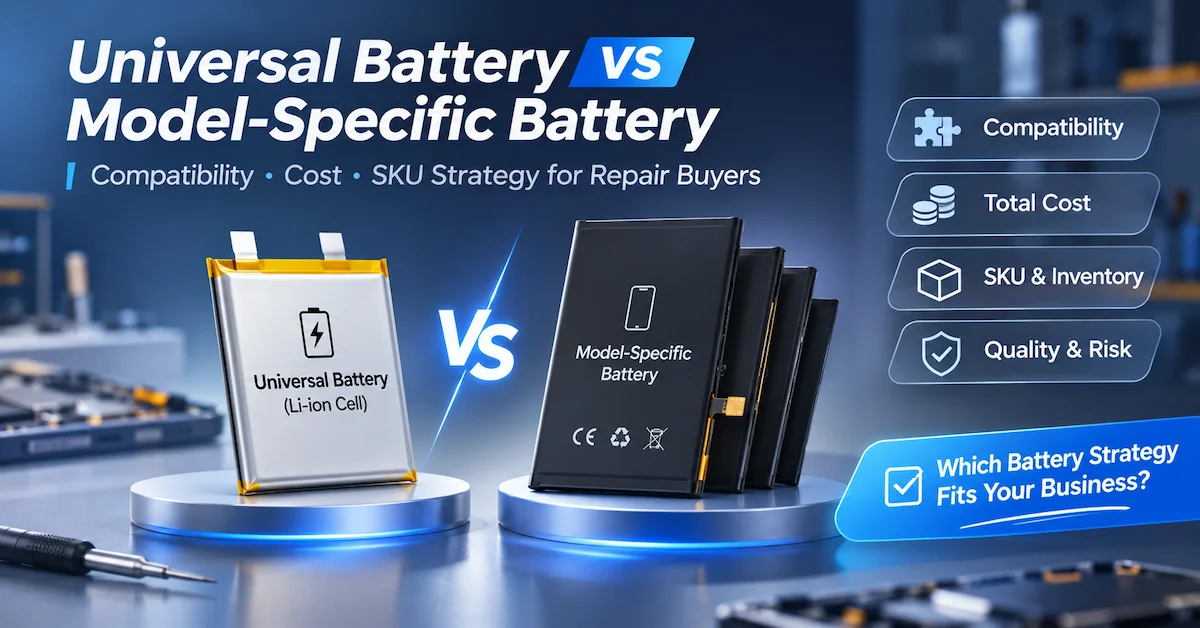
Begin with sample identity: exact model, material revision, cell format, electronics configuration, and production source. Confirm the intended phone, tablet, or laptop reference. For aftermarket phone replacements, identify the correct connector and mechanical clearance; a battery with similar dimensions is not necessarily electrically or mechanically interchangeable.
Next, agree on a staged evaluation. A technical team might separately assess appearance, dimensional conformity, capacity under defined conditions, voltage and resistance consistency, charging behavior, and safe installation in approved representative devices. The use of thermal monitoring or aging observations should be specified by qualified personnel and linked to the intended design and test method.
Make acceptance thresholds contractual, not improvised after the results arrive. The plan should state what qualifies as a critical defect, which failures require investigation, how many samples are evaluated, and who is authorized to approve the design.
Separate pre-existing damage from test-induced change
If an intact sample later shows deformation during an approved qualification program, that event should be documented, stopped, and escalated through the laboratory's safety procedures. Do not continue cycling the abnormal sample merely to obtain a better-looking graph or a longer cycle-count claim.
The sample report should preserve the pre-test condition, test sequence, method, dates, operator, equipment, environment, observed deviation, and final disposition. This makes the finding useful even when the immediate result is rejection.
Use three distinct qualification gates
Engineering approval answers whether the design is suitable for the specified application. Pilot-lot approval checks production-representative material. Routine lot release checks whether the shipment is consistent with the approved design and incoming acceptance plan.
One satisfactory prototype does not approve all later batches. Equally, a passing capacity measurement cannot substitute for correct fit, packaging, traceability, and physical condition.
8. Prevent Mechanical Pressure and Installation-Related Damage
A battery is not simply an electrical commodity. It is also a component that must fit safely into a constrained device enclosure.
For smartphone replacement batteries, the procurement specification should define critical thickness, connector orientation, flex routing, insulation, and any approved adhesive materials. The buyer's professional repair team should verify these against representative devices before mass installation.
Do not use device closure as a method of forcing a battery into specification. A display that will not close normally, unexpected case pressure, a trapped flex, or an assembly requiring abnormal force is a stop condition. The device must be reassessed through the approved repair procedure.
High-capacity designs may deserve particular dimensional scrutiny because a larger printed mAh value does not demonstrate compatible thickness, proper cell construction, or lower swelling risk. ESC offers high-capacity iPhone batteries, but each model's geometry and electrical characteristics need their own approval; this category does not imply that high-capacity batteries are inherently safer or less safe than original-capacity products.
For tablets and laptops, also consider enclosure geometry, mounting points, cables, and access restrictions. Some assemblies consist of multiple cells or differently shaped pack sections; the drawing and installation plan should reflect the actual configuration. ESC's tablet and laptop battery range provides a separate sourcing category for these applications.
Training and workmanship records are commercially important. If the same battery model produces physical damage repeatedly at one repair station, a supplier investigation should also examine tools, adhesive removal practices, technician instructions, and device condition. This is not an excuse to dismiss a material defect; it is a way to avoid unsupported root-cause conclusions.
9. Manage Storage and Inventory Exposure by Model and Lot
Warehouse conditions do not replace sound cell design, but they can reduce avoidable exposure after receipt. A professional program should define storage, handling, rotation, and periodic condition-review rules for the exact battery products being held.
Health Canada advises keeping lithium-ion batteries in a dry location at room temperature and away from harsh temperature exposure. These public guidelines do not establish a single qualified temperature band, storage state of charge, or maximum shelf life for every aftermarket battery. Obtain model-specific limits from the approved product documentation and applicable site requirements.
A useful warehouse system tracks the supplier SKU, lot, receipt date, location, inspection status, packaging condition, and stock age. Where appropriate, it may also track planned review or expiry dates. Avoid mixing unidentified old stock with recently approved stock under one barcode.
Operational controls should consider:
-
Protection from crushing, puncture, and inappropriate stacking;
-
Separation from heat sources and locations exposed to strong sunlight;
-
Terminal and connector protection within approved packaging;
-
Monitoring of environmental conditions against specified limits;
-
Controlled handling of returned or opened packaging;
-
Clearly identified stock statuses: Available, Hold, Qualified Review, and Retired;
-
Regular review of low-turnover and legacy-device battery inventories.
Storage decisions should be proportionate to product risk and documented evidence. If a shipment was exposed to an unusual heat event or physical impact, the correct response is not to assume it remains acceptable because cartons look intact. Hold the defensible affected scope and obtain qualified review.
The term “FIFO” (first in, first out) is useful for routine stock control, but it cannot resolve missing lot identity, damaged goods, or technical shelf-life requirements. A known suspect lot should not be released because it happens to be the oldest inventory.
10. Build a Battery Swelling Lot-Release Matrix That Stops Unsafe Stock
The key procurement control is a release decision made against predefined evidence. Avoid a vague status of “QC done” without knowing which samples, criteria, and documents support it.
| Lot status | Typical evidence situation | Appropriate business decision |
|---|---|---|
| Awaiting inspection | Correct shipment received; checks not complete | Do not release to normal picking |
| Approved | Identity, packaging, specified screening, and documents meet agreed rules | Release under authorized sign-off |
| Conditional hold | Incomplete evidence, unresolved trend, or revision question | Restrict scope while investigation continues |
| Safety hold | Suspected swelling, leakage, dangerous heat, or physical damage | Stop use and escalate through safety procedures |
| Rejected / retired | Confirmed nonconformity or failed approved review | Remove from available inventory; use authorized disposition |
A safety hold is not the same as a routine commercial hold. The former requires the site's trained personnel, safety arrangements, and restrictions on handling; the latter may involve ordinary paperwork or document correction.
Define what connects one suspicious unit to others: shared cell lot, final pack lot, packaging batch, storage location, transport incident, or repeated customer reports. Start with the scope supported by evidence, and enlarge it if lot separation is unreliable or common exposure is plausible.
A single swollen unit does not automatically prove that every unit from the supplier is defective. However, it is enough to stop the affected item and place a defensible scope under review. The quantity to hold and any wider market action should be decided through qualified safety, quality, and regulatory assessment—not a blanket claim made in a blog.
For release after investigation, require a documented owner, confirmed identity, risk assessment, review of relevant evidence, disposition decision, and any corrective-action conditions. Do not reopen normal sales merely because no second customer complaint has arrived.
11. Compare Representative Battery Models Without Ranking Safety by Capacity
Swelling prevention requirements should be attached to the actual product design and application. A smartphone pouch-cell assembly and a multi-cell laptop pack cannot share one arbitrary thickness limit, test fixture, or inspection threshold. The following ESC-listed products illustrate why buyers need separate qualification plans.
| ESC-listed product reference | Published electrical information | Primary qualification focus | Intended purchasing application |
|---|---|---|---|
| iPhone 11 replacement battery | 3110mAh, nominal 3.83V | Fit, pouch condition, flex routing, device-level approval | Phone repair and refurbishment |
| OPPO BLP851 replacement battery | 5000mAh typical; 4880mAh rated; nominal 3.87V | Exact BLP851 identity, rated-versus-typical labeling, connector fit | Android repair, distribution, mixed-model wholesale |
| A1493 MacBook replacement battery | 6330mAh, nominal 11.34V, approximately 71.8Wh | Pack configuration, multi-cell mechanical fit, connector and host compatibility | Laptop repair and refurbishment |
These specifications are published product-page values, not independently measured results for the buyer's future shipment. They must be confirmed against the exact quoted revision. The table does not imply that any model has lower swelling probability than another.
A procurement comparison should not rank batteries by the largest mAh value. Nominal voltage differs between products, device energy demand differs, and each pack's mechanical design and electronics are specific to its intended device. Comparing only mAh across smartphones and laptops is not technically meaningful.
Instead, compare suppliers within each approved model using consistent specifications and accepted evidence. Then compare supplier performance over time with comparable lot definitions and exposure periods.
12. Turn Battery Swelling Claims Into Supplier Corrective Actions
When a post-sale swelling allegation is received, the business should protect people first and preserve a reliable account of what was observed. It should not ask a customer or technician to charge, puncture, open, or stress the suspect item to prove a claim.
The quality team can request non-contact photographs only when doing so is safe, plus information already available from sales and repair records. A structured case should identify the device model, installed battery SKU, purchase order, batch or lot code, installation date, observed symptoms, approximate timeline, and storage or usage context when known.
Claims should be categorized separately: swelling, suspected leakage, physical damage, charging failure, low capacity, installation error, device fault, and insufficient evidence. Mixing these under one “battery defect” field makes trends harder to interpret and can lead to unfair or inaccurate supplier conclusions.
Ask for an evidence-based supplier response
A meaningful corrective-action response should distinguish confirmed facts, possible causes, tests or records examined, immediate containment, planned corrective measures, and verification of effectiveness. When an investigation cannot determine one root cause, say so and specify what evidence remains missing.
Potential actions could include reviewing the affected cell or assembly records, investigating storage and logistics exposure, updating a handling instruction, improving a particular inspection method, or strengthening product-change notification. Which action is justified depends on the actual evidence.
An investigation is not complete when a supplier simply offers a replacement carton. A commercial remedy may resolve a purchase dispute, but preventive measures should address the reason the problem could recur.
ESC's Terms of Service outline product safety requirements, warranty evidence, and the need for authorization before returns. The actual remedy, evidence requirements, and warranty period should be checked against the applicable order and agreement rather than described as universal across all products.
Measure the trend using the right denominator
A useful field rate has an explicit definition:
Confirmed swelling claim rate = confirmed, distinct swelling cases / comparable units sold or installed during the defined observation period × 100%.
That rate is only meaningful if the numerator reflects the investigation status, returns are not double-counted, and the denominator corresponds to the same model, lot or exposure cohort. A shipment sent out yesterday should not be compared naively with a shipment observed for twelve months.
A buyer may also track incoming damage rate, lot hold frequency, verified defect resolution time, supplier response time, and repeat complaints after corrective action. These indicators can be reviewed monthly or quarterly according to purchase volume.
13. Do Not Turn a Damaged Battery Into an Ordinary Return Shipment
Battery transport classification is a separate technical and legal decision from warranty approval. A seller may agree that a claim deserves a refund without having authorization to send the swollen unit back through a standard courier service.
The 2026 IATA battery guidance explains that lithium batteries identified as defective for safety reasons, or damaged in ways capable of dangerous heat, fire, or short circuit, are forbidden for air transport. U.S. PHMSA guidance separately describes special requirements for damaged, defective, or recalled lithium batteries in permitted ground and vessel transport. Requirements vary by jurisdiction, shipment configuration, and mode.
Never assume that ordinary lithium-battery paperwork authorizes transport of a swollen or safety-defective unit. A UN38.3 test summary for a qualified design does not turn an already damaged item into normal cargo. Nor should a business instruct customers to put a swollen battery in household waste or a regular mail return envelope.
For an affected unit, the responsible dangerous-goods and safety professionals should determine its classification, authorized handler, suitable location, documentation, and lawful disposal or transport route. Some unsafe items may require local disposal rather than return to the manufacturer. If smoke or active failure is present, prioritize emergency response rather than shipment planning.
The purchasing agreement should state who arranges approved management of hazardous returns, how photographs and records can substitute for physical samples when appropriate, and what documents the parties need to resolve a warranty claim safely.
14. Evaluate the Commercial Cost of Battery Swelling Prevention
Purchasing teams sometimes compare replacement batteries using only unit price. For a program exposed to safety-related returns, a better model includes prevention cost, rework, after-sales handling, and inventory disruption.
A useful internal planning formula is:
Total program cost = product purchase + inbound logistics + agreed inspection + handling and storage + installation rework + warranty response + safe disposition + disruption costs.
The exact accounting categories depend on the organization. Avoid double-counting an inspection cost already included in the supplier price or a replacement cost also recorded within warranty expense.
For illustration only, consider two hypothetical quotes for the same approved battery configuration. Supplier A offers a lower unit price but provides weak lot traceability and inconsistent document revisions. Supplier B is slightly more expensive but supports agreed sampling records, batch labels, and change notifications. The extra value of Supplier B is not proven simply by those features; it must be evaluated against actual receiving efficiency, traceability performance, defect outcomes, and contract terms.
Calculate the cost per accepted and supported unit, not merely the cost per unit ordered. Track repair labor, repacking, customer communication, lost production time, and disposal costs if they occur. Over a meaningful observation period, this information can support a rational supplier comparison instead of a blanket “cheaper batteries swell more” assumption.
15. Include Prevention Requirements in OEM and Private-Label Projects
Custom battery branding can create a stronger business offering, but it also gives the brand owner more responsibility for accurate descriptions and customer communication.
ESC publishes OEM support for replacement battery labels, mixed-model supply, and customized packaging across its battery product range. The precise design, packaging options, minimum quantities, lead times, and documentation must be confirmed for a specific project.
A private-label purchasing specification should identify which technical configuration sits behind the branded SKU. Approved packaging must match the electrical rating, battery type, warnings, intended compatible device, and lot-traceability scheme. If the supplier changes a cell or electronics revision, the brand owner needs a documented review before releasing products bearing the old approved identity.
For professional repair-channel packaging, buyers can also request clear instructions on safe storage, inspection before installation, actions if damage is suspected, and authorized warranty escalation. Those instructions should be reviewed by the responsible technical and regulatory teams and translated where required by the destination market.
Avoid claims such as “100% swelling-proof,” “zero fire risk,” or “certified safe in all countries.” An appropriate promise is narrower: the product is supplied according to an agreed specification and supported by the evidence applicable to that particular model and order.
16. Send a Purchasing RFQ That Makes Quality Measurable
To obtain comparable quotes, buyers should send the same requirements to each potential supplier. Rather than asking only for “best price on phone batteries,” identify the devices, quantity, quality expectations, and commercial scope.
An effective RFQ includes the device model and battery part number; buyer and supplier SKU; target capacity and nominal voltage; required cell and assembly configuration; critical dimensions; proposed pilot order; quality and documentation requirements; packaging and label scope; destination market; shipping terms; and expected purchasing volume.
Add the prevention-specific questions that make this article commercially actionable:
-
What is the controlled cell and finished-assembly revision for this quoted SKU?
-
Which appearance, dimensional, electrical, and aging checks are performed, and at which stages?
-
Which documented limits and sampling rules apply to lot release?
-
What storage and handling instructions apply to this specific model?
-
Which lot identifiers and inspection records accompany repeat orders?
-
What is the escalation process for a suspected swollen unit or a repeated field trend?
-
How are component changes notified and approved?
-
What documents support transport and product compliance for the actual destination?
-
How are warranty remedies and safe disposition responsibilities agreed?
Ready to qualify a replacement battery supplier? Review ESC's company and battery supply information, then contact ESC with your model list, annual or quarterly quantity estimate, destination, and proposed acceptance plan. Request written confirmation of the exact product configuration, available QC evidence, sample conditions, and commercial terms before approving a bulk order.
17. Frequently Asked Questions About Battery Swelling and B2B Sourcing
1. What is battery swelling in a lithium-ion replacement battery?
It is visible expansion or deformation associated with abnormal internal conditions, often involving gas generation in a pouch cell. Swelling is different from ordinary capacity loss and should be treated as a potential safety hazard. It does not, by itself, identify one manufacturing or usage cause. Buyers should stop ordinary handling and testing of a suspect unit, preserve safe non-contact observations, and refer the case to the site's trained safety personnel.
2. Is a swollen phone battery safe to charge briefly for testing?
No. Do not charge or cycle a visibly swollen battery to complete inspection, reproduce a complaint, read capacity, or gather evidence for a supplier claim. Nor should anyone puncture, squeeze, bend, or open it. Stop use and apply the approved damaged-battery response. Technical investigation, any authorized handling, and disposal or transport decisions belong with appropriately trained personnel.
3. Can a supplier guarantee that its batteries will never swell?
No responsible supplier should issue an unconditional zero-risk promise for a lithium-ion product. Risk depends on product design, cell condition, manufacturing controls, handling, storage, installation, charging, and service exposure. Buyers should request measurable specifications, relevant testing evidence, lot traceability, and a defined corrective-action process. Those controls reduce uncertainty but cannot prove that a battery will never fail.
4. Does battery swelling prove that the manufacturer used a poor-quality cell?
Not by itself. Cell defects may contribute to a failure, but a field observation can also involve external heat, mechanical damage, incompatible use, unsuitable storage, or other conditions. A fair supplier investigation should connect the affected unit with its lot, device and service history, and any qualified examination. Conclusions should identify what is confirmed, what remains possible, and what cannot yet be determined.
5. Should buyers choose original-capacity or high-capacity replacement batteries to minimize risk?
Neither label establishes lower swelling risk. The correct choice is the model that fits the target device, meets the approved electrical and mechanical specifications, and passes the buyer's application-specific qualification. A high-capacity claim does not excuse insufficient enclosure clearance, and an original-capacity label does not prove original-equipment origin. Compare the exact cell design, dimensions, test conditions, and applicable quality evidence for each offered SKU.
6. What inspections are useful before releasing a normal battery shipment?
For apparently intact, identified products, a buyer may use approved packaging, appearance, dimensions, voltage, resistance, capacity, and functional checks according to the particular specification and sampling plan. The buyer should also confirm traceability, storage history where available, and product documentation. The inspection plan must define acceptance, retest, and hold decisions. Visibly swollen or physically compromised units are excluded from routine electrical tests and escalated separately.
7. How does storage time affect battery swelling risk in wholesale inventory?
There is no safe universal shelf-life number that applies to every chemistry, pack design, state of charge, and warehouse environment. Obtain product-specific storage limits, review intervals, and handling instructions from the supplier. Track receiving dates, lots, locations, packaging condition, and periodic review status. Older stock should not be mixed with newly approved material under ambiguous identifiers or sold automatically when its approved review status is uncertain.
8. Does UN38.3 documentation mean a swollen battery can be shipped normally?
No. UN38.3 relates to transport design-type testing; it does not override restrictions applicable to an individual damaged or safety-defective battery. IATA's 2026 guidance prohibits air transport of lithium batteries with qualifying safety defects or damage. Other modes may involve special classification, packaging, labeling, training, and carrier requirements. Consult an authorized dangerous-goods professional rather than returning a swollen battery through ordinary air express or consumer mail.
9. What evidence supports a battery swelling claim from a wholesaler?
Provide order reference, exact battery model and supplier SKU, lot or carton code, affected quantity, date and location of discovery, installation or storage stage, and a factual description of the observed condition. Include pre-existing records and non-contact images only when safe to obtain. Do not ask a customer to remove, power-cycle, charge, or ship the suspect item for proof. Confirm the agreed safety and warranty reporting channel before any physical return.
10. What should I request from ESC before placing a bulk battery order?
Send your device and battery references, required quantities, application, target market, and OEM packaging needs. Ask ESC to identify the exact quoted configuration, approved specifications, sampling and QC information, lot-identification method, storage instructions, available model-specific documents, warranty conditions, and feasible delivery plan. If your organization has a formal release standard, share it at quotation stage. Use the ESC contact form to request a product-specific discussion rather than relying on a general catalog description.
Conclusion
Battery swelling prevention is a supply-chain quality discipline, not a single inspection or a promise printed on a battery label. For professional buyers, the strongest process combines accurate product identification, supplier qualification, engineering sample approval, incoming-lot release rules, controlled warehouse exposure, careful device integration, and traceable after-sales evidence.
When swelling is suspected, safety always takes precedence over performance testing, warranty deadlines, or the desire to recover a unit. Stop normal use, keep untrained personnel from handling it, and follow the appropriate damaged-battery response and lawful disposition process. A suspect item should never return to ordinary inventory simply because its capacity label or voltage reading appears acceptable.
For wholesalers, refurbishment companies, repair chains, and private-label brands, the commercial objective is to prevent avoidable disruption while maintaining fair, evidence-based supplier accountability. A lower quotation price has limited value if product identity, lot history, inspection records, or corrective actions cannot be demonstrated when problems arise.
ESC supplies aftermarket replacement batteries across multiple device categories and supports wholesale and customization discussions. If you are preparing a sourcing program, start with the exact device models and approved specifications, then request traceable samples and a written agreement on quality, packaging, documentation, and warranty handling. Explore the ESC replacement battery catalog and contact the ESC team to discuss the requirements for your next bulk battery order.