
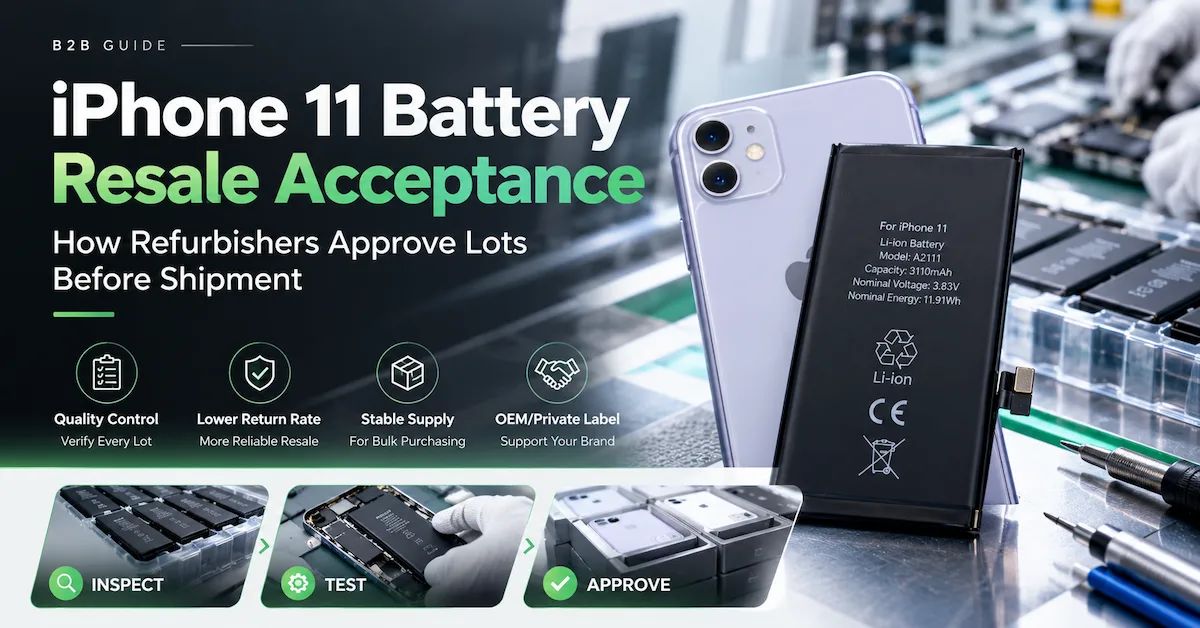
An iPhone 11 battery should be approved for refurbishment production only after the buyer has verified its physical compatibility, electrical performance, charging behavior, software-related information, and consistency with an agreed purchasing specification. A battery that looks acceptable in its packaging is not necessarily ready for installation across hundreds of refurbished devices.
For refurbishment companies, battery approval is more than a component inspection. It directly affects production efficiency, product grading, customer satisfaction, warranty exposure, and the profitability of refurbished smartphone sales.
A reliable purchasing process should connect three critical stages: supplier qualification, incoming battery inspection, and finished-device acceptance before resale.
This distinction matters because a battery can pass an individual electrical test but still create problems when installed. Incorrect connector positioning, inconsistent charging behavior, unexpected battery-information messages, or differences between approved samples and production batches can interrupt refurbishment operations.
ESC supplies aftermarket smartphone replacement batteries for professional repair businesses, refurbishers, distributors, and wholesale buyers. Its mobile phone battery product range includes different capacity and repair-oriented solutions intended for professional purchasing requirements.
This guide focuses on how buyers can evaluate a replacement battery for iPhone 11 refurbishment programs, establish practical acceptance criteria, compare battery configurations, and reduce preventable risks before releasing finished phones for resale.
1. Why iPhone 11 Battery Acceptance Matters in Refurbished Phone Production
The iPhone 11 remains relevant to refurbishment businesses because repairable smartphones can continue serving the secondary market after their original owners upgrade.
However, refurbishing smartphones is fundamentally different from replacing the battery in a single customer's device.
A repair technician handling one phone can investigate an installation problem individually. A refurbishment facility processing 500 or 1,000 phones needs consistent procedures that prevent the same problem from affecting an entire production batch.
Battery quality affects more than battery runtime
A replacement battery influences several aspects of the finished refurbished device:
-
Functional reliability: The phone must start, charge, discharge, and operate without battery-related abnormalities.
-
Production efficiency: Technicians need compatible components that can be installed without unnecessary adjustment or rework.
-
Resale grading: Buyers may expect a documented battery-health or minimum-runtime standard.
-
Customer confidence: Battery notifications, unusual charging behavior, or unexpected shutdowns can create concerns after purchase.
-
Warranty costs: A defective battery can generate testing, return shipping, repair labor, and replacement expenses.
-
Inventory consistency: Purchasing teams must be able to reorder the same approved battery configuration.
These factors mean that the lowest unit price does not automatically represent the lowest purchasing cost.
For example, two suppliers may offer batteries with identical printed capacities. However, if one shipment creates more installation failures, rework, or warranty claims, its total operational cost may exceed the apparent savings.
Professional buyers should therefore evaluate the relationship between battery quality, installation efficiency, and finished-device acceptance rather than comparing quotation prices alone.
Separate component acceptance from finished-device acceptance
A practical quality-control program has two distinct approval points.
Component acceptance confirms that the supplied battery meets the agreed requirements before installation. These requirements may cover identification, appearance, dimensions, electrical measurements, capacity-test results, and documentation.
Finished-device acceptance confirms that the refurbished iPhone operates correctly after the battery has been installed.
Both stages are necessary because a battery may meet its individual specifications while the finished phone still experiences problems caused by the installation, device condition, or software behavior.
The strongest refurbishment programs maintain a documented relationship between the battery lot, the installed device, and the final inspection result.
2. Which B2B Buyers Need a Formal Battery Acceptance Process?
Not every purchaser needs the same level of documentation or inspection.
A refurbishment facility installing hundreds of batteries each week faces different risks from a local repair shop replacing a few batteries per day.
Smartphone refurbishment factories
Refurbishment factories need repeatable procedures because battery problems can affect production schedules and resale grading.
Their main concerns include incoming-lot consistency, installation time, charging performance, failure categorization, and finished-device release criteria.
Repair chains
Repair chains need approved replacement components that behave consistently across multiple service locations.
They may prioritize compatibility, repair instructions, predictable warranty handling, and clear identification of each battery configuration.
Replacement battery wholesalers
Wholesalers typically purchase inventory before knowing exactly which repair customer will use each unit.
Their priorities include product identification, packaging, stock rotation, complaint handling, and repeat-order consistency.
Private-label battery distributors
Brand owners must consider both technical performance and the information printed on products and packaging.
They need accurate product descriptions, traceable SKU information, approved labeling, and a clear method for investigating customer complaints.
Who may need a different supply solution?
An aftermarket replacement battery program is not appropriate for buyers whose contracts specifically require genuine Apple service parts.
Similarly, a cell-only solution may not suit repair facilities that do not have the equipment, procedures, and training necessary to handle battery electronics and complete the relevant assembly operations.
ESC offers multiple categories, including original-capacity iPhone replacement batteries, decode battery solutions, and battery cells without flex assemblies.
These categories should be evaluated separately because their intended repair procedures, supplied components, and verification requirements may differ.
3. iPhone 11 Battery Specifications: Establish the Correct Technical Baseline
Before approving a battery for resale production, the buyer should establish a controlled technical specification.
The original iPhone 11 uses a battery platform commonly identified with approximately 3110mAh capacity and 3.83V nominal voltage. ESC lists a compatible aftermarket replacement configuration with these same nominal values.
Its iPhone 11 3110mAh replacement battery is positioned for professional repair, refurbishment, and wholesale applications.
Technical specification reference
The following values are based on ESC's published product information. They are supplier-stated specifications, not independent measurements of a particular production lot.
|
Specification |
Published information |
Buyer verification requirement |
|---|---|---|
|
Product |
iPhone 11 Replacement Battery |
Confirm exact supplier SKU |
|
Compatible device |
iPhone 11 |
Do not confuse with 11 Pro or Pro Max |
|
Device identifiers |
A2111, A2221, A2223 |
Confirm actual device model and fit |
|
Battery chemistry |
Rechargeable lithium-ion |
Review approved product specification |
|
Rated capacity |
3110mAh |
Verify with agreed discharge-test conditions |
|
Nominal voltage |
3.83V |
Check against the approved electrical specification |
|
Nominal energy reference |
Approximately 11.91Wh |
Verify labeling and supporting documents |
|
Capacity positioning |
Original-capacity replacement |
Does not mean Apple-original |
|
Cell description |
Brand-new pure-cobalt cell, as described by ESC |
Request relevant cell and material information |
|
Assembly |
Battery, flex, electronics, and protection components |
Confirm the exact supplied configuration |
|
Protection |
Overcharge, over-discharge, and short-circuit functions listed |
Review applicable validation evidence |
|
System information |
Depends on battery solution and repair conditions |
Verify on target devices and software versions |
|
OEM options |
Logo, labels, barcodes, and packaging |
Confirm approved artwork and order requirements |
|
Target applications |
Repair, refurbishment, wholesale |
Specify intended purchasing and use conditions |
Why nominal capacity alone is insufficient
Battery capacity is commonly expressed in milliampere-hours (mAh), while stored energy is expressed in watt-hours (Wh).
The approximate relationship is:
Using the published nominal values:
This calculation checks the arithmetic relationship between rated capacity and nominal voltage. It does not establish independently measured discharge energy or finished-device runtime.
Real performance depends on the discharge profile, temperature, internal resistance, cell condition, device power consumption, and other factors.
For procurement teams, the important questions are therefore:
-
What capacity does the supplier guarantee under the agreed test method?
-
Which test current, temperature, and cutoff conditions apply?
-
Is the reported result from an individual sample or the supplied production lot?
-
What tolerance defines acceptance or rejection?
-
Are capacity records associated with identifiable production batches?
An advertised rating becomes a useful purchasing requirement only when both parties agree on how it will be verified.
iPhone 11 compatibility must be model-specific
The iPhone 11, iPhone 11 Pro, and iPhone 11 Pro Max should not be treated as interchangeable battery applications.
They have different device configurations and battery assemblies.
A technician should never select a replacement battery simply because its product name contains “iPhone 11.”
The purchasing specification should identify the exact device model, supplier battery reference, mechanical dimensions, connector configuration, and any applicable electronic variant.
For bulk orders, this information should be reflected in the product SKU, carton labeling, quotation, and approved specification.
4. Build an Incoming Battery Inspection Standard Before Purchasing
A reliable inspection process begins before the first shipment arrives.
The buyer and supplier should agree on the product specification, inspection method, defect categories, and responsibility for nonconforming material.
Without these agreements, disputes can arise even when both parties believe they supplied or received the correct product.
Step 1: Establish a controlled purchasing specification
The purchasing team should request a specification that identifies the exact replacement battery configuration.
At minimum, it should address:
-
Compatible phone model and battery reference
-
Nominal capacity, voltage, and energy
-
Assembly dimensions and critical tolerances
-
Flex cable and connector configuration
-
Battery electronics and protection requirements
-
Label and packaging identification
-
Required test methods
-
Approved sample identification
-
Applicable documentation and warranty conditions
The specification should carry a revision identifier.
This allows the buyer to distinguish an approved version from a later variation that may use different components or electronics.
A common sourcing mistake is to approve a sample based only on its appearance, then assume any future shipment with the same marketing name is equivalent.
The approved configuration—not the marketing name—should control repeat purchasing.
Step 2: Check packaging and identification
Incoming inspection should begin with the shipping cartons and retail or workshop packaging.
Inspectors should confirm the purchase order, product quantity, SKU, labels, carton condition, and traceability details.
They should also examine the packaging for visible damage, deformation, leakage, or signs of inappropriate storage.
For lithium-ion batteries, unusual swelling, physical damage, leakage, smoke, odor, or excessive heat should be treated as a safety concern.
Suspect batteries should be isolated according to an established lithium-battery safety procedure. They should not be charged, squeezed, punctured, or installed for ordinary functional testing.
Step 3: Inspect mechanical condition
Physical inspection should cover the battery housing or pouch, cable routing, connector, adhesive arrangement, and dimensions.
Particular attention should be given to:
Battery thickness. Excessive thickness may interfere with the phone enclosure or create pressure after assembly.
Flex cable condition. Damaged, sharply folded, incorrectly positioned, or poorly supported flex assemblies may create installation difficulties.
Connector fit. The connection must correspond to the intended device without requiring force or modification.
Adhesive and insulation. Protective films and insulating materials should match the approved construction and allow safe professional assembly.
General workmanship. Wrinkles, damage, contamination, exposed conductors, or inconsistent assembly details require investigation rather than automatic acceptance.
Technicians should use the approved sample as a reference, not rely solely on printed dimensional claims.
Step 4: Perform electrical screening
An appropriate electrical inspection may include terminal voltage, polarity, internal resistance, and other parameters defined by the test plan.
A measured voltage within an expected range does not prove that a battery has the correct capacity or is suitable for installation.
Likewise, an internal-resistance reading must be interpreted using a specified method and comparable conditions.
The supplier and buyer should agree on instruments, measurement conditions, and acceptance criteria before comparing results from different locations.
Step 5: Record and classify abnormalities
Every inspection result should be recorded against a clearly identified shipment or production lot.
A useful defect classification separates:
|
Defect category |
Illustrative finding |
Recommended disposition |
|---|---|---|
|
Critical safety concern |
Swelling, leakage, abnormal heating, exposed conductor |
Isolate affected material and initiate safety review |
|
Major compatibility problem |
Incorrect connector or assembly dimensions |
Hold affected material pending investigation |
|
Major functional problem |
Failure to charge or unstable device operation |
Hold affected lot or defined subgroup |
|
Specification nonconformity |
Capacity below agreed acceptance criteria |
Apply the contractual rejection procedure |
|
Identification issue |
Incorrect SKU, model reference, or lot label |
Quarantine until traceability is restored |
|
Minor cosmetic issue |
Nonfunctional packaging appearance variation |
Evaluate against agreed cosmetic criteria |
These are suggested classifications. Actual acceptance thresholds, sampling procedures, and disposition authority should be agreed upon in the buyer's quality plan.
5. How to Verify iPhone 11 Battery Capacity and Electrical Performance
Capacity verification is one of the most important steps in battery qualification.
However, the testing method must be defined carefully.
A battery labeled 3110mAh does not automatically deliver that capacity under every current, temperature, or cutoff condition.
Capacity testing requires controlled conditions
A repeatable test should define the charging method, discharge current, cutoff voltage, ambient temperature, equipment calibration, and any rest periods.
For professional procurement, buyers should ask whether the capacity test is conducted on cells, complete battery assemblies, or both.
This matters because production changes and assembly electronics can affect the measured behavior of the finished product.
A complete battery assembly should be evaluated against the approved configuration, rather than assuming that satisfactory incoming-cell results guarantee final product acceptance.
Compare measured values against contractual requirements
Consider a hypothetical batch in which several samples produce different measured capacities.
A purchasing team should not automatically average all results and accept the lot.
Instead, it should determine whether each result satisfies the applicable specification, whether the testing conditions were consistent, and whether any abnormal result suggests a broader production problem.
For example, a buyer might agree on a minimum measurable capacity under a specified procedure, together with rules for retesting and investigation.
That minimum must come from the approved specification—not from an arbitrary percentage selected after receiving the goods.
The same principle applies to voltage and internal resistance.
Charging and discharge stability
In refurbishment production, capacity is only one dimension of performance.
Technicians should also evaluate whether the installed battery supports normal charging, stable discharge, and reliable device operation.
The assessment may include:
-
Charging initiation and progression
-
Behavior at different states of charge
-
Unusual temperature increases
-
Unexpected shutdowns or restarts
-
Abnormal battery-percentage changes
-
Charging interruptions
-
Inconsistent operation under defined workloads
Testing should be conducted using appropriate equipment, controlled conditions, and established safety procedures.
An isolated abnormality does not always prove that the replacement battery is defective. Charging accessories, device components, installation errors, and existing phone faults can also contribute to the observed behavior.
A professional quality system must therefore distinguish battery-related failures from broader device problems.
Battery-health readings are not independent capacity tests
A displayed battery-health percentage should not replace electrical testing.
Battery-health information is generated through device software and battery-related electronics. Its availability and interpretation depend on the installed component, repair configuration, and system behavior.
A screen showing 100% battery health is not equivalent to independently verifying that a cell delivers its published rated capacity under controlled conditions.
For refurbishment operations, these should be treated as separate measurements:
Battery capacity verification evaluates electrical performance using an agreed test method.
Battery-information verification records what the phone displays after installation.
Both may be relevant, but they answer different quality questions.
6. Battery Cell, Protection Electronics, and Assembly Quality
An iPhone 11 replacement battery is more than an energy-storage cell.
The supplied assembly includes components responsible for connection, monitoring, and electrical protection.
ESC describes its original-capacity replacement product as incorporating a lithium-ion cell, flex assembly, electronics, and PCM protection.
Why cell consistency matters
Differences in cell materials, manufacturing consistency, and storage conditions can influence electrical performance.
Procurement teams should ask how the supplier evaluates important cell characteristics before final assembly.
Relevant indicators can include:
-
Capacity consistency
-
Open-circuit voltage
-
Internal resistance
-
Dimensional conformity
-
Self-discharge behavior
-
Physical appearance
-
Aging performance
Statements such as “premium cells” or “A-grade quality” are not substitutes for measurable acceptance requirements.
An effective supplier discussion should focus on the controlled characteristics and evidence associated with the agreed battery configuration.
Protection electronics and assembly integrity
Protection components are intended to help manage certain electrical hazards, but their presence does not eliminate the risks associated with lithium-ion batteries.
The purchasing team should verify the protection functions claimed for the exact product and assess the related documentation or testing evidence.
Assembly workmanship also matters.
Poor insulation, inconsistent electrical connections, incorrect component positioning, and damaged flex cables can create failures even when the underlying cell meets its specification.
Why a complete replacement assembly may be preferable
For refurbishment companies focused on production throughput, a complete preassembled battery can offer a simpler procurement and installation workflow than a bare-cell solution.
However, the correct choice depends on the facility's repair process.
Operations equipped for specialized battery-electronics work may evaluate other component configurations, while high-volume general refurbishment lines may prefer fully assembled, approved replacements.
The goal is not to select the most technically complicated solution.
It is to choose the configuration that meets the buyer's performance requirements while minimizing unnecessary handling and process variation.
7. Battery Health, Software Messages, and Resale Disclosure
Software-related battery information is especially important when refurbished smartphones are sold to consumers who may inspect device settings before completing a purchase.
Apple's published Parts and Service History guidance explains that repaired devices may show information about replacement components and their verification status.
For iPhone 11 models, battery information can be relevant to the device's repair history.
Why battery status must be checked independently
Different aftermarket battery configurations may produce different system behaviors.
The result can depend on factors such as the battery electronics, installation method, device history, and software version.
Therefore, suppliers and refurbishers should not make universal claims that every replacement battery will always display a particular status or remain free of notifications after every software update.
A useful qualification procedure records the actual result on the target device.
Suggested software verification sequence
After the professionally installed battery has passed the necessary safety and functional checks:
-
Record the phone's exact model and software version.
-
Confirm that the device starts and operates normally.
-
Inspect available battery-health and charging information.
-
Check Parts and Service History where supported.
-
Record any battery-related messages or warnings.
-
Verify normal charging behavior.
-
Confirm that the observed result matches the approved product requirements.
-
Save the inspection record with the device and battery lot identifiers.
The specific menu labels and available features may vary with software versions.
Distinguish aftermarket batteries from genuine Apple parts
This distinction is essential for honest resale descriptions.
An aftermarket replacement battery should never be represented as a genuine Apple service part unless its origin and applicable verification genuinely support that description.
The expression “original capacity” describes the intended capacity positioning of a replacement battery. It does not establish Apple manufacture or authorization.
Likewise, a battery-health display or system message is not proof of cell origin, electrical capacity, or product certification.
ESC's decode battery range addresses certain professional repair requirements involving battery information and system behavior.
For the specific iPhone 11 decode replacement battery, the supplier describes battery-health display support and a warning-reduction-oriented solution.
Buyers should verify these functions on actual target devices under their intended installation and software conditions, rather than interpreting product positioning as a universal guarantee.
Resale disclosure should reflect actual device condition
A refurbishment business should establish clear policies for how replacement parts are described to customers.
Appropriate disclosure should align with the actual component, inspection result, and applicable market requirements.
A professional seller should avoid misleading claims about original component status, cycle count, battery health, or guaranteed operating lifetime.
Transparent descriptions help reduce disputes and support better after-sales communication.
8. How to Approve a Pilot Lot Before Full Refurbishment Production
An approved sample is not sufficient evidence that every subsequent production lot will perform identically.
For high-volume refurbishment programs, buyers should use a staged approval process that connects supplier qualification with actual production results.
Stage 1: Supplier sample qualification
Begin by obtaining a clearly identified sample configuration.
Document the model, supplier reference, component description, packaging, and applicable product revision.
A sample approval plan should include the following evaluations:
|
Qualification area |
What to verify |
Required evidence |
|---|---|---|
|
Product identity |
Correct iPhone 11 battery configuration |
Approved specification and sample identifier |
|
Mechanical compatibility |
Dimensions, connector, flex orientation |
Inspection and installation records |
|
Capacity |
Measured result against approved rating |
Controlled discharge-test report |
|
Electrical characteristics |
Voltage, resistance, charging behavior |
Recorded measurements and test conditions |
|
Safety screening |
No visible damage or abnormal thermal behavior |
Inspection and approved test records |
|
Software behavior |
Actual battery-information display |
Device model, software version, screenshots |
|
Installation performance |
Repeatable fitting and assembly |
Technician feedback and installation log |
|
Documentation |
Correct product and transport-related records |
Version-controlled document package |
Samples should be evaluated under conditions representative of the buyer's intended refurbishment process.
For example, testing only on a single fully functional phone may fail to reveal issues associated with different device conditions encountered in production.
Stage 2: Controlled pilot production
After samples meet the agreed requirements, the next step is a limited production trial.
The pilot quantity should be determined by the buyer's risk assessment, production volume, historical failure information, and sampling plan.
During the trial, the refurbishment company should monitor:
-
Batteries received and inspected
-
Batteries rejected before installation
-
Installation problems
-
Battery-related diagnostic failures
-
Charging abnormalities
-
Device-level rework
-
Finished phones passing final inspection
-
Customer complaints during the defined observation period
These figures should be calculated consistently.
For example, an installation failure rate should clearly identify its numerator and denominator. A battery rejected before installation should not automatically be counted as a post-sale product failure.
Stage 3: Review pilot results
Before approving full-volume purchasing, representatives from procurement, engineering, quality, and production should review the results.
Questions should include:
Did the received batteries match the approved configuration?
Were any failures linked to a specific battery lot or assembly variation?
Did technicians encounter unexpected installation difficulties?
Were system-related results consistent with the agreed requirements?
Did device-level failures arise from the battery, installation, or unrelated phone conditions?
Were rejected units identifiable and traceable?
A pilot should not be approved solely because the majority of phones turned on successfully.
The review should determine whether the process is stable enough for the intended production volume.
Stage 4: Approve, conditionally release, or reject
A formal pilot decision may have three outcomes.
Approved: The product and supporting records satisfy the agreed acceptance criteria.
Conditionally approved: Limited use is allowed under defined controls while outstanding issues are investigated.
Rejected: Critical requirements are not met, or the available evidence is insufficient for release.
The decision should identify the approved specification revision, lot, any restrictions, and the person responsible for authorization.
This turns sample purchasing into a controlled supply program rather than an informal agreement.
9. Compare iPhone 11 Battery Configurations Before Selecting a Supply Program
Not all replacement batteries serve the same repair requirements.
ESC offers a standard original-capacity replacement battery and a separate iPhone 11 decode-oriented product.
Both are presented for aftermarket repair applications, but their intended functions and verification requirements differ.
Original-capacity versus decode battery solutions
|
Comparison |
Standard iPhone 11 replacement battery |
iPhone 11 decode battery |
|---|---|---|
|
ESC product positioning |
Original-capacity replacement |
Repair-oriented decode solution |
|
Published capacity |
3110mAh |
3110mAh |
|
Published nominal voltage |
3.83V |
3.83V |
|
Main purchasing consideration |
Consistent standard replacement |
Additional battery-information behavior |
|
Mechanical validation |
Required |
Required |
|
Capacity verification |
Required |
Required |
|
Software verification |
Depends on agreed requirements |
Essential to qualification |
|
System warning behavior |
Depends on configuration and repair conditions |
Supplier describes warning-reduction functionality |
|
Buyer type |
Repair chains, wholesalers, refurbishers |
Specialized repair channels and refurbishers |
|
OEM options |
Available according to agreed order |
Available according to agreed order |
|
Approval priority |
Performance, fit, batch consistency |
Performance, fit, software behavior, batch consistency |
The values and positioning reflect ESC's published listings and should be reconfirmed in the current quotation.
When should a refurbisher select the standard replacement?
A standard original-capacity replacement may be suitable when the purchasing program focuses on mechanical compatibility, electrical performance, stable supply, and an agreed aftermarket replacement specification.
However, the buyer must still determine whether the finished device meets the applicable resale disclosure requirements.
When should a refurbisher evaluate a decode solution?
A decode-oriented battery may be worth evaluating when the repair workflow has particular requirements for battery-information presentation.
The buyer should request a demonstration on the intended device and software configuration, then verify the result through its own pilot process.
Do not assume that a supplier's marketing description guarantees the same behavior on every device or after every software update.
Should high-capacity batteries be included?
A high-capacity option should be evaluated as a separate product configuration.
Do not assume that every battery advertised for the iPhone 11 has identical dimensions, performance characteristics, or validation documentation.
If a higher-capacity option is proposed, request its exact specification and repeat the applicable mechanical, electrical, safety, and device-level checks.
The best choice is the configuration that meets the defined refurbishment requirements—not necessarily the one with the largest printed capacity.
10. Connect Battery Lot Traceability to Finished-Device Quality
Traceability is one of the most important controls for preventing a localized component issue from becoming a large-scale warranty problem.
When a refurbished phone is returned, the quality team should be able to determine which battery configuration was installed and, where practical, which incoming lot supplied it.
Recommended traceability information
A practical record may include:
-
Supplier name and product reference
-
Purchase order number
-
Shipment or incoming lot identifier
-
Battery SKU and specification revision
-
Receiving inspection date and result
-
Device serial number or controlled internal asset identifier
-
Installation date and production workstation
-
Technician or inspection operator identifier
-
Functional and software inspection results
-
Final disposition and warranty history
The data system should apply appropriate privacy and access controls to device identifiers and repair records.
For larger refurbishment operations, linking incoming material records with finished-device inspection results can make failure investigations substantially more useful.
Why traceability improves supplier relationships
Consider a hypothetical situation in which several returned phones exhibit similar charging problems.
Without traceability, the buyer may be unable to determine whether the failures involve one supplier lot, different suppliers, a common repair station, or a particular category of devices.
With appropriate records, the quality team can compare:
-
Affected battery lots.
-
Installation dates and workstations.
-
Software and device configurations.
-
Incoming inspection results.
-
Similar failures in retained samples or uninstalled stock.
This enables a more targeted investigation.
It also reduces the risk of blaming the battery supplier for unrelated phone defects or overlooking a genuine recurring component issue.
Control product changes after approval
A supplier should not treat product approval as permission to change components without review.
Changes to the cell, flex assembly, electronics, labeling, or other characteristics may affect the approved configuration.
The purchasing agreement should establish which changes require notification, technical review, additional samples, or renewed testing.
For repeat orders, purchasing teams should confirm that the supplied product remains consistent with the approved specification revision.
11. Calculate the Real Cost of iPhone 11 Battery Procurement
The commercial value of a replacement battery depends on more than its unit price.
For refurbishment companies, the important measure is the total cost of acquiring, installing, inspecting, and supporting the component throughout its intended use.
Total cost of ownership
A practical calculation is:
Total battery program cost = Purchase cost + Freight and import costs + Incoming inspection + Installation labor + Rework + Warranty-related costs + Inventory carrying costs
This calculation should be based on actual operating records wherever possible.
For example, a supplier offering a lower battery price may still be more expensive if the buyer experiences additional rework, lower final-test yield, or more warranty claims.
The opposite is also possible: a more expensive component is not automatically better if both suppliers satisfy the same verified requirements.
Compare quotations using identical assumptions
When evaluating iPhone 11 battery wholesale offers, request quotations based on the same purchasing conditions.
These should include:
|
Cost factor |
What buyers should clarify |
|---|---|
|
Product unit price |
Exact SKU, quantity, configuration, currency |
|
MOQ |
Single-model and mixed-model requirements |
|
Packaging |
Bulk trays, individual packaging, private-label options |
|
Inspection |
Agreed tests, records, and any additional inspection fees |
|
Sampling |
Sample price, quantity, and approval conditions |
|
Freight |
Shipping method, destination, commercial terms |
|
Import charges |
Taxes, duties, and other destination-specific costs |
|
Warranty |
Coverage period, evidence requirements, exclusions |
|
Nonconforming goods |
Credit, replacement, return, or other agreed remedy |
|
Repeat orders |
Pricing validity, product revision, and replenishment conditions |
Two quotations cannot be compared accurately if one includes custom packaging and inspection while the other excludes them.
How to measure the commercial impact of rework
A refurbishment operation can track battery-related rework cost using:
Battery rework cost = Number of verified battery-related rework cases × Average cost per case
Average cost per case may include technician time, replacement material, inspection, and associated handling.
Post-sale warranty cost should be measured separately to prevent double counting.
Procurement teams can then compare total program cost per accepted finished phone rather than relying solely on component cost per unit.
This measure connects purchasing performance with actual resale outcomes.
12. Quality Control, Documentation, and International Shipping
International sourcing introduces additional requirements because lithium-ion batteries are regulated for transport and may be subject to destination-specific product rules.
A supplier's declaration that its battery is suitable for international shipping does not replace the need to confirm the documentation and transport conditions applicable to a particular shipment.
Quality-control evidence
ESC describes quality-control activities involving capacity, voltage, internal resistance, charging, aging, and finished-product inspection.
Professional buyers should ask for the specific procedures and records relevant to the product being purchased.
It is important to distinguish between three types of evidence:
Product specifications describe the intended technical characteristics.
Test reports document results obtained under identified conditions.
Certificates and compliance documents address particular standards, requirements, products, or systems according to their scope.
One document does not automatically replace the others.
For example, a transport test summary should not be treated as proof that a replacement battery meets every product safety or import requirement.
What should international buyers request?
Depending on the shipment, destination, and applicable rules, the documentation review may include:
-
Exact battery product identification
-
Rated energy and electrical specifications
-
Appropriate UN38.3 test-summary information
-
Applicable safety data documentation
-
Relevant product-level test reports
-
Required labeling and package information
-
Transport classification and shipping instructions
-
Destination-specific compliance documents
A certificate should be checked for the issuing body, applicable standard, product scope, validity, and relationship to the actual supplied configuration.
Some documents referenced in ESC's broader battery business may apply only to particular models or product families.
Buyers should not assume that every certificate displayed on a supplier website covers every battery SKU.
Safe storage and handling
Replacement lithium-ion batteries should be stored and handled according to their approved product instructions, the applicable safety documentation, and local requirements.
Storage conditions, state of charge, packaging protection, handling practices, and stock rotation may influence inventory performance.
Damaged or suspect batteries should be managed using appropriate safety and waste-handling procedures.
For refurbishment facilities, incoming inspection personnel and repair technicians should receive role-appropriate training.
Battery-related safety problems should never be treated as ordinary cosmetic defects.
13. OEM and Private-Label Opportunities for Refurbishment Supply Chains
Private-label battery programs allow distributors and repair brands to create product identification, packaging, and channel-specific offerings.
However, successful customization requires more than printing a logo.
ESC supports OEM services for replacement batteries, including battery labels, barcodes, and customized packaging, subject to the agreed order configuration.
Define the scope of customization
A typical OEM purchasing discussion may address:
Product identity: Which approved battery configuration will be supplied?
Branding: What name, logo, and product description should appear?
Labeling: Which electrical values, warnings, identifiers, and regulatory information are required?
Packaging: Will the buyer use workshop bulk packaging, individual distribution packs, or retail boxes?
Traceability: How will the buyer identify production batches and investigate complaints?
Quality documentation: What inspection records or product documents are included?
Commercial terms: What quantities, lead times, sample costs, and payment conditions apply?
Why version control is important
Private-label products may use the same underlying replacement battery but different packaging or labeling.
A packaging change should not create uncertainty about the internal battery configuration.
Likewise, a technical component change should not remain hidden simply because the outer packaging appears unchanged.
The buyer should maintain a controlled relationship between battery SKU, specification revision, approved artwork, and packaging version.
Support multiple repair markets with mixed-model purchasing
Refurbishment companies often handle more than one phone generation.
A buyer may need batteries for several iPhone and Android models rather than a large quantity of only one SKU.
ESC describes mixed-model wholesale support within its replacement battery product portfolio.
This can be useful for distributors seeking to consolidate purchasing, provided the supplier confirms the actual models, quantities, pricing, and availability for the proposed order.
The goal should be balanced inventory and repeatable quality rather than simply increasing the number of SKUs.
14. How to Prepare a Decision-Ready iPhone 11 Battery RFQ
A request for quotation should contain enough information for suppliers to provide comparable proposals.
An inquiry such as “Please send your best price for iPhone 11 batteries” leaves important technical and commercial questions unanswered.
A more effective RFQ identifies the intended device, product configuration, order conditions, and quality expectations.
Recommended RFQ information
|
RFQ field |
Buyer information to provide |
|---|---|
|
Product |
iPhone 11 aftermarket replacement battery |
|
Device models |
Applicable iPhone 11 identifiers |
|
Capacity requirement |
Original-capacity 3110mAh or another separately approved option |
|
Battery solution |
Standard, decode, or another specifically quoted configuration |
|
Usage |
Repair, refurbishment, wholesale, or private label |
|
Pilot quantity |
Proposed sample or qualification lot |
|
Forecast volume |
Expected monthly or quarterly demand |
|
Quality requirements |
Inspection standards and acceptance criteria |
|
Software requirements |
Required battery-information behavior and test devices |
|
Packaging |
Bulk or customized packaging |
|
Branding |
Logo, label, barcode, artwork |
|
Documentation |
Required test, transport, and destination-market records |
|
Delivery destination |
Country, city, and preferred shipping terms |
|
Warranty |
Requested coverage and claim procedures |
This approach gives the supplier a better opportunity to respond with a technically meaningful quotation.
What should be included in the supplier's response?
An effective response should identify the proposed SKU, approved product specification, quoted quantities, packaging scope, lead time, warranty conditions, and documentation availability.
Any proposed substitutions or technical differences should be made clear.
The buyer should also understand how the supplier handles sample approval, product revisions, nonconforming material, and repeat orders.
Work with ESC on an iPhone 11 refurbishment supply program
ESC provides replacement battery products for professional repair and B2B purchasing applications.
Buyers can begin by reviewing the iPhone 11 3110mAh replacement battery and identifying the configuration that best matches their intended refurbishment process.
For projects involving particular system-information requirements, the iPhone 11 decode battery can be evaluated as a separate option.
To request a quotation or discuss sampling, submit your device models, expected quantities, packaging requirements, destination market, and acceptance criteria through the ESC contact page.
A detailed inquiry helps establish the correct product and verification requirements before committing to bulk purchasing.
15. Frequently Asked Questions About iPhone 11 Battery Acceptance
1. What capacity should buyers expect from a standard iPhone 11 replacement battery?
ESC publishes an original-capacity iPhone 11 replacement battery rated at 3110mAh and 3.83V, corresponding to approximately 11.91Wh of nominal energy.
Buyers should verify the capacity under an agreed test method rather than relying only on printed labeling.
If another capacity configuration is proposed, it should have its own specification and approval evidence. The advertised capacity should not be assumed to represent actual runtime under every operating condition.
2. Can the same replacement battery be used for iPhone 11, iPhone 11 Pro, and iPhone 11 Pro Max?
No. These models should not be treated as interchangeable battery applications.
Their internal battery structures and related assembly configurations differ.
Procurement teams should verify the exact device model, approved battery SKU, flex cable, connector, and mechanical dimensions before installation.
A successful test on an iPhone 11 does not establish suitability for an iPhone 11 Pro or iPhone 11 Pro Max.
3. How many batteries should be tested before approving a bulk order?
There is no universal sample quantity suitable for every buyer or lot.
The sampling plan should consider lot size, product risk, previous supplier performance, inspection history, and the consequences of failure.
Critical safety concerns may require a different response from minor cosmetic defects.
Buyers should agree on a risk-based sampling method and acceptance criteria before receiving the shipment, rather than deciding the sample size after discovering a problem.
4. Does 100% Battery Health mean an aftermarket battery has passed capacity testing?
No. A displayed battery-health value is not a substitute for independent electrical verification.
The phone's reported information may depend on battery electronics, device verification, repair configuration, and software behavior.
A professional refurbishment program should evaluate actual battery performance separately from the information shown by the device.
Both may be relevant to resale acceptance, but they do not establish the same facts.
5. What is the difference between an original-capacity battery and a genuine Apple battery?
An original-capacity aftermarket battery is designed around a capacity positioning associated with the intended device.
It does not mean the battery was manufactured or supplied by Apple.
A genuine Apple service part has a different origin and verification context.
Refurbishment sellers should describe the installed component accurately and avoid representing aftermarket products as genuine Apple parts without appropriate evidence.
6. What should a refurbishment company do if a battery fails incoming inspection?
The affected material should be identified, segregated, and handled according to its risk classification.
For ordinary nonconformities, the buyer should document the failure, review testing conditions, notify the supplier, and follow the agreed disposition procedure.
Safety-related abnormalities require appropriate isolation and specialist handling.
The purchasing team should avoid using suspect batteries in production simply to meet a shipment deadline.
7. Can ESC supply customized iPhone 11 batteries for private-label distributors?
ESC publishes OEM and private-label services for replacement batteries, including branding, labels, barcodes, and packaging.
The exact customization scope, order quantity, lead time, and costs should be confirmed for the proposed configuration.
Buyers should approve both the battery specification and artwork before production.
Customized packaging should not be treated as evidence that the internal battery design has changed or that additional functions are automatically included.
8. What documents are important when importing replacement lithium-ion batteries?
Relevant documents depend on the destination, shipping mode, battery configuration, and applicable regulations.
Buyers may need product specifications, appropriate UN38.3 test-summary information, transport documentation, packaging details, and market-specific compliance records.
All documents should be checked against the actual supplied product.
A general certificate or unrelated product report should not be accepted as proof that every battery model meets a particular requirement.
9. How can a refurbishment company reduce battery-related warranty returns?
The most effective approach is to manage the entire process rather than rely on one final test.
This includes qualified supplier selection, agreed specifications, incoming inspection, professional installation, device-level functional testing, accurate resale descriptions, and traceability.
Returned devices should be investigated to distinguish genuine battery faults from installation errors, charging problems, or unrelated phone defects.
The resulting data should be used to improve supplier approval and production controls.
10. What should I send ESC when requesting an iPhone 11 battery wholesale quotation?
Provide the exact device model, required battery configuration, intended use, estimated quantity, destination country, packaging requirements, and relevant quality criteria.
If you are evaluating software-related battery functions, describe the desired behavior and target device/software combination.
For OEM orders, include branding and labeling requirements.
You can submit these details through the ESC inquiry and contact page to begin a product-specific quotation and sample discussion.
Conclusion
Approving an iPhone 11 battery for refurbishment is not simply a matter of confirming the printed capacity or checking whether a phone turns on after installation.
A reliable B2B battery purchasing program should combine model-specific compatibility, verified electrical performance, safe assembly, software-information checks, documented lot acceptance, and finished-device inspection.
For refurbishment companies, these controls provide practical commercial value. They help identify problems before finished devices reach customers, support clearer supplier communication, improve fault investigations, and reduce avoidable rework and warranty exposure.
The most important principle is to approve a defined battery configuration through documented evidence and ensure that subsequent shipments remain consistent with that approved standard.
ESC offers aftermarket iPhone 11 replacement batteries, decode-oriented repair options, wholesale supply, and private-label services for professional B2B buyers. Rather than choosing a supplier on price or promotional claims alone, refurbishment businesses should request the relevant specifications, confirm sample requirements, and establish clear acceptance criteria before volume purchasing.
Explore the ESC iPhone 11 replacement battery or contact ESC with your refurbishment volume, target market, product configuration, and testing requirements to discuss a suitable battery supply and sample evaluation plan.