
An iPhone diagnostic battery supplier does not only provide a replacement battery pack. In professional repair and refurbishment work, the battery must support a complete post-install process: physical installation, battery pairing, service-history checking, Battery Health verification and final customer handoff. Shenzhen ESC focuses on this full workflow because modern iPhone battery replacement is no longer a simple swap-and-go job. A battery may charge the phone normally, but if the device still shows a warning message, incomplete battery information or unstable Battery Health status, the repair shop still faces customer complaints.
Product Pain Points: Why Battery Replacement Creates More After-Sales Pressure Today
For repair shops, the most painful problem is not always the battery installation itself.
The real pressure starts after the customer checks the phone.
Customers may open Settings.
They may check Battery Health.
They may look at Parts and Service History.
They may ask why a warning message appears.
They may ask whether the battery is original, used, unsafe or incompatible.
For refurbishers, the problem becomes batch risk.
If hundreds of phones are installed with batteries that do not validate smoothly, the issue becomes production delay, resale hesitation and return pressure.
For wholesalers, the same problem becomes downstream complaints from repair stores.
For private label buyers, it becomes brand trust damage.
That is why buyers searching for an iPhone show genuine battery supplier are usually asking for more than a battery. They want a battery solution that supports cleaner repair validation, stable Battery Health communication and fewer avoidable after-service disputes.
Working Principle: What an iPhone Diagnostic Battery Is Designed to Do
An iPhone diagnostic battery is not only a cell with a flex cable.
It is a replacement battery solution designed around both electrical performance and software-side repair behavior.
The battery cell provides energy.
The PCM helps manage overcharge, over-discharge, over-current and short-circuit protection.
The flex cable and connector must match the iPhone model.
The chip and data behavior must support stable battery reporting.
The repair workflow must allow the device to complete pairing and status verification.
For repair businesses, this means the battery must perform on the bench and inside the phone’s service environment.
If the battery has capacity but creates confusion during validation, the shop loses time.
If the phone shows unclear Battery Health after installation, the customer loses confidence.
If the supplier does not provide workflow guidance, the technician has to troubleshoot alone.
This is why Shenzhen ESC treats diagnostic support as part of the battery product value.
How Does the iPhone Battery Diagnostic Workflow Work?
The workflow starts after the new battery is installed.
The technician should not hand the phone back immediately.
The phone should be checked through the system interface first.
Step 1: Open Settings
The technician starts from the iPhone Settings page.
This is where the device-side repair information and battery-related status can be checked.
Step 2: Go to General
From Settings, the technician taps General.
This step keeps the repair check inside the iPhone’s own service information path instead of relying only on external test tools.
Step 3: Open About
Inside About, the technician checks device information, iOS version and service-related entries.
This is important because different models and software versions may show different repair information.
Step 4: Find Parts and Service History
Parts and Service History helps show battery-related repair information where supported.
For professional repair shops, this screen matters because customers may check it after service.
Step 5: Start Repair Assistant Where Available
If the phone shows a battery-related repair option, the technician may need to start Repair Assistant and follow the on-screen prompts.
This is where many repair mistakes happen.
The battery is physically installed, but the process is not finished.
Step 6: Connect to Stable Wi-Fi
Stable Wi-Fi should be prepared before validation.
Weak network, captive portals or interrupted connection can create unnecessary failure or delay.
For repair shops, stable Wi-Fi is part of the repair environment, not an optional detail.
Step 7: Keep Sufficient Battery Power
The device should have enough charge or remain connected to power during the process.
If the phone loses power during validation, the workflow may be interrupted.
Step 8: Follow On-Screen Instructions Until Completion
The technician should not exit the process early.
Pairing and validation steps need time.
A rushed process can create avoidable confusion.
Step 9: Recheck Battery Health
After pairing or validation, Battery Health should be checked again.
The technician should confirm the battery status, maximum capacity display and any visible service information before customer handoff.
Comparison: Basic Replacement Battery vs Shenzhen ESC Diagnostic Battery Solution
A basic replacement battery mainly focuses on power restoration.
It can be suitable for low-cost repair markets, older models or customers who only care about price.
A Shenzhen ESC diagnostic battery solution focuses on cleaner repair workflow, Battery Health communication and lower post-repair uncertainty.
Basic Replacement Battery
Restores power function
Lower unit price
Limited workflow support
More technician troubleshooting
More customer questions after repair
Shenzhen ESC Diagnostic Battery Solution
Supports post-install checking
Better Battery Health communication
No pop-up option for selected models
Workflow guidance for technicians
Better for refurbishers and wholesale buyers
The difference is not only product specification.
It is repair efficiency.
A battery that saves one dollar but costs ten minutes of technician time is not always cheaper.
For B2B buyers, the real cost includes labor, returns, complaints and reputation risk.
Solution: How Shenzhen ESC Supports the Full Repair Process
Shenzhen ESC supports iPhone battery buyers with a structured product program.
The solution can include standard capacity batteries, high capacity batteries, Battery Health display batteries, no pop-up warning options, diagnostic-compatible batteries and private label packaging.
For repair shops, Shenzhen ESC helps reduce customer-facing confusion after replacement.
For repair chains, Shenzhen ESC supports standardized battery kits and technician workflow.
For refurbishers, Shenzhen ESC focuses on batch consistency and resale readiness.
For wholesalers, Shenzhen ESC supports mixed-model supply, carton labeling and repeat stock planning.
For e-commerce sellers, Shenzhen ESC helps create clearer product positioning.
For private label buyers, Shenzhen ESC supports product series planning, packaging, barcodes, warranty cards, manuals and carton marks.
This creates a more complete battery supply system instead of a one-time parts transaction.
Core Advantages: Why Diagnostic Support Matters for B2B Buyers
The first advantage is fewer false failures.
Sometimes the battery is not the problem.
The problem may be Wi-Fi, low charge, incomplete pairing or recent part replacement.
Clear workflow guidance helps technicians avoid wrong conclusions.
The second advantage is better repair confidence.
When Battery Health and service information are checked before handoff, the repair feels more complete.
The third advantage is lower customer communication pressure.
Technicians spend less time explaining warning messages or unclear battery status.
The fourth advantage is better refurbishment efficiency.
Batch installation needs repeatable process, not manual guessing on every phone.
The fifth advantage is stronger wholesale value.
Wholesalers can sell a diagnostic-compatible battery program, not just another low-cost battery.
The sixth advantage is private label differentiation.
Private label buyers can build a professional iPhone battery line around repair experience, not only capacity claims.
Application Scenarios: Where Shenzhen ESC Diagnostic Batteries Create Value
Repair shops use Shenzhen ESC diagnostic batteries to reduce customer doubts after replacement.
Repair chains use standardized battery solutions to keep service quality consistent across multiple stores.
Refurbished phone factories use diagnostic-compatible batteries to improve finished-device pass rates.
Wholesalers use mixed-model cartons and product tiers to serve different repair-store customers.
E-commerce sellers use clearer battery categories to reduce product misunderstanding and return pressure.
Private label buyers use Shenzhen ESC battery programs to build local battery brands with stronger packaging, documentation and technical positioning.
Common Validation Blockers Buyers Should Understand
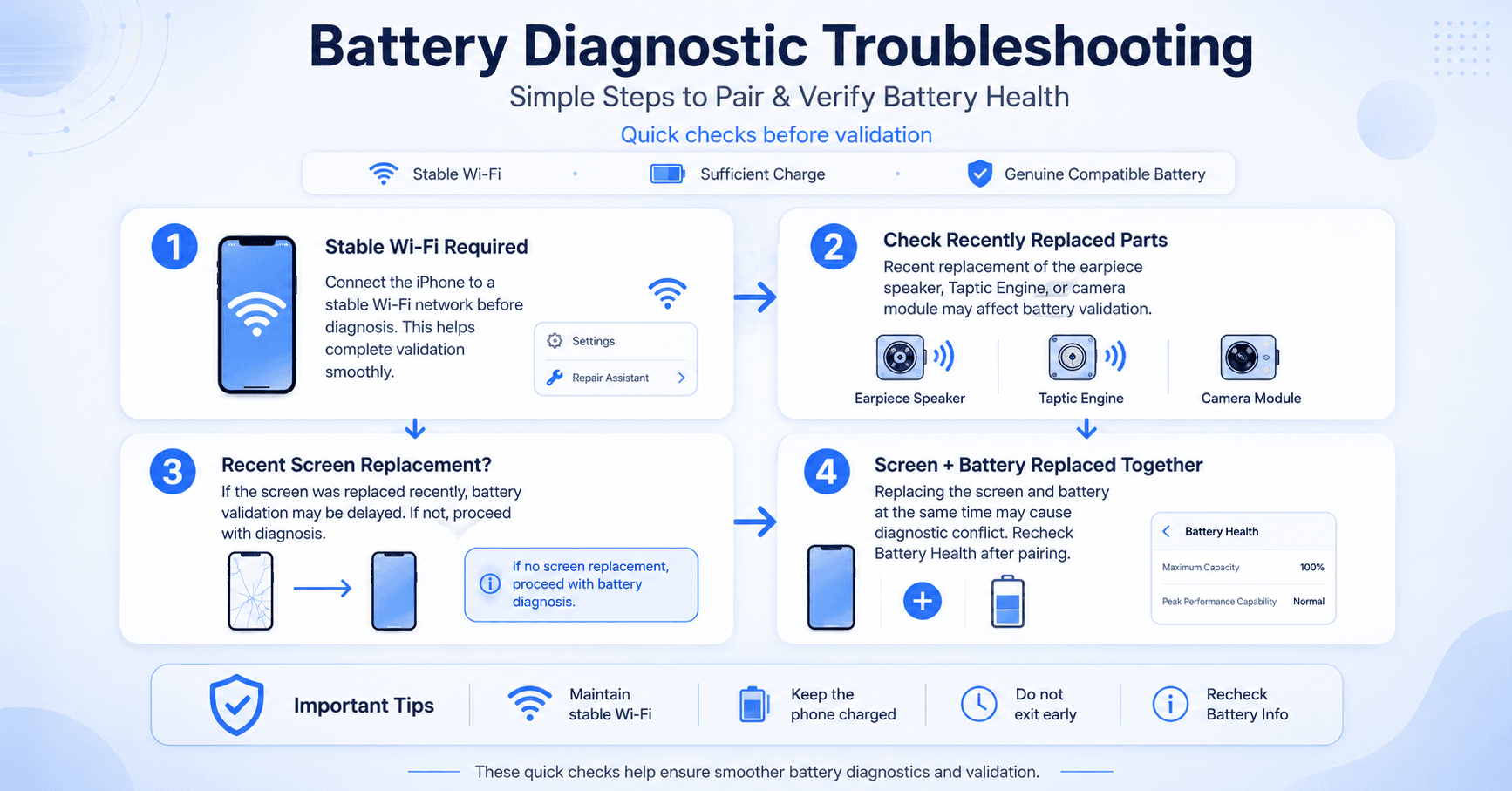
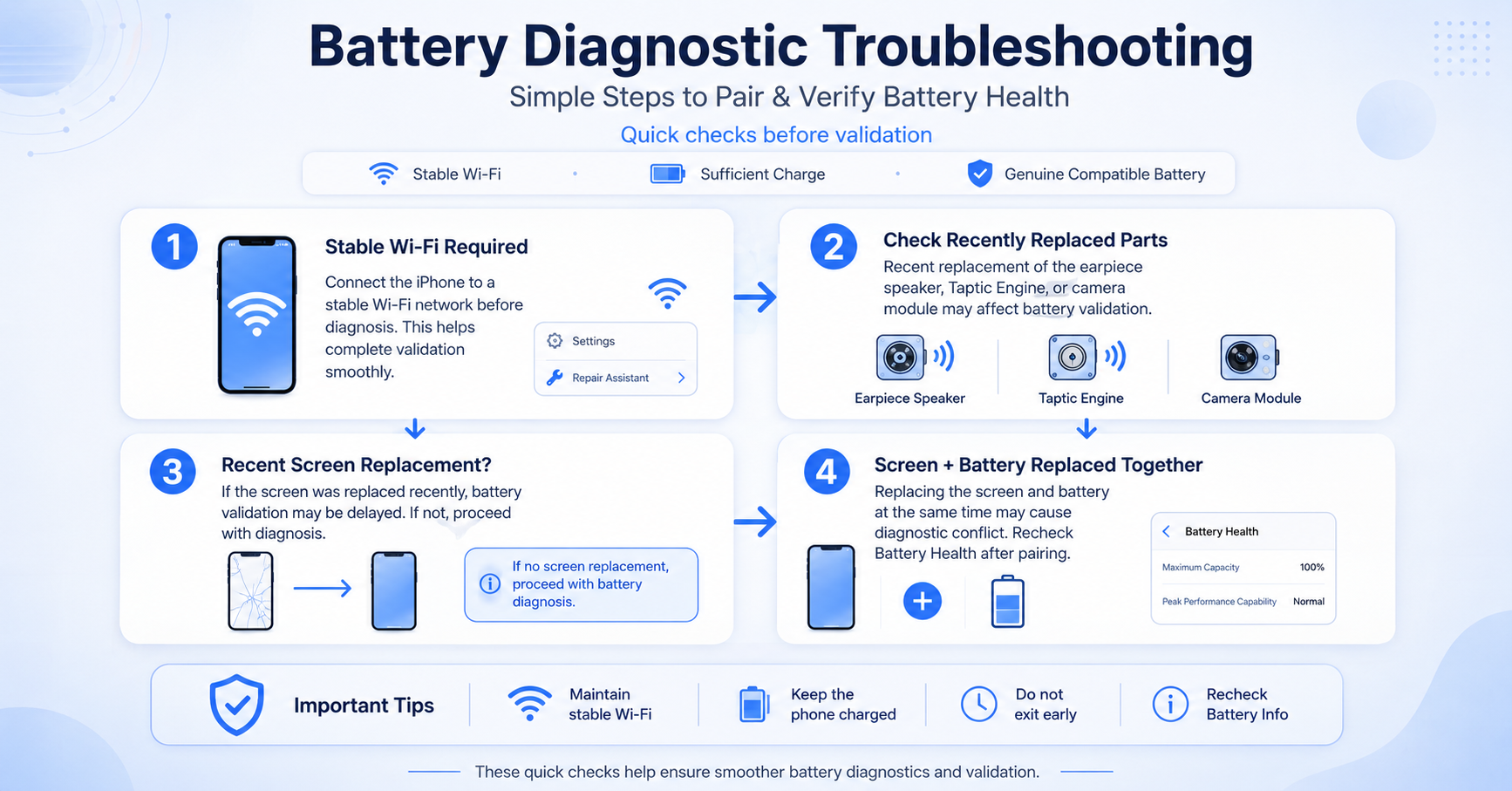
Stable Wi-Fi is required.
If the network is weak, the diagnostic or pairing process may fail or delay.
Sufficient charge is important.
The device should not shut down during the validation sequence.
Do not exit the workflow early.
Repair Assistant or pairing prompts should be completed before final checking.
Recent part replacement can affect diagnosis.
If the earpiece speaker, Taptic Engine, vibration motor, camera module or screen was recently replaced, the battery validation process may become more complicated.
Screen and battery replacement together may create conflict.
When multiple parts are replaced at the same time, the phone may not identify the battery workflow cleanly.
This does not automatically mean the battery is defective.
It means the technician should check the repair sequence, device condition and validation environment first.
Selection Advice: How Different Buyers Should Choose
Repair shops should choose Shenzhen ESC diagnostic battery options if their customers often check Battery Health or ask about warning messages after repair.
Repair chains should standardize technician workflow across locations.
The same process should be used every time: stable Wi-Fi, sufficient charge, Repair Assistant completion and Battery Health recheck.
Refurbished phone factories should test multiple samples from the same batch before mass installation.
They should check capacity, voltage, internal resistance, charging behavior, standby drain, Battery Health display and service-history behavior.
Wholesalers should focus on repeat supply and clear product tiers.
They need standard series, high capacity series, no pop-up options and diagnostic-compatible series with clear labels.
E-commerce sellers should avoid exaggerated claims.
The product page should explain supported models, expected behavior and repair requirements carefully.
Private label buyers should focus on product planning.
A complete battery catalog should include technical positioning, packaging language, warranty terms and after-sales process.
Before bulk ordering from any iPhone diagnostic battery supplier, buyers should test the battery in real repair conditions and confirm whether it is only compatible or truly service-friendly.
FAQ
What is an iPhone diagnostic battery?
An iPhone diagnostic battery is a replacement battery solution designed to support post-install checking, pairing workflow, Battery Health review and cleaner repair communication after replacement.
Is an iPhone diagnostic battery the same as an original Apple battery?
No. Shenzhen ESC provides aftermarket iPhone replacement battery solutions for repair shops, refurbishers, wholesalers and private label buyers. These products should not be described as original Apple batteries.
Why does Wi-Fi matter during battery validation?
Stable Wi-Fi may be needed for the phone to complete on-screen repair or validation steps. Weak connection can interrupt the process and create unnecessary troubleshooting.
Why should Battery Health be checked after pairing?
Battery Health is a visible customer-facing check. Repair shops should confirm the result before handing the phone back.
Can recent screen replacement affect battery validation?
Yes. Recent replacement of other parts can complicate the diagnostic process. Repair shops should check repair history before blaming the battery.
What should buyers test before placing bulk orders?
Buyers should test voltage, capacity, internal resistance, charging behavior, standby drain, installation fit, Battery Health display, warning-message behavior, packaging and batch consistency.
What is a no pop-up iPhone battery factory?
It refers to a supplier or factory that offers battery options designed to reduce visible battery warning messages for selected iPhone models and repair methods.
Can Shenzhen ESC support private label battery projects?
Yes. Shenzhen ESC can support private label battery labels, retail boxes, barcodes, warranty cards, instruction sheets, manuals, carton marks and product series planning.
Conclusion
Choosing an iPhone diagnostic battery supplier is not only about buying a battery that powers on the device.
For professional buyers, the real value is whether the battery and support workflow help the phone complete pairing, show clearer Battery Health information, reduce warning-message pressure and improve customer handoff.
Shenzhen ESC supports repair shops, refurbishers, wholesalers, e-commerce sellers and private label buyers with diagnostic-compatible iPhone battery solutions, no-pop-up options, Battery Health display support, sample testing and OEM packaging.
Contact Shenzhen ESC to request iPhone diagnostic battery samples, model support, packaging options and wholesale pricing for your repair or refurbishment business.