
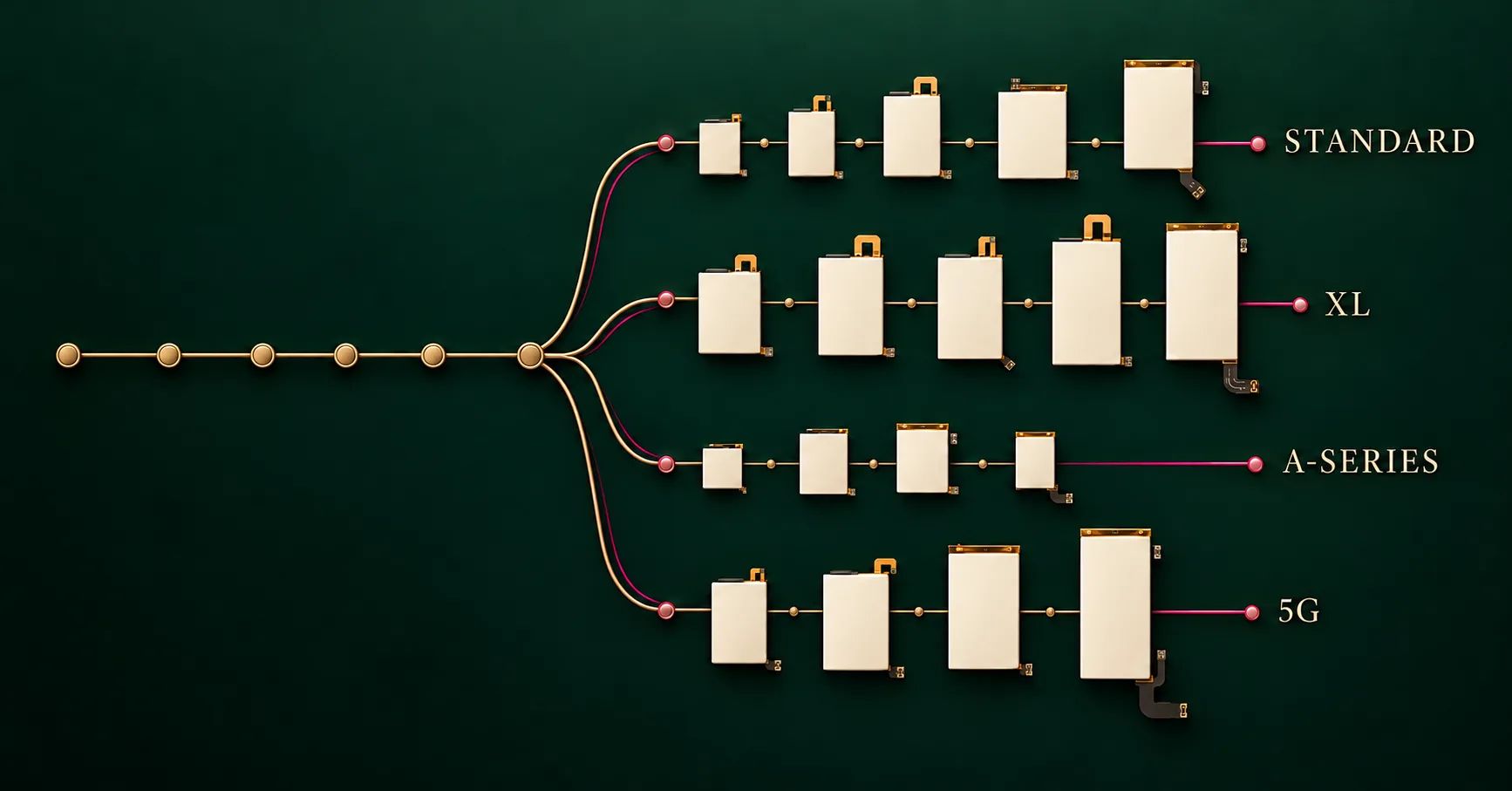
Quick answer: Pixel 2–5 replacement batteries should be managed as a legacy family with many independent SKUs, not as four simple generations. Standard, XL, a-series and 5G variants can differ in body size, battery capacity, flex routing, connector position and service procedure. B2B buyers should map the complete device identity before approving samples or replenishing stock.
The largest search demand in this cluster comes from pixel 4a battery replacement and Pixel 5 queries, but procurement must also control lower-volume Pixel 2, 3, 3a and 4 variants. The commercial goal is balanced coverage: enough stock to support repair demand without accumulating batteries whose age, traceability or future sell-through creates avoidable risk.
Use a Model Matrix Before Approving Any Legacy Pixel Battery
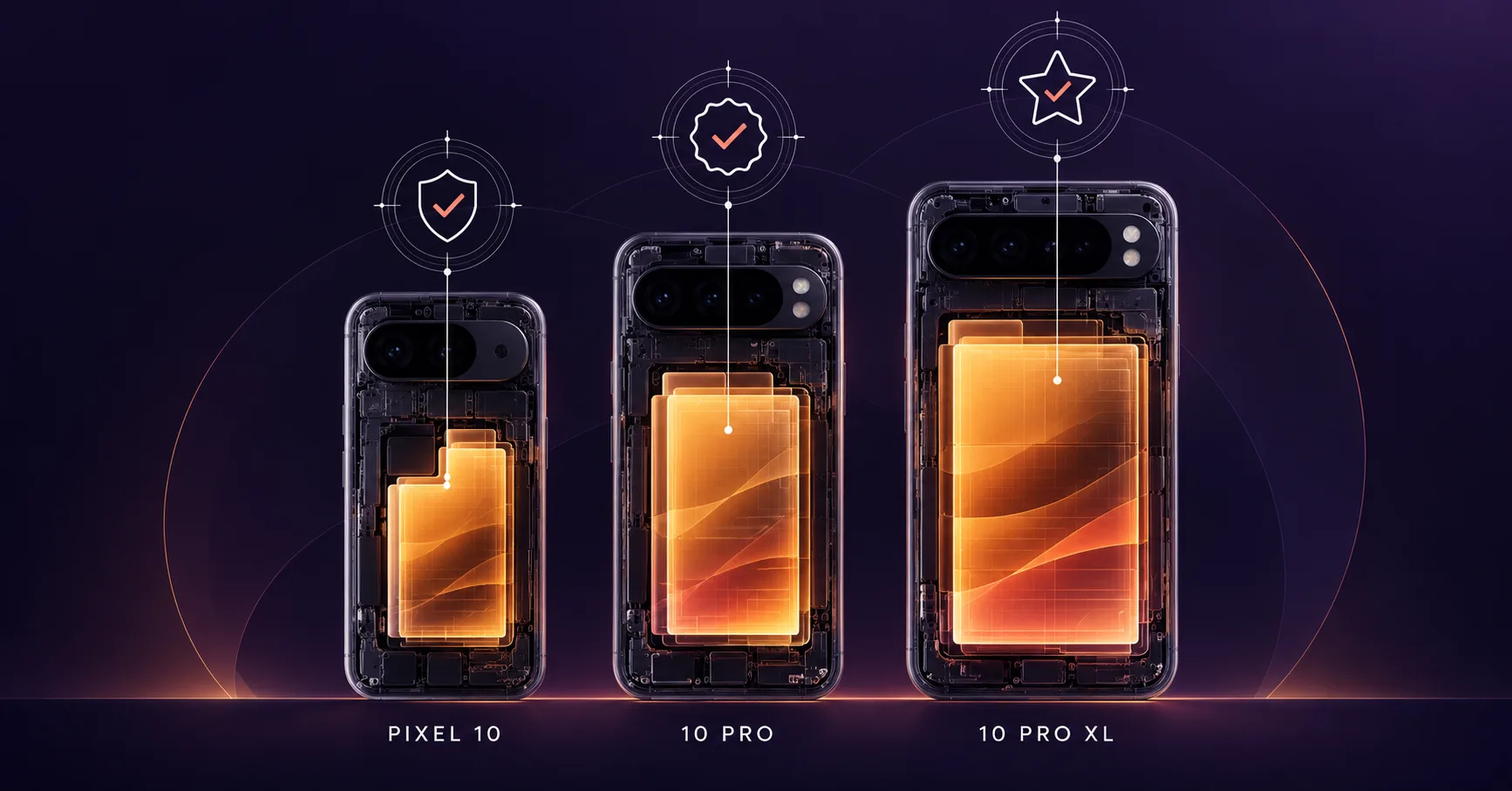
Google's Pixel hardware specifications list these phones as separate products with different dimensions and battery references. The practical lesson is simple: the generation number alone is not a compatibility key.
| Generation | Important branches | Official typical capacity references | Procurement rule |
|---|---|---|---|
| Pixel 2 | Pixel 2; Pixel 2 XL | 2,700 mAh; 3,520 mAh | Two independent SKUs |
| Pixel 3 | Pixel 3; 3 XL; 3a; 3a XL | 2,915; 3,430; 3,000; 3,700 mAh | Four independent SKUs |
| Pixel 4 | Pixel 4; 4 XL; 4a; 4a 5G | 2,800; 3,700; 3,140; 3,885 mAh | Four independent SKUs |
| Pixel 5 | Pixel 5; Pixel 5a 5G | 4,080; 4,680 mAh | Two independent SKUs |
These figures are official device references, not automatic specifications for third-party replacement packs. Google notes that typical capacity is an estimate based on testing and expected cell behavior. Keep the official reference, supplier-declared minimum and buyer-measured discharge result in separate fields.
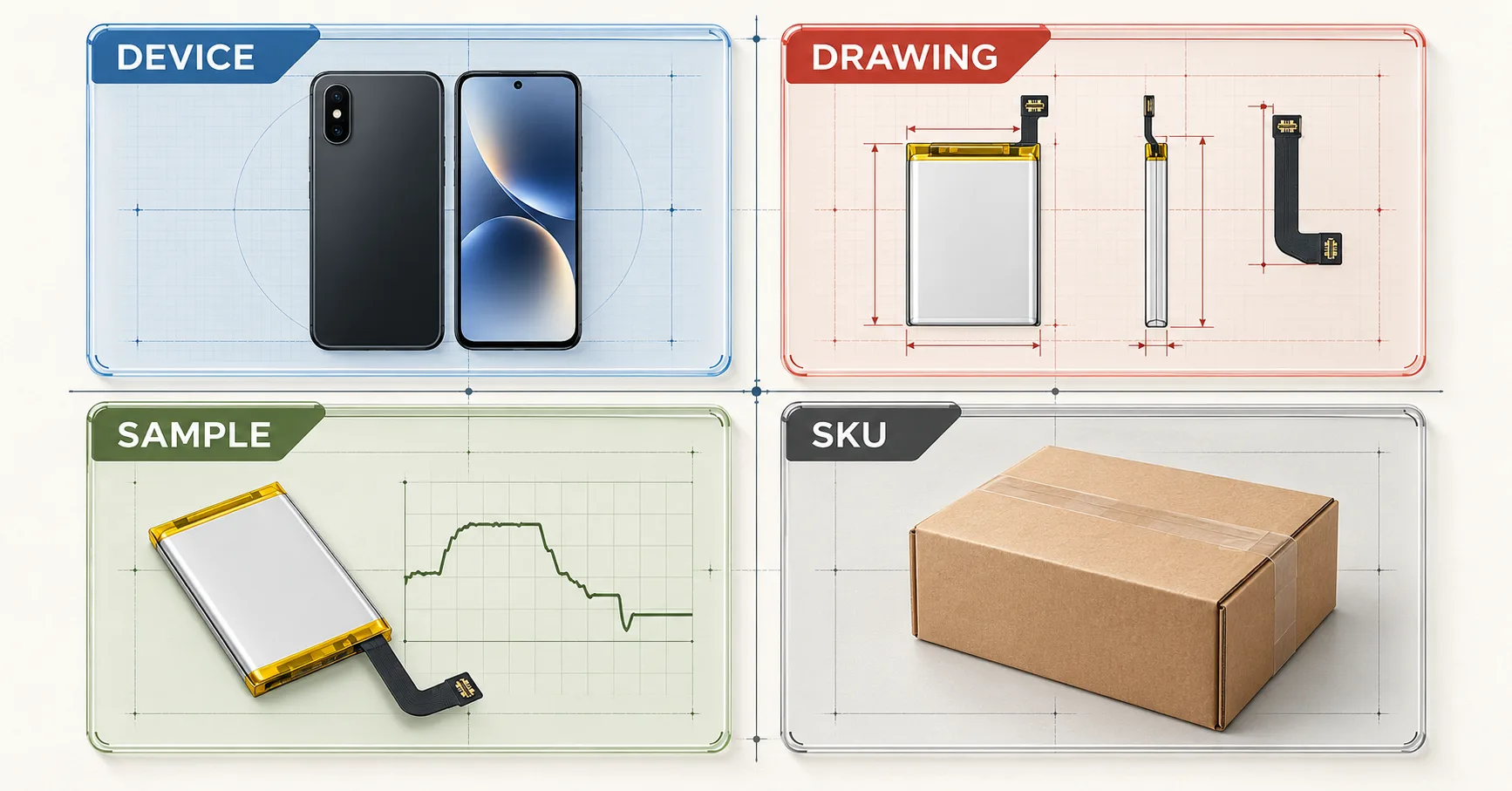
Capture the complete model identifier, market and carrier variant from the device or service record. Do not interpret “Pixel 4a” as “Pixel 4a 5G,” or treat an XL battery as an enlarged substitute for the standard model. A ranking product page may show a battery cross-reference, capacity and kit contents; those fields are useful RFQ inputs but not complete compatibility proof.
Turn Search Demand Into a Real Assortment Decision
Search volume is a demand signal, not a purchase forecast. Consumer troubleshooting, DIY research and commercial parts demand can use the same phrase. Compare keyword interest with the repair chain's actual jobs, quotes, cancellations, stockouts and warranty claims.
For a pixel 5 battery replacement program, track monthly device count, conversion rate, average installed margin and repeat demand. For lower-volume Pixel 2 or Pixel 3 variants, order against consolidated demand or a smaller replenishment window where feasible. Avoid giving every listed model the same stock depth.
| SKU class | Buying approach | Typical trigger |
|---|---|---|
| Active legacy | Small recurring replenishment | Stable repair demand and controlled claims |
| Intermittent | Consolidated batch | Demand accumulates above economic order point |
| Order-driven | Purchase for confirmed jobs where practical | Rare model with low stock-turn confidence |
| Phase-out | Stop automatic reorder | Weak demand, aging stock or poor supply evidence |
Control Inventory Age and Storage Evidence
Legacy stock often has a longer or less transparent history. Record production date, pack lot, receipt date, packaging condition and storage evidence. Inspect for swelling, deformation, damaged insulation, contamination, corrosion, puncture or leakage. Unsafe or damaged batteries belong in quarantine and an approved disposition process, not exploratory installation.
A date alone does not determine acceptance. Apply a documented review rule that combines age, traceability, physical condition, receiving voltage and sampled performance. Use release, hold, retest and retire dispositions so operators do not improvise decisions. ESCCharge's mobile phone battery storage SOP provides a framework for separation, rotation and periodic condition review.
First-expire-first-out is more useful than simple first-in-first-out when the business defines a review or expiry date. Do not mix newly validated stock with older unidentified units under one barcode.
What a Legacy Pixel Sample Must Prove
Identity and document control
- Complete phone identifier, market and internal buyer SKU.
- Supplier SKU, battery cross-reference, drawing revision and label artwork.
- Cell lot, finished-pack lot and production date.
- Adhesive, liners, pull tabs and any kit components.
- Change-notification rules for cell, board, flex, connector and insulation.
A google pixel 4a battery replacement offer must identify whether it targets Pixel 4a or Pixel 4a 5G. Similar names and overlapping launch periods are not evidence of a common assembly.
Physical fit
Inspect and measure the pouch outline, thickness, edge seals, fold zones, flex exit, connector location, insulation and adhesive pattern. Install samples in known devices using a controlled repair procedure. Reject a sample that needs forced seating, pouch bending, connector strain or improvised adhesive changes.
Electrical and capacity evidence
Confirm polarity, receiving condition, connector engagement and agreed protection behavior with qualified equipment. For capacity testing, define nominal voltage, watt-hours, charge procedure, discharge rate, cutoff voltage, temperature, rest periods and sample count. The battery capacity testing guide explains the general evidence logic; Pixel fixtures and limits must be model-specific.
Installed-device performance
Run initial boot, charging recognition, charge progression, idle observation, representative workload and cool-down. Record the phone model, software state, charger, cable, ambient conditions and observed messages. A google pixel 5 battery replacement sample should not pass from one startup event; it needs repeatable behavior under the approved sequence.
Treat the Pixel 4a Battery Program as a Specific Evidence Boundary
Google's Pixel 4a Battery Performance Program states that certain Pixel 4a phones require a software update to improve battery-performance stability. This is a device-specific support program. It should not be rewritten as proof that every Pixel 4a has the same condition, that Pixel 4a 5G is included, or that any third-party pack resolves a device covered by the program.
Record the exact handset, software version, symptoms and support-program applicability before diagnosing a battery complaint. Separate device policy, software behavior, installation and battery evidence. This protects the buyer from accepting unsupported marketing claims and from rejecting good stock for a handset-specific issue.
Use Qualified Repair and Safety Controls
Google's Pixel 4a safety manual calls the lithium-ion battery “a sensitive component that can cause injury if damaged.” It warns that improper replacement can create fire, explosion, leakage or other hazards. Commercial repair programs need trained technicians, appropriate PPE, safe isolation, damaged-battery quarantine and approved recycling or disposal routes.
The official Pixel safety and regulatory library lists separate manuals for Pixel 2, Pixel 3, Pixel 3a, Pixel 4, Pixel 4a, Pixel 4a 5G, Pixel 5 and Pixel 5a 5G. That model-specific structure supports the same rule for procurement and repair: do not substitute a generic procedure across variants.
Approve a Pilot Lot and Repeat-Order Controls
Freeze the approved sample with photographs, drawing revision, label file and measured results. Receive a small pilot lot under a defined sampling plan. Quarantine it, verify labels and lots, inspect condition and dimensions, test electrical state, install representative units and record release, hold or reject decisions.
Use the mobile phone battery incoming-inspection guide to structure receiving checks. Requalify when the cell source, board, flex, connector, adhesive, label or observed performance changes. An old model does not justify weaker change control.
Prevent Catalog, Picking and Warranty Errors
Assign separate internal SKUs and bins to every supported variant. The sales title, purchase order, barcode and repair ticket should expose the exact model. Avoid labels such as “Pixel 3/3a battery” or “Pixel 4 family” unless verified evidence truly supports every listed device.
For warranty claims, record device identifier, battery lot, technician, symptom, photos, charger conditions and test result. ESCCharge's battery warranty-claims workflow helps distinguish battery, installation, device, storage and evidence-insufficient cases. Grouping claims by precise SKU reveals whether a problem follows one model, lot or repair location.
Set Replenishment and Retirement Rules
Review each SKU on a fixed cadence using units sold, months of cover, oldest lot, gross margin after claims and confirmed customer commitments. Stop automatic reorder when demand falls below economic batch size, inventory cannot be consumed within the approved holding period, or supply evidence no longer meets the acceptance plan.
A pixel 3 battery replacement SKU may remain valuable for a specialist repair network while being uneconomic for a general distributor. Retirement should specify last-buy quantity, customer notice, warranty reserve and safe disposition. Do not allow obsolete batteries to remain indefinitely because their original purchase cost has already been paid.
Send a Legacy Pixel RFQ With Comparable Fields
- exact devices, model identifiers, regions and forecast by SKU;
- battery cross-reference and revision-controlled dimensional drawing;
- production-date range and storage-history requirements;
- declared minimum or typical capacity with complete test conditions;
- cell, board, flex, connector, insulation and adhesive scope;
- label, barcode, packaging and private-label requirements;
- sample and pilot-lot quantities with acceptance limits;
- traceability, change notice, warranty and phase-out expectations.
MOQ, lead time, warranty, capacity and documentation depend on the exact model, quantity, destination and agreement. Compare offers on equivalent scope, including inspection, packaging, traceability and claim handling—not unit price alone.
Frequently Asked Questions
Can standard, XL, a-series and 5G Pixel batteries be combined?
No. Treat every device variant as a separate assembly unless controlled drawings and target-device tests prove otherwise.
Does old production date automatically make a battery unusable?
No single date decides acceptance. Apply the buyer's approved age policy with storage history, traceability, condition and sampled performance evidence.
Does the Pixel 4a Battery Performance Program apply to Pixel 4a 5G?
Google states that the program concerns certain Pixel 4a devices and specifically separates Pixel 4a 5G. Confirm the exact handset and current official terms.
How should buyers stock rare Pixel 2 or Pixel 3 variants?
Use small consolidated orders or confirmed-demand purchasing where practical, then review stock age and sell-through before every reorder.
What should trigger legacy SKU retirement?
Weak demand, uneconomic order quantity, aging inventory, poor traceability, rising claims or unavailable qualified supply can justify phase-out.
Build Coverage Around Evidence, Not Nostalgia
A disciplined Pixel 2–5 program links exact device identity, drawing, sample, pilot lot, storage record, sale and warranty outcome. This keeps useful legacy coverage available without turning slow-moving batteries into an uncontrolled quality and cash-flow burden.
Request a legacy Pixel sourcing review: send ESCCharge the target models, markets, recent repair demand, preferred batch size, packaging needs and acceptance plan. The team can review requested configurations and propose a sample-to-pilot route. Final capacity, MOQ, lead time, warranty and documentation remain subject to confirmed models and order conditions.