
iPhone 13 Mini Battery Replacement: What You Need to Know
An iPhone 13 mini battery replacement is often the most practical way to extend the useful life of a compact iPhone that suffers from shortened runtime, unexpected shutdowns, slow performance related to battery aging, or repeated charging complaints.
However, replacing the battery is not simply a matter of installing a component with the correct capacity printed on its label.
The iPhone 13 mini uses a compact lithium-ion battery assembly designed for a tightly controlled internal space. Its replacement requires precise model compatibility, appropriate electrical characteristics, careful handling, and verification of battery recognition and charging behavior.
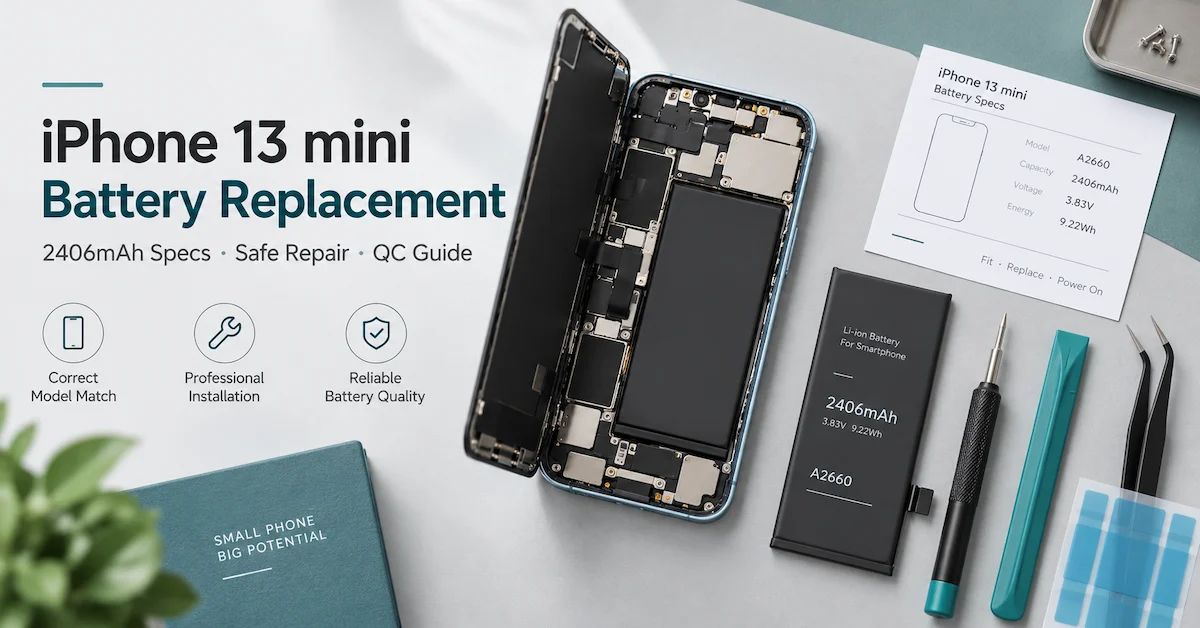
The commonly referenced original-capacity specification is 2406mAh, approximately 9.34Wh, with a nominal voltage of about 3.88V. Specifications may vary slightly between compatible aftermarket cell designs, so the actual product datasheet remains essential.
For individual users, the main question is usually:
Will replacing my iPhone 13 mini battery improve battery life enough to keep the phone?
For professional repair businesses, the decision involves additional questions:
-
Does the replacement battery match the exact device model?
-
Is the battery supplied as a complete assembly or as a cell without a flex cable?
-
How has its actual capacity been verified?
-
What will appear in Battery Health and Parts and Service History?
-
Can the repair be completed safely and consistently?
-
Does the supplier offer reliable batch quality and traceability?
-
What happens if a battery fails after installation?
-
Can multiple device models be sourced through one purchasing program?
These questions determine whether a battery replacement becomes a successful repair or a costly warranty problem.
ESC supplies replacement batteries for iPhones and other smartphones, supporting professional repair shops, refurbishment companies, distributors, wholesalers, and private-label projects.
This guide explains both the technical repair considerations and the commercial purchasing decisions involved in selecting an iPhone 13 mini replacement battery.
Quick Answer: When Should You Replace an iPhone 13 Mini Battery?
The battery should be evaluated for replacement when its condition begins to interfere with normal device use.
Typical indicators include noticeably reduced runtime, unexpected shutdowns, performance-management notifications, or a battery service recommendation.
Battery Health is useful, but it should not be treated as the only diagnostic factor.
Apple states that batteries in iPhone 14 models and earlier are designed to retain approximately 80% of their original capacity after 500 complete charge cycles under ideal conditions. Actual aging depends on usage, charging behavior, temperature, and other factors.
This is a battery-design reference, not a rule requiring every battery to be replaced immediately at 80%.
A practical decision should consider both the displayed health percentage and actual performance.
| Battery Condition | Recommended Assessment |
|---|---|
| Above 90% with normal runtime | Replacement usually unnecessary |
| 85–90% with reduced runtime | Check usage, charging behavior, and battery condition |
| Around 80–85% with frequent charging complaints | Consider replacement based on actual symptoms |
| Below 80% with noticeable runtime loss | Strong reason to evaluate battery service |
| Unexpected shutdowns | Check battery condition and power-management behavior |
| Battery swelling | Stop normal use and arrange safe professional handling |
| Abnormal heat or charging failure | Diagnose the complete charging system before replacement |
These ranges are practical diagnostic guidance rather than official universal replacement thresholds.
A phone may have relatively high displayed battery health and still experience problems caused by electrical degradation or another hardware fault.
Conversely, a device showing lower capacity may remain usable if its owner is satisfied with the runtime and the battery is otherwise functioning normally.
iPhone 13 Mini Battery Specifications: Capacity, Voltage, and Compatibility
Correct specifications are essential for professional repair and bulk purchasing.
The iPhone 13 mini was introduced in 2021 with a 5.4-inch display. Its compact construction places important constraints on battery dimensions, connector positioning, and internal assembly.
Original-Capacity Reference Specifications
| Specification | iPhone 13 Mini Reference |
|---|---|
| Device | iPhone 13 mini |
| Introduction Year | 2021 |
| Display Size | 5.4 inches |
| Battery Chemistry | Rechargeable lithium-ion |
| Common Capacity Reference | 2406mAh |
| Energy | Approximately 9.34Wh |
| Common Nominal Voltage Reference | Approximately 3.88V |
| Common Battery Model Reference | A2660 |
| Battery Design | Compact internal rechargeable assembly |
| Installation | Professional battery replacement recommended |
The values above describe commonly referenced original-capacity characteristics, not a guarantee that every aftermarket product has identical specifications.
For example, some compatible replacement cells may publish slightly different nominal-voltage values based on their specific cell design.
Professional buyers should always verify the selected battery's actual rated voltage, charging requirements, dimensions, connector arrangement, and supporting documentation.
Why 2406mAh Matters
Battery capacity is commonly expressed in milliampere-hours.
The 2406mAh reference helps buyers identify the expected capacity class of the iPhone 13 mini battery.
However, an accurate capacity label must be supported by actual testing.
A battery labeled 2406mAh that consistently delivers significantly less usable capacity under an agreed test method may not meet the purchaser's quality requirements.
Similarly, a battery marketed with a much higher capacity needs evidence that the additional capacity is physically and electrically credible.
A larger printed mAh figure does not automatically mean a better battery.
The correct purchasing question is whether the battery provides the declared capacity under specified testing conditions while remaining compatible with the device.
Battery Capacity vs. Energy
Capacity in mAh and energy in Wh are related but not identical measurements.
The approximate relationship is:
Energy (Wh) = Capacity (Ah) × Nominal Voltage (V)
For example:
2.406Ah × 3.88V ≈ 9.34Wh.
Watt-hours are particularly useful when comparing battery energy and reviewing transportation documentation.
However, buyers should avoid calculating energy from a voltage value taken from an unrelated product specification.
Use the actual rated data of the selected battery.
iPhone 13 Mini vs. iPhone 12 Mini: Why Battery Compatibility Matters
One of the most important sourcing mistakes is confusing iPhone 12 mini and iPhone 13 mini batteries.
Both devices use compact 5.4-inch designs, but their batteries are not interchangeable simply because the phones have similar names or external dimensions.
| Feature | iPhone 12 Mini | iPhone 13 Mini |
|---|---|---|
| Launch Year | 2020 | 2021 |
| Common Battery Capacity | 2227mAh | 2406mAh |
| Common Energy Reference | 8.57Wh | 9.34Wh |
| Common Battery Model Reference | A2471 | A2660 |
| Replacement SKU | Must be specific to 12 mini | Must be specific to 13 mini |
| Interchangeability | Not assumed | Not assumed |
The difference is not limited to capacity.
Battery shape, electrical configuration, connector positioning, and the intended repair assembly must all be verified.
For a repair shop, receiving the wrong model wastes technician time.
For a distributor shipping hundreds of batteries, an incorrect model description can lead to widespread returns and inventory losses.
How to Prevent Model Confusion
Before ordering, match at least four identifiers:
-
Exact device name.
-
Regional device model number.
-
Battery specification and reference.
-
Supplier SKU and technical drawing.
Do not use a generic warehouse label such as "iPhone Mini Battery" for multiple generations.
That label is insufficient for reliable repair inventory management.
Which iPhone 13 Mini Models Are Supported?
Apple identifies five regional model numbers for the iPhone 13 mini.
| Model Number | Market or Region |
|---|---|
| A2481 | United States |
| A2626 | Canada, Japan, Mexico, Saudi Arabia |
| A2628 | Other countries and regions |
| A2629 | China mainland |
| A2630 | Armenia, Belarus, Kazakhstan, Kyrgyzstan, Russia |
These model numbers refer to the iPhone device, not to different battery capacities.
A replacement battery supplier should verify which exact configurations its battery supports.
For wholesale purchasing, this distinction matters because regional distributors may receive devices from multiple markets.
A single repair chain may service imported, refurbished, and locally purchased iPhones.
Maintaining a verified compatibility database helps avoid incorrect parts selection.
Why Does the iPhone 13 Mini Battery Lose Capacity?
Lithium-ion batteries are consumable components.
Their capacity and electrical performance change through use and aging.
This process is influenced by more than the number of months since the phone was purchased.
Charge Cycles
A charge cycle represents the cumulative use of energy equivalent to 100% of the battery's capacity.
It does not necessarily mean charging the phone from zero to 100% in a single session.
For example, using 50% of the battery capacity on one day and another 50% later can contribute approximately one complete cycle.
Repeated charge and discharge activity gradually affects battery chemistry.
Heat Exposure
High temperature can accelerate battery aging.
Relevant situations include prolonged exposure to direct sunlight, charging in hot environments, and sustained high device workloads.
A warm phone during ordinary charging does not automatically indicate a defective battery.
However, repeated abnormal heat should be investigated.
Storage and Charging Conditions
Long periods at unsuitable states of charge or elevated temperature can affect battery lifespan.
Battery aging also depends on time, even when a device is used infrequently.
For this reason, wholesalers should not assume that unused inventory remains equivalent to freshly manufactured stock indefinitely.
Storage age and conditions matter.
Internal Impedance
As batteries age, their impedance may increase.
Higher impedance can cause a greater voltage drop when the device demands substantial current.
This can contribute to unexpected shutdowns or reduced peak performance.
Apple specifically explains the relationship between chemical aging, battery impedance, power delivery, and device performance.
For repair technicians, this means a capacity reading alone does not reveal every aspect of battery condition.
Seven Signs Your iPhone 13 Mini Battery May Need Replacement
1. Battery Drains Much Faster Than Before
The most common complaint is reduced runtime.
A user who previously reached the evening with remaining battery charge may now need to recharge during the afternoon.
However, battery drain can also be influenced by applications, weak network coverage, background activity, and changes in usage.
Compare normal usage conditions before concluding that the battery is the cause.
2. Battery Health Shows a Service Recommendation
An iPhone may recommend battery service when its condition has significantly deteriorated.
This should prompt evaluation of replacement options.
It does not mean that every other component in the phone is functioning correctly.
3. Unexpected Shutdowns
A degraded battery may struggle to supply the power required during demanding operations.
If the voltage falls below the device's operating requirements, the phone may shut down.
These events may occur more frequently at low charge levels or in cold conditions.
4. Reduced Performance
Battery-related performance management may influence perceived device speed under certain conditions.
Replacing a sufficiently degraded battery may improve the device's ability to sustain expected performance.
It will not upgrade the processor or correct unrelated software issues.
5. Unstable Battery Percentage
A phone may show unusual charge-level changes or restart unexpectedly.
Possible causes include inaccurate battery information, electrical degradation, charging problems, or other hardware faults.
The symptoms should be documented and reproduced before selecting a replacement.
6. Charging Problems
Slow charging or interrupted charging may involve the battery, but can also originate from the charger, cable, charging port, software, or charging circuitry.
Repair technicians should test these variables separately.
For a broader explanation of charging-related faults, see ESC's phone repair and battery troubleshooting guide.
7. Battery Swelling or Physical Damage
Swelling is a safety concern.
A battery showing swelling, leakage, punctures, unusual deformation, or other visible damage should not be treated as an ordinary battery-health case.
Stop normal charging and use.
Do not press the battery flat or attempt to puncture it.
Arrange handling by an appropriately trained professional.
Should You Replace the iPhone 13 Mini Battery Yourself?
The answer depends on repair experience, equipment, and the condition of the phone.
Opening an iPhone requires more than removing a back cover.
The iPhone 13 mini battery is located inside a compact assembly that includes sensitive electrical components, flex cables, the display assembly, and adhesive materials.
Apple publishes a model-specific repair manual and states that battery replacement should be undertaken by technicians with the necessary knowledge, experience, and tools.
Professional Repair Is Recommended When:
-
the user has no experience opening smartphones;
-
the battery is swollen or visibly damaged;
-
the display is cracked;
-
the device has liquid damage;
-
the phone has already been repaired multiple times;
-
the appropriate repair equipment is unavailable;
-
the customer requires documented warranty coverage.
For inexperienced users, professional service is generally the more appropriate choice.
Why DIY Battery Replacement Can Be Risky
The main risks include:
Battery damage: Incorrect removal can bend, puncture, crush, or otherwise damage the lithium-ion cell.
Display damage: Opening the device incorrectly can damage the display assembly.
Flex-cable damage: Small internal connectors and cables can be damaged during disassembly.
Loss of sealing performance: Opening the device affects its original sealing arrangement, and water resistance cannot simply be assumed to remain unchanged.
Incorrect reassembly: Loose screws, poorly positioned components, or incorrect adhesive placement can cause additional problems.
Battery information issues: Depending on the replacement and repair procedure, the phone may display battery verification or service-history information.
A professional repair process should control these risks before the device is returned to the customer.
Professional iPhone 13 Mini Battery Replacement Process
The following is an overview of the repair workflow and its quality-control checkpoints. It is not a substitute for the complete model-specific repair manual or hands-on technician training.
Step 1: Confirm the Device and Battery Condition
Before opening the device, verify the exact iPhone model.
Record:
-
device identification;
-
current Battery Health information;
-
charging behavior;
-
visible damage;
-
previous repair history;
-
reported symptoms.
Test unrelated functions that could become disputed after repair.
These may include Face ID, display, touch response, cameras, and charging.
Step 2: Back Up Important Data
Battery replacement normally does not require deleting user data.
Nevertheless, internal hardware repairs carry risk.
Important data should be backed up before service whenever possible.
Repair providers should also use a documented privacy process when handling customer devices.
Step 3: Prepare a Battery-Safe Workstation
Battery safety must be established before disassembly.
Apple's current safety guidance emphasizes appropriately trained technicians, suitable equipment, a properly prepared workspace, and discharging the battery before repair.
Technicians should follow the current model-specific instructions rather than relying on a generic battery-replacement checklist.
If the battery's condition or state of charge cannot be determined safely, the repair should not proceed as an ordinary removal operation.
Step 4: Open the Device Using the Correct Procedure
The iPhone 13 mini requires controlled access through the display assembly.
The display must be handled carefully to protect its connectors and nearby components.
The exact tools, opening methods, and handling requirements should follow the relevant service documentation.
Step 5: Access the Battery
Apple's model-specific procedure identifies the display and bottom speaker among the components removed before battery replacement.
The technician must protect surrounding components and maintain correct screw and bracket organization.
Using unnecessary force around the battery increases the risk of damaging the cell or nearby assemblies.
Step 6: Remove the Existing Battery Safely
The battery is secured using adhesive.
Safe removal depends on the prescribed adhesive-release procedure.
The technician should not puncture, crush, or forcibly bend the battery.
If the adhesive cannot be released according to the specified safe method, the repair should be stopped rather than continued through uncontrolled prying.
This is particularly important because mechanical damage to a lithium-ion pouch cell can create a serious safety event.
Step 7: Inspect the Replacement Battery
Before installation, confirm:
-
exact model compatibility;
-
physical dimensions;
-
correct connector configuration;
-
intact insulation;
-
no swelling or deformation;
-
approved battery condition;
-
correct adhesive arrangement.
A visually damaged or incorrectly labeled battery should not be installed.
Step 8: Install and Secure the Battery
The replacement must be positioned according to the specified alignment and adhesive procedure.
The battery must not move freely inside the enclosure.
Flex cables must not be trapped, twisted, or exposed to unnecessary pressure.
For professional operations, proper adhesive application is part of repair quality, not a cosmetic detail.
Step 9: Reassemble the Device
Reinstall the required components using the prescribed procedure.
Check that brackets and screws are returned to their correct positions.
Ensure that the device closes correctly without mechanical pressure from a misaligned battery.
Renew the relevant sealing materials as required by the repair procedure, but do not promise that the original factory water resistance has automatically been restored.
Step 10: Complete Repair Configuration and Testing
After assembly, the technician should verify charging, battery recognition, runtime behavior, and the relevant device functions.
For supported replacement configurations, Apple's Repair Assistant may be needed to complete the repair.
The expected result depends on the installed component and whether the supported calibration requirements have been met.
Battery Health After Replacement: What Should You Expect?
Battery Health is one of the most common sources of confusion after an iPhone battery replacement.
Customers frequently expect the maximum-capacity display to show 100% immediately.
However, the displayed information is influenced by the battery, associated electronics, device software, and repair process.
What Does Battery Health Measure?
Battery Health estimates capacity relative to the battery's original condition.
It also provides information related to performance capability.
A value shown on the screen should not be treated as a substitute for independent battery testing.
For professional buyers, actual capacity, charging behavior, internal resistance, and aging performance remain important.
Will Battery Health Always Show 100%?
No supplier should make an unconditional promise that every replacement battery will display 100% across every iOS version and repair procedure.
The result depends on the selected battery configuration and the system's recognition behavior.
Repair businesses should test the exact combination of device model, software, battery product, and installation method before making customer-facing claims.
Does a Warning Mean the Battery Is Defective?
Not necessarily.
Battery-related messages can reflect the device's inability to verify a component or complete an expected service process.
They do not independently prove that a cell has inadequate capacity.
However, the opposite is also true: the absence of a warning does not prove that a battery has passed meaningful quality-control testing.
For professional sourcing, both the electrical performance and customer-facing system behavior must be evaluated.
iPhone 13 Mini Battery Replacement: Genuine vs. Aftermarket
There are important differences between genuine Apple service parts and compatible aftermarket replacement batteries.
Genuine Apple Battery
A genuine battery supplied through an appropriate Apple service channel is intended to work within Apple's specified repair and calibration processes.
Availability, cost, and service requirements depend on the region and repair provider.
Aftermarket Replacement Battery
An aftermarket battery is produced by a third-party supplier for compatible repair applications.
Its quality depends on the selected cell, electronics, assembly, production controls, and testing.
Aftermarket batteries should not be represented as genuine Apple components.
Comparison for Buyers
| Factor | Genuine Apple Service Battery | Compatible Aftermarket Battery |
|---|---|---|
| Supply Channel | Apple or applicable service channel | Third-party supplier |
| Brand Identity | Apple genuine part | Aftermarket product |
| Capacity | Model-specific original specification | Standard or validated alternative |
| Battery Recognition | Supported official repair process | Depends on product and installation |
| Packaging | Service-channel configuration | May support OEM/private label |
| Bulk Sourcing | Subject to service-channel terms | Supplier-dependent wholesale options |
| Custom Branding | Not generally a private-label product | Often available |
| Quality Assurance | Apple service and product standards | Supplier-specific QC verification |
| Best Fit | Customers seeking official service | Qualified professional aftermarket programs |
The appropriate option depends on customer expectations, service requirements, costs, and the repair business model.
A legitimate aftermarket purchasing program should emphasize verified compatibility and transparent labeling rather than unsupported claims of original Apple authorization.
Standard Battery vs. No-Pop-Up vs. Cell Without Flex
Not every replacement product is intended for the same repair workflow.
ESC's mobile battery portfolio includes several product configurations for professional buyers.
Standard Replacement Battery
A conventional replacement assembly is typically selected when the repair business needs a ready-to-install battery configuration appropriate to the device.
The exact assembly specification must be confirmed before ordering.
No-Pop-Up Battery
A no-pop-up product is designed for selected replacement workflows where warning-message behavior is a commercial concern.
ESC lists a specific iPhone 13 Mini No Pop-Up Battery with a published 2406mAh capacity.
Buyers should confirm whether its expected warning and Battery Health behavior is supported on the target iOS version and with the intended installation method.
It must not be marketed as an original Apple service battery merely because a particular device displays favorable battery information.
Battery Cell Without Flex
This configuration is intended for specialized repair operations.
ESC also offers a 2406mAh iPhone 13 Mini battery cell without flex cable.
That product is a cell-only component, not a complete ready-to-install battery assembly.
It does not include the flex cable or battery management system.
Qualified technicians must account for the appropriate component-transfer or assembly process, along with the additional risks involved.
Which Configuration Is Better?
| Buyer Requirement | More Relevant Option |
|---|---|
| Conventional battery replacement | Complete replacement assembly |
| Warning-message considerations | Verified model-specific no-pop-up solution |
| Professional cell-transfer workflow | Cell without flex |
| Retail-ready private-label replacement | Validated complete assembly with OEM packaging |
| High-volume refurbishment | Standardized approved SKU and repair procedure |
| Lowest installation complexity | Complete assembly rather than cell-only |
The correct choice depends on technician capability, repair objectives, and the device's software and hardware condition.
Why Battery Quality Control Matters More Than Printed Capacity
A replacement battery may look correct and fit inside the phone while still failing to meet its expected electrical performance.
For professional buyers, a reliable sourcing decision requires evidence.
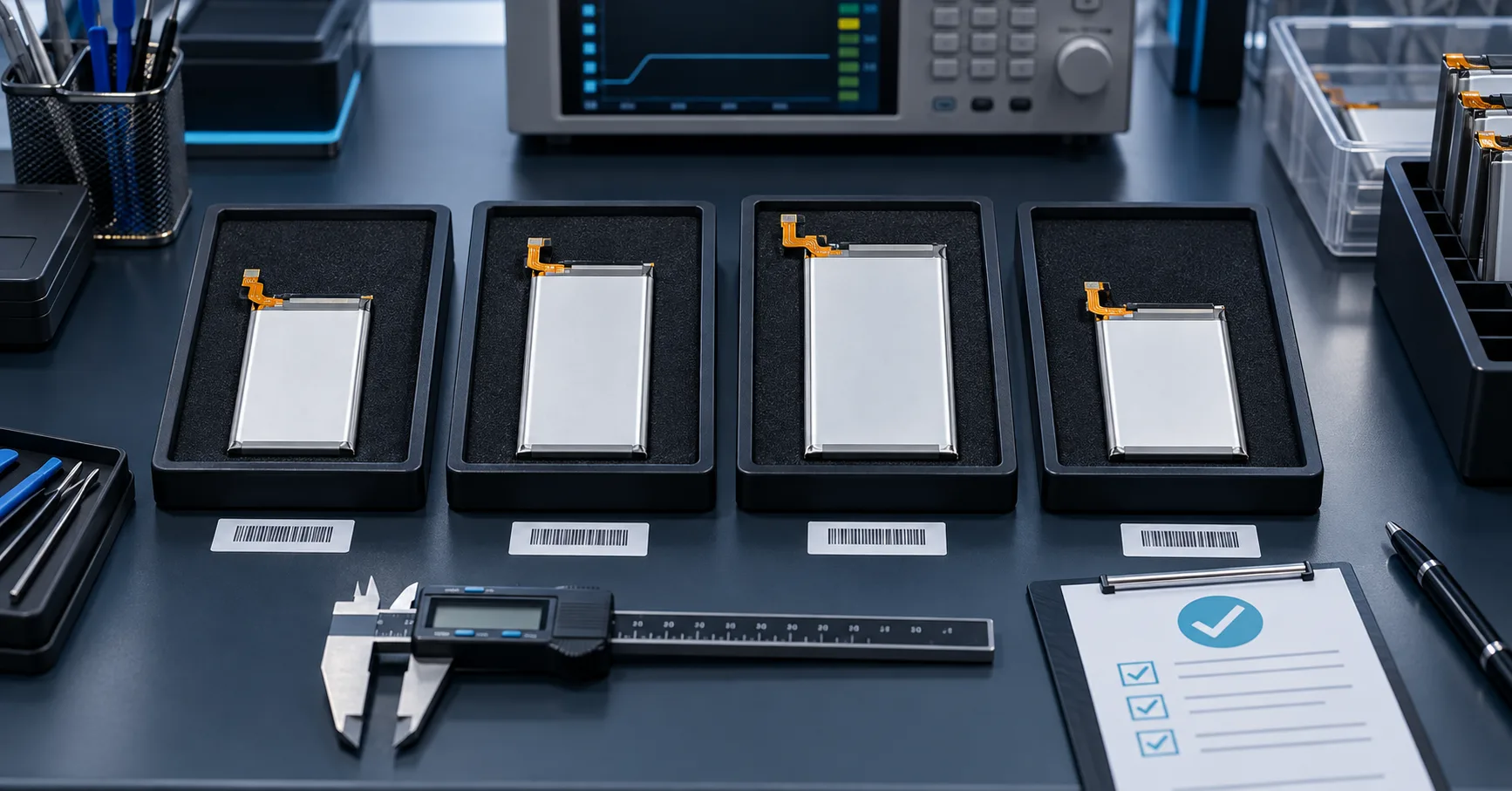
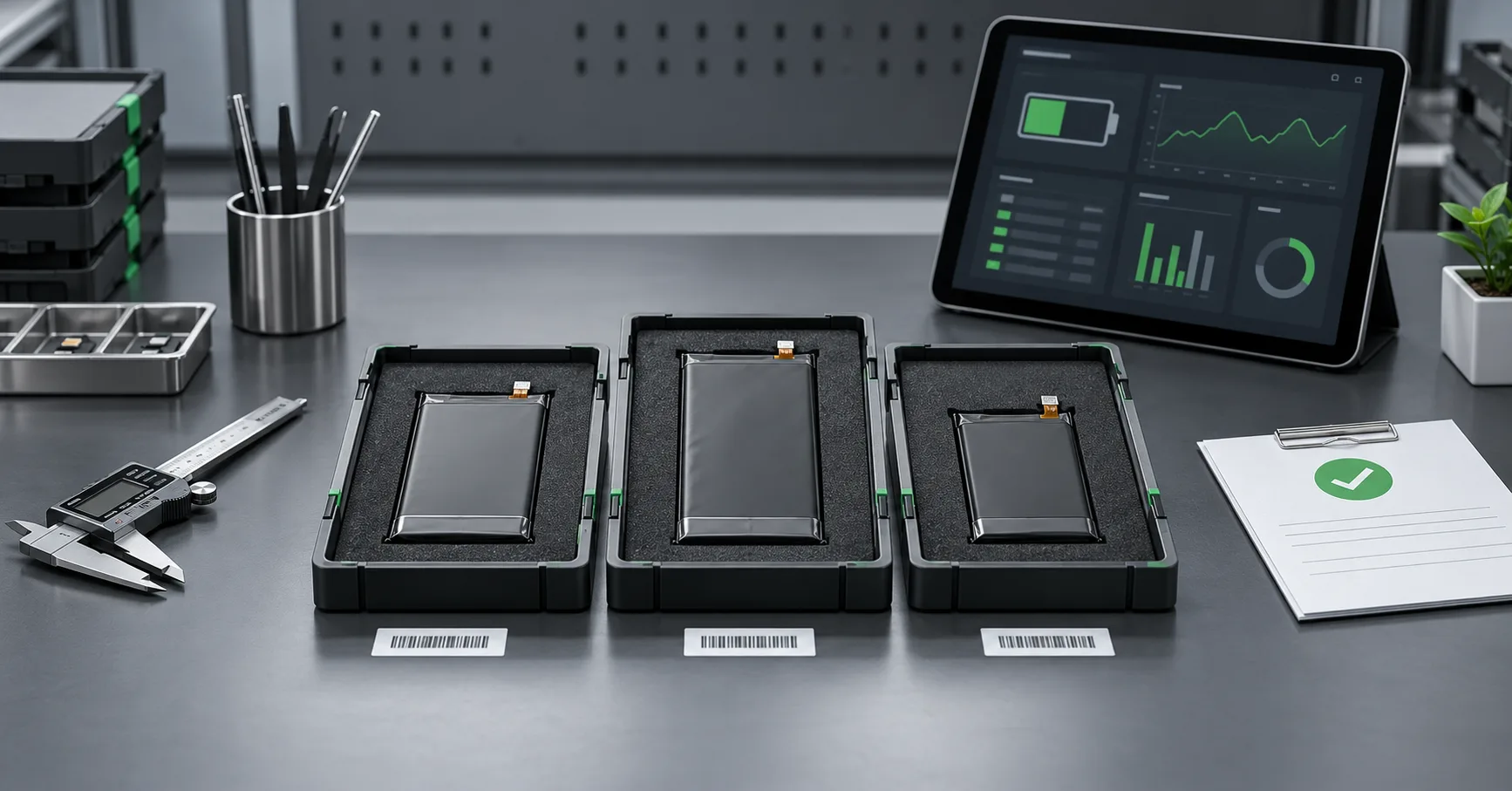
ESC's mobile phone battery product range is supported by quality-control processes covering capacity, voltage, cell grading, charging and discharging, and other production checks.
Buyers should request the relevant model-specific test information when evaluating samples.
1. Incoming Cell Inspection
Incoming cells should be inspected for physical damage and specification consistency.
Relevant checks include:
-
appearance;
-
dimensions;
-
voltage;
-
internal resistance;
-
surface condition;
-
manufacturing identification.
A battery that is already deformed or damaged should not proceed into normal assembly.
2. Capacity Verification
Capacity testing should use an agreed method.
Buyers should ask about:
-
charge and discharge conditions;
-
test temperature;
-
current;
-
voltage limits;
-
equipment calibration;
-
acceptance criteria.
Without defined conditions, capacity figures are difficult to compare.
3. Internal Resistance Testing
Internal resistance affects electrical performance under load.
Unexpectedly high or inconsistent values may justify further investigation.
However, resistance must be compared under matched conditions.
Different measurement methods can produce different results.
A useful specification should describe both the accepted range and the test method.
4. Voltage Consistency
Voltage checks help identify abnormal cells or inconsistent states.
However, open-circuit voltage alone is not sufficient proof of battery quality.
It should form part of a broader electrical inspection.
5. Charging and Discharging Tests
A professional supplier should verify that the battery behaves predictably during representative charging and discharge conditions.
Abnormal voltage changes, charging interruptions, or discharge instability require investigation.
6. Aging Tests
Aging tests can help identify certain problems before shipment.
They may reveal abnormal self-discharge or unstable performance that would not necessarily appear during a brief power-on test.
A battery passing one immediate functional check should not automatically be considered fully validated for bulk deployment.
7. Protection Circuit Verification
Complete battery assemblies may contain protection and management electronics.
Buyers should confirm which protection functions apply to the exact product.
These may relate to overcharge, over-discharge, and other electrical conditions.
Cell-only products must be evaluated differently because the relevant protection components may not be included.
8. Mechanical Inspection
For compact phones, physical dimensions are important.
Inspect:
-
thickness;
-
battery outline;
-
insulation;
-
connector location;
-
flex-cable position;
-
adhesive configuration;
-
surface damage.
Small assembly deviations can complicate installation and increase rework.
Battery Quality Checklist
| QC Item | Why It Matters | Buyer Evidence |
|---|---|---|
| Capacity | Runtime expectations | Test report |
| Voltage | Electrical consistency | Inspection data |
| Internal resistance | Performance under load | Measurement method and range |
| Self-discharge | Storage stability | Aging or retention records |
| Connector quality | Installation reliability | Sample inspection |
| Dimensions | Mechanical compatibility | Technical drawing |
| Protection electronics | Electrical protection | Product-specific documentation |
| Charging behavior | Functional stability | Charging test |
| Appearance | Physical safety and quality | Inspection record |
| Traceability | Warranty investigation | Lot or batch identifier |
Sample Testing Before Wholesale Orders
For wholesalers and refurbishment businesses, sample approval should be a separate stage before bulk ordering.
A sample that fits and turns on the phone is useful evidence, but it is not enough to validate a purchasing program.
Stage 1: Document Review
Request the selected product's:
-
technical datasheet;
-
compatibility list;
-
capacity and voltage ratings;
-
battery configuration;
-
inspection criteria;
-
packaging specification;
-
available documentation.
Verify that the document describes the exact iPhone 13 mini product, not a different member of the iPhone 13 family.
Stage 2: Physical Evaluation
Inspect samples for mechanical consistency.
Compare dimensions, adhesive layout, connectors, flex configuration, insulation, and labeling.
Check that samples from the same approved specification do not show unexplained variation.
Stage 3: Electrical Evaluation
Perform controlled testing appropriate to the product configuration.
For a complete assembly, this may include charging, controlled discharge, capacity measurement, and operating-condition monitoring.
For a cell-only product, testing must account for the absence of the complete battery management assembly.
Stage 4: Device-Level Validation
Install only appropriately approved samples using the relevant professional repair procedure.
Record:
-
device model;
-
iOS version;
-
installation method;
-
charging behavior;
-
Battery Health information;
-
Parts and Service History result;
-
representative runtime;
-
observed temperature behavior.
Stage 5: Repeatability
Testing more than one unit can help distinguish an isolated problem from repeated behavior.
The appropriate sample size depends on the purchase risk, quantity, specification changes, and historical supplier performance.
There is no universal sample count that guarantees a batch will be defect-free.
Stage 6: Approval and Traceability
Approve a product only after linking its sample results to the corresponding supplier specification.
Subsequent orders should be checked against that approved reference.
If the supplier changes the cell, protection electronics, connector, or other critical component, the change may require renewed validation.
iPhone 13 Mini Battery Replacement for Refurbishment Companies
A refurbishment facility has different priorities from a repair shop servicing one customer.
It may process many phones with different usage histories, battery conditions, and previous repairs.
The goal is not just to make one device work.
The goal is to produce a repeatable refurbishment outcome.
Incoming Device Grading
Before battery replacement, evaluate:
-
device model;
-
visible damage;
-
existing battery condition;
-
charging behavior;
-
functional status;
-
previous repairs;
-
battery service history.
Record defects that exist before the device enters the refurbishment process.
This helps separate incoming faults from repair-related problems.
Battery Replacement Criteria
Refurbishment companies should establish documented rules.
For example, an internal policy might consider battery health, runtime performance, and customer resale requirements.
The threshold should align with the company's product grading standards and market expectations.
Avoid replacing every battery simply because the phone is several years old.
A functional test provides more useful evidence than age alone.
Standardized Repair Stations
Each station should use approved equipment, validated parts, documented repair procedures, and consistent inspection criteria.
This improves repeatability across technicians.
Final Quality Control
After replacement, check:
-
power-on behavior;
-
charging;
-
battery information;
-
relevant device functions;
-
display and touch;
-
cameras;
-
Face ID;
-
enclosure condition.
The objective is a device that can be sold with a documented functional condition.
How to Select an iPhone 13 Mini Battery Supplier
A supplier's value extends beyond its quoted unit price.
For repair chains, wholesalers, and distributors, reliability depends on repeat supply, accurate technical information, and consistent after-sales handling.
Product Compatibility
Ask whether the supplier has a verified iPhone 13 mini specification and model list.
Check that product labels clearly distinguish iPhone 12 mini, iPhone 13 mini, iPhone 13, and iPhone 13 Pro.
Cell and Component Quality
Request information on cell grading, electrical testing, protection components, and connector assembly.
Avoid treating vague phrases such as "premium quality" as a replacement for verifiable specifications.
Quality-Control Evidence
A reliable sourcing discussion should address:
-
test methods;
-
acceptance limits;
-
batch records;
-
incoming inspection;
-
in-process control;
-
final inspection;
-
traceability.
Flexible Model Purchasing
Repair businesses often need multiple iPhone generations.
Mixed-model purchasing can simplify sourcing when supported by the supplier.
ESC offers flexible ordering arrangements across its battery portfolio, subject to the product and project requirements.
OEM and Private Label
Distributors may require custom labels, retail boxes, barcodes, warranty cards, and export-carton markings.
ESC supports these types of customization for suitable replacement battery projects.
Commercial Terms
Before confirming an order, request:
-
the approved battery SKU;
-
minimum order quantity;
-
sample policy;
-
unit price;
-
packaging costs;
-
production lead time;
-
shipping terms;
-
warranty conditions;
-
available documentation.
Do not assume a minimum quantity or delivery time published for one product applies to every battery variant.
iPhone 13 Mini Battery Replacement Cost: What Determines the Price?
The total cost depends on whether the buyer is paying for a complete repair service or purchasing batteries wholesale.
For Individual Users
The cost may include:
-
replacement battery;
-
professional labor;
-
adhesive and necessary repair materials;
-
testing;
-
applicable service charges;
-
warranty coverage.
A genuine Apple service repair and a third-party aftermarket repair may follow different pricing structures.
Ask for a quotation based on the exact device and service conditions.
For Repair Shops
The real cost of replacement includes more than the battery purchase price.
Consider:
Battery cost: The component price.
Labor: The time required for disassembly, installation, and testing.
Materials: Adhesives and other approved repair consumables.
Warranty risk: The probability and cost of rework.
Inventory cost: Stock management, storage age, and unused models.
Shipping: Freight and relevant logistics charges.
Total Cost of Ownership
For a repair business, an inexpensive battery can become costly if it causes repeated repairs.
A more useful purchasing comparison is:
Total Repair Cost = Component + Labor + Consumables + Expected Warranty Cost + Inventory and Logistics Costs
This helps buyers evaluate purchasing decisions without relying entirely on unit price.
Wholesale Inventory Planning for the iPhone 13 Series
An iPhone 13 mini purchasing program should not be managed as though every iPhone 13 model uses the same battery.
At a minimum, maintain separate inventory records for:
-
iPhone 13 mini;
-
iPhone 13;
-
iPhone 13 Pro;
-
iPhone 13 Pro Max.
Each has its own battery requirements.
For a detailed approach to stocking and replenishment, see ESC's iPhone 13 series replacement battery SKU planning guide.
Forecast From Repair Demand
Search volume may reveal market interest, but it is not the same as purchasing demand.
A distributor should consider actual repair orders, customer inquiries, historical sales, and local device populations.
Establish Reorder Points
Inventory planning should incorporate:
-
average demand;
-
lead time;
-
demand variation;
-
available stock;
-
reserved orders;
-
acceptable inventory age.
Rotate Inventory
Lithium-ion batteries age during storage.
A first-in, first-out or other controlled stock-rotation policy can help reduce unnecessary aging exposure.
Warehousing conditions should follow the approved battery storage requirements.
Control Product Revisions
Do not assume a battery ordered six months later is electrically identical to the earlier version.
If critical specifications or components change, assess whether new sample approval is required.
OEM and Private-Label iPhone Battery Opportunities
Private-label buyers often need more than individual battery packs.
They may require a consistent product family across several device generations.
A suitable sourcing strategy can include:
Product positioning: Define standard replacement, premium repair, diagnostic-compatible, and specialized battery categories.
Packaging: Create accurate model labeling and clear technical information.
Barcodes: Link each battery model to a unique stock code.
Instructions: Provide appropriate repair, storage, and safety information.
Warranty documentation: Define the claim process and relevant conditions.
Quality records: Maintain supplier and batch traceability.
ESC provides OEM and replacement battery supply support for suitable professional projects.
Buyers should submit exact model lists and customization requirements before requesting quotations.
Avoid Misleading Claims
Private-label packaging should not describe aftermarket batteries as genuine Apple components.
Claims about Battery Health display, warning-message behavior, or charging performance should be supported by model-specific validation.
Similarly, a high-capacity claim must be supported by actual technical data.
Accurate labeling is part of both customer trust and long-term product quality.
Battery Documentation, Certification, and International Shipping
Lithium-ion battery products may require specific documents and handling arrangements for international transport.
Buyers commonly encounter:
UN38.3: Relevant to lithium battery transport testing requirements.
MSDS or SDS: Documentation describing hazards and safe handling information.
CE and RoHS: Relevant regulatory and conformity topics where applicable to the product and market.
Other market-specific requirements: Depending on the destination and product configuration.
Documentation availability must be confirmed for the actual product, shipment, and applicable requirements.
A certificate for one battery model should not automatically be treated as evidence for another model.
Shipping Considerations
Logistics decisions may depend on:
-
battery quantity;
-
packaging;
-
shipment configuration;
-
destination;
-
carrier restrictions;
-
documentation;
-
transport mode.
A supplier should help buyers clarify these requirements before shipping.
ESC offers international shipment support for relevant battery projects, with the final shipping arrangement determined by the order and destination.
For basic battery handling information, refer to the company's User Guide.
Post-Replacement Testing: What a Repair Shop Should Record
A successful battery installation requires more than a device that turns on.
The following inspection checklist provides a practical starting point.
| Test | Expected Observation | Action if Abnormal |
|---|---|---|
| Power On | Device starts normally | Check installation and power system |
| Charging | Stable charging behavior | Check battery, cable, charger, and charging circuit |
| Battery Information | Expected result for repair configuration | Review component and service history |
| Battery Percentage | Reasonably stable behavior | Investigate fuel-gauge or electrical issues |
| Runtime | Consistent with approved test conditions | Compare workload and battery performance |
| Temperature | No unexplained abnormal behavior | Stop and investigate |
| Display | Normal image and touch response | Check repair-related damage |
| Face ID | Function matches documented pre-repair state | Investigate connection or unrelated fault |
| Mechanical Fit | No pressure, movement, or enclosure distortion | Correct assembly |
| Final Appearance | Clean and properly assembled | Reinspect before delivery |
Not every repair requires a lengthy discharge test.
However, repair chains should define appropriate functional checks and escalation rules.
Why Face ID Matters After a Battery Replacement
Although Face ID is not a function of the battery cell, technicians may handle nearby components while opening the device.
For this reason, Face ID should be included in pre-repair and post-repair checks where practical.
A separate ESC article discusses iPhone repair and troubleshooting, including broader hardware and battery diagnosis.
The objective is to avoid confusing a repair-related issue with a defective battery.
Common iPhone 13 Mini Battery Replacement Problems
Problem 1: The Phone Does Not Turn On
Possible causes include insufficient battery charge, a connection issue, a damaged part, or an unrelated device fault.
A technician should use the appropriate diagnostic procedure rather than repeatedly opening the phone without a plan.
Problem 2: The Device Shows an Unknown Battery Message
This may relate to battery identification or the repair process.
Check the Parts and Service History and the selected battery's supported configuration.
Do not assume the message alone proves an electrical defect.
Problem 3: Battery Health Is Not Displayed as Expected
The expected outcome depends on the battery assembly and repair method.
Review the exact product documentation and applicable service procedure.
A displayed figure should not be used as the only measure of battery quality.
Problem 4: Battery Drains Quickly After Replacement
Possible causes include background software activity, unstable cellular conditions, an unsuitable battery, or another device problem.
Compare charging, controlled runtime, and other observations before blaming the cell.
Problem 5: The Phone Becomes Unusually Hot
Stop testing if there is abnormal heat, swelling, leakage, or another safety concern.
For ordinary thermal complaints, investigate charging accessories, workload, environment, and battery condition.
Problem 6: The Battery Does Not Fit Correctly
Do not force the assembly into place.
Confirm that the battery is intended for the iPhone 13 mini and that its dimensions, flex arrangement, and adhesive configuration match the approved specification.
Problem 7: The Device Has Charging Interruptions
Charging interruptions can originate from multiple sources.
Inspect the verified charging setup and device condition before selecting further repair actions.
Problem 8: The Battery Performs Poorly After Storage
Long-term storage can affect rechargeable batteries.
Review manufacturing or shipment age, storage conditions, and the battery's measured electrical condition.
For wholesale operations, this should lead to an inventory and quality-control review.
Frequently Asked Questions About iPhone 13 Mini Battery Replacement
1. What is the original iPhone 13 mini battery capacity?
The commonly referenced original-capacity specification is 2406mAh, approximately 9.34Wh. The battery is designed for the compact 5.4-inch iPhone 13 mini. Aftermarket replacement products should be evaluated according to their actual technical datasheets, including capacity, voltage, dimensions, and component configuration.
2. Is 2227mAh the correct capacity for an iPhone 13 mini?
No. The 2227mAh capacity is commonly associated with the iPhone 12 mini, not the iPhone 13 mini. The iPhone 13 mini is commonly specified at 2406mAh. Buyers should verify the device model, battery reference, connector, dimensions, and selected product before purchasing.
3. Can an iPhone 13 mini battery be replaced?
Yes. Battery replacement is possible, and Apple provides a model-specific repair manual. However, the procedure requires appropriate skills and tools. Professional service is recommended, particularly when the battery is swollen, the phone is damaged, or the user has no experience repairing electronic devices.
4. When should I replace my iPhone 13 mini battery?
Consider replacement when reduced runtime, unexpected shutdowns, or a service recommendation significantly affects normal use. Battery Health around or below 80% may support the decision, but it is not the only criterion. The device's actual behavior and overall condition should also be evaluated.
5. Will a new battery improve iPhone 13 mini performance?
A new, correctly installed battery can improve runtime and may help restore the ability to deliver expected power when the old battery has degraded. However, it cannot upgrade the device's processor, increase storage, or correct unrelated hardware and software faults.
6. How long does an iPhone 13 mini battery replacement take?
The required time depends on the repair provider, device condition, available tools, and necessary testing. A straightforward repair may be completed relatively quickly by a trained technician, while a damaged device or one requiring additional diagnostics can take longer. Customers should request a service-specific estimate.
7. Will I lose my data after battery replacement?
A normal battery replacement does not inherently require erasing the phone. Nevertheless, hardware repairs involve risk, so important data should be backed up in advance. Customers should also discuss privacy and access requirements with the service provider.
8. Why does my iPhone say the battery is not genuine after replacement?
The phone may be unable to verify the installed battery or the relevant service configuration. Apple's Parts and Service History provides additional context. This message does not by itself measure the battery's actual capacity, but it matters for repair documentation and customer expectations.
9. Can an aftermarket battery show 100% Battery Health?
The displayed result depends on the particular battery configuration, the device software, and the repair procedure. No aftermarket supplier should guarantee identical behavior across all installations without appropriate validation. Professional buyers should test samples using their actual device and repair workflow.
10. What is the difference between a complete battery and a cell without flex?
A complete battery assembly includes the components required by its specified ready-to-install configuration. A cell without flex is a specialized component intended for qualified technicians carrying out a suitable cell-transfer or assembly process. The cell-only product does not automatically provide battery management or recognition functions.
11. Is a high-capacity iPhone 13 mini battery better?
Not automatically. Increased stated capacity may appeal to customers seeking longer runtime, but buyers must verify actual capacity, mechanical fit, electrical behavior, and safety. A larger capacity label without appropriate testing is not sufficient evidence of higher quality.
12. Does replacing the battery restore water resistance?
A battery replacement requires opening the device and affects the original sealing arrangement. Proper replacement of sealing materials is important, but the device should not automatically be represented as having its original factory water resistance after repair. Discuss the repair provider's testing and service conditions.
13. Can I use an iPhone 13 battery in an iPhone 13 mini?
No. The standard iPhone 13 and iPhone 13 mini are different devices with different battery configurations. A supplier should use separate product codes and verified compatibility information. Selecting a battery based only on the shared iPhone 13 family name is not acceptable.
14. What should repair shops test after installation?
At minimum, check power-on, charging, relevant battery information, basic device functions, and correct mechanical assembly. More detailed testing may include controlled runtime, temperature observations, and verification of previously documented functions such as Face ID.
15. How can I identify a reliable iPhone 13 mini battery supplier?
Evaluate exact model compatibility, verified capacity, electrical testing, connector quality, dimensions, batch consistency, quality-control procedures, traceability, documentation, and warranty handling. Sample validation should precede larger orders, particularly when the buyer operates multiple repair locations.
16. Does ESC supply iPhone 13 mini replacement batteries?
Yes. ESC lists iPhone 13 mini battery products, including a 2406mAh no-pop-up replacement option and a 2406mAh battery cell without flex. Buyers should confirm the exact configuration, current technical specifications, supported installation workflow, and commercial terms before ordering.
17. Can ESC support OEM or private-label battery projects?
ESC supports suitable OEM and private-label battery projects with options such as customized labels, packaging, barcodes, and other branding requirements. Availability depends on the selected product and order requirements. Customers should submit model lists, quantities, target markets, and customization details for evaluation.
18. What information should I include in a wholesale inquiry?
Provide the exact iPhone models, battery configuration, required capacities, approximate quantities, target country, intended repair process, packaging preferences, desired documentation, and any special Battery Health or warning-message requirements.
This helps suppliers prepare a more relevant quotation and identify potential compatibility issues before sample approval.
Conclusion
A successful iPhone 13 mini battery replacement starts with accurate model identification, a verified 2406mAh-class specification, safe installation, and proper post-repair testing. For professional buyers, capacity alone is not enough: connector quality, electrical consistency, battery recognition, quality-control evidence, and batch traceability all affect repair reliability and long-term costs.
ESC supports repair shops, refurbishment companies, wholesalers, and private-label brands through its mobile phone replacement battery portfolio, including selected iPhone 13 mini battery configurations. To evaluate samples, confirm current specifications, or discuss OEM packaging and wholesale supply, contact ESC with your model requirements, order quantities, target market, and intended repair workflow.