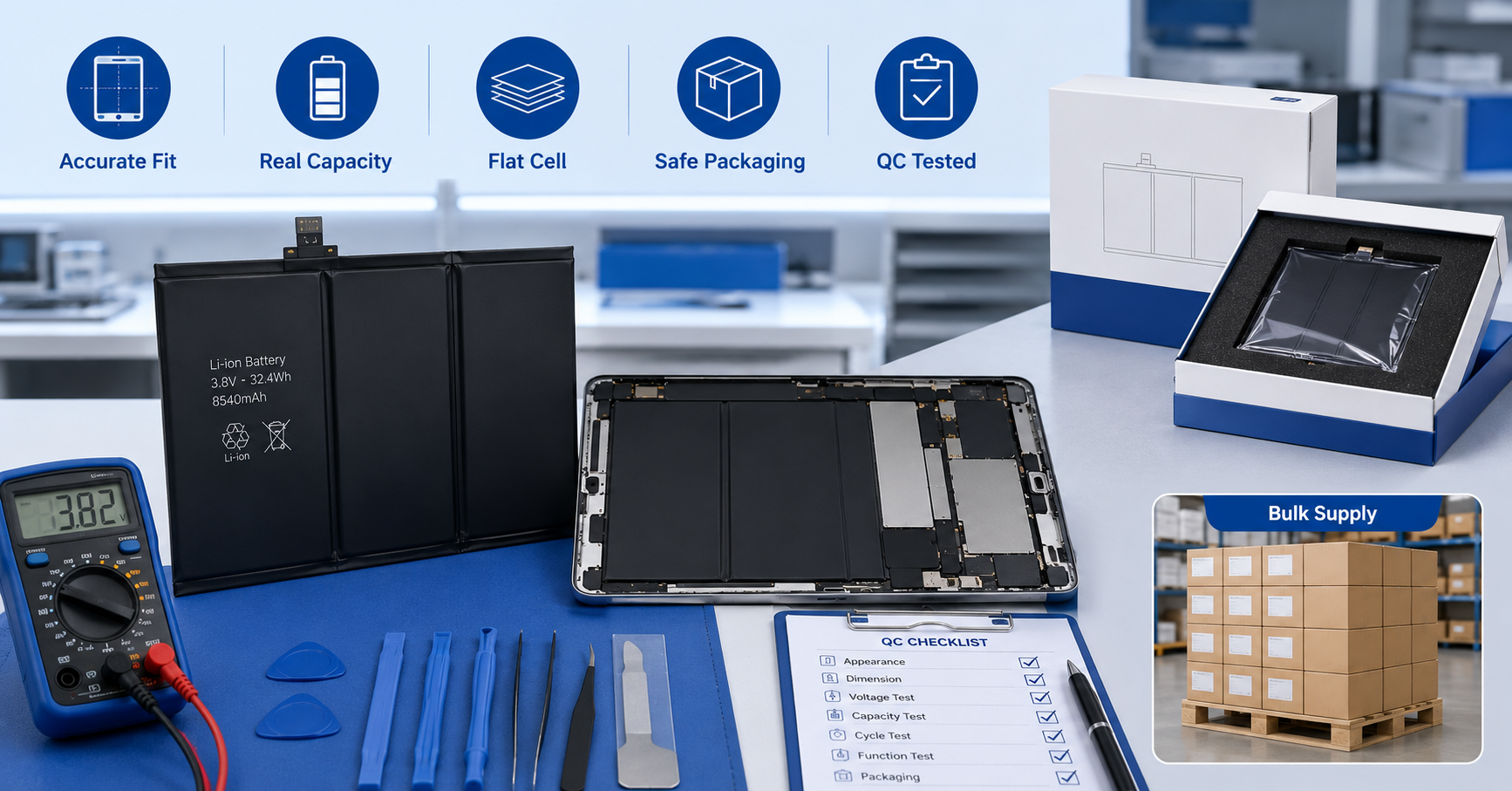

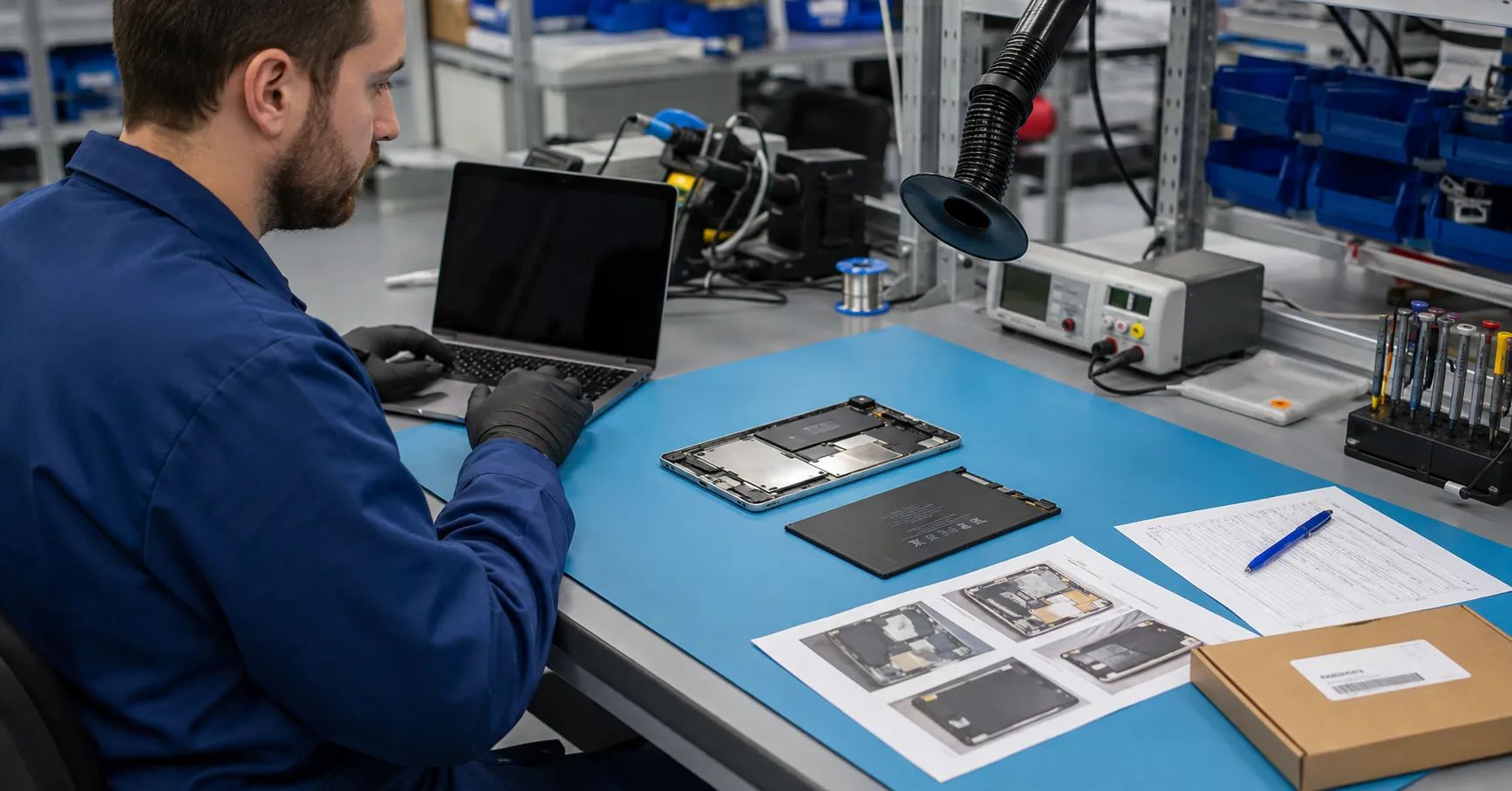
Tablet battery warranty claims become expensive when decisions depend on short customer messages, incomplete photographs, or assumptions about the returned part. A repair chain may call every fast-drain complaint a defective battery. A supplier may reject every case as an installation error. Neither approach creates reliable quality data or a sustainable commercial relationship.
A better system treats each claim as a controlled investigation. It connects the customer symptom with the tablet model, battery identity, installation record, diagnostic results, purchase order, and production lot. The goal is not to create unnecessary paperwork. The goal is to reach faster, more consistent decisions while identifying whether a problem belongs to one battery, one technician, one device family, one shipment, or an entire batch.
For wholesalers, refurbishment facilities, repair networks, and private-label buyers, a good warranty process protects four outcomes:
-
customers receive a timely and understandable response;
-
technicians receive feedback that improves installation quality;
-
buyers can measure supplier and batch performance;
-
suppliers receive enough evidence to investigate and correct genuine product problems.
Define the Warranty Before the First Order
Warranty control starts during sourcing, not after a return arrives. A buyer and supplier should agree on coverage, exclusions, evidence, response time, remedy options, and responsibility for logistics before approving mass production.
The written agreement should answer practical questions:
-
When does the warranty period begin: production, shipment, buyer receipt, installation, or end-customer sale?
-
Which documents establish the applicable purchase and warranty period?
-
Are sample orders and mass-production orders covered in the same way?
-
Which symptoms qualify for technical review?
-
Which conditions are excluded, such as impact, puncture, liquid exposure, unauthorized modification, incorrect installation, or use with an incompatible device?
-
Is the remedy replacement, account credit, repair support, partial compensation, or another agreed solution?
-
Who pays return freight, diagnostic labor, and disposal costs?
-
Must physical batteries be returned, or can selected cases be reviewed with digital evidence?
-
What happens when several claims point to the same lot?
-
Which response and escalation times apply?
Do not copy a consumer electronics warranty and assume it fits a B2B parts program. A repair chain installing hundreds of batteries has different evidence, labor, and batch risks from an individual device owner.
Manufacturer warranty, local consumer rights, repair-shop promises, and an aftermarket battery supplier’s commercial warranty may also be different. Apple’s official iPad service and repair information, for example, describes Apple’s own service, coverage, inspection, and parts terms. An independent aftermarket supplier should not present its batteries or warranty as Apple-authorized, Apple-certified, or equivalent to Apple’s service program.
Build a Standard Claim Intake Package
Every claim should begin with the same minimum information. If sales teams, technicians, and distributors submit different evidence, the quality team cannot compare cases reliably.
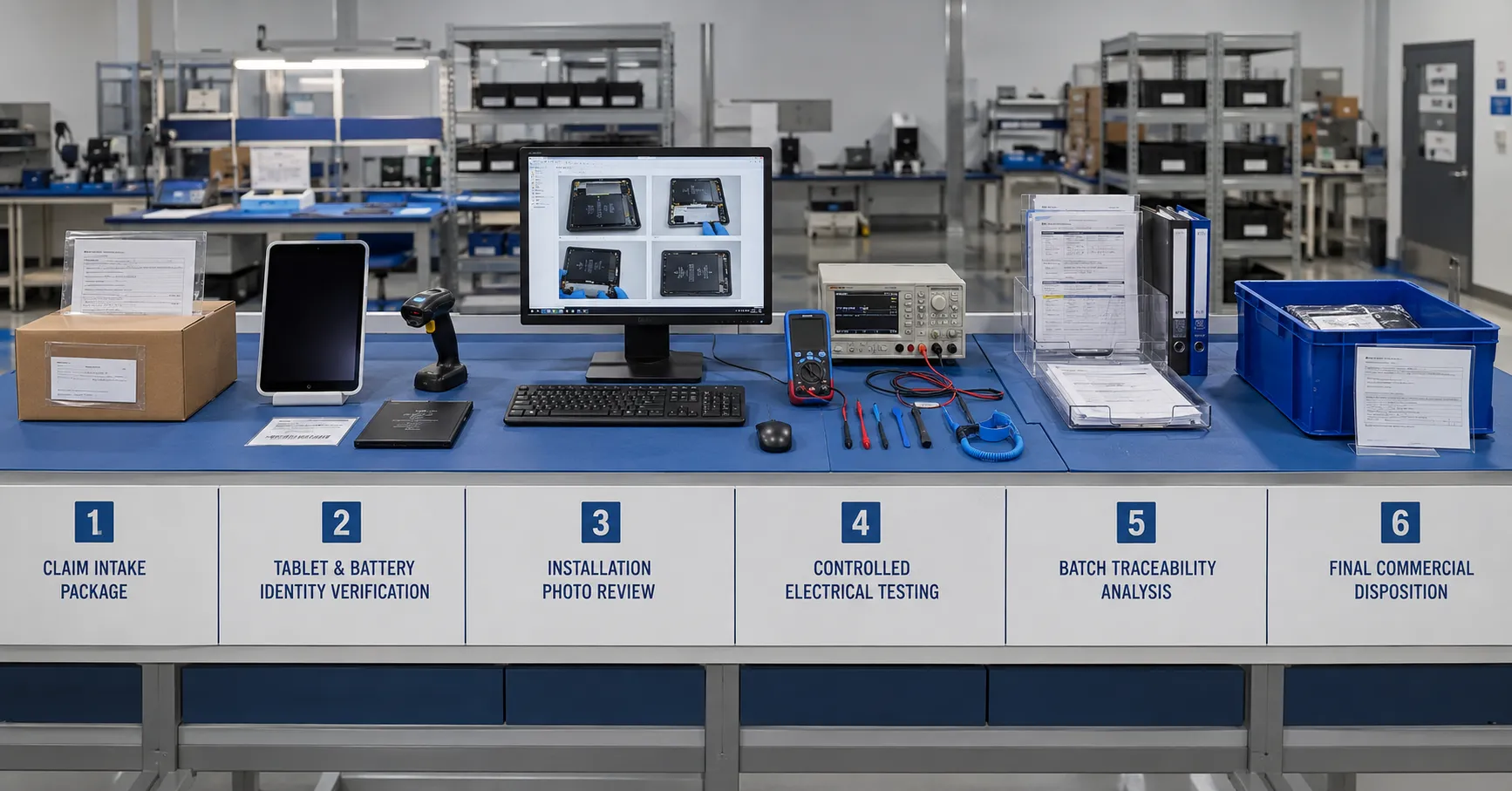
A practical intake form should capture the following sections.
Buyer and Transaction Information
Record the claimant’s company, contact person, sales channel, purchase order, invoice or delivery reference, quantity purchased, quantity installed, quantity affected, and date the problem was reported.
The number of affected batteries needs context. Two reports from a purchase of ten units and two reports from a purchase of two thousand units are not the same signal. Installed quantity is often more useful than purchased quantity because stock may still be sitting unopened in the buyer’s warehouse.
Tablet Identification
Record the tablet brand, exact model, model number, regional or hardware variant where relevant, storage or connectivity version if it affects the internal design, and any board or device identifier used by the repair operation.
Avoid descriptions such as “iPad battery,” “Samsung tablet battery,” or “battery for 10-inch tablet.” Similar product names can hide meaningful differences in enclosure dimensions, connector location, flex length, pin assignment, rated values, and software behavior.
The existing tablet battery compatibility checklist provides a structured method for confirming the device, battery shape, connector, cable routing, markings, and sample fit before bulk purchasing.
Battery and Packaging Identity
Photograph or record the battery model code, label, rated values, supplier SKU, barcode, lot number, production code, packaging label, and any inspection or traceability mark. Keep the full battery visible in at least one image and use additional close-ups for relevant details.
A photograph of a loose silver pouch without its label or packaging rarely proves which product was installed. When the label has been removed during installation, the buyer should preserve the original packaging record or scan the battery identity before fitting it.
Installation and Device History
Record the installation date, technician, work order, tablet condition before repair, reason for battery replacement, tools and adhesive system used, and any unusual event during opening or reassembly.
Also document whether the tablet had:
-
liquid exposure;
-
bent housing or previous impact damage;
-
damaged charging port;
-
logic-board repair history;
-
non-standard charger use;
-
display or frame replacement;
-
evidence of earlier battery work;
-
operating-system or firmware problems;
-
unusually high standby drain before replacement.
This history does not automatically invalidate a claim. It helps determine what needs to be tested.
Symptom Description
Ask for observable behavior instead of conclusions. “Defective battery” is a conclusion. Better descriptions include:
-
tablet does not power on after installation;
-
charging indicator appears but percentage does not increase;
-
battery percentage drops from one recorded level to another during a defined test;
-
device shuts down under a repeatable workload;
-
battery is not detected;
-
connector becomes unusually warm;
-
pack does not sit flat before installation;
-
visible swelling or odor was observed;
-
runtime differs materially from the approved sample under the same test method.
Record when the symptom began, whether it is constant or intermittent, and whether it can be reproduced.
Separate Safety Cases from Normal Technical Claims
Not every returned battery should travel through an ordinary diagnostic queue. A battery showing swelling, leakage, smoke, hissing, abnormal heat, puncture, crushed edges, torn insulation, or impact damage requires immediate isolation and a site-specific safety response.
The US Occupational Safety and Health Administration explains in its guidance on preventing fire and explosion injuries from lithium-powered devices that damaged or failing batteries may show signs such as bulging, cracking, leaking, rising temperature, hissing, or smoking. The guidance recommends removing suspect products from service and training exposed workers to recognize and respond to these conditions.
Warehouse or repair personnel should not press a swollen battery flat, puncture it, continue charging it to reproduce a complaint, or ship it through an ordinary parcel method. Follow the manufacturer’s instructions, the facility emergency plan, applicable transport rules, and local disposal requirements.
The US Environmental Protection Agency’s lithium-ion battery fact sheet advises against placing lithium-ion batteries in household trash or municipal recycling bins and recommends suitable battery or electronics recycling channels. Local requirements and available services differ, so the responsible team should confirm the correct route in its market.
Safety isolation is not the same as accepting warranty responsibility. It protects personnel while the commercial and technical investigation continues.
Use a Fault-Isolation Sequence
The investigation should move from identity and obvious physical conditions to controlled testing. Jumping directly to a capacity test can waste time when the wrong battery was supplied, the connector is not seated, or the tablet itself has a charging fault.
Step 1: Confirm the Supplied Product
Match the returned battery and packaging to the purchase order, approved sample, supplier specification, and relevant lot. Confirm that it is actually a product supplied under the agreement.
If identity cannot be established, classify the claim as “evidence incomplete” rather than automatically accepted or rejected. The buyer can then provide packaging, inventory, or work-order records.
Step 2: Recheck Compatibility
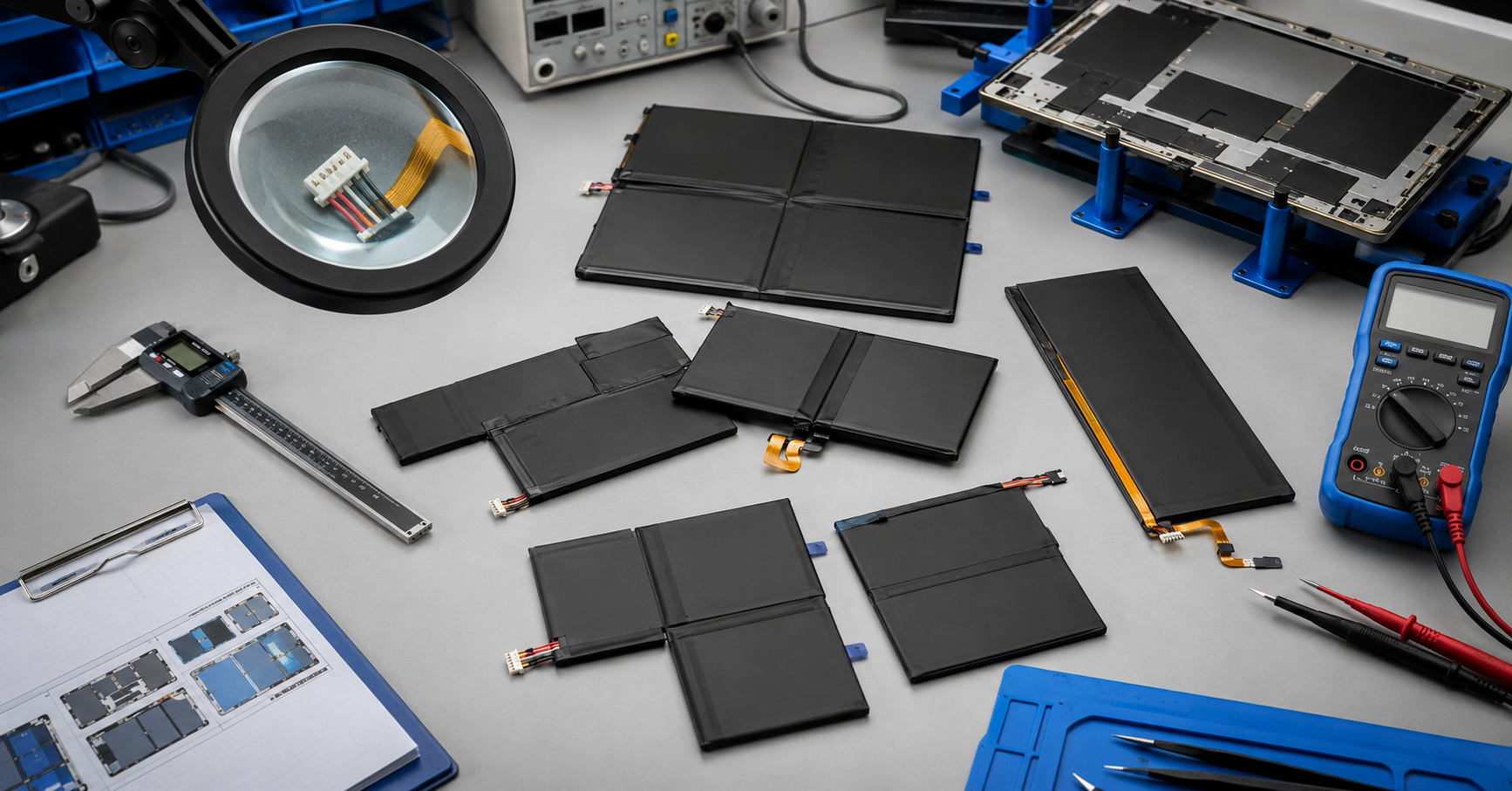
Compare physical outline, thickness, cable length, connector, pin arrangement, mounting features, rated voltage, and other approved attributes. Confirm that the target tablet matches the model for which the battery was supplied.
A battery may fit inside the enclosure but still be wrong electrically or mechanically. If the product was ordered using a broad commercial model name, revisit the sample-approval record and determine whether an unrecognized device variant entered the repair batch.
Buyers planning a new program should complete the tablet replacement battery sourcing and sample-approval process before mass installation begins.
Step 3: Review Installation Evidence
Check whether the flex was folded beyond its intended path, the connector was inserted at an angle, conductive debris entered the work area, screws were misplaced, insulation was damaged, or the pack was bent during adhesive application.
Inspect the tablet housing for distortion. A bent frame can place pressure on a correctly manufactured battery. Confirm that adhesive thickness and placement do not create concentrated pressure or interfere with cable routing.
Installation evidence should be reviewed neutrally. The purpose is not to blame the technician. Repeated installation errors may reveal that the work instruction, fixture, packaging, or product design needs improvement.
Step 4: Check the Tablet and Charging System
Where safe and technically appropriate, inspect the charging port, charger, cable, board condition, and current behavior using an approved process. A battery cannot correct excessive system drain, damaged charging circuitry, liquid-corroded connectors, or unstable board repair.
Use a known-good charger and cable when the device specification allows it. If the operation has an approved known-good battery, a controlled comparison can help identify whether the symptom follows the battery or remains with the tablet.
Do not use an uncontrolled swap if it could damage the comparison battery, erase traceability, or create a safety risk.
Step 5: Perform Authorized Battery Checks
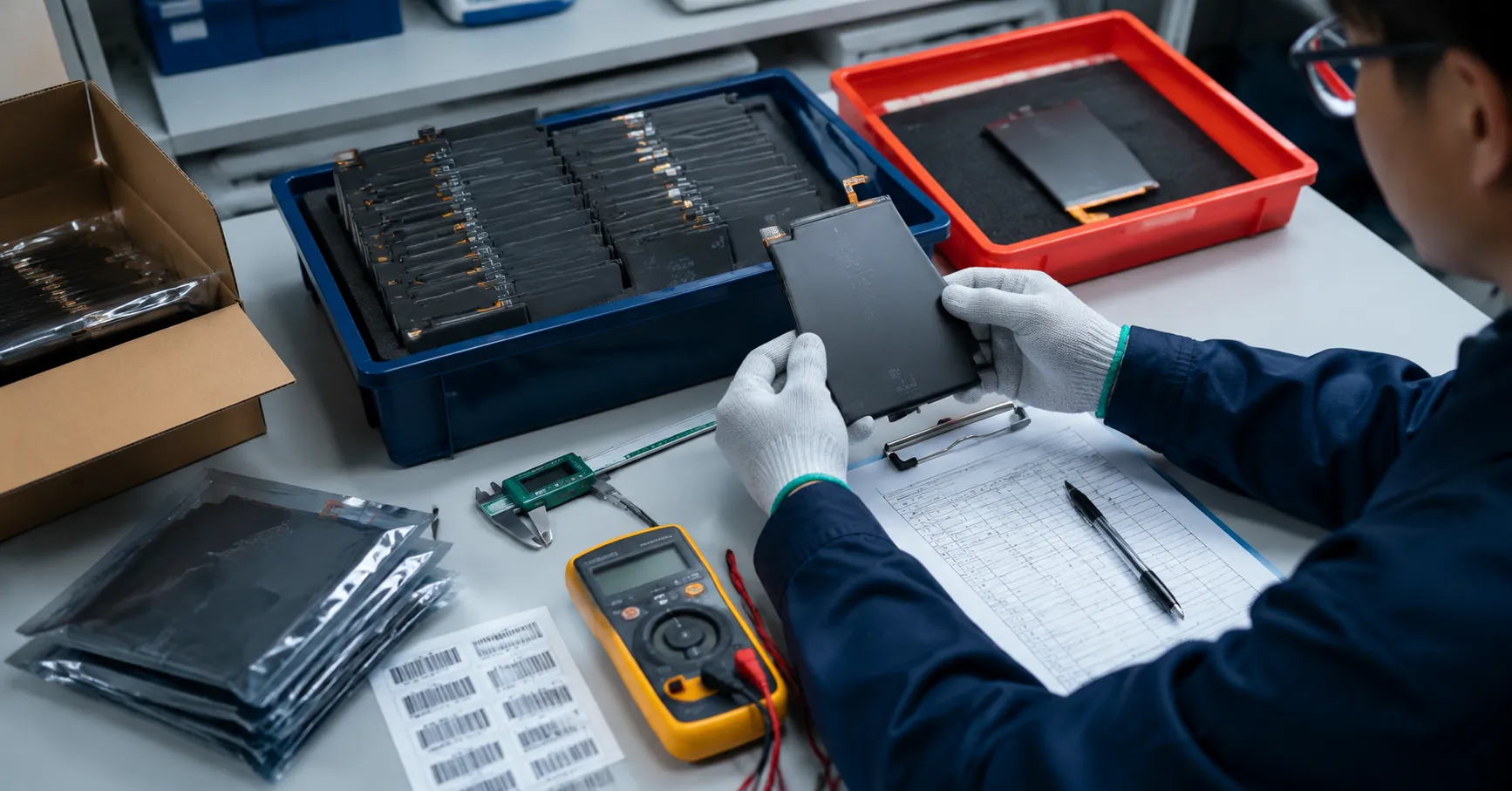
The exact checks and acceptance limits should come from the approved specification and test plan. Depending on the product and equipment, the review may include appearance, dimensions, connector condition, open-circuit voltage, internal resistance, charging behavior, discharge behavior, protection response, standby behavior, and usable capacity.
Record the equipment ID, calibration status where applicable, test method, environmental conditions when relevant, operator, date, raw result, and acceptance limit. “Tested OK” is not enough for a disputed claim.
Do not invent one universal capacity, voltage, internal-resistance, or runtime threshold for every tablet battery. Model design, rated capacity, device load, test method, temperature, software state, and supplier specification can all influence the result.
Step 6: Reproduce the Reported Symptom
A technically valid battery may still perform poorly in a particular device condition. Where safe, try to reproduce the customer’s reported behavior under a defined setup.
For runtime complaints, control screen brightness, connectivity, background activity, software version, test duration, starting condition, and workload. For charging complaints, record the charger, cable, port condition, starting level, test time, and observed current or device response.
The purpose is not to create a laboratory simulation for every return. It is to replace vague impressions with repeatable evidence.
Classify the Outcome Consistently
A claim should end with a defined classification. Useful categories include:
-
confirmed battery nonconformity;
-
probable battery nonconformity;
-
compatibility mismatch;
-
installation-related damage;
-
tablet or charging-system fault;
-
transport or handling damage;
-
normal wear or performance expectation mismatch;
-
no fault found under the agreed test;
-
evidence incomplete;
-
safety exception requiring specialist disposition;
-
mixed or undetermined cause.
Each category should have a standard next action. A confirmed product issue may receive replacement or credit and trigger a batch review. An installation issue may require technician feedback and revised instructions. An incomplete case may remain open for a limited period while additional records are requested.
“No fault found” should not mean “customer is wrong.” It means the submitted symptom was not reproduced under the documented method. The case record should state what was tested and what evidence would justify reopening it.
Connect Individual Claims to Batch Risk
One isolated complaint does not always indicate a lot problem, while several individually small claims may reveal a pattern. The quality team should monitor cases by supplier, SKU, battery code, production lot, receiving batch, customer, technician, tablet model, symptom, and disposition.
Useful indicators include:
-
claims per installed quantity;
-
repeat symptom rate;
-
claims concentrated in one production lot;
-
claims concentrated in one tablet variant;
-
time from installation to complaint;
-
percentage confirmed as product-related;
-
percentage linked to installation or device faults;
-
average response and closure time;
-
replacement or credit cost;
-
diagnostic and labor cost;
-
recurrence after corrective action.
Avoid setting universal alarm thresholds without considering volume, market, product maturity, and severity. A single serious safety-related event may justify immediate escalation even when the numerical rate is low.
When a pattern appears, quarantine remaining stock from the relevant lot, review incoming inspection records, compare retained samples where available, and ask the supplier for production and test information. Do not continue normal release while waiting for the claim count to become statistically convenient.
A complete tablet battery claim evidence package should allow the supplier to trace the issue beyond a sales invoice. It should connect the reported unit to the batch, approved specification, relevant production records, and buyer test results.
Choose a Resolution That Matches the Evidence
Commercial remedies should be proportionate and agreed in advance. Options may include:
-
replacement units in the next shipment;
-
immediate replacement from local stock;
-
account credit;
-
refund for confirmed affected units;
-
additional inspection of remaining stock;
-
return authorization;
-
controlled disposal with evidence;
-
packaging or instruction changes;
-
technician training support;
-
replacement of a confirmed affected lot;
-
corrective and preventive action report.
Do not promise automatic reimbursement for device value, customer compensation, technician labor, freight, lost sales, or reputational damage unless the contract clearly defines those liabilities. Equally, suppliers should not assume that sending one replacement battery resolves repeated labor-intensive failures.
For high-volume programs, agree on a claim-value matrix. Low-risk, well-documented cases may be resolved digitally, while repeated, high-value, unclear, or safety-related cases receive deeper investigation.
Turn Claim Data into Corrective Action
The warranty process creates value only when findings change future behavior. Review closed cases regularly and ask:
-
Did the approved sample represent mass production?
-
Was the compatibility record precise enough?
-
Did packaging protect the connector and pouch?
-
Did incoming inspection sample the right characteristics?
-
Were installation instructions clear?
-
Did technicians have suitable tools and fixtures?
-
Did labels preserve lot identity?
-
Did warehouse rotation or handling affect the product?
-
Did the supplier communicate a material or process change?
-
Did the same symptom return after correction?
If a product issue is confirmed, the corrective action should identify the containment scope, root cause, correction, preventive action, responsible owner, due date, and evidence of effectiveness. Replacing affected batteries without preventing recurrence is a commercial remedy, not a complete corrective action.
The tablet battery factory selection guide can help buyers evaluate whether a supplier can support model planning, repeatable testing, packaging, and batch-oriented quality control before problems reach the market.
Frequently Asked Questions
What evidence should accompany a tablet battery warranty claim?
Provide the purchase reference, tablet model, battery and packaging identity, lot number, installation date, technician or work order, symptom description, photographs, relevant device history, test method, raw results, and affected-versus-installed quantity.
Should every claimed battery be physically returned?
Not necessarily. The agreement may allow digital review or controlled local disposal for selected cases. Physical return may be necessary when identity, failure mode, value, repeated patterns, or technical analysis justify it. Safety and transport requirements must be considered before returning a damaged battery.
How can a buyer distinguish battery failure from a tablet fault?
Use a documented sequence: confirm identity and compatibility, inspect installation, check the tablet and charging system, perform authorized battery measurements, and reproduce the symptom under controlled conditions. No single observation proves every case.
Does fast battery drain always mean the replacement battery is defective?
No. Runtime can be influenced by the battery, device load, screen settings, connectivity, background activity, software condition, charging behavior, board faults, temperature, and the test method. Compare results using a defined and repeatable procedure.
What should happen when several cases come from one lot?
Place remaining stock from the relevant lot on hold, review receiving and outbound records, compare symptoms, inspect retained or available samples, and request a supplier investigation. The scope should be based on traceability and evidence rather than assumption.
Can a swollen battery be tested to confirm the claim?
Do not continue ordinary charging, discharging, pressing, opening, or improvised testing of a visibly swollen or otherwise unsafe battery. Isolate it and follow trained safety procedures, manufacturer guidance, applicable transport rules, and local disposal requirements.
Build a Better After-Sales System
A reliable warranty program is not designed to approve every claim or reject every claim. It is designed to make the same evidence lead to the same decision, regardless of which salesperson, technician, customer, or supplier receives the case.
The best tablet battery warranty claims workflow begins with a clear agreement, precise product identity, controlled compatibility approval, consistent intake records, safe fault isolation, documented testing, batch analysis, and proportionate resolution. That structure reduces argument, shortens response time, and turns after-sales cases into useful quality information.
ESC supports B2B tablet replacement battery projects for repair shops, refurbishment facilities, wholesalers, distributors, e-commerce sellers, and private-label buyers. Buyers can provide target tablet models, expected order quantities, compatibility references, packaging requirements, test expectations, and proposed warranty terms for a structured sourcing and quality review.
External Source References
-
Apple Support — Apple Service and Repair for iPad — accessed 2026
-
US Occupational Safety and Health Administration — Preventing Fire and/or Explosion Injury from Small and Wearable Lithium Battery Powered Devices — 2019
-
US Environmental Protection Agency — Know the Facts: Lithium-Ion Batteries — 2023