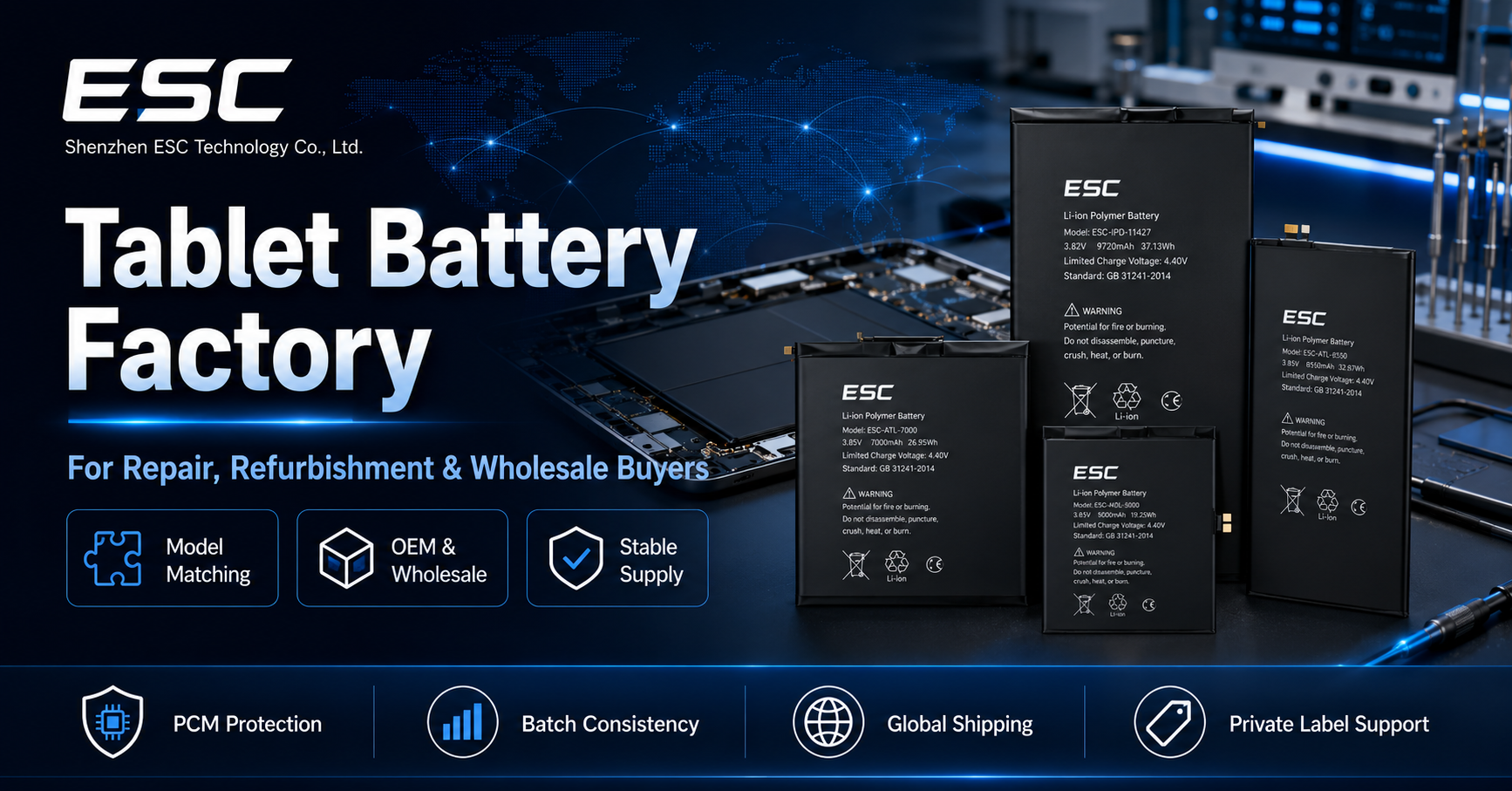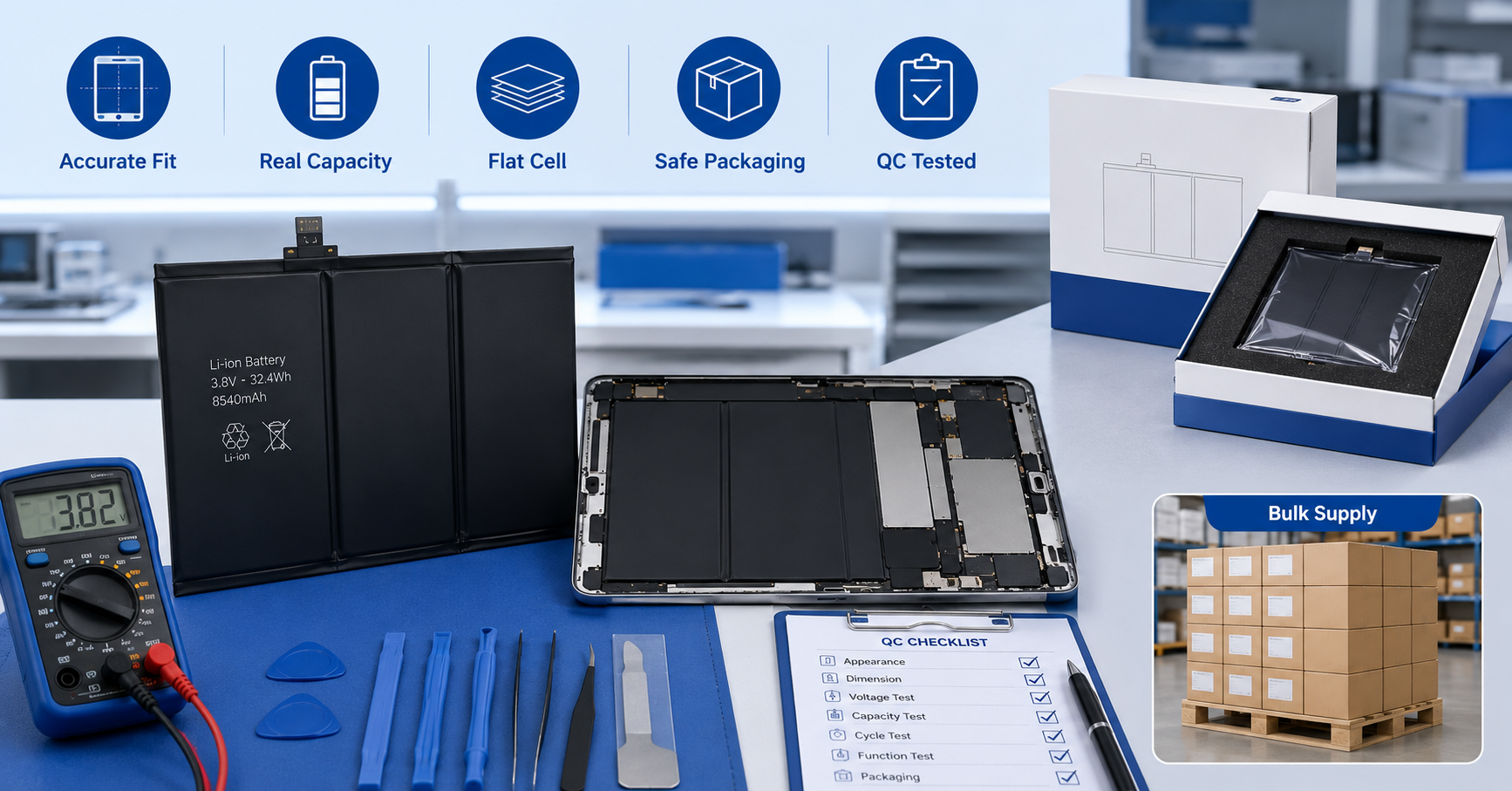


Tablet replacement battery sourcing should begin with device identification and acceptance criteria, not with a price list. For repair chains, refurbishment facilities, wholesalers, and private label brands, a battery must fit the intended tablet, perform consistently across multiple samples, arrive with the documents required for the destination and shipping method, and remain repeatable in later orders.
A useful sourcing process has three gates: a complete request for quotation, a documented sample review, and a written bulk-order specification. This structure reduces preventable disputes because both buyer and supplier agree on what is being purchased and how it will be evaluated.
Why Tablet Battery Orders Fail After a Good-Looking Sample
One sample can power on correctly and still be a weak basis for a bulk order. The sample may fit one device but not another revision. Its connector position may be acceptable, while the flex cable bends poorly during repeated installation. The printed capacity may also be mistaken for verified performance when no test method has been agreed.
For a B2B buyer, the larger risk is variation. A repair operation needs predictable installation time. A refurbisher needs repeatable runtime and final-device behavior. A wholesaler needs clear model labels and manageable returns. A private label brand also needs packaging and claims that match the actual product.
This is why the lowest quotation is not necessarily the lowest total cost. Rework, technician time, misidentified inventory, customer credits, reshipment, and warranty handling can outweigh a small unit-price difference.
Build the RFQ Around the Device, Battery, and Order
A strong tablet battery RFQ separates confirmed requirements from open questions. Do not send only a tablet marketing name such as “iPad battery” or “Samsung tablet battery.” Model families can contain regional versions, production revisions, and different battery part references.
1. Identify the Target Device
Provide as many of the following as possible:
-
Tablet brand and full device model number
-
Battery part number printed on the original pack
-
Clear photos of the original battery label
-
Battery length, width, and thickness
-
Connector shape, pin count, and orientation
-
Flex cable length, bend position, and exit direction
-
Photos of the battery compartment and connector location
-
Any known regional or production revision
-
Expected monthly demand by model
Compatibility must be confirmed by device model and battery specification. A similar product name or matching voltage alone is not enough.
2. Define the Battery Specification
The RFQ should state the required nominal voltage, charge-voltage information when relevant, labeled capacity, dimensions, connector, protection-board requirements, label language, and packaging format. If a capacity claim is important to the purchase, also define how it will be tested.
Capacity should be verified for the specific battery model and test method. The buyer and supplier should agree on the test equipment, charge and discharge conditions, cutoff criteria, ambient conditions, and reporting format before treating a result as acceptance evidence.
3. Describe the Commercial Project
Include:
-
Target country or region
-
Buyer type and sales channel
-
Initial quantity and forecast demand
-
Required model mix
-
Neutral, bulk, or private label packaging
-
Barcode, serial, date-code, and carton-mark needs
-
Required language for labels and instructions
-
Preferred shipping method
-
Required compliance or transport documents
-
Requested sample quantity and approval schedule
MOQ depends on the selected model and customization scope. Lead time also depends on the model, customization, and order quantity. Ask the supplier to confirm both for the actual project instead of applying one general number to every SKU.
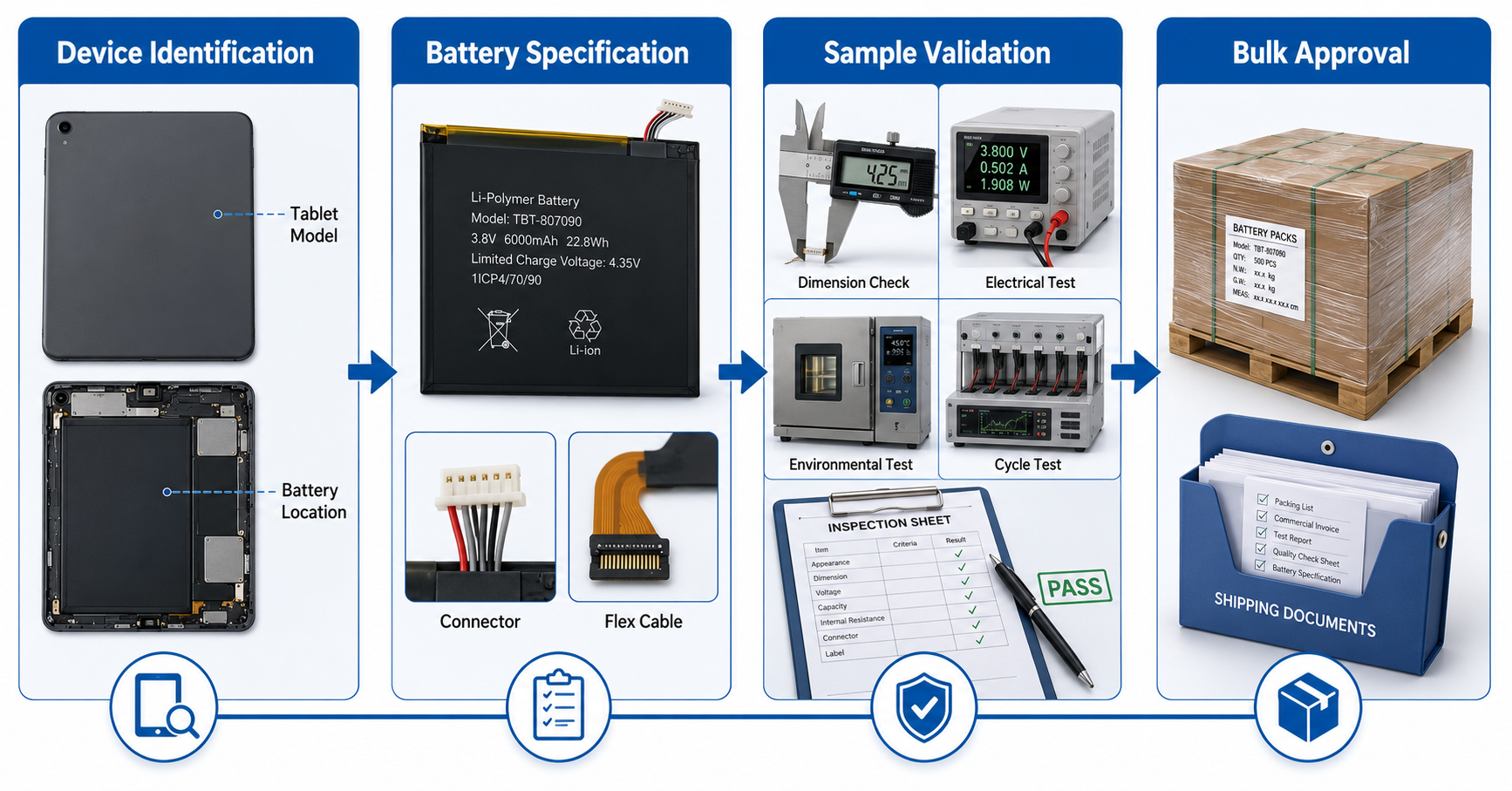
Use a Specification Matrix for Mixed-Model Orders
Mixed-model purchasing is common for repair and refurbishment buyers, but it creates a high risk of labeling and picking errors. A specification matrix gives every SKU a controlled identity.
| Field | What the buyer should record | Why it matters |
|---|---|---|
| Buyer SKU | Internal unique code | Prevents similar models from being mixed |
| Device model | Full model reference | Defines intended application |
| Battery part number | Original-pack reference when available | Supports cross-checking |
| Electrical specification | Voltage and labeled capacity | Establishes the ordered configuration |
| Mechanical specification | Dimensions, connector, and flex layout | Controls installation fit |
| Sample revision | Photo or revision code | Links approval to the tested sample |
| Packaging | Bulk, neutral, or private label | Prevents packing disputes |
| Required documents | Model- and market-specific list | Supports compliance and shipment planning |
| Inspection criteria | Tests, sample size, and limits | Defines bulk-order release |
The matrix should be version-controlled. If a connector, label, cell, protection board, or packaging component changes after sample approval, the supplier should identify the change before production rather than treating it as an invisible substitution.
Evaluate Samples in Five Separate Layers
Sample approval should answer five different questions. Combining them into a simple “works/does not work” decision hides important risks.
Layer 1: Identity and Visual Condition
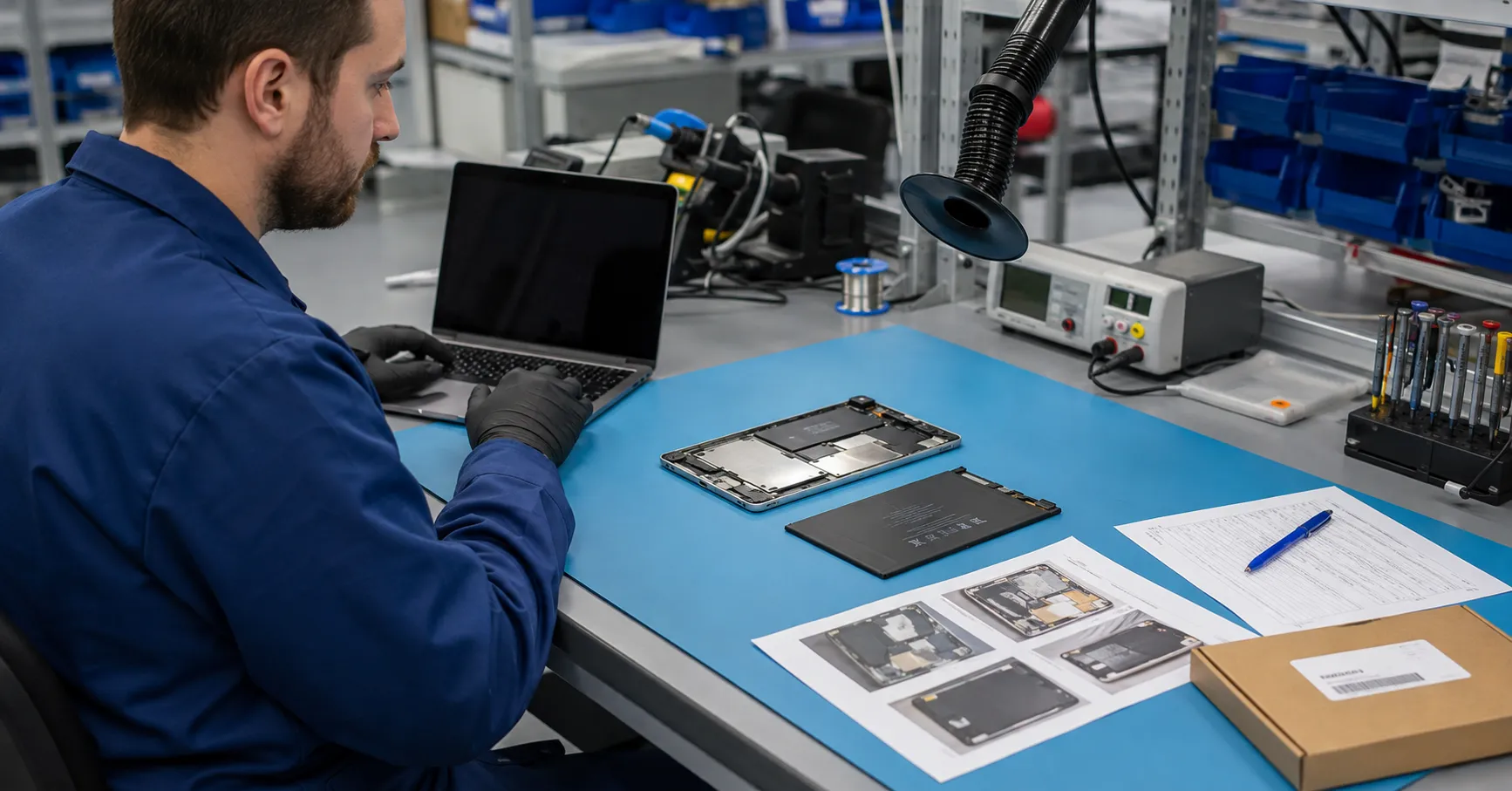
Check the model label, part reference, dimensions, connector, flex cable, insulation, edge sealing, surface flatness, and packaging condition. Photograph each sample and record its sample code or batch reference.
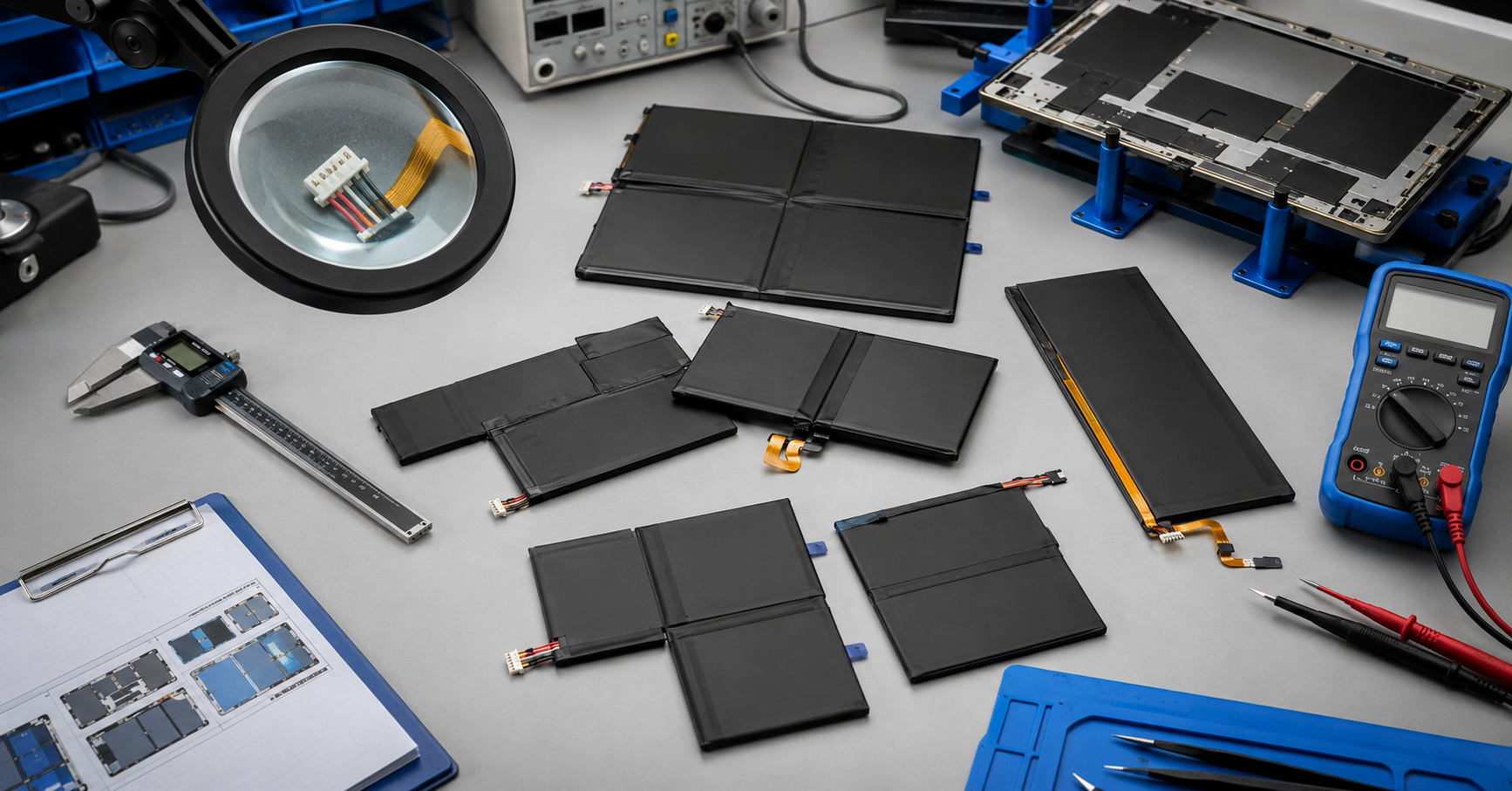
Look for differences between samples, not only obvious defects. Variation in thickness, cable position, label placement, or pouch finish may signal a process-control issue that deserves clarification.
Layer 2: Mechanical Installation
Install samples in verified compatible devices. Check whether the battery sits flat, whether the connector aligns without force, whether the flex cable follows the intended path, and whether adhesive areas are suitable for the repair process.
Installation should be repeated across more than one device when possible. A battery that fits one worn or previously repaired unit does not automatically prove repeatable fit.
Layer 3: Electrical and Functional Behavior
The test plan may include open-circuit voltage, internal resistance, controlled capacity testing, charge and discharge behavior, standby observation, percentage stability, and device function after installation. The exact tests and limits should match the product, target market, and buyer risk.
Do not convert an unrecorded bench observation into a universal performance claim. Test records should identify the battery model, equipment, load or current, temperature or environment, date, and result.
Layer 4: Protection and Safety Review
Ask what protection-board functions apply to the proposed model and how they are checked. Risk depends on cell quality, protection design, storage, charging, and operating conditions; no responsible supplier should promise zero swelling or 100% safety under every condition.
IEC 62133-2 specifies safety requirements and tests for portable sealed secondary lithium cells and batteries under intended use and reasonably foreseeable misuse. Certification availability, however, must be confirmed for the specific battery model and target market. A supplier’s general experience with a standard is not the same as a certificate or report covering the quoted SKU.
Layer 5: Packaging, Labeling, and Documents
Inspect retail or bulk packaging as part of the sample, especially when a private label is involved. Verify model identification, warnings, barcode readability, artwork version, included instructions, and outer-carton marks.
Shipping documentation should be planned before production. IATA’s 2026 lithium battery guidance explains that manufacturers and subsequent distributors must make the applicable UN 38.3 test summary available. The summary includes model identification and other test information, which is why buyers should check that the document actually corresponds to the battery being purchased.
Requirements vary by battery configuration, transport mode, and destination. Confirm the final document set with the supplier, logistics provider, and relevant market specialists for the specific shipment.
Turn Sample Results Into Bulk-Order Acceptance Criteria
“Sample approved” is too vague for production control. Approval should produce a signed or otherwise controlled reference containing:
-
Approved model and buyer SKU
-
Approved electrical and mechanical specification
-
Approved battery, connector, flex, label, and packaging photos
-
Approved artwork files and revision numbers
-
Test methods, sample quantities, and acceptance limits
-
Required model-specific documents
-
Rules for component or process changes
-
Pre-shipment inspection plan
-
Nonconformance and after-sales communication process
Warranty depends on the specific product and agreement. Define the warranty scope, evidence required for a claim, excluded conditions, credit or replacement method, and response process in the commercial agreement.
Inspect Bulk Production Against the Approved Reference
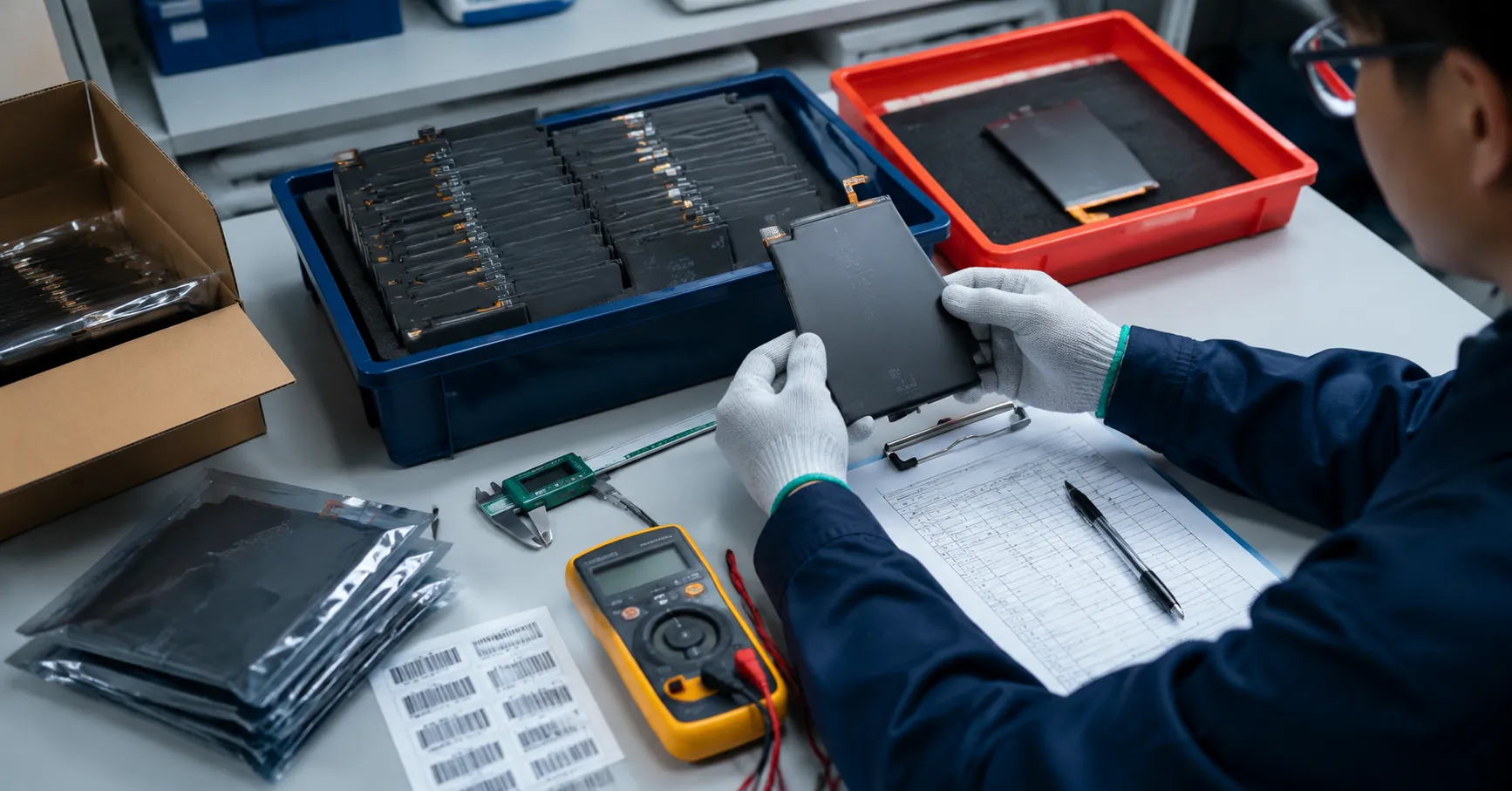
Bulk inspection should verify identity and consistency, not simply repeat a visual check. Select samples from different cartons or production lots and compare them with the approved reference.
A practical inspection can cover:
-
SKU, model, quantity, and carton identification
-
Dimensions, connector, and flex-cable layout
-
Label and packaging revision
-
Surface, sealing, insulation, and appearance
-
Agreed electrical or functional checks
-
Installation checks on compatible devices
-
Required document availability
-
Shipping marks and packing condition
The appropriate sampling plan and limits depend on the order, buyer risk, and inspection agreement. They should be agreed before production. If a result falls outside the agreed limit, define whether the response is sorting, rework, replacement, additional testing, or a production hold.
Match the Sourcing Process to the Buyer
Repair Chains
Prioritize installation fit, clear model identification, technician feedback, and a simple claim process. A slightly wider SKU range is useful only when staff can identify and control it accurately.
Refurbishment Facilities
Prioritize repeatability across devices, documented sample tests, installation time, final-device checks, and predictable replenishment. Separate high-volume models from project-based or slow-moving models.
Wholesalers and Distributors
Prioritize model coverage, inventory labels, barcode control, carton accuracy, and after-sales evidence requirements. Do not build a large mixed inventory until demand and model identity are understood.
Private Label Brands
Add artwork control, product claims, warranty wording, language requirements, barcode ownership, packaging protection, and change approval. A private label project needs a controlled product system, not only a logo on an existing pack.
A Pre-Order Checklist for Tablet Battery Buyers
Before placing a bulk order, confirm that:
-
The device model and battery part reference are documented.
-
Dimensions, connector, and flex-cable layout match the intended device.
-
The labeled electrical specification is agreed.
-
Capacity claims have a defined test method.
-
Multiple samples have been compared where practical.
-
Installation has been checked in compatible devices.
-
Packaging and label artwork have controlled revisions.
-
Required certifications or reports are confirmed for the specific model and market.
-
The transport-document plan matches the battery and shipment.
-
MOQ, lead time, and warranty are confirmed for the actual order.
-
Bulk inspection criteria refer back to the approved sample.
-
Any material or component change requires buyer notification.
Frequently Asked Questions
How Many Samples Should a Buyer Test?
There is no single quantity for every project. The number should reflect order size, model risk, test cost, and the buyer’s need to evaluate variation. Testing several samples is more informative than approving one unusually good unit, but the exact plan should be agreed for the project.
Can One Tablet Model Name Be Enough for Compatibility Confirmation?
Usually not. Confirm the full device model, original battery reference when available, dimensions, connector, flex layout, and photographs. Compatibility must be confirmed by the device model and battery specification.
Does a Supplier’s Certificate Cover Every Tablet Battery?
Not automatically. Certification availability must be confirmed for the specific model and target market. Buyers should check the model references, report scope, issuing body, and current document status.
What Should Be Included in an OEM Tablet Battery RFQ?
Include the device and battery identity, electrical and mechanical specifications, quantity and model mix, target market, packaging and artwork needs, test criteria, required documents, forecast demand, and shipment plan.
When Should Packaging Be Approved?
Approve packaging before bulk production, not after the batteries are finished. Packaging affects model identification, product claims, barcode control, shipment protection, and the customer-facing experience.
How Can Buyers Reduce Risk in Repeat Orders?
Maintain a version-controlled specification, retain an approved reference sample, track changes, inspect different production lots, record field feedback by SKU, and review recurring failures with the supplier before the next production run.
Build a Repeatable Approval System, Not a One-Time Purchase
Effective tablet replacement battery sourcing connects commercial terms with technical evidence. A precise RFQ tells the supplier what is required. A layered sample review tests identity, fit, function, protection, and documentation. Written acceptance criteria then give the bulk order a measurable reference.
For repair, refurbishment, wholesale, and private label projects, this process supports better model control and clearer supplier communication without relying on unsupported promises.
Send ESC your target tablet models, original battery references or photos, required quantity, sales market, packaging needs, and required documents. ESC can review the project requirements and discuss a suitable model-confirmation and sampling plan.
Internal Link Suggestions
-
Explore tablet and laptop replacement batteries → https://www.esccharge.com/products/tablet-laptop-battery
-
Learn about ESC → https://www.esccharge.com/about-us/company-info
-
Contact ESC about a tablet battery project → https://www.esccharge.com/
External Source References
-
IEC 62133-2:2017+A1:2021 — https://webstore.iec.ch/en/publication/70017
-
IATA Guidance Document for Lithium Batteries and Sodium Ion Batteries — 2026 — https://www.iata.org/contentassets/05e6d8742b0047259bf3a700bc9d42b9/lithium-battery-guidance-document.pdf