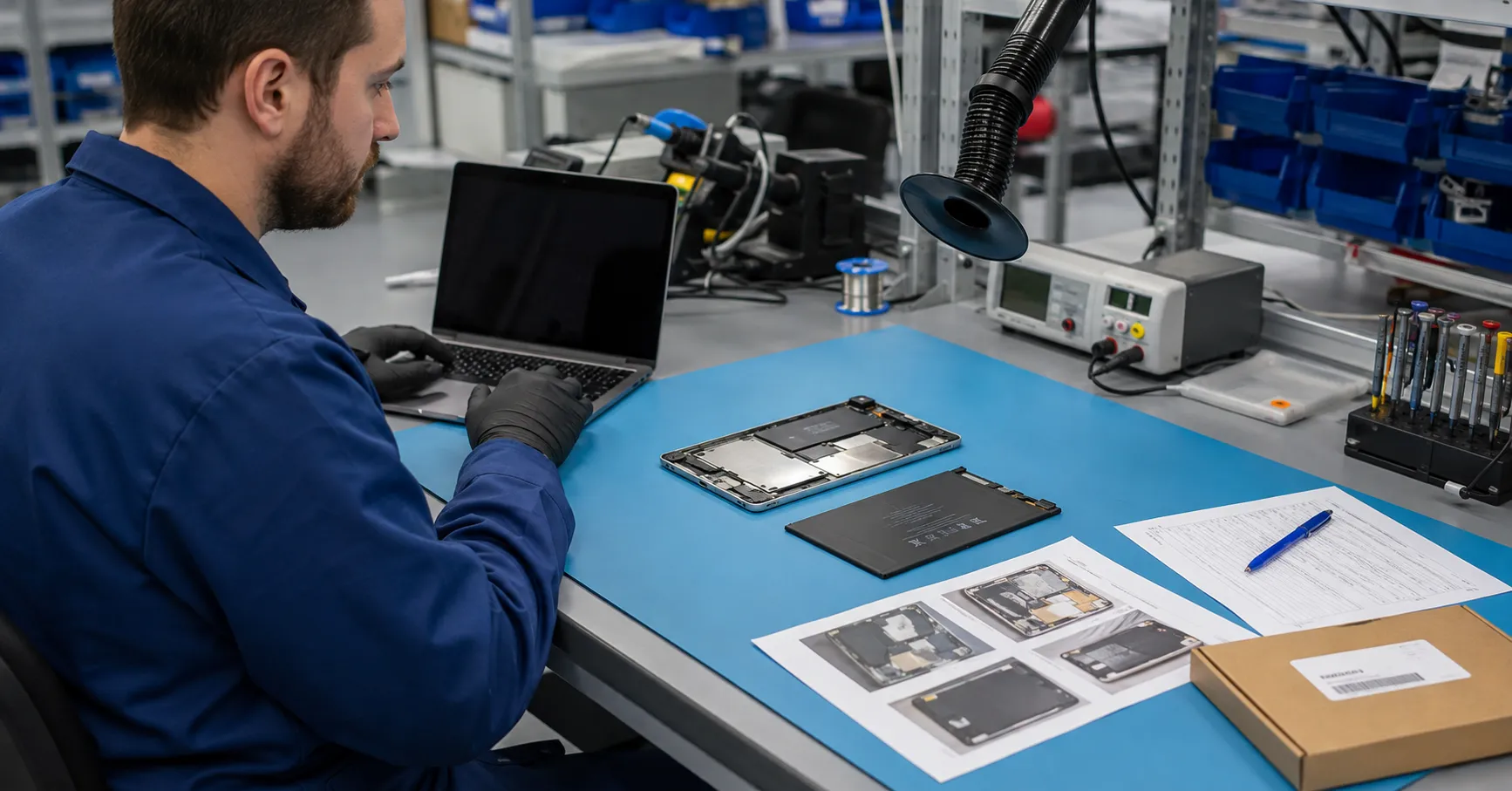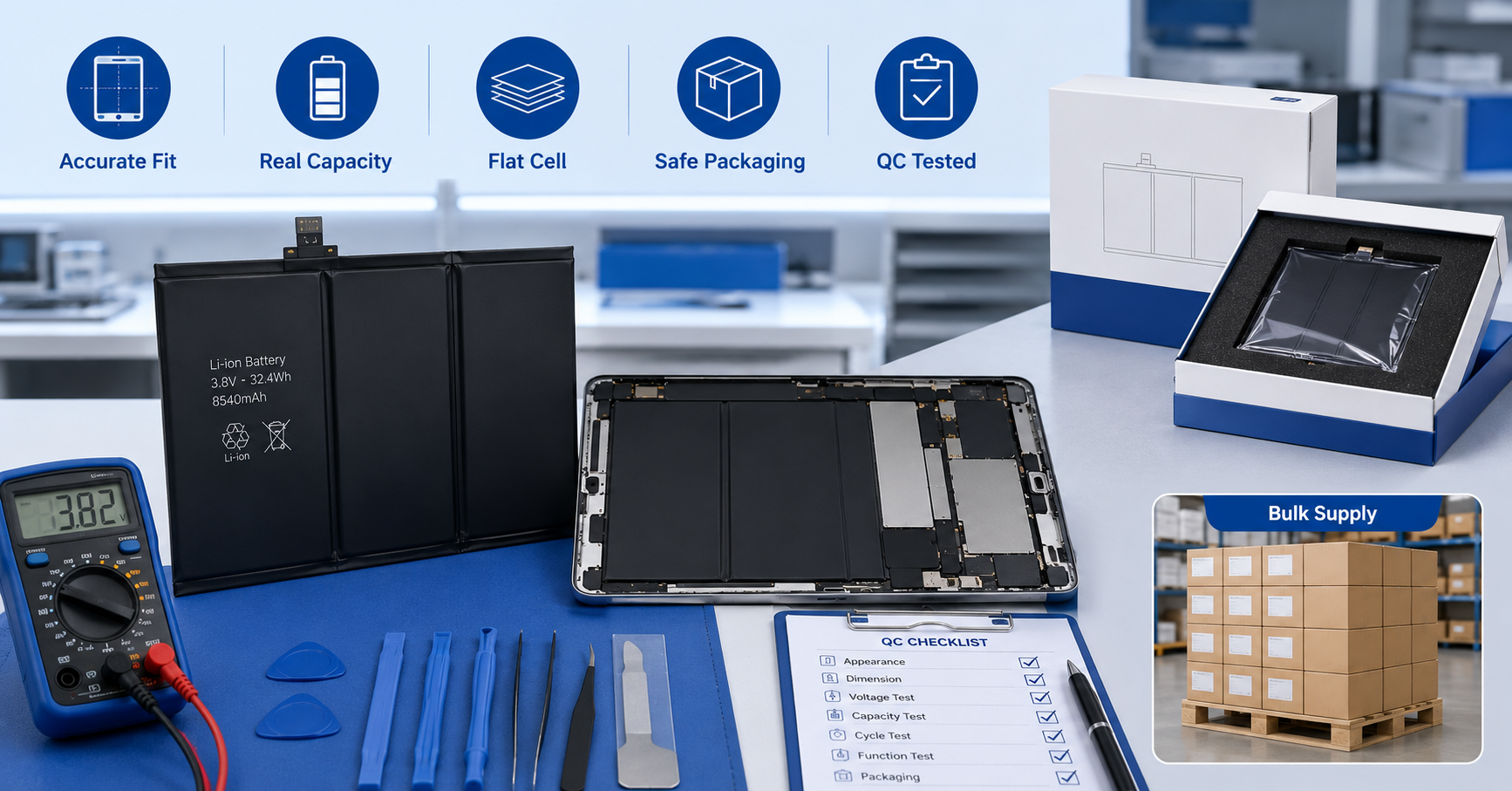

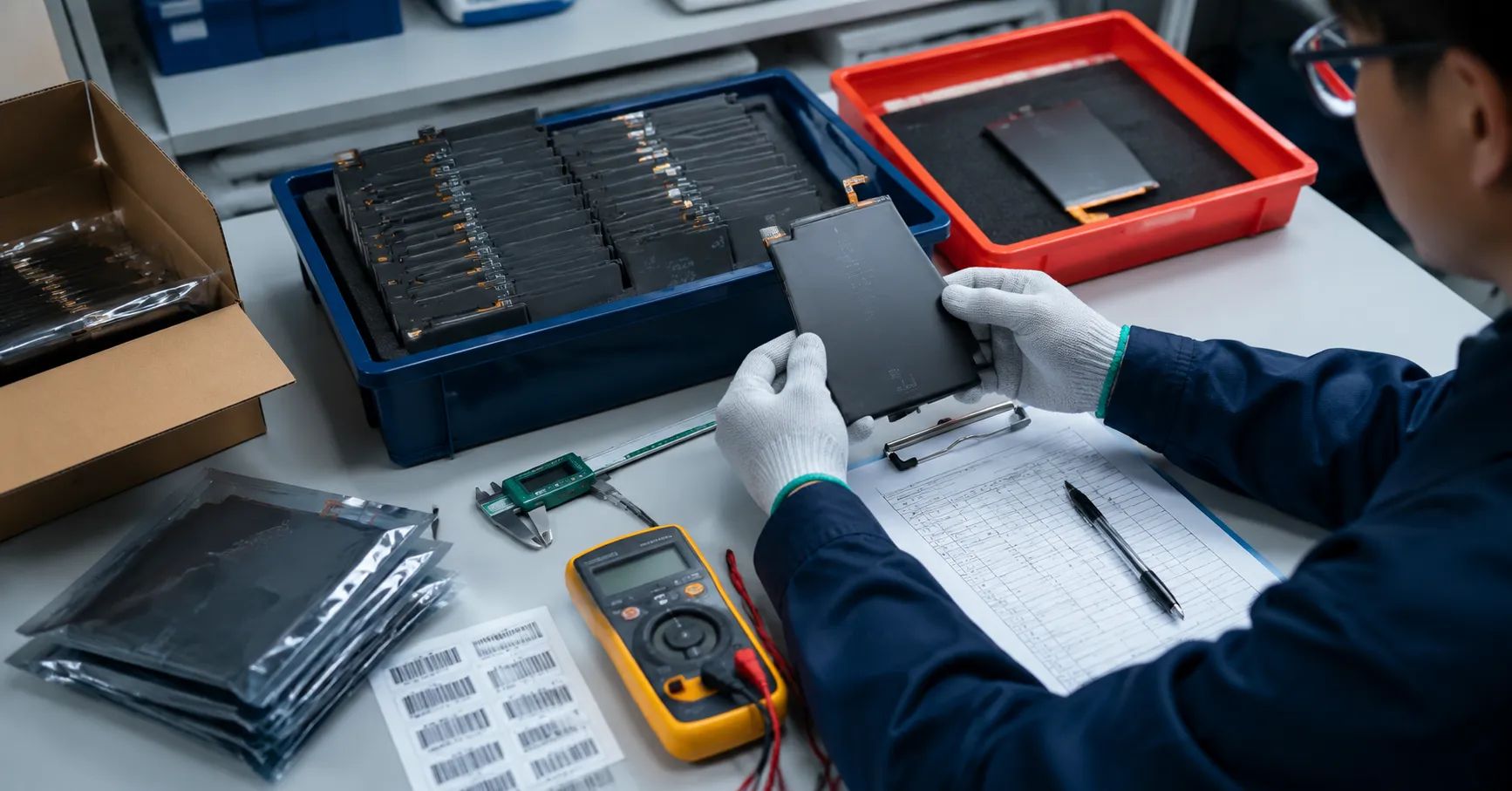
A tablet battery incoming inspection should produce a documented decision: release the shipment, hold it for further evaluation, or reject it according to agreed criteria. For repair chains, refurbishment facilities, wholesalers and private-label buyers, the process should verify more than appearance. It should connect the received lot to the purchase specification, approved sample, model mapping, packaging revision and applicable test method.
The objective is not to prove that every battery will perform perfectly throughout its service life. Incoming inspection provides evidence that the received lot matches the approved configuration and does not show defined defects before it enters inventory, installation or resale.
Why Tablet Battery Inspection Requires Its Own Control Plan
Tablet batteries often have large, thin pouch-cell structures installed inside limited device space. A battery may have the correct commercial description while still presenting the wrong dimensions, connector position, flex-cable route, label revision or electrical configuration.
These differences create costs at several stages:
- Warehouse staff may place the wrong model into an inventory location.
- Technicians may lose time diagnosing what is actually a product-selection problem.
- A thick, deformed or incorrectly routed battery may interfere with device closure.
- Incorrect labels or barcodes may send a compatible battery to the wrong repair order.
- Electrical or functional problems may appear only after installation.
- An uncontrolled shipment may make later warranty analysis difficult.
Before designing the inspection plan, buyers should complete model mapping through a controlled process such as ESC’s tablet replacement battery compatibility checklist. Incoming inspection should verify an approved relationship rather than create compatibility assumptions after the shipment arrives.
Establish a Document Gate Before Opening the Lot
Start by collecting the documents that define what was ordered and approved. The receiving team should not build acceptance criteria from the supplier’s shipping label alone.
The inspection package may include:
- Purchase order and ordered quantities
- Buyer SKU and supplier SKU
- Exact tablet device models and original battery references
- Approved product specification and drawing
- Approved sample or controlled sample photographs
- Battery label and packaging artwork revision
- Connector, flex-cable and insulation requirements
- Agreed inspection and test methods
- Approved defect definitions and disposition authority
- Required shipment, compliance or test documents for the specific order
If a required specification, drawing or approved revision is missing, record the document gap before testing. A battery cannot be judged consistently when the receiving team and supplier are using different acceptance references.
Buyers still preparing these requirements can use the tablet battery RFQ and sample-approval guide to structure the pre-order process.
Define the Lot Before Selecting Samples
A lot should represent a controlled group of products rather than every battery delivered on the same day. Record the supplier, product model, purchase order, quantity, production or traceability code, packaging revision and other identifiers needed to separate one production group from another.
Do not combine visibly different label revisions, battery structures or packaging versions into one inspection result without investigation. Mixing them can hide a product change and make the final decision difficult to trace.
The sampling plan must be agreed before results are known. ISO 2859-1:2026 defines acceptance-sampling schemes indexed by acceptance quality limit for lot-by-lot inspection. Its existence does not automatically determine the correct inspection level, sample size, AQL or acceptance number for a particular battery order. Buyers must select and document the plan according to product risk, supplier history, contractual requirements and the consequences of a defect.
Safety-critical or easily missed conditions may require controls beyond ordinary attribute sampling. The responsible quality team should decide which checks are sampled, which are performed per carton and which require broader screening.
Verify Identity, Quantity, Labels, and Packaging
Begin with checks that establish whether the received goods are the goods that were ordered.
- Compare the purchase order, packing list and physical carton quantities.
- Confirm buyer SKU, supplier SKU and battery model.
- Check the stated compatible device models against the approved matrix.
- Verify label and packaging revisions.
- Confirm barcode content and scan behavior where barcodes are used.
- Check batch or traceability identification.
- Inspect inner packaging, separators and carton protection.
- Look for mixed models, duplicate labels or unidentified units.
Labels should support correct warehouse and repair decisions. A marketing name such as “10-inch tablet battery” is not a sufficient model definition. The approved identification system should connect the package to the exact replacement battery and intended device family.
Perform a Controlled Visual Inspection
Inspect products under suitable lighting and record defects using consistent terminology. The inspection plan should define what constitutes a critical, major or minor defect for the order rather than leaving classification to individual judgment.
Visual checks may cover:
- Swelling, deformation, leakage or abnormal odor
- Punctures, dents, scratches or edge damage
- Torn, loose or contaminated insulation
- Exposed conductive material
- Damaged connectors or flex cables
- Poorly positioned adhesive or pull tabs
- Wrinkles, bubbles or foreign material affecting assembly
- Incorrect, unreadable or detached labels
- Corrosion, moisture exposure or packaging damage
Do not install or continue routine testing on a battery that shows a potentially unsafe physical condition. Isolate it, protect it from unintended handling and escalate it according to the organization’s battery-safety procedure.
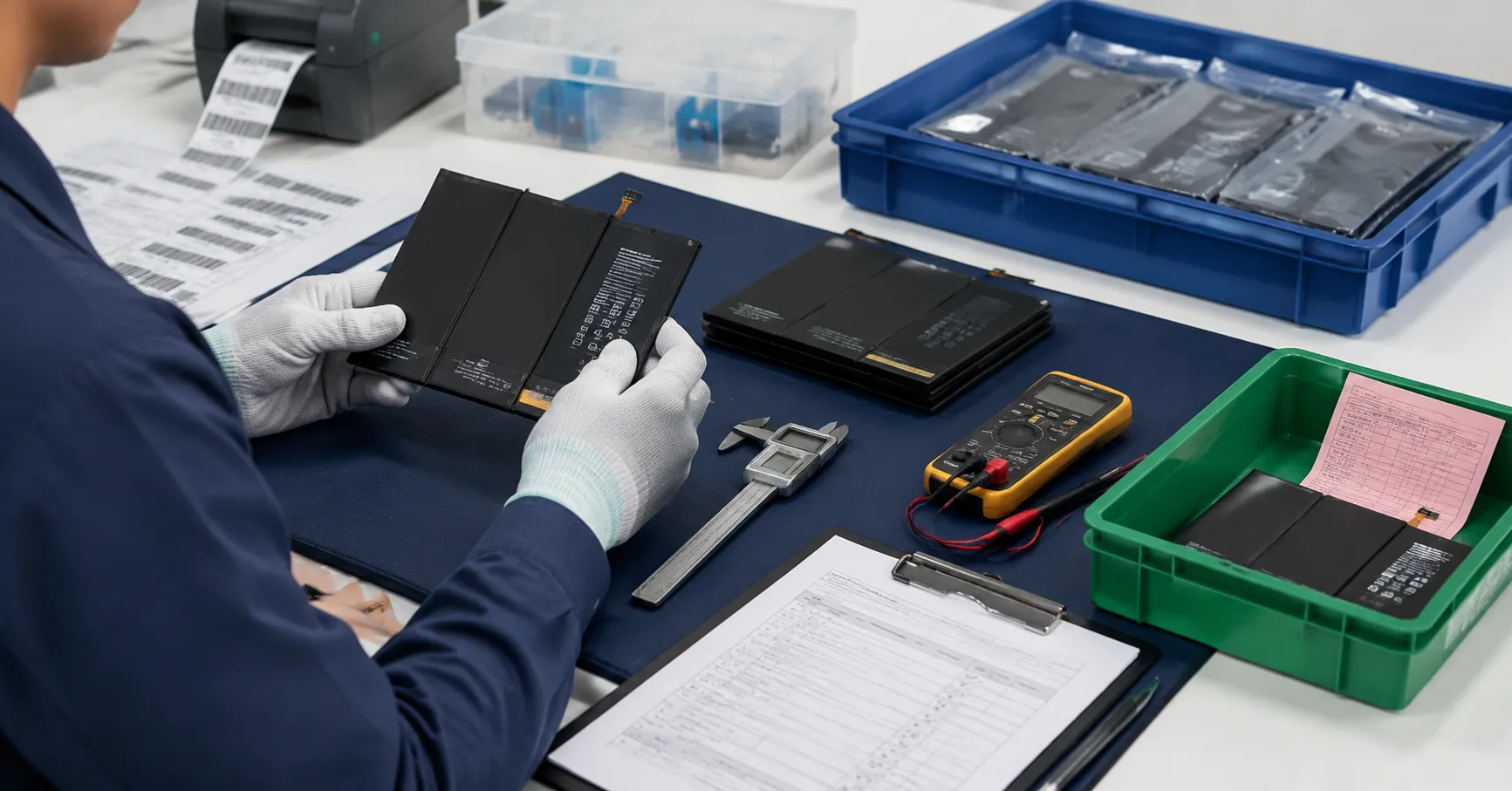
Inspect Dimensions, Thickness, and Flatness
Tablet battery fit depends on more than overall length and width. Compare the received unit with the approved drawing or specification using an identified measuring method.
Relevant characteristics can include:
- Overall length and width
- Maximum thickness
- Thickness at defined measurement points
- Cell-section shape and flatness
- Tab, edge and alignment positions
- Connector location and height
- Flex-cable length and exit direction
- Adhesive and insulation coverage
The control plan should state the measuring equipment, measurement locations, tolerances and recording requirements. Do not invent universal dimensional tolerances; they must come from the approved model specification.
Check Electrical Identity Without Inventing Universal Limits
Electrical inspection should use the approved specification and a documented method. Depending on the product and buyer’s control plan, checks may include open-circuit voltage, polarity, internal resistance, applicable protection behavior or another agreed characteristic.
Every numerical limit must belong to the specific battery design and test method. A value copied from another tablet model, chemistry, meter or environmental condition may be inappropriate. Record the equipment identification, calibration status where applicable, test conditions and result.
Printed capacity is not proof of measured capacity. Capacity verification requires a defined charge-discharge method, equipment, cutoff conditions and environmental controls. If capacity testing is performed on incoming samples, keep those results separate from label verification.
Inspect the Connector, Flex Cable, and Protection Configuration
Connector shape alone cannot prove correct configuration. Inspect the attributes defined by the approved sample or drawing:
- Connector family and pin count
- Keying, orientation and position
- Pin or contact condition
- Flex-cable length and bend location
- Cable reinforcement and insulation
- Strain relief and attachment quality
- Protection-board configuration where visible and approved for inspection
A connector should not require unusual force, twisting or improvised cable routing during installation. If the received construction differs from the approved sample, place the affected product on hold until the change is reviewed.
Use Installation and Functional Testing as a Separate Sample Stage
Visual and dimensional checks cannot reveal every installation problem. Select suitable samples for installation in verified tablet devices using an approved repair procedure.
A functional sequence may include:
- Confirm the test tablet’s exact model and condition.
- Record the battery model, lot and sample identifier.
- Inspect the connector and installation area before assembly.
- Install the battery without forcing the connector or flex cable.
- Check that the battery sits correctly without abnormal pressure.
- Perform the approved power-on and charging observations.
- Check relevant device-reported behavior where applicable.
- Record the technician, device, method, date and result.
Keep device faults separate from battery findings. Charging-port damage, display faults, logic-board problems and power-management failures can produce symptoms that are incorrectly assigned to the replacement battery.
For a model-level example of controlled device and battery mapping, review ESC’s A2042 iPad Pro 11 replacement battery page. Specifications and acceptance limits must still follow the final approved product documentation.
Classify Defects and Control Nonconforming Products
| Finding area | Typical decision question | Required control |
|---|---|---|
| Identity | Does the model, SKU or revision differ from the order? | Hold the affected quantity and verify the product relationship. |
| Physical condition | Is there swelling, leakage, deformation or insulation damage? | Isolate safely and escalate under the battery-safety procedure. |
| Dimensions | Is a measured characteristic outside the approved specification? | Record the result and evaluate the affected lot. |
| Electrical result | Was the correct method used, and is the result outside its approved limit? | Confirm the method, hold the lot and investigate. |
| Installation | Does the sample create fit, connector or functional problems? | Stop approval and compare with the validated configuration. |
| Packaging | Could labeling or packing cause a wrong shipment or damaged product? | Segregate, correct and verify before inventory release. |
Nonconforming batteries should be physically and digitally separated from releasable inventory. Record the affected quantity, location, defect evidence, decision owner and final disposition. Rework, sorting, replacement or concession should follow documented authorization rather than informal messages.
Make Tablet Battery Lot Release a Traceable Decision
The release record should show what was inspected, which specification and revision were used, how samples were selected, what equipment and methods were applied, what defects were found and who approved the disposition.
A practical record includes:
- Purchase order, model, SKU and received quantity
- Supplier and traceability identifiers
- Inspection date and inspector
- Specification and label revisions
- Sampling plan and actual sample quantity
- Visual, dimensional, electrical and functional results
- Photographs and measurement records
- Nonconformance report references
- Released, held or rejected quantity
- Authorized decision and date
Retain the record with inventory and after-sales data. If complaints later appear, the buyer should be able to connect the returned product to its model, shipment, inspection result and supplier response.
Use Inspection Results to Improve Repeat Orders
Incoming inspection should improve the next purchase, not end at the warehouse door. Trend recurring defects by model, lot, supplier and defect type. Compare initial samples with later production, and require notification before changes to cells, connectors, flex cables, protection components, insulation, adhesive, labels or packaging.
For buyers managing multiple tablet models, ESC’s tablet and laptop replacement battery range can support product-range planning. Any quotation, sample plan, MOQ, packaging option, test scope or documentation requirement should be confirmed for the selected models and order.
FAQ
Does passing an AQL inspection prove that every battery is defect-free?
No. Acceptance sampling supports a lot decision under a selected plan; it does not inspect every characteristic of every unit or guarantee future service life. Buyers should combine sampling with risk-based controls, approved specifications and supplier process management.
Can one inspection plan be used for every tablet battery model?
Not automatically. Battery structure, device compatibility, order quantity, defect risk, supplier history and test cost can differ. Define the applicable checks and limits for each controlled model or model family.
Should capacity be checked during every incoming inspection?
That depends on the approved control plan. Capacity testing takes time and requires a defined method. Buyers may use sample validation, periodic verification or incoming testing according to product risk and supplier performance, but label capacity alone is not a measured result.
What should happen when the shipment differs from the approved sample?
Place the affected product on hold and document the difference. Determine whether it is an identification error, uncontrolled change or approved revision before releasing inventory or installing additional units.
Can compliance documents replace physical and functional inspection?
No. Documents may support a compliance or shipping review, but they do not prove that the received model, dimensions, connector, workmanship and functional behavior match the approved order.
Build the Inspection Plan Before the Shipment Arrives
A controlled tablet battery incoming inspection begins with an approved specification, defined lot, selected sampling method and documented decision authority. It verifies identity first, then workmanship, dimensions, electrical characteristics and installation behavior according to the risk of the order.
Send ESC your tablet model list, original battery references, target quantities, packaging requirements and intended inspection scope. Use the ESC contact page to discuss sample validation and a model-specific bulk-order quality plan before production.
External Source References
- International Organization for Standardization — ISO 2859-1:2026: Sampling procedures for inspection by attributes — Part 1 — 2026