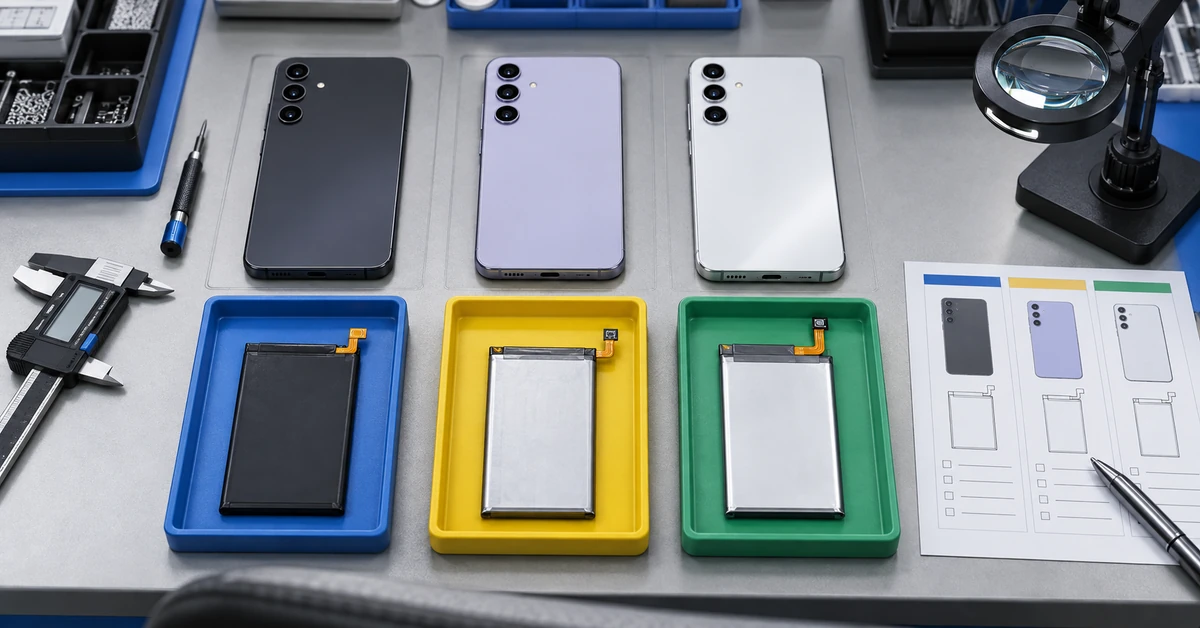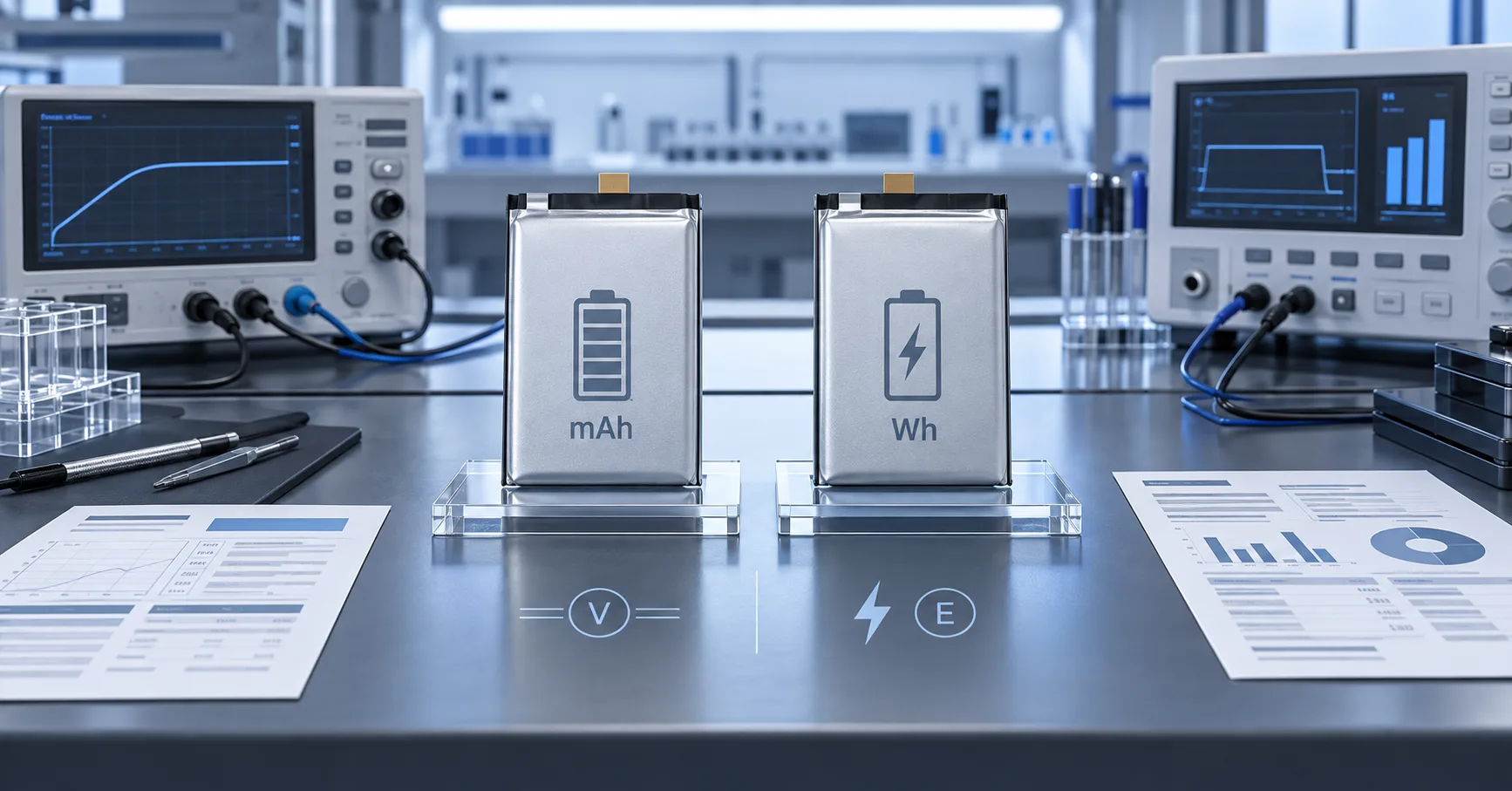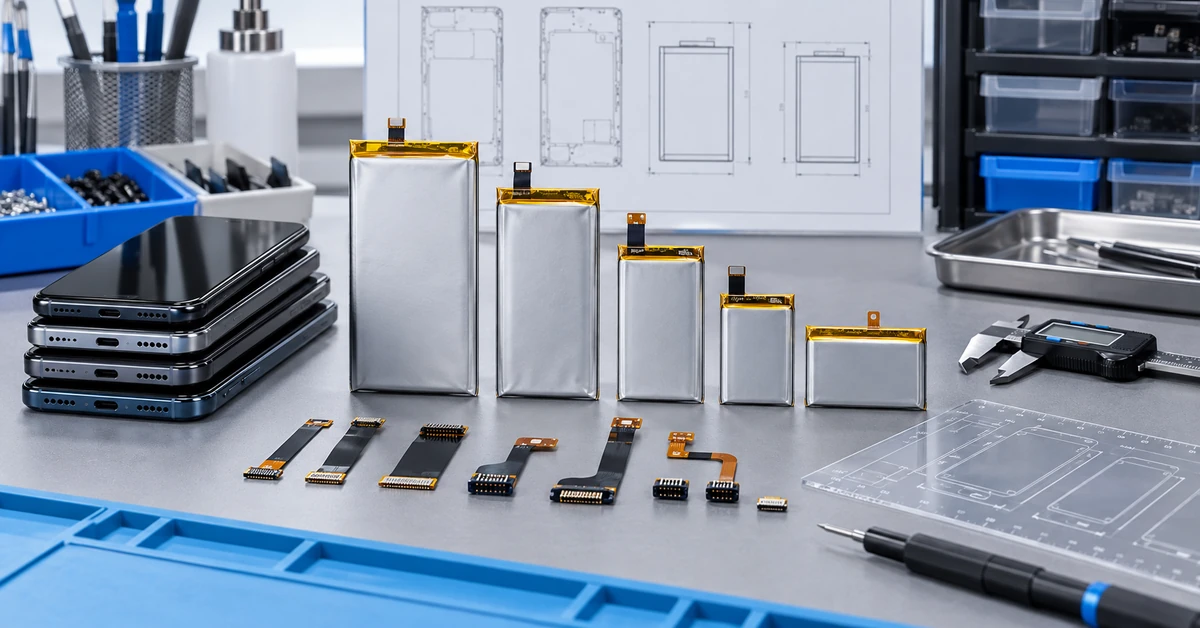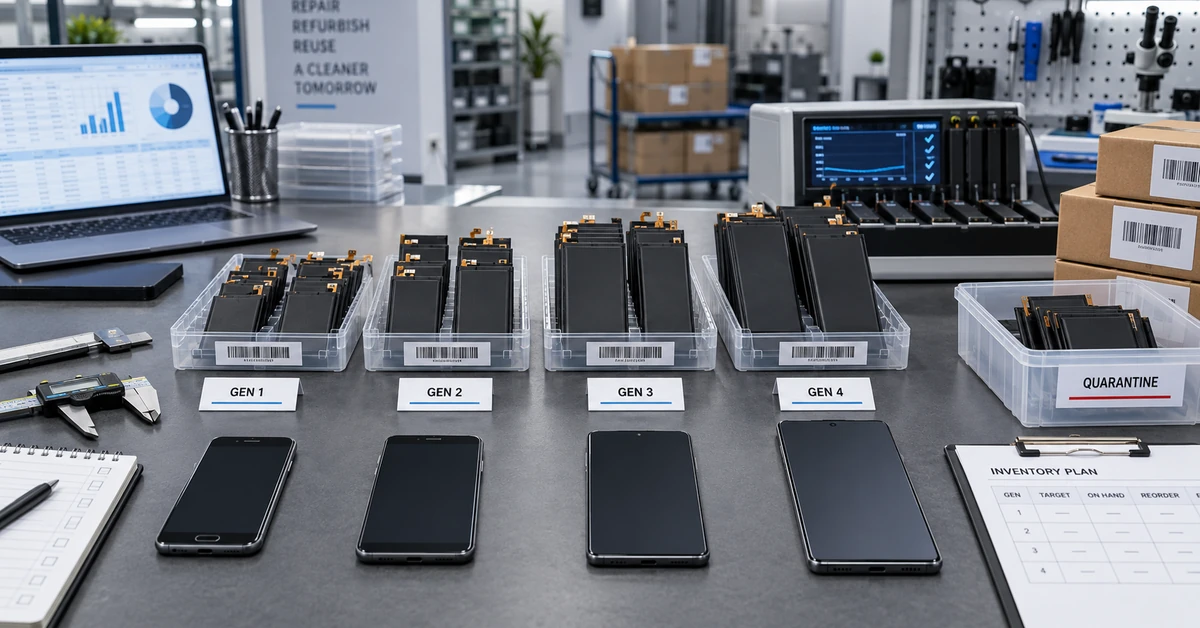

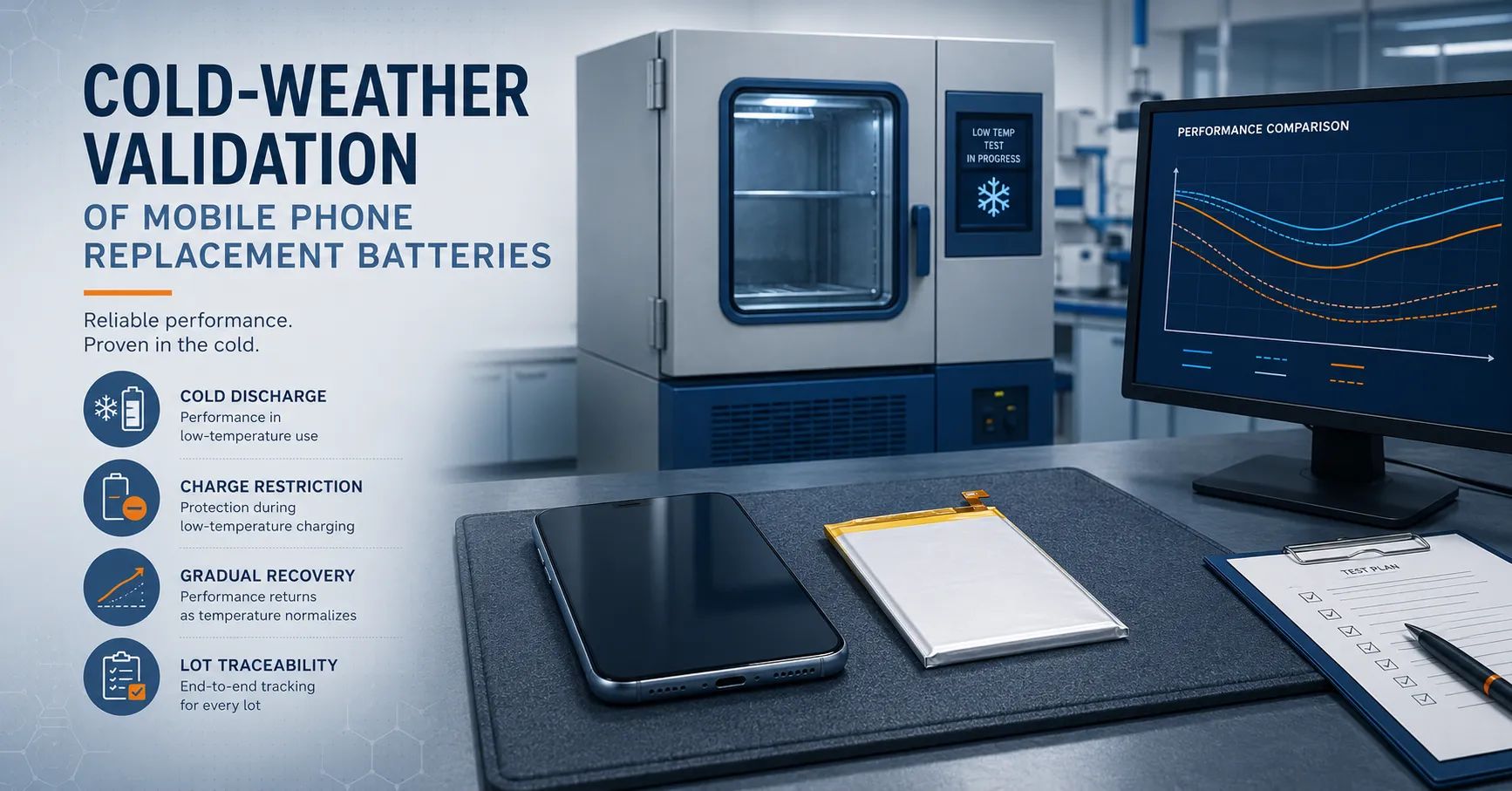
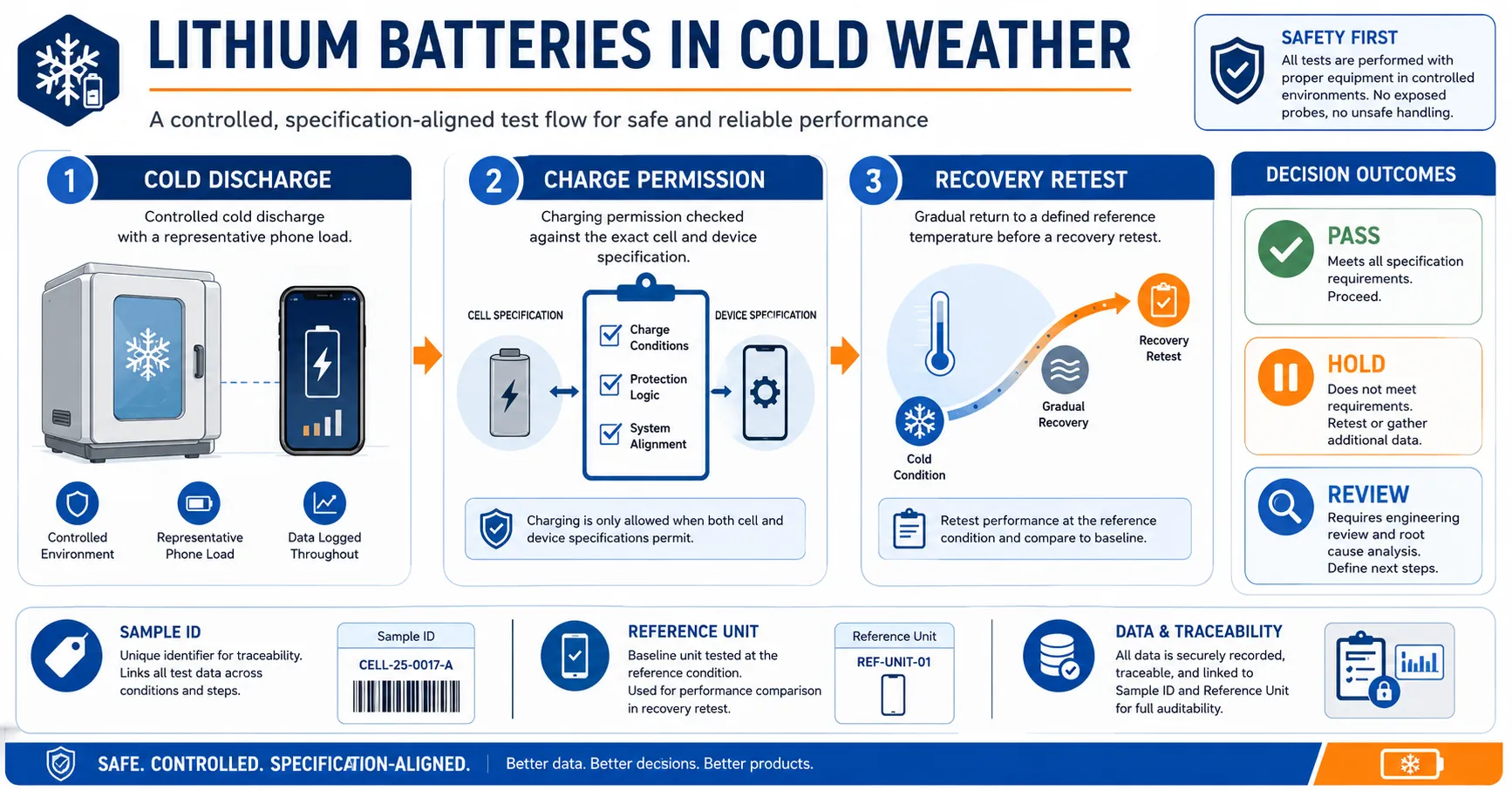
Lithium batteries and cold weather require separate decisions for discharge performance, charging permission and recovery. A phone battery can show shorter runtime or weaker peak-power delivery while cold, yet recover after it returns to the approved reference condition. Charging can be limited or paused under conditions in which discharge is still possible. B2B approval therefore cannot rely on one percentage reading, one runtime result or one charge attempt.
For replacement-battery brands, repair chains, refurbishers and wholesalers, the practical goal is to define the intended environment, test the exact battery and device combination under controlled conditions, and decide whether the result is temporary, repeatable or evidence of a wider product problem. The temperature limits and acceptance values must come from the applicable cell, pack and host-device specifications. This guide does not create universal limits.
Separate Cold Discharge, Cold Charging and Recovery
| Validation stage | Buyer question | Evidence to retain | Interpretation limit |
|---|---|---|---|
| Cold discharge | Can the approved assembly support the defined workload after controlled exposure? | Battery temperature, starting condition, workload, time series and reference comparison | A shorter cold result does not alone prove permanent capacity loss |
| Cold charging | Does the system permit, reduce or pause charging under the applicable specification? | Battery and ambient temperature, input source, device message, current state and recovery behavior | Discharge capability does not establish that charging is permitted |
| Recovery | Does performance return after gradual conditioning at the defined reference temperature? | Conditioning time, stabilized temperature and repeated reference test | One improved result does not erase a repeatable lot difference |
| Lot verification | Are sample, pilot and production results consistent? | SKU, cell and flex revision, lot, test method, equipment and decision record | One passing engineering sample cannot approve every shipment |
This separation prevents two common mistakes. First, a buyer may reject an otherwise conforming sample because a temporary cold result is treated as permanent degradation. Second, a buyer may approve unsafe or unsupported charging merely because the phone can still operate. Each stage needs its own written conditions and stop rules.
Why Runtime and Peak Power Can Change in the Cold
Lower temperature can slow electrochemical processes and increase internal resistance. The effect seen by a phone depends on chemistry, design, state of charge, aging, current demand and device power management. Apple explains that battery impedance can temporarily increase at low state of charge and in cold conditions; under load, the larger voltage drop can contribute to an unexpected shutdown. Its iPhone battery and performance guidance also separates stored capacity from the ability to deliver instantaneous power.
This is why phone battery cold weather performance should not be described by runtime alone. A light idle test may appear normal while camera, navigation, radio transmission or another representative workload exposes a power-delivery limitation. Conversely, an abnormal event in one phone does not automatically identify the battery: connector condition, installation, software, device hardware and reporting remain possible contributors.
For lithium ion battery cold weather evaluation, retain the full curve or interval readings rather than only the final runtime. Note percentage progression, shutdown point, workload changes, warnings and whether the device restarts without external power. If the complaint is an abrupt shutdown with charge indicated, use the separate unexpected-shutdown diagnosis workflow rather than calling the event ordinary fast drain.
Define a Representative Cold-Exposure Plan
Begin with the real market. Document the expected transport, storage and use environment, the phone models, battery SKU, installed configuration and intended customer activity. An outdoor delivery fleet, a winter retail return and a device left overnight in an unheated vehicle do not present the same exposure history.
A qualified test owner should define chamber settings, exposure duration, sample orientation, starting state of charge, device power state, stabilization evidence, workload and stop conditions. Record both ambient and relevant battery or device temperature using an approved method. Ambient temperature alone does not prove that the battery has stabilized.
- Use traceable samples and an approved compatible reference combination.
- Keep software, network state, display, workload and starting condition comparable.
- Randomize or balance test order where prior charging and use could affect temperature.
- Prevent condensation according to the laboratory procedure when moving samples between environments.
- Stop on swelling, leakage, odor, damaged insulation, abnormal heat or unstable behavior.
- Do not place phones or batteries in household freezers, on ice or against improvised heaters.
The purpose of low temperature battery testing is a repeatable comparison, not the most dramatic failure. Avoid cycling a sample to shutdown repeatedly merely to create a visible result. Any electrical measurement on an installed assembly should use suitable equipment and trained personnel under an approved procedure.
Compare Workloads Without Confusing Charge Level and Capacity
Use at least one reference workload that reflects the target channel. Record the same intervals for the candidate and control. A displayed starting percentage helps with consistency, but it is an estimate and does not prove equal stored energy. Where delivered capacity is a purchase requirement, run the appropriate cell or pack capacity method separately and state its temperature and discharge conditions.
The published iPhone battery capacity-testing guide explains how method, equipment and cutoff conditions affect a capacity result. The mobile phone battery incoming-inspection guide helps teams separate identity, appearance and initial electrical screening from the controlled performance tests required here.
| Pattern | What it may support | Required next check |
|---|---|---|
| Candidate and control both decline similarly while cold and recover similarly | Condition-related behavior under the defined setup | Confirm the setup represents the agreed market and specification |
| Candidate repeatedly underperforms a matched control | Possible battery assembly or lot difference | Repeat across traceable samples and review cell, protection, flex and assembly revisions |
| Symptom follows one device across approved batteries | Possible installation or device-level cause | Route to qualified device and repair-process diagnosis |
| Cold result is weak but reference-condition result returns to baseline | Temporary temperature dependence | Compare against the approved cold requirement before accepting or rejecting |
| Performance remains abnormal after controlled recovery | Possible lasting damage or an unrelated fault | Hold the sample and investigate without assuming cold exposure is the sole cause |
Treat Charging as a Separate Permission Check
Cold weather battery charging must follow the limits of the exact rechargeable cell, battery assembly, charger and host device. A temperature at which a battery can discharge is not necessarily a temperature at which it may be charged. Never infer a charging window from a generic lithium-ion chart or another supplier's cell.
Apple states that an iPhone or iPad may put charging on hold when the device becomes too hot or too cold, and charging resumes when temperature returns to normal. Record the actual device message and conditions using Apple's Charging On Hold guidance. Do not defeat thermal controls, warm a battery rapidly while connected to power or describe an intentional pause as a battery defect.
The existing ESCCharge article on slow charging in low temperatures remains the page for the general slow-charge problem. This page owns the replacement-battery approval decision: whether cold discharge, permitted charging behavior and recovery meet the agreed evidence plan.
Observe Recovery Before Assigning a Permanent Defect
Move the sample through the approved conditioning procedure and allow its relevant temperature to stabilize before retesting. Do not use direct heat, hot air, heated surfaces or charging current as an improvised warming method. Record the conditioning duration and evidence of stabilization.
Apple notes that cold-related battery-life reduction may be temporary and performance can return when the battery returns to a normal operating range. See its temperature-management guidance for iPhone and iPad. That statement supports a recovery check, but it does not approve every third-party battery or define the acceptance limits for an ESCCharge SKU.
Repeat the same reference-condition workload used before exposure when baseline data exist. Classify the outcome as recovered within the agreed comparison, partially recovered, persistently abnormal or inconclusive. Preserve uncertainty when temperature stabilization, sample history or device condition prevents a valid comparison.
Validate Samples, Pilot Lots and Production Consistency
Cold-weather performance belongs in product definition and change control when it matters to the target market. Freeze the approved battery model, cell designation, protection design, flex, connector, mechanical stack, firmware-related assumptions and test revision. The mobile phone battery storage guide helps teams preserve traceable storage conditions before samples enter the cold-weather test plan.
- Engineering samples: explore behavior and confirm that the proposed method is safe, measurable and relevant.
- Approval samples: run the agreed cold-discharge, charging-permission and recovery matrix against validated controls.
- Pilot lot: check whether process variation changes the result after assembly at production conditions.
- Production lots: apply the agreed sampling plan and escalation rules to traceable lots.
- Changes: require notification and revalidation for material, cell, protection, flex, connector, adhesive or process changes that could affect performance.
Use the mobile phone battery sampling-plan guide to define sample selection and lot escalation. One strong prototype is not evidence that every unit will behave identically, while one failed sample is not enough to estimate a defect rate. Report the numerator, the tested population and the selection method.
Convert Results Into Release and Warranty Decisions
- Release: candidate samples and controls meet the approved method, including recovery and charging behavior where applicable.
- Conditional release: the product meets a clearly limited market or use condition documented in specifications and sales material.
- Hold: results are repeatably outside the agreed acceptance criteria, traceability is incomplete or safety-relevant behavior occurs.
- Device or installation route: the symptom remains associated with a particular phone or repair condition across compatible controls.
- Inconclusive: the exposure, stabilization, sample history or reference setup does not support a defensible conclusion.
Warranty terms depend on the specific product and agreement. Keep a goodwill replacement separate from a confirmed technical defect. For a repeated field pattern, compare model, lot, revision, repair team, geography, exposure and installed population before widening a hold.
Frequently Asked Questions
Does cold weather permanently reduce phone battery capacity?
Not necessarily. Cold can temporarily change runtime and power delivery. Retest after approved recovery before assigning permanent loss, while retaining evidence of any repeated abnormality.
Can a phone battery be charged whenever it can still power the phone?
No. Discharge and charge limits are different. Use the exact cell, assembly and device requirements and respect any system-imposed charging pause.
Should buyers specify one universal cold-temperature runtime?
No. Define model-specific conditions, workload, starting state, stabilization, controls and acceptance criteria. A universal figure can misclassify different batteries and devices.
Is a freezer test suitable for incoming inspection?
No. Household freezers do not provide the controlled, instrumented and condensation-managed conditions needed for a defensible battery test. Use a qualified facility and approved procedure.
What evidence should accompany a cold-weather warranty claim?
Include device model, battery SKU and lot, installation record, exposure history, temperature evidence, workload, time-series behavior, recovery result and comparison with an approved compatible control.
Build the Requirement Before Requesting Samples
A useful cold-weather specification states the target market, battery and device configuration, discharge workload, charging boundaries, reference condition, recovery method, sample quantity and decision rule. It distinguishes temporary behavior from persistent nonconformance and records when evidence remains inconclusive.
For an ESCCharge replacement-battery project, send the target phone models, expected climate and use case, required cold-performance evidence, order quantity and target market. Compatibility and specifications must be confirmed for each selected model. Capacity claims require a defined test method; certification availability, MOQ, lead time and warranty depend on the product and agreement.
External Source References
- Apple Support — iPhone Battery and Performance — accessed September 4, 2026.
- Apple Support — If a Charging On Hold Notification Appears on Your iPhone or iPad — accessed September 4, 2026.
- Apple Support — If Your iPhone or iPad Gets Too Hot or Too Cold — May 14, 2026.