
What Should a Phone Battery Export Packaging Supplier Actually Provide?
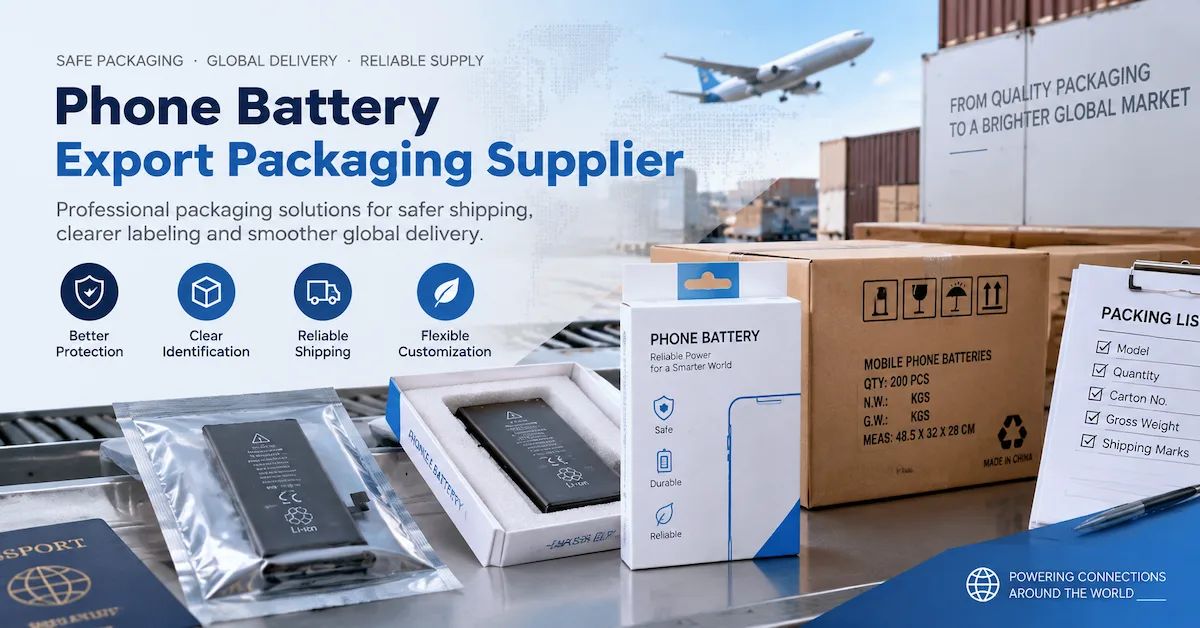
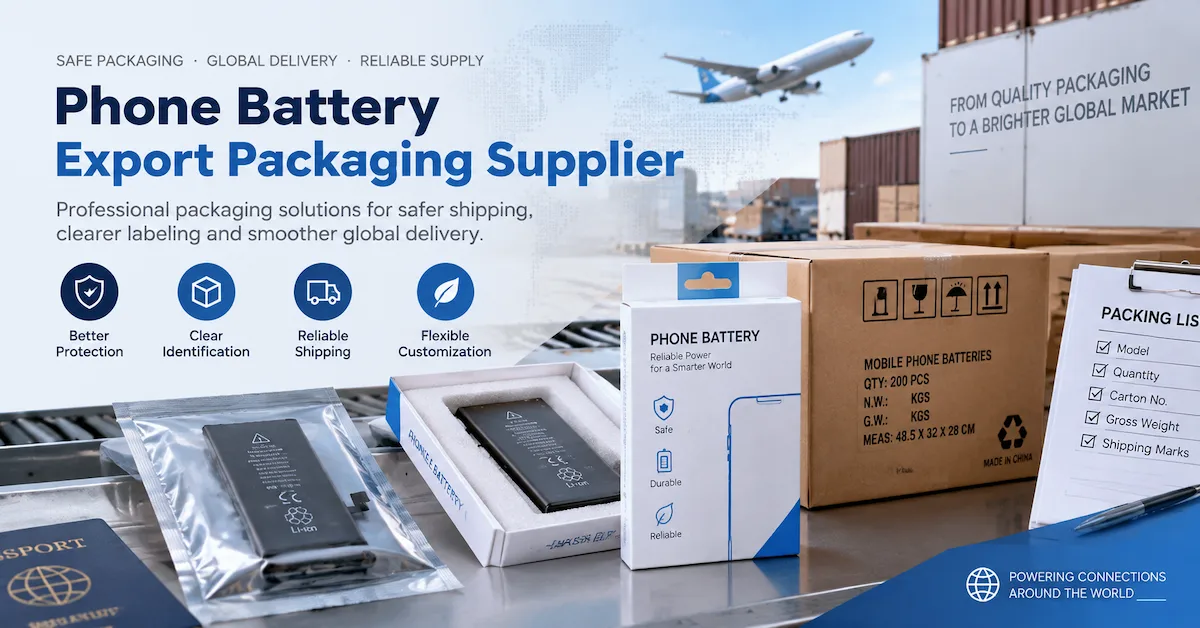
A phone battery export packaging supplier should connect the approved battery, its unit packaging, carton identification and shipment preparation into one controlled system. The purpose is not simply to make a battery look professional. Export packaging needs to protect the correct battery configuration, keep different SKUs identifiable, support warehouse handling, match the agreed packing list and remain suitable for the intended distribution route.
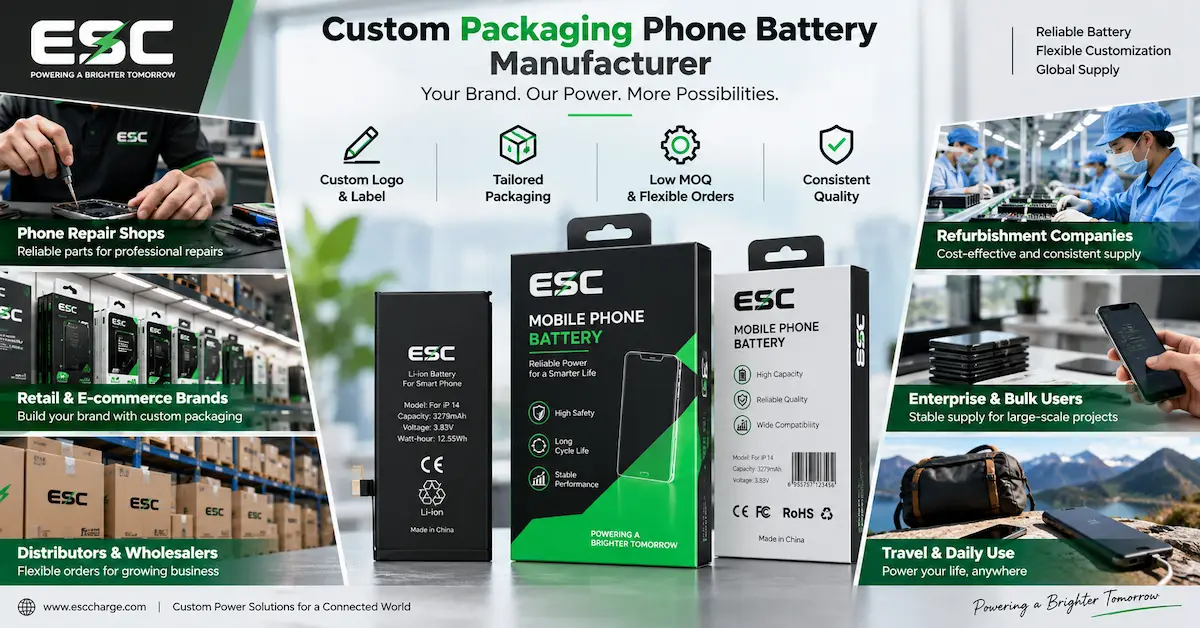
ESC’s existing custom phone battery packaging guide separates battery specification, labels, inserts, retail boxes and export cartons rather than treating packaging as a printing-only project. ESC also lists neutral packaging, branded retail packaging, barcode options and customized export cartons for applicable phone battery projects, with the exact arrangement to be confirmed for the selected order.
For a B2B buyer, the first question should therefore be: what battery is being protected, identified and shipped? Packaging approval should begin only after the device model, battery configuration, capacity, SKU and relevant technical specification are clear.
Who Needs a Structured Phone Battery Export Packaging Process?
Importers need cartons and documentation that can be reconciled with the products entering their warehouse. Regional distributors may receive dozens of phone battery models in one shipment and need to separate them quickly for downstream orders. Repair chains often value efficient identification and physical protection more than elaborate consumer presentation. Refurbishment factories may need large quantities of clearly separated batteries that move directly into a controlled production environment. Private-label brands must manage all of these requirements while also controlling logos, labels, barcodes, languages and retail appearance.
These buyers should not automatically use the same packaging. A box designed for e-commerce resale may be unnecessary for a refurbishment line, while a minimal repair-channel package may not provide the presentation or labeling expected in retail distribution. ESC’s mobile phone battery range covers multiple phone battery configurations for different professional channels, which makes the sales channel an important input when defining packaging.
Separate Product Packaging from Transport Packaging
One of the most important export-packaging decisions is understanding that retail presentation and transport protection are not the same thing. A small branded box may identify the battery and support retail presentation, but it should not automatically be treated as the complete transport solution. The shipment may also require inner restraints, model separation, grouped packaging, master cartons and other protective elements appropriate to the actual logistics plan.
ESC’s export-focused packaging content separates sales packaging, grouped packaging, transport packaging and battery-protection functions. It also warns against removing a protective component merely because it appears visually unnecessary; some packaging elements exist to limit movement, protect connectors or reduce mechanical damage.
For B2B buyers, this means every packaging layer should have a defined function. If the purpose cannot be explained, it may be unnecessary. If the component prevents a real transport or handling problem, its function should be retained and validated.
Build an Export Packaging Specification Before Requesting Final Pricing
A professional phone battery export packaging supplier should work from a controlled packaging specification rather than photographs and informal descriptions such as “standard export box.” One specification should connect the battery, unit package and outer carton.
| Packaging specification field | What the buyer should define | What should be approved before production |
|---|---|---|
| Battery identity | Device model, battery reference and supplier SKU | Correct battery is linked to the correct package |
| Product configuration | Finished battery or cell-only product | Package accurately describes what is included |
| Electrical information | Approved capacity, voltage and applicable product data | Printed information matches the technical specification |
| Unit protection | Insert, restraint, insulation and connector protection | Packed battery is held without damaging the cell or flex |
| Retail packaging | Neutral or branded box, language and artwork | Physical sample matches approved artwork |
| Barcode/SKU | Buyer SKU, barcode data and labeling location | Barcode scans to the intended product |
| Inner packing | Quantity and separation method | Different models remain clearly separated |
| Export carton | Carton dimensions, quantity and markings | Contents reconcile with the packing list |
| Documents | Required shipment and product records | Documents correspond to the actual battery configuration |
| Revision | Packaging drawing, artwork and sample revision | Repeat orders use the approved version |
ESC’s own packaging framework recommends controlling battery compatibility, electrical ratings, physical fit, branding, SKU identification, construction and carton configuration together rather than approving them independently.
Protect the Battery Before Optimizing the Box Appearance
Replacement phone batteries are thin components with flex cables, connectors and electrical contacts that can be damaged if the packaging allows pressure, movement or impact in the wrong area. A visually premium box can still be poorly designed if the battery moves freely inside it or if an insert presses against a vulnerable connection.
During physical sample approval, check whether the battery can move inside the package, whether the flex cable is bent or compressed, whether contacts can touch conductive objects and whether any internal edge can damage the battery surface. The packaging should be assessed in its fully assembled condition rather than through an artwork PDF alone.
ESC’s phone battery supplier with MSDS guide likewise emphasizes protecting batteries against pressure, flex deformation, connector impact and poor carton control when preparing professional battery orders.
Choose Packaging According to the Actual Sales Channel
Different B2B channels create different packaging priorities. The following comparison is a sourcing framework rather than a statement that every ESC order uses these exact structures.
| Packaging strategy | Main priority | Typical buyer | Main risks to control |
|---|---|---|---|
| Repair-channel protective pack | Fast identification and protection | Repair chains | Model mix-up, connector damage, inefficient unpacking |
| Refurbishment bulk pack | High-volume handling and SKU separation | Refurbishment factories | Production-line errors, movement and mixed models |
| Distributor mixed-model pack | Clear inventory identification | Wholesalers and importers | Incorrect carton quantity and SKU confusion |
| Private-label retail package | Brand presentation plus product accuracy | Battery brands | Wrong artwork, unsupported claims and barcode errors |
| E-commerce package | Unit presentation plus downstream handling | Online sellers | Repacking damage and weak single-unit protection |
| Export master carton | Shipment consolidation and traceability | International buyers | Carton damage, wrong contents and poor reconciliation |
A shared packaging platform can reduce complexity, but it should not force incompatible battery shapes into the same insert. ESC’s packaging guidance notes that a common branded design may be used across a range when model-specific identification and physical fit remain controlled.
Mixed-Model Export Orders Need Stronger SKU Control
Mixed-model purchasing can help distributors manage inventory, but it increases packaging risk. Two phone batteries may look similar while differing in capacity, flex design, connector or supported device. One carton-label error can therefore create a large warehouse problem even when every battery inside the shipment functions correctly.
Use a three-level identification system:
Battery identification → unit-package identification → master-carton and packing-list identification.
The same model relationship should be understandable at all three levels. If the buyer uses a private-label SKU, maintain an internal cross-reference to the supplier model. Barcode approval should include both visual review and actual scanning rather than checking only that a barcode image appears on the artwork.
ESC’s custom packaging article recommends matching the battery identification, unit package and carton records as separate packaging-acceptance controls.
Packaging Approval Should Follow Battery Approval
Do not release a large packaging print run before the battery configuration is confirmed. The correct sequence is generally to define the device models and quantities, evaluate the battery sample, approve the technical specification, review the packaging artwork, inspect a physical packed sample and then approve the production version.
This prevents a common sourcing problem: packaging is printed with one capacity or product description while the final supplied battery uses another approved configuration.
ESC’s packaging workflow specifically recommends approving battery configuration before final packaging production and maintaining dated references for product samples, artwork, inserts and carton layouts.
For private-label buyers, this sequence also reduces the risk of printing unsupported performance, compliance or environmental claims.
Export Packaging and Battery Quality Need Separate Acceptance Gates
Good packaging cannot compensate for a poor battery, and a technically good battery can still create commercial problems when packaged incorrectly. Use two separate approvals.
The battery approval should cover the relevant specification, capacity, fit, electrical behavior and production QC. ESC’s phone battery quality control process describes incoming inspection, cell grading, capacity verification, protection-circuit checks, charging and discharging, aging and final inspection.
The packaging approval should cover the correct product identity, physical protection, label, barcode, artwork, unit quantity, master-carton contents and final packing-list reconciliation.
Keeping these decisions separate makes corrective action easier. A capacity problem belongs in battery QC. A wrong barcode belongs in packaging control. A crushed connector may require investigation of packaging, handling or both.
Shipping Documents Must Describe the Same Battery Being Packed
Export packaging should not be finalized independently from shipment documentation. The exact battery design and commercial SKU need to remain traceable to the applicable product and shipping documents.
ESC’s mobile phone battery certificates and shipping documents guide explains that a shipment-specific file should connect the exact battery model and production configuration with its test evidence, specification, packaging, transport classification, destination requirements and carrier instructions.
The same principle applies to UN38.3-supported phone battery sourcing: a document containing “UN38.3” should not automatically be treated as evidence for every battery model or every shipment configuration.
A phone battery export packaging supplier should therefore help the buyer maintain consistent product identity across the battery, carton and commercial shipment file, while the responsible logistics or dangerous-goods personnel confirm the actual transport requirements.
Do Not Treat MSDS and UN38.3 as Packaging Certificates
Buyers frequently ask a supplier for “MSDS and UN38.3 for the package,” but these documents do not function as general packaging approval certificates.
ESC’s MSDS phone battery sourcing guide explains that SDS/MSDS communicates safety-related information, while UN38.3 evidence serves a different transport-testing purpose. The actual shipment still depends on the product, packaging, route, mode and carrier conditions.
Packaging should therefore be evaluated against the actual shipment plan. A branded retail box, a safety-data sheet and a test summary are three different parts of the export process and should not be treated as substitutes for one another.
Review Export Carton Construction as a Controlled Specification
The master carton is often treated as an afterthought, yet it controls model consolidation, warehouse handling and part of the physical protection during international distribution. Define the carton dimensions, packed quantity, gross and net weight where required, inner arrangement, model separation, markings and revision.
Do not simply copy a carton size from another battery order. If the unit package, model mix or quantity changes, confirm that the new arrangement still restrains the products appropriately and does not create excessive empty space or damaging compression.
For an initial order, request a fully packed carton sample or packaging plan where appropriate. For repeat orders, maintain the approved carton specification and require notification if the supplier changes dimensions, materials or packing quantity.
Validate Packaging for the Intended Distribution Route
A package can perform well in a factory sample room and still fail during actual distribution. The validation plan should consider how the order will move after it leaves the supplier: master-carton transport, warehouse stacking, distributor splitting, courier handling, e-commerce repacking or repair-chain redistribution.
Possible evaluation methods can include appropriate compression, drop, vibration, handling and pack-opening checks determined by the project and logistics requirements. The objective is not to conduct arbitrary destructive tests; it is to verify that the approved package protects the battery throughout the expected handling environment.
ESC’s EU-oriented phone battery packaging checklist similarly recommends validating reduced or changed packaging before release rather than assuming that less material automatically produces a better solution.
Reduce Excess Packaging Without Creating Battery Risk
Buyers increasingly want smaller cartons and less unnecessary material, but packaging reduction needs to preserve product protection and required information.
ESC’s guide to reducing excess replacement-battery packaging focuses on evaluating each packaging layer according to its real function. Decorative empty space, duplicated inserts and unnecessary secondary structures can be reviewed, while components needed to prevent connector damage, movement or other handling risks should not be removed simply to make the package appear more sustainable.
For EU-bound products, ESC’s PPWR mobile phone battery packaging guide also recommends separating packaging sustainability requirements from battery transport requirements rather than assuming that compliance in one area automatically covers the other.
OEM and Private-Label Export Packaging Need Revision Control
OEM packaging can include battery labels, buyer logos, barcodes, instruction materials, retail artwork and customized cartons. Once multiple models are involved, artwork control becomes a technical purchasing issue rather than only a marketing task.
Create a revision-controlled record linking:
Buyer SKU → supplier battery model → battery specification → unit-package artwork → barcode → insert → master carton → applicable documents.
ESC’s customized solution service can be used to discuss project-specific branding and customization requirements.
When one element changes, determine whether other parts need review. A change in battery capacity can affect labels. A new battery size may affect the insert. A changed carton quantity affects logistics and packing-list control. Revision management protects repeat orders from slowly drifting away from the originally approved product.
MOQ Should Be Checked at Battery, Package and Print Levels
Packaging MOQ is not necessarily the same as battery MOQ. A supplier may accept a flexible mixed-model battery order but require a different quantity for customized printed packaging.
Ask separately about:
- MOQ per battery SKU
- Total mixed battery quantity
- MOQ for printed unit boxes
- MOQ for custom labels
- MOQ for specialized inserts
- MOQ for export cartons if customized
- Setup or printing charges
- Sample costs
- Storage of unused printed packaging
ESC’s custom packaging guide recommends separating these commercial items rather than treating one MOQ as the rule for the whole project.
This is especially important for a new private-label brand because packaging ordered in quantities far above battery demand can become obsolete after an artwork or product revision.
Lead Time Should Be Split into Packaging Approval and Production Stages
A single statement such as “15-day lead time” provides limited value if it is unclear what starts the clock. A packaging project can involve battery samples, artwork preparation, physical package samples, buyer revisions, printing, battery production, packing, QC and shipment preparation.
Ask the supplier to distinguish:
Battery sample readiness → artwork approval → packaging sample approval → bulk battery completion → packing → final inspection → shipment readiness.
A phone battery export packaging supplier should also identify which delays depend on buyer approval. Late artwork, barcode data or language confirmation should not be confused with battery production delays.
Build Repeat-Order Packaging Control into the First Order
Export packaging becomes most valuable when it remains consistent over time. Retain the approved packaging specification, physical reference sample where appropriate, artwork files, barcode mapping and carton arrangement after the first shipment.
Before every repeat order, check:
- Has the battery configuration changed?
- Has the package material changed?
- Has the insert changed?
- Has the barcode or SKU changed?
- Has the carton quantity changed?
- Has the destination market changed?
- Have document requirements changed?
- Is unused packaging from the previous order still being used?
ESC’s existing packaging guidance recommends making repeat-order control part of the initial project instead of treating each reorder as an independent packaging job.
What Should You Send a Phone Battery Export Packaging Supplier?
A useful inquiry should contain enough information to define both the battery and its route to market. Provide the exact device models, battery references where available, quantity per SKU, destination market, sales channel and expected transport route. State whether you need neutral wholesale packaging, private-label retail packaging or both.
For customization, also prepare your logo, required languages, barcode data, artwork preferences and any existing packaging guidelines. If your importer, customer or logistics provider requires specific documents or carton information, include those requirements from the beginning.
Buyers can first review ESC’s mobile phone battery range, then submit the model list and packaging requirements through Contact Us.
Frequently Asked Questions
1. What does a phone battery export packaging supplier provide?
The service can include battery unit packaging, labels, barcodes, inserts, private-label retail packaging and export-carton customization depending on the project. Buyers should request a written scope because not every option automatically applies to every battery SKU.
2. Is retail packaging the same as export shipping packaging?
No. Retail packaging focuses on unit protection, information and presentation, while the export arrangement may also require grouped packaging, master cartons and other controls suitable for the actual logistics route.
3. Can different phone battery models use the same retail box?
They can sometimes share a branded outer design when each product remains clearly identified and physically protected. Inserts, labels and technical information should still be validated for each battery configuration.
4. Can one export carton contain multiple phone battery models?
Mixed-model orders can be possible, but the packaging plan should clearly separate and identify each SKU. Unit quantities, carton labels and the packing list should reconcile so the buyer can receive the shipment accurately.
5. Does UN38.3 prove that the export packaging is approved?
No. UN38.3-related evidence and the packaging or shipment configuration serve different purposes. The actual shipment should be reviewed using the applicable battery, packaging, route and carrier requirements.
6. Is an MSDS enough to ship phone batteries internationally?
An SDS/MSDS provides safety information but should not be treated as universal shipment approval. Confirm the complete document and packaging requirements for the actual shipment with the responsible logistics parties.
7. What should private-label brands approve before printing boxes?
Approve the battery specification, capacity and product identity first, then finalize technical wording, SKU, barcode, languages and artwork. Review an assembled physical package before bulk printing where appropriate.
8. How should export packaging be tested?
Testing should reflect the intended distribution and handling risks. Depending on the project, packaging teams may evaluate fit, movement, pressure, carton stacking, drops, vibration and downstream handling using suitable procedures.
9. Is packaging MOQ the same as phone battery MOQ?
Not necessarily. Battery quantities, printed boxes, custom labels and specialized packaging components can have different minimum quantities. Request each item separately in the quotation.
10. What should I send ESC for an export-packaging quotation?
Provide the phone models, battery references, quantities, destination market, sales channel, branding requirements, languages, barcode information and preferred packaging format. Also identify any specific shipment-document or carton requirements already requested by your importer or logistics provider.
Conclusion
Choosing a phone battery export packaging supplier is ultimately about controlling the complete journey from an approved battery to an identifiable, protected and correctly documented shipment. B2B buyers should separate retail presentation from transport packaging, connect every package to the correct SKU, approve physical samples, control cartons and barcodes, and keep shipment documents aligned with the actual battery configuration. For private-label and mixed-model programs, revision control and repeat-order consistency are as important as the first packaging design. Review ESC’s mobile phone battery solutions and contact ESC with your model list, quantities, destination market, packaging format and branding requirements to discuss an export packaging and bulk-supply plan.