
What Should a Custom Packaging Phone Battery Manufacturer Deliver?
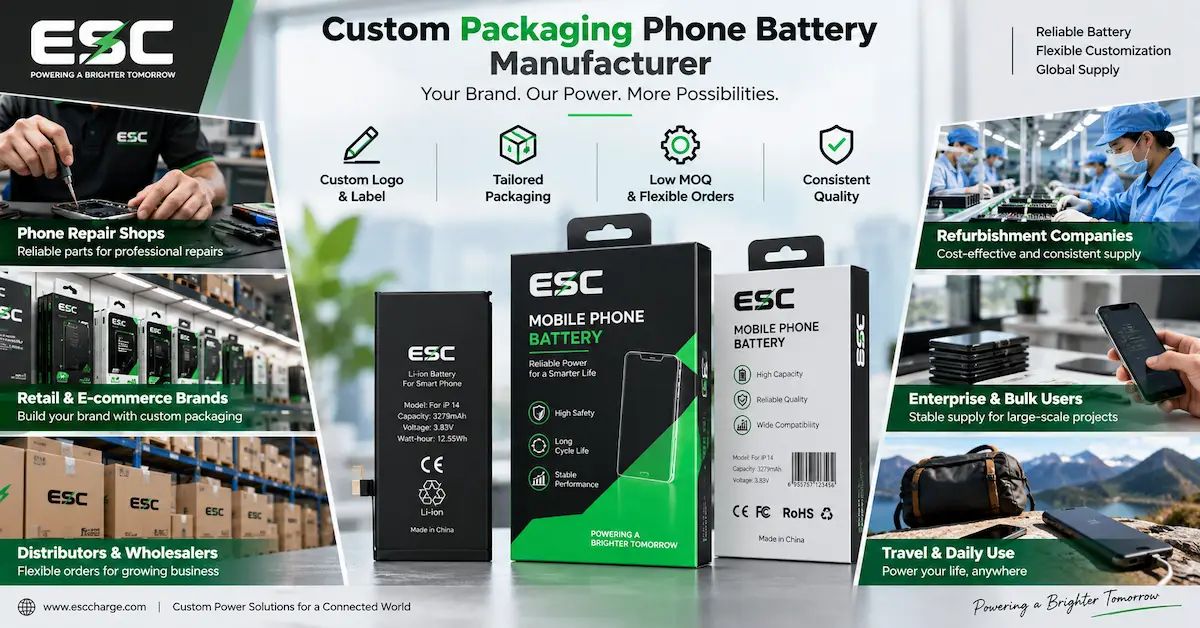
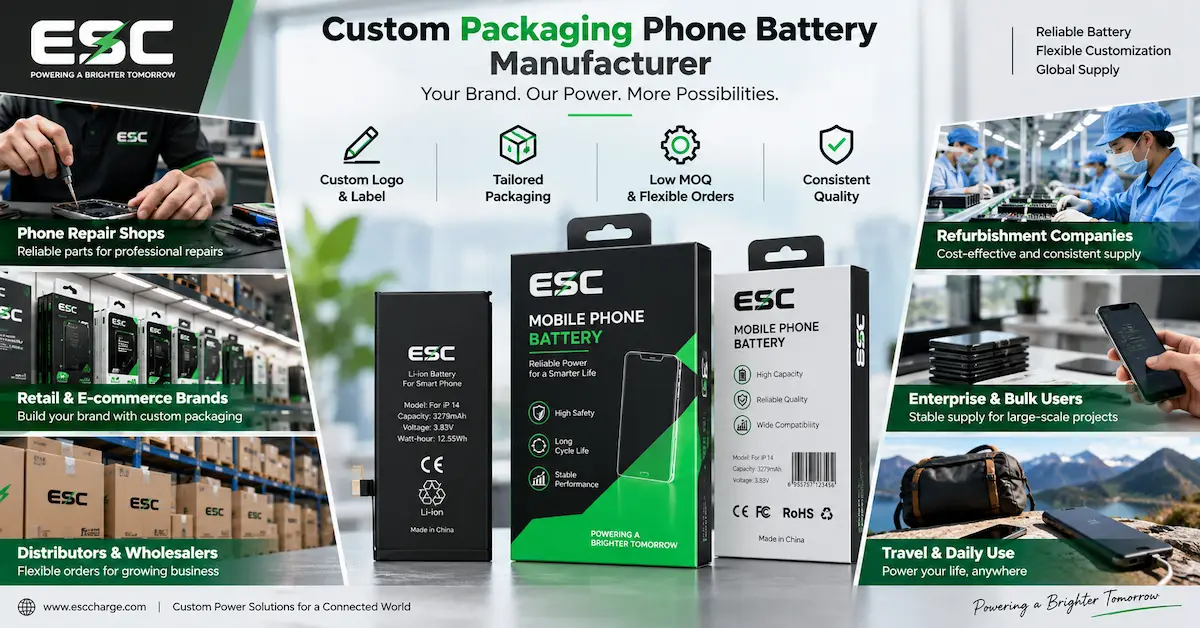
A custom packaging phone battery manufacturer should connect three things: the approved battery, its product information and the packaging that reaches your customer. Start with the exact battery configuration, then approve the label, protective arrangement, retail presentation and carton identification together. A box can carry the correct logo while containing the wrong capacity variant or a battery intended for a different repair process. Treat that as a product-control problem, not simply a printing error. ESC’s mobile phone battery range includes replacement batteries for multiple smartphone brands, with standard-capacity, high-capacity and customized options alongside OEM packaging services. For a private-label project, the important question is which configuration and packaging details will be confirmed for each stock-keeping unit, or SKU.
Match the Packaging Project to Your Sales Channel
Private-label brands should prioritize consistent presentation and accurate product claims. Parts distributors should prioritize readable model identification and organized mixed-model deliveries. Repair chains and refurbishment businesses should prioritize efficient receiving, protected components and clear separation between finished batteries and technician-only products. For online sales, consider how the unit will be identified and protected after leaving the original master carton. ESC identifies these professional buyer groups in its company and service overview. The appropriate package therefore depends on who handles the battery next—not just who places the order. A dedicated retail box may be unnecessary for an internal repair program, while a wholesale-only presentation may need additional information before consumer-facing sale. This guide concerns aftermarket battery sourcing, not packaging that presents third-party batteries as original device-brand parts.
Separate Branding Customization from Battery Engineering
Define the project scope before requesting prices. Branding work can involve battery labels, retail artwork, barcodes, instruction cards and carton markings. Changes to capacity, dimensions, flex cables, connectors or protection electronics belong in a separate technical discussion. Approving one should not automatically approve the other. ESC lists logo printing, packaging design and private labeling among its customization services, while individual product pages describe the available options for particular batteries. Ask your custom packaging phone battery manufacturer to identify what remains unchanged, what requires a new sample and which operations are performed internally or by production partners. The quotation should also identify who controls artwork, packing inspection and corrective action. Do not assume that a battery manufacturer owns printing or packaging-tooling equipment simply because it offers branded boxes.
Build a Battery-to-Packaging Specification Sheet
Use one controlled specification sheet as the reference for purchasing, artwork and final inspection. The following is a recommended buyer checklist, not a statement that every item is included in every ESC order. Replace descriptions such as “premium box” or “standard battery label” with identifiable materials, dimensions, files and approval criteria. In particular, make sure the electrical values printed on the battery and box refer to the same approved product.
| Specification field | What to define before production | What to check during approval |
|---|---|---|
| Device compatibility | Exact phone model, variant and battery reference | Product, label and order line identify the same application |
| Product configuration | Finished replacement battery or cell-only product; included components | Package does not imply that missing components are included |
| Electrical ratings | Approved capacity, nominal voltage and applicable energy information | Printed values match the confirmed specification |
| Physical fit | Battery dimensions, connector position and flex-cable clearance | Insert and closure do not press on vulnerable areas |
| Branding and language | Logo file, wording, languages and artwork revision | Final proof matches the approved files |
| SKU and identification | Buyer SKU, barcode data and agreed batch-code relationship | Scanning and visual checks return the intended item |
| Packaging construction | Unit box, tray or insert, protective materials and closure | Actual packed sample matches the agreed construction |
| Carton configuration | Units per carton, model separation, carton dimensions and markings | Carton contents reconcile with the packing list |
| Approval reference | Product sample, packed sample and document revision | Production and repeat orders use the approved version |
Compare Product Formats Before Reusing Labels or Inserts
A shared brand design does not make different batteries interchangeable. These two published ESC products illustrate why packaging control must cover both electrical information and product format. The listed values are product-page specifications, not independent test results; reconfirm them in the order documentation. The packaging checks in the final column are purchasing recommendations.
| ESC product example | Published format | Listed capacity and voltage | Packaging approval priority |
|---|---|---|---|
| iPhone 11 Pro Max higher-capacity replacement battery | Aftermarket replacement battery with integrated protection circuitry | 4500mAh; 3.83V | Identify the exact device and capacity variant; validate the insert against the supplied assembly |
| iPhone 14 Plus battery cell without flex | Cell supplied without a pre-installed flex cable | 4325mAh; 3.83V | State the cell-only configuration clearly; do not present it as a complete ready-to-install assembly |
Choose a Packaging Format That Fits the Order
Ask for alternatives rather than specifying an elaborate box immediately. For repair-channel supply, consider a neutral protective package with a clearly controlled brand and SKU label. For a mixed-model private-label range, consider a shared branded outer design with model-specific identification and separately validated internal fit. For established retail products, evaluate dedicated printed boxes, suitable trays and product-specific instructions. ESC’s iPhone 11 Pro Max product page lists neutral packaging, branded retail boxes, blister trays, barcode labels and customized export cartons; availability should still be confirmed for the selected order. Compare the options on identification, handling, material usage and reorder practicality—not appearance alone. A shared box is only useful when the enclosed battery remains properly supported and its identity is unambiguous. It should not become an excuse to force every battery into one insert.
Approve Materials, Fit and Print Quality on a Physical Sample
A screen proof can help approve wording and layout, but it cannot establish how the finished package holds the battery. Request a packed sample using the intended product configuration and packaging materials. Specify the board or plastic material, thickness where relevant, insert construction, label stock, closure and surface finish instead of relying on a photograph. During review, check for unwanted movement, pressure on the cell, flex-cable distortion, exposed contact risks and sharp internal edges. Also check folded edges, adhesive placement, print legibility and barcode readability on the assembled package. Keep claims such as “recyclable,” “waterproof” or “tamper-proof” out of the artwork unless the exact construction and supporting evidence justify them. Agree any handling or transport-validation plan with qualified personnel; an attractive retail sample is not a shipping approval.
Check Battery Quality and Packaging Accuracy Separately
Ask for two distinct acceptance decisions: whether the battery meets its agreed technical requirements and whether it has been identified and packed correctly. ESC describes incoming inspection, cell grading, capacity testing, battery-management-system checks, charging and discharging, aging and final shipment inspection in its quality-control service information. Request the records relevant to your selected product rather than treating a process description as proof of a particular batch result. For packaging acceptance, propose a three-way match between the battery identification, unit-pack label and carton packing record. Specify how discrepancies will be contained and corrected. Review available product and transport documents separately, checking that they apply to the supplied configuration. A printed compliance mark or certificate image should not substitute for reviewing the underlying documentation.
Set Clear Approval Steps Before Mass Production
Agree the approval sequence before committing to a print run: confirm the model list and quantities, evaluate battery samples, approve the technical specification, review artwork, inspect the packed sample, and authorize the final production version. Then agree the inspection and shipment-release requirements. Treat this as a proposed project workflow to finalize with the supplier, not an assumption about automatically included services. Give each approval a dated reference so that “approved packaging” identifies one version rather than several email attachments. Include the unit package, inserts, instructions, barcode data and outer-carton layout in the same approval record. ESC’s OEM and order terms address customer approval of specifications, samples, artwork and packaging, and explain that later changes can affect costs and timing. Settle unresolved details before materials are purchased.
Compare MOQ, Lead Time and Total Packaging Cost
Ask for the minimum order quantity at three levels: each battery SKU, the combined battery order and each printed or specially produced packaging component. A flexible battery MOQ does not establish the minimum printing quantity for every design. ESC’s low-MOQ phone battery sourcing guide discusses mixed-model orders and shared packaging as options to evaluate. In your quotation, separate battery cost, packaging cost, setup or tooling charges, sample fees and freight. Also ask who owns unused printed materials, how they will be stored and what happens when artwork changes. Compare suppliers using the same approved scope and accepted-unit quantity. For timing, distinguish sample readiness, artwork approval, production completion and delivery. Request current capacity for your actual model mix rather than applying a general production estimate to a customized order.
Make Repeat Orders Part of the First Packaging Agreement
Before selecting a custom packaging phone battery manufacturer, decide how a repeat order will be checked against the first approved batch. Retain the specification, artwork revision, barcode mapping, packaging-material description and reference sample. Require proposed changes to be identified before production, including changes that appear minor, such as a different insert, label location or carton quantity. For each reorder, request confirmation of the applicable version and any remaining packaging stock. Build a simple issue log that distinguishes battery performance complaints from incorrect labels, packing damage and quantity discrepancies. This gives both sides a clearer basis for corrective action than a single undifferentiated “return rate.” To start an ESC discussion, prepare your device list, quantities, target market, packaging concept and sample requirements so the product and packaging scope can be reviewed together.
Frequently Asked Questions
What does a custom packaging phone battery manufacturer customize?
The project can cover battery branding, unit packaging and shipping-carton identification without changing the battery itself. ESC describes labels, barcode options, private packaging and carton customization on relevant product pages. Request a written scope identifying the included items and any separate development work.
Can I add my logo to both the battery and its box?
ESC lists battery printing and private-label packaging options. Submit the logo and both artwork layouts for review, keeping product identification and technical information consistent. Ask for separate approval of the battery label and assembled box rather than approving only a brand mockup.
Can different phone battery models share one branded box?
Potentially, provided the product identity and internal fit remain correct for every included model. A shared outer design should retain model-specific labels and validated protection. Compare physical samples before deciding whether one insert is suitable or different inserts are necessary.
What is the MOQ for custom phone battery packaging?
Request a project-specific figure. Ask separately about the quantity per battery model, total mixed order, printed boxes, labels and any dedicated tooling. Also establish how packaging purchased above the first shipment quantity will be allocated, stored or charged.
Can I mix iPhone, Samsung and Xiaomi batteries in one order?
ESC describes mixed-model purchasing within its replacement-battery services, and its phone battery portfolio includes these brands. Submit the exact model list and quantities for confirmation. Do not assume that every model has the same availability, minimum quantity or packing arrangement.
Which artwork files should I prepare?
Prepare your logo, approved product wording, language requirements, barcode data and any existing brand guidelines. Ask the supplier for its accepted file formats and packaging drawing before final layout. Confirm the final dimensions and revision instead of resizing an old design by eye.
How should barcodes be checked before shipment?
Specify a check that connects the printed code to the correct SKU in your receiving system. Review both the encoded data and scanning performance on an assembled sample. Where batch information is required, define its relationship to the SKU separately; a product barcode alone should not be assumed to provide batch traceability.
Should battery samples or packaging samples be approved first?
Approve the battery configuration before releasing final packaging for production, then review the assembled package. Artwork can be developed in parallel, but final claims, dimensions and internal fit should follow the confirmed product. A packaging approval should not silently authorize a different battery.
Does custom packaging make the battery an original device-brand part?
No. Branding and packaging do not change an aftermarket product’s identity. ESC identifies the example products above as aftermarket replacement products. Use accurate compatibility wording and distinguish your own brand from the device brand; do not present private-label packaging as proof of original-part status.
What should I send when requesting a quotation?
Send the device models and battery references, quantity per SKU, target market, required languages, logo, packaging concept, barcode requirements and preferred delivery schedule. State whether samples are required and whether the project is packaging-only or also changes the battery configuration.
Conclusion
Choosing a custom packaging phone battery manufacturer is an exercise in product control as well as branding. The strongest proposal connects an approved battery specification with accurate labels, suitable protection, clear commercial terms and a repeatable reorder process. For a new private-label range, prioritize correct identification and sample approval before committing to complex packaging. For established distributors and repair chains, make version control and carton reconciliation part of routine purchasing. Contact ESC to discuss your custom-packaged phone battery order with your model list, quantities, target market and packaging requirements, and request a quotation that separates product, packaging and approval responsibilities.