

mAh and Wh are related, but they do not describe the same quantity. Milliampere-hours measure electric charge. Watt-hours measure energy and include voltage. For a B2B phone-battery buyer, the practical rule is simple: compare mAh directly only when the voltage basis and test conditions are sufficiently equivalent; use Wh when energy needs to be compared across different nominal voltages.
The formula is Wh = (mAh ÷ 1000) × nominal voltage. However, a correct calculation does not prove that a label is accurate, that two replacement batteries are compatible, or that one phone will run longer. A sound mAh vs Wh review separates unit conversion from supplier-claim verification and device-level performance.
What mAh Measures
mAh is a unit of charge capacity. A specification of 4,000 mAh is equivalent to 4 Ah. In an idealized example, 4 Ah could describe 1 A delivered for four hours or 2 A for two hours. A real battery does not deliver a fixed result under every condition: temperature, discharge rate, cutoff voltage, aging, protection behavior and measurement method can affect the recorded capacity.
This is why a purchase specification should not contain only a large mAh number. It should identify whether the value is rated, minimum, typical, nominal, design or measured capacity and state the applicable test conditions. If two quotations use different definitions, the larger printed number may not represent the stronger offer.
What Wh Measures
Wh is a unit of energy. It combines charge capacity with voltage, so it is useful when the compared batteries do not share the same nominal-voltage basis. The 2026 IATA battery guidance states that watt-hour rating is calculated by multiplying nominal voltage in volts by capacity in ampere-hours: Wh = V × Ah. If only mAh is shown, divide by 1,000 to obtain Ah first.
NIST's SI conversion reference lists one ampere-hour as 3,600 coulombs and one watt-hour as 3,600 joules. This reinforces the underlying difference: Ah is associated with electric charge, while Wh is associated with energy. The units are connected through voltage, not interchangeable labels for the same property.
| Metric | What it expresses | Useful B2B question | What it does not prove |
|---|---|---|---|
| mAh | Electric charge capacity | How much charge is claimed or measured under defined conditions? | Energy without a voltage basis; runtime in a device |
| Ah | The same charge quantity at a larger unit scale | Has mAh been converted correctly before the Wh calculation? | Compatibility or safety |
| Wh | Energy based on capacity and nominal voltage | Are batteries with different voltage bases being compared consistently? | Usable runtime under an undefined workload |
| W | Instantaneous power | What power is the device or test load drawing? | Stored energy or capacity by itself |
The Conversion Formula and Its Limits
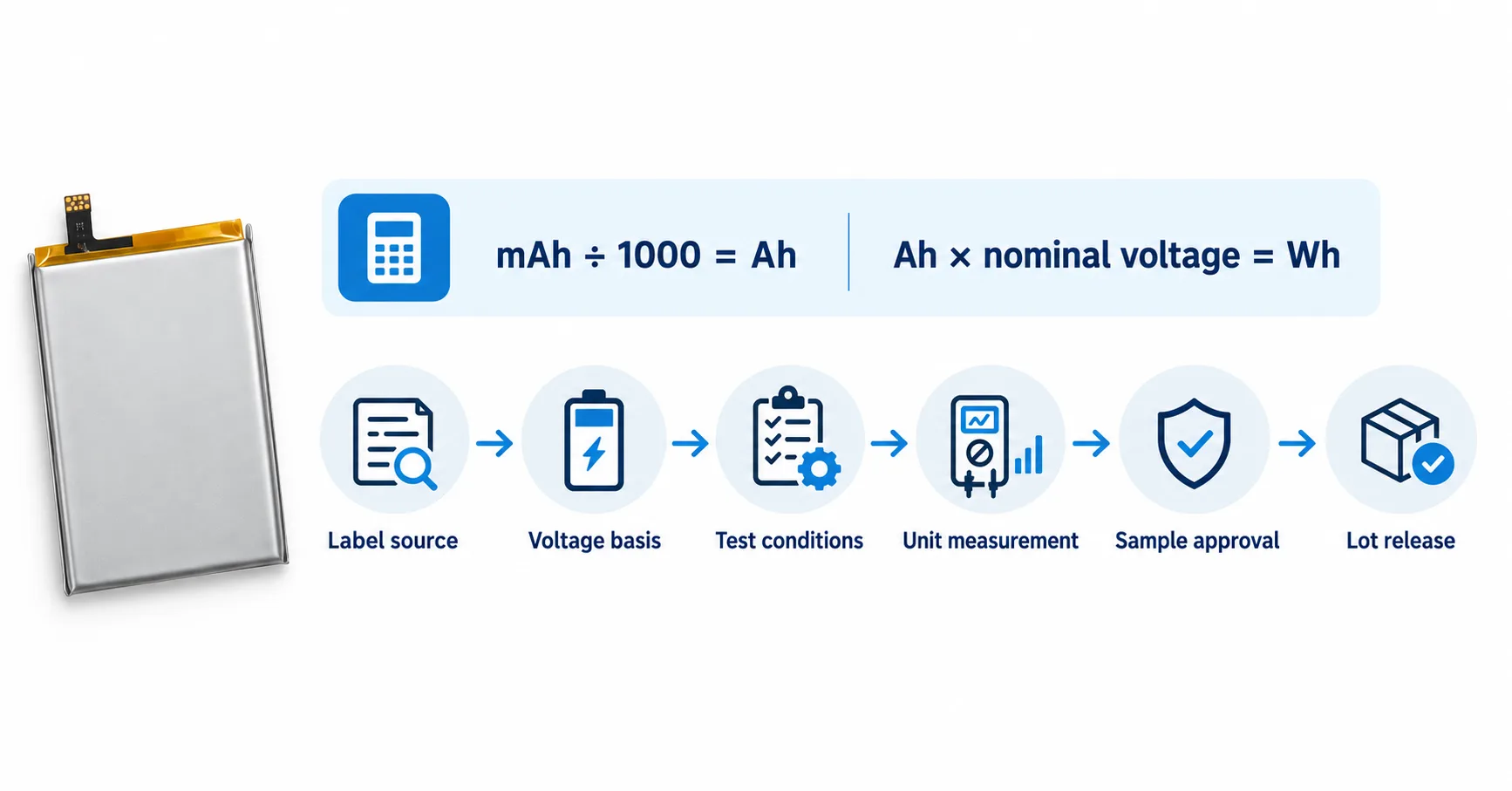
Suppose a battery is marked 4,000 mAh and 3.85 V nominal. Convert 4,000 mAh to 4 Ah, then multiply 4 Ah by 3.85 V. The calculated watt-hour rating is 15.4 Wh.
Now consider another battery marked 4,200 mAh and 3.7 V. Its calculated rating is 15.54 Wh. The second battery has 5% more mAh, but only about 0.9% more calculated Wh. This example shows why a Wh vs mAh comparison changes when nominal voltage differs.
The formula is not a complete performance test. It uses stated capacity and nominal voltage; it does not measure the energy actually delivered by an individual unit over its discharge curve. Nor does it account for device efficiency, system power demand, temperature or cutoff behavior. Keep calculated label energy separate from measured discharge energy.
Use the Correct Voltage in a Calculation
Do not multiply mAh by the maximum charge voltage unless that is explicitly the required calculation for a separately defined purpose. For watt-hour rating, IATA refers to nominal voltage. Maximum charge voltage describes a different point in the operating range and can inflate an energy calculation if substituted without justification.
Ask the supplier to identify the voltage value and its definition on the cell specification, finished-battery specification and label. If the label's Wh value does not reasonably reconcile with its mAh and nominal voltage after rounding, hold the document for clarification. Do not silently correct inconsistent artwork before the responsible party approves the technical source.
Why Higher mAh Does Not Automatically Mean Longer Runtime
The competitor article reviewed for this topic correctly distinguishes charge from energy and discusses device power consumption. ESCCharge buyers should take the next step: runtime comparisons require a controlled device, software state, network condition, display setting, workload, temperature, starting state of charge and termination criterion.
Even when two batteries have equal battery mAh and Wh values, phones can produce different runtimes because the devices consume energy differently. Conversely, two battery samples installed in the same model may perform differently because of delivered capacity, internal resistance, protection behavior, aging, installation quality or unit variation.
Use the iPhone battery capacity-testing guide for a broader view of sample measurement. Capacity evidence should support the exact battery construction under review; it should not be borrowed from another model or an earlier lot.
Separate Label Capacity From Measured Capacity
A professional quotation should identify the source of each value. “4,000 mAh” may be a design target, typical claim, minimum rating, label value, sample average or single-unit result. Those are not equivalent.
| Evidence level | Buyer should request | Decision use |
|---|---|---|
| Label and datasheet | Capacity type, nominal voltage, Wh rating, revision and responsible product identity | Initial consistency review |
| Supplier sample report | Equipment, method, temperature, charge and rest conditions, discharge current, cutoff and unit-level data | Determine whether the claim is testable |
| Buyer or qualified-lab verification | Results under the agreed method with sample identities preserved | Approve or reject engineering samples |
| Pilot and production data | Lot identity, sampling plan, acceptance limits and outlier disposition | Confirm repeatability after sample approval |
The mobile phone battery incoming-inspection guide explains how to connect document identity, appearance, dimensions and selected electrical checks. It should enforce the approved specification rather than substitute a universal capacity threshold across unrelated models.
Do Not Use Wh to Approve Compatibility
Two batteries with the same Wh rating can have different dimensions, connector geometry, polarity, protection circuits, flex routes, temperature sensing or supported charge-voltage designs. Energy equivalence is not mechanical or electrical interchangeability.
A replacement-battery RFQ should therefore keep the phone battery energy capacity field beside, not in place of, model identity, battery code, drawing, connector, protection design, insulation, packaging and traceability. If a supplier markets one capacity across several models, request the model-specific finished construction and approval evidence for every saleable SKU.
How to Compare Supplier Quotations
- Normalize the units: convert all mAh values to Ah and calculate Wh from the stated nominal voltage.
- Normalize the definitions: separate rated, minimum, typical and measured values.
- Normalize the method: compare results only when charge, rest, temperature, discharge rate and cutoff conditions are aligned.
- Check the exact construction: connect every result to the approved cell, protection board, flex, connector and finished SKU.
- Review dispersion: request unit-level results, not only an average that can hide low performers.
- Calculate qualified cost: include sample failures, inspection, rework, warranty and replacement logistics instead of ranking quotations by claimed mAh per dollar.
A convert mAh to Wh spreadsheet can make arithmetic consistent, but it should lock the source fields and preserve units. Record who supplied the nominal voltage, which revision was used and how rounding is handled. A formula with an uncontrolled input only produces a precisely formatted uncertainty.
Turn Sample Approval Into Lot Control
Begin with engineering samples, freeze the approved specification and golden sample, then verify a pilot lot before normal production release. Use a risk-based sampling plan for repeat orders, and define what happens when an individual unit or lot falls outside the capacity or energy acceptance rule.
ESCCharge's mobile phone battery sampling-plan guide explains how to scale inspection and separate individual defects from lot decisions. For field performance, use the mobile phone battery warranty-claims guide to connect symptoms with device, installer, SKU and lot evidence.
Do not promise that every production unit will equal a sample average. Define an acceptance limit, measurement uncertainty, retest rule and disposition path. When the supplier changes the cell, material, factory, protection board, test method or label basis, require notification and determine whether requalification is necessary.
Transport and Documentation Context
IATA notes that watt-hour rating is a measure used in lithium-ion battery transport regulation and that applicable lithium-ion batteries require Wh marking. Its guidance also states that it is not a substitute for the legal requirements. Buyers should confirm current requirements for the exact cell or battery, shipment mode, configuration, route, carrier and packaging with qualified dangerous-goods personnel.
A correct Wh calculation does not establish that a battery has completed the applicable UN testing, that its test summary matches the shipped type, or that packaging and documentation are compliant. Keep energy-rating review, transport evidence and product-performance approval as connected but separate controls.
RFQ Fields for Capacity and Energy Claims
- Exact device and finished-battery SKU, drawing revision and quantity.
- Capacity value plus its definition: rated, minimum, typical, design or measured.
- Nominal voltage, maximum charge voltage and the source for each value.
- Calculated Wh rating and rounding rule.
- Charge, rest, discharge, temperature and cutoff conditions.
- Test-equipment identity, calibration status and unit-level sample results.
- Engineering-sample, pilot-lot and production acceptance limits.
- Cell and assembly lot traceability plus change-notification requirements.
- Required transport evidence for the exact shipped type and configuration.
Frequently Asked Questions
Is mAh the same as Wh?
No. mAh measures charge capacity, while Wh measures energy. Voltage connects them through Wh = (mAh ÷ 1000) × nominal voltage.
Can two batteries with different mAh have similar Wh?
Yes. If their nominal voltages differ, a higher-mAh battery can have only slightly more, the same or even less calculated energy than another battery.
Should buyers compare phone batteries by Wh?
Wh is helpful for energy comparison, especially across different nominal voltages. It does not replace model-specific fit, electrical, interface, safety and device validation.
Does calculated Wh equal measured discharge energy?
Not necessarily. The label calculation uses stated capacity and nominal voltage. Measured energy depends on the full test method and the voltage delivered across discharge.
Does more Wh guarantee longer phone runtime?
No. Runtime also depends on device power consumption, software state, workload, radio conditions, display use, temperature, battery condition and system cutoffs.
Make the Units Part of the Evidence Chain
A reliable capacity review does more than perform a conversion. Confirm what each number means, use nominal voltage consistently, compare aligned test conditions, preserve unit-level data and connect results to the exact finished-battery lot. That turns mAh and Wh from marketing labels into useful procurement controls.
Send ESCCharge the target device models, reference battery specifications, capacity definitions, voltage basis, test method, forecast and destination market. The team can review the requested replacement-battery scope and sample plan; capacity, compatibility, documentation, availability and commercial terms remain subject to project confirmation.