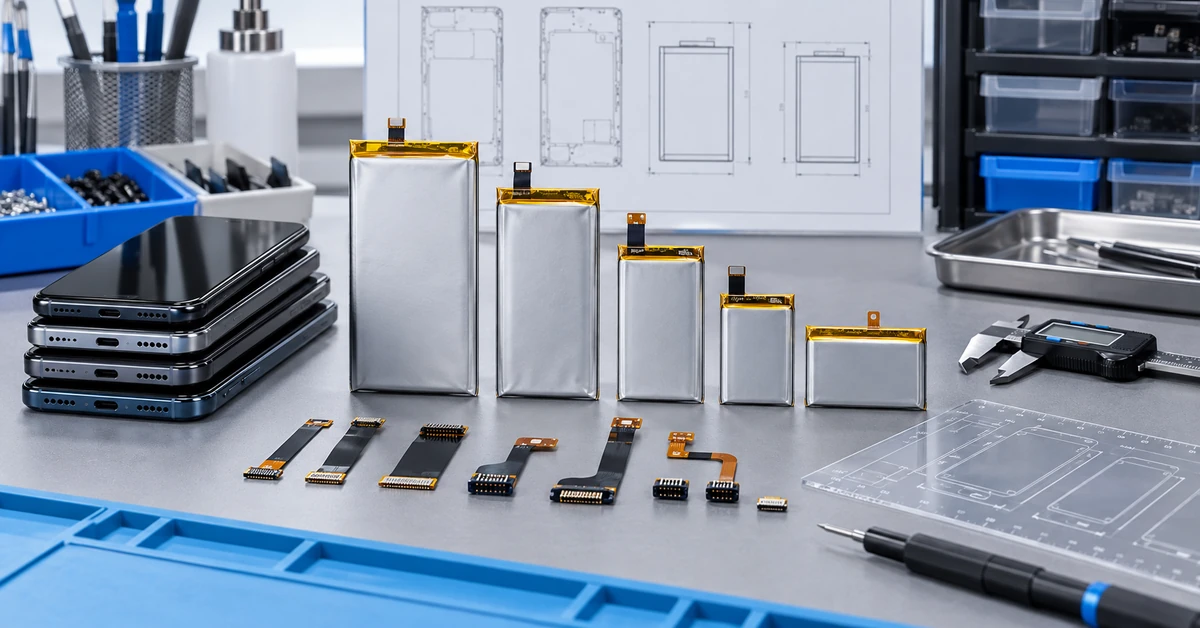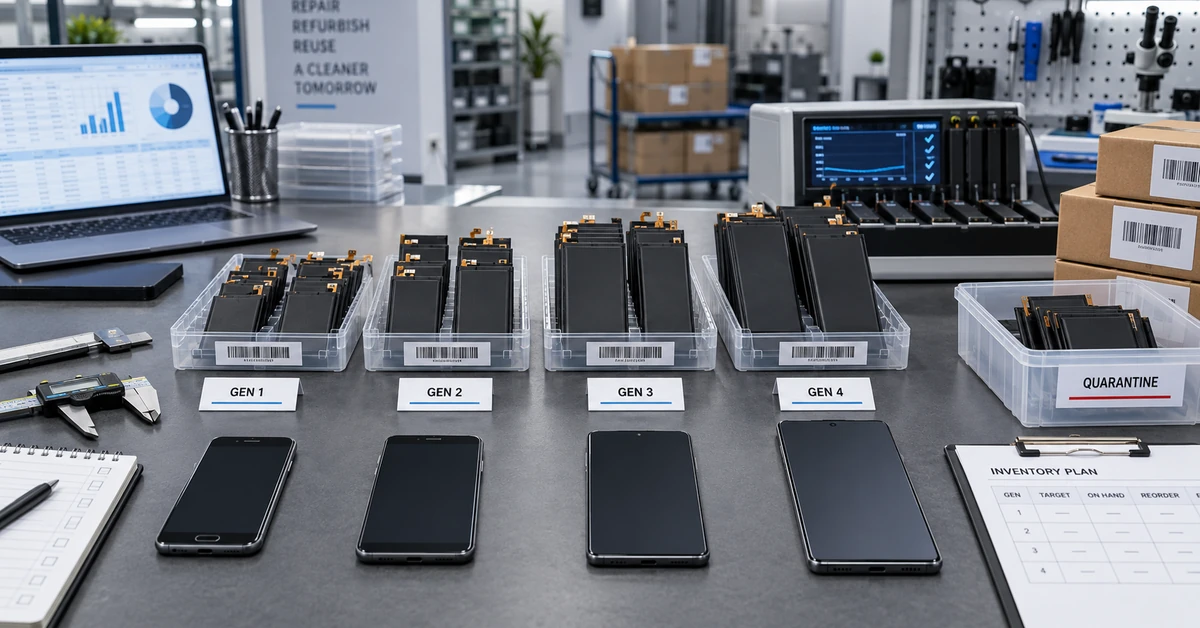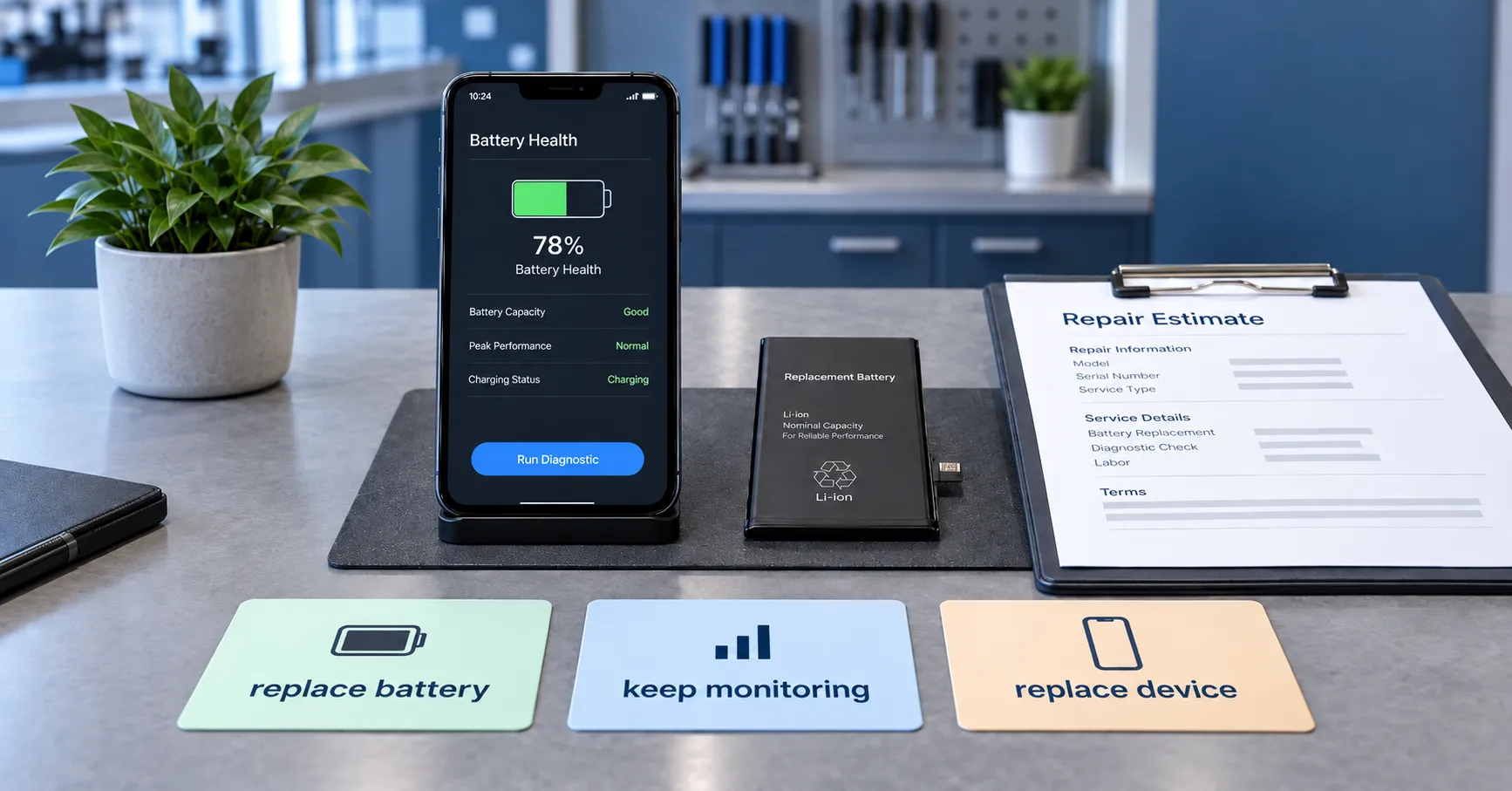

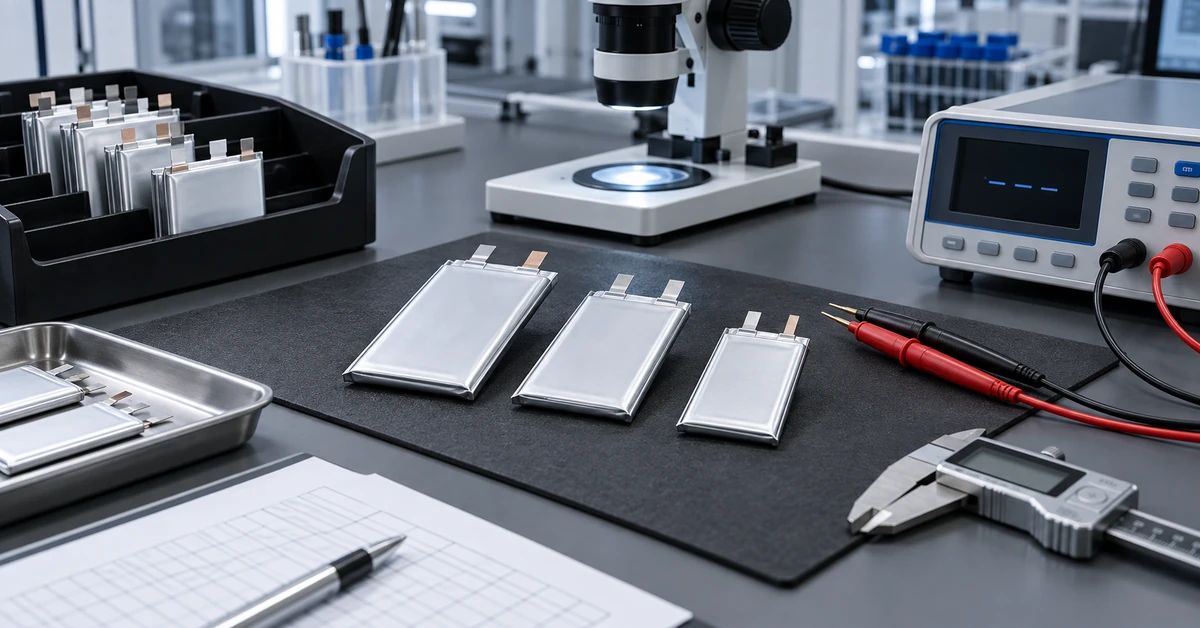
A battery tab is the conductive path that carries current from the coated electrode and current collector toward the cell terminal or finished battery assembly. In a mobile phone replacement battery, that path continues through welded joints, a protection circuit, a flex assembly and a device connector. A tab that looks minor can therefore become a source of resistance, localized heating, intermittent power or production variation.
The search phrase tab battery is often used for several different things: a bare cell supplied with metal tabs, a finished battery with solder or weld tabs, or the internal electrode tabs of a pouch cell. B2B buyers should define which meaning applies before comparing quotations or approving samples.
What Are Lithium Battery Tabs?
Lithium battery tabs are metal conductors joined to the positive and negative current collectors. They provide an electrical route from the electrode stack or wound element to the external part of the cell. In a finished phone battery, the cell tabs are usually only one part of a longer path that includes joints, protection components, conductors, flex geometry and the final connector.
The tab is not the same as the full terminal assembly, protection board or connector. It also does not independently prevent an internal short circuit. Safety depends on the complete cell design, separator integrity, insulation, sealing, protection architecture, manufacturing controls and operating conditions. Treating the tab as a stand-alone safety device can hide more important failure paths.
Battery research supports the importance of the electrical connection geometry. A 2023 study on charge heterogeneity and tab design found that tab number and position affected internal resistance and current distribution, while an electro-thermal pouch-cell study found that tab arrangement influenced heat generation and temperature uniformity. These findings do not provide a universal phone-battery specification, but they show why tab design cannot be judged only by appearance.
Why Tabs Matter to Replacement-Battery Buyers
For a repair chain or private-label buyer, the tab affects five practical outcomes.
- Electrical loss: material, cross-section, joint area and connection quality contribute to resistance along the current path.
- Thermal behavior: resistive loss and uneven current paths can create localized heating, especially under demanding loads.
- Mechanical reliability: tab alignment, unsupported length, folds and joint condition affect how the assembly tolerates handling and installation.
- Dimensional fit: tab and flex position must match the battery envelope, protection-board location, fold path and connector orientation for the exact device model.
- Production consistency: a good engineering sample is not enough if welding settings, material lots or alignment drift during production.
These outcomes connect tab review to the wider controls in ESCCharge's mobile phone battery incoming-inspection guide. Incoming inspection can confirm identity, dimensions, appearance and selected electrical behavior, but it should use limits approved for the exact SKU rather than generic pass values copied from another battery.
Materials Must Be Defined by Function and Interface
Positive and negative current collectors use different base materials, and the external tab or transition section may include additional plating or joined materials to support the next manufacturing operation. A buyer should not reduce the specification to “nickel tab” or “copper tab” without defining which layer, polarity and interface the term describes.
| Specification field | Why it matters | Evidence to request |
|---|---|---|
| Polarity and base material | Confirms the intended current-collector and external connection path | Controlled drawing or material declaration tied to the exact cell |
| Plating or transition construction | Affects joining compatibility and corrosion behavior at the interface | Layer description, supplier specification and change-control status |
| Width and thickness | Influences resistance, heat and mechanical handling | Nominal dimensions, tolerances and measurement method |
| Exposed length and fold route | Affects fit, strain and insulation clearance | Assembly drawing and approved physical sample |
| Seal-area compatibility | Poor control near a pouch seal can create mechanical or sealing risk | Cross-section or process evidence where applicable |
The objective is not to demand a particular metal for every product. It is to confirm that the declared construction matches the cell design, joining process and finished replacement-battery assembly. Any material or geometry change should trigger documented review rather than being treated as a harmless purchasing substitution.
Battery Tab Welding Is a Controlled Process, Not a Cosmetic Feature
Battery tab welding may use ultrasonic, laser, resistance or another qualified joining process depending on materials and construction. The purchasing question is not which process name sounds more advanced. It is whether the supplier has a controlled process window and evidence that the selected materials, stack-up and geometry produce repeatable joints.
A weld can appear acceptable while still having an unsuitable current path or weak mechanical margin. Conversely, a visible mark does not prove poor performance. Recent experimental work on laser-welded aluminum tabs found that very low measured resistance could remain similar across different weld states, making electrical resistance alone an unreliable estimate of weld condition. Buyers therefore need multiple evidence layers rather than one resistance reading.
Ask how the supplier controls energy input, pressure or clamping, tool condition, surface preparation, electrode or horn maintenance, alignment, material lot changes and inspection frequency. Request traceability from weld-process records to the exact sample or production lot. Do not ask an unqualified repair operator to destructively test live cells; destructive joint validation belongs in an appropriately controlled manufacturing or laboratory process.
Build a Five-Layer Battery Tab Inspection Plan
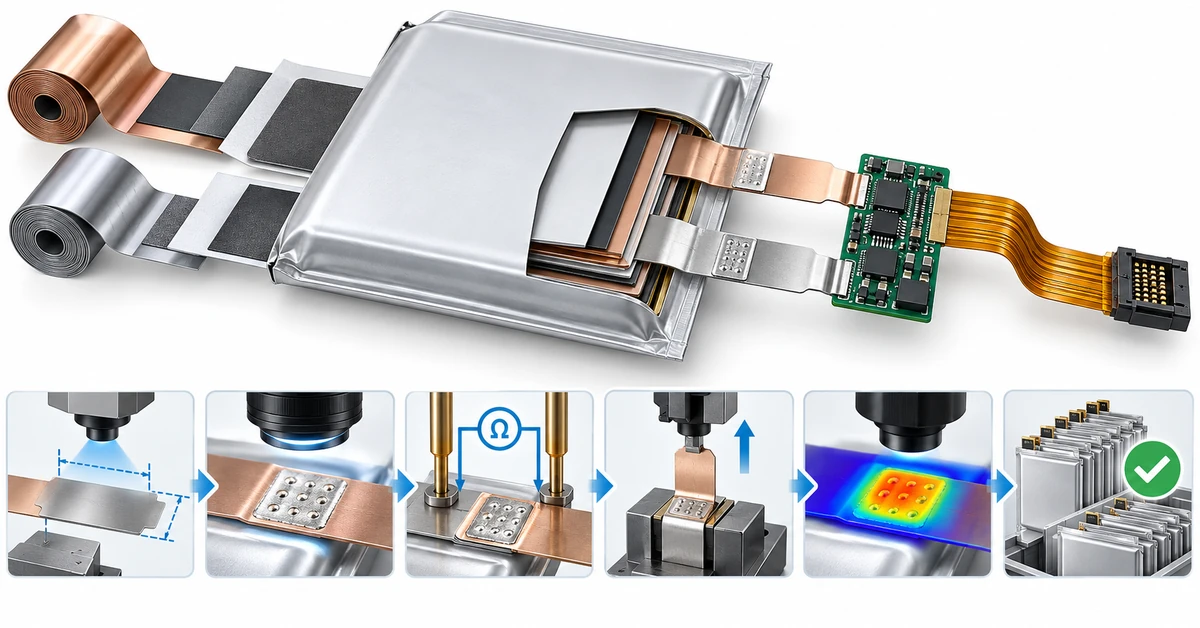
Battery tab inspection should combine non-destructive production checks with qualified sample-level validation. The following five layers prevent one convenient measurement from being mistaken for complete proof.
- Identity and drawing review. Confirm cell model, polarity, material declaration, revision, dimensions, tab position, protection-board interface and approved golden sample.
- Visual and dimensional inspection. Check alignment, folds, burrs, tears, contamination, insulation placement, seal-area condition and fit within the finished assembly. Use documented criteria and suitable magnification.
- Electrical-path verification. Confirm polarity and continuity, then compare resistance-related measurements under a controlled method. Record fixture contact, instrument resolution, rest condition and temperature so results are comparable.
- Qualified joint validation. Use an approved sampling plan for mechanical or destructive examination where required. Define who performs it, how samples are made safe and how results connect to the production lot.
- Functional and thermal comparison. Evaluate the finished battery under representative device loads and charging conditions, using the same setup for candidate and approved reference units. Investigate localized or inconsistent behavior rather than applying an unsupported universal temperature limit.
Sampling frequency should reflect process risk, lot size, history and change status. ESCCharge's mobile phone battery sampling-plan guide explains how buyers can separate routine lot checks from change-triggered or failure-driven validation.
Connect Tab Approval to the Finished Battery Assembly
Pouch cell tabs should not be approved in isolation when the purchased item is a finished replacement battery. The same cell can behave differently after a change in protection-board layout, conductor length, flex routing, connector, insulation or assembly pressure. Review the complete current path and mechanical stack.
A practical sample sequence starts with document review, then moves through engineering samples, a controlled pilot lot and production-lot verification. At each stage, preserve the cell identity, tab material and geometry, weld-process revision, protection-board revision and finished SKU. If a supplier changes any of those elements, the buyer can determine whether focused revalidation or full sample approval is necessary.
This approach complements, rather than replaces, supplier qualification. Buyers comparing factories can use the broader questions in the mobile phone battery manufacturer guide, then add model-specific tab and joint evidence to the RFQ and approval record.
Common Tab-Related Failure Signals and Next Actions
| Signal | Possible tab-path contribution | Required next action |
|---|---|---|
| Intermittent power under movement | Joint, fold, conductor or connector discontinuity | Quarantine affected units and compare the full connection path |
| Unexpected voltage drop under load | Excess resistance somewhere from cell to connector | Use controlled comparison; do not assign the tab without isolating other components |
| Localized heating near a joint | Current constriction, joint variation or nearby component loss | Stop if the condition is unsafe; investigate with qualified thermal and electrical methods |
| Visible tear, burr or misalignment | Material handling, cutting or assembly variation | Hold the lot and review scope, process records and containment |
| Sample passes but production varies | Process-window, tooling, material-lot or alignment drift | Audit change control and compare traceable pilot and production evidence |
A single symptom does not prove a tab defect. Similar field behavior can come from the cell, protection circuit, connector, installation, charger or device. Preserve failed units and production evidence so the supplier can perform root-cause analysis. The battery warranty-claims guide provides a structure for moving from an individual complaint to a possible lot-level investigation.
What to Put in the RFQ and Sample Approval Record
- Exact device model, regional variant where relevant and finished battery SKU.
- Cell manufacturer code or controlled internal identity and revision.
- Positive and negative tab construction, dimensions, tolerances and drawing revision.
- Joint method, controlled process revision and lot traceability.
- Protection-board, flex, connector, insulation and fold-path revisions.
- Visual, dimensional, electrical, mechanical and functional acceptance methods.
- Golden-sample identity and production comparison plan.
- Material, tooling, site and process change-notification requirements.
- Quarantine, root-cause, corrective-action and warranty evidence expectations.
Do not accept an RFQ response that promises “high conductivity” or “strong welding” without a controlled specification and test method. Ask which evidence is available for the exact model and which checks will repeat during production.
Frequently Asked Questions
Are battery tabs the same as battery terminals?
Not always. A tab usually refers to the conductor joined to a current collector or emerging from a cell. A finished replacement battery can add welded transitions, a protection board, flex conductors and a connector before reaching the device terminal interface.
Can buyers approve a weld by measuring resistance only?
No. Resistance is useful when the method and contact path are controlled, but it may not distinguish every weld condition. Combine it with geometry, visual evidence, qualified mechanical or cross-sectional sampling where appropriate, and finished-battery functional comparison.
Does a wider tab always make a phone battery better?
No. Geometry must match current demand, cell construction, sealing, space, mass, joining and assembly constraints. Research on larger cells can explain mechanisms, but it does not create a universal dimension for mobile phone batteries.
Should tabs be checked during every incoming lot?
Identity, visible condition and relevant dimensions can be part of routine incoming control. Destructive or specialized validation may follow an approved sampling plan and should increase after material, tooling, process or supplier changes and after abnormal field evidence.
What evidence should trigger lot quarantine?
Examples include out-of-spec geometry, polarity errors, tears, burrs, contamination, damaged insulation, joint abnormalities, inconsistent electrical behavior or a repeated field pattern linked to a traceable lot. The hold decision should follow the approved specification and safety process.
Turn a Small Component Into a Controlled Buying Decision
Battery tabs deserve more than a line in a generic cell specification. Define the material and geometry, connect the tab to its joining process and finished assembly, approve traceable samples, and verify that production uses the same controlled construction. This creates a defensible path from supplier evidence to lot release and warranty investigation.
Send ESCCharge your target device models, expected order volume, drawing requirements, sample plan and target market. The team can review the replacement-battery configuration and prepare a model-specific sampling discussion; final specifications, compliance documents and commercial terms remain subject to project confirmation.