
Quick Answer: An iPhone 12 battery should be evaluated before a used phone is purchased, refurbished, or resold. Check Battery Health, Parts and Service History, charging behavior, physical condition, and runtime under controlled use. A battery below 80% maximum capacity may justify replacement, but the displayed percentage alone does not prove failure. For refurbishment businesses, the best decision depends on the required resale grade, the actual fault, replacement cost, and expected warranty risk.
The iPhone 12 battery is an important consideration for businesses trading used smartphones.
An iPhone 12 may have an excellent display and acceptable exterior condition but deliver insufficient battery life for the intended resale market.
Another device may report lower Battery Health while still meeting the buyer's functional requirements.
Replacing every battery can increase refurbishment costs unnecessarily. Failing to replace genuinely degraded batteries can increase customer complaints and warranty expenses.
The challenge is deciding which phones should be retained with their existing batteries, which require professional replacement, and which should be held for further diagnosis.
This guide addresses that commercial decision rather than repeating a battery installation tutorial.
It is designed for used-phone wholesalers, refurbishment companies, trade-in programs, repair chains, and distributors purchasing replacement batteries in volume.
ESC supplies aftermarket iPhone replacement batteries for professional repair and B2B sourcing applications.
1. What Should Buyers Know About the iPhone 12 Battery?
The standard iPhone 12 was introduced in 2020 and uses a built-in rechargeable lithium-ion battery.
Apple publishes battery performance information for the iPhone 12, including a video-playback rating of up to 17 hours under its specified conditions.
Actual battery runtime varies with application workload, network conditions, brightness, software activity, temperature, and battery condition.
iPhone 12 battery specifications for replacement sourcing
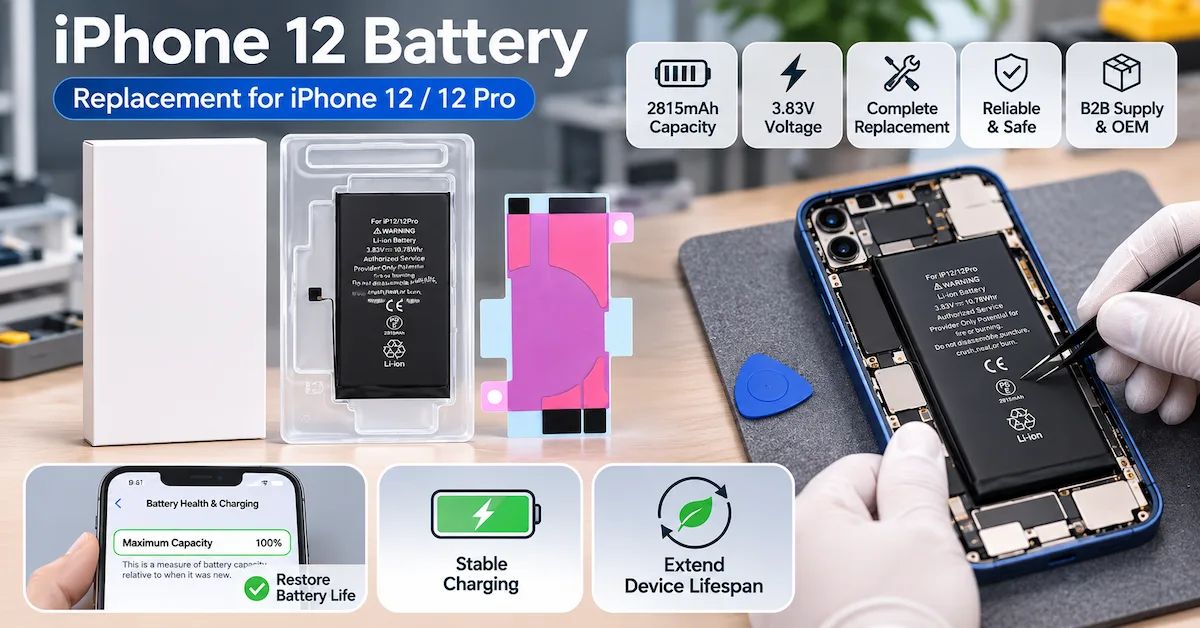
ESC currently publishes the following specifications for its iPhone 12 / iPhone 12 Pro replacement battery.
| Specification | ESC published value | Buyer verification |
|---|---|---|
| Battery application | iPhone 12 / iPhone 12 Pro | Confirm exact handset model |
| Battery type | Lithium-ion replacement battery | Verify complete configuration |
| Rated capacity | 2815mAh | Confirm capacity testing method |
| Nominal voltage | 3.83V | Match approved specification |
| Rated energy | 10.78Wh | Verify label and technical document |
| Product positioning | Diagnosable, smart recognition | Validate actual software behavior |
| Supply format | Complete replacement battery | Confirm flex and electronics |
| Warranty | 12 months listed | Confirm contractual terms |
| MOQ | Negotiable | Request current quotation |
| Published lead time | 7–15 working days | Reconfirm for order and customization |
These are supplier-published specifications, not independently verified measurements or guarantees for every future order.
The product is intended for professional replacement applications and must not be confused with a genuine Apple battery.
Buyers can review the ESC iPhone 12 / iPhone 12 Pro replacement battery before requesting samples.
2. How Do You Check iPhone 12 Battery Health?
Before purchasing or grading a used iPhone 12, review the available battery information.
Step 1: Open Battery settings
On supported iOS versions, navigate to:
Settings → Battery → Battery Health & Charging
The menu name may vary with the installed iOS version.
Review the maximum-capacity estimate and any available battery service information.
Step 2: Interpret Maximum Capacity
Maximum Capacity estimates how much charge the battery can hold relative to when it was new.
For example, a reading of 88% means the device estimates its maximum capacity at approximately 88% of the original reference.
It does not mean the battery currently has an 88% charge level.
Step 3: Review Peak Performance Capability
Where available, review the device's peak-performance information and battery-related service notifications.
Battery aging can affect both stored energy and the ability to deliver power under demanding conditions.
Step 4: Check repair history
Open:
Settings → General → About → Parts and Service History
This section may provide information about previous battery repairs.
Step 5: Record the result
For B2B purchasing, create a device record containing:
-
Device model and identifier
-
iOS version
-
Battery Health reading
-
Available performance or service message
-
Battery repair-history information
-
Charging and functional observations
-
Date and inspection operator
Important: A Battery Health percentage is useful evidence, not a complete electrical or safety assessment.
According to Apple's iPhone Battery and Performance guidance, rechargeable batteries lose capacity as they chemically age.
3. What Is Good iPhone 12 Battery Health for Resale?
There is no universal resale grading standard that every refurbishment business must follow.
A device acceptable for one resale channel may not meet the requirements of another.
Apple states that batteries in iPhone 14 models and earlier are designed to retain 80% of their original capacity after 500 complete charge cycles under ideal conditions.
This is a battery design reference, not an automatic commercial grading policy.
Example used-phone battery grading framework
| Reported maximum capacity | Suggested internal classification | Commercial action |
|---|---|---|
| 90–100% | Strong reported condition | Consider reuse after functional inspection |
| 85–89% | Moderate wear | Check against intended resale grade |
| 80–84% | Noticeable capacity reduction | Review pricing and replacement economics |
| Below 80% | Significantly reduced reported capacity | Prioritize professional replacement evaluation |
| Reading unavailable or unreliable | Unverified | Hold for additional diagnosis |
| Swelling, physical damage, abnormal heat | Safety Hold | Stop ordinary testing |
These percentages are illustrative buyer-defined thresholds, not official Apple resale grades or ESC warranty criteria.
An 89% reading does not guarantee acceptable runtime, and a device below 80% may still operate.
The final decision should combine reported health, functional testing, customer expectations, and the company's written acceptance policy.
Why grading by percentage alone is risky
Two phones with the same maximum-capacity estimate may behave differently.
One may operate normally during everyday calls and browsing.
Another may experience unexpected shutdowns under demanding workloads.
Battery behavior depends on more than the reported capacity.
For used-phone buyers, the practical question is:
Does this specific battery allow the device to satisfy the promised resale condition?
4. When Should You Keep the Existing Battery?
Replacing an existing battery is not always the best commercial decision.
Keeping the original installed battery may be reasonable when:
-
The device passes functional and safety checks.
-
Runtime meets the intended resale requirements.
-
Battery Health meets the company's agreed threshold.
-
No unresolved charging or shutdown problems are present.
-
The device's repair history is accurately disclosed.
-
Customer and marketplace policies permit the battery condition.
For example, a used iPhone 12 with a reported 87% maximum capacity may remain suitable for a resale category that allows moderate battery wear.
If the buyer promises at least 90% Battery Health, however, that same device would not qualify for that specific category.
Do not confuse cosmetic grade with battery grade
A visually excellent iPhone is not automatically a high-grade refurbished device.
A useful listing should distinguish exterior condition, display condition, battery condition, and functional status.
For B2B wholesalers, this reduces ambiguity between the supplier's grading system and the buyer's acceptance criteria.
5. When Does an iPhone 12 Battery Need Replacement?
Replacement should be considered when verified battery degradation prevents the device from meeting its functional or commercial requirements.
Common reasons include:
-
Significantly reduced usable runtime
-
Battery service recommendations
-
Confirmed capacity below the buyer's acceptance threshold
-
Unexpected shutdowns associated with battery condition
-
Repeated battery-related failures after other causes have been excluded
A replacement decision should also account for available parts and repair complexity.
Battery replacement decision matrix
| Observation | Recommended action |
|---|---|
| Good health and acceptable runtime | Keep and document |
| Moderate wear but meets resale standard | Keep or price according to grade |
| Below required resale threshold | Evaluate replacement |
| Unexpected shutdowns | Diagnose battery and power system |
| Unusually fast idle drain | Check software and hardware causes |
| Charging intermittently | Inspect charger, port and charging system |
| Swollen or physically damaged battery | Safety Hold and professional handling |
| Replacement cost exceeds expected value | Consider lower resale category or rejection |
Does 80% health always mean replace?
No.
For a professional refurbishment program, 80% can be used as a useful decision reference.
However, the actual threshold should reflect the promised product condition and buyer requirements.
A company may set a stricter standard for premium refurbished devices and a different documented standard for lower-priced functional devices.
The important requirement is consistency.
6. Why Is an iPhone 12 Battery Draining Quickly?
Fast battery drain does not always indicate battery failure.
A used iPhone may consume more energy because of background applications, weak cellular reception, intensive workloads, or software activity.
Battery degradation
Chemical aging reduces usable capacity and may affect performance under load.
Background applications
Cloud synchronization, navigation, media playback, and other background tasks may increase consumption.
Weak cellular coverage
Maintaining connections in poor signal conditions can increase energy demand.
Temperature
Very hot or cold operating conditions can affect battery performance.
Charging problems
A damaged cable, unsuitable adapter, charging-port problem, or power-management fault may create symptoms that appear battery-related.
How refurbishers should respond
First, confirm that the battery can be evaluated safely.
Then review app usage, charging behavior, the available battery-health information, and the phone's operating conditions.
If the symptoms remain unexplained, move the device to a diagnostic hold.
Do not replace the battery simply because one customer reports that the phone drains quickly.
A standardized test should distinguish genuine battery degradation from other causes.
7. How Should Refurbishers Test Used iPhone 12 Batteries?
A resale inspection should be repeatable across technicians and batches.
The purpose is to establish whether the completed phone meets its promised operating standard.
Recommended device-level inspection
| Inspection | What to verify | Why it matters |
|---|---|---|
| Device identity | Exact iPhone model and iOS version | Prevents wrong application decisions |
| Physical condition | Damage, deformation, swelling signs | Identifies safety risks |
| Battery Health | Available capacity and service status | Provides condition information |
| Repair history | Available part-history status | Supports accurate disclosure |
| Charging function | Normal charge initiation and behavior | Identifies charging problems |
| Idle behavior | Unexpected drain during controlled rest | Helps identify abnormal consumption |
| Runtime | Performance under a defined workload | Supports resale grading |
| Shutdown behavior | Unexplained restarts or power loss | Flags possible power issues |
| Temperature | Abnormal heat during ordinary operation | Supports safety review |
| Final status | Keep, replace, hold or reject | Creates auditable decisions |
Use consistent test conditions
When comparing multiple devices, standardize relevant conditions such as screen brightness, network connection, applications, test duration, charger, and ambient temperature.
Otherwise, an apparent runtime difference may result from test conditions rather than battery quality.
What about capacity testing?
Controlled battery capacity testing may provide stronger technical evidence than a displayed percentage alone.
However, a bench test and an installed-device test answer different questions.
Bench capacity testing helps assess electrical performance under defined conditions.
Installed-device testing evaluates charging, runtime, fit, and integration with the actual phone.
For a deeper technical explanation, see ESC's iPhone battery capacity testing guide.
Battery safety
Do not charge, compress, puncture, or conduct normal capacity tests on a visibly swollen or damaged lithium-ion battery.
Such devices require appropriate professional handling and applicable waste or transport procedures.
8. What Do Genuine, Unknown, and Other Battery Messages Mean?
Battery replacement history can affect customer confidence and resale value.
Apple provides Parts and Service History on iPhone 12 models running supported iOS versions.
According to Apple's Parts and Service History documentation, relevant labels may include Genuine, Unknown, and other part-history information.
What should buyers understand?
Genuine: Indicates a repair performed using genuine Apple parts and applicable processes.
Unknown: May appear when a replacement part is nongenuine, not functioning as expected, or cannot be verified under Apple's system.
Other service information: Depending on the device, iOS version, repair, and part, further status information may be available.
Does Unknown prove the battery has poor capacity?
No.
A system message and an electrical capacity measurement are different forms of evidence.
An aftermarket battery may require separate technical evaluation regardless of what the system displays.
Similarly, a preferred screen status does not guarantee that a battery has passed the buyer's capacity or performance tests.
What about Repair Assistant?
Apple documents Repair Assistant support for certain iPhone 12 repair categories, including batteries, under supported software and repair conditions.
The feature is associated with Apple's applicable calibration and repair processes.
It should not be described as a method that automatically makes an aftermarket battery genuine.
See Apple's Repair Assistant guidance for the supported requirements and process.
B2B disclosure rule
Record what the phone actually displays.
Do not promise that every aftermarket replacement will show a specific Apple service status.
Do not label an aftermarket battery as a genuine Apple part unless that claim is accurate and appropriately supported.
This distinction is particularly important for refurbished-device listings and wholesale contracts.
9. Which iPhone 12 Models Use Different Batteries?
The iPhone 12 family includes four different handset models.
A purchasing team should not treat every device described as “iPhone 12 series” as a single battery application.
iPhone 12 family identification
| Device | Selected Apple regional model numbers | Battery purchasing rule |
|---|---|---|
| iPhone 12 mini | A2176, A2398, A2399, A2400 | Dedicated battery application |
| iPhone 12 | A2172, A2402, A2403, A2404 | Verify iPhone 12 replacement SKU |
| iPhone 12 Pro | A2341, A2406, A2407, A2408 | Verify iPhone 12 Pro replacement SKU |
| iPhone 12 Pro Max | A2342, A2410, A2411, A2412 | Dedicated battery application |
ESC publishes one 2815mAh finished replacement battery for the standard iPhone 12 and iPhone 12 Pro.
That published compatibility does not extend automatically to the mini or Pro Max models.
Why exact model mapping matters
Incorrect battery selection may create mechanical, connector, electrical, or repair-workflow problems.
Even when two devices have similar exterior dimensions, compatibility should be verified using the supplier's approved battery specification and representative-device testing.
For detailed compatibility and sample approval, refer to ESC's iPhone 12 series battery validation guide.
This article focuses on deciding whether a used device requires a battery; the validation guide addresses approval of the actual replacement component.
10. What Replacement Battery Configuration Should Refurbishers Choose?
Professional buyers should distinguish between a finished replacement battery and a cell-only component.
These configurations are not interchangeable purchasing formats.
ESC replacement battery comparison
| Product format | Finished iPhone 12 / 12 Pro battery | Cell without flex or BMS |
|---|---|---|
| Published capacity | 2815mAh | 2815mAh |
| Published nominal voltage | 3.83V | 3.83V |
| Battery assembly | Finished replacement configuration | Cell-only |
| Flex and electronics | Included in the finished product configuration | Not supplied |
| Main application | Professional complete-battery replacement | Specialized cell-level repair |
| Buyer responsibility | Validate fit, charging and operation | Validate cell and subsequent assembly |
| Typical buyer | Repair chains, distributors, refurbishers | Technically equipped repair facilities |
The cell-only configuration requires specialized technical capability and additional assembly validation.
It should not be marketed as a ready-to-install finished replacement battery.
Recommendation for refurbishment production lines
For businesses using standardized complete-battery replacement procedures, a validated finished battery assembly may provide a more straightforward workflow.
Specialized cell-only repair should be evaluated separately, including safety, labor, equipment, and completed-product verification.
ESC publishes both a finished iPhone 12 / 12 Pro replacement battery and an iPhone 12 / 12 Pro battery cell without flex.
Buyers should confirm the exact product configuration before purchasing.
11. How Much Does iPhone 12 Battery Replacement Affect Resale Profit?
The lowest component price does not always produce the most profitable refurbished device.
A battery replacement affects labor, inspection costs, turnaround time, and warranty exposure.
Calculate the incremental benefit
Incremental Replacement Value = Expected Resale Price Increase + Expected Warranty Savings − Total Additional Replacement Cost
This helps determine whether replacing a still-functional battery offers enough commercial value.
Illustrative example
Consider a hypothetical used iPhone 12 that meets the buyer's minimum resale conditions.
| Item | Keep existing battery | Replace battery |
|---|---|---|
| Expected resale price | $205 | $225 |
| Acquisition cost | $120 | $120 |
| Other processing and sales costs | $35 | $35 |
| Battery and additional repair costs | $0 | $30 |
| Expected warranty allowance | $12 | $8 |
| Expected contribution | $38 | $32 |
In this hypothetical situation, replacement increases the resale price but reduces the expected contribution by $6.
The existing battery may be the better commercial choice if it meets the promised resale grade.
However, if that battery fails the applicable quality standard, retaining it is not an acceptable option for that resale category.
The buyer must then consider replacement, a different accurately disclosed sales grade, or rejection.
These figures are illustrative calculations, not actual ESC pricing, market resale data, or a reported customer result.
Maximum replacement budget
For a desired resale grade, the business can calculate the maximum allowable battery-repair cost.
Maximum Battery Repair Budget = Expected Net Resale Revenue − Acquisition Cost − Other Costs − Required Contribution
A repair should meet both the technical acceptance criteria and the commercial requirement.
12. How Should a Used-Phone Buyer Grade a Mixed iPhone 12 Batch?
Batch inspection requires a consistent decision system.
A wholesaler purchasing 200 used iPhones should not estimate replacement demand from the average Battery Health alone.
Some devices may need no battery work, while others may require replacement or additional diagnosis.
Recommended batch disposition
| Decision | Condition | Next action |
|---|---|---|
| Release | Battery and device meet resale criteria | Approve listing |
| Conditional release | Moderate wear within disclosed grade | Approve with appropriate description |
| Replace | Confirmed battery issue or grade shortfall | Authorize professional replacement |
| Diagnostic Hold | Conflicting symptoms or unclear repair history | Additional inspection |
| Safety Hold | Suspected damaged or swollen battery | Appropriate safety handling |
| Reject | Repair not commercially or technically viable | Reject or use approved recovery route |
Suggested inspection record
Each device should have an internal asset ID connected to its model, test results, condition grade, repair decision, and final disposition.
A useful dataset includes:
-
Acquisition channel
-
Device model and storage variant
-
Initial Battery Health
-
Available repair history
-
Reported symptoms
-
Original inspection result
-
Replacement approval decision
-
Replacement battery supplier SKU, if used
-
Final functional test
-
Resale classification
-
Relevant warranty outcome
Monitor trends by acquisition source
Over time, compare battery replacement demand and warranty complaints by supplier, shipment lot, device grade, and refurbishment route.
This allows the business to identify purchasing sources that consistently require more battery work.
A lower purchase price may not be attractive if the source also produces higher refurbishment and warranty costs.
13. What Should Buyers Verify When Purchasing iPhone 12 Batteries Wholesale?
Once the refurbishment program establishes actual replacement demand, sourcing can begin.
The goal is to buy the correct battery in quantities supported by real repair requirements.
Wholesale quality-control checklist
| Requirement | Buyer action |
|---|---|
| Compatibility | Approve exact device-to-battery mapping |
| Rated capacity | Verify 2815mAh specification for the applicable ESC SKU |
| Electrical characteristics | Confirm voltage and relevant test method |
| Mechanical configuration | Check dimensions, flex and connector |
| Battery condition | Confirm new or other declared condition |
| Sample approval | Test representative replacement units |
| System information | Record actual Battery Health and repair-history behavior |
| Charging and runtime | Test under controlled conditions |
| Lot identification | Maintain batch traceability |
| Documentation | Request applicable product and transport records |
| Warranty | Confirm written claims and replacement procedure |
| Packaging | Confirm label, barcode and carton requirements |
How does ESC address quality control?
ESC describes product checks covering cell condition, capacity, voltage, charging and discharging, functional performance, and final inspection.
Buyers should confirm which specific procedures and acceptance limits apply to their approved iPhone 12 battery SKU.
The existence of a published QC process does not replace order-specific quality agreements.
What about battery certifications?
ESC's iPhone 12 replacement battery page lists CE, MSDS, and UN38.3 support.
These items do not serve identical functions.
A material safety data sheet, transport test documentation, and product compliance evidence must be reviewed according to their intended purposes.
Buyers should verify applicability to the actual SKU, shipment, and destination market.
14. How Do MOQ, Lead Time, and OEM Packaging Affect Purchasing?
For professional buyers, the required quantity should come from expected repairs, rather than the total number of refurbished devices.
A company refurbishing 500 iPhone 12 units does not automatically need 500 replacement batteries.
Its purchase quantity should reflect confirmed replacement needs, expected warranty demand, inspection allowances, available inventory, and replenishment conditions.
ESC published commercial information
ESC currently lists the finished iPhone 12 / 12 Pro replacement battery with:
-
Negotiable MOQ
-
Published lead time of 7–15 working days
-
OEM/private-label labeling options
-
Custom packaging and barcode support
-
A listed 12-month warranty
These are published product-page statements, not confirmed terms for a specific purchase order.
Actual MOQ, lead time, warranty scope, and customization costs should be included in the quotation.
OEM and private-label requirements
Buyers developing branded replacement-battery products may require customized labels, retail boxes, barcode systems, and other approved packaging elements.
The technical battery configuration should be approved before the packaging design is finalized.
If capacity, connector, cell construction, or other important product features change, the buyer should assess whether the product approval and labeling require revision.
Avoid unsupported claims
Do not automatically describe aftermarket batteries as:
-
Genuine Apple batteries
-
Apple-authorized parts
-
Guaranteed to display 100% Battery Health
-
Guaranteed to eliminate every system message
-
Compatible with all iPhone 12-series models
Each claim requires evidence appropriate to the exact product and repair configuration.
15. What Should You Include in an iPhone 12 Battery RFQ?
A well-prepared quotation request helps suppliers evaluate the actual project.
Instead of asking only for the lowest battery price, provide the technical and commercial context.
Recommended B2B RFQ checklist
| RFQ item | Information to provide |
|---|---|
| Buyer type | Repair chain, refurbisher, distributor or brand |
| Device model | iPhone 12, iPhone 12 Pro or other exact variant |
| Battery format | Finished battery or cell-only |
| Rated capacity | Approved product requirement |
| Quantity | Sample volume and expected repeat orders |
| Target market | Destination country or region |
| Repair workflow | Standard replacement or specialized repair |
| Software expectations | Required observations and disclosure standards |
| Testing | Agreed quality and sample acceptance requirements |
| Traceability | SKU, lot and labeling requirements |
| Packaging | Standard or private-label |
| Documentation | Applicable compliance and shipping information |
| Commercial terms | MOQ, lead time, warranty and payment terms |
B2B sourcing with ESC
ESC offers a published 2815mAh iPhone 12 / iPhone 12 Pro replacement battery for professional repair and wholesale applications.
Businesses planning a refurbishment program can review the product specifications and contact ESC with their model requirements, purchasing quantities, sample-testing needs, and desired packaging.
Recommended inquiry message:
"We are sourcing iPhone 12 / iPhone 12 Pro replacement batteries for a used-phone refurbishment program. Please confirm the current 2815mAh finished battery specification, sample availability, MOQ, lead time, product-specific QC information, applicable shipping documents, and wholesale pricing for our planned quantity."
A specific inquiry is more useful than an unspecified request for the "best iPhone 12 battery price."
Frequently Asked Questions
1. What is the capacity of an iPhone 12 battery?
ESC's published iPhone 12 / iPhone 12 Pro aftermarket replacement battery has a rated capacity of 2815mAh, a nominal voltage of 3.83V, and a rated energy of 10.78Wh. Buyers should confirm these specifications for the actual product and order.
2. How do I check iPhone 12 battery health?
Open Settings → Battery and find Battery Health or Battery Health & Charging, depending on the installed iOS version. Review maximum capacity and available service information. For used phones, also examine Parts and Service History and perform appropriate functional checks.
3. Is 85% iPhone 12 battery health good?
An 85% maximum-capacity reading indicates some estimated capacity loss. Whether it is acceptable depends on actual battery performance and the promised resale condition. A refurbisher should apply a documented grading policy rather than automatically classifying every 85% battery as defective.
4. Should I replace an iPhone 12 battery below 80% health?
A reading below 80% is a strong reason to evaluate replacement, particularly for refurbished devices with defined minimum battery standards. However, the correct action still depends on diagnosis, technical feasibility, and intended use. It is not an automatic universal replacement rule.
5. Does replacing the iPhone 12 battery increase resale value?
It may increase the price or resale classification when buyers value improved battery condition. However, the price increase must be compared with replacement parts, labor, inspection, and warranty costs. A higher sale price does not necessarily mean higher profit.
6. Can the same replacement battery fit iPhone 12 and iPhone 12 Pro?
ESC publishes a finished 2815mAh replacement battery for both iPhone 12 and iPhone 12 Pro applications. Buyers should verify the approved SKU and test compatibility with representative devices. The same assumption must not be extended to iPhone 12 mini or Pro Max.
7. What does Unknown Part mean after an iPhone 12 battery replacement?
Apple states that an Unknown label can appear when a part is nongenuine, is not functioning as expected, or cannot be verified under its system. It does not independently establish the battery's measured capacity. The actual status and repair details should be recorded accurately.
8. Is an aftermarket iPhone 12 battery the same as a genuine Apple battery?
No. An aftermarket battery is a third-party replacement product. It may be designed for a compatible iPhone model, but that does not make it a genuine Apple part or establish Apple authorization. Its specifications, performance, and software behavior should be evaluated separately.
9. How should refurbishers inspect iPhone 12 batteries in bulk?
Identify each device, record Battery Health and available repair history, examine safety and charging conditions, perform repeatable functional checks, and assign a documented keep, replace, hold, or reject decision. Use lot and device records to support later warranty analysis.
10. Where can businesses source iPhone 12 batteries wholesale?
ESC publishes aftermarket replacement batteries for iPhone 12 and iPhone 12 Pro and supports professional B2B inquiries. Buyers can request sample specifications, pricing, MOQ, lead time, quality information, and packaging options through ESC's contact page before approving bulk orders.
Conclusion
The iPhone 12 battery is an important part of used-phone grading, but replacement should be based on verified condition and commercial requirements rather than device age alone.
For professional refurbishment businesses, Battery Health provides useful information about estimated capacity, while Parts and Service History adds context about previous repairs.
Neither indicator replaces proper functional testing.
A battery with moderate wear may remain acceptable for a clearly defined resale grade. A significantly degraded or unreliable battery may require professional replacement, provided the device remains technically and commercially viable.
The most effective used-phone purchasing programs separate five decisions: initial battery condition, functional acceptability, resale grade, replacement economics, and final quality approval.
This reduces the risk of replacing usable batteries while allowing genuinely defective devices to be identified before resale.
When battery replacement is justified, businesses should verify the exact iPhone model, battery assembly, electrical specification, repair workflow, and supplier quality records.
ESC provides a 2815mAh iPhone 12 / iPhone 12 Pro replacement battery for professional repair and refurbishment applications.
Wholesalers, repair chains, and refurbished-device distributors can contact ESC to discuss compatible replacement batteries, sample approval, OEM packaging, and bulk purchasing.
By combining evidence-based battery grading with disciplined replacement decisions and verified B2B sourcing, businesses can improve inventory decisions, control refurbishment costs, and deliver more consistent used-phone quality.