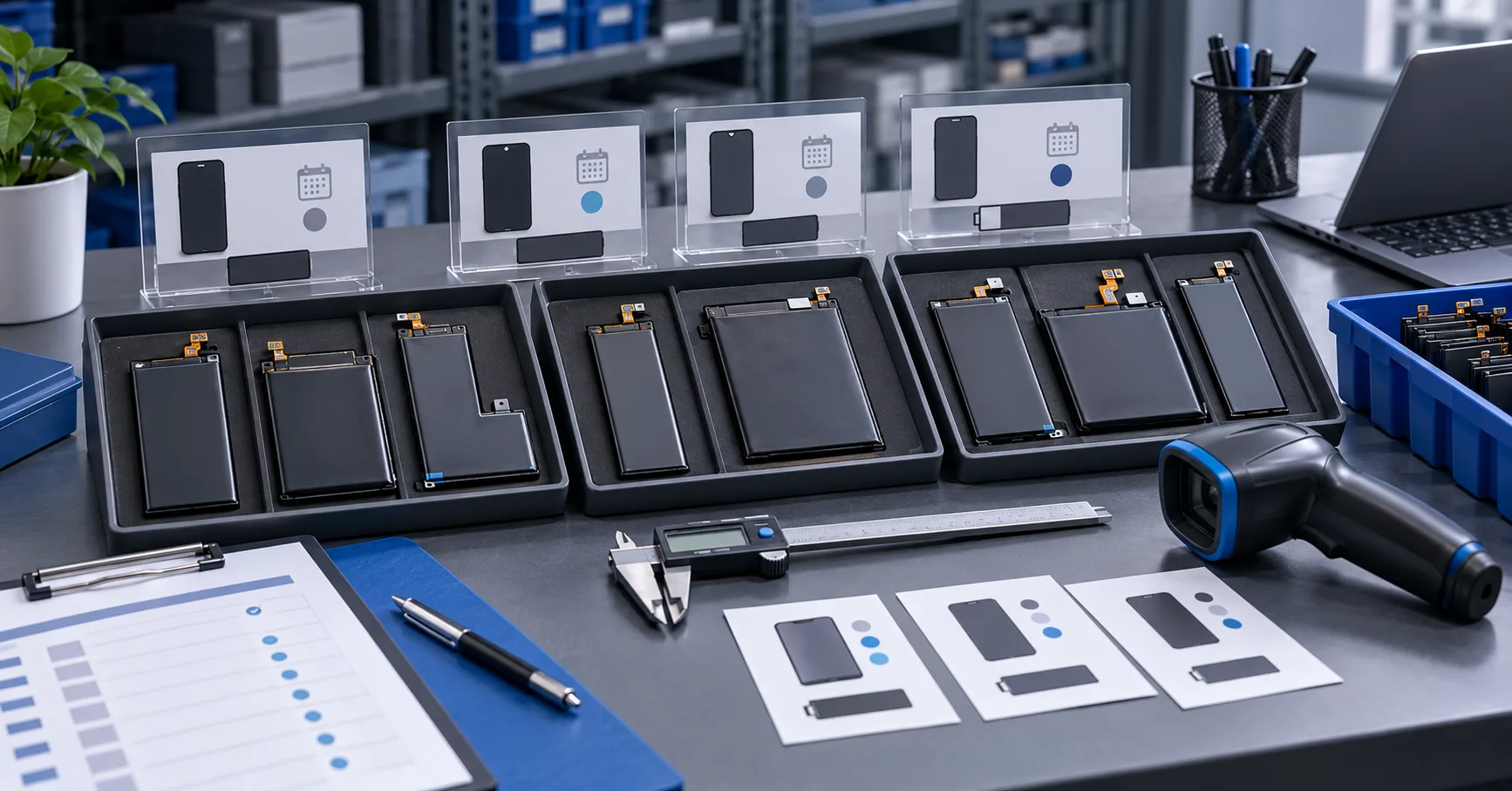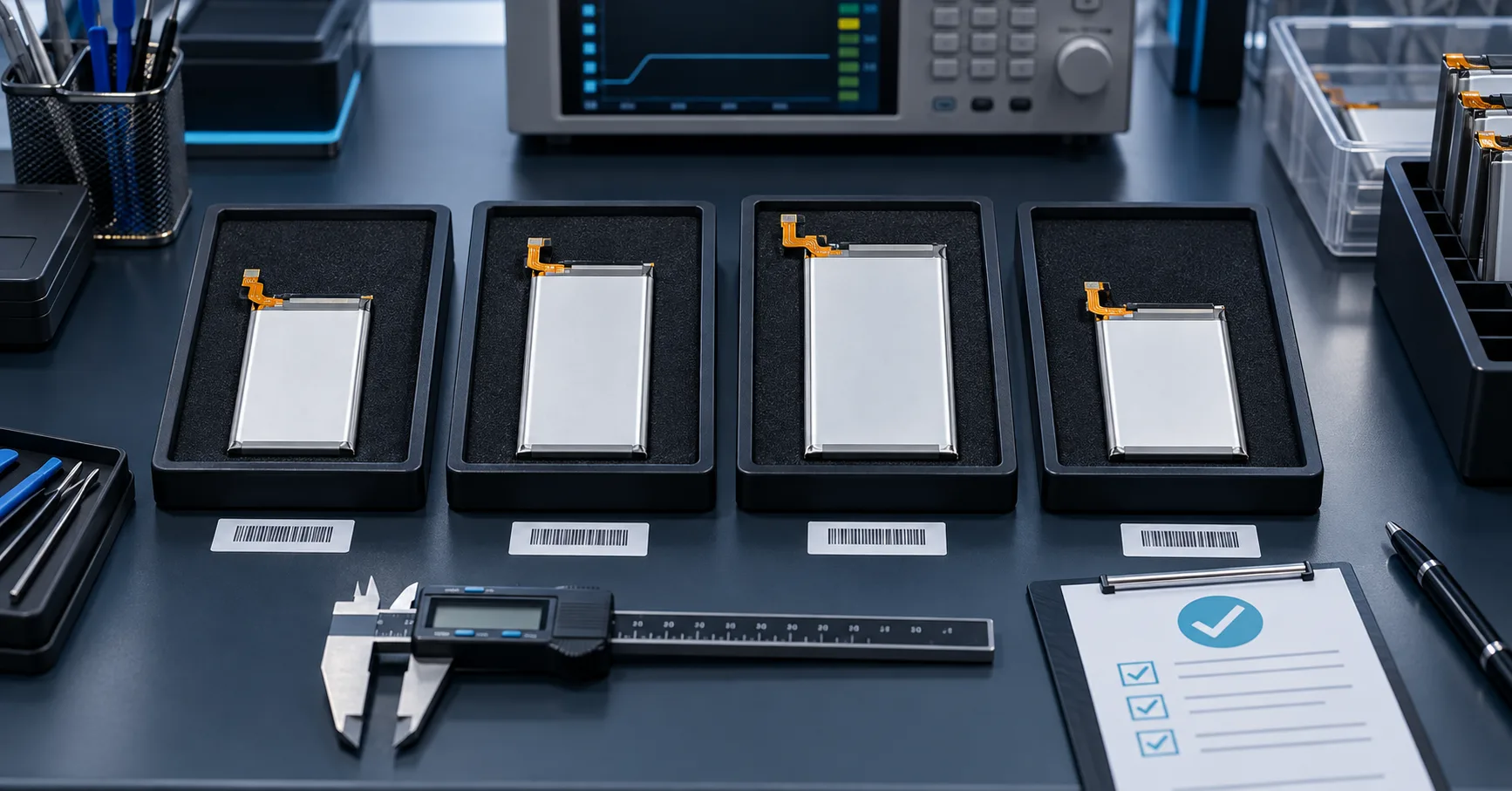


Silicon-carbon technology is attracting smartphone brands because adding silicon-based material to the anode can support more stored energy within a constrained battery volume. That commercial promise is relevant to slim phones, foldable devices and premium replacement-battery programs. However, the chemistry name alone does not prove usable capacity, safe fit, acceptable temperature, cycle retention or production consistency.
A B2B buyer should approve a silicon-carbon phone battery only after connecting the supplier’s claim to a defined model, physical sample, controlled test method and acceptance record. The purpose of validation is not to decide whether silicon-carbon technology is universally better than graphite. It is to determine whether the proposed battery is suitable for the target device, repair process, sales claim and order risk.
This guide provides a practical validation framework for battery brands, importers, wholesalers, repair chains, refurbishment facilities and private-label buyers. Numerical limits should be established for the actual model. ESC should not publish a universal capacity, temperature, cycle or swelling limit without approved model-level evidence.
Understand What the Technology Name Does and Does Not Prove
Silicon can store more lithium than conventional graphite, which is why silicon-containing anodes are studied as a route to higher energy density. The practical challenge is that silicon changes volume during lithiation and delithiation. Repeated expansion and contraction can create mechanical stress, unstable interfaces and capacity loss if the material and cell design do not manage those changes effectively.
A peer-reviewed review of high-performance silicon anodes discusses conductivity, volume change, pulverization and capacity degradation as major engineering challenges. Research published in Nature Communications also illustrates how structured silicon-carbon designs can accommodate expansion more effectively than unstructured silicon.
These findings explain why buyers should test the finished battery rather than purchase a chemistry label. They do not prove that any particular commercial phone battery has a certain lifetime or safety level.
Convert the Supplier Claim Into a Testable Specification
Before samples arrive, require a controlled specification containing:
- battery model and intended phone models;
- cell chemistry description and approved wording;
- nominal voltage and charging-voltage limit;
- rated and minimum capacity definitions;
- Watt-hour rating;
- length, width, thickness and dimensional tolerances;
- connector, flex cable, pinout and protection-board details;
- maximum permitted mass;
- approved label and traceability code;
- recommended charging, discharging and storage conditions;
- sample test method and proposed acceptance limits;
- change-notification requirements.
Do not infer silicon percentage, actual energy density or cycle life from the product name. If the supplier makes a specific material claim, request the evidence supporting that wording and clarify whether it applies to the anode material, electrode formulation, cell or complete battery pack.
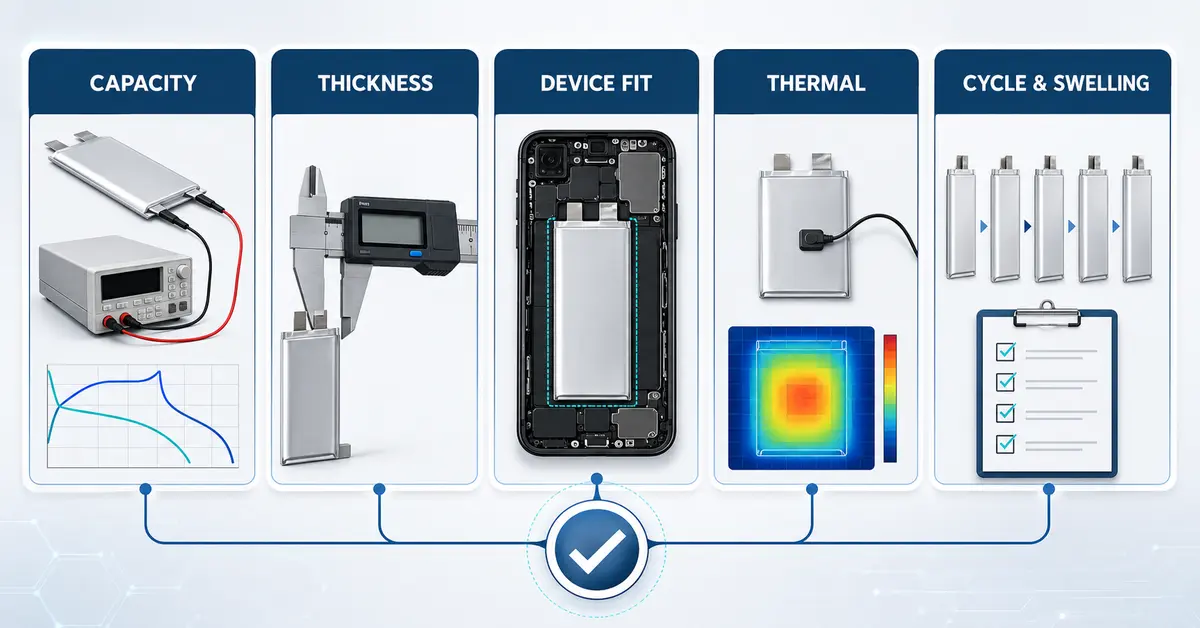
Build a Five-Layer Validation Matrix
| Validation layer | Main question | Evidence | Commercial risk controlled |
|---|---|---|---|
| Identity and fit | Does the sample match the approved model and installation space? | Dimensions, connector, flex route, label and device installation record | Installation failure, pressure and wrong-SKU returns |
| Capacity and energy | Does measured output support the stated rating? | Controlled charge-discharge report and raw curves | Capacity complaints and misleading claims |
| Electrical behavior | Does the pack operate consistently under the intended load? | Voltage, internal resistance, protection and device-function records | Shutdown, fast drain and unstable charging |
| Thermal and mechanical behavior | Does temperature or thickness change create device risk? | Sensor data, thermal images and repeated thickness measurements | Heat complaints, pressure and swelling |
| Cycle and batch consistency | Does performance remain controlled over time and across samples? | Cycle curves, retention, thickness trend and multi-sample statistics | Early degradation and sample-to-production drift |
Verify Identity, Thickness and Installation Fit First
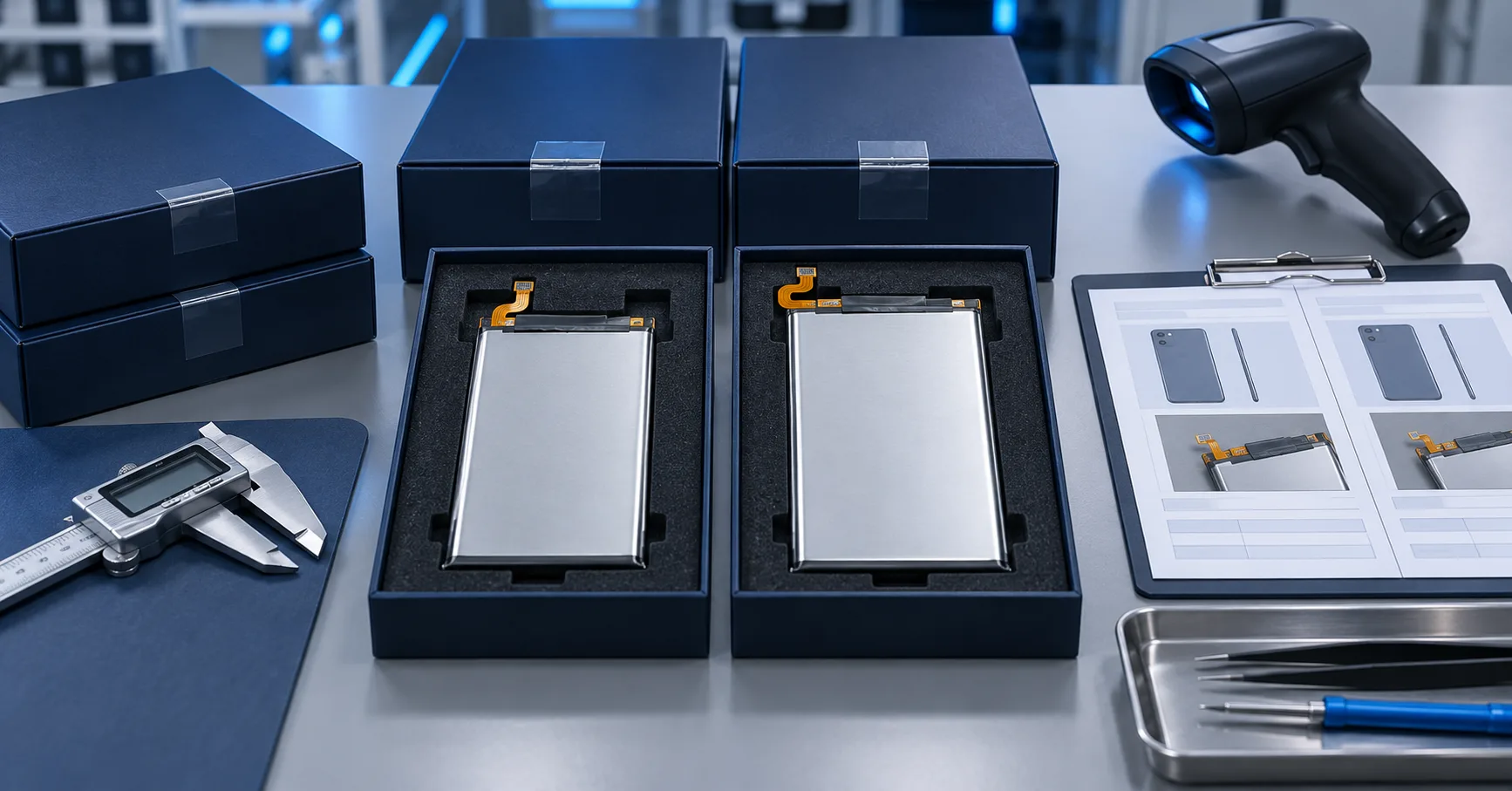
A higher stated capacity has little value if the battery places pressure on the display, rear cover, connector or internal frame. Begin with dimensional inspection before electrical cycling.
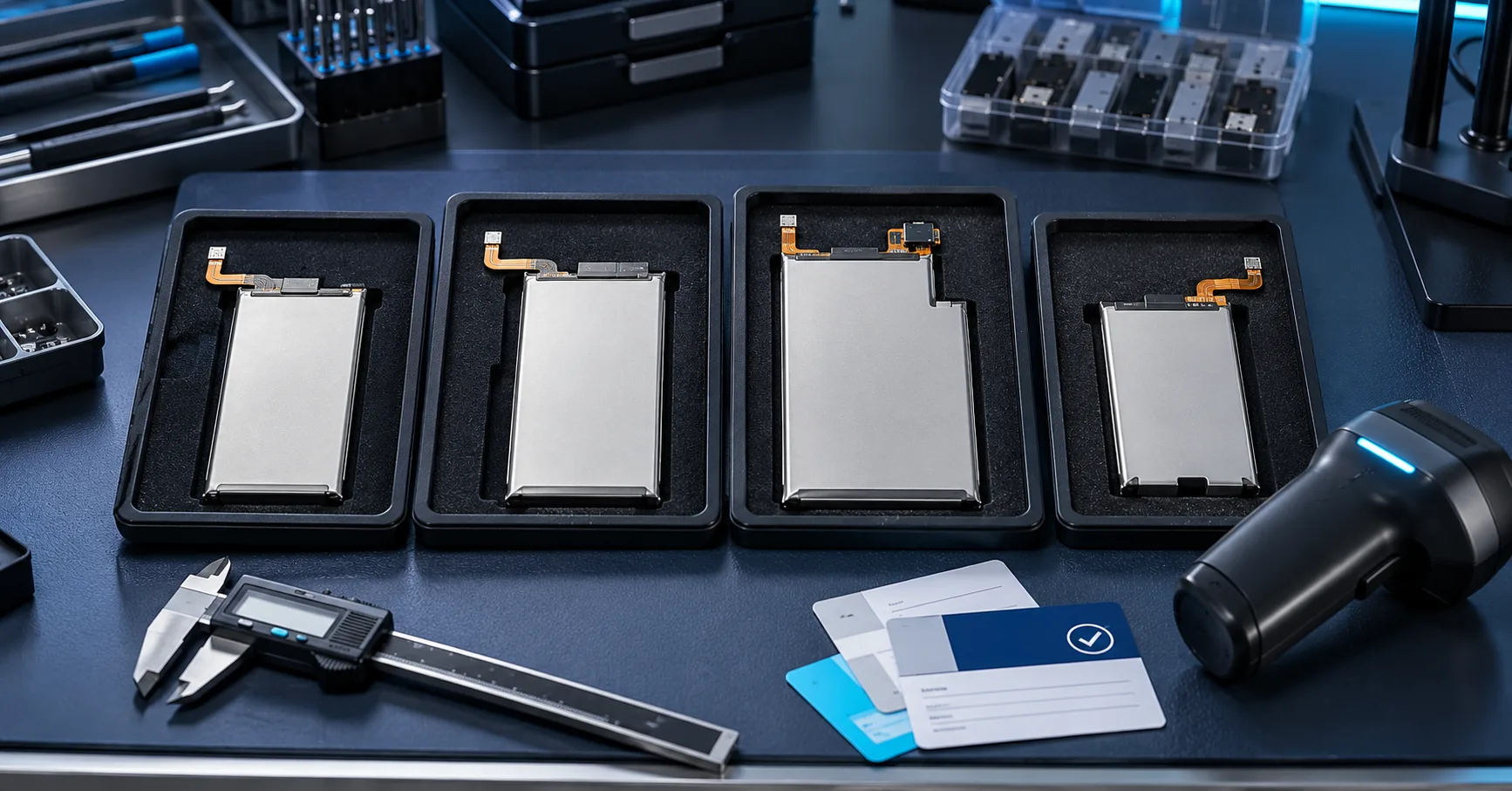
Measure length, width and thickness at defined locations with a specified instrument and contact force. Record the sample temperature and state of charge because battery dimensions can vary with condition. Compare all samples with the approved drawing and original installation envelope.
Installation validation should check:
- connector housing and pin orientation;
- flex-cable length, bend radius and routing;
- alignment with adhesive and pull-tab locations;
- clearance from cameras, charging coils, frames and covers;
- absence of rocking, compression or forced closure;
- device boot, charge recognition and battery-percentage behavior;
- removal without puncture or uncontrolled deformation.
Photograph the battery before installation, after installation and after removal. Record any marks showing contact pressure. A “fits the phone” statement is incomplete unless the installation method and inspected clearances are documented.
Measure Capacity Under Controlled Conditions
Capacity results cannot be compared when charging current, cutoff voltage, rest time, discharge rate, cutoff condition, temperature or sample history changes. Approve the method before comparing suppliers.
A useful test record includes:
- sample identification and manufacturing batch;
- initial voltage and storage history;
- charging current, voltage limit and termination rule;
- rest time after charging;
- discharge current or power profile;
- discharge cutoff condition;
- ambient and battery temperature;
- measured ampere-hours and Watt-hours;
- complete voltage, current and temperature curves;
- equipment model, calibration status, operator and date.
Use multiple samples rather than approving the highest result. Compare the average, spread, lowest result and any abnormal curve. A supplier should not compensate for one weak sample by presenting only a favorable average.
ESC’s phone battery runtime acceptance framework can support device-level verification, while laboratory capacity testing should remain a separate controlled measurement.
Test Temperature as a Curve, Not a Single Number
Temperature should be recorded throughout charging, rest, discharge and device operation. A final surface reading can miss a transient peak, sensor lag or localized hot area.
Define sensor type, location, attachment method, ambient conditions and sampling interval. For device tests, keep software, signal conditions, screen brightness, background activity, charger and test sequence consistent. For bench tests, define airflow and fixture contact.
Compare samples under the same load. Investigate:
- rapid temperature rise early in charge;
- higher temperature near the connector or protection board;
- inconsistent temperature between nominally identical samples;
- charging interruption or repeated current throttling;
- temperature that remains elevated during rest;
- capacity results achieved only under unusually light test conditions.
Temperature alone does not identify the root cause. Cell resistance, protection design, connection quality, charging strategy, device heat and mechanical compression can all contribute.
Monitor Thickness and Swelling Throughout Cycling
Do not wait until a battery is visibly swollen. Establish a thickness baseline at the same charge condition, temperature, rest period and measurement points used for later readings.
The test plan should include measurements at sample receipt, after initial conditioning, at defined cycle intervals and after the final rest period. Record photographs and mass where useful. Use a fixture that does not hide expansion or create uncontrolled pressure.
Research on silicon-containing anodes shows why mechanical behavior requires attention, but it does not justify assuming that every silicon-carbon product will swell. The purpose of silicon carbon battery sample testing is to observe the actual finished design under relevant conditions.
Stop testing and quarantine a sample if it develops abnormal deformation, leakage, odor, excessive temperature, unstable voltage or damaged insulation. Do not compress a suspect battery to continue the test.
Design a Cycle Test Around the Buyer’s Use Case
A cycle result is meaningful only when its conditions are stated. Define:
- charge and discharge rates;
- upper and lower voltage limits;
- rest periods;
- ambient and fixture temperature;
- capacity measurement intervals;
- thickness and temperature checkpoints;
- end-of-test criterion;
- handling of interruptions and invalid cycles.
Review capacity retention together with energy efficiency, internal resistance, temperature and thickness. A smooth capacity number can hide increasing resistance or mechanical change. Conversely, one abnormal reading should be retested under the approved deviation procedure rather than deleted.
Do not create a universal cycle guarantee from a short sample test. The buyer should define what evidence is required before sample approval, pilot order, mass production and marketing claims.
Separate Bench Results From Device-Level Performance
A cell or battery pack can perform normally on a tester yet behave differently in a phone because the device controls charging, calibration, thermal limits and shutdown behavior.
Use a controlled device matrix with known-good phones. Record device model, operating-system version, charger, cable, initial settings and background conditions. Check:
- installation and boot;
- charging recognition and current behavior;
- battery percentage progression;
- standby drain and controlled runtime;
- peak-load stability;
- shutdown percentage;
- temperature at repeatable locations;
- post-test physical condition.
Third-party replacement batteries must not be described as genuine or authorized parts. System messages and battery-health behavior should be recorded accurately for the tested model and software version.
Approve a Golden Sample and Freeze Critical Inputs
Sample approval should create a manufacturing reference, not merely an email saying “quality is good.” Retain approved samples and freeze:
- cell model or controlled material specification;
- protection-board design and firmware;
- connector, pinout and flex cable;
- battery dimensions and tolerances;
- adhesive and insulation materials;
- label artwork and claims;
- test method and acceptance limits;
- packaging and traceability format.
Require advance notification for changes. A new cell source, protection component, flex design, thickness, capacity rating or manufacturing site may require partial or full revalidation.
Convert Sample Results Into Production-Lot Controls
Mass production cannot repeat a long cycle test on every unit. Translate sample evidence into practical controls:
- identity and traceability verification;
- dimensional sampling;
- open-circuit voltage and internal-resistance screening;
- capacity sampling under the approved method;
- appearance and insulation checks;
- connector and flex-cable inspection;
- device installation sampling;
- charging and protection-function checks;
- periodic cycle and thickness verification;
- quarantine and corrective-action rules.
The incoming buyer can combine this plan with ESC’s mobile phone battery incoming inspection guide and warehouse storage SOP.
Common Sample-Approval Mistakes
- Approving the chemistry name instead of the exact model.
- Testing only one favorable sample.
- Comparing capacity results from different methods.
- Measuring thickness at different charge conditions.
- Using one temperature reading after the test.
- Claiming cycle life from a short validation run.
- Ignoring device installation and software behavior.
- Failing to retain raw curves and photographs.
- Allowing unapproved cell or protection-board changes.
- Assuming the production lot will match the sample automatically.
Frequently Asked Questions
Does silicon-carbon automatically mean higher phone-battery capacity?
No. The material can support higher energy-density designs, but actual capacity depends on the complete cell and pack. Verify the exact model using a controlled charge-discharge method.
Are silicon-carbon batteries more likely to swell?
Silicon expansion is an engineering challenge at electrode level, but swelling risk cannot be assigned to every finished product from the chemistry name alone. Validate thickness, temperature and cycling on the actual design.
How many samples should a buyer test?
There is no universal number. Select a sample plan based on design maturity, order size, supplier history, test duration and risk. Include enough units to evaluate variation, not just a single demonstration sample.
Can measured capacity alone approve the battery?
No. Capacity should be reviewed with fit, resistance, temperature, protection behavior, cycle retention, physical condition and device performance.
Should the same limits apply to every phone model?
No. Device space, charging control, capacity, structure and use conditions differ. Establish model-level specifications and methods.
What should be revalidated after a supplier change?
Review the affected risks whenever the cell, anode formulation, protection board, connector, flex cable, dimensions, adhesive, manufacturing site or test method changes.
Approve Evidence, Not a Technology Label
A silicon-carbon phone battery should earn approval through traceable capacity, fit, thermal, cycle and mechanical evidence. The strongest B2B program connects an approved sample to frozen specifications, change control and repeatable production-lot inspection.
Send ESC your target phone model, capacity goal, installation space, order quantity and validation requirements. ESC can prepare samples and model-level records for your evaluation. Capacity, cycle, temperature and safety claims must be confirmed for the specific design and test method.
External Source References
- Nano-Micro Letters — Innovative Solutions for High-Performance Silicon Anodes, 2024
- Nature Communications — Hierarchical Porous Silicon Structures with Mechanical Strength, 2020
- HONOR — HONOR Magic V3 Silicon-Carbon Battery Product Information