
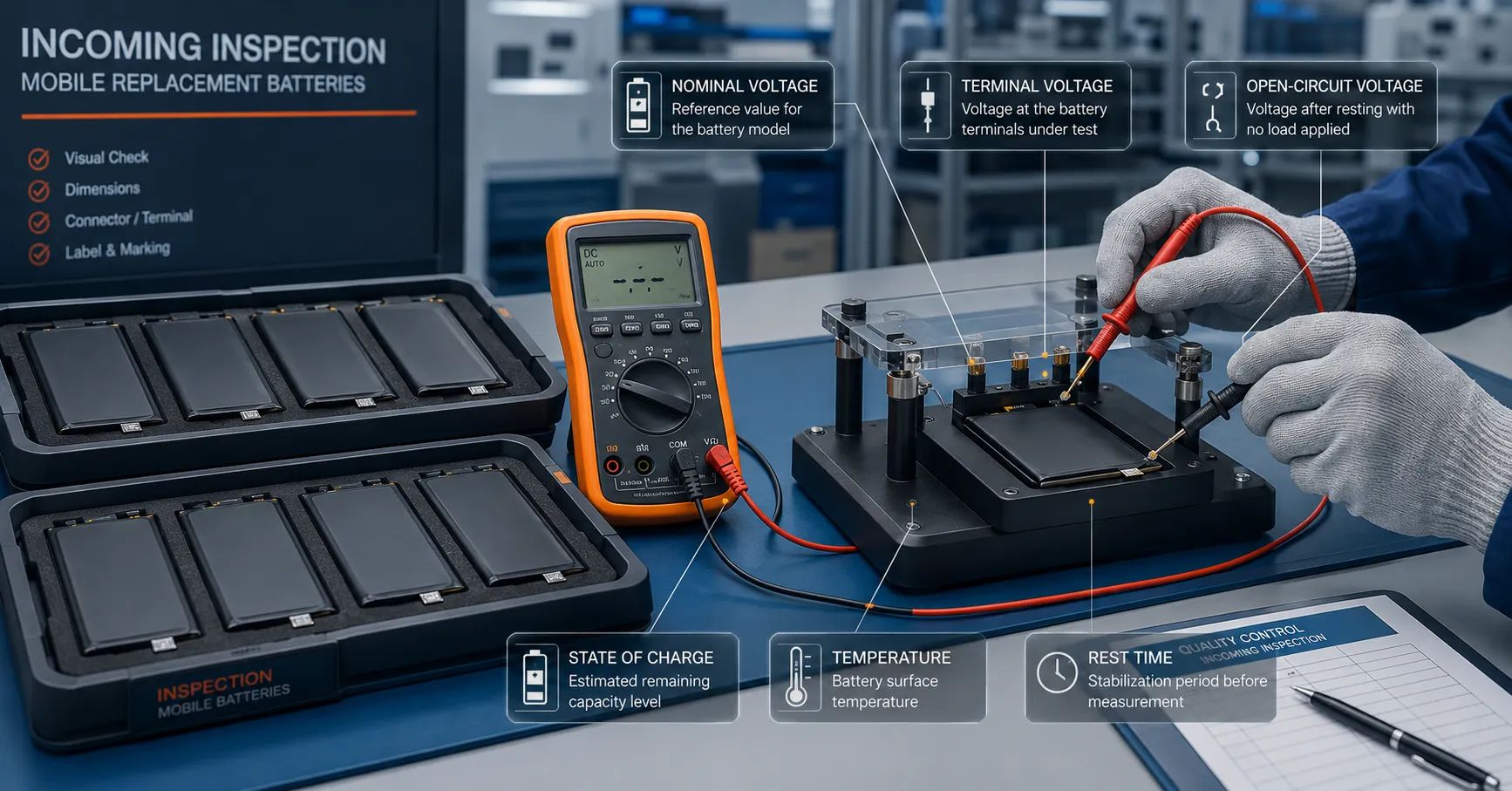
Phone battery voltage is a screening measurement, not a complete quality verdict. It can help a B2B buyer confirm battery identity, polarity, electrical condition and lot consistency. It cannot by itself prove rated capacity, runtime, cycle life, low internal resistance or safe device compatibility.
For useful incoming-inspection results, procurement and IQC teams must define the battery model, measurement point, instrument, temperature, rest time and recent charge or discharge history. The measured value should then be compared with an approved specification and a qualified reference lot for the same SKU. A universal pass value copied from another battery model is not a defensible release rule.
Separate Nominal Voltage, Terminal Voltage and OCV
| Term | What it means | Appropriate buyer use | Common misuse |
|---|---|---|---|
| Nominal voltage | A specification value used to identify and describe the battery system | Confirm offered SKU and device design basis | Treating it as the voltage every sample must show |
| Terminal voltage | The voltage measured across the accessible battery terminals at that moment | Check polarity, gross abnormality and condition under defined circumstances | Calling every terminal reading true OCV |
| Open-circuit voltage | Voltage associated with an unloaded, sufficiently relaxed battery condition | Support SoC estimation and model-specific consistency screening | Measuring immediately after charging or loading and calling it OCV |
| Loaded voltage | Terminal voltage while current is flowing | Observe voltage stability and drop under a defined load | Comparing it directly with relaxed OCV limits |
| Charge-limit or cutoff value | A model- and chemistry-specific control threshold | Verify charger, protection and cell specifications | Assuming it is the nominal voltage or an incoming OCV target |
These terms answer different questions. The voltage of phone battery samples in a carton may vary because their state of charge and recent history differ, even when the batteries share the same nominal specification. Before rejecting a lot, determine whether the comparison used equivalent conditions.
Why OCV Requires a Relaxed Condition
True open-circuit measurement assumes that the battery is not being charged or discharged and has had enough time to relax. Immediately after charging, discharging or device operation, polarization and recovery effects can make the terminal voltage unsuitable for a stable comparison.
Texas Instruments explains in its open-circuit voltage measurement guidance that a true OCV measurement requires an unloaded and relaxed battery condition; its fuel-gauge implementation also evaluates voltage, current and temperature because real systems cannot always reach a perfect open-circuit state. The exact relaxation rule in a supplier laboratory should come from the approved cell and test method, not from an unrelated device example.
Build the incoming procedure around a defined stabilization temperature, rest period and measurement sequence. Record exceptions such as samples received hot, cold, recently charged or recently loaded. If the required condition is not met, label the reading as a terminal-voltage observation rather than a qualified OCV result.
OCV Can Support SoC Estimation but Does Not Equal Capacity
State of charge (SoC) describes the estimated remaining charge relative to an applicable full-charge reference. OCV can contribute to that estimate because the relationship between voltage and state varies with the cell profile. However, one generic voltage-to-percentage chart is not reliable for every battery chemistry, design, age and temperature.
TI’s fuel-gauge accuracy and verification report defines OCV as terminal voltage after an extended rest and explains that available capacity is affected by battery characteristics, load and impedance. TI’s broader battery gauging overview also describes algorithms that use factors beyond voltage, including current, temperature, resistance and learned battery parameters.
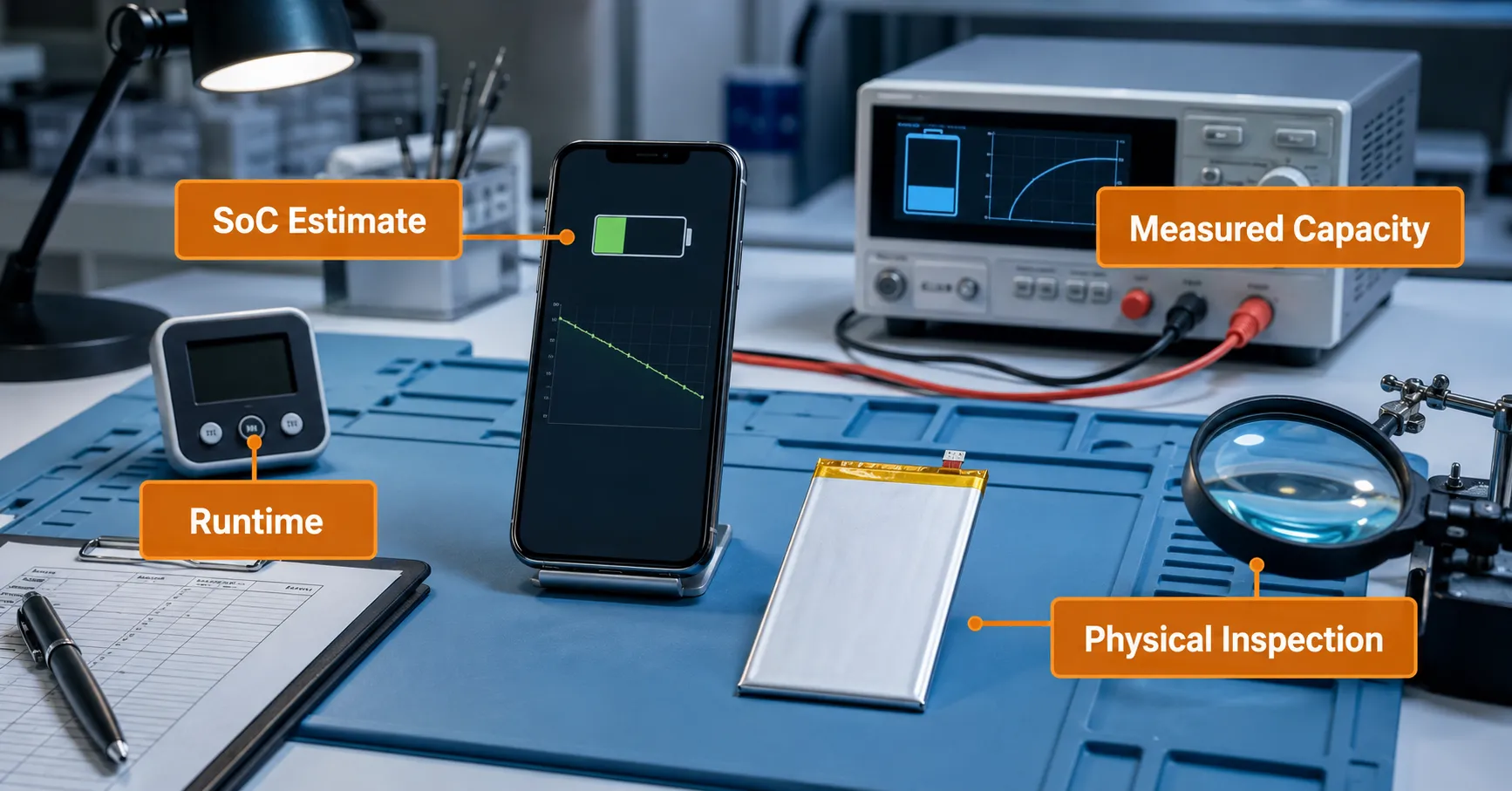
This is why a normal-looking phone battery voltage does not prove that the unit delivers its labelled capacity. Capacity requires a controlled charge and discharge method with the applicable current, cutoff, temperature, timing and measurement equipment. Capacity claims must be verified for the specific battery model and test method.
Control Temperature, Rest Time and Recent History
Comparability matters more than collecting a large number of uncontrolled readings. At minimum, the work instruction should record:
- battery model, revision, supplier and lot;
- received date and storage condition;
- sample temperature or controlled-room condition;
- time since charge, discharge, transport or device operation;
- defined rest start and measurement time;
- instrument ID, range, resolution and calibration status;
- measurement points and polarity;
- individual results, lot statistics and disposition.
A supplier should not compare samples measured at different temperatures or immediately after different electrical histories and then describe the variation as manufacturing inconsistency. When conditions cannot be standardized, quarantine the comparison or repeat it under the approved method.
Use OCV for Batch Screening, Not as a Standalone Release Test
OCV can reveal outliers, polarity errors, open connections, unusual self-discharge exposure or inconsistent received condition. Its strongest B2B use is comparative: same SKU, same method, same conditioning window and an approved reference population.
Define the alert logic from model-specific evidence. A useful control plan may include an expected window, a retest band and a hold condition, but the numerical limits must be approved for the particular battery. The program should also define whether a shifted lot mean, increased spread or isolated extreme value triggers additional sampling.
The published mobile phone battery incoming-inspection guide connects electrical screening with identity, appearance, pouch, connector and dimensional checks. Voltage should remain one line of evidence inside that broader acceptance plan.
Check Polarity, Connector and Protection-Board Behavior
Before measuring, confirm the approved pinout and safe access points. Do not assume that visually similar connectors share the same polarity or signal layout. Use fixtures and probes that reduce the risk of short circuit, connector damage or accidental contact with adjacent pins.
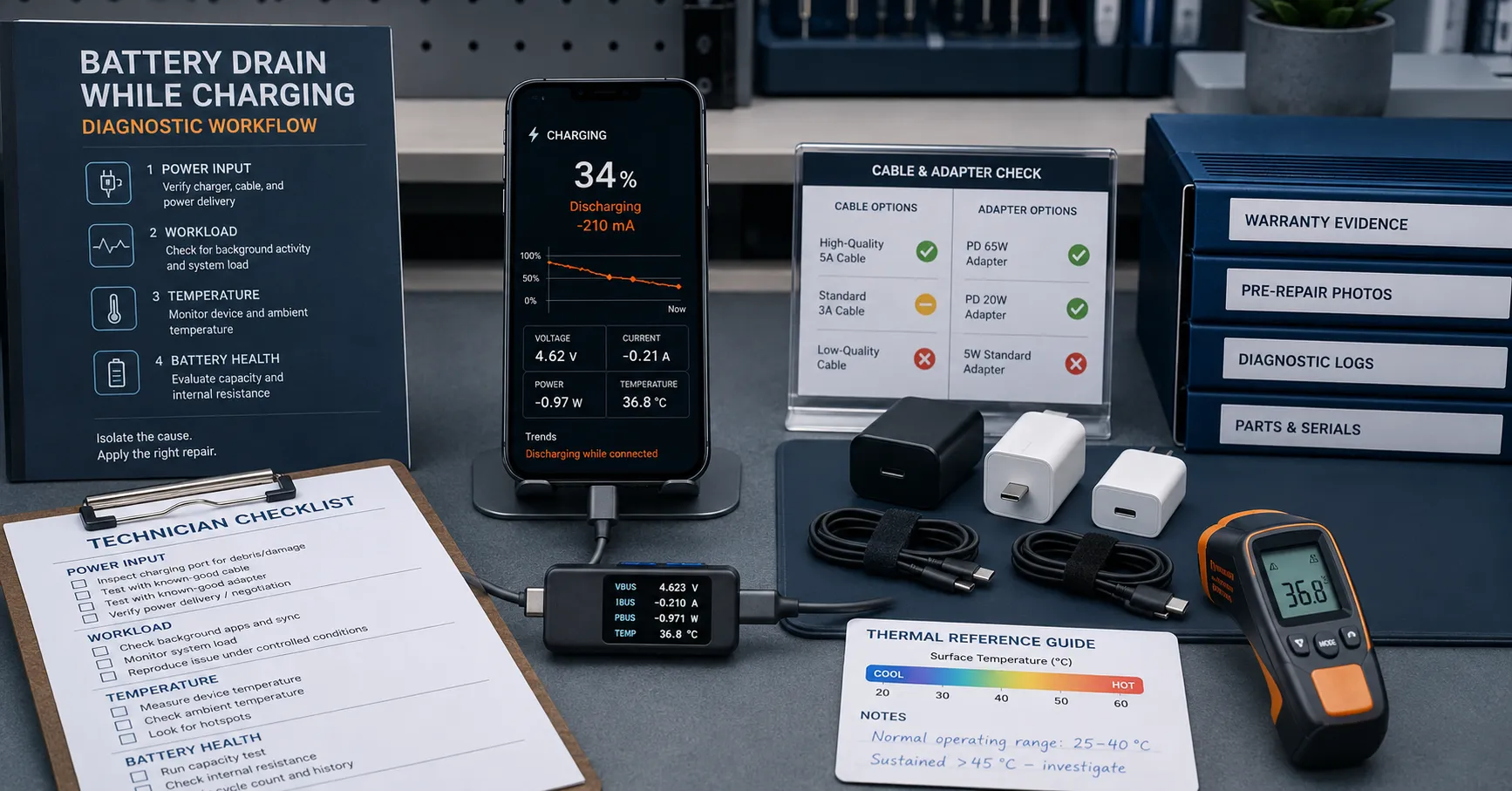
A finished phone replacement battery may include a protection circuit, flex and communication connections. A zero or unexpected terminal reading can reflect a depleted cell, an open protection path, connector damage, an incorrect measurement point or another assembly fault. It does not automatically identify the root cause.
If safe troubleshooting is within the approved procedure, compare the result with the drawing, protection specification and known-good assembly. Do not bypass protection, puncture a pouch, force current into an abnormal sample or improvise a recovery charge during routine incoming inspection.
Pair Voltage With Internal Resistance and Capacity Evidence
Voltage, internal resistance and capacity answer related but different questions. OCV provides information about relaxed electrical condition and can assist SoC interpretation. Internal resistance screening can identify changes in voltage response when the method, SoC, temperature and instrument are controlled. Capacity testing measures delivered charge or energy under a defined cycle.
| Check | Useful evidence | Does not prove by itself |
|---|---|---|
| OCV | Received condition, SoC-related comparison and lot outliers | Capacity, runtime, cycle life or full safety |
| Internal resistance | Batch consistency and voltage-drop risk under a controlled method | Rated capacity or compatibility |
| Capacity test | Delivered charge or energy under stated conditions | Mechanical fit or all field-use behavior |
| Device test | Charging, load behavior, reporting, shutdown and installation fit | Every future lot without change control |
The existing internal-resistance topic should own AC-IR method selection, four-wire measurement and resistance trend analysis. This voltage guide owns nominal-versus-measured terminology, relaxed OCV conditions, SoC interpretation, polarity checks and voltage-driven hold decisions.
Define Clear Retest and Hold Conditions
A battery should enter a controlled hold process when the result cannot be safely or credibly released. Examples include:
- wrong polarity or an unapproved connector/pinout;
- visible swelling, leakage evidence, heating, odor, seal damage or deformation;
- voltage outside the approved model-specific window after valid conditioning and repeat measurement;
- an unusually broad distribution or shifted lot trend versus the approved reference;
- a zero or unstable reading that may indicate an open protection path or assembly fault;
- missing identity, revision, lot or measurement-condition records;
- a mismatch between specification, label, drawing and measured configuration.
Hold does not automatically mean supplier rejection. It means the affected stock is segregated while the team confirms the instrument, method, sample identity and likely failure mode. The escalation path should specify who can authorize retest, expanded sampling, destructive analysis, return or concession.
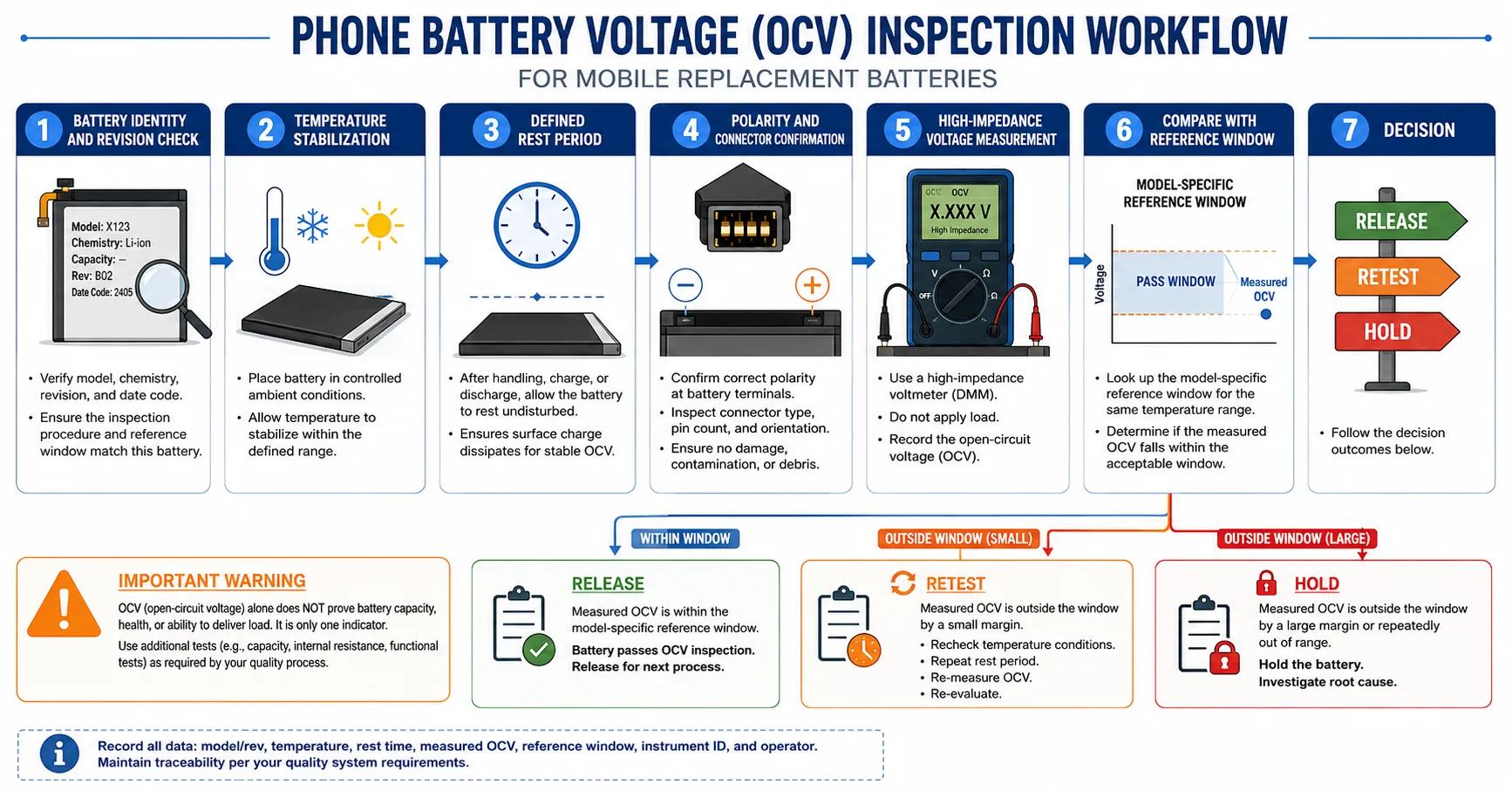
Build the Incoming Inspection Workflow
- Confirm identity. Match model, revision, label, dimensions, flex and connector against the approved record.
- Inspect condition. Check packaging, pouch, seals, insulation, terminals and deformation before electrical contact.
- Stabilize samples. Apply the approved temperature and rest conditions.
- Verify the setup. Confirm meter status, fixture, polarity and measurement points with a known reference.
- Measure and record. Capture individual values without rounding away meaningful variation.
- Compare correctly. Use the SKU-specific window and reference distribution, not a generic internet chart.
- Retest exceptions. Repeat only under the documented retest rule; do not keep testing until a sample passes.
- Disposition the lot. Release, expand sampling, hold or escalate with traceable authorization.
Use the published mobile phone battery sampling-plan guide to separate engineering approval, pilot-lot confirmation and production-lot sampling. A single acceptable reading is not evidence for every unit or future revision.
Protect Voltage Consistency During Storage
Inventory age, temperature, packaging condition and handling history can change the received electrical state. Track lot, date, storage location and inspection status so a voltage shift can be investigated rather than hidden inside mixed inventory.
The mobile phone battery storage SOP provides a related framework for environmental monitoring, rotation, physical protection and isolation. Do not publish one universal storage interval or shelf-life promise without model-specific evidence.
Prepare a Decision-Ready RFQ and QC Agreement
Ask the supplier to confirm the battery model, cell designation, nominal voltage, approved charge and cutoff limits, connector and pinout, protection-board revision, shipment condition, storage requirements and applicable OCV inspection method. The agreement should identify conditioning, instruments, sample plan, pass/retest/hold rules, lot traceability and change notification.
The exact phone battery volts accepted at incoming inspection must be tied to the selected SKU and test conditions. MOQ depends on the selected model and customization scope. Lead time depends on model, customization and order quantity. Warranty depends on the specific product and agreement.
Frequently Asked Questions
What is the normal voltage of a phone battery?
There is no single universal incoming reading for every phone battery. Confirm the model’s nominal voltage, charge limits and approved OCV window, then measure under the specified temperature and rest conditions.
Can OCV show the battery percentage?
OCV can support SoC estimation when the cell profile and conditions are known. It should not be converted through a generic chart without considering chemistry, temperature, relaxation, age and measurement method.
Does correct voltage prove full capacity?
No. A battery can show a plausible voltage yet fail a controlled capacity or load test. Voltage, capacity, internal resistance and device behavior require separate evidence.
Should batteries be measured immediately after arrival?
Visual and identity checks can begin promptly, but qualified OCV comparison should follow the approved stabilization and rest method. Record transport or temperature exceptions before interpreting results.
Why can the voltage change after the battery rests?
Terminal voltage can recover after charging or discharging stops as the cell relaxes. That is why recent electrical history and rest time must be standardized.
When should an abnormal voltage trigger a lot hold?
Use the model-specific control plan. A confirmed out-of-window result, polarity error, unstable reading, unsafe physical condition or unexplained lot shift should trigger segregation and investigation rather than automatic use.
Use Voltage as Evidence, Not as a Shortcut
The practical answer to voltage of a phone battery questions is always conditional: which battery, measured where, after what history, at what temperature and against which approved specification? Once those fields are controlled, voltage and OCV become efficient tools for screening identity, received condition and batch consistency.
They remain only part of the decision. Combine them with appearance, dimensions, connector, protection, internal resistance, capacity, device testing and traceability before approving a replacement-battery lot.
For an ESCCharge sourcing discussion, provide the target device models, battery identifiers, nominal-voltage specification, connector and pinout, required sample quantity, inspection method, market and packaging needs. Compatibility, capacity, specifications, MOQ, lead time, documentation and warranty must be confirmed for the selected SKU and agreement.
External Source References
- Texas Instruments — bq27531-G1 Technical Reference Manual: Open-Circuit Voltage Measurement Background — revised 2018
- Texas Instruments — Accuracy and Verification Methodologies for Advanced Fuel Gauges — 2014
- Texas Instruments — Battery Fuel Gauges and Gauging Algorithm Overview — accessed 2026