
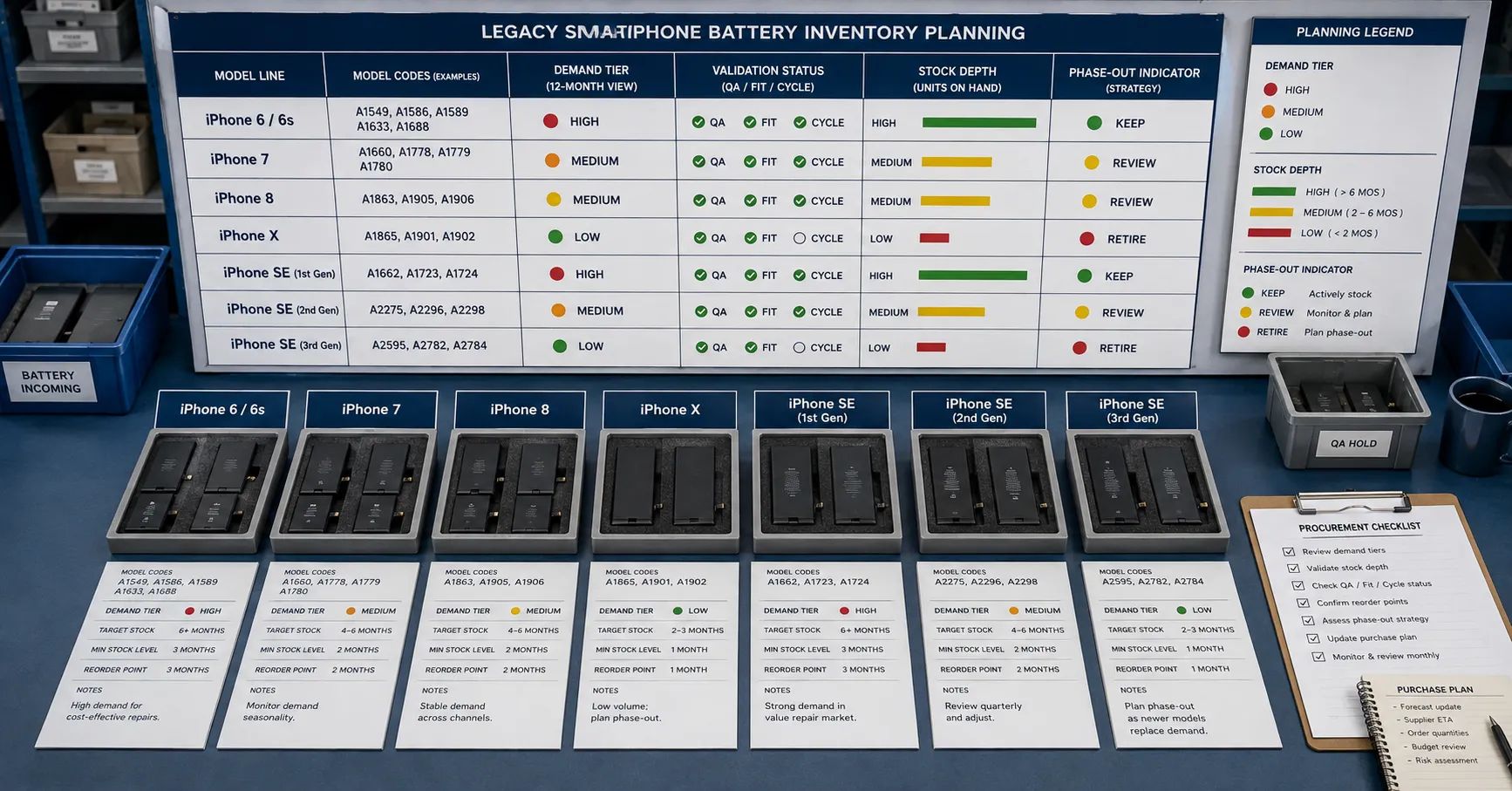
A legacy iPhone replacement battery portfolio should be built around verified repair demand, exact device identity and controlled inventory exposure. Repair chains and wholesalers should not stock every iPhone 6, 6s, 7, 8, X and SE battery at the same depth. The correct assortment separates high-turn core items, regional items, long-tail service stock and models that should be ordered only after confirmation.
Older models can produce useful repair demand, but they also create risks: similar names, Plus and non-Plus variants, multiple SE generations, aging inventory, uncertain repeat orders and device values that may not support every repair. This guide explains how to turn those variables into a buyer-owned SKU plan. It does not state that ESCCharge currently supplies every model listed; availability, specifications and order conditions require confirmation.
Start With Device Identity, Not the Sales Name
“iPhone 6 battery” or “iPhone SE battery” is not precise enough for purchasing. Apple provides an official model-identification list showing model numbers and regional variants. Apple also explains how to find the model number in Settings or on the device in its model-number guidance.
Record the commercial device name, generation, screen-size variant, full A-number, sales region and other buyer-approved identifiers. Do not merge iPhone 6 with 6s, standard with Plus, or first-generation SE with later SE models because the names seem related. Each device-to-battery mapping needs documentary and sample evidence.
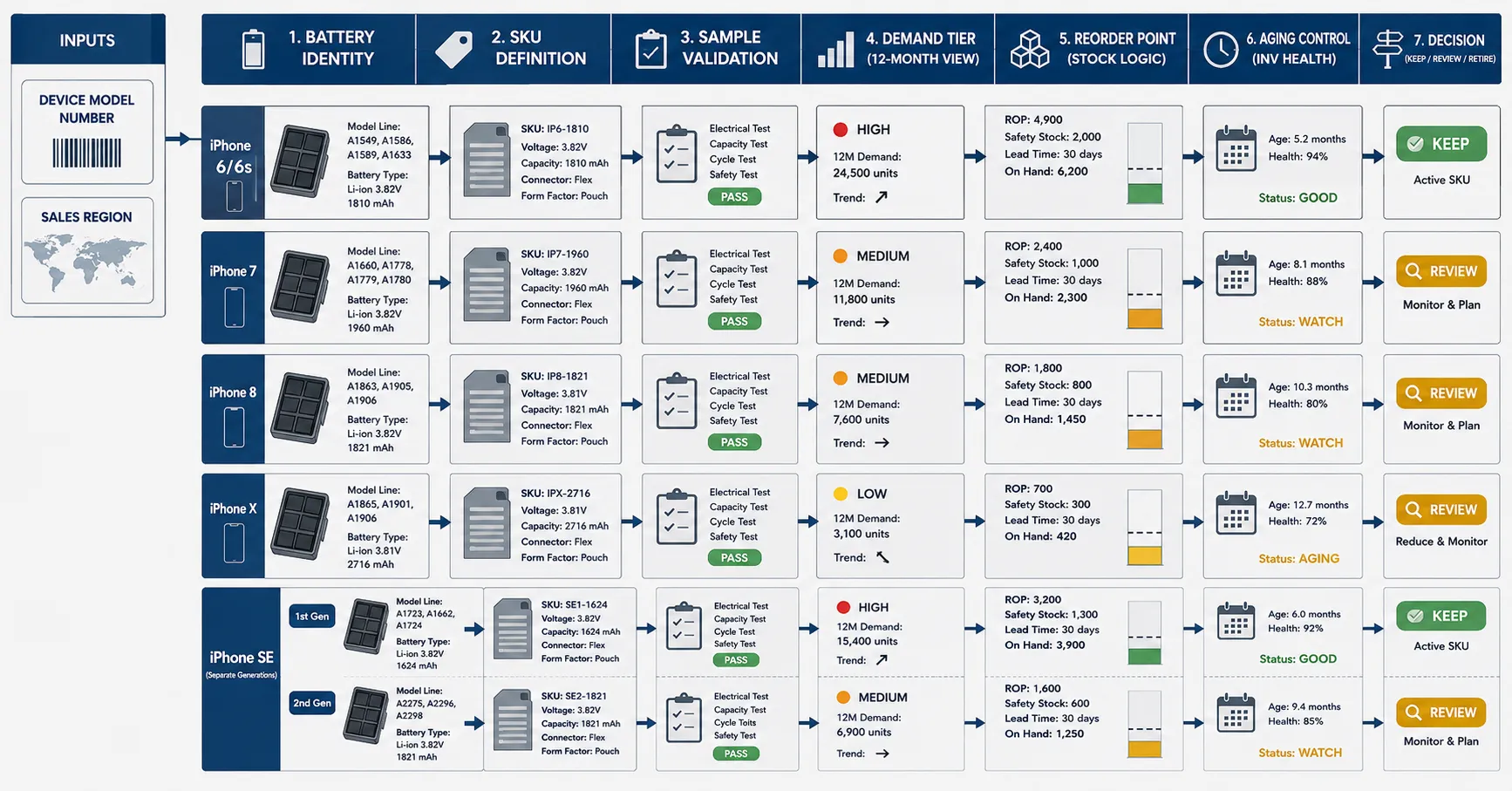
Build a Buyer-Owned Model Master
| Portfolio family | Variants to keep separate | Primary planning question |
|---|---|---|
| iPhone 6/6s | 6, 6 Plus, 6s and 6s Plus | Is local repair demand sufficient to justify four active records? |
| iPhone 7 | 7 and 7 Plus | Which version turns fast enough for regular replenishment? |
| iPhone 8 | 8 and 8 Plus | Should both remain core, regional or long-tail stock? |
| iPhone X family boundary | X must not be casually merged with XR, XS or XS Max | Which exact models are included in this portfolio? |
| iPhone SE | 1st, 2nd and 3rd generation | Can sales and warehouse systems prevent generation mix-ups? |
For every battery SKU, store the supplier part code, battery identifiers, drawing revision, connector and flex information, target device codes, approved regions, cell or electronics revision, sample-report number and status. Keep customer-facing aliases for search, but use the controlled internal code for purchasing and picking.
Separate Compatibility Evidence Into Levels
A catalogue match is not the same as an approved production SKU. Use evidence levels so sales teams know what can be promised:
- Claimed: a supplier lists the model, but the buyer has not reviewed supporting evidence.
- Document matched: identifiers, drawings and specifications have been compared; device testing is pending.
- Sample approved: defined samples passed mechanical, electrical and functional checks in identified devices.
- Pilot approved: a production-representative lot reproduced the sample results.
- Conditional: approval is limited to named device codes, regions, revisions, quantities or sales channels.
- Hold or retired: the mapping cannot be sold until investigation is complete, or the business has ended support.
The mobile phone battery sampling plan can structure the movement from engineering samples to pilot and lot release. Never let one installation approve a family of related names.
Use Repair Demand Rather Than Search Volume Alone
Keyword demand can indicate interest, but stock decisions should use the buyer's repair tickets, quotations, sales history, device population, market income level, labor economics and return data. An older model may have search volume but low completed-repair demand. Another may remain important in a specific region even when global attention is limited.
Measure monthly inquiries, confirmed orders, fill rate, lost sales, gross-margin assumptions, average inventory age and warranty claims by exact model. Separate one-time promotional orders from recurring demand. Review at least enough periods to distinguish a stable service base from a temporary spike.
Assign Four Inventory Tiers
Core Stock
Use for repeatedly ordered, validated SKUs with predictable replenishment. Core does not mean unlimited depth; set reorder points using actual consumption, supplier lead-time confirmation and safety-stock policy.
Regional Stock
Use when a model matters in certain countries, carriers or customer groups. Store the permitted markets in the item record so a regional approval does not become a global listing.
Long-Tail Service Stock
Use small controlled quantities for infrequent but profitable repairs. Long-tail items need tighter aging review because demand may stop before inventory is consumed.
Order After Confirmation
Use when demand is rare, compatibility evidence is incomplete, or minimum-order exposure is high. Sales should confirm the exact device and availability before quoting a firm delivery date.
Old iPhone battery SKU planning should allow movement between tiers. A quarterly review can promote a validated fast mover, reduce a declining item or retire a record that no longer has acceptable evidence or economics.
Treat Apple Service Status as One Risk Signal
Apple maintains a changing vintage and obsolete products page. Apple describes vintage products as those it stopped distributing for sale more than five and less than seven years ago, and obsolete products generally as those it stopped distributing more than seven years ago. Service and parts availability can depend on product, location, law and availability.
This classification is relevant to portfolio risk, but it does not measure independent repair demand or prove third-party battery availability. Use it to trigger review of service expectations, customer disclosures and phase-out timing. Recheck the official page before publication and during scheduled portfolio reviews because individual models can move between lists.
Validate Samples by Exact Model
Inspect packaging, labels, pouch condition, edge seals, insulation, connector, flex route, adhesive area and key dimensions. Verify polarity and electrical condition using an approved safe method. Install in documented test devices without forcing the connector, compressing the pouch or changing the intended cable route.
Functional testing should cover boot, wired charging, applicable wireless charging, stable discharge, unexpected restart or shutdown, capacity, controlled runtime and temperature. Record test equipment, ambient conditions, starting state of charge, software build and device condition. Capacity claims must be verified for the specific battery and method.
Use the incoming-inspection framework for receiving control. Sample approval should freeze the relevant battery code, drawing, cell or electronics revision, connector, flex, label and test method before the first production lot is accepted.
Do Not Apply One System-Message Rule to Every Generation
Parts and Service History support differs by iPhone generation and software. Apple's official service-history page explains the supported parts and possible status messages. Do not assume a result from a newer phone applies to iPhone 6, 7, 8, X or every SE generation.
For each approved SKU, record the software observations relevant to that device. Keep system presentation separate from capacity, fit and charging performance. A favorable screen does not prove battery origin, measured capacity or safety, and independent replacement batteries must not be described as Apple genuine or Apple-authorized parts.
Plan iPhone 6 and 6s as Multiple SKUs
iPhone 6 replacement battery wholesale programs should distinguish iPhone 6, 6 Plus, 6s and 6s Plus. These four names create frequent quotation and picking risk when sales descriptions are shortened. Use separate barcodes, bins and product images. Require the device model before order confirmation.
Because these devices are old, review whether repair value, local demand and warranty exposure support regular stock. A high keyword count does not justify purchasing four deep inventories. Consider core status only for proven regional movers; use long-tail or confirmation-only rules for the rest.
Control iPhone 7, 8 and X Boundaries
Keep standard and Plus models separate for iPhone 7 and 8. Train sales teams not to treat physical familiarity as compatibility evidence. For the X-era range, avoid using “iPhone X battery” as a loose family label that silently includes XR, XS or XS Max. Each needs its own device mapping and validation status.
These families may occupy different inventory tiers by market. Review actual repair count and aging monthly. If an item becomes slow, reduce reorder quantity before existing inventory ages beyond the buyer's control window.
Treat iPhone SE as Three Generations
“iPhone SE” is especially vulnerable to order errors because it refers to distinct generations. The master record, product title, packaging label, barcode and warehouse location should show the generation explicitly. Do not rely only on a customer saying “small iPhone” or “SE battery.”
Sourcing batteries for the iPhone SE family should begin with device identification and demand by generation. A later-generation SE may have a different commercial life from the first generation, so combining their sales history can produce the wrong reorder decision.
Use Packaging and Warehouse Controls to Prevent Mis-Picks
Physically similar battery packages need prominent, consistent identifiers. Use the buyer's SKU, exact device name, approved model codes, revision and lot code. Avoid unsupported “original,” “OEM Apple” or universal-compatibility language.
Separate confusing variants in storage and require barcode or second-person verification for picking where error consequences justify it. Apply the battery storage SOP for environmental monitoring, rotation, periodic inspection, isolation and traceability.
Set Reorder and Aging Rules
A reorder point should reflect validated consumption, confirmed lead time, order quantity and desired service level. Do not use one rule for every legacy model. Core items may justify regular review and buffer stock; long-tail items may use a maximum on-hand quantity or customer-backed order.
Track received date, lot, inspection status and inventory age. Define review points for appearance, electrical screening and disposition according to the approved quality plan. Do not make a universal shelf-life claim without model-level evidence and documented storage conditions.
Design a Controlled Phase-Out Process
Retire a SKU when demand, evidence, supply continuity or repair economics no longer support it. Before retirement, stop automatic replenishment, identify committed customer orders, review remaining stock, communicate the last-order process and define warranty support for units already sold.
A replacement or superseding SKU should not inherit compatibility automatically. Validate the new construction and preserve the old lot history. If stock is removed, use an appropriate disposition route and keep records needed for claims.
Review Warranty Data by Model and Lot
Link every claim to the device, battery SKU, revision, lot, installation date and reported symptom. Separate capacity, charging, fit, swelling, connector, installation, software and host-device issues. The battery warranty evidence guide can support consistent intake and resolution.
Use return trends to change inventory tiers. A fast-selling item with rising mismatch claims should move to Hold, not remain core because of volume. A low-volume SKU with stable evidence may remain useful as controlled service stock.
Prepare a Decision-Ready RFQ
Send suppliers the exact device models and A-numbers, target regions, forecast mix, desired inventory tier, sample quantities, approved battery identifiers, capacity method, mechanical and functional tests, packaging, barcode, traceability and change-notification requirements.
Ask the supplier to identify unsupported or uncertain mappings instead of filling gaps with assumptions. ESCCharge can review a proposed model list and sampling structure after these details are available. Availability, specifications, compatibility, capacity, MOQ, lead time, certification documents and warranty must be confirmed for the actual SKU, market and agreement.
Frequently Asked Questions
Should a wholesaler stock every old iPhone battery?
No. Stock depth should follow verified local repair demand, compatibility evidence, inventory age and commercial risk.
Can iPhone 6 and 6s share one inventory record?
No. Keep 6, 6 Plus, 6s and 6s Plus distinct unless a specific mapping is documented and validated.
Is Apple vintage or obsolete status the same as independent repair demand?
No. It is a service-status signal, not a measurement of third-party market demand.
How should iPhone SE batteries be labeled?
Show the exact generation, buyer SKU, approved device identifiers, revision and lot to prevent mix-ups.
When should a legacy SKU be retired?
Retire it when demand, evidence, supply stability, quality or repair economics no longer justify continued replenishment.