
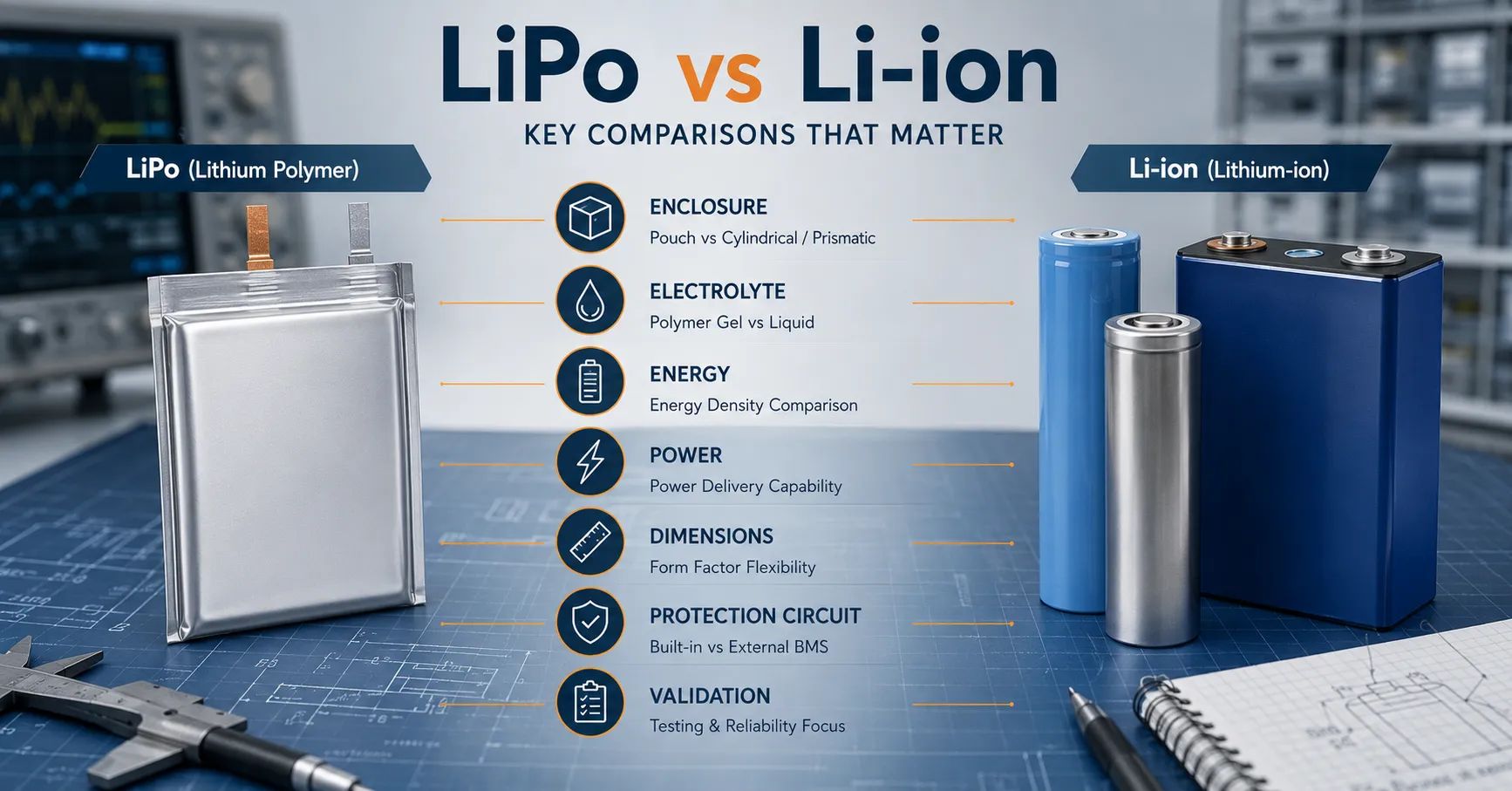
The most important answer to lipo battery vs li ion battery is that the labels are not always mutually exclusive. In consumer electronics, “LiPo” commonly refers to a rechargeable lithium-ion battery using a polymer-based or gelled electrolyte system and often a flexible pouch enclosure. “Lithium-ion” is the broader rechargeable battery family and can appear in pouch, cylindrical or prismatic formats with different electrode and electrolyte combinations.
For B2B replacement-battery buyers, the correct question is not simply which label is better. The decision should identify the exact cell chemistry, enclosure, dimensions, voltage limits, capacity method, power requirement, protection electronics, connector, flex, mechanical restraint, charging system, target device and supply evidence. Two products both sold as LiPo can perform differently, while two products described with different marketing labels may belong to the same regulated lithium-ion category.
Start With the Terminology
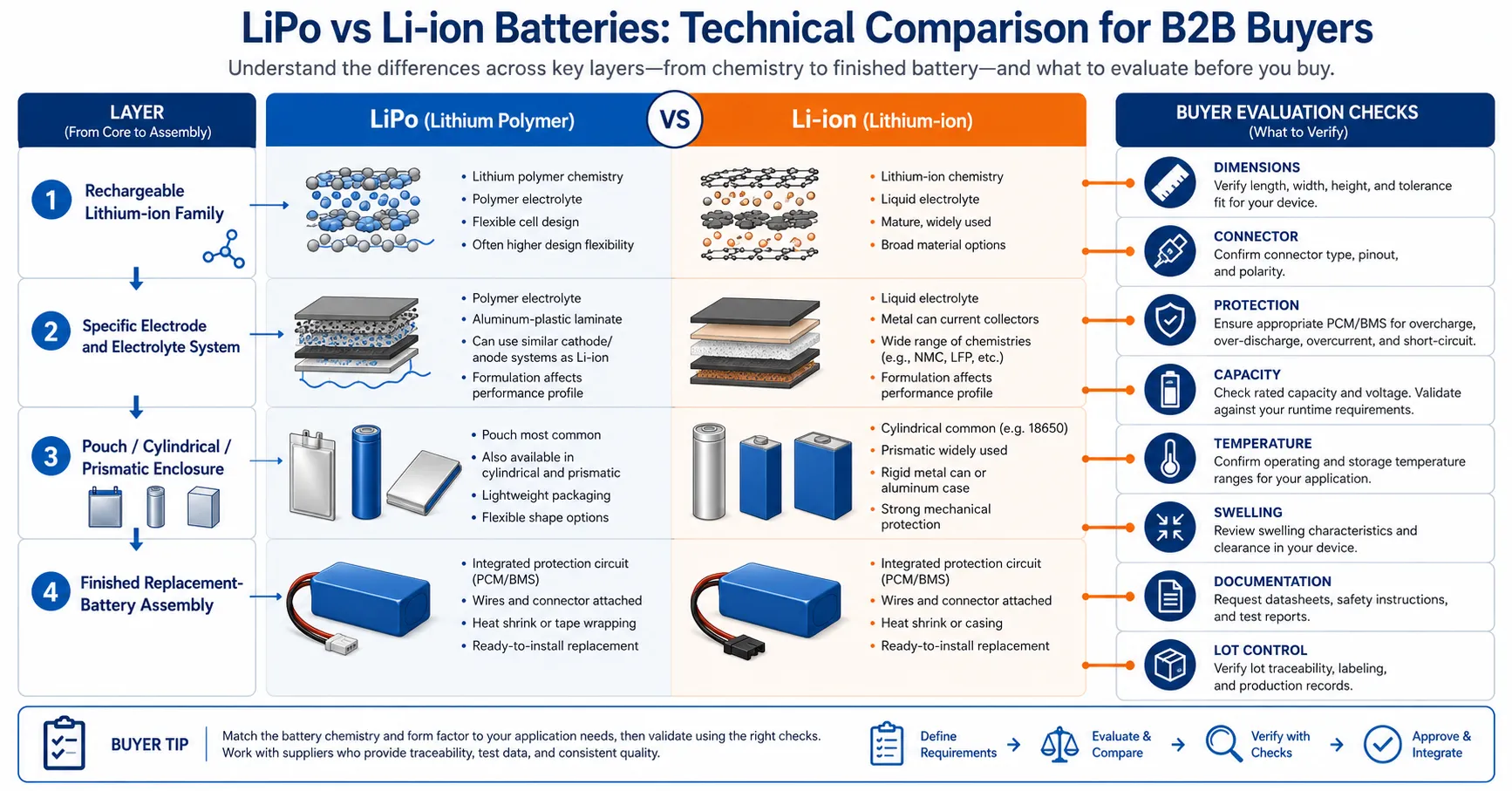
The U.S. Department of Energy describes lithium-ion cells as systems built from cathode, anode, separator and electrolyte components and notes that battery form factors can include cylindrical, prismatic and pouch designs. Its battery basics appendix also explains that electrolytes can be liquid, polymer, gel or ceramic. This means chemistry, electrolyte and enclosure should be recorded as separate fields.
For transport classification, IATA’s 2026 Battery Guidance Document treats rechargeable lithium-ion batteries as a broad regulated category. Earlier IATA explanatory material explicitly includes lithium polymer within the lithium-ion category. A buyer should therefore avoid assuming that a product called “LiPo” follows a completely separate shipping class.
Use Four Identification Layers
| Layer | Buyer question | Why the label is insufficient |
|---|---|---|
| Battery family | Is it rechargeable lithium-ion, lithium metal or another system? | Transport and charging rules begin with the correct family. |
| Cell chemistry | What cathode, anode and electrolyte system is used? | “Li-ion” alone does not define performance or limits. |
| Cell format | Is the cell pouch, cylindrical, prismatic or another approved design? | Format changes packaging, restraint, dimensions and integration. |
| Finished assembly | What connector, flex, protection circuit, insulation and adhesive are included? | A cell is not the complete replacement-battery SKU. |
Apply all four layers in the RFQ, sample report and item master. If the supplier provides only “LiPo battery” or “lithium-ion battery,” request the missing construction and specification evidence before comparing quotations.
Compare Pouch, Cylindrical and Prismatic Formats
A pouch cell uses a flexible laminated enclosure rather than a rigid metal can. This can support thin, application-specific shapes that are useful in smartphones, tablets and other space-constrained devices. The tradeoff is that the finished product must control compression, edge protection, adhesive, flex routing and clearance without damaging the pouch.
Cylindrical cells use a rigid cylindrical can and standardized shapes in many applications. Prismatic cells use a rigid or semi-rigid rectangular enclosure. Neither format is automatically safer, more powerful, longer lasting or more suitable. The correct choice depends on the verified cell design, device architecture, protection, thermal path, manufacturing control and use conditions.
NASA testing of lithium-ion pouch designs has examined long-term performance, pouch deformation and swelling under several conditions. The published pouch-cell safety and performance report shows why enclosure behavior and mechanical integration deserve their own validation rather than being inferred from the word “polymer.” Its space-oriented conditions should not be copied directly as consumer-electronics acceptance limits.
Do Not Infer Chemistry From Shape Alone
Many thin consumer-device batteries are described as lithium-polymer because they use a pouch format, but the commercial name may not fully identify the electrolyte or electrode materials. Conversely, a pouch is an enclosure format, not proof of one exclusive chemistry.
A technically useful specification should state the manufacturer’s cell designation, nominal voltage, charging limit, cutoff conditions, rated and minimum capacity definitions, dimensions and tolerances, mass, protection requirements and approved operating conditions. Any chemistry claim should be supported by controlled supplier documentation.
This terminology matters when comparing lithium polymer vs lithium ion battery offers. Without a precise definition, the buyer may compare marketing names instead of actual constructions.
Compare Energy and Capacity Under Defined Conditions
Capacity in ampere-hours does not by itself describe stored energy. Energy also depends on voltage, and the useful output depends on the test method, cutoff, rate, temperature and device behavior. A physically larger label value should not be accepted without model-specific evidence.
For replacement batteries, verify nominal capacity, minimum capacity where applicable, energy in watt-hours, nominal voltage, test current, charging method, discharge cutoff, ambient condition and measurement equipment. Capacity claims must be verified for the specific battery and method.
Do not publish a universal statement that LiPo has higher energy density than every lithium-ion alternative. Pouch packaging can reduce enclosure mass and fit thin spaces efficiently, but actual gravimetric and volumetric results depend on chemistry, electrodes, inactive materials, protection, tabs, packaging and finished dimensions.
Compare Power Delivery and Internal Resistance
A battery may meet a capacity target yet perform poorly under peak device load if voltage drops excessively or resistance is unstable. Buyers should define relevant load behavior, voltage stability, temperature observation and shutdown criteria for the target device.
Internal resistance can support batch screening when state of charge, temperature, rest time, instrument and method are controlled. It should not be used alone to declare capacity, cycle life or safety. Compare trends against an approved reference and investigate shifts by lot.
The phrase lithium ion battery vs lipo does not answer the power question. Obtain data for the actual cell and finished assembly rather than applying a chemistry stereotype.
Make Mechanical Fit a Release Gate
Replacement batteries have model-specific space and routing constraints. Verify length, width, thickness, tab location, connector, flex shape, bend region, insulation, adhesive position and clearance in approved devices. A cell that fits on paper can still create pressure or routing problems after tolerances and adhesive are included.
Do not force a pouch into a cavity, compress a swollen cell or alter the intended flex route to complete an installation. Compatibility must be confirmed by device model and battery specification.
Use the published mobile phone battery incoming-inspection guide to connect identity, packaging, pouch condition, dimensions, connector and electrical checks to lot acceptance.
Understand Swelling Without Making Absolute Claims
Pouch construction makes dimensional change visually apparent because the enclosure is flexible. That does not mean every pouch cell will swell or that rigid-can cells have no failure risk. Swelling and safety risk depend on cell quality, protection design, storage, charging and operating conditions.
Inspect incoming and returned units for thickness change, deformation, seal damage, edge stress, odor, leakage evidence, heating and installation pressure. Define isolation and escalation rules. Never continue charging or compressing a damaged pouch merely to reproduce a customer complaint.
The iPhone battery swelling investigation provides a related repair-buyer framework. This pillar page remains focused on construction and sourcing decisions rather than duplicating the full incident workflow.
Verify Protection Electronics and Device Integration
A finished replacement battery normally includes more than the cell. The protection circuit, flex, connector, insulation and device interface influence charging, discharging, fault response and system reporting. A supplier comparison that omits these components is incomplete.
Request the protection design scope, approved current and voltage limits, component revision, connector specification, flex drawing and change-notification process. Functional testing should cover charging, stable discharge, applicable device functions, unexpected shutdown, restart behavior and temperature under defined conditions.
Do not claim that a particular cell label guarantees battery-health display, no notification or no unknown-part message. Software presentation varies by device, repair approach, component configuration and software version and remains separate from capacity and safety evidence.
Design a Sample Approval Plan
A buyer comparing lipo vs lithium ion options should validate production-representative samples rather than isolated engineering units. The plan should define:
- exact battery and device identities;
- sample quantities and lot representation;
- documents, drawings and revision records;
- appearance, pouch, seal, insulation and dimension checks;
- connector and flex inspection;
- electrical condition and polarity;
- capacity and energy test methods;
- charging, discharge, load and temperature observations;
- installation and controlled runtime checks;
- failure classification, hold and escalation rules;
- pilot-lot comparison and supplier change notification.
The mobile phone battery sampling-plan guide can help structure engineering samples, pilot approval and production-lot release. One passing unit should not approve every model or future revision.
Compare Storage and Inventory Exposure
Storage risk depends on the specific battery, state of charge, environment, duration, packaging and handling. Track received date, lot, inspection status, inventory age and disposition. Separate slow legacy SKUs from regular-turn stock so aging does not disappear inside a blended inventory number.
Pouch cells require physical protection from bending, compression, puncture and terminal short circuit. Use the mobile phone battery storage SOP for environmental monitoring, rotation, isolation and traceability. Do not state a universal shelf life without model-level evidence.
Treat Transport Classification as a Separate Check
The choice between a marketing label and a cell format does not remove dangerous-goods responsibilities. The U.S. Pipeline and Hazardous Materials Safety Administration states that lithium cells and batteries offered for transport must meet applicable hazardous-material requirements and that manufacturers and subsequent distributors must make UN 38.3 test summaries available on request. See PHMSA’s lithium-battery transport guidance.
Confirm the actual cell or battery type, configuration, watt-hour rating, condition, packaging scenario, mode, route, market and carrier requirements. Certification and document availability must be confirmed for the specific model and target market. A factory’s general experience does not prove that the offered SKU has the required current documents.
Use a Buyer-Owned Comparison Scorecard
| Decision field | Evidence required | Reject shortcuts |
|---|---|---|
| Identity | Cell designation, chemistry, format and finished SKU revision | LiPo or Li-ion label alone |
| Fit | Drawing, tolerances and device installation evidence | Nominal dimensions without tolerance |
| Energy | Capacity and watt-hour method with conditions | Printed mAh alone |
| Power | Defined load, voltage and temperature observations | Generic “high power” claim |
| Safety controls | Cell, protection, insulation, handling and escalation evidence | “100% safe” or “zero swelling” |
| Consistency | Sample, pilot and lot-level records | One engineering sample |
| Transport | Applicable classification and current model documents | Factory-level certificate list |
| Commercial terms | Confirmed MOQ, lead time, remedy and warranty agreement | Unqualified standard promises |
Weight these fields according to the application. A thin smartphone battery may place high weight on thickness, pouch protection and flex routing. A speaker battery may emphasize runtime, connector, vibration environment and pack integration. The buyer owns the scorecard and acceptance limits.
Prepare a Decision-Ready RFQ
Send the supplier the target device models, approved battery identifiers, available cavity and tolerance, connector and flex requirements, nominal voltage, capacity and energy method, load profile, charging environment, temperature conditions, protection requirements, labels, packaging, traceability, target markets, forecast mix and change-control expectations.
Ask the supplier to identify what its “LiPo” or “lithium-ion” wording means for the offered SKU. Request the cell maker’s designation and the evidence permitted for disclosure. MOQ depends on the selected model and customization scope. Lead time depends on model, customization and quantity. Warranty depends on the specific product and agreement.
Frequently Asked Questions
Is LiPo different from lithium-ion?
LiPo is generally treated as a type within the rechargeable lithium-ion family, but commercial usage can emphasize electrolyte or pouch construction. Ask for the exact chemistry, format and finished assembly specification.
Is a pouch lithium battery always LiPo?
No universal inference should be made from the enclosure alone. Pouch describes a form factor. Confirm the manufacturer’s chemistry and electrolyte description for the actual cell.
Which type has higher energy density?
There is no safe universal winner based only on LiPo or lithium-ion wording. Compare actual watt-hours, mass, volume, test conditions and finished pack components.
Are LiPo batteries more likely to swell?
Pouch deformation is easier to observe because the enclosure is flexible, but actual swelling risk depends on design, quality, protection, storage, charging and operating conditions.
Can buyers use the same battery in several device models?
Only when each model mapping is documented and validated. Dimensions, connector, flex, protection and device behavior must be confirmed.
What should a buyer verify before bulk ordering?
Verify identity, chemistry, format, drawings, capacity method, power behavior, protection, fit, documents, traceability, samples, pilot consistency, MOQ, lead time and warranty terms for the actual SKU.
Select the Verified Battery, Not the Better-Sounding Label
A productive lipo battery vs li ion battery decision starts by recognizing that LiPo usually sits within the broader lithium-ion family. The buyer should then separate chemistry, electrolyte, enclosure and finished replacement-battery construction. This prevents a marketing name from substituting for the evidence that actually controls fit, energy, power, safety and supply performance.
Choose the battery whose model-level specifications and validation results meet the target device and business program. Do not choose a format because it is described as universally safer, newer or higher capacity.
For an ESCCharge sourcing discussion, provide the target devices, battery dimensions, connector and flex requirements, nominal voltage, capacity method, load profile, sample quantity, market and packaging needs. Availability, compatibility, specifications, capacity, MOQ, lead time, certification documents and warranty must be confirmed for the selected SKU and agreement.
External Source References
- International Air Transport Association — Battery Guidance Document for the 2026 Regulations — 2026
- U.S. Department of Energy — Battery Basics Appendix — 2023
- NASA Technical Reports Server — Safety and Long-Term Performance of Lithium-Ion Pouch Cells — 2012
- U.S. Pipeline and Hazardous Materials Safety Administration — Transporting Lithium Batteries — accessed 2026