
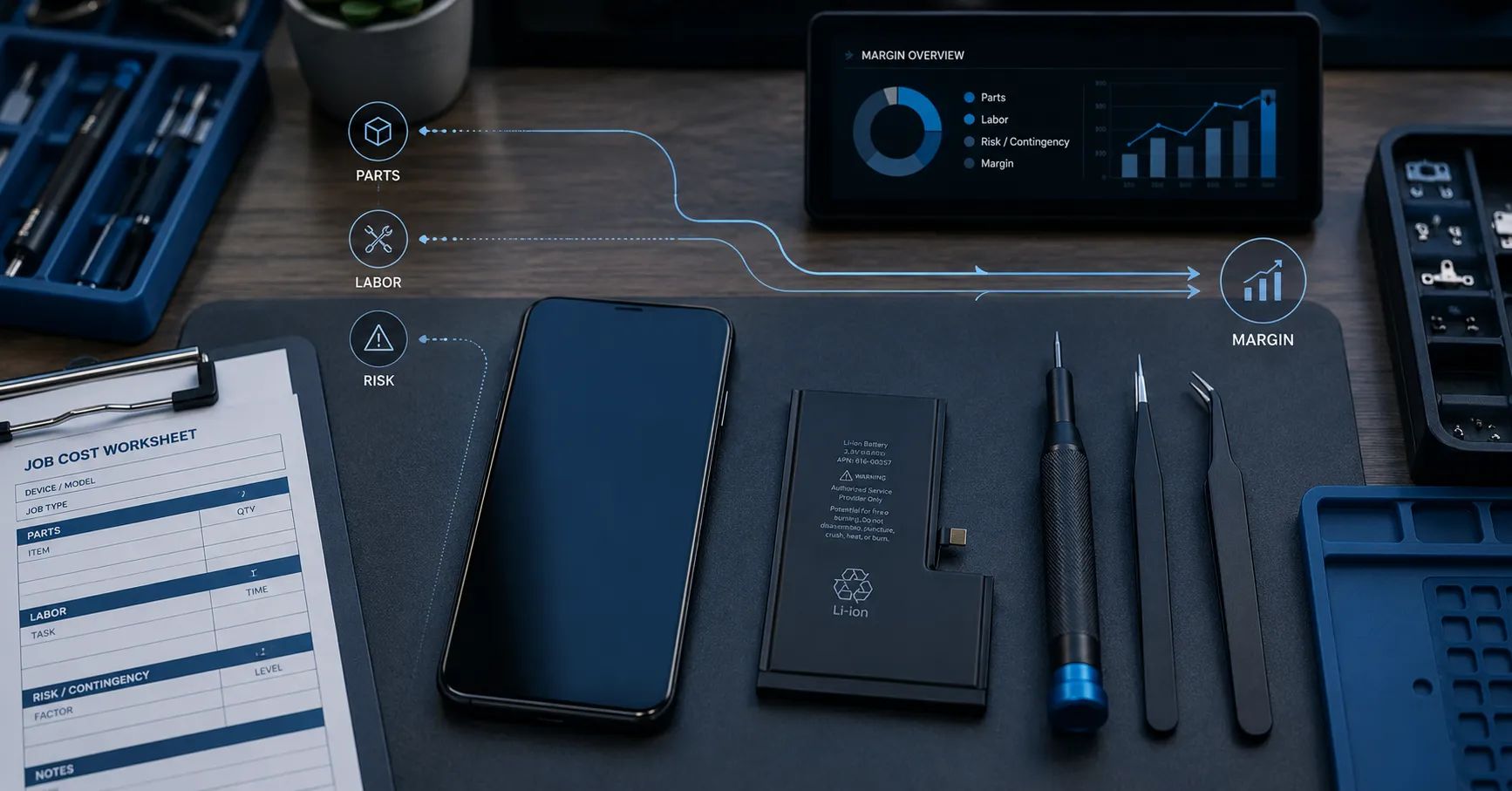
The correct iPhone battery replacement cost for a repair business is the expected cost of delivering one accepted, paid and supportable repair—not merely the price printed on the battery invoice. A useful model includes the landed battery, consumables, productive technician time, testing, failed installations, rework, warranty exposure, payment or marketplace fees and an appropriate share of operating overhead. Only after those inputs are calculated should the business set its selling price and margin target.
This distinction matters to repair chains, refurbishment facilities and independent workshops because two batteries with different unit prices can reverse their apparent ranking after installation yield and after-sales cost are included. The lowest quoted component can become the more expensive operational choice. Conversely, a higher-priced option does not automatically produce better economics; it must earn that position through documented fit, performance, consistency and support.
Separate Customer Price From Business Cost
A customer sees one service price. The operator sees several cost layers and a probability of future work. Keep these views separate. Customer price may vary with model, local competition, service speed, warranty, channel and tax treatment. Internal cost should be calculated from evidence the business controls.
Use one definition across purchasing, workshop operations and finance. If procurement compares invoice prices while operations tracks only technician minutes and finance includes refunds, departments will reach different conclusions about the same SKU. A shared job-cost record prevents a cheap-looking purchase from hiding downstream losses.
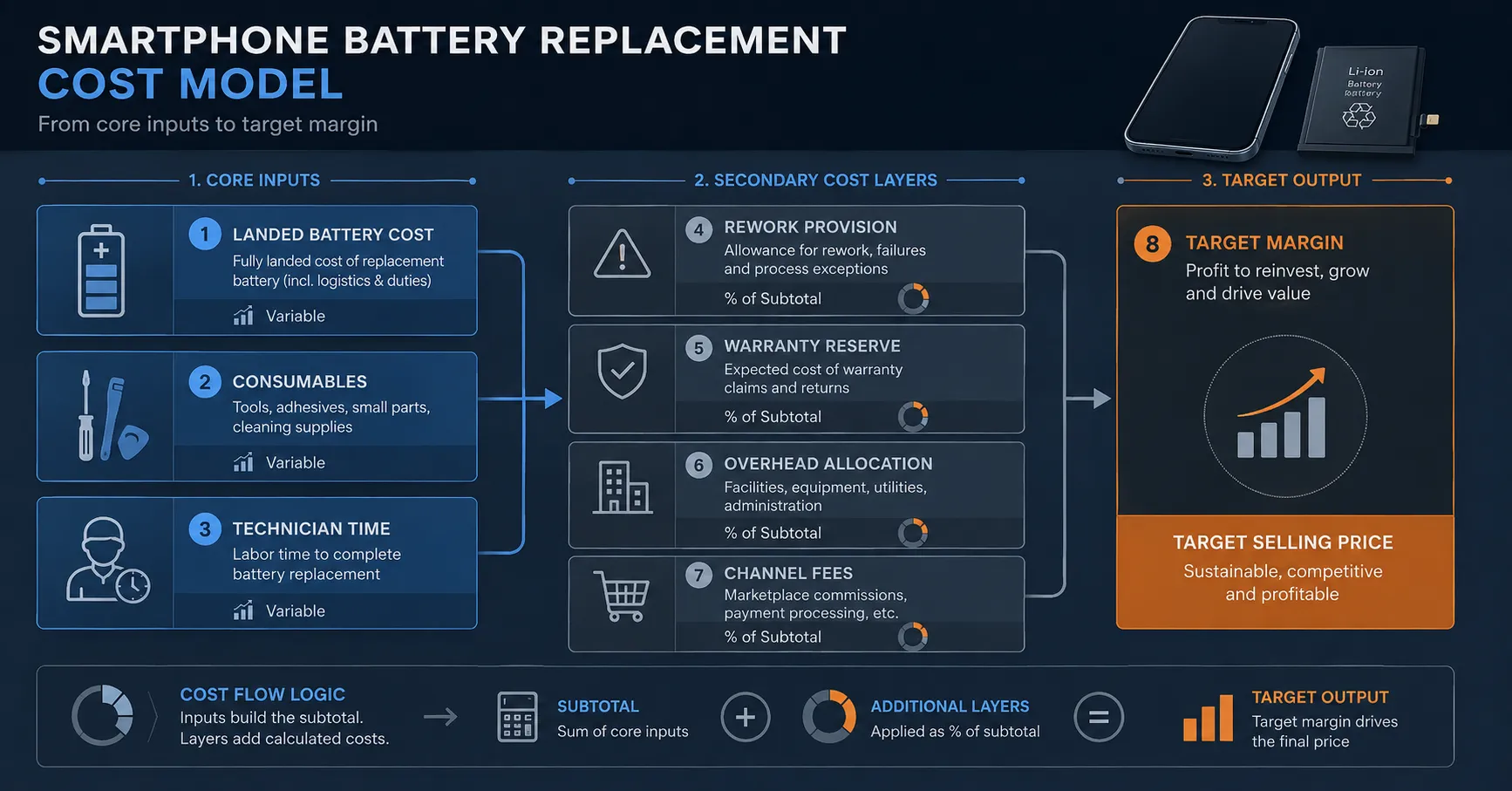
Build the Cost Model in Layers
| Cost layer | Typical inputs | Recommended basis |
|---|---|---|
| Landed battery | Unit price, freight, duty, inspection and inbound loss | Accepted units received, not units ordered |
| Direct consumables | Adhesive, seals, cleaning materials and protective items | Standard quantity plus actual waste |
| Direct labor | Intake, opening, replacement, reassembly and testing | Productive minutes × loaded labor rate |
| Yield and rework | Part defects, fit issues, installation errors and repeat testing | Observed rate by model, lot and technician group |
| Warranty reserve | Return handling, replacement part, repeat labor and refund risk | Historical claim cost per completed job |
| Overhead | Rent, supervision, tools, software, training and administration | Consistent allocation method |
| Channel cost | Payment, marketplace, referral or logistics fees | Actual percentage or per-order charge |
The model should calculate an expected cost rather than assume every job is perfect. A simple structure is:
Expected job cost = landed battery + consumables + direct labor + expected rework + expected warranty cost + allocated overhead + channel cost.
This is a management equation, not a universal accounting standard. Finance should confirm which costs belong in contribution margin, gross margin and operating-profit reporting for the company. What matters operationally is that the same scope is used when comparing models, suppliers and service channels.
Calculate Landed Battery Cost per Accepted Unit
Start with the supplier price, then add transport, import handling, duty where applicable, receiving inspection and other directly attributable inbound costs. Divide by units accepted for use, not simply units shipped. If 100 units arrive but some are quarantined or rejected, the usable units carry the inbound spend unless the supplier credit is confirmed.
Keep currency conversion and payment charges visible when they are material. Do not use a favorable quotation exchange rate after settlement occurs at another rate. For multi-location operations, separate central inbound freight from branch distribution so regional service economics are comparable.
Purchasing teams can use a documented mobile phone battery incoming-inspection process to identify which received units qualify for stock. Capacity, compatibility and acceptance claims must remain specific to the battery model and test method.
For purchasing comparison, track the replacement battery wholesale cost as an accepted landed-unit figure. A quotation without freight, receiving loss and supplier-credit status is not yet comparable with the cost already recorded for another source.
Measure Labor With Productive Minutes
iPhone repair labor cost should include more than the time when a technician physically moves the battery. Measure intake checks, data or condition acknowledgement, device opening, adhesive removal, installation, reassembly, charging checks, functional testing and job documentation. Include the expected portion of setup, cleanup and supervisor assistance where relevant.
Use a loaded labor rate that reflects the business's chosen cost definition. Record time by device family because an average across easy and difficult jobs can distort pricing. Separate training jobs from steady-state production, and do not set a permanent price from one unusually fast technician.
Utilization also matters. A technician paid for eight hours may not complete eight hours of billable repairs. If the business uses a loaded hourly rate based on paid time, the utilization assumption must be visible. Otherwise, unbooked time disappears from the model and the service appears more profitable than it is.
Add Consumables, Tools and Process Costs
Adhesive, seals, cleaning materials, protective films, labels and packaging may be inexpensive individually but meaningful across volume. Create a standard consumables kit for each job type and compare standard usage with actual withdrawal. Excess consumption can signal training, process or supplier-fit problems.
Reusable tools are normally allocated over expected useful work rather than charged fully to one repair. Include calibration, maintenance and replacement where applicable. Specialized fixtures or programmers should be evaluated against expected job volume, the models they support and the risk of obsolescence. Do not assume a tool investment is recovered simply because the shop owns it.
Convert Failure Rates Into Expected Cost
Yield is the bridge between technical quality and financial performance. Track first-pass completion: the share of jobs that pass installation and final checks without another battery, repeated disassembly or additional technician time. Record failure reason separately for incoming part, compatibility, physical damage, installation, test equipment, software observation and host-device condition.
Expected rework cost can be estimated as the probability of each failure route multiplied by its average consequence. For example, a repeated opening may consume labor and adhesive even when the battery itself is reusable. A damaged part may add both labor and another unit. Use actual internal observations; do not copy a generic failure percentage from another business.
A structured battery sampling plan can help screen a new model or lot before normal production. Sample approval is not a promise that every unit or every installation will pass, so lot traceability and incoming controls still matter.
Create a Warranty Reserve From Claim Evidence
A warranty reserve converts future service risk into a current expected job cost. Include the average cost of claim intake, diagnostics, replacement parts, repeat labor, shipping or customer handling, and refunds where applicable. Multiply claim frequency by average claim cost, using comparable models and time windows.
Do not treat every return as a battery defect. The battery warranty evidence framework can separate capacity, charging, fit, swelling, connector, installation, software and host-device issues. Accurate classification improves supplier corrective action and prevents the reserve from becoming an unexplained percentage.
Warranty terms depend on the specific product and agreement. A longer customer promise raises the period during which support costs may emerge, but it does not by itself prove product quality. Align the customer warranty, supplier remedy, traceability period and stored evidence.
Allocate Overhead Without Hiding Poor Jobs
Repair services consume rent, utilities, management, scheduling software, training, inventory control and customer support. Choose a stable allocation driver such as productive labor hours, completed jobs or workshop capacity. Avoid changing the method merely to make a model look profitable.
Contribution margin can still be useful for short-term decisions, provided management knows which overhead is excluded. For regular price setting, show both contribution and fully loaded views. This lets the business distinguish a job that helps cover fixed cost from one that earns the intended return after operating resources are considered.
Set the Selling Price From the Target Margin
Markup and margin are not interchangeable. If expected job cost is C and the target gross-margin rate is M, the price before applicable tax is commonly modeled as C ÷ (1 − M). Adding M percent to cost produces a markup, not the same margin percentage.
The battery replacement profit margin should be stress-tested rather than treated as one optimistic number. Build at least three scenarios:
- Base case: current observed labor, yield, warranty and channel inputs.
- Guardrail case: slower labor, a weaker but plausible first-pass yield and higher support cost.
- Improvement case: benefits only from changes already validated through training, process control or supplier performance.
Set a price floor and an approval rule for discounts. A promotion that removes the entire risk allowance can turn normal variation into a loss. Track realized selling price after discounts, refunds, fees and tax treatment rather than relying on the menu price.
Review the battery replacement profit margin at model and channel level. A blended company percentage can conceal a model that repeatedly consumes additional labor or a sales channel whose fees absorb the intended return.
Build a Battery Repair Cost Calculator With Buyer-Supplied Inputs
Use a worksheet with variables rather than publishing a universal price. Suppose a business enters LC for landed component cost, CU for consumables, LR for loaded labor rate per minute, TM for productive minutes, RW for expected rework, WR for warranty reserve, OH for overhead and CF for channel fees. The model becomes:
Total expected cost = LC + CU + (LR × TM) + RW + WR + OH + CF.
If the business targets margin M, the indicative pre-tax selling price is total expected cost divided by one minus M. Finance should then apply local tax and revenue-recognition treatment. The value of the example is not a fixed answer; it is the visibility of every assumption. Each variable can be replaced with verified data by model, supplier, branch and period.
A battery repair cost calculator should preserve the source and review date for each variable. This makes price changes auditable and prevents a temporary freight quote, training-time result or immature warranty period from silently becoming the permanent baseline.
Compare Suppliers by Cost per Successful Job
A supplier comparison should use the same device mix, inspection rules, technician cohort and observation period. Compare accepted landed cost, first-pass installation rate, average labor, rework, warranty claims, response time, traceability and confirmed remedy. Do not give a supplier credit for an unverified compatibility or capacity claim.
The iPhone replacement battery supplier assessment provides broader sourcing questions. For a commercial decision, connect those answers to the job-cost model: better documentation may reduce receiving effort; stable construction may reduce process variation; faster corrective action may reduce claim handling. These benefits should appear only after the buyer measures them.
Segment the Model by Device and Channel
Do not use one blended result for every iPhone generation. Device value, opening difficulty, part configuration, labor time, demand and customer price tolerance can differ. Maintain a model-level record and combine models only for management reporting after their individual economics are understood.
Also separate walk-in, mail-in, wholesale refurbishment and marketplace work. Each channel may carry different acquisition, logistics, payment and return costs. A high-volume contract can justify a lower selling price only when its process and risk profile support the decision.
Use Inventory Age in the Cost Decision
Slow stock ties up cash and may require inspection, controlled storage or disposition before it is sold. Track inventory age by model and lot. Include financing or carrying cost only under the business's approved method, but never ignore obsolete or unusable inventory when evaluating a product line.
The mobile phone battery storage SOP explains warehouse monitoring, rotation, isolation and traceability. Storage conditions and review rules should be documented; a universal shelf-life assumption should not be used without model-level evidence.
Monthly Management Checklist
- Reconcile invoice quantity, accepted quantity, supplier credits and landed cost.
- Update median productive minutes by exact device model and repair route.
- Review first-pass yield, rework reasons and parts consumed per successful job.
- Recalculate the warranty reserve from mature claim periods.
- Compare menu price with realized revenue after discounts and channel fees.
- Identify inventory aging, write-offs and models that need lower reorder limits.
- Investigate changes by supplier lot, battery revision, technician group and branch.
- Require approval when a discount crosses the cost or margin guardrail.
Frequently Asked Questions
Is the battery purchase price the most important cost?
No. It is visible and important, but labor, first-pass yield, rework, warranty and channel costs can change the ranking between two options. Compare expected cost per successful supported job.
Should every iPhone model use the same labor allowance?
No. Use observed time by model and process. A blended average can underprice difficult work and overprice efficient work.
How often should a repair business update its cost model?
Review high-volume lines monthly and whenever part price, freight, process, warranty behavior, device mix or channel fees change materially. Lower-volume models may need a longer evidence window.
Can a lower-cost battery improve margin automatically?
No. The saving is real only if compatibility, acceptance yield, installation performance and after-sales outcomes remain within approved limits.
What should be included in a battery RFQ?
Provide exact device models, target markets, forecast mix, required battery specifications, sample quantity, inspection and functional tests, packaging, traceability and change-notification requirements. Ask for confirmed MOQ, lead time, applicable documents and warranty terms for the actual SKU.
Turn Cost Data Into a Controlled Purchasing Decision
A durable pricing system connects procurement, workshop and finance data. Begin with the accepted landed part cost, add the resources required to complete the job, then price the expected rework and support burden. Review the result by model, lot and channel instead of relying on one industry average.
Recalculate iPhone battery replacement cost whenever the part source, repair method, technician time, failure rate, warranty evidence or sales channel changes materially. Keeping the original assumptions visible allows managers to explain whether a margin change came from purchasing, operations, pricing or customer support.
For an ESCCharge sourcing discussion, send the exact iPhone models, expected order mix, battery requirements, target market, sample plan and packaging needs. Availability, specifications, compatibility, capacity, MOQ, lead time, certification documents and warranty must be confirmed for the selected SKU and agreement. The final commercial decision should remain tied to the buyer's own validation and job-cost evidence.