
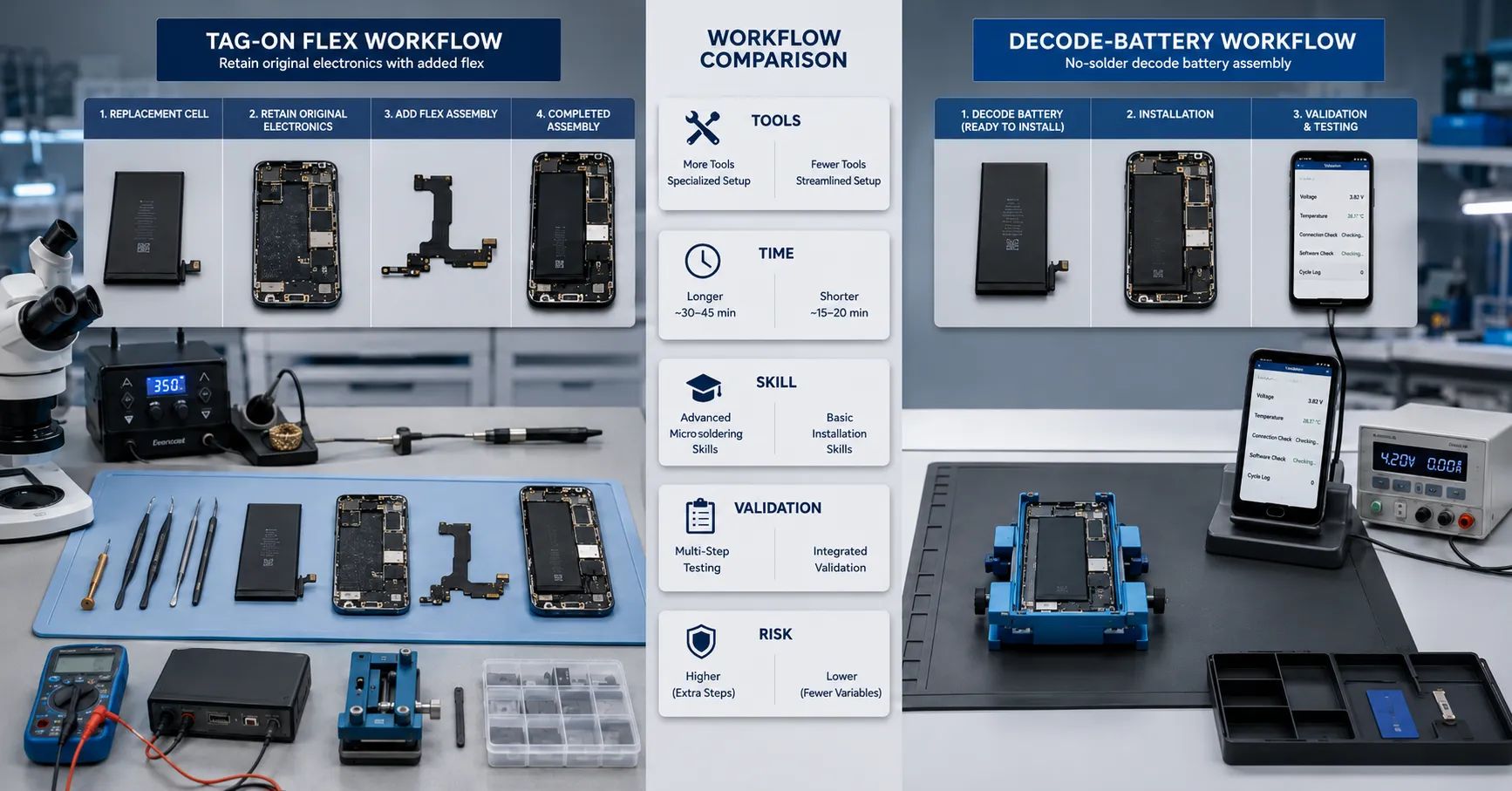
Tag-on flex vs decode battery is not a contest with one universal winner. Tag-on flex can suit repair or refurbishment operations that deliberately retain or adapt battery electronics and have the tools, skills and controls to manage that process. A finished decode-battery design can suit programs that prioritize a simpler installation path and more standardized technician work. The right choice is the method that produces the lowest controlled cost per accepted device for the exact models, software versions and service conditions involved.
Buyers should compare complete workflows rather than component descriptions. Health information, the absence of an immediate notification and a Parts and Service History result are separate observations. Neither architecture should be marketed as permanently “no popup,” universally compatible or Apple genuine merely because one test phone shows a favorable screen.
Define Both Solutions Before Comparing Them
“Tag-on flex” normally refers to an added interface used within a repair-market battery workflow, but the retained components, connection method and programming steps can differ between suppliers. “Decode battery” commonly refers to a more complete replacement assembly intended to simplify one or more transfer, welding, added-flex or on-site programming steps. Neither term is an Apple product category or a complete purchasing specification.
Request photographs, drawings and installation instructions for each candidate. Identify the cell, retained electronics, added interface, protection components, connector, insulation and adhesive. State what arrives from the supplier and what the technician must reuse, prepare, connect or program. A fair comparison is impossible when one option includes a finished assembly and the other price covers only a cell and interface.
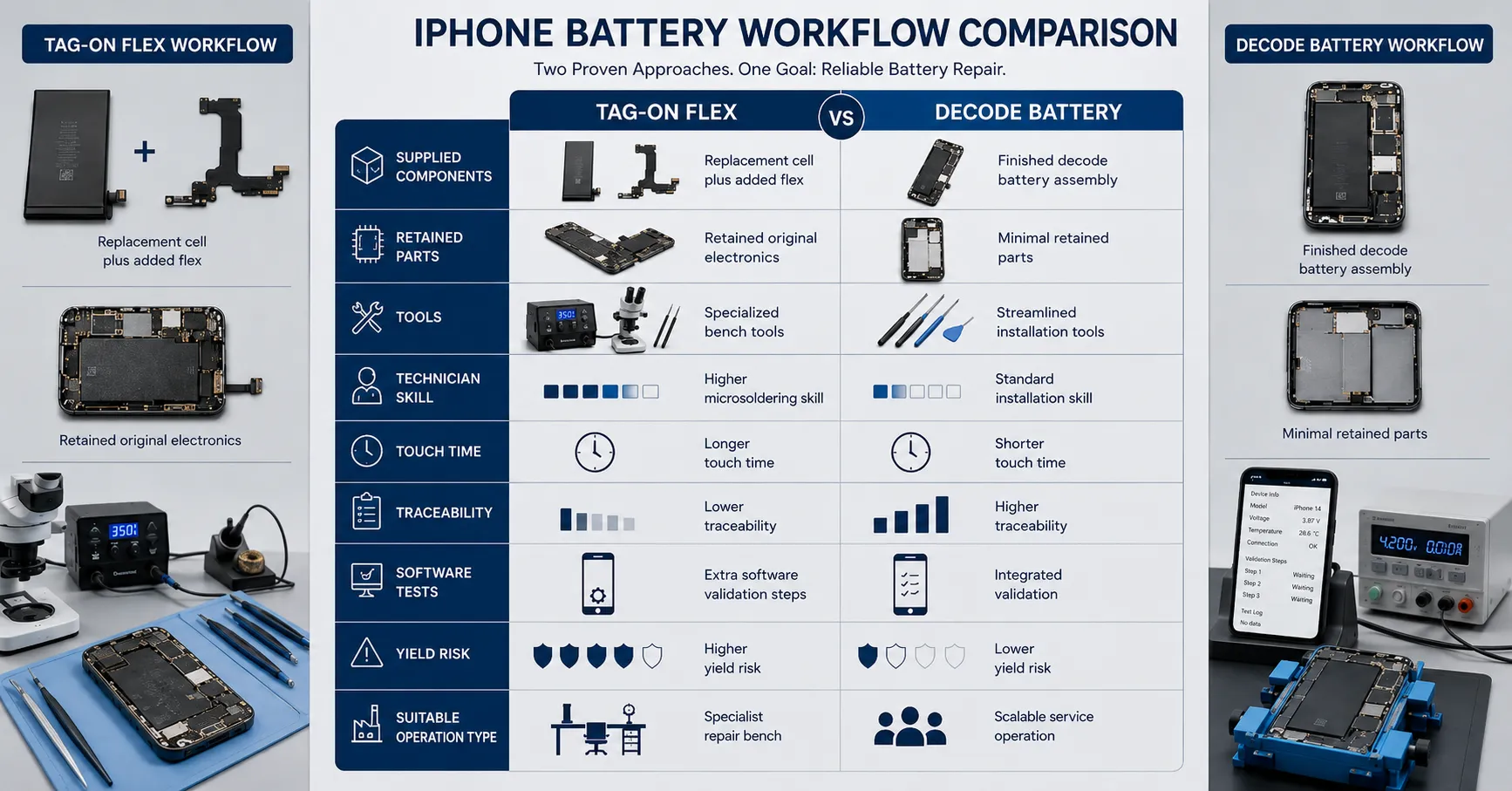
Compare the Two Workflows at a Glance
| Decision field | Tag-on flex route | Decode-battery route |
|---|---|---|
| Supplied format | Cell and interface may form part of a transplant or adaptation process | Often positioned as a more complete installation-ready assembly |
| Retained components | May depend on inspected electronics from the existing assembly | May reduce or remove reliance on transferred parts; verify the exact design |
| Tools and fixtures | Can require more specialized preparation and controlled assembly equipment | May reduce specialized connection work but still requires normal device-repair tools |
| Technician skill | Higher process discipline may be needed for component handling and insulation | Installation may be easier to standardize, but device opening and testing remain skilled work |
| Traceability | Must link cell, retained component, interface, operator and device | Finished battery code may simplify traceability if revisions remain controlled |
| Primary risk | Donor condition and assembly workmanship add variation | Dependence on the supplied complete design, supported models and revision consistency |
| Best initial fit | Controlled refurbishment lines with capable technicians and reusable-part policies | Repair networks seeking a repeatable installation flow and reduced specialist work |
The table describes common decision patterns, not guaranteed properties. Suppliers may use the same market term for different constructions. The buyer's approved drawing and sample evidence remain authoritative for the program.
Compare Tool Requirements by Actual Process Step
Create a tool map from device intake to final release. Both routes require safe device opening, battery isolation, adhesive removal, enclosure preparation, installation, reassembly and functional testing. The difference usually appears in the battery preparation and connection stages.
A flex-assisted transplant route may require fixtures for holding components, controlled preparation, alignment, insulation and electrical screening. Depending on the construction, specialized connection or programming equipment may also be involved. A decode design may remove some of these steps, but buyers should confirm whether configuration occurs at the supplier, at a central workshop or at each repair location.
Include equipment purchase, maintenance, calibration, consumables, spare fixtures and workstation space in the comparison. A rarely used machine can carry a high cost per accepted unit even when its purchase price looks reasonable.
Measure Labor Instead of Using Supplier Estimates
Time production-representative pilots with technicians who have comparable training. Separate touch time, equipment cycle time, waiting time, inspection and rework. Do not benchmark the fastest specialist on one method against a new technician on the other.
The flex route may add donor inspection, component preparation, alignment, insulation and more intermediate checks. The decode route may shorten preparation, but time can return through model identification, software observation, troubleshooting or device reopening if samples are inconsistent. Measure the full cycle from receiving a test device to a completed, documented pass.
Record the learning curve. A workflow that is initially slower may stabilize after training, while a process that appears simple may still produce repeated errors when model codes or revisions are easily mixed.
Compare Technician Skill and Training Burden
List the skills required at every station: lithium-battery handling, device disassembly, adhesive removal, visual inspection, electrical screening, component alignment, insulation, software observation and evidence capture. Then define which roles may perform each task and how competency is confirmed.
A transplant-based route can concentrate specialized work at a central facility while branch technicians install approved assemblies. Alternatively, branches may perform the entire process, increasing training and audit requirements. A finished decode design may make distributed installation easier to standardize, but it does not remove the need for safe handling or accurate model matching.
Training cost includes instructor time, practice components, damaged units, qualification, refresher sessions and procedure updates. Include these costs when making an iPhone battery repair solution comparison.
Do Not Combine System Behavior With Cell Quality
Apple's Parts and Service History guidance explains that repaired iPhones may show Genuine, Used, Unknown or Finish Repair depending on the model, component and repair process. Apple states that an Unknown result can appear when a part is nongenuine, is not functioning as expected, has not been verified and linked after repair, or has been modified.
Apple also notes in its battery-support information that health data may be inaccurate when a battery cannot be verified. Accordingly, a screen result does not establish measured capacity, cell quality, safety or Apple authorization.
For both workflows, maintain two acceptance blocks. The software block records Settings notifications, Battery Health, Parts and Service History, restart behavior, observation time and planned iOS updates. The performance block records fit, charging, discharge, capacity, runtime, temperature and consistency. A solution should meet both blocks under the buyer's stated conditions.
Run the Same Validation Matrix on Both Options
- Identity: record device model and region, iOS build, battery code, cell lot, interface or electronics revision and sample ID.
- Appearance: inspect packaging, pouch, edge seals, insulation, connector, flex, labels and adhesive.
- Mechanical fit: verify dimensions, routing, connector seating, enclosure clearance and display seating.
- Electrical screening: check agreed characteristics using safe documented methods.
- Function: test boot, wired and applicable wireless charging, stable discharge, restart and shutdown.
- Performance: measure capacity, controlled runtime and temperature under identical conditions.
- System presentation: capture notifications and battery-information screens at defined checkpoints.
- Repeatability: compare devices, component lots, operators and pilot-production output.
Use a documented mobile phone battery sampling plan. Do not test one route on easier devices or newer batteries. The two groups need comparable model mix, device condition, sample quantity, technicians and acceptance limits.
Compare Mechanical and Electrical Risk
The flex-assisted route can introduce risk through donor-component condition, extra interfaces, routing, connection quality and insulation workmanship. Its advantage may be control over selected components or a workflow already understood by an experienced refurbishment line. Reject swollen, corroded, overheated, damaged or untraceable retained parts.
The decode route can reduce assembly variables at the repair station, but it concentrates responsibility in the supplied battery design and production consistency. Verify connector position, pouch dimensions, flex geometry, protection electronics and model mapping. A finished appearance should not substitute for incoming inspection.
Apply the incoming-inspection framework to both methods. Stop testing and isolate any sample with deformation, leakage, odor, abnormal heat, unstable electrical behavior or forced fit.
Compare First-Pass Yield and Rework
First-pass yield is the proportion that completes the approved process without rework. Record failures by component lot, device, operator, station and method. Useful categories include donor rejection, fit, connector, insulation, charging, capacity, temperature, system presentation, device condition and undetermined cause.
A lower material price can be erased by rework, repeated device opening or specialist troubleshooting. Conversely, a higher-priced finished assembly may reduce labor but still be uneconomical if model mapping or lot consistency is weak. Compare cost per accepted device, not cost per purchased component.
Calculate Total Cost Under Three Scenarios
Build conservative, expected and favorable scenarios for each route. Include battery materials, interfaces, donor losses, adhesive, insulation, direct labor, equipment depreciation, maintenance, training, testing, rejected units, rework, damaged devices, inventory, warranty and disposal. Divide total batch cost by accepted units.
Model different volumes and device mixes. Specialized fixed costs may be economical at central high volume but inefficient for small distributed branches. Finished batteries may simplify branch operations while creating more model-specific inventory. Update the calculation with pilot data instead of relying on a generic claim that one method is cheaper.
Choose by Operating Model
When Tag-on Flex May Fit Better
Consider it when the business has trained technicians, controlled central workstations, traceable retained components, stable volume and a deliberate transplant strategy. It may also suit programs that already manage the related inspection and workmanship controls.
When Decode Battery May Fit Better
Consider it when the priority is a more standardized branch installation, reduced specialist preparation and simpler training. The supplier must still demonstrate exact model support, production consistency and the claimed workflow under the buyer's software conditions.
When Neither Should Be Released
Do not release either option when component identity is unclear, samples require forced fit, system claims cannot be reproduced, temperature or charging is abnormal, traceability is missing or the supplier cannot control revisions.
Control Software and Product Changes
Test planned iOS updates on non-production devices before changing network-wide approval. Repeat observations after first unlock, restart, charging cycles and a defined waiting period. Keep screenshots connected to the device, sample and software build.
Require change notification for the cell, protection electronics, interface, connector, flex, firmware, insulation, adhesive, factory site or process. Review the affected risks and repeat the necessary document, bench, device and software checks. Decode battery vs tag-on flex decisions should be revisited when the construction or operating environment changes.
Use Warranty Data to Improve the Decision
Link every field claim to the device model, iOS build, battery lot, method, operator and installation date. Classify failures before assigning responsibility. The battery warranty-claims workflow helps separate battery, workmanship, software and host-device causes.
Review return rate, repeated symptoms, rework time and customer downtime by method. Early pilot yield alone cannot show long-term commercial performance. Use the same warranty definitions and observation window for both routes.
Prepare a Comparable RFQ
Send both candidate suppliers the same device list, regional variants, current and planned iOS builds, monthly mix, required installation workflow, available tools, technician skill, acceptance matrix, sample quantity, capacity method, temperature conditions, packaging, traceability and change-notification requirements.
Ask each supplier to identify excluded models, required programming, retained components, system-screen limitations and revalidation triggers. ESCCharge can discuss a sample and pilot structure after these inputs are reviewed. Compatibility, displayed behavior, capacity, MOQ, lead time, certification availability, warranty and performance limits must be confirmed for the exact product and agreement.
Frequently Asked Questions
Which option is always cheaper?
Neither. Compare total cost per accepted device using measured labor, yield, rework, equipment, inventory and warranty data.
Which option requires less skill?
A finished decode design may reduce specialist battery-preparation work, but safe device repair, model identification and validation still require trained technicians.
Does either method guarantee battery health without a message?
No. Treat every system outcome as model-, component-, repair- and software-specific evidence.
Can the same approval cover every iPhone model?
No. Maintain model-level and revision-level approval records.
Should software display or measured capacity receive priority?
They answer different questions. A commercial program should define and validate both independently.