
Pre-launch samples can help a buyer prepare fixtures, inspection forms, technician training and sourcing plans, but they cannot establish final compatibility before the commercial device and its service requirements are available. Drawings, leaked photographs, engineering samples and supplier statements may all change before mass production.
A responsible iPhone 18 battery replacement program should therefore use staged approval. Buyers should separate preliminary research, verified commercial-device testing, pilot-lot approval and mass-production release. Every conclusion must identify the exact phone version, battery sample, software build, repair procedure and test method.
This checklist is designed for repair chains, refurbishment facilities, mobile-parts wholesalers, private-label brands and quality teams. It does not claim that ESC or any third-party supplier already possesses a final Apple specification. Apple has not provided the complete public information required to approve an aftermarket battery for an unreleased configuration, so all pre-launch results must remain conditional.
Define the Meaning of Pre-Launch Validation
Pre-launch validation is a risk-reduction activity, not a product certification. Its first purpose is to identify which information is known, which information comes from an unverified report and which characteristics require measurement after the commercial device becomes available.
Use at least four development states:
- Concept sample: prepared from preliminary market information and used only for internal planning.
- Commercial-device verification sample: installed and tested in a traceable retail device after release.
- Pilot sample: manufactured using the proposed production materials, tooling, flex design and process.
- Mass-production lot: released only after the approved sample, specification, test method and change-control requirements are frozen.
Packaging, quotations and sales presentations should identify the current state. Wording such as “development sample for evaluation” is materially different from “verified for named commercial models.” A successful boot in one device is not enough to change that status.
Freeze Claims Until the Commercial Configuration Is Known
Do not approve capacity, dimensions, connector geometry, flex routing, adhesive position, protection-board design or software behavior from a rumor. Even apparently precise numbers may describe a prototype, a regional model, a different member of the product family or an incomplete measurement.
Create a claim-control table with the proposed statement, evidence source, verification owner, affected SKU and approval date. Statements that cannot be traced to a released device, an authorized specification or a controlled measurement should remain marked “pending verification.”
The same principle applies to model naming. A Pro, Pro Max, standard model or another variant may use a different enclosure, electrical interface or service sequence. Do not approve one battery for multiple devices simply because their commercial names are related.
Build a Controlled Pre-Launch Test Matrix
| Dimension | Required record | Release question |
|---|---|---|
| Phone identity | Full model, region, storage version, hardware reference and photographs | Was the battery tested in every claimed configuration? |
| Battery identity | Supplier model, sample number, revision, batch, rated voltage and capacity | Can the tested sample be traced to production? |
| Mechanical interface | Envelope dimensions, connector, flex, adhesive and clearance | Does installation avoid force, compression and interference? |
| Electrical behavior | Voltage, current, resistance, protection and communication results | Does the pack operate within the approved design window? |
| Device performance | Charging, runtime, temperature, percentage progression and shutdown | Does performance repeat across samples and devices? |
| Software and repair state | iOS build, Battery Health, Parts and Service History and repair result | Are system observations reported accurately? |
| Disposition | Pass, conditional pass, hold, reject and required corrective action | Who authorized the commercial claim? |
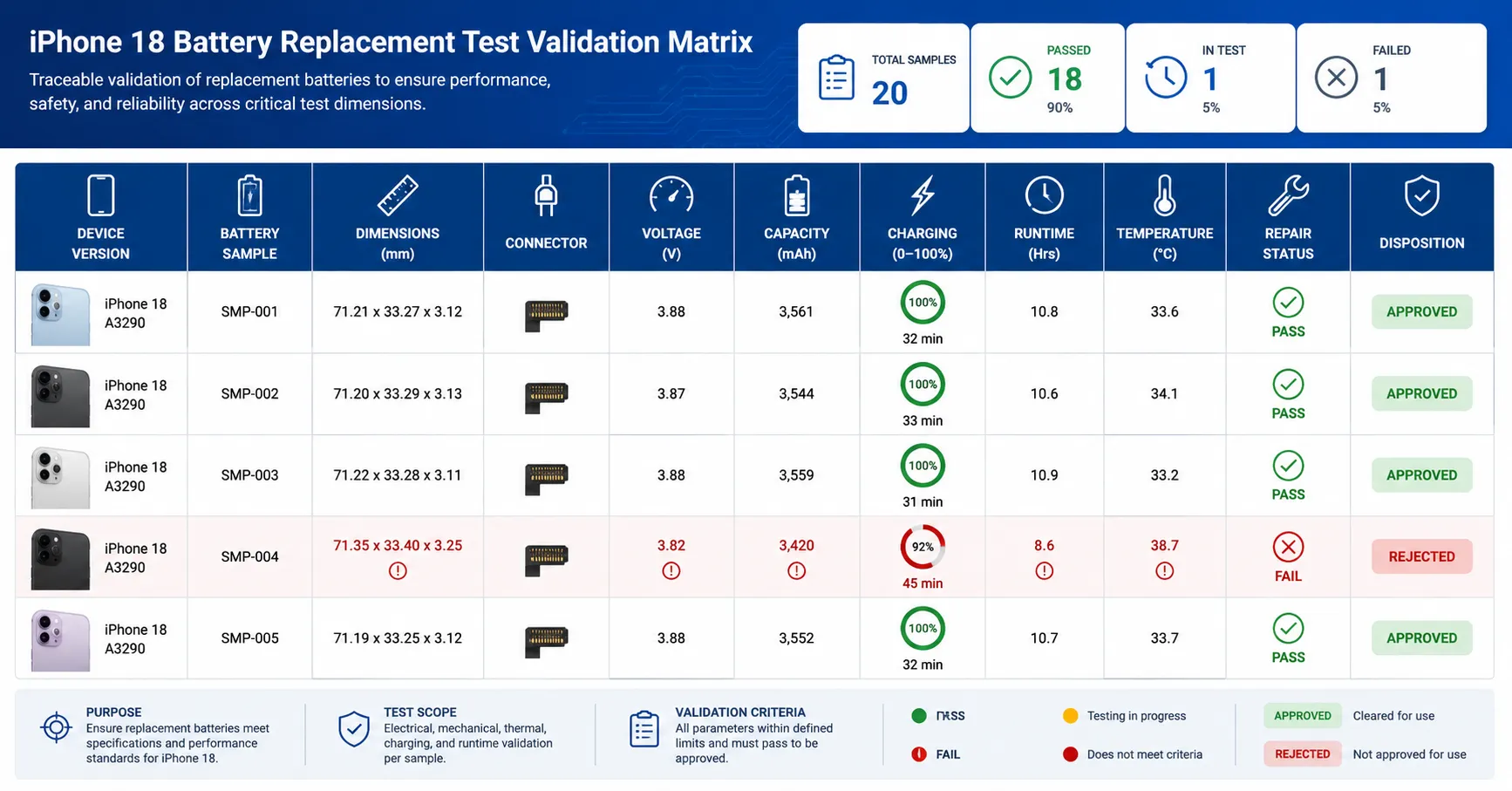
The matrix should include at least one known-good control device and control battery where an authorized and safe workflow permits. Results from different software builds, phone regions or sample revisions must not be merged into one undifferentiated pass rate.
Verify the Commercial Device Identity
After release, purchase or obtain devices through a traceable channel. Photograph the model information, enclosure, original battery label, connector, flex routing, adhesive arrangement and relevant internal clearances. Record the region and hardware reference because physical-SIM arrangements, radio hardware or other regional differences may affect the internal layout.
Do not dismantle every reference device immediately. Keep one device in its original condition to provide a baseline for charging, idle drain, temperature, runtime and software screens. If every device is modified at once, the team loses the control needed to separate a battery problem from a device, software or repair-process problem.
Link each phone to an internal asset number. A note reading “tested on iPhone 18” is inadequate when several variants, production dates or regions may exist.
Measure the Original Battery Before Copying a Design
Document nominal voltage, charging voltage where confirmed, rated capacity, Watt-hour value, dimensions, mass, connector, contact arrangement, flex length, protection layout, adhesive and insulation. Measurements should use calibrated equipment and a written method.
Do not assume the printed capacity equals independently measured usable capacity. Apple explains that rechargeable lithium-ion batteries are consumable components and distinguishes battery life from battery lifespan in its iPhone battery and performance guidance. Capacity, impedance, temperature and peak-power delivery interact with device behavior.
Opening an original pack can introduce electrical, chemical and mechanical hazards. Destructive analysis should be performed only by trained personnel using an approved safety procedure. Commercial approval does not require copying proprietary markings or presenting an aftermarket product as an Apple part.
Inspect Mechanical Fit Without Forcing the Pack
A battery can appear to fit while applying pressure to the display, enclosure or nearby components. Measure maximum length, width and thickness at controlled state of charge and temperature. Inspect corner radii, connector alignment, flex bend radius, cable slack, insulation and adhesive coverage.
During trial installation, technicians should record:
- whether the pack enters the cavity without bending or compression;
- whether the connector aligns without lateral force;
- whether the flex remains clear of screws and sharp edges;
- whether the battery lies flat across the approved support area;
- whether adhesive can be applied and later removed safely;
- whether the display and enclosure close to the original gap;
- whether pressure marks, raised edges or internal movement appear.
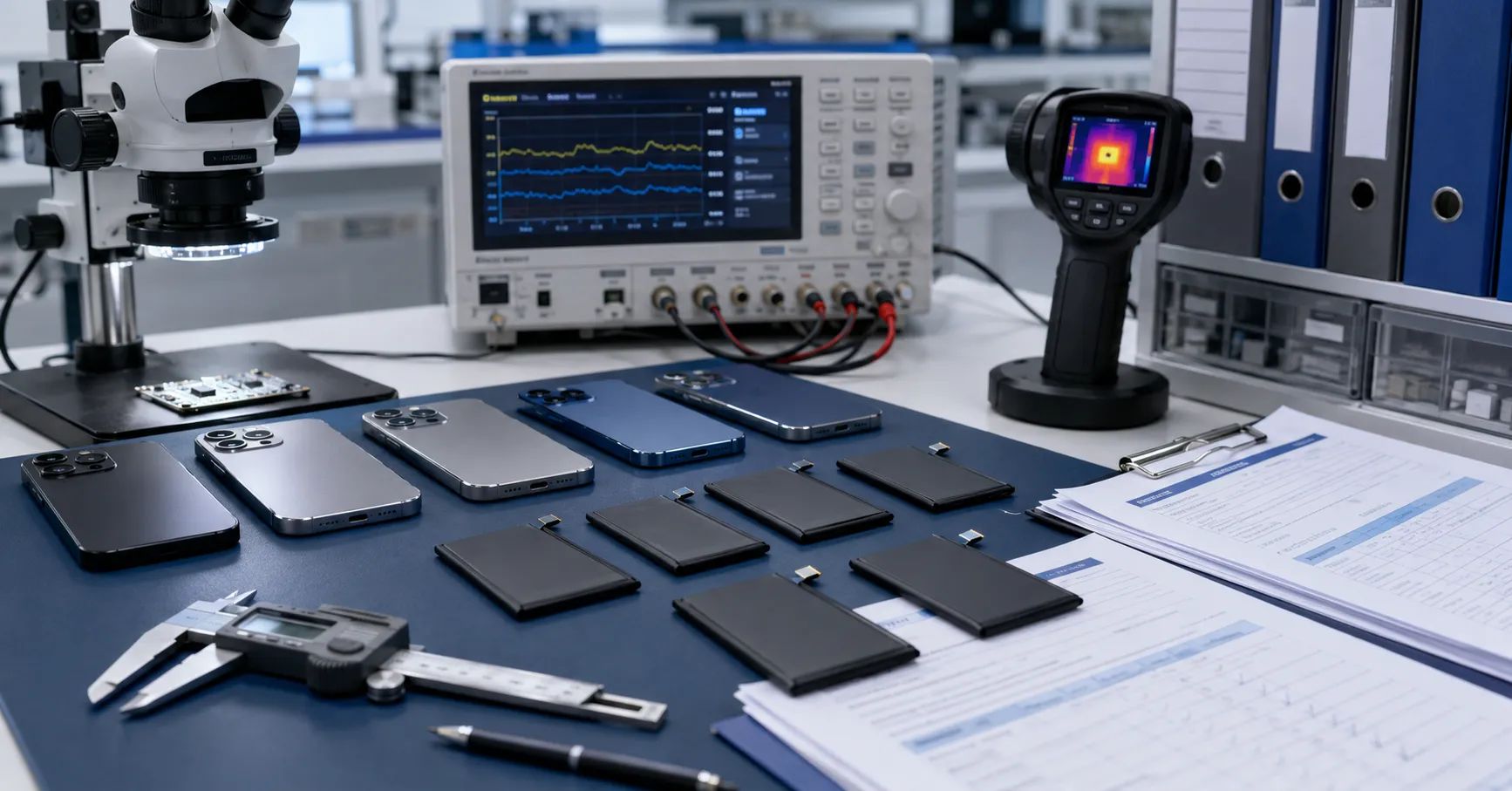
Compare the procedure with ESC’s published mobile phone battery incoming inspection guide, but create model-specific limits for the new device. Generic phone-battery tolerances should not replace verified drawings and fit trials.
Confirm Connector, Flex and Protection Design
Visual similarity does not prove electrical equivalence. Confirm connector keying, contact order, mating height, flex length, polarity and communication behavior. Inspect soldering, insulation, welds, component clearance and strain relief.
The protection system should be evaluated for the proposed cell and device load. Required checks may include overcharge, overdischarge, overcurrent, short-circuit response and temperature sensing, but test conditions and acceptance limits must come from the approved model specification. Destructive protection testing requires qualified equipment, containment and safety controls.
Do not bypass protection or modify a flex merely to make a sample boot. A sample that requires uncontrolled rework is not evidence of a production-ready design.
Establish a Clean Software and Hardware Baseline
Before replacing the original battery, record the exact iOS version and build, charging settings, Battery Health information, Parts and Service History, available diagnostics, battery percentage, temperature and controlled runtime. Save screenshots under the device asset number.
Apple’s current documentation explains that Parts and Service History may display statuses such as Genuine, Used, Unknown or Finish Repair depending on the part and repair state. These meanings are described in Apple’s Parts and Service History guidance. They must not be converted into unsupported marketing claims for an unreleased model or a third-party pack.
Use the same phone settings, network, applications and environmental conditions before and after iPhone 18 battery replacement. Otherwise, changes caused by indexing, background downloads, signal strength or display settings may be blamed incorrectly on the battery.
Run Controlled Charging Tests
Use a known-good charger and cable appropriate for the released device. Control ambient temperature, starting state of charge, screen state, network activity and case condition. Record input voltage, current, power, battery percentage, temperature and time at defined intervals.
The test should examine initial recognition, low-state charging, normal progression, high-state taper, charge-limit behavior, reconnection and restart. Apple documents Optimized Battery Charging and selectable charge limits for supported current models, including the fact that software may occasionally charge to 100% to maintain accurate state-of-charge estimates. These behaviors are described in Apple’s Charge Limit guidance.
Therefore, one pause or reduced-current period does not prove a defective battery. Repeat the test under a frozen method and compare it with the original battery and another replacement sample.
Measure Capacity and Runtime Separately
Bench capacity and installed-device runtime answer different questions. A controlled charge-discharge test can measure delivered ampere-hours and Watt-hours under defined conditions. A device test reveals how the complete phone behaves with its display, processor, modem, operating system and thermal controls.
For capacity testing, document equipment, calibration, charge profile, rest period, discharge load, cutoff, ambient temperature and calculation method. ESC’s existing iPhone battery capacity testing guide can support the general workflow, but the final limits must be approved for the verified model.
For runtime testing, freeze brightness, refresh settings, radios, signal conditions, app versions, audio level and test sequence. Include at least idle, video, browsing, camera and controlled load stages when relevant. Record percentage and temperature at fixed intervals rather than keeping only a final runtime number.
Check Percentage Estimation and Shutdown Behavior
A phone may boot and charge while still showing unstable state-of-charge estimation. Watch for percentage jumps, long plateaus, rapid drops, restart changes and shutdown above the expected lower boundary. Repeat the observation after a full controlled cycle and stabilization period.
Apple notes that impedance can increase with chemical age, low state of charge and cold temperature, and that inadequate peak-power delivery can contribute to an intentional system shutdown. This is why a low-temperature or high-load shutdown should not be diagnosed from capacity alone.
Compare voltage, temperature, load and the system-reported percentage at the event. Retain raw data so engineering can distinguish estimation, communication, resistance, cell and device causes.
Evaluate Thermal Behavior
Temperature must be measured during charging, controlled load, idle and recovery. Use the same ambient conditions, enclosure state and measurement locations for the original battery and replacement samples.
A temperature difference may arise from the battery, connector, charging system, processor load, radio activity or software. Investigate the complete system. Stop testing if swelling, odor, leakage, abnormal heat, damaged insulation or unstable electrical behavior appears, and move the sample into the approved quarantine process.
Do not advertise “no heat,” “zero swelling” or “100% safe.” Risk depends on cell design, manufacturing, protection, storage, charging, installation and operating conditions.
Record Repair Status Without Overpromising
After installation, record the exact wording shown in Battery Health and Parts and Service History. Take screenshots after the first boot, internet connection, restart, software update and any supported repair-completion process.
Apple states that Repair Assistant installs calibration data for supported repairs and currently requires an up-to-date device, Wi-Fi and more than 20% battery. The applicable models and parts are listed in Apple’s Repair Assistant instructions. Future iPhone support must be confirmed after Apple updates that documentation.
A supplier should never promise Genuine, Used, Unknown-free or Battery Health behavior for an unreleased model without repeatable evidence. Record an observed result as an observation under named conditions, not as a permanent operating-system guarantee.
Validate Installation Repeatability
One expert installation can hide a design that is difficult for normal production technicians. Use several trained operators and record installation time, connector alignment, adhesive handling, enclosure closure, rework and damage.
A pilot should include multiple devices and samples from the proposed manufacturing process. Define how many units are needed according to commercial risk, expected order volume, design maturity and failure cost. Do not choose the sample count merely to obtain a favorable result.
If different operators produce different outcomes, investigate the fixture, work instruction, flex geometry, adhesive, training and inspection method before blaming individual technicians.
Approve a Pilot Lot Before Mass Production
The pilot lot should use the intended cell, protection board, connector, flex, insulation, adhesive, labels, packaging and manufacturing route. Compare every element with the signed golden sample and bill of materials.
Review individual data and batch distributions for voltage, resistance, dimensions, capacity and functional performance. A normal average can hide outliers or two mixed populations. Retain raw results and link each tested unit to its production batch.
Production approval should state the accepted device versions, battery revision, software builds tested, inspection limits, packaging and unresolved conditions. “Pass” without scope is not an adequate release decision.
Control Changes After Approval
Require written approval before changing the cell source, chemistry, capacity, protection component, connector, flex, adhesive, insulation, tooling, label, packaging, production location or critical test method. A visually minor change may affect fit, resistance, communication or field performance.
Retain approved samples and specifications. Compare repeat orders with the retained baseline through incoming inspection, capacity sampling, fit checks and device tests. If a shipment differs from the approved configuration, place it on hold until the change is reviewed.
The pre-launch battery validation record should become a living configuration file rather than a one-time presentation.
Create a Commercial Release Gate
- Confirm the exact retail device and regional variants.
- Freeze the original-battery measurements and photographs.
- Verify mechanical and electrical interfaces.
- Complete capacity, charging, runtime, thermal and shutdown tests.
- Record software and repair-status observations.
- Complete multi-operator installation trials.
- Approve a production-representative pilot lot.
- Freeze claims, specifications and change-control requirements.
- Define incoming inspection and warranty evidence.
- Authorize sales only for the tested scope.
Any failure should be coded by category: phone condition, installation, battery sample, software, network, repair process, test method or unable to reproduce. This reduces false supplier claims and improves corrective action.
Frequently Asked Questions
Can a pre-launch sample be advertised as fully compatible?
No. It can support development and risk assessment, but final compatibility requires testing in traceable commercial devices using the production-representative battery and approved repair workflow.
Is one successful installation enough?
No. Buyers need multiple samples, devices and operators, followed by pilot-lot and repeat-order controls.
Can a higher printed mAh value justify approval?
No. Capacity must be verified under a documented method and considered together with dimensions, voltage, protection, temperature, runtime and repeatability.
Should Parts and Service History determine battery quality?
No. It reports part and repair information under Apple’s software rules. Physical condition, capacity, charging, temperature and runtime require separate validation.
When should packaging claims be finalized?
After the commercial device, battery configuration, software behavior and production-representative samples have passed the approved release gate.
Move From Forecasting to Traceable Approval
An iPhone 18 battery replacement project should move through evidence gates instead of jumping from a rumor to mass production. Buyers need traceable devices, model-specific measurements, controlled testing, pilot-lot approval and written change control.
Send ESC your target device markets, expected repair volume, sample requirements and validation plan. ESC can prepare a model-level sampling and inspection discussion after the commercial configuration becomes available. Capacity, compatibility, software status, MOQ and lead time must be confirmed for the specific project.
External Source References
- Apple Support — iPhone Battery and Performance
- Apple Support — About iPhone Parts and Service History
- Apple Support — Use Repair Assistant to Finish a Repair
- Apple Support — About Charge Limit and Optimized Battery Charging