
Do Not Merge iPhone 12 and iPhone 13 Battery SKUs
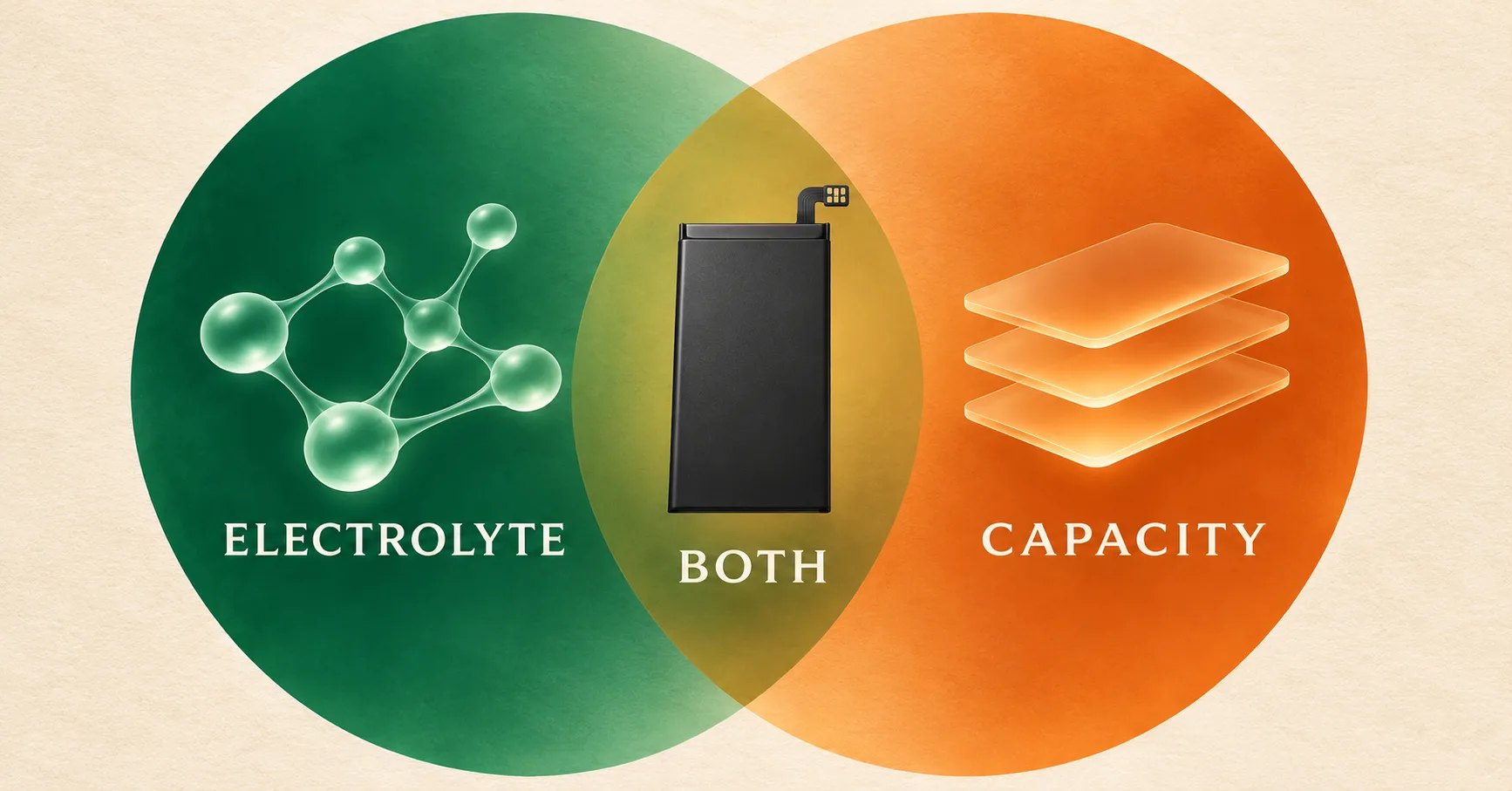
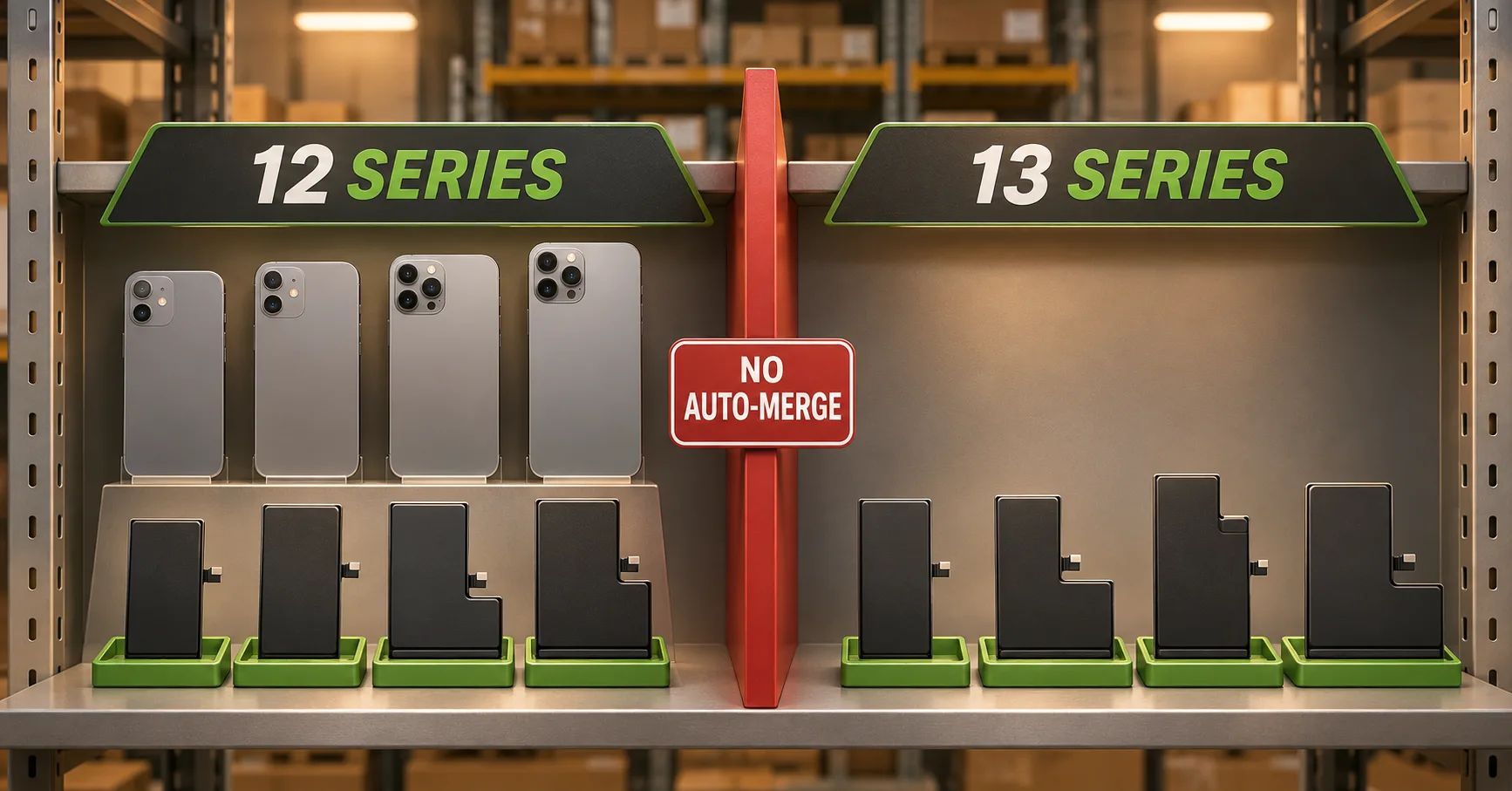
The practical answer to an iphone 12 vs 13 battery comparison is that the two generations must not be treated as one replacement-battery application. Each series contains a mini, base, Pro and Pro Max device, creating eight separate handset applications. Similar screen sizes or external styling do not prove that the internal battery assemblies share geometry, flex routing, connector position or electrical configuration.
For repair chains, refurbishers and wholesalers, capacity and runtime comparisons are useful for demand planning and customer expectations. They are not compatibility evidence. The purchasing decision must start with the complete handset identity, followed by the finished battery assembly, installed fit, charging behavior, system observations and lot traceability.
This page owns the cross-generation comparison and inventory decision. The existing ESCCharge iPhone 12 and iPhone 13 series drafts continue to own detailed validation within each generation. The broader iPhone replacement battery supplier guide remains the supplier-qualification owner.
Start With the Exact Device, Not the Series Name
Apple advises users to identify an iPhone by its model number and physical details. Its identification page lists separate regional model numbers for every iPhone 12 and iPhone 13 variant. Apple’s instruction is direct: Find out how to identify your iPhone model.
Apple Support — Identify your iPhone model.
Build the application record from Settings > General > About, a verified device label or another controlled source. Record the commercial name, model number, region, storage or carrier details when relevant, software version and the internal repair reference used by the workshop. Do not allow “iPhone 12/13” as a complete purchase-order description.
| Generation | Device applications to control | Purchasing rule |
|---|---|---|
| iPhone 12 series | 12 mini, 12, 12 Pro, 12 Pro Max | Create four independent battery application records |
| iPhone 13 series | 13 mini, 13, 13 Pro, 13 Pro Max | Create four independent battery application records |
The base iPhone 12 and iPhone 12 Pro both use a 6.1-inch display, but that shared external dimension does not authorize a buyer to infer a shared replacement battery. The same caution applies to devices across the 12 and 13 generations. Approve every device-and-battery combination on its own evidence.
Use Official Runtime Data With Its Conditions Attached
Apple’s technical specifications rate the base iPhone 12 for up to 17 hours of video playback and the base iPhone 13 for up to 19 hours. The official pages also identify both as using built-in rechargeable lithium-ion batteries. Apple Support — iPhone 12 technical specifications and Apple Support — iPhone 13 technical specifications.
| Official comparison field | iPhone 12 | iPhone 13 | B2B interpretation |
|---|---|---|---|
| Year introduced | 2020 | 2021 | Separate generation and demand cohort |
| Device depth | 7.4 mm | 7.65 mm | External thickness changed; internal assembly still requires drawing and sample evidence |
| Apple-rated video playback | Up to 17 hours | Up to 19 hours | Device-level reference under Apple’s conditions, not a replacement-pack acceptance limit |
| Chip | A14 Bionic | A15 Bionic | System efficiency differs, so runtime cannot be explained by mAh alone |
Apple cautions that actual results will vary
and explains that battery life and charge cycles vary with use and settings. Preserve that condition whenever the figures are quoted. Device runtime combines battery energy, system efficiency, display behavior, radio conditions, software and workload. It cannot be converted directly into a guaranteed runtime for an aftermarket battery.
Third-party mAh tables can be useful research clues, but the purchasing specification should require a traceable supplier declaration and model-specific verification. Compare charge capacity and energy only when voltage basis, test method, temperature, cutoff conditions and sample identity are recorded.
Capacity Does Not Establish Compatibility
An iphone 12 battery replacement should be approved as a complete finished assembly. The same is true for an iphone 13 battery replacement. A battery with a plausible printed capacity can still have the wrong outline, thickness, flex, connector, protection layout or adhesive arrangement.
Require controlled drawings or measured approved samples for:
- Overall outline, including tabs, folds and stepped sections.
- Thickness at defined points and allowable stack-up.
- Flex length, bend path and strain condition.
- Connector position, orientation and mating condition.
- Protection-board and sensing configuration.
- Adhesive pattern, liner and removal method used by the approved process.
- Unit label, lot traceability and packaging protection.
Do not force a battery into a cavity or alter the flex to make a sample appear compatible. A fit decision must include cover closure, clearance, connector engagement and absence of unintended pressure. Record the installed sample and retain photographs for receiving comparison.
Build an Eight-Application Approval Matrix
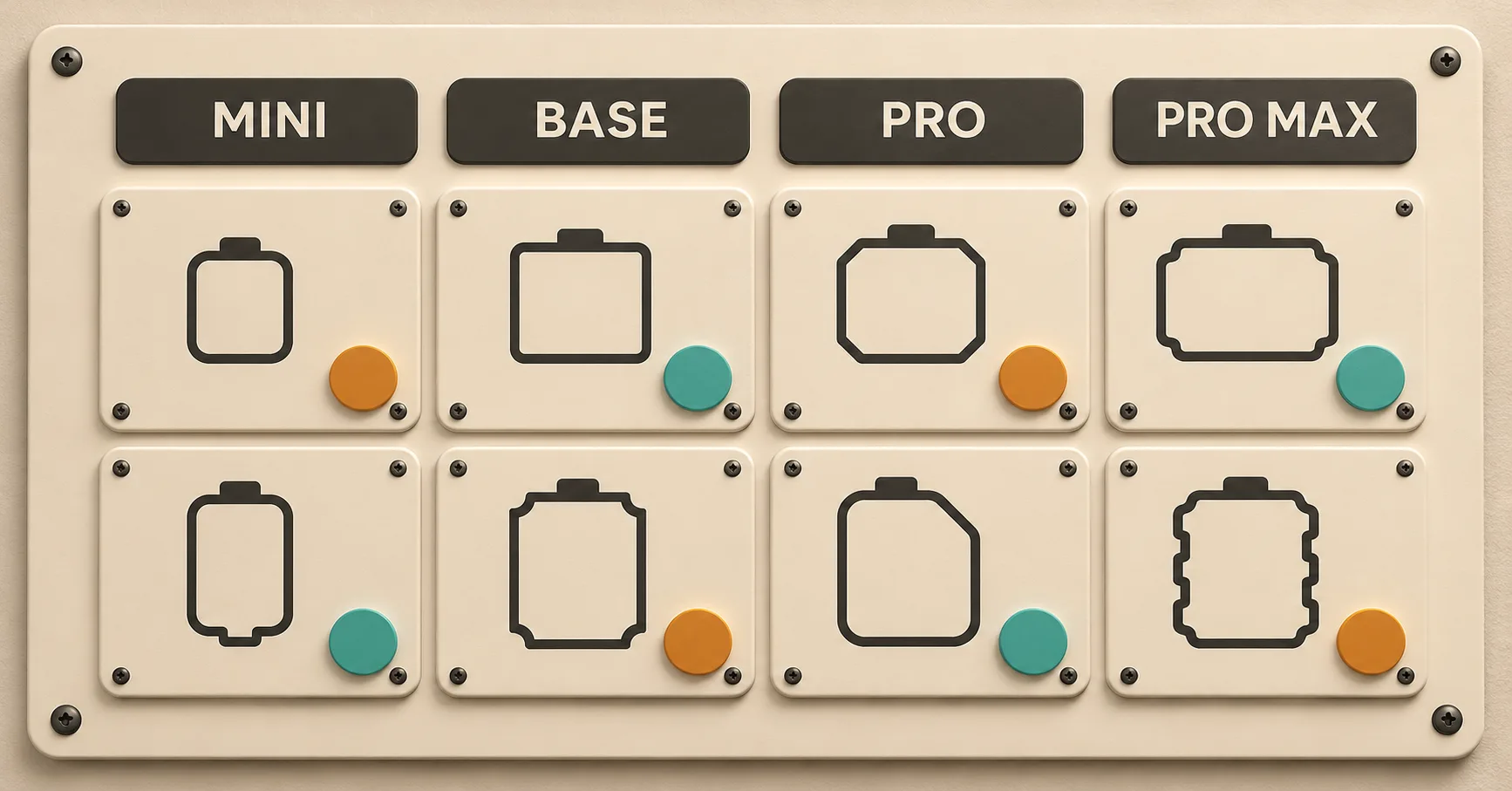
A disciplined iphone battery compatibility matrix has eight rows, not two. Give every mini, base, Pro and Pro Max application its own device codes, supplier battery reference, assembly revision, declared values, drawing revision, sample record and disposition.
| Application field | Required evidence | Release condition |
|---|---|---|
| Device identity | Commercial name, full model number and controlled device record | Exact application is unambiguous |
| Battery identity | Supplier reference, revision, label and lot code | Matches the approved sample configuration |
| Physical fit | Drawing or measurement plus installed photos | No interference, pressure or routing deviation |
| Electrical and charging | Recorded voltage, charge and representative-load observations | Results meet the application-specific approval plan |
| Capacity and runtime | Method, equipment, conditions, sample results and device comparison | Meets the agreed model-specific criteria |
| System observation | Software version and post-installation messages | Observed status matches the approved disclosure and workflow |
If one supplier proposes the same commercial battery reference for more than one device, require evidence for every claimed application. A shared reference is a claim to validate, not permission to skip a row. If the pack construction or device behavior differs, split the internal SKUs.
Test Runtime With a Comparable Device Method
A useful comparison holds the controllable variables constant. Use known-good devices of the same model when approving a replacement pack. Record the software build, display settings, network state, radio signal, temperature, starting state of charge, workload and test duration. Do not compare an iPhone 12 under one workload with an iPhone 13 under another and label the difference a battery result.
Separate three questions:
- Does the sample meet its declared capacity or energy under the agreed bench method?
- Does the installed device charge, report state of charge and remain stable?
- Does runtime remain consistent against approved samples or a controlled model-specific reference?
These tests answer different questions. A bench capacity pass cannot prove mechanical fit or installed stability. A short functional check cannot prove full usable capacity. A runtime result without controlled workload cannot isolate the battery. ESCCharge’s iPhone battery capacity-testing guide provides a deeper framework for declared versus measured results.
Plan Inventory by Model Demand, Not Generation Totals
For iphone battery SKU planning, aggregate demand by generation only for a management summary. Replenishment should use the sell-through, service demand, return rate, lead time and approved supplier status of each individual model.
Suppose a network’s last three months show 90 approved iPhone 12-series jobs and 120 approved iPhone 13-series jobs. Those totals are not enough to place an order. If most iPhone 12 demand is for the base model while iPhone 13 demand is split between base and Pro Max, a generation-level ratio will overstock some applications and create shortages in others.
Build the reorder calculation with:
- Average monthly demand for each of the eight applications.
- Supplier lead time and receiving-inspection time.
- Approved safety stock based on service target and demand variability.
- Open warranty replacements and non-sale sample needs.
- Current released stock, held stock and purchase orders in transit.
- Age and revision of existing inventory.
Keep held or superseded stock out of available inventory. Do not use a 13-series surplus to cover a 12-series shortage without approved application evidence. The mobile phone battery storage SOP explains segregation and periodic warehouse review.
Control Repair Status and Customer Disclosures
Post-repair system behavior must be recorded by model and software version. Do not promise that a third-party battery will display a specific Apple status. Do not describe an aftermarket part as genuine or Apple-authorized.
On supported devices, Parts and Service History can show information about a battery repair. Apple notes that messages can reflect several situations, including a part that cannot be verified or is not functioning as expected. Apple Support — iPhone Parts and Service History.
Define the approved repair workflow, technician evidence and customer disclosure before rollout. Record any post-installation notification separately from physical fit, capacity and runtime results. One status message should not overwrite all other evidence, and a clean functional check should not be used to promise a particular system label.
Approve the First Lot and Control Later Changes
After sample approval, order a controlled pilot or first production lot. Reconcile unit labels, carton labels and quantities. Sample from the defined lot, repeat identity, visual, dimensional, electrical, capacity and installed checks, then record pass, hold or reject decisions by application.
Use a documented mobile phone battery sampling plan. Require advance notice for changes to the cell, protection parts, flex, connector, adhesive, label, packaging or manufacturing location. Determine which changes require document review, sample reapproval or a new pilot lot.
Warranty records should retain the device application, battery revision and lot. If failures cluster by one model or lot, hold the relevant stock without automatically blocking the other seven applications. Model-level traceability makes that containment possible.
RFQ Checklist for iPhone 12 and 13 Batteries
- Exact quantity forecast for each mini, base, Pro and Pro Max application.
- Complete device model numbers and target sales regions.
- Finished battery reference, revision and declared electrical specifications.
- Controlled drawing, dimensions, flex routing, connector and adhesive configuration.
- Capacity and energy definitions, test method and sample evidence.
- Required installed-device and charging validation.
- Expected packaging, labeling, lot traceability and private-label scope.
- Target market and shipment documents to confirm for the exact configuration.
- MOQ, lead time and warranty terms confirmed for the selected model and agreement.
Send ESCCharge the eight-model demand split, device codes, target market, packaging format and sample plan. The team can discuss an application-specific validation and quotation structure. Actual availability, compatibility, capacity, MOQ, documents, delivery terms and warranty must be confirmed for the selected batteries.
Frequently Asked Questions
Can an iPhone 13 battery be installed in an iPhone 12?
Do not assume it can. The two generations require separate assembly and device evidence. Similar external dimensions or capacity claims do not prove fit, connector compatibility or installed behavior.
Do iPhone 12 and iPhone 12 Pro use the same replacement battery?
Treat them as separate applications until the exact finished assembly is supported by controlled compatibility evidence and installed tests for both devices.
Why does the iPhone 13 have a higher official runtime rating?
Runtime reflects the complete device, including battery energy, chip efficiency, display, radios, software and test conditions. It should not be explained by mAh alone.
Can Apple’s video-playback hours be used as an incoming-inspection limit?
No. They are device-level claims under Apple’s conditions. Create a reproducible replacement-battery test method with model-specific approved samples and acceptance criteria.
Should a wholesaler stock all eight applications equally?
No. Allocate inventory using application-level demand, variability, lead time, released stock and warranty needs. Review slow-moving models separately.
Can one lot be released for several iPhone models?
Only if each claimed device application has its own approved evidence and the shipment remains traceable to the exact assembly and revision. Do not infer compatibility from a shared listing.
External Source References