
Treat S3, S3 Mini and S5 as Separate Battery Programs
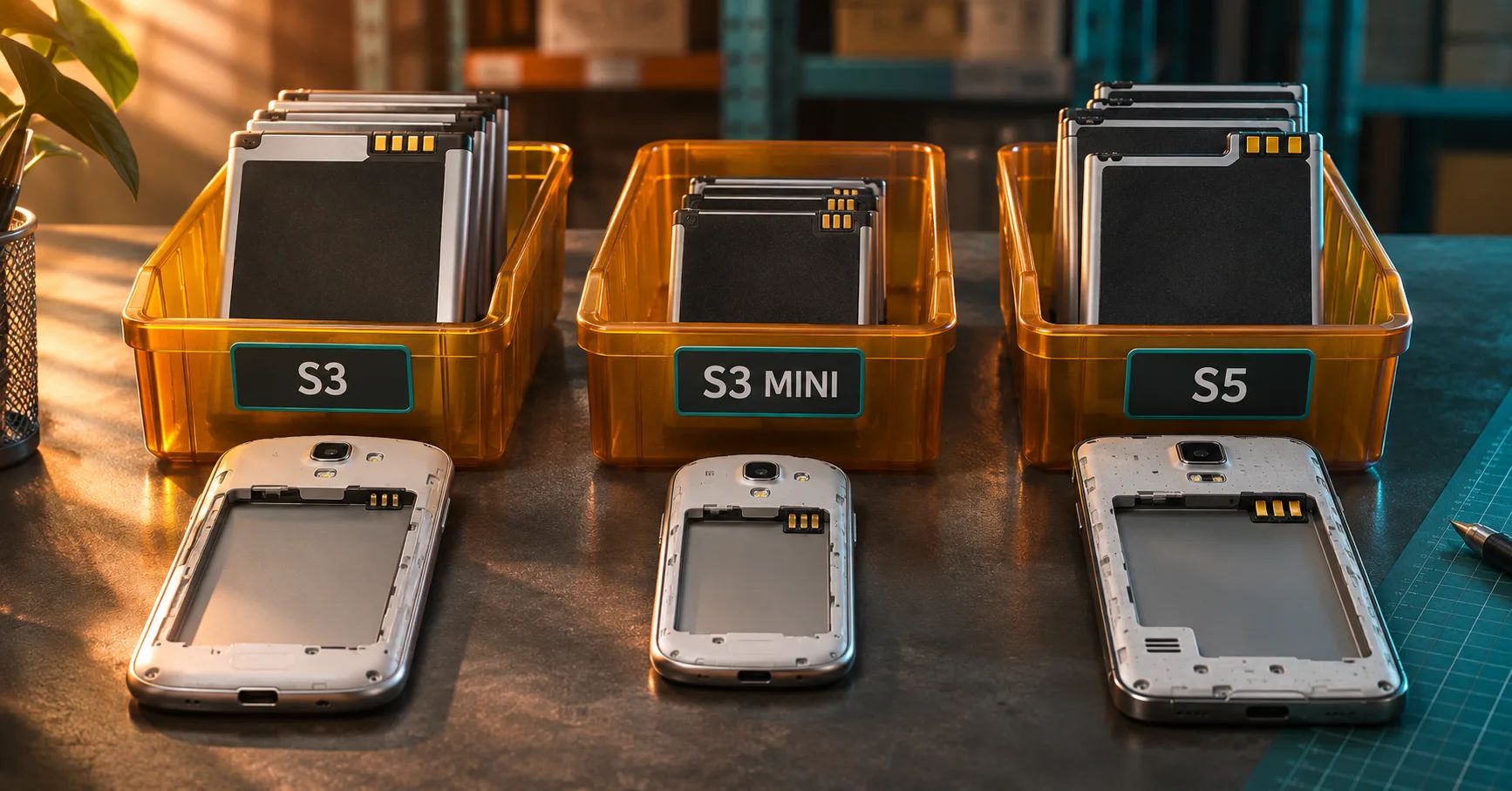
A samsung galaxy s3 battery can still serve repair, resale and dedicated-device fleets, but legacy demand does not justify loose compatibility assumptions. Build one controlled application record for every handset variant. Keep the S3, S3 Mini and S5 separate until physical, electrical and installed-device evidence supports a specific mapping.
The removable format makes these batteries easier to exchange than modern bonded assemblies. It does not make them interchangeable. Different outlines, contact positions, rated voltage, NFC construction and regional handset codes can change the application. A family name on a marketplace listing is not enough evidence for a purchase order.
For wholesalers and repair chains, the decision is not simply whether old models still sell. The useful question is whether the expected demand can support fresh, traceable stock without creating excessive storage time, mixed-SKU errors or warranty exposure. This page therefore owns the S3-to-S5 inventory decision. ESCCharge's existing Samsung replacement battery sourcing guide remains the broader supplier-evaluation page.
Use Original Specifications as References, Not Compatibility Proof
Samsung's archived business page for the AT&T Galaxy S III lists the battery as 2100mAh
. The page identifies that handset as SGH-I747, which matters because Galaxy S III variants were sold through different carriers and regions. Samsung Business — Galaxy S III SGH-I747 specifications.
Samsung's support record for the Galaxy S5 standard battery identifies the application as Galaxy S5 and gives 2800 mAh
, 3.85 V output voltage and physical dimensions for the referenced accessory. Samsung Support — Galaxy S5 standard battery EB-BG900.
These official values establish useful reference points. They do not prove that an unverified replacement pack fits, communicates correctly, carries the same NFC function or delivers the declared capacity. A galaxy s3 battery replacement should be approved against the exact device code and finished battery construction. Apply the same rule to every samsung galaxy s5 battery replacement.
| Application | Reference evidence | Buyer control |
|---|---|---|
| Galaxy S III | Samsung's SGH-I747 page states 2100mAh | Record the complete handset code, battery reference, contact layout and installed result |
| Galaxy S III Mini | Separate handset family and physical format | Do not group it under S3 without model-specific drawings and samples |
| Galaxy S5 | Samsung's EB-BG900 page states 3.85 V and 2800mAh | Confirm exact S5 variant, pack construction, NFC requirement and device function |
Do not replace the supplier's model evidence with a capacity comparison. Two packs can show similar mAh values and still differ in geometry, terminal position, protection configuration or supported device. Likewise, a higher printed capacity does not establish usable runtime. Capacity claims must be verified for the specific battery model and test method.
Build an Application Record That Receiving Can Use
Each approved SKU should have a short application record shared by purchasing, quality and warehouse teams. Include the commercial handset name, full device code, approved battery reference, controlled photos of both faces, outer dimensions, thickness, terminal orientation, nominal electrical declarations and required functions. Where NFC or another antenna function is part of the battery construction, state whether it is required and how it is verified.
Record the package scope as well. Legacy removable batteries may be supplied as bare service stock, individually bagged units, blister-packed retail items or private-label cartons. The battery can be identical while labeling, traceability and unit protection differ. Give each approved presentation its own packaging revision so staff do not infer equivalence from a product photo.
The purchase order should reference the approved application record. Ask the supplier to disclose any change to the cell, protection parts, housing, label, terminal assembly, NFC layer or packaging before shipment. A substitution that appears harmless can alter fit, contact pressure, traceability or installed behavior.
Build a Lot-Age Control Before Buying
Legacy demand makes stock age a central purchasing variable. Request the finished-pack production date or another traceable date code, lot definition, storage history and quantity by lot before accepting an offer. A seller's statement that stock is “new” may only mean unused; it does not describe when the pack was assembled or how it was stored.
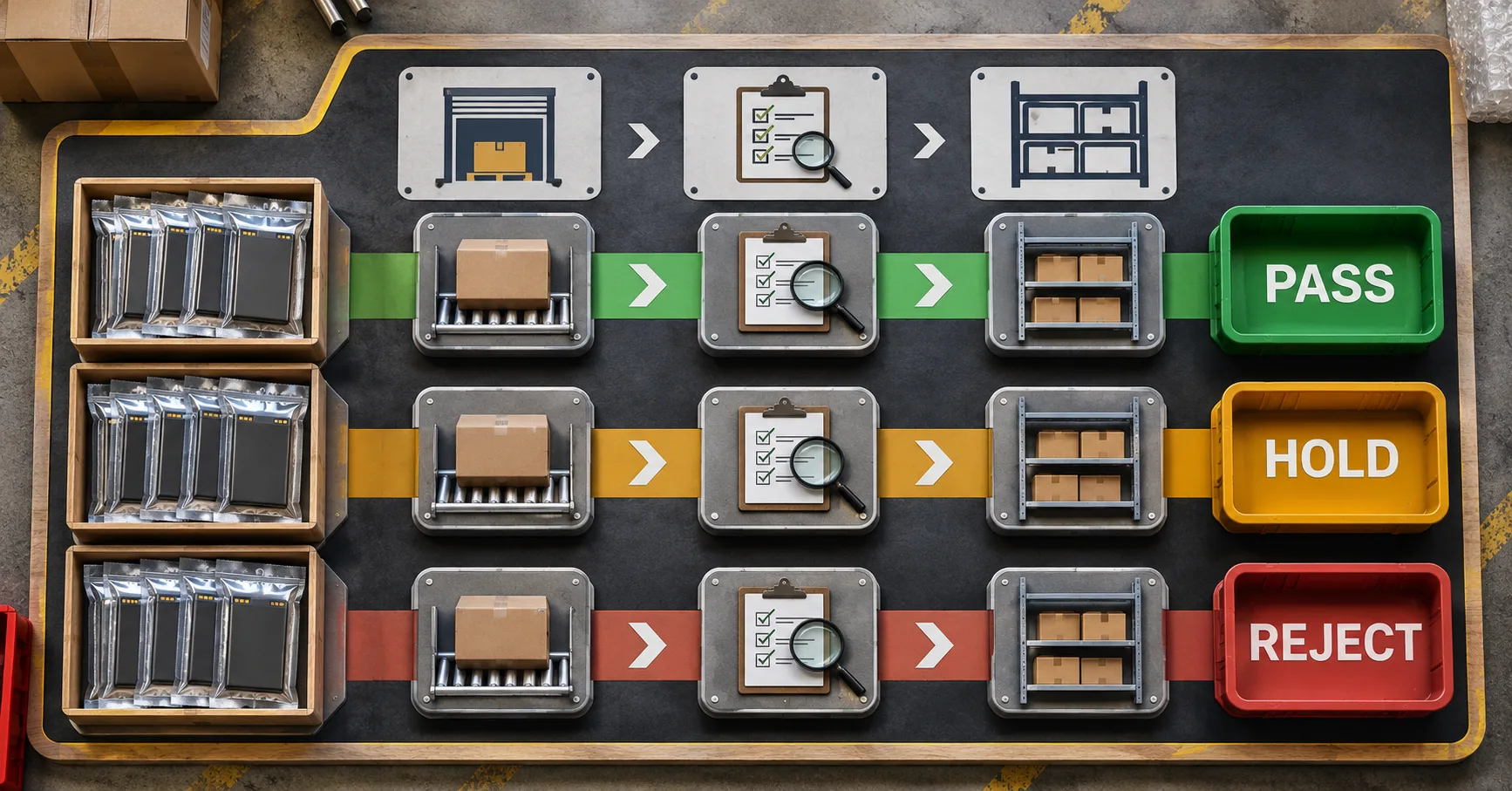
Set model-specific receiving checks before the order arrives. Inspect packaging and labels, reconcile lot quantities, screen for deformation, corrosion, leakage, terminal damage and contamination, then apply an approved electrical and capacity sampling plan. Samsung's removable-battery guidance states, Do not use batteries that are visibly damaged
. Samsung Mobile — battery use, care and safe handling.
Do not turn one open-circuit-voltage reading into a capacity or safety conclusion. Voltage is one screening observation under controlled rest and temperature conditions. Capacity, charge behavior, device stability and physical condition provide separate evidence. The mobile phone battery incoming-inspection guide explains how to connect unit identity, sampling and disposition.
| Evidence | What it answers | Possible decision |
|---|---|---|
| Traceable lot and date information | Can the shipment be separated and investigated by production group? | Continue, request clarification or hold |
| Visual and dimensional inspection | Does the pack match the approved construction without visible damage? | Pass the step, sort or reject affected units |
| Controlled electrical screening | Are sampled units within the approved model-specific receiving window? | Continue testing or hold the lot |
| Capacity and installed-device checks | Does the sample deliver the agreed result under recorded conditions? | Release, investigate or reject under the purchase agreement |
Define limits from approved samples, engineering requirements and the sales agreement. Do not copy a universal acceptance threshold from another model. Store the test method, equipment, temperature, rest period and disposition with the lot record.
Separate Demand Forecasting From the Initial Supplier MOQ
Low-volume legacy stock should be purchased from observed sell-through rather than nostalgia for a once-popular model. Start with monthly demand by exact SKU, then account for the supplier lead time, inspection time, expected service level and a justified buffer. Use warranty replacements and non-sale samples as separate requirements.
For example, if a repair network uses 18 units per month and the replenishment cycle is two months, the base requirement is 36 units before adding the agreed buffer and non-sale quantities. That arithmetic is an illustration, not a recommendation. The actual order should use the buyer's demand history and the supplier's confirmed terms.
If the supplier's minimum quantity exceeds a reasonable coverage period, compare alternatives: scheduled releases from one confirmed lot, consolidated packaging with separate model-level traceability, a smaller trial order, or discontinuing the slow SKU. Do not solve a minimum-order problem by accepting mixed S3, S3 Mini and S5 stock under one ambiguous line.
MOQ depends on the selected model and customization scope. Private-label printing or retail packaging can create a different economic minimum from neutral service packaging. Ask for both options when branding is not essential to the repair program.
Use a Three-Tier Legacy Inventory Policy
A practical legacy phone battery inventory policy gives every SKU a service level and exit rule.
- Active legacy: repeat demand supports regular replenishment. Maintain an approved source, sample record, receiving plan and defined reorder point.
- Controlled tail: demand is intermittent. Buy smaller quantities, review aging more often and avoid customized packaging that cannot move across channels.
- Special order or phase-out: demand no longer supports stocked coverage. Quote lead time and availability only after reconfirming supply and sample status.
Review the tier at a fixed interval using sales, repair completion, returns, warranty findings and write-offs. A galaxy s5 battery can move from active legacy to controlled tail as local demand changes. Do not keep the same reorder point simply because it worked in the previous year.
Use first-in, first-out movement within the same approved SKU and condition, but retain lot identity. Do not blend a held lot into released stock to improve apparent turnover. The mobile phone battery storage SOP provides a broader warehouse framework for segregation, environmental records and periodic review.
Approve Samples in the Intended Devices
Bench inspection alone cannot approve a legacy battery. Install sampled units in the exact handset variants included in the application record. Check fit, terminal engagement, cover closure, startup, charging, reported state of charge, representative load behavior and any required NFC function. Record the handset code, software state, charger, environment and test duration.
Use known-good devices where possible. An old handset may have connector wear, liquid damage, charging faults or abnormal standby consumption. Cross-checking the same battery in another controlled device helps separate a pack issue from a device issue. Samsung's support guidance also tells users of removable-battery devices to inspect the battery connectors when a device will not hold charge. Samsung Support — device not staying on or holding charge.
Approve the finished configuration, not only the cell. The housing, terminals, protection path, labeling and packaging all belong to the supplied item. Link the approved sample to a production lot and use a documented battery sampling plan for bulk orders when the first shipment arrives.
What to Include in the RFQ
- Complete handset names, regional or carrier codes and expected quantity by application.
- Required finished battery reference, voltage and capacity declarations, with no inferred cross-model compatibility.
- Controlled photos or drawings showing outline, thickness, terminal position and required functional layers.
- Requested lot, production-date, storage and change-notification evidence.
- Sample quantity and model-specific installed validation plan.
- Packaging format, label fields, carton breakdown and private-label scope.
- Target market, shipment route and documents that must be verified for the specific battery and shipment.
- Warranty evidence, claim workflow and commercial terms confirmed for the specific agreement.
Send ESCCharge the device codes, expected monthly demand, packaging format, target market and sample requirements. The team can review the proposed application list and prepare a model-specific sampling discussion. Availability, MOQ, documentation, capacity claims and warranty terms must be confirmed for the selected battery and order.
Frequently Asked Questions
Can one SKU cover the Galaxy S3 and S3 Mini?
Do not assume so. Treat them as separate applications unless controlled drawings, finished-pack identity and installed-device tests support the exact mapping. The family name alone is insufficient.
Is a printed 2100mAh value enough to approve an S3 replacement?
No. It is only one declared characteristic. Verify the exact device application, pack construction, voltage declaration, dimensions, terminals, protection, traceability and capacity under an agreed method.
Should a buyer accept old stock if it is unused?
Unused does not mean recently produced or correctly stored. Request traceable lot and date evidence, inspect the shipment and use model-specific electrical, capacity and installed checks before release.
How much legacy stock should a wholesaler keep?
Use actual SKU-level sell-through, replenishment time, service target, inspection time and a justified buffer. Reduce or move a SKU to special order when coverage becomes disproportionate to demand.
Can S3 and S5 batteries share one receiving plan?
They may share the same process structure, but application records, samples, test conditions and acceptance evidence must remain model-specific. Keep results and dispositions separated by SKU and lot.
External Source References