
These Labels Answer Different Questions
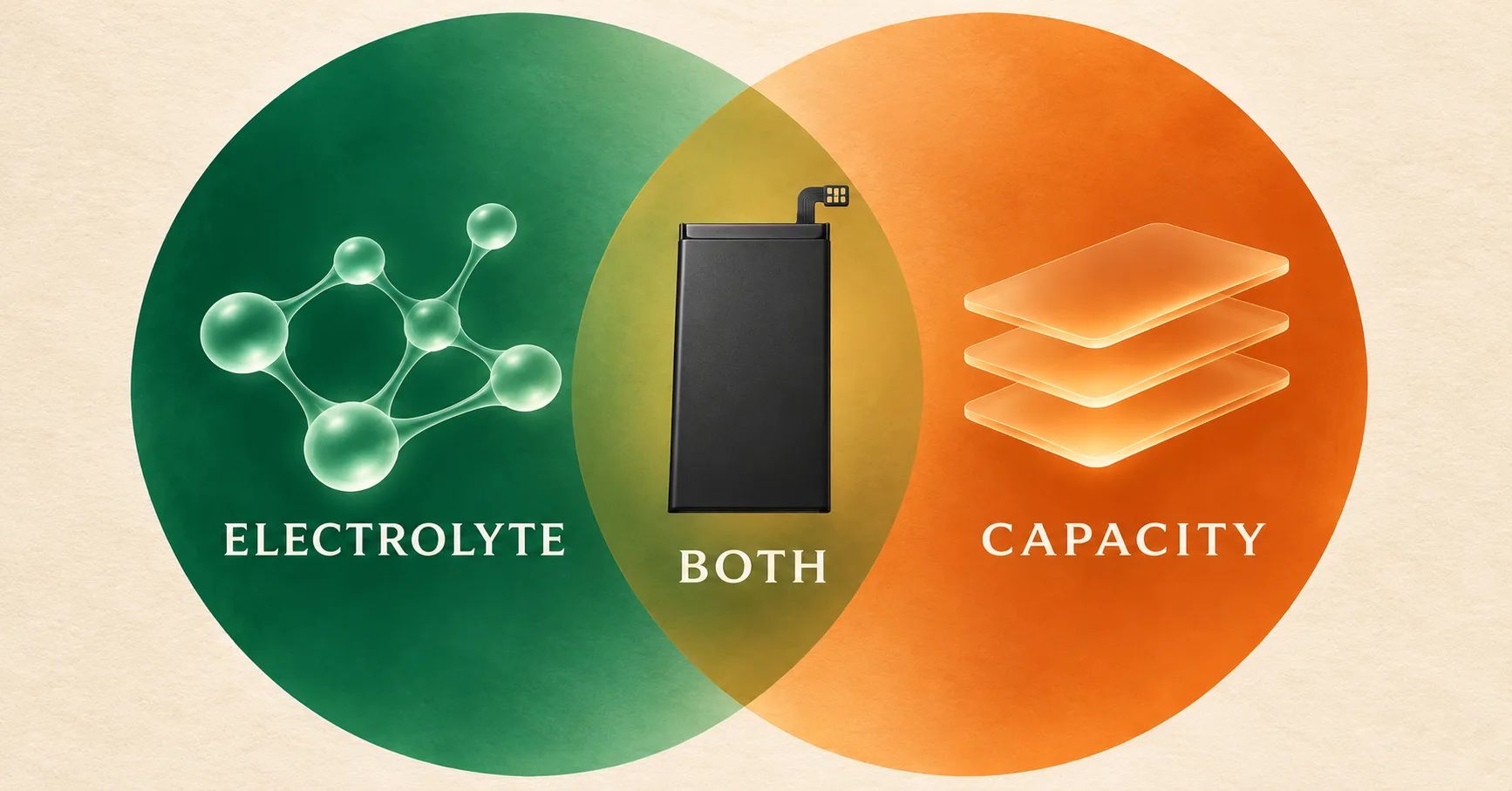
A semi solid state vs high capacity iphone battery comparison starts with a distinction: semi-solid-state describes a proposed electrolyte or cell-design approach, while high-capacity describes an energy-storage claim relative to a stated reference. They are not mutually exclusive product categories.
A replacement assembly could use a semi-solid electrolyte approach and also claim increased capacity. Another could use that approach without claiming an increase. Likewise, a high-capacity label does not identify the electrolyte design. Buyers need independent evidence for each statement.
For repair chains, refurbishers and wholesalers, the useful question is which complete assembly meets the intended handset requirements and demonstrates the claimed value. This guide provides a comparison framework, not a ranking of untested products or a claim about ESCCharge performance.
What a Semi-Solid-State Claim Can Tell You
Gel-polymer systems offer one relevant technical approach. In their InfoMat review of gel polymer electrolytes, Ma and colleagues describe a polymer network holding liquid electrolyte and note that suitable systems could reduce the electrolyte leakage or flammability
. These are research opportunities with formulation-dependent tradeoffs.
That description does not establish the composition of every commercially labeled semi-solid battery. Ask the supplier what the term means for the offered cell, what documentation supports it and how the tested cell connects to the complete replacement assembly.
A semi solid state iphone replacement battery still needs verified dimensions, connector and flex configuration, protection design and device compatibility. Material terminology cannot establish installed runtime, a particular charging speed or a guaranteed reduction in field failures.
Keep safety evaluation separate from marketing comparisons. A favorable result for one sample and method supports only the relevant test claim. Do not extrapolate it into a promise that every unit will resist every failure condition.
What High-Capacity Must Be Compared Against
A high capacity iphone replacement battery needs a named baseline. Ask whether the claimed increase is relative to a new original-reference battery, another aftermarket assembly or an aged battery removed from service. Those comparisons answer different questions.
Replacing a degraded battery with a new battery can improve runtime without demonstrating an increase over the new reference specification. Require the supplier to identify the reference, its capacity definition and the test method behind any advertised uplift.
Keep rated, minimum and typical capacity declarations separate. Do not compare a typical label value with another product's minimum specification and present the difference as a measured improvement. Also distinguish the capacity of a bare cell from the value delivered by the finished assembly.
The capacity-upgrade sourcing guide covers model-specific purchasing checks. In this comparison, use its capacity evidence as one axis, then assess the electrolyte claim independently.
Four Possible Claim Combinations
The following table classifies claims rather than confirming that every combination is commercially available for a particular iPhone. Each proposed SKU requires its own evidence.
| Proposed electrolyte description | Capacity positioning | What procurement must establish |
|---|---|---|
| Conventional liquid-electrolyte design | Reference-capacity option | Exact reference, assembly identity and performance |
| Conventional liquid-electrolyte design | Higher-capacity claim | Verified capacity increase within the approved fit envelope |
| Semi-solid-state design claim | Reference-capacity option | Material description plus relevant finished-product results |
| Semi-solid-state design claim | Higher-capacity claim | Separate support for both claims and the complete assembly |
A missing electrolyte declaration should be recorded as unspecified, rather than automatically classified as conventional. Similarly, a premium price or unusual pouch appearance cannot identify the material system. Use the documentation to populate the matrix.
Compare Delivered Energy, Dimensions and Mass
Charge capacity in milliamp-hours and energy in watt-hours describe different quantities. For a declared nominal rating, watt-hours equal amp-hours multiplied by nominal voltage. Measured discharge energy is obtained from voltage and current over time under the stated test conditions; it should not be confused with a label calculation.
When assessing iphone battery energy density, ask whether the denominator is cell mass, complete assembly mass, cell volume or complete assembly volume. A cell-level figure cannot be directly compared with a pack-level figure that includes its protection components and flex.
Keep the handset model and mechanical envelope fixed. Obtain drawings and inspect thickness, clearances, connector engagement, insulation and flex routing. A larger stated energy value is not a useful upgrade if the assembly cannot be installed correctly.
Record dimensional behavior after the agreed aging or cycling conditions as well as at delivery. Do not assume that a day-one fit assessment answers every long-term dimensional question. Agree the measurement method and product-specific acceptance limits before comparing reports.
Build a Comparison Matrix Before Ranking Suppliers
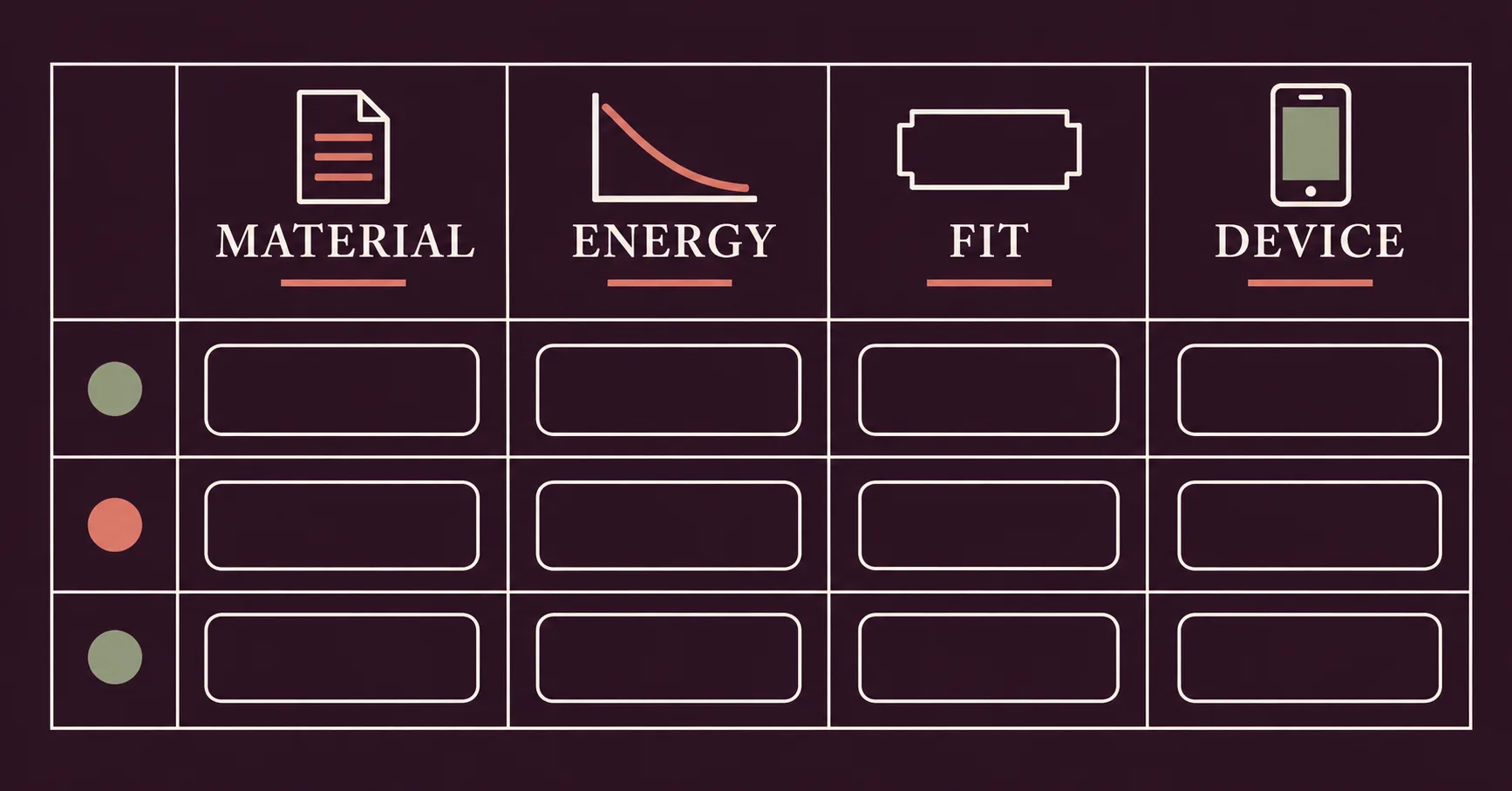
Use one row per exact assembly and revision. Keep empty fields visible so that an attractive headline cannot hide missing evidence.
| Comparison field | Evidence to request | Inference to avoid |
|---|---|---|
| Electrolyte description | Traceable material or cell declaration with relevant supporting documents | The label alone proves safer operation |
| Capacity and energy | Declared definitions, reference and complete test conditions | Printed mAh guarantees runtime |
| Fit and configuration | Drawings, assembly photos and installed assessment | Similar appearance proves interchangeability |
| Cycle performance | Rates, voltage limits, temperature and end-of-life criterion | Cycle count alone predicts warranty life |
| Installed behavior | Handset, software, charging setup and recorded observations | Chemistry guarantees system recognition |
Assign a separate outcome to each field: supported, unsupported or pending clarification. Mandatory safety, fit and functional requirements should be acceptance gates, rather than weak scores that a higher capacity number can offset.
Validate Runtime and Charging in the Same Device Conditions
For a useful iphone battery comparison, control the handset condition, software, display settings, network conditions, workload, starting charge and test temperature. Document the method well enough for the supplier and buyer to interpret the same result.
Compare measured energy and installed runtime separately. Differences in device power consumption can affect runtime, while laboratory discharge conditions may differ from the intended phone workload. Avoid transferring a percentage increase from one measurement directly to the other.
Review charging continuity, temperature observations and abnormal percentage behavior using the approved charger and cable. Neither high-capacity nor semi-solid wording establishes faster charging. Additional capacity also does not by itself establish lower heat during operation.
Record the number of samples and individual results, not only the best trace. If results vary widely or a candidate cannot meet mandatory requirements, resolve that issue before considering commercial positioning.
Keep iOS Status Separate from Material and Capacity Claims
Apple states in its guidance on genuine iPhone batteries that, for an unverified battery, the battery health information might not be accurate
. A displayed health percentage is therefore a different evidence item from measured usable capacity.
Neither comparison label establishes genuine Apple status or guarantees a particular Parts and Service History message. Capture the actual handset model, software and post-repair behavior during approval. Keep any display-related supplier claim tied to the tested configuration.
If a product changes, review which approvals remain applicable. A cell, protection design or flex change may require renewed assessment even when the commercial product name stays the same.
Choose the SKU Around the Verified Buyer Need
A repair business seeking longer runtime should prioritize a demonstrated improvement under its intended workload. A buyer investigating a material-related safety claim needs appropriate product-specific evidence. A project requiring both should qualify both rather than choose whichever label sounds more advanced.
Use a battery sampling plan to connect the approved specification to lot acceptance, and apply incoming inspection controls when shipments arrive. Sample approval and production consistency are separate decisions.
Compare commercial offers only after the technical gates are met. Normalize component scope, accepted-unit cost, required consumables and inspection effort. Keep warranty terms and actual field outcomes separate from laboratory performance, and do not infer a fixed savings rate.
For an ESCCharge sourcing discussion, provide the exact handset models, assembly scope, capacity reference and claims you need supported. Request the applicable specifications, samples and documentation, then confirm availability and commercial terms for the actual project.
FAQ
Can a battery be both semi-solid-state and high-capacity?
Yes, the descriptions concern different dimensions. A supplier offering both claims must support each one for the exact assembly.
Is high-capacity the opposite of semi-solid-state?
No. High-capacity needs a reference and measurement basis. Semi-solid-state needs a substantiated material or design description.
Which option gives longer runtime?
Determine that through comparable installed tests. Neither label alone establishes the result for a given handset and workload.
What is the first purchasing step?
Identify the complete assembly and target device, then separate the claims into independently verifiable requirements. A semi solid state vs high capacity iphone battery decision should follow that evidence, rather than a universal ranking.
External Source References
- Ma and colleagues — In situ preparation of gel polymer electrolyte for lithium batteries: Progress and perspectives — InfoMat, 2022 issue; first published 2021: gel-electrolyte structure and research context.
- Apple — About genuine iPhone batteries: repair, verification and battery-health information.