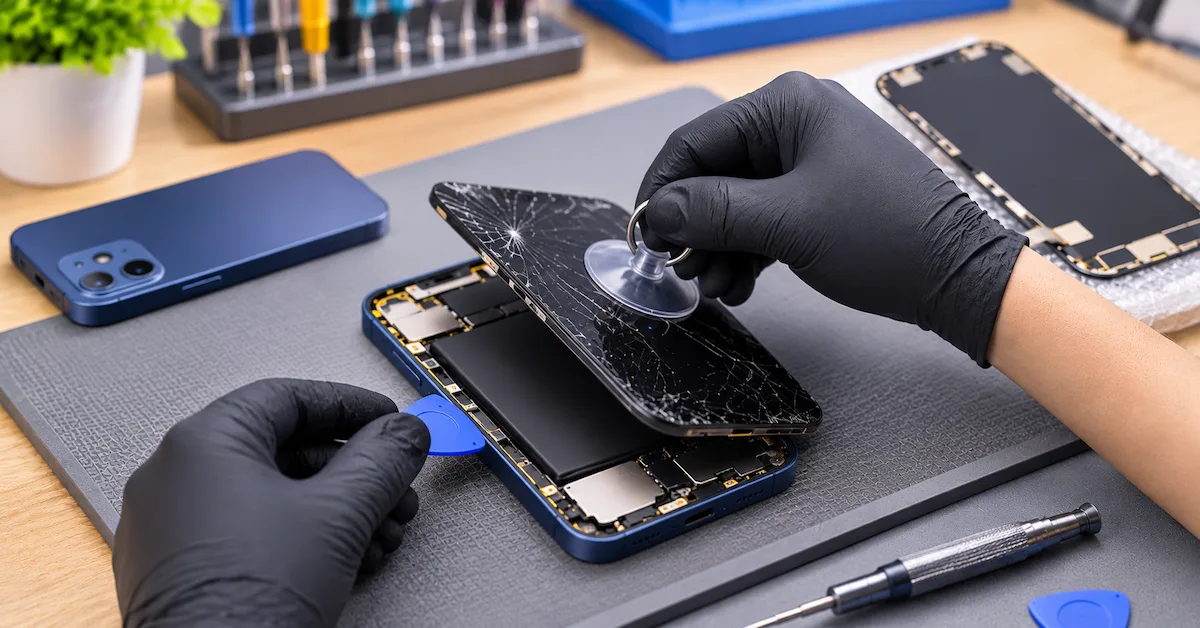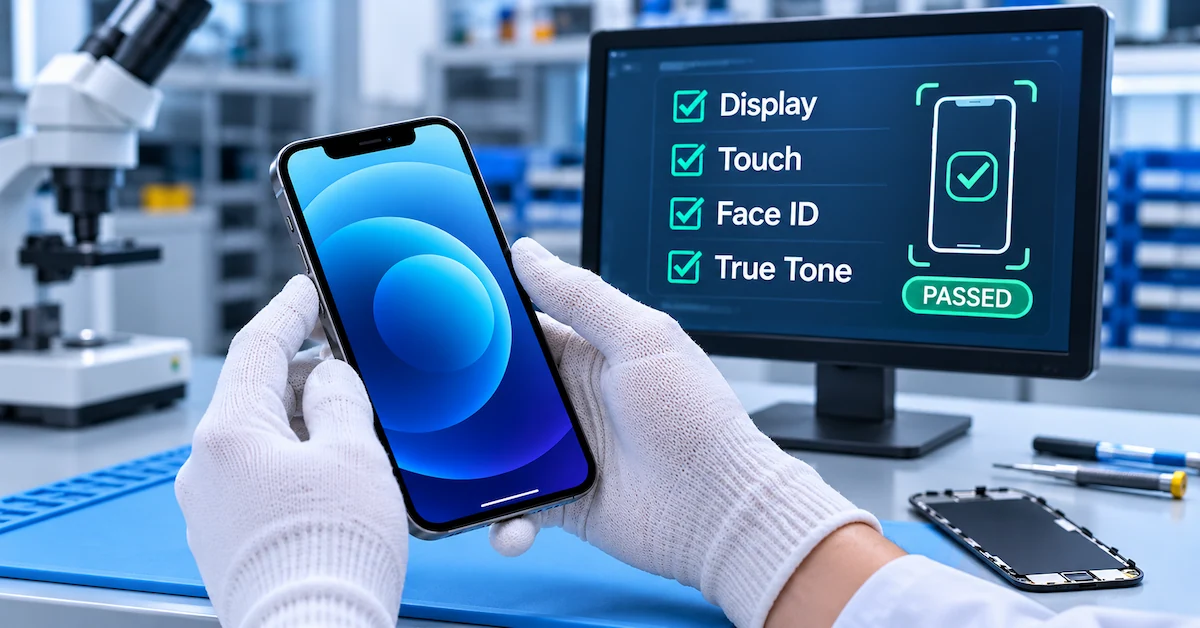

Quick Answer: An iPhone 12 Pro screen replacement should be approved based on actual display performance, not physical compatibility alone. The original iPhone 12 Pro has a 6.1-inch OLED display with a published typical maximum brightness of 800 nits, compared with 625 nits for the standard iPhone 12. Some replacement assemblies fit both models, but repair businesses should independently verify brightness, image quality, touch response, Face ID, True Tone, and repair-history status before approving a repaired device or bulk screen order.
An iPhone 12 Pro screen replacement can create an unexpected problem for repair businesses: a display may work correctly at first glance but still fail to meet the intended refurbishment standard.
The iPhone 12 and iPhone 12 Pro share several display characteristics, including screen size, pixel resolution, and OLED technology.
That similarity can make a cross-model replacement screen attractive to distributors seeking to simplify inventory.
However, Apple publishes different typical maximum brightness specifications for the two devices.
For a retail repair customer, the difference may influence the experience of using the phone outdoors.
For a refurbishment business, it can affect the accuracy of product grading, the credibility of replacement-part claims, and the final quality standard.
The challenge is therefore not simply finding a screen that fits.
It is identifying a compatible assembly that meets the required performance, software, and commercial conditions.
This guide focuses on the iPhone 12 Pro's specific replacement-screen considerations, including cross-model display matching, practical optical testing, sensor protection, and documented B2B acceptance.
1. What Screen Does the iPhone 12 Pro Originally Use?
The iPhone 12 Pro was introduced in 2020 with Apple's Super Retina XDR OLED display.
Its original screen supports HDR, True Tone, wide color, and Haptic Touch.
Original iPhone 12 Pro display specifications
| Specification | Apple-published value |
|---|---|
| Model | iPhone 12 Pro |
| Display technology | Super Retina XDR OLED |
| Display size | 6.1 inches |
| Resolution | 2532 × 1170 pixels |
| Pixel density | 460 ppi |
| Typical contrast ratio | 2,000,000:1 |
| Typical maximum brightness | 800 nits |
| Maximum HDR brightness | 1,200 nits |
| Wide color | P3 |
| True Tone | Supported |
| Haptic Touch | Supported |
| Front protection | Ceramic Shield |
Source: Apple — iPhone 12 Pro Technical Specifications.
These specifications describe the original device.
They do not mean every third-party replacement screen automatically achieves the same performance.
Why are original specifications important?
Repair shops use original-equipment specifications as a reference when defining quality.
A replacement display with the correct size and resolution may still differ in:
-
Maximum luminance
-
Color accuracy
-
Brightness uniformity
-
Viewing characteristics
-
Touch response
-
Mechanical construction
-
Power consumption
-
Software-related behavior
A supplier's description of a display as "premium" or "original quality" is not a substitute for technical evidence.
For a professional refurbishment program, the purchasing team should document the display characteristics required by its intended resale grade.
2. Can an iPhone 12 Screen Be Used for iPhone 12 Pro Screen Replacement?
This is one of the most useful compatibility questions for repair distributors.
The standard iPhone 12 and the iPhone 12 Pro have the same nominal screen dimensions and resolution.
Independent repair testing has also demonstrated physical cross-compatibility for certain display assemblies.
However, this finding needs to be interpreted carefully.
iPhone 12 vs. iPhone 12 Pro display comparison
| Display characteristic | iPhone 12 | iPhone 12 Pro |
|---|---|---|
| Original technology | OLED | OLED |
| Screen size | 6.1 inches | 6.1 inches |
| Resolution | 2532 × 1170 | 2532 × 1170 |
| Pixel density | 460 ppi | 460 ppi |
| Typical maximum brightness | 625 nits | 800 nits |
| Maximum HDR brightness | 1,200 nits | 1,200 nits |
| True Tone | Supported | Supported |
| Wide color | P3 | P3 |
| Haptic Touch | Supported | Supported |
Sources: Apple iPhone 12 specifications and Apple iPhone 12 Pro specifications.
The published difference in typical maximum brightness is 175 nits.
That is approximately a 28% higher stated maximum typical luminance for the iPhone 12 Pro, using the standard iPhone 12 as the reference.
This is a comparison of published specifications, not a claim that users will perceive a 28% difference in brightness.
What did iFixit find?
During its iPhone 12 and iPhone 12 Pro teardown, iFixit reported that its early tests showed the displays could function when swapped between the two models.
See iFixit — iPhone 12 and 12 Pro Teardown.
This is useful independent evidence of cross-model compatibility for the tested assemblies.
However, it should not be interpreted as proof that every third-party display:
-
Fits both models correctly
-
Achieves the Pro's original brightness
-
Preserves True Tone behavior
-
Produces an identical repair-history result
-
Meets the same optical or reliability standard
What does this mean for wholesale purchasing?
A supplier may legitimately offer an assembly compatible with both iPhone 12 and iPhone 12 Pro.
The buyer should nevertheless require separate model-level validation.
Mechanical compatibility and Pro-grade optical performance are different acceptance requirements.
For businesses supplying premium refurbishment programs, this distinction is especially important.
3. When Does an iPhone 12 Pro Actually Need a New Screen?
A cracked display is an obvious reason to investigate replacement.
Other symptoms may be more difficult to diagnose.
A black screen does not always indicate a failed OLED panel.
Likewise, intermittent touch response may result from the display, a damaged connection, or another device-level problem.
Fault diagnosis matrix
| Reported symptom | Possible cause | Recommended decision |
|---|---|---|
| Cracked glass | Physical damage | Evaluate complete display assembly |
| Permanent colored lines | OLED or display electronics defect | Assess screen replacement |
| Black display with functioning phone | Display or related connection problem | Perform controlled display diagnosis |
| Black display with no confirmed power | Battery, charging, power system, software or display | Diagnose before purchasing parts |
| Touch dead zones | Digitizer or related fault | Verify full-area touch response |
| Ghost touch | Touch subsystem or associated issue | Investigate under repeatable conditions |
| Flickering image | Display hardware, software, or power issue | Controlled troubleshooting |
| Dim display | Settings, sensor, software, or panel performance | Check brightness system |
| Screen lifting | Adhesive, enclosure or possible battery swelling | Safety assessment first |
How can technicians distinguish display faults from power faults?
A qualified repair process should determine whether the device itself is operational.
Relevant observations may include normal charging behavior, successful startup, recognized system connections, and results from appropriate diagnostics.
If the phone is not functioning electrically, a display replacement may not resolve the problem.
When should work stop?
If the device shows signs of battery swelling, deformation, overheating, leakage, or other physical battery damage, stop ordinary charging and disassembly procedures.
A damaged lithium-ion battery requires suitable professional safety handling.
Do not force a lifting screen back into the enclosure.
4. Which Buyers Benefit Most From This Repair Framework?
The same replacement-screen specification may not suit every buyer.
Independent repair shops
These businesses need reliable compatibility, manageable installation requirements, and a clear method for explaining replacement options to customers.
They should also document existing Face ID, True Tone, and screen-function problems before opening the device.
Refurbishment companies
Refurbishers must ensure that repaired devices meet an agreed functional and cosmetic grade.
Display brightness, color consistency, repair status, battery condition, and resale margin can all influence acceptance.
Parts distributors
Distributors need accurate SKU descriptions and stable supplier revisions.
An assembly advertised for two iPhone models should have evidence of its compatibility and relevant performance characteristics.
Repair chains
Multi-location businesses need consistent technical procedures and return classifications.
One repair location should not reject a screen under conditions that another location considers acceptable unless their specifications intentionally differ.
When is this framework not sufficient?
It is not a substitute for device-specific repair training, Apple's service procedures, or technical qualification of a new display assembly.
It also does not establish that a particular aftermarket screen is genuine Apple or qualifies for Apple's calibration process.
5. How Should Buyers Select an iPhone 12 Pro Replacement OLED?
Screen selection should begin with the required finished-device standard.
Buyers may encounter new genuine parts, refurbished original assemblies, aftermarket OLED panels, and LCD alternatives.
Rather than treating these as universal quality grades, evaluate the actual supplied configuration.
Replacement display purchasing matrix
| Option | Potential advantage | Principal verification |
|---|---|---|
| New genuine Apple display | Original-design service component | Provenance and supported repair process |
| Refurbished original OLED | May retain original panel characteristics | Panel history, bonding and optical quality |
| Aftermarket soft OLED | Flexible OLED-based construction | Brightness, fit, touch and consistency |
| Aftermarket hard OLED | Alternative OLED construction | Mechanical durability and optical performance |
| LCD replacement | May reduce initial purchase cost | Technology differences, power behavior and disclosure |
What should the supplier specify?
An accurate product specification should identify:
-
Target model or models
-
Panel technology
-
Display assembly configuration
-
Claimed resolution and brightness
-
Touchscreen functionality
-
Frame and connector details
-
Included or excluded components
-
Product revision
-
Packaging
-
Warranty conditions
If the supplier advertises compatibility with both iPhone 12 and iPhone 12 Pro, request evidence for both applications.
A buyer should not approve a panel solely because its connector fits or its screen illuminates.
6. How Do You Test iPhone 12 Pro Screen Brightness?
Brightness evaluation is the most important distinctive part of this guide.
Apple publishes an original typical maximum brightness of 800 nits for iPhone 12 Pro.
However, a casual visual inspection cannot establish whether a replacement panel meets that value.
What are nits?
A nit is a unit of display luminance equal to one candela per square meter (cd/m²).
It describes emitted light intensity per unit area in a given direction.
A measurement in nits is not interchangeable with an ambient illuminance reading in lux.
Recommended professional test equipment
For a quantitative evaluation, buyers should use suitable calibrated luminance-measurement equipment and a controlled test procedure.
Depending on the laboratory's capabilities, this may involve a display luminance meter or an appropriate imaging photometer.
Proposed screen evaluation procedure
Step 1: Confirm the display configuration
Record the device model, display supplier, SKU, and product revision.
Step 2: Establish common conditions
Use controlled ambient lighting, suitable device temperature, consistent software settings, and an agreed display test pattern.
Step 3: Record the software environment
Document the iOS version and relevant brightness settings.
True Tone, Night Shift, automatic brightness behavior, and other display adjustments should be accounted for in the test method.
Step 4: Measure luminance
Use an appropriate instrument to measure the defined region of the display under the specified test conditions.
Step 5: Evaluate uniformity
Assess multiple display locations to identify significant unwanted variation.
Step 6: Compare with the approved reference
Where practical, use a known-good iPhone 12 Pro display and an approved replacement sample as comparison references.
Step 7: Record the result
Store the measurement method, readings, observations, equipment details, and pass/fail decision.
Does every replacement need to measure exactly 800 nits?
Not as a universal acceptance rule.
Apple's published specification should not be converted directly into a pass/fail threshold under an unrelated workshop measurement setup.
Screen luminance depends on the test pattern, settings, environmental conditions, and measurement procedure.
A buyer seeking original-equivalent performance should develop or obtain a suitable validated test method and agree on numerical acceptance limits.
The practical goal is to determine whether the replacement meets the stated performance requirement under reproducible conditions.
Avoid misleading brightness claims
A screen advertised as "800-nit OLED" should have relevant supporting test evidence.
Similarly, a result obtained using HDR content should not be presented as the same measurement as typical maximum brightness.
For refurbishment companies, repeatability is more useful than a single unverified peak reading.
7. What Other Display Characteristics Should Be Verified?
Brightness is not the only relevant optical characteristic.
A replacement assembly may have acceptable maximum luminance while producing inconsistent color, poor uniformity, or unstable touch performance.
Recommended optical and functional tests
| Test | Purpose | Suggested evidence |
|---|---|---|
| Image output | Confirm full-screen operation | Visual inspection record |
| Luminance | Evaluate brightness performance | Controlled measurement |
| Uniformity | Identify uneven illumination | Multi-point assessment |
| Color | Evaluate visible color consistency | Reference comparison |
| Black levels | Assess OLED presentation | Defined image pattern |
| Dead or bright pixels | Identify visible defects | Pixel inspection |
| Touch accuracy | Verify interaction | Full-area touch test |
| Haptic Touch | Verify expected interaction | Functional observation |
| True Tone | Check relevant feature behavior | Settings and functional record |
| Auto-brightness | Check ambient-light response | Controlled lighting test |
| Image stability | Identify flicker or image loss | Functional observation |
What about refresh rate?
The iPhone 12 Pro should not be confused with later Pro models that feature ProMotion.
A supplier's 120Hz marketing claim is not an original iPhone 12 Pro requirement.
For this device, the more meaningful quality questions concern its actual OLED performance, touch accuracy, and compatibility.
8. How Do Face ID and Sensor Components Affect Screen Replacement?
The iPhone 12 Pro includes Apple's TrueDepth camera system for Face ID.
Screen replacement takes place near sensitive front-facing components.
In independent repair procedures, the original earpiece speaker and sensor assembly may need to be retained or transferred according to the approved procedure.
Why component handling matters
iFixit's iPhone 12 Pro Screen Replacement Guide identifies the original earpiece and sensor assembly as associated with the specific device.
Damage to relevant Face ID components can create additional repair problems, even when the new display itself works.
Recommended pre-repair inspection
Record:
-
Existing Face ID functionality
-
Front camera status
-
Earpiece performance
-
Proximity behavior
-
True Tone status
-
Touchscreen condition
-
Relevant repair-history messages
Recommended post-repair inspection
Repeat the same tests.
A new problem should be investigated against the original baseline rather than automatically attributed to the replacement OLED panel.
Can screen replacement disable Face ID?
Incorrect repair procedures or damaged associated components may affect Face ID.
However, screen replacement does not inherently mean Face ID must be lost.
The result depends on the actual device condition, component handling, and appropriate repair process.
For repair chains, before-and-after biometric testing should be part of the documented acceptance procedure.
9. What Happens to True Tone and Repair Assistant?
True Tone adjusts display characteristics according to ambient lighting.
Its operation can be affected by the replacement component, calibration state, and installed software.
Apple's guidance identifies True Tone limitations, brightness differences, and touch problems as potential issues with nongenuine replacement displays.
These outcomes are possible, not inevitable for every aftermarket product.
Does iPhone 12 Pro support Repair Assistant?
Yes. Apple's supported Repair Assistant framework includes eligible display repairs for the iPhone 12 family.
Repair Assistant installs applicable calibration data for supported repairs.
According to Apple's Repair Assistant guidance, the general requirements include:
-
A supported device and component
-
A suitable Wi-Fi connection
-
More than 20% battery charge
-
Current supported iOS software
-
Completion of the applicable process
Where can technicians find it?
When a qualifying repair requires completion, navigate to:
Settings → General → About → Parts and Service History
Select the available repair-completion option and follow Apple's instructions.
Does Repair Assistant work with every third-party OLED?
No such blanket compatibility should be assumed.
The presence of Repair Assistant does not make an aftermarket screen genuine Apple.
Supported calibration depends on the model, component, software, and applicable repair requirements.
Likewise, Apple's support for certain reused genuine components on iPhone 15 and later should not be treated as an unrestricted policy for iPhone 12 Pro.
Recommended acceptance record
Document the actual True Tone behavior and repair-completion result.
Avoid promising that every replacement screen will show the same software status.
10. What Does Parts and Service History Mean After Repair?
Apple supports display-related repair information on the iPhone 12 family.
On supported iOS versions, the phone may show relevant details under Parts and Service History.
Understanding common statuses
| Status | General meaning | B2B inspection response |
|---|---|---|
| Genuine | Genuine Apple part and applicable repair process | Record and verify function |
| Unknown | The part cannot be verified as expected, or another defined condition applies | Investigate and document |
| Finish Repair | Applicable repair completion remains pending | Check supported calibration process |
The displayed information depends on the model, software version, and actual repair.
Apple's Parts and Service History documentation explains the meaning of these statuses.
Does Unknown prove the panel is defective?
No.
An Unknown message may relate to component origin, verification, or other conditions.
Actual optical and electrical performance must be evaluated independently.
Does Genuine guarantee perfect screen quality?
No.
Even a genuine part requires functional inspection after installation.
Physical damage, installation problems, and other device faults can still affect the completed repair.
Why does repair history matter for resale?
Refurbishment businesses may need to disclose the origin and condition of replacement parts.
A documented service history helps distinguish product authenticity from repair quality.
A professional inspection record should preserve both the actual system message and the completed hardware test results.
11. What Should Be Included in the Final Repair Inspection?
A successful iPhone 12 Pro screen repair should pass an agreed final-device acceptance procedure.
The requirements may differ between premium refurbished phones and lower-priced functional devices, but each grade needs clear criteria.
Post-repair quality-control checklist
| Inspection area | Required verification |
|---|---|
| Device identity | Correct iPhone 12 Pro model |
| Display output | Stable full-screen image |
| OLED condition | No unacceptable visible defects |
| Brightness | Meets agreed test specification |
| Color and uniformity | Meets approved reference |
| Multi-Touch | Accurate response across display |
| True Tone | Expected availability and behavior |
| Auto-brightness | Appropriate sensor response |
| Face ID | Required functionality confirmed |
| Front camera | Normal functional operation |
| Earpiece | Normal sound output |
| Proximity sensor | Correct applicable behavior |
| Haptic Touch | Normal interaction |
| Physical assembly | Correct seating and alignment |
| Repair information | Actual status recorded |
| Charging and battery | No unresolved power issue |
| Final cosmetic grade | Meets resale standard |
Why include cameras and battery?
The iPhone 12 Pro is sold and refurbished as a complete device.
Its rear camera system includes wide, ultra-wide, telephoto, and LiDAR-related functions.
Those are not display components, but they may matter to the final resale grade.
Similarly, a repaired screen does not eliminate an existing battery or charging problem.
A professional refurbisher should distinguish display-specific acceptance from complete-device acceptance.
Water-resistance disclosure
The original iPhone 12 Pro was designed with an IP68 rating under specified conditions.
Opening the phone disturbs its original sealing system.
Using replacement display adhesive does not independently guarantee restoration of the original factory water-resistance rating.
Do not make unsupported waterproof claims after repair.
12. How Should Buyers Approve iPhone 12 Pro Screen Lots?
A wholesaler purchasing screens for several repair locations needs more than a single successful installation.
The actual supplier SKU, product revision, and quality characteristics should remain consistent.
Three-stage acceptance framework
| Stage | Main objective | Decision |
|---|---|---|
| Sample qualification | Establish approved configuration and performance | Approve or reject design |
| Incoming inspection | Confirm shipment identity and condition | Accept, hold, or reject lot |
| Post-installation verification | Confirm finished-device function | Release or rework device |
Sample qualification
Use representative displays from the proposed supplier.
Verify:
-
Model compatibility
-
Panel and assembly configuration
-
Relevant optical performance
-
Touch functionality
-
Mechanical fit
-
Software-related observations
-
Installation requirements
A sample should be approved against a written specification, not simply marked "tested."
Incoming inspection
Check product labeling, packaging, connector condition, visible damage, and revision identity.
For high-value applications, use an agreed sampling plan and defined acceptance criteria.
The sample size and rejection rules should reflect the contract and product risk.
Post-installation verification
Record screen performance on representative or individual repaired devices, depending on the inspection requirement.
A screen that passes incoming inspection may still fail during installed-device testing because certain issues only become visible after integration.
Change control
A supplier should notify the buyer when relevant display components or assembly configurations change.
For example, a revision involving the panel, touch system, connector, or frame may require fresh qualification.
The same marketing product name does not prove technical equivalence across different revisions.
13. How Can Repair Chains Distinguish Supplier Defects From Repair Errors?
Return classification is a common source of disagreement between component suppliers and repair businesses.
An unsuccessful repair does not automatically establish that the replacement display was defective.
Recommended failure categories
| Failure classification | Example |
|---|---|
| Incoming component defect | Screen arrives with visible panel damage |
| Optical performance failure | Screen does not meet agreed brightness criteria |
| Installation-related issue | Damage occurs during handling |
| Compatibility issue | Approved assembly does not function in specified device |
| Calibration-related issue | Eligible repair completion remains unresolved |
| Pre-existing device fault | Original Face ID or power problem remains |
| Customer-caused damage | New damage occurs after repair |
| Unconfirmed complaint | Reported defect cannot be reproduced |
Traceability information
For each repair, record the device model, supplier SKU, component lot, technician, software version, before-and-after testing, and final disposition.
When a defect trend appears, these records help identify whether the issue is associated with a particular supplier lot, assembly revision, repair process, or customer environment.
Important B2B metric
First-Pass Acceptance Rate = Devices Passing Final QC Without Rework ÷ Total Completed Repairs × 100%
Track this metric alongside confirmed supplier failures and warranty claims.
A high return rate alone does not prove poor panel quality unless the causes have been investigated.
14. What Does iPhone 12 Pro Screen Replacement Cost?
The actual replacement price varies according to parts, service provider, region, labor, device condition, and warranty requirements.
A single universal price would be misleading.
For B2B refurbishment, the important question is whether the completed repair meets both the technical acceptance standard and the required profit contribution.
Calculate repair economics
Expected Contribution = Net Resale Revenue − Device Acquisition − Display Repair − Other Repairs − Processing Costs − Expected Warranty Cost
Illustrative refurbishment example
The following example uses hypothetical figures, not current market quotations or ESC screen prices.
| Item | Approved Pro-grade OLED | Lower-cost alternative |
|---|---|---|
| Expected resale proceeds | $245 | $220 |
| Device acquisition | $110 | $110 |
| Display component | $52 | $30 |
| Labor and consumables | $27 | $27 |
| Other processing | $18 | $18 |
| Expected warranty allowance | $8 | $16 |
| Expected contribution | $30 | $19 |
In this hypothetical scenario, the more expensive qualified display produces a higher expected contribution because of the assumed resale price and warranty differences.
However, these differences must be supported by real sales and quality records before being used in purchasing decisions.
A premium OLED does not automatically create a higher resale price.
When should a repair be rejected?
If the device has substantial frame damage, unresolved power problems, multiple defective components, or insufficient resale value, replacement may be uneconomical.
The company may need to choose a different approved resale category, further diagnosis, or rejection.
The repair should not proceed simply because a compatible screen is available.
15. When Should Battery Replacement Be Included?
Display repair and battery replacement are separate technical decisions.
An iPhone 12 Pro with a broken screen may have an acceptable battery.
Another may have both a damaged display and significant battery degradation.
For refurbished phones, both conditions can affect the final sale.
Battery evaluation during display repair
| Condition | Recommended action |
|---|---|
| Damaged screen, healthy battery | Evaluate screen repair only |
| Functional screen, degraded battery | Evaluate battery replacement |
| Screen and battery both defective | Approve separate repair scopes |
| Black screen, uncertain power condition | Diagnose before ordering either component |
| Suspected battery swelling | Safety Hold |
Verified ESC replacement battery
ESC publishes a compatible iPhone 12 / iPhone 12 Pro Replacement Battery.
| Specification | ESC published value |
|---|---|
| Application | iPhone 12 / iPhone 12 Pro |
| Battery type | Aftermarket lithium-ion replacement |
| Rated capacity | 2815mAh |
| Nominal voltage | 3.83V |
| Rated energy | 10.78Wh |
| Configuration | Diagnosable / smart recognition |
| MOQ | Negotiable |
| Published lead time | 7–15 working days |
| Warranty | 12 months listed |
These are supplier-published specifications and commercial terms, not independently verified performance measurements or a guaranteed quotation.
The battery is an aftermarket product, not a genuine Apple service battery.
Actual capacity, system behavior, warranty coverage, and order terms should be verified for the intended purchasing project.
Why separate screen and battery procurement?
Although the two repairs may be performed during the same refurbishment project, they involve different technical specifications and supply chains.
For a screen, buyers should prioritize optical performance, touch, fit, and sensor-related repair results.
For a battery, buyers should evaluate capacity, voltage, mechanical configuration, charging, safety, and applicable product documentation.
ESC's iPhone 12 battery replacement and bulk sourcing guide provides more detail about the battery-specific approval process.
16. What Should B2B Buyers Include in a Screen Replacement RFQ?
A technically useful request for quotation should allow suppliers to propose comparable products.
The more precisely the requirements are defined, the easier it becomes to evaluate the submitted quotations.
Screen assembly RFQ checklist
| Requirement | Information to request |
|---|---|
| Exact application | iPhone 12 Pro |
| Model identifiers | Approved regional device models |
| Cross-model claims | Evidence supporting iPhone 12 compatibility |
| Display technology | Original OLED, refurbished OLED, aftermarket OLED or alternative |
| Optical requirements | Brightness, uniformity, color and relevant tolerances |
| Touch performance | Functional acceptance procedure |
| Assembly contents | Display, frame and included components |
| Repair process | Relevant installation and sensor-handling requirements |
| Software observations | True Tone and Parts and Service History information |
| Sample testing | Qualification quantity and procedure |
| Product revision | Part number, lot and change notification |
| Commercial terms | MOQ, pricing, delivery and warranty |
| Documentation | Applicable technical and quality records |
Important supplier question
Ask the screen supplier:
"Does this replacement assembly merely fit iPhone 12 Pro, or has its optical performance been validated against a Pro-specific acceptance specification?"
The answer helps distinguish basic compatibility from a genuinely qualified replacement option.
17. How Can ESC Support Related B2B Refurbishment Purchases?
ESCCharge focuses on replacement batteries and charging-related products.
A dedicated iPhone 12 Pro screen assembly has not been verified in its public catalog.
Therefore, screen components should be sourced through an appropriately qualified display supplier unless ESC confirms a specific offering.
For the battery portion of a refurbishment program, ESC provides a verified iPhone 12 / iPhone 12 Pro replacement battery and supports wholesale inquiries.
Recommended ESC purchasing route
Buyers handling mixed iPhone refurbishment batches can review the original-capacity iPhone replacement battery category.
For the iPhone 12 Pro specifically, the 2815mAh replacement battery product page provides the relevant published specification.
What should a battery inquiry include?
A professional buyer should provide:
-
The target device models
-
Required battery configuration
-
Estimated monthly or order quantity
-
Sample-testing requirements
-
Relevant software and repair expectations
-
Required packaging or labeling
-
Destination market
-
Required documentation
-
Delivery schedule
Request a quotation
Repair chains, used-phone refurbishers, wholesalers, and distributors can contact ESC to discuss suitable replacement batteries, sample availability, quality requirements, and bulk-order terms.
Suggested inquiry message:
"We operate an iPhone refurbishment program and need replacement batteries for iPhone 12 Pro devices. Please confirm the current 2815mAh battery configuration, sample availability, technical specifications, MOQ, lead time, applicable product documentation, warranty terms, and wholesale quotation for our estimated quantity."
This allows ESC to respond to a verified product requirement rather than implying that the company supplies an unconfirmed screen assembly.
Frequently Asked Questions
1. What type of screen does the iPhone 12 Pro use?
The original iPhone 12 Pro uses a 6.1-inch Super Retina XDR OLED display with 2532 × 1170 resolution at 460 ppi. Apple specifies typical maximum brightness of 800 nits and maximum HDR brightness of 1,200 nits. Aftermarket screens should be evaluated against the required performance standard.
2. Are iPhone 12 and iPhone 12 Pro screens interchangeable?
Some display assemblies have been shown to work across the two models, including in early iFixit testing. However, compatibility should be verified for the exact replacement SKU. Physical fit does not independently establish original Pro-level brightness, calibration behavior, or optical quality.
3. Why is iPhone 12 Pro screen brightness different from iPhone 12?
Apple publishes typical maximum brightness ratings of 800 nits for iPhone 12 Pro and 625 nits for iPhone 12. The two models share screen size and resolution but are not specified identically for typical brightness. The reason for any particular replacement panel's measured behavior must be assessed separately.
4. How much does iPhone 12 Pro screen replacement cost?
The price varies with the chosen screen, repair provider, regional labor cost, device condition, and warranty. For B2B refurbishment, compare total expected repair cost and the contribution from an accepted finished device rather than focusing only on the screen purchase price.
5. Can a replacement iPhone 12 Pro screen affect Face ID?
Damage to sensitive Face ID-related components or connections during the repair can affect functionality. A professional technician should follow an appropriate repair procedure and test Face ID before and after replacing the display.
6. Will True Tone work after replacing an iPhone 12 Pro screen?
True Tone behavior depends on the replacement part, software, and applicable repair process. Apple supports Repair Assistant for eligible iPhone 12-family display repairs. An aftermarket screen should not be assumed to support the same calibration or feature behavior as a genuine Apple service part.
7. Does iPhone 12 Pro have a 120Hz screen?
No. The original iPhone 12 Pro does not feature the later ProMotion display system. A buyer should not use a 120Hz ProMotion requirement as the original specification for this model. Focus instead on the correct OLED, brightness, touch, and other supported functions.
8. What does Unknown Part mean after iPhone 12 Pro screen replacement?
Apple explains that Unknown can appear under several circumstances, including a nongenuine component or a part that cannot be verified or is not operating as expected. It does not independently establish the panel's measured optical quality. Record the exact status and investigate the repair separately.
9. How should wholesalers test iPhone 12 Pro replacement screens?
Verify the product revision, exact model compatibility, panel technology, mechanical fit, luminance, uniformity, color, touch response, sensor-related functions, and actual post-repair software status. Approve representative samples and maintain traceability before accepting production quantities.
10. Does ESC sell iPhone 12 Pro replacement screens or batteries?
ESC has a verified aftermarket 2815mAh iPhone 12 / iPhone 12 Pro replacement battery for professional repair and B2B purchasing. A dedicated iPhone 12 Pro replacement-screen assembly has not been verified in ESC's public catalog. Screen sourcing should be confirmed separately.
Conclusion
iPhone 12 Pro screen replacement is not simply a question of whether a new display can be installed successfully.
The original device uses a 6.1-inch OLED panel with a published typical maximum brightness of 800 nits, creating an important distinction from the standard iPhone 12.
Although certain assemblies can function across both models, compatibility does not automatically establish equivalent brightness, display quality, or software-related repair results.
For professional repair shops, the appropriate process begins with accurate fault diagnosis and a documented pre-repair baseline.
For refurbishment businesses and wholesale buyers, it also requires controlled optical testing, sample qualification, component traceability, and clearly defined acceptance criteria.
Face ID, True Tone, touch response, Parts and Service History, and relevant repair-calibration information should be evaluated separately.
A supplier should be able to demonstrate how its replacement display meets the buyer's intended finished-device standard.
Commercial decisions should then consider total repair cost, warranty exposure, and the expected value of the accepted refurbished phone.
Battery problems should not be confused with display defects.
When an iPhone 12 Pro also has a confirmed battery issue, ESC provides a 2815mAh iPhone 12 / iPhone 12 Pro replacement battery for professional repair and wholesale applications.
Repair chains, refurbishers, and distributors can contact ESC to discuss compatible replacement batteries, sample evaluation, B2B quality requirements, and bulk purchasing.
By separating screen compatibility from display-grade performance and establishing documented repair acceptance, businesses can reduce avoidable rework, make more informed purchasing decisions, and support consistent refurbished-device quality.