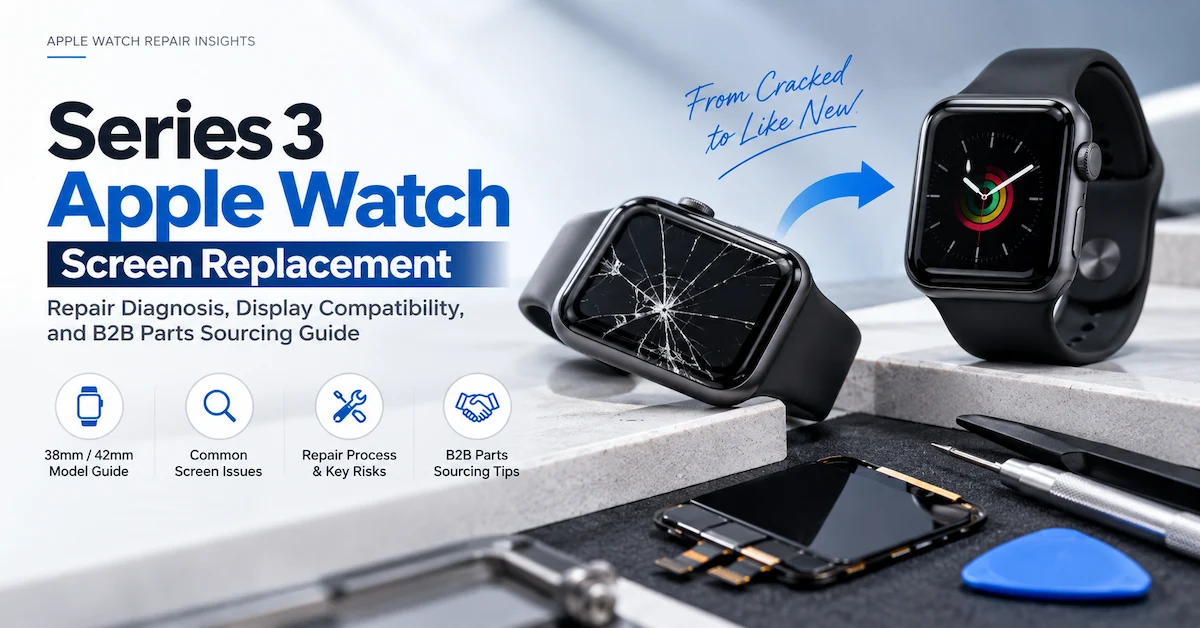

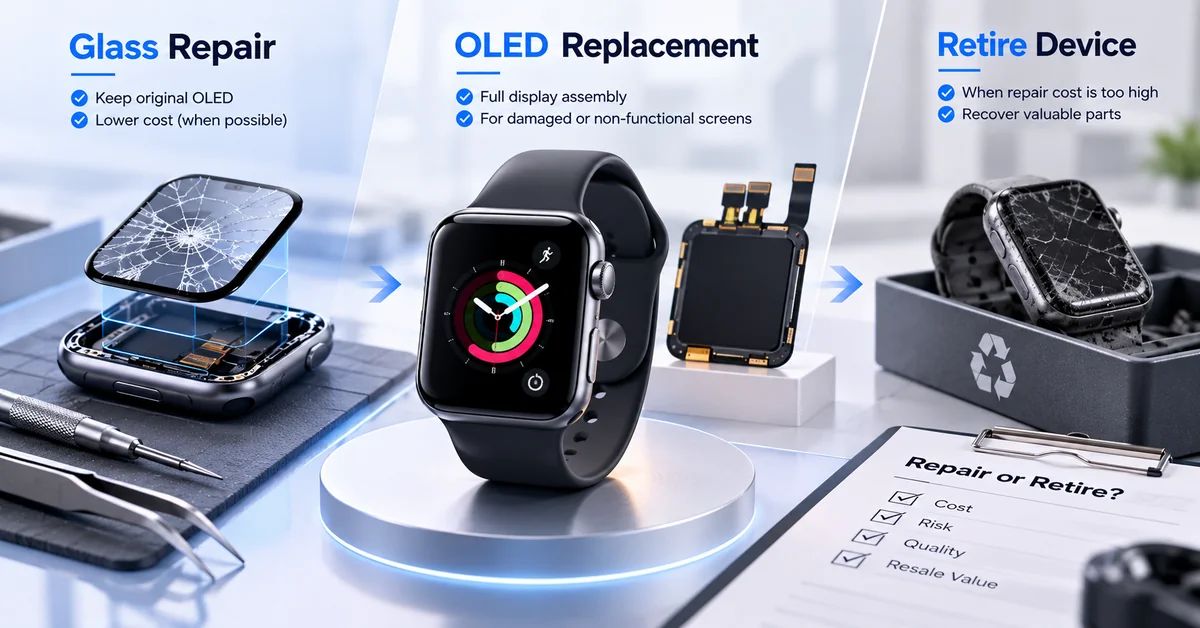
TL;DR: Apple Watch 3 screen replacement should be approved only when the selected repair method meets the watch's compatibility and functional requirements while leaving an acceptable commercial margin. Glass-only refurbishment may preserve a functioning OLED panel but requires specialist equipment. Full OLED replacement is more appropriate for damaged display panels, while retiring the device may be preferable when repair costs, battery condition, or other defects make refurbishment uneconomical.
For refurbishment engineers and B2B purchasing managers, damaged Apple Watch Series 3 displays present a practical dilemma: should the company refurbish the existing display, purchase a replacement OLED assembly, or withdraw the watch from repair production?
The correct decision depends on more than the price of the replacement screen.
Model compatibility, display condition, technician labor, battery health, additional components, final inspection requirements, and expected resale value all influence the outcome.
A watch with cracked glass but a functioning OLED panel may justify specialist glass refurbishment. Another with a failed OLED panel may require full replacement. A third with display damage, battery degradation, and unresolved charging faults may be more economical to retire.
This guide compares all three options using measurable purchasing criteria, technical considerations, and a practical repair-cost calculation.
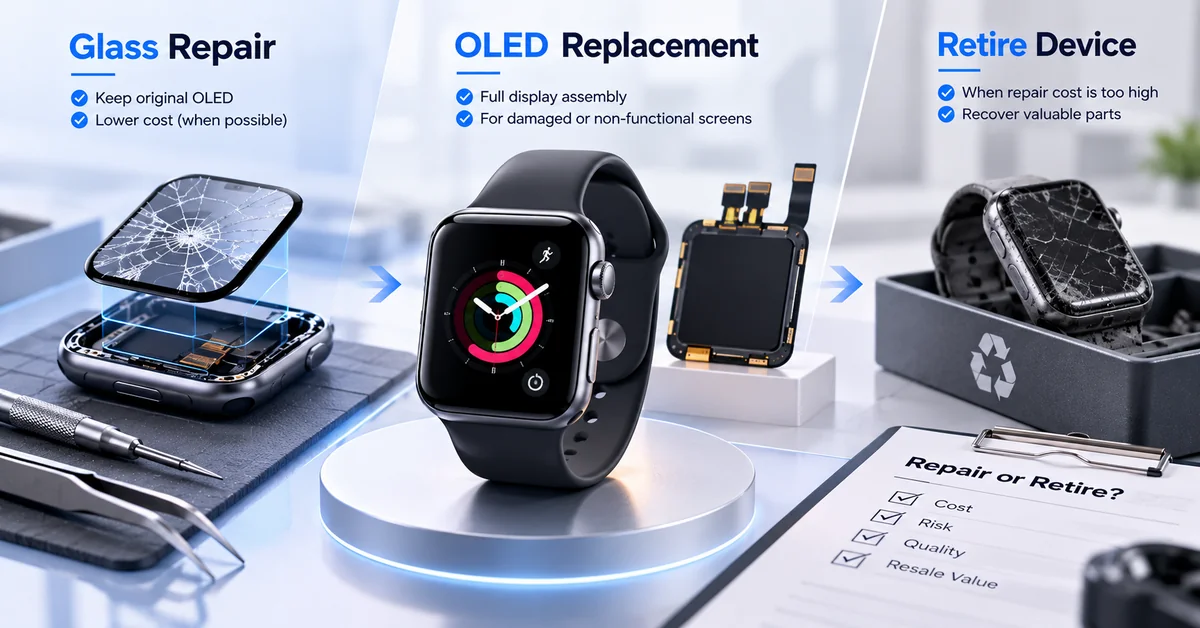
How Do Glass Repair, OLED Replacement, and Device Retirement Compare?
The following comparison helps refurbishment businesses select an appropriate repair strategy before ordering parts.
| Comparison dimension | Glass-only refurbishment | Full OLED replacement | Retire / parts recovery |
|---|---|---|---|
| Suitable condition | Glass damaged; OLED and touch remain functional | OLED or touch assembly requires replacement | Multiple faults or unfavorable repair economics |
| Main advantage | Potentially retains a functional original display panel | Replaces a failed display assembly | Avoids further uneconomical repair spending |
| Main limitation | Specialist equipment and risk of damaging the OLED | Display cost and compatibility requirements | Does not produce a complete refurbished watch |
| Technical difficulty | High | Moderate to high for trained specialists | Requires condition assessment and safe parts handling |
| Equipment requirements | Specialized glass-separation and bonding processes | Model-specific repair equipment and assembly procedures | Inspection and approved recovery procedures |
| Additional components | May need glass, adhesive, gasket and related materials | May need gasket, adhesive and other repair parts | Depends on recovery policy |
| Main QC requirement | Optical quality, bonding and touch performance | OLED performance, fit, touch and related functions | Accurate condition classification |
| Best-fit business | Specialist display refurbisher | Professional watch repair chain | High-volume refurbisher with repair/retire controls |
| Economic decision | Depends on process yield and costs | Depends on complete repair cost and resale margin | Depends on lawful recovery value and handling costs |
The main distinction: Glass refurbishment attempts to preserve a functioning OLED panel; full assembly replacement addresses a defective display; retirement avoids investing more resources in a watch that cannot meet the required technical or commercial standard.
No repair method is universally the cheapest or most reliable. Buyers should compare the actual results of qualified suppliers and their own repair processes.
Key Takeaways
-
Check 38mm and 42mm compatibility first. Apple Watch Series 3 includes GPS and GPS + Cellular variants, and screen assemblies should not be assumed interchangeable based only on the series name.
-
Select glass-only refurbishment when the OLED and touch system remain functional and specialist process economics support the work.
-
Select complete OLED replacement when the display assembly is defective and a compatible, qualified replacement is commercially justified.
-
Retire devices with excessive combined repair costs, unresolved major faults, or safety concerns that cannot be addressed through an approved process.
-
Evaluate the battery separately. A lifted screen may indicate battery swelling rather than a normal display-bonding defect.
-
Use a documented repair-cost threshold, not a universal price or margin claim.
The Engineering Process Behind a Reliable Repair-or-Retire Decision
A professional refurbishment operation should use the same evaluation logic for every incoming watch.
The process begins with device identification and safe preliminary inspection. It then considers the technical feasibility of each repair path before comparing the complete costs.
Three types of evidence should be kept separate:
Device evidence describes the actual condition of the watch, including damage, available functions, and known faults.
Part evidence identifies the proposed display or battery, compatibility, construction, and relevant acceptance requirements.
Economic evidence covers part costs, labor, testing, rework, expected proceeds, and the company's minimum acceptable margin.
A repair should proceed only when all three support the decision.
This avoids approving a technically possible repair that is financially unattractive or choosing a cheaper part that fails the required finished-device grade.
Which Repair Option Provides Better Display Quality?
The original Apple Watch Series 3 uses an OLED Retina display with different resolutions for the 38mm and 42mm versions.
Image quality matters because refurbished watches must pass visual and functional inspection before resale.
Glass-only refurbishment
Glass-only refurbishment is most relevant when the OLED image remains normal and touch functionality is intact.
The objective is to remove damaged cover glass and restore the display's exterior while preserving the functioning panel.
However, the process involves technical risks.
The curved display construction, adhesive bonding, and small component dimensions require specialist equipment and controlled methods.
An error may damage an otherwise usable OLED panel.
For procurement managers, the important metric is not simply the cost of replacement glass.
It is the successful refurbishment yield after accounting for damaged panels, labor, and final quality inspection.
Complete OLED replacement
A full display assembly is appropriate when the OLED panel itself is defective or the existing assembly cannot meet the required functional standard.
This method avoids relying on a damaged display panel but introduces other considerations.
Replacement OLED screens may differ in origin, refurbishment history, construction, optical performance, and supplied components.
A commercial grade such as “premium” or “original quality” should be defined through evidence rather than accepted as proof of Apple origin.
Display quality acceptance criteria
| Inspection item | Recommended evaluation |
|---|---|
| Image output | No unacceptable lines, black regions, or display failure |
| Color performance | Consistent appearance under defined test conditions |
| Brightness | Meets the agreed inspection standard |
| Touch response | Functional coverage across the active display |
| Glass condition | Meets the intended cosmetic grade |
| Bonding | No unacceptable lifting, gaps, or delamination |
| Frame fit | Correct seating without excessive pressure |
| Connector integrity | No visible damage or incorrect construction |
These criteria should be adapted to the buyer's approved product specifications.
A display that turns on is not necessarily suitable for premium refurbishment.
How Does 38mm vs 42mm Compatibility Affect Replacement Screen Purchasing?
Compatibility errors can eliminate the savings expected from a low-priced replacement screen.
Apple Watch Series 3 includes different case sizes and connectivity configurations.
Apple Watch Series 3 model identification
| Version | Case size | Model numbers | Original display resolution |
|---|---|---|---|
| Series 3 GPS | 38mm | A1858 | 272 × 340 pixels |
| Series 3 GPS | 42mm | A1859 | 312 × 390 pixels |
| Series 3 GPS + Cellular | 38mm | A1860, A1889, A1890 | 272 × 340 pixels |
| Series 3 GPS + Cellular | 42mm | A1861, A1891, A1892 | 312 × 390 pixels |
The Cellular model numbers vary by region.
Some original watches use Ion-X glass, while certain stainless-steel and ceramic configurations use sapphire crystal.
These differences should be considered when evaluating original-part provenance and replacement construction.
Why matching screen size is not sufficient
Two displays may have similar outer dimensions but different internal component arrangements.
Buyers should confirm the exact assembly reference, connector configuration, supplied components, and approved application.
The resolution also does not establish that two complete assemblies are interchangeable.
A supplier should provide a model-specific compatibility list.
For additional technical background, ESC's existing Apple Watch Series 3 screen replacement guide discusses display diagnosis and parts compatibility.
Procurement recommendation
Require each screen SKU to identify the supported case size and device variants.
Do not consolidate GPS and Cellular screen inventory without verified assembly-level compatibility.
Which Repair Risks Can Increase Rework and Warranty Costs?
The technical risks of Apple Watch 3 screen replacement extend beyond the OLED panel.
Force Touch gasket and adhesive
The original Series 3 construction includes a Force Touch-related gasket and display sealing components.
The gasket may be damaged during opening and can require replacement.
Actual Force Touch interaction availability also depends on software; it should not be assumed to remain an active user-interface feature on every operating-system version.
For purchasing purposes, the key question is whether the correct gasket, adhesive, and related parts are included or separately available.
NFC and Apple Pay functionality
Some watch display repair procedures involve components associated with NFC and Apple Pay.
Improper handling can create additional functional failures.
Professional repair facilities should verify relevant features before and after repair, where testing is possible.
A successful OLED replacement does not automatically prove that every original function remains operational.
Water-resistance limitations
Apple Watch Series 3 was originally designed with water resistance rated to 50 meters under specified conditions.
However, opening the case can affect its sealing system.
Installing new adhesive does not guarantee restoration of the original water-resistance rating.
Refurbishers should avoid unsupported waterproof claims and describe the device according to its actual condition and verified capabilities.
Battery-related safety risks
A lifted display may result from adhesive deterioration or physical deformation, but it can also be associated with battery swelling.
If swelling, leakage, unusual heat, or physical battery damage is suspected, normal repair and charging should stop.
The watch should be handled according to an appropriate lithium-ion battery safety procedure by qualified personnel.
Never force the display closed over a suspect battery.
When Does Complete OLED Replacement Become Too Expensive?
The break-even point is different for every refurbishment program.
It depends on the expected net proceeds, acquisition cost, replacement parts, technician labor, inspection, and warranty exposure.
A useful formula is:
Maximum Affordable Screen Cost = Net Resale Proceeds − Acquisition Cost − Labor − Consumables − QC Cost − Risk Allowance − Required Profit
If the actual quoted screen price exceeds this maximum, the project does not meet the selected profit target.
Illustrative break-even calculation
Assume the following hypothetical situation:
| Item | Example amount |
|---|---|
| Expected net resale proceeds | $85 |
| Damaged watch acquisition | $15 |
| Installation labor | $18 |
| Consumables and adhesive | $4 |
| Final inspection | $6 |
| Warranty and rework allowance | $8 |
| Required profit contribution | $10 |
| Maximum affordable screen cost | $24 |
If the proposed display costs $35, the repair would not satisfy the $10 profit target under these assumptions.
A different resale price, labor cost, or repair yield would produce a different threshold.
These are hypothetical figures for illustrating the purchasing method, not verified Apple Watch parts prices, ESC quotations, or market resale data.
Consider success probability
A glass-only process can appear inexpensive until failed refurbishment attempts are included.
For example, a specialist should record how many acceptable finished displays result from a defined quantity of attempted glass repairs.
The economic comparison should reflect lost panels, additional labor, and final inspection failures.
The relevant measure is cost per successfully accepted refurbished watch—not simply the nominal cost of the glass.
How Do Repair Volume and Workstation Capability Affect the Best Strategy?
Production volume changes the economics of tool utilization and process setup.
A specialist facility handling regular volumes of damaged OLED displays may justify dedicated glass-refurbishment equipment.
A small repair shop with occasional watch repairs may find complete assembly replacement more practical, provided compatible screens are available and the finished repair remains profitable.
A refurbishment business dealing with mixed-condition legacy watches may benefit from a strict screening process that retires uneconomical units early.
Repair strategy by operating model
| Operating model | Potential preferred route | Main economic factor |
|---|---|---|
| Occasional customer repairs | Qualified full assembly replacement | Avoid specialized equipment investment |
| Specialist glass refurbishment | Glass-only process where suitable | Successful process yield and equipment utilization |
| High-volume refurbishment | Controlled combination of repair and retirement | First-pass yield and cost per accepted watch |
| Low-value or heavily damaged stock | Retirement or lawful parts recovery | Avoid additional unrecoverable repair spending |
Unlike a manufacturing process with known tooling amortization, there is no universal unit-volume threshold at which Apple Watch glass refurbishment always becomes cheaper than OLED replacement.
Buyers need their own process and cost records.
How Can Refurbishers Choose a Repair Strategy in Three Steps?
The following framework turns the technical comparison into a practical purchasing decision.
Step 1: Identify the Watch and Screen Condition
Action: Confirm the exact Series 3 model, case size, connectivity version, and visible damage.
Decision rule: If the device has a safety-related fault, stop normal repair and escalate. If the OLED and touch functions are intact, evaluate specialist glass refurbishment. If the display assembly has failed, evaluate complete replacement.
Step 2: Check Functional and Component Risks
Action: Assess charging, battery condition, display connection, relevant sensors, case damage, and availability of compatible repair parts.
Decision rule: Proceed only when the required final device functions can be verified and unresolved problems are either addressed or reflected in a legitimate, clearly disclosed service outcome.
Step 3: Calculate the Commercial Break-Even
Action: Estimate complete repair cost and compare it with expected net proceeds or the authorized customer repair budget.
Decision rule: Approve the repair only when its expected technical outcome and commercial margin meet the business's defined standard. Otherwise, hold or retire the unit.
This three-step process helps prevent unnecessary parts purchases and inconsistent repair decisions across technicians or locations.
Illustrative B2B Case: Screening a Mixed Batch of Damaged Series 3 Watches
Consider a hypothetical refurbishment company receiving 100 damaged Apple Watch Series 3 devices.
The company should not order 100 replacement screens immediately.
Instead, it categorizes the watches through initial inspection.
Suppose the inspection identifies three groups:
Group A: Glass damage with functioning OLED. These devices qualify for specialist glass-refurbishment evaluation.
Group B: Defective OLED but otherwise potentially functional. These devices require a compatible display quotation and a repair-cost calculation.
Group C: Multiple significant defects or unresolved safety concerns. These devices are held for further assessment or managed through an approved retirement process.
The company then tracks the number of devices entering each process and the number successfully passing final quality inspection.
What should the business measure?
| Metric | Business value |
|---|---|
| Devices approved for repair | Controls parts purchasing |
| Glass refurbishment success rate | Evaluates specialist process capability |
| OLED replacement first-pass yield | Measures repair consistency |
| Average labor per accepted device | Supports cost planning |
| Battery-related additional repairs | Reveals combined repair requirements |
| Warranty returns | Measures post-sale outcomes |
| Cost per accepted watch | Supports repair-or-retire decisions |
This is a planning scenario, not an actual ESC customer case or a measured production result.
A real case study should include observed quantities, costs, failure categories, inspection methods, and documented outcomes.
How Should Buyers Evaluate Replacement Screen Suppliers?
Supplier selection should emphasize verified product configuration and repeatable quality rather than promotional grade names.
A screen supplier should identify the panel type, compatible variants, assembly contents, inspection procedures, packaging, and warranty terms.
Supplier qualification checklist
| Requirement | What the buyer should request |
|---|---|
| Model compatibility | Exact watch models and case sizes |
| Display construction | Refurbished original or aftermarket assembly description |
| Optical quality | Agreed appearance and functional checks |
| Connector and frame | Approved construction and sample |
| Additional parts | Gasket, adhesive, brackets and included components |
| Sample approval | Representative samples for pilot repair |
| Traceability | Supplier SKU and lot identification |
| Warranty | Defined defect categories and evidence requirements |
| Lead time | Order-specific availability and delivery conditions |
| Product changes | Notification of relevant revision changes |
A purchasing team should also distinguish the screen supplier's outgoing inspection from the refurbisher's final device acceptance.
Both are necessary for reliable quality management.
How Does Battery Condition Change the Repair Decision?
Battery evaluation is an important part of smartwatch refurbishment economics.
A watch requiring both screen and battery replacement may have a substantially different repair cost from a device needing only display service.
ESC lists an A1850 281mAh replacement battery for Apple Watch Series 3 38mm.
Published ESC battery specifications
| Specification | Published value |
|---|---|
| Battery reference | A1850 |
| Compatible product category | Apple Watch Series 3 38mm |
| Capacity | 281mAh |
| Nominal voltage | 3.82V |
| Nominal energy | 1.07Wh |
| Battery type | Rechargeable lithium-ion |
These values are ESC's published product specifications and should be reconfirmed for the quoted product.
A1850 refers to the battery, not the complete watch model.
Buyers should not assume that the same battery is compatible with 42mm watches or every variant.
Why battery procurement should remain separate
Screen compatibility and battery compatibility involve different parts, tests, and purchasing specifications.
A refurbishment company can coordinate inventory planning while maintaining separate approval records for each component.
ESC's Apple Watch replacement battery category provides an entry point for professional smartwatch battery purchasing.
It should not be interpreted as confirmation that ESC stocks Series 3 OLED display assemblies.
Frequently Asked Questions
1. Is Apple Watch 3 screen replacement worth doing?
It is worth considering when the watch is technically repairable, compatible parts are available, and the total expected cost fits the customer's approved budget or the refurbisher's required margin. The decision should include labor, additional components, inspection, and warranty exposure.
2. Is glass-only refurbishment cheaper than full OLED replacement?
It can be, particularly for equipped specialists working with functional OLED panels. However, the true cost depends on process success rate, equipment utilization, labor, and damaged-panel losses. Glass cost alone is not sufficient for comparison.
3. Can a 38mm Series 3 display fit a 42mm watch?
No. The two case sizes use different display dimensions. Buyers must also verify the exact compatible assembly rather than relying only on the case-size label.
4. Are GPS and Cellular Series 3 screen assemblies interchangeable?
Interchangeability should not be assumed. The buyer should check the model, internal component arrangement, supplier compatibility documentation, and intended repair procedure before approving a screen.
5. Can a refurbished original OLED be better than an aftermarket screen?
It may retain original-panel characteristics, but condition and refurbishment workmanship matter. Aftermarket assemblies also vary. Compare approved samples for display quality, fit, functionality, and durability instead of relying on product labels.
6. Can screen repair affect Apple Pay?
Yes. Certain repair procedures can involve NFC-related components. Buyers should account for component handling and perform relevant functional checks as part of post-repair inspection.
7. Will screen replacement restore original water resistance?
Not automatically. Opening the watch can affect its sealing system, and replacing adhesive alone does not prove restoration of the original rating. Avoid unsupported waterproof claims.
8. How should a refurbisher calculate screen repair profitability?
Subtract acquisition cost, parts, labor, consumables, inspection, risk allowance, and required margin from expected net resale proceeds. Account for failed repairs and additional component requirements when comparing repair routes.
9. When should an old Series 3 watch be retired instead of repaired?
Consider retirement when multiple significant faults, unavailable compatible parts, excessive repair costs, or unresolved safety concerns prevent the watch from meeting the required technical and commercial standard.
10. Does ESC supply Apple Watch Series 3 replacement screens?
A Series 3 OLED replacement screen is not verified in ESC's published product catalog. ESC does list a Series 3 38mm A1850 replacement battery and other wearable battery products. Screen sourcing should be qualified independently unless ESC confirms an additional offering.
Conclusion
Apple Watch 3 screen replacement is a repair strategy decision, not simply a screen purchasing decision.
For refurbishment companies, glass-only refurbishment, complete OLED replacement, and device retirement each address different technical and commercial conditions.
Glass refurbishment can be attractive when the original display remains functional and the specialist process has acceptable yield. OLED replacement is appropriate when the display assembly requires replacement and the complete cost supports the finished-device target. Retirement may be preferable when additional faults or uncertain repair outcomes make the project uneconomical.
The most reliable approach is to compare compatibility, functionality, process risk, total cost, and finished-device quality before committing to replacement parts.
A model-specific inspection process and documented repair-or-retire threshold can help businesses reduce unnecessary spending, avoid incompatible purchases, and improve refurbishment consistency.
Battery condition must also be evaluated independently. ESC supplies aftermarket smartwatch replacement batteries, including its Apple Watch Series 3 38mm A1850 battery, for professional repair and wholesale applications.
For battery-related procurement, buyers can review ESC's wearable battery portfolio and contact ESC with their target models, purchasing quantities, sample requirements, and quality expectations.
By combining evidence-based repair decisions with controlled parts sourcing and transparent quality standards, refurbishment businesses can protect margins, reduce avoidable rework, and deliver more consistent results across their smartwatch repair operations.