
Phone repair kits for professional repair chains should be standardized according to repair tasks, technician skill levels, approved replacement parts, and quality-control requirements—not simply the number of tools included. For a business operating multiple repair shops, the most effective approach combines a consistent workstation configuration, model-specific equipment, controlled battery sourcing, and documented repair procedures.
A basic toolkit may help a technician open a smartphone, but successful commercial repair requires more. Every location must be able to identify the correct device, use suitable equipment, install approved components, perform relevant functional tests, and document the repair outcome.
Without these controls, two branches of the same repair company may produce different results even when they service identical smartphone models.
For business owners, purchasing managers, and refurbishment operators, this creates operational challenges involving training, inventory management, replacement-part consistency, customer complaints, and warranty costs.
This guide explains how to build a scalable repair equipment program, compare workstation configurations, establish battery quality requirements, and create a purchasing system that supports repeatable service quality.
ESC supplies aftermarket replacement batteries for professional repair businesses, wholesalers, distributors, and refurbishment companies. Its mobile phone replacement battery portfolio supports multiple smartphone brands and purchasing configurations.
The equipment frameworks discussed below are professional procurement recommendations. They should not be interpreted as confirmation that ESC manufactures or sells complete phone repair tool kits.
1. Why Repair Chains Need Standardized Phone Repair Kits
When a business expands from one repair shop to several locations, purchasing decisions become more complicated.
A single experienced technician may work efficiently with a personally selected tool collection. However, a repair chain needs equipment and procedures that can be understood, maintained, and reproduced across different branches.
Inconsistent equipment increases operational variation
Imagine a repair business operating ten service locations.
One shop uses precision screwdriver sets designed for the devices it regularly repairs. Another uses inexpensive generic tools with poorly fitting bits.
Some locations use controlled adhesive-removal equipment, while others depend on improvised heating methods.
Battery testing procedures may also differ between stores.
These differences can lead to inconsistent repair times, damaged fasteners, component handling problems, and difficulties comparing quality results.
The solution is not necessarily to purchase the most expensive equipment.
Instead, the business should define a common baseline that meets its repair requirements.
Standardization supports four commercial objectives
Repair consistency: Technicians perform common procedures using approved equipment and documented methods.
Inventory control: Purchasing teams maintain a defined list of tools, consumables, and replacement components.
Quality visibility: Repair outcomes can be compared across stores because inspection procedures are consistent.
Scalable training: New technicians can learn standardized workstation layouts and approved repair workflows.
A standardized repair kit becomes part of the company's operational system rather than an isolated product purchase.
2. Identify the Buyers and Repair Environments
Different businesses require different equipment configurations.
| Buyer type | Main requirements | Purchasing priorities |
|---|---|---|
| Independent repair shop | Versatile equipment for common repairs | Cost, flexibility, tool durability |
| Multi-location repair chain | Standardized workstations | Consistency, training, replenishment |
| Smartphone refurbishment facility | Repeatable inspection and assembly | Production throughput, traceability |
| Specialized battery repair center | Battery-compatible tools and testing | Safety, accuracy, component qualification |
| Mobile parts distributor | Resellable tools and replacement parts | SKU clarity, packaging, reliable supply |
| Private-label repair brand | Consistent products and branding | Specifications, quality records, customization |
Who should not rely on a general repair kit?
A basic toolkit is unsuitable for tasks requiring advanced electronics diagnosis, microsoldering, specialized battery-cell assembly, or damaged lithium-ion battery handling.
These activities require additional equipment, validated procedures, and trained personnel.
Similarly, opening tools intended for one smartphone design may be unsuitable for another device with different adhesives, fasteners, or internal construction.
Professional purchasing should begin with the actual repair scope.
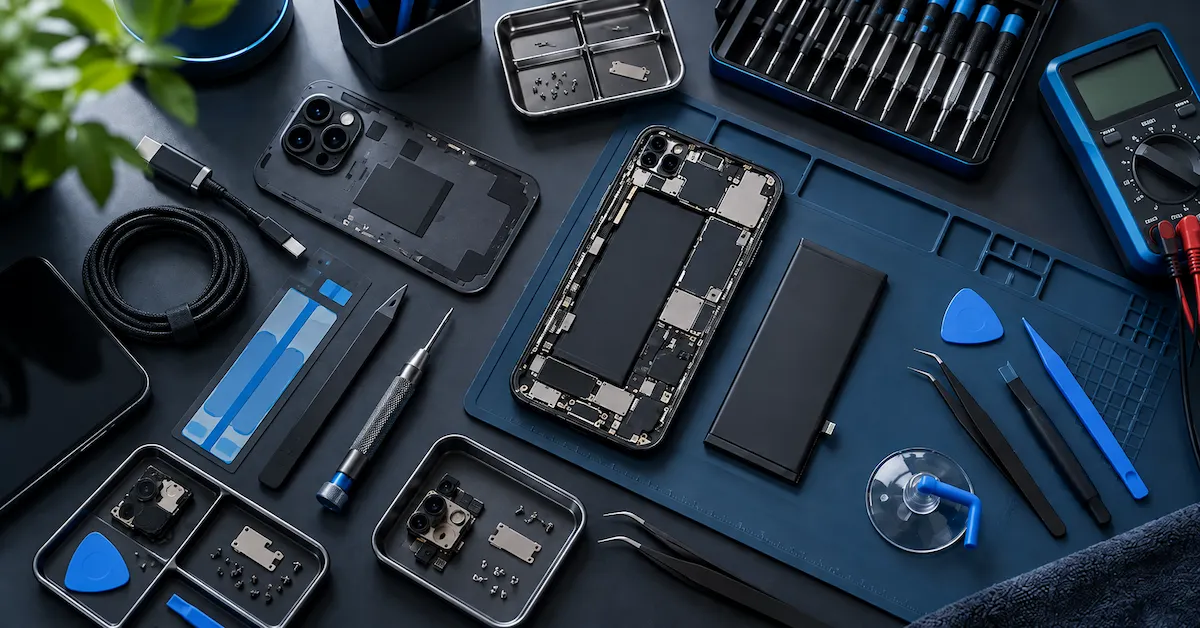
3. What Should a Standardized Repair Workstation Include?
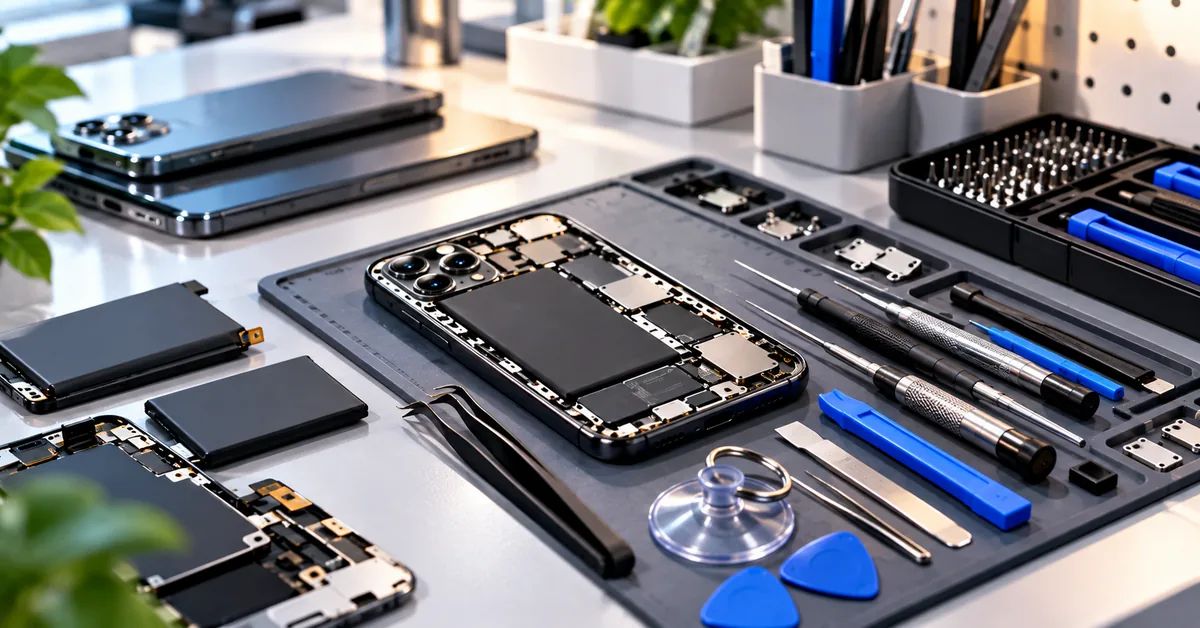
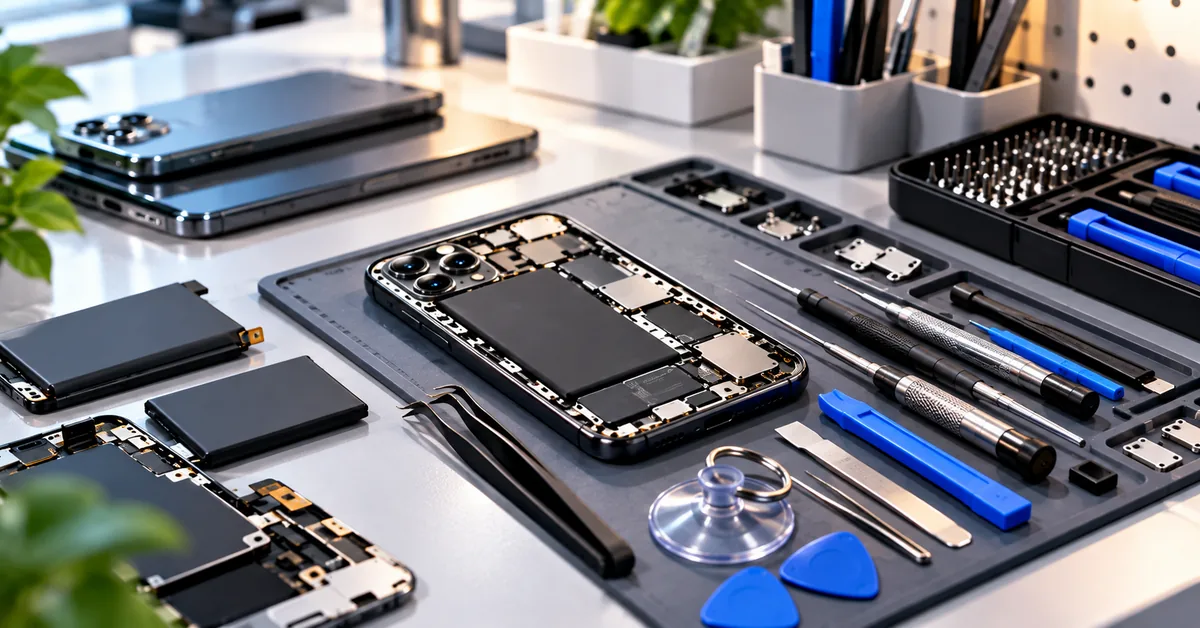
A professional repair workstation should be organized into separate equipment groups.
This helps purchasing teams identify essential tools, model-specific accessories, and components that require periodic maintenance or calibration.
Recommended workstation specification
| Equipment category | Recommended items | Main purchasing criteria |
|---|---|---|
| Precision fastening | Model-specific screwdriver bits and drivers | Tip accuracy, compatibility, wear resistance |
| Opening tools | Suction tools, plastic picks, opening cards | Controlled separation and damage prevention |
| Component handling | Nonconductive spudgers, suitable tweezers | Precision and insulation where required |
| ESD protection | Approved work mat, grounding accessories | Proper installation and verification |
| Magnification | Magnifying lamp or inspection microscope | Visibility and working distance |
| Controlled heating | Approved electronics repair heating equipment | Temperature control and device compatibility |
| Cleaning | Electronics-compatible cleaning materials | Material suitability and residue control |
| Reassembly | Approved adhesives, seals, and fasteners | Correct model and installation requirements |
| Diagnostics | Suitable multimeter, USB meter, diagnostic equipment | Measurement capability and calibration |
| Battery handling | Appropriate inspection and safety arrangements | Compatibility with battery safety procedures |
| Workstation management | Labeled containers, storage trays, identification tools | Organization and traceability |
These are functional equipment recommendations, not a specification for an ESC-branded tool kit.
Precision tools
Screwdriver tips should match the fastener type and dimensions required by the target phone.
Incorrect bits can damage screws and complicate otherwise routine repairs.
Purchasing teams should also evaluate replacement-bit availability and tool durability.
Controlled opening equipment
Modern smartphones often use adhesive to secure displays and rear covers.
Appropriate suction tools, opening picks, and controlled heating equipment help trained technicians follow approved disassembly methods.
Excessive force or uncontrolled heat can damage nearby components, including batteries.
Diagnostic equipment
A useful diagnostic setup may include suitable USB power measurement, electrical inspection, and device testing equipment.
However, measuring charging current does not establish battery capacity or confirm every protection function.
Each diagnostic instrument must be selected for a defined task.
4. Compare Three Professional Phone Repair Kit Configurations
A multi-store business can simplify purchasing by defining standard equipment tiers.
These tiers should correspond to repair complexity rather than arbitrary accessory counts.
| Configuration | Essential equipment | Suitable environment | Main limitation |
|---|---|---|---|
| Basic repair workstation | Precision tools, opening tools, ESD equipment, lighting | General repair shops | Limited advanced diagnostics |
| Professional repair workstation | Basic tools plus magnification, controlled heating, diagnostics | High-volume repair chains | Requires equipment maintenance and training |
| Refurbishment production workstation | Professional equipment plus fixtures, inspection systems, traceability tools | Refurbishment facilities | Higher setup and process-management requirements |
Basic workstation
Suitable for common service tasks when technicians follow model-specific instructions.
It should not be used for specialized procedures beyond the facility's approved capabilities.
Professional workstation
This configuration adds diagnostic and inspection capabilities for repair businesses processing a broader range of devices.
The business should establish equipment inspection, maintenance, and calibration responsibilities.
Refurbishment workstation
Refurbishment facilities need stronger integration between tools, replacement parts, quality inspection, and inventory systems.
For example, an accepted battery should be identifiable by SKU and production lot when installed in a refurbished phone.
The best configuration is the one that supports the required repair process with measurable consistency—not the kit containing the most accessories.
5. Separate Tool Specifications From Replacement Battery Specifications
One important purchasing mistake is treating repair equipment and replacement batteries as a single product category.
A screwdriver and a lithium-ion battery have different technical characteristics, inspection methods, safety risks, and warranty considerations.
Tool specifications
Professional tool purchasing may require information about:
-
Bit type and dimensional compatibility
-
Construction materials
-
Mechanical durability
-
Maintenance requirements
-
Reusable or replaceable components
-
Applicable operating conditions
Battery specifications
Replacement battery purchasing requires additional technical information.
| Battery requirement | What buyers should verify |
|---|---|
| Device compatibility | Exact smartphone model and battery reference |
| Capacity | Rated value and defined measurement conditions |
| Nominal voltage | Approved electrical specification |
| Dimensions | Correct length, width, thickness, and fit |
| Connector | Correct orientation and mechanical configuration |
| Protection electronics | Functions applicable to the supplied assembly |
| Battery condition | Appearance and safe handling requirements |
| Identification | Product SKU, revision, and batch traceability |
| Documentation | Relevant quality, safety, and transport records |
ESC's original-capacity iPhone replacement battery range and high-capacity battery collection illustrate why different configurations need separate specifications.
An increased capacity claim does not automatically establish better quality or compatibility.
6. Standardize Battery Quality Control Across Repair Locations
Battery quality can affect charging performance, installation efficiency, customer satisfaction, and warranty exposure.
A professional repair chain should therefore maintain a controlled replacement-battery approval program.
ESC describes quality-control activities involving incoming materials, cell grading, capacity testing, protection electronics, charging and discharging, aging, and final inspection.
Its published phone battery quality control guide provides further detail on these stages.
These supplier-described processes should be verified against the exact product and purchasing agreement.
Stage 1: Approve the battery configuration
Confirm the exact device application, supplier SKU, capacity, voltage, dimensions, connector, and relevant electronics.
A product should not be approved solely because its packaging lists the correct phone model.
Stage 2: Evaluate representative samples
A qualified technical team should examine safe, intact samples using agreed methods.
Depending on the battery, testing may include dimensional inspection, electrical measurements, capacity verification, and device-level functional checks.
Stage 3: Control receiving inspection
Incoming stock should be checked against the approved configuration.
Incorrect labels, damaged packaging, visible battery deformation, or unexplained product changes require appropriate investigation.
Stage 4: Link installed parts to repair records
Where practical, record the battery SKU and lot against the repaired device.
This helps distinguish supplier-related issues from installation problems and unrelated phone defects.
Stage 5: Monitor warranty outcomes
Track reported failures by model, lot, installation location, and confirmed cause.
A single general “battery failure” category makes effective analysis difficult.
7. Build a Consistent Repair Workflow Across Every Store
Standardized phone repair kits are most valuable when paired with a standardized repair procedure.
A practical workflow consists of eight stages.
1. Device identification
Record the device model, relevant identifiers, reported fault, and visible condition.
2. Safety screening
Check for damage, abnormal heating, swelling, or other conditions requiring specialist assessment.
A visibly swollen or damaged lithium-ion battery should not undergo routine charging or repair tests.
3. Repair authorization
Confirm the required service and obtain appropriate customer approval.
4. Tool and part verification
Check that the workstation equipment and replacement component correspond to the device and approved service procedure.
5. Professional repair
Perform the authorized work using suitable equipment and trained personnel.
6. Controlled reassembly
Inspect connections, component placement, insulation, and relevant fastening or adhesive requirements.
7. Final functional inspection
Verify the functions affected by the repair, including charging, startup, and device-specific features where relevant.
8. Repair documentation
Record the work performed, part reference, technician, inspection result, and unresolved conditions.
This process helps businesses compare results across branches and identify repeated quality problems.
8. ESD Control and Battery Safety Are Separate Requirements
Professional electronics repair needs both electrostatic-discharge controls and appropriate battery safety procedures.
The EOS/ESD Association's ANSI/ESD S20.20 framework addresses ESD control programs for electronic parts and assemblies.
Its principles support appropriate grounding, protected workstations, personnel training, and verification of controls.
However, ESD protection does not replace lithium-ion battery safety measures.
Battery handling requires additional procedures for mechanical damage, overheating, swelling, storage, and disposal.
Health Canada's lithium-ion battery safety guidance advises against using batteries showing swelling, damage, or abnormal heating.
A repair operation should never attempt to flatten, puncture, force-charge, or casually transport a swollen battery.
Suspect batteries require the facility's approved safety response and qualified handling.
For purchasing managers, this means safety equipment and inspection procedures must be part of the workstation program—not optional additions made only after an incident.
9. Create a Centralized Tool and Battery Inventory System
Multi-location purchasing becomes more efficient when equipment and parts are managed through a consistent identification system.
Establish approved SKU lists
Maintain separate records for:
Repair tools: Equipment category, compatible tasks, approved supplier, revision, and replacement requirements.
Consumables: Adhesives, cleaning supplies, seals, and other materials.
Replacement batteries: Device models, supplier references, electrical specifications, product revisions, and lot information.
Define minimum stock levels
Inventory requirements should reflect actual repair demand, replenishment times, and operational risk.
A simple reorder-point framework is:
Reorder Point = Expected Demand During Lead Time + Safety Stock
For example, branches with frequent battery replacement demand may require different stock levels from locations specializing in screen repairs.
The inputs should come from actual transaction records rather than assumptions.
Prevent unnecessary SKU duplication
Different suppliers may use different commercial names for similar products.
However, similar names do not establish identical configurations.
Before consolidating SKUs, compare specifications, compatibility, inspection requirements, and approved samples.
ESC supplies multiple smartphone replacement battery categories, including Samsung replacement batteries and Xiaomi replacement batteries.
For mixed-model purchasing, each battery should remain identifiable by its actual device compatibility and approved configuration.
10. Evaluate Suppliers for Long-Term Repair Operations
A repair chain needs suppliers capable of supporting repeat orders and resolving quality issues.
For tool suppliers, assess component precision, available replacements, durability evidence, maintenance information, and consistency between samples and bulk deliveries.
For battery suppliers, evaluate additional factors.
Battery supplier qualification checklist
| Evaluation area | Buyer questions |
|---|---|
| Product coverage | Which exact models and configurations are offered? |
| Technical specification | Are dimensions, capacity, voltage, and electronics documented? |
| Quality control | Which tests apply to the selected product? |
| Sample approval | Can representative samples be evaluated? |
| Batch traceability | Are products linked to identifiable lots? |
| Change control | Are relevant configuration changes communicated? |
| Documentation | Are applicable product and transport documents available? |
| OEM capability | Which branding and packaging options can be confirmed? |
| Delivery | What lead time applies to the specific order? |
| Warranty | How are nonconforming products and claims handled? |
Buyers should request product-specific evidence rather than rely on broad supplier promises.
For ESC's battery business, the company information page provides background on its aftermarket battery and charging-product activities.
Actual order quantities, sample arrangements, documentation, and delivery commitments should be confirmed through a written quotation.
11. Calculate Total Repair Equipment and Component Costs
Purchasing decisions should account for more than initial equipment prices.
A useful operating-cost model is:
Total Repair Cost = Equipment Allocation + Replacement Parts + Consumables + Labor + Inspection + Rework + Warranty Handling
Equipment allocation
A professional workstation may cost more initially than a basic toolkit but support additional services or more consistent workflows.
The commercial benefit should be evaluated through actual productivity and repair data.
Replacement components
Battery cost depends on the approved device configuration, purchasing quantity, packaging, and supply terms.
The cheapest unit is not necessarily the lowest-cost installed component if additional rework is required.
Labor and rework
Poorly fitting tools or incorrect components can increase repair time.
Repeated defects may also create customer-service and warranty expenses.
A useful operational indicator is:
First-Pass Repair Yield = Repairs Passing Final Inspection Without Rework ÷ Completed Repairs Entering Final Inspection × 100%
This allows businesses to assess whether workstation or supplier changes improve outcomes.
12. OEM and Private-Label Battery Programs
Repair chains and distributors may want to develop branded replacement battery products alongside standardized repair services.
ESC publishes OEM and customization support for aspects such as labels, logos, and packaging, subject to the product and project requirements.
Buyers can explore its battery and charging customization services and confirm which options apply to the required battery models.
A private-label project should define:
-
Approved battery configuration
-
Product labeling and branding
-
Packaging specifications
-
Model and barcode identification
-
Relevant documentation
-
Sample approval requirements
-
Batch traceability
-
Warranty responsibilities
-
Order quantity and delivery conditions
The underlying battery must remain identifiable even when the outer packaging carries the buyer's brand.
Private-label battery supply does not mean ESC has been verified as a manufacturer of complete precision tool kits.
13. How to Prepare a B2B Purchasing Request
Before ordering phone repair kits and replacement batteries, prepare a procurement brief covering the intended repair services and actual purchasing requirements.
For tools, state the target smartphone models, repair tasks, equipment types, workstation quantities, maintenance expectations, and sample requirements.
For replacement batteries, provide a separate technical request.
Recommended battery RFQ
| Information | What to provide |
|---|---|
| Business type | Repair chain, refurbisher, distributor, or brand |
| Target market | Country or sales region |
| Device models | Exact smartphone model list |
| Battery type | Standard-capacity, high-capacity, or other approved configuration |
| Specifications | Capacity, voltage, dimensions, connector requirements |
| Quantity | Units per model and expected repeat volume |
| Samples | Required models and qualification quantities |
| Quality criteria | Inspection and acceptance requirements |
| Packaging | Standard or customized |
| Documentation | Applicable product and transport records |
| Delivery | Destination and requested schedule |
| Warranty | Required terms and reporting process |
For businesses building a standardized replacement-battery supply program, ESC offers mobile phone batteries for professional B2B purchasing.
You can contact ESC with your model list, expected quantities, target market, and quality requirements to discuss available products, samples, and order-specific terms.
14. Frequently Asked Questions About Phone Repair Kits
1. What are the essential components of professional phone repair kits?
Professional kits usually include compatible precision screwdrivers, opening tools, suitable tweezers, nonconductive handling tools, ESD protection, and equipment for inspection and reassembly. More advanced workstations may require magnification, controlled heating, electrical diagnostics, and model-specific fixtures. The correct configuration depends on the repair procedures performed.
2. How are professional repair kits different from DIY kits?
DIY kits generally support occasional tasks, while professional workstations must withstand repeated use and support consistent service quality. Commercial operations may require additional diagnostics, maintenance schedules, technician training, standardized procedures, and traceable replacement parts. A kit's accessory count alone does not establish professional suitability.
3. Should every repair-chain location use identical equipment?
Locations performing the same repairs should follow a common approved equipment baseline. However, specialized branches may need additional tools or diagnostics. A central purchasing standard should identify mandatory equipment, optional task-specific items, maintenance responsibilities, and procedures for approving replacements or alternatives.
4. Are battery replacement tools included in every phone repair kit?
Not necessarily. Some kits contain only basic opening and fastening tools. Professional battery replacement may require additional handling equipment, appropriate diagnostic instruments, approved adhesives, and safety procedures. Replacement batteries are normally selected separately because they must match exact device requirements.
5. How can repair chains control replacement battery quality?
They should approve specific battery configurations, evaluate representative samples, verify incoming material, and document installation and functional results. Monitoring warranty claims by SKU and lot can identify recurring problems. The inspection method should reflect the actual battery design rather than applying one generic standard to every model.
6. What is the best way to manage spare parts across multiple stores?
Use centrally approved SKU lists, location-level inventory records, defined reorder points, and clear receiving procedures. Link replacement batteries to exact compatible devices and approved product revisions. Branches should report stock discrepancies and quality problems through a consistent system.
7. How should buyers compare phone repair tool suppliers?
Compare actual tool compatibility, construction, precision, durability evidence, replacement availability, and warranty terms. Request samples for important equipment and verify performance in representative repair tasks. A lower unit price may not deliver better overall value if tools wear quickly or increase repair rework.
8. Can one professional repair kit support all smartphone models?
No single configuration can be assumed suitable for every smartphone. Different devices may require specific bits, opening methods, adhesives, fixtures, and repair procedures. Buyers should create a coverage matrix based on the models their business actually services and add specialized equipment where necessary.
9. What should wholesalers consider when purchasing phone repair supplies?
Wholesalers should evaluate product demand, compatibility, technical specifications, packaging, supplier consistency, sampling, MOQ, delivery conditions, and warranty handling. For lithium-ion replacement batteries, they must also review relevant safety, storage, transport, and documentation requirements.
10. Does ESC supply complete phone repair kits?
ESC's publicly verified product portfolio focuses on replacement batteries, power banks, and charging products. Complete precision repair tool kits have not been confirmed as a standard ESC product category. Buyers can contact ESC regarding its documented battery wholesale, OEM, and private-label services, while qualifying tool suppliers separately.
Conclusion
Choosing phone repair kits for a professional repair business requires a broader strategy than purchasing precision tools in bulk.
For multi-location repair chains, the most effective approach combines standardized workstation equipment, trained technicians, controlled repair procedures, accurate inventory identification, and verified replacement components.
Professional tools help technicians perform repairs consistently, while appropriate quality-control systems help ensure that installed batteries and other replacement parts meet the intended specifications.
Businesses should also distinguish basic repair equipment from specialized diagnostics and lithium-ion battery safety requirements. No toolkit eliminates the need for trained personnel, compatible components, and documented inspection.
From a commercial perspective, the objective is to improve first-pass repair yield, reduce avoidable rework, maintain reliable stock availability, and create a purchasing system that can expand with the business.
ESC supports the replacement-battery side of this workflow through its aftermarket smartphone battery portfolio and B2B customization services. Repair chains, refurbishers, and distributors can review the ESC mobile phone battery range and contact the ESC team to discuss model coverage, wholesale purchasing, sample requirements, OEM packaging, and product-specific quality expectations.
By combining appropriately sourced repair equipment with consistent battery procurement and documented quality controls, repair businesses can build more efficient operations and provide dependable service across multiple locations.