
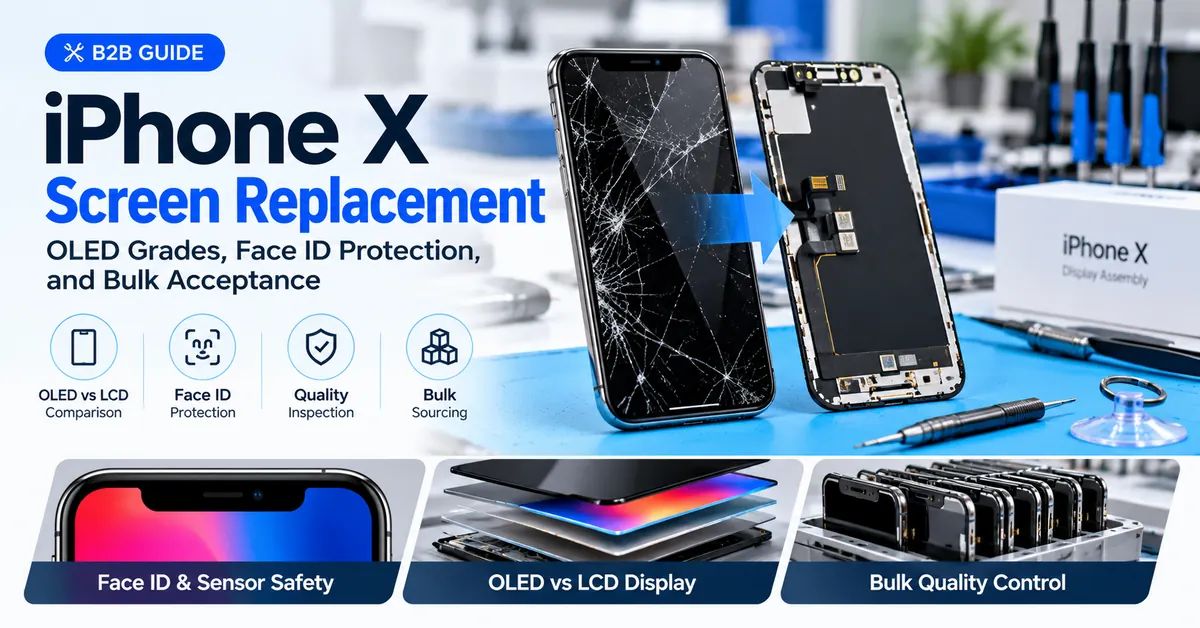
1. Why iPhone X Screen Replacement Requires a Different B2B Purchasing Strategy
Professional iPhone X repair is not simply a matter of replacing cracked glass. The display assembly is an integrated component that influences image quality, touchscreen interaction, mechanical fit, sensor operation, and the resale condition of the finished phone.
For a repair shop handling individual customers, the primary concern may be restoring the original device to working condition within an agreed budget.
For a refurbishment facility processing hundreds of older smartphones, the purchasing decision becomes more complex.
The company must consider whether the replacement screens are consistent enough for standardized production, whether technicians can install them efficiently, and whether the finished devices meet the promised resale grade.
Different buyers have different priorities
|
B2B buyer |
Primary requirement |
Main purchasing risk |
|---|---|---|
|
Independent phone repair shops |
Reliable replacement at a competitive cost |
Customer complaints and repeat repairs |
|
Smartphone refurbishment factories |
Consistent performance across batches |
Rework and low production yield |
|
Mobile phone parts wholesalers |
Repeatable quality and product identification |
High return rates and inconsistent supply |
|
Repair franchise operators |
Standardized repair outcomes |
Uneven service quality between locations |
|
Private-label replacement parts brands |
Product differentiation and packaging |
Incorrect quality claims and warranty exposure |
|
Electronics recycling and refurbishment companies |
Economically viable restoration |
Repair cost exceeding device resale value |
A successful sourcing strategy begins by defining which of these customers the product is intended to serve.
For example, a refurbishment company selling premium-grade devices may require a high-quality OLED display with consistent color and brightness.
A business restoring heavily used devices for a price-sensitive market may evaluate a different replacement technology, provided the finished product is accurately described and passes its specified functional requirements.
Neither approach is automatically correct for every project.
Establish a target finished-device grade
Before comparing quotations, buyers should define the quality standard their refurbished phones must achieve.
A useful grading system may distinguish:
Premium refurbishment: Higher requirements for display appearance, color performance, brightness uniformity, touch accuracy, and visible cosmetic condition.
Standard refurbishment: A functional display meeting an agreed visual and touch specification, with permitted cosmetic variation clearly documented.
Budget refurbishment: A lower-cost repair program in which display differences are disclosed and the device still meets applicable safety and functional requirements.
These are suggested commercial grading categories, not internationally standardized iPhone refurbishment grades.
The buyer should document the exact inspection limits for each grade and avoid assuming suppliers use identical definitions.
2. OLED vs LCD: Which iPhone X Replacement Screen Should Buyers Choose?
One of the most important purchasing decisions concerns display technology.
The original iPhone X uses an OLED panel. However, aftermarket replacement screens may be marketed as soft OLED, hard OLED, refurbished original OLED, or LCD alternatives.
These names do not guarantee a consistent quality level across manufacturers.
Soft OLED replacement screens
Soft OLED is commonly used in the aftermarket to describe displays built using a flexible OLED substrate.
The main potential advantage is that a flexible substrate may accommodate designs closer to the original OLED construction.
However, actual durability, thickness, color performance, touch response, and manufacturing consistency depend on the complete assembly.
A product described as soft OLED should not automatically be accepted as original-equipment quality.
Buyers should request objective measurements, representative samples, and information about the panel's origin.
Hard OLED replacement screens
Hard OLED typically refers to an OLED panel using a more rigid substrate construction.
It can provide OLED characteristics such as individually controlled pixels and deep black levels, but its mechanical behavior may differ from flexible OLED designs.
Depending on the product, a rigid construction may introduce additional fragility under certain impacts or bending conditions.
The important procurement question is not whether all hard OLED screens are inferior, but whether the proposed assembly satisfies the buyer's durability, dimensional, optical, and installation requirements.
LCD replacement screens
LCD alternatives use a backlight-based display system rather than OLED's individually illuminated pixels.
LCD can provide a lower-cost replacement option in some aftermarket supply chains, but buyers should carefully evaluate the resulting differences.
Potential concerns include:
-
Lower black-level performance compared with OLED
-
Different contrast characteristics
-
Possible changes in display thickness
-
Backlight uniformity
-
Differences in power consumption
-
Variations in viewing angles
-
Possible effects on mechanical fit
Not every LCD replacement screen has the same limitations, and price alone does not establish its quality.
A buyer considering LCD should test the actual assembly in the intended phone and disclose relevant differences when selling the refurbished device.
Comparison of iPhone X screen technologies
|
Display type |
Potential advantage |
Main limitation to evaluate |
Best purchasing application |
|---|---|---|---|
|
Refurbished original OLED |
May retain original-panel characteristics |
Refurbishment quality, prior wear, provenance |
Higher-grade refurbishment where verified |
|
Soft OLED aftermarket |
OLED image characteristics and flexible construction |
Panel origin, durability, calibration |
Quality-focused repair programs |
|
Hard OLED aftermarket |
OLED technology, often positioned at a different cost level |
Mechanical durability and assembly thickness |
Cost-controlled OLED refurbishment |
|
Aftermarket LCD |
May reduce initial component cost |
Display differences, backlight, fit, power behavior |
Budget repair programs with accurate disclosure |
B2B recommendation: Never select a screen based only on the terms “Original Quality,” “Premium OLED,” or “AAA.”
Ask suppliers to identify the actual technology, panel origin, display assembly configuration, test method, and applicable warranty conditions.
The best procurement option is the one that meets the approved finished-device standard at an acceptable total cost.
3. Technical Specifications Every iPhone X Screen Buyer Should Verify
Before approving a supplier, distinguish Apple's original device specifications from the performance claims of a third-party replacement assembly.
Apple's published iPhone X specifications provide a useful reference baseline.
Original iPhone X display specification reference
|
Technical parameter |
Original device specification |
Purchasing relevance |
|---|---|---|
|
Device |
Apple iPhone X |
Confirm exact model |
|
Model identifiers |
A1865, A1901, A1902 |
Verify device application |
|
Screen size |
5.8 inches |
Confirm display fit |
|
Display technology |
YOU ARE |
Reference panel technology |
|
Resolution |
2436 × 1125 pixels |
Compare proposed panel specifications |
|
Pixel density |
458 ppi |
Assess claimed image sharpness |
|
Typical maximum brightness |
625 nits |
Reference for brightness evaluation |
|
Contrast ratio |
1,000,000:1 typical |
Original OLED reference |
|
Color capability |
Wide color (P3) |
Verify color performance |
|
HDR capability |
Supported |
Determine whether replacement preserves required behavior |
|
True Tone |
Supported originally |
Evaluate post-repair availability |
|
3D Touch |
Supported originally |
Include pressure-sensitive interaction in testing |
|
Face ID |
Integrated TrueDepth system |
Protect associated original components |
These are original iPhone X reference characteristics, not a promise that every replacement screen achieves the same performance.
For example, a replacement labeled “OLED” may not reproduce the original display's brightness, color calibration, or advanced interaction features.
Why replacement screen resolution matters
Display resolution affects image detail and text clarity.
When a supplier advertises an iPhone X replacement display, buyers should request the actual active-pixel resolution rather than assuming that the product matches Apple's published specification.
If a product uses a different pixel structure or lower resolution, the buyer should determine whether the difference is acceptable for the intended resale grade.
A sample should be assessed using suitable image patterns, text, photographs, and standard user-interface screens.
Why brightness should be measured consistently
Brightness measurements are meaningful only when testing conditions are comparable.
For instance, a measurement obtained using a small bright region on a dark background should not automatically be compared with a full-screen white measurement.
Supplier data should identify the measurement method, display settings, ambient conditions, and relevant sample information.
The same principle applies to color accuracy and contrast.
A technical purchasing decision requires comparable measurements rather than isolated marketing numbers.
Mechanical fit is equally important
Even if a screen appears visually acceptable, an incorrect assembly thickness or frame construction may affect installation.
Buyers should check:
-
Overall dimensions
-
Frame and bezel geometry
-
Display-to-frame alignment
-
Connector compatibility
-
Cable routing
-
Sensor openings
-
Adhesive contact surfaces
-
Screw and bracket clearance
-
Final enclosure fit
An assembly should not require excessive pressure or force to close the device.
If the screen does not fit according to the approved repair procedure, the part should be held for investigation rather than modified informally on the production line.
4. Original, Refurbished, and Aftermarket Screens: How to Verify Product Identity
The word “original” is frequently used in replacement-parts marketing, but it may describe different products.
For B2B purchasing, ambiguous descriptions create avoidable disputes.
Genuine original service parts
A genuine Apple service part has an origin and supply context associated with Apple's service-parts system.
A supplier should not call an aftermarket screen genuine simply because it resembles the original display or uses OLED technology.
Where genuine original parts are contractually required, the buyer must obtain appropriate evidence of origin and follow any applicable service procedures.
Refurbished original displays
A refurbished original display may incorporate an original panel that has undergone repair or refurbishment.
Depending on the process, the supplier may have replaced damaged cover glass, adhesive, frame components, or other parts.
Its quality depends on the original panel condition and the quality of the refurbishment work.
The term “refurbished original” should therefore be supported by a clear description of what remains original and what has been replaced.
Aftermarket replacement assemblies
An aftermarket display is manufactured for compatibility with the target device but is not necessarily an original Apple service part.
Aftermarket assemblies can vary widely.
One supplier's premium OLED screen may be substantially different from another supplier's product using the same marketing grade.
A practical provenance checklist
Buyers should ask suppliers to confirm:
-
Whether the display panel is new or recovered.
-
Whether the panel is original-equipment, refurbished original, or aftermarket.
-
Which components have been refurbished or replaced.
-
Whether the digitizer and display panel are supplied as a complete assembly.
-
Whether frames, brackets, adhesives, or sensors are included.
-
What appearance and functional tests are performed.
-
How returned and defective panels are separated from acceptable stock.
-
Whether the claimed grade is linked to documented inspection results.
A label such as “AAA OLED” should be treated as a supplier-defined commercial grade until its technical meaning has been established.
Create a controlled product naming system
For wholesale inventory, product names should make the configuration recognizable.
An internal identification structure might distinguish:
IPX-OLED-SOFT-GRADE-A
IPX-OLED-REFURB-GRADE-A
IPX-LCD-AFTERMARKET-STANDARD
These are illustrative internal SKU formats, not actual ESC products.
Each identifier should connect to an approved specification, supplier reference, price, warranty terms, packaging, and inspection record.
This reduces the risk of mixing products with different technologies or quality grades under one generic listing.
5. Face ID Protection During iPhone X Screen Replacement
Face ID is one of the most important functional considerations in iPhone X display repair.
The original iPhone X includes a TrueDepth camera system with components associated with secure facial authentication.
The earpiece speaker and front sensor assembly attached to the original display contains components associated with this system, including the flood illuminator.
Professional repair guidance from iFixit emphasizes that the original assembly is paired to the device and must be handled with particular care.
Damage to these components or their delicate flex connections can result in loss of Face ID functionality.
Why screen quality alone cannot guarantee Face ID
A replacement display may show images and respond to touch correctly while the phone still fails Face ID testing.
This is because Face ID functionality depends on more than the visible panel.
The original sensor system, its connections, the condition of the device, and the quality of the repair procedure all matter.
Therefore, buyers should reject any unsupported claim that a screen assembly alone universally restores or guarantees Face ID.
Protect the original sensor assembly
Professional repair facilities should maintain appropriate handling procedures for device-specific original components.
Before the repair, record whether Face ID works.
During service, only trained personnel should handle the original sensor assembly using a validated repair procedure.
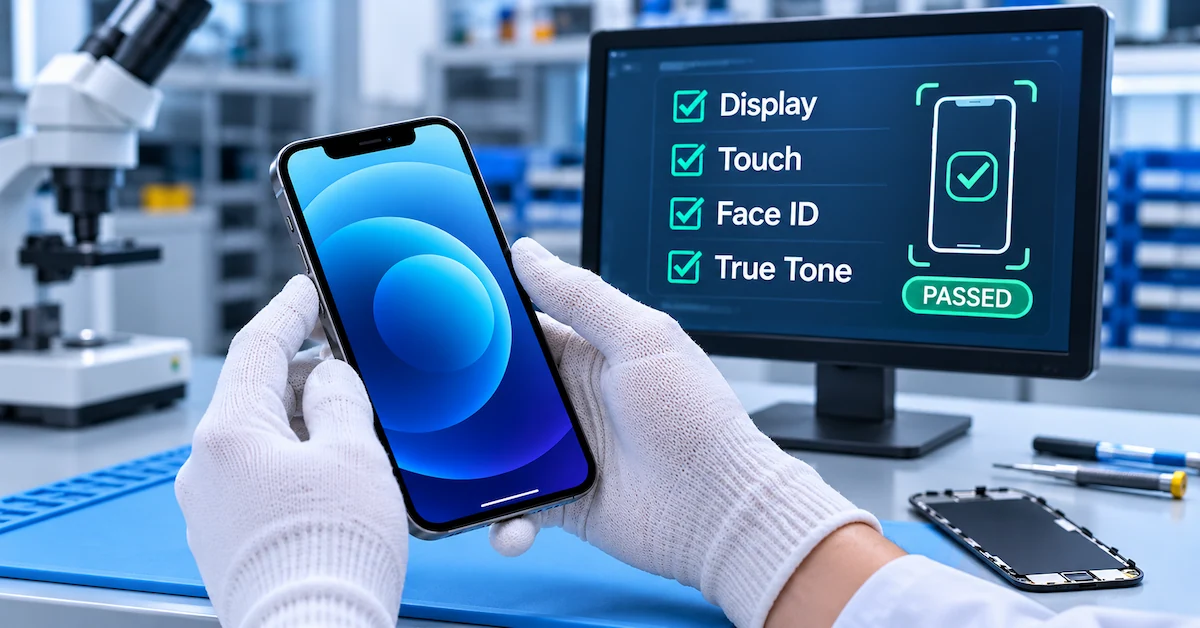
Afterward, verify the relevant front-sensor functions and Face ID behavior.
If Face ID was not working before the repair, the result should be recorded separately from screen-related failures.
Suggested Face ID verification record
|
Inspection stage |
Required observation |
|---|---|
|
Before screen removal |
Record pre-existing Face ID status |
|
Device identification |
Confirm exact iPhone X device |
|
Component inspection |
Identify original sensor-related components |
|
Installation |
Record any component or cable damage observed |
|
Post-repair power-on |
Confirm normal device startup |
|
Face ID verification |
Check actual availability and operation |
|
Related functions |
Check earpiece, proximity response, and relevant front sensors |
|
Final quality decision |
Distinguish display faults from sensor or device faults |
The purpose is to protect original functionality and accurately identify repair outcomes.
It is not appropriate to represent an unsupported aftermarket sensor assembly as equivalent to the device's paired original components.
What if Face ID fails after replacement?
The repair facility should stop normal release of the device and apply an approved diagnostic process.
Potential explanations may include pre-existing device faults, component damage, incorrect assembly, or connection problems.
A qualified technician or authorized service provider should determine the appropriate next action.
Repeated attempts to manipulate delicate components without a controlled procedure can make the problem worse.
For refurbishment businesses, this risk should be included in training, repair labor estimates, and warranty-cost planning.
6. True Tone, 3D Touch, and Touchscreen Performance After Replacement
A professional screen replacement should restore more than basic image output.
The iPhone X originally supports True Tone, 3D Touch, and capacitive multi-touch interaction.
These features should be included in the acceptance requirements whenever they are relevant to the customer's expected device functionality.
True Tone functionality
True Tone adjusts the display's appearance according to surrounding lighting conditions.
After a display replacement, True Tone availability can be affected by repair procedures and display-related calibration data.
Professional repair guidance notes that conventional screen replacement may result in loss of True Tone functionality, including in situations involving original displays.
Some aftermarket repair processes involve additional calibration or data-handling procedures, but buyers should not assume these restore every original feature or are supported under every condition.
Procurement recommendation: Ask the supplier what it means when advertising a screen as “True Tone compatible.”
Does the description refer to hardware capability, a tested repair procedure, or an actual demonstrated post-repair result?
These are different claims.
A supplier should identify the relevant conditions rather than simply promising “100% True Tone.”
3D Touch functionality
The iPhone X originally supports 3D Touch, which responds to pressure-sensitive input.
A replacement screen that supports ordinary tapping and swiping does not automatically reproduce every aspect of the original interaction.
If pressure-sensitive interaction is part of the buyer's required functionality, it should be specifically tested.
A practical check should examine whether the device responds appropriately to supported interactions under the relevant software conditions.
Touchscreen accuracy and response
Touchscreen performance should be evaluated across the entire active display area.
Useful checks include:
-
Single-touch response
-
Multi-touch recognition
-
Continuous tracing across the panel
-
Touch accuracy near edges and corners
-
Gesture responsiveness
-
Keyboard input
-
Unexpected or ghost touch events
-
Intermittent input failures
-
Touch behavior after device wake-up
-
Stable performance during ordinary operation
An effective inspection process should use repeatable test patterns rather than relying on a technician's subjective impression that the screen “feels good.”
Check for post-repair visual and functional abnormalities
Testing should also address:
Flickering: Unexpected changes in brightness or image stability.
Dead pixels: Pixels that do not display as intended.
Bright or stuck pixels: Pixels showing abnormal constant output.
Image retention: Persistent visual traces after displaying static content.
Color nonuniformity: Unwanted variations between areas of the display.
Brightness instability: Unexpected changes under consistent operating conditions.
Touch failure zones: Regions with missing or inaccurate input response.
Buyers should define which findings are unacceptable and whether any tolerance is permitted for the intended refurbished-device grade.
7. Establish Incoming Quality Control for Wholesale iPhone X Screens
When buying screens in bulk, inspection should begin before the components enter the repair production line.
A controlled receiving process helps prevent mismatched products, transportation damage, and visibly defective assemblies from reaching technicians.
Step 1: Verify the shipment and product identity
Compare the received products with the purchase order and approved specification.
Inspectors should confirm:
-
Supplier and order reference
-
Display technology
-
Product SKU
-
iPhone X compatibility
-
Grade or agreed quality classification
-
Quantity received
-
Packaging configuration
-
Lot or batch identification
-
Specification revision
-
Any required supporting documents
An OLED order should not be accepted simply because the received boxes say “iPhone X Screen” if the actual supplied technology is different.
Step 2: Inspect the packaging
Screen assemblies are vulnerable to damage during transport and handling.
Check for evidence of crushing, abnormal bending, broken protective packaging, moisture exposure, or improper stacking.
Individual assemblies should be protected from contact that could damage their display surfaces, frames, or flexible circuits.
Damaged packaging does not automatically prove that the screen itself has failed, but it should trigger appropriate inspection and documentation.
Step 3: Perform visual inspection
The inspection should evaluate the visible panel surface and associated components.
Typical observations include:
-
Cracks and chips
-
Scratches
-
Delamination
-
Contamination
-
Uneven bonding
-
Frame deformation
-
Damaged flex cables
-
Connector damage
-
Incorrect bracket positioning
-
Adhesive defects
-
Unusual pressure marks
A protective film can conceal some defects, so the inspection procedure should specify how the surfaces are examined without unnecessarily damaging or compromising acceptable products.
Step 4: Verify dimensions and construction
The replacement assembly should be compared with an approved sample and relevant drawings.
Critical features can include panel outline, frame thickness, connector location, flex length, mounting geometry, and sensor openings.
A part with a different frame construction may require a different installation process even if it uses a similar display panel.
Step 5: Complete approved electrical and optical checks
For undamaged, properly identified screens, qualified technicians can perform the tests established in the incoming quality plan.
The specific method depends on the assembly and available equipment.
Tests may cover image output, touch response, brightness, color consistency, and relevant display functions.
A buyer should not conduct improvised electrical testing on visibly damaged flex cables or suspected short-circuited assemblies.
Suggested incoming inspection checklist
|
Inspection item |
What to check |
Example disposition |
|---|---|---|
|
SKU identities |
Matches order and approved configuration |
Hold mismatched stock |
|
Display technology |
OLED or LCD as contracted |
Reject unauthorized substitution |
|
Cover-glass condition |
Scratches, cracks, chips |
Grade or reject against specification |
|
Frame condition |
Alignment, straightness, bonding |
Investigate mechanical nonconformity |
|
Flex and connectors |
No visible damage or incorrect construction |
Hold affected assembly |
|
Display image |
Correct output and no unacceptable defects |
Apply visual acceptance rules |
|
Touch response |
Complete functional coverage |
Reject functional failure |
|
Color and brightness |
Within agreed criteria |
Recheck using approved conditions |
|
Sensor interface |
Correct construction and fit |
Verify on approved device |
|
Packaging |
Suitable protection and identification |
Correct before release |
|
Traceability |
Supplier, model, lot and revision identifiable |
Hold untraceable stock |
These are suggested inspection categories. Actual thresholds and release decisions should be approved by the buyer's quality team.
Should all screens be inspected?
Inspection intensity depends on purchase volume, supplier history, product risk, and the intended resale standard.
Some businesses use incoming sample inspection combined with complete functional testing after installation.
Others may require broader incoming checks for unfamiliar suppliers, high-risk components, or premium refurbishment programs.
A supplier should not claim that “100% QC” means every possible optical and electrical characteristic has been measured unless that is supported by its actual inspection plan.
The purchasing contract should distinguish supplier outgoing inspection from buyer incoming acceptance and finished-device testing.
8. Build a Pilot Lot Acceptance Process Before Mass Installation
A display sample may look excellent during a sales demonstration but still produce inconsistent results in production.
For this reason, sample approval should be followed by a controlled pilot lot.
Stage 1: Define the approved sample
Obtain a sample with a documented identity and specification.
Record the display technology, supplier SKU, panel grade, supplied components, and sample version.
The sample should be tested using representative iPhone X devices.
Stage 2: Establish pass/fail criteria
The quality team should determine which failures are critical, major, or minor.
For example:
Critical: A defect creating an immediate safety hazard during inspection or use.
Major: A display that cannot produce a usable image, has unacceptable touch failure, or cannot be installed according to the approved procedure.
Minor: A cosmetic imperfection that falls outside the standard for one grade but may be acceptable for another explicitly defined grade.
A major quality issue may require holding the pilot lot rather than continuing ordinary production.
The grading rules should be agreed upon before testing begins.
Stage 3: Complete controlled trial installation
Technicians should install the approved sample configuration using an established repair procedure.
The pilot should record:
-
Installation difficulty
-
Panel and frame fit
-
Flex routing
-
Display performance
-
Touchscreen performance
-
Face ID status before and after repair
-
Earpiece and proximity functions
-
True Tone and 3D Touch observations where applicable
-
Cosmetic appearance after assembly
-
Rework requirements
A pilot lot should involve enough devices and representative conditions to support the buyer's risk-based decision.
There is no universal pilot quantity suitable for every repair operation.
Stage 4: Review trial results
Procurement, quality, and production teams should review the results together.
The review should distinguish display-related failures from pre-existing device faults and technician-induced problems.
If a screen fails only when installed with a certain frame configuration or on devices with prior housing damage, the team should investigate that relationship before assigning the problem to the display panel alone.
Stage 5: Authorize production release
A documented decision should identify the approved product revision, inspection method, results, and any remaining restrictions.
Possible outcomes include:
-
Approved for purchasing and installation
-
Conditionally approved for limited controlled use
-
Held pending further investigation
-
Rejected for the intended application
This process allows a refurbishment business to purchase by evidence rather than relying solely on sample appearance or supplier assurances.
9. Repair Workmanship: Prevent Damage During Screen Installation
High-quality replacement parts can still produce poor repair outcomes when installation practices are inconsistent.
For refurbishment businesses, workmanship is a controllable factor that deserves its own quality standards.
Maintain a controlled repair environment
A professional repair workstation should provide appropriate lighting, electrostatic-discharge precautions, organized tools, and clean working surfaces.
Technicians should follow a validated repair procedure for the exact device.
The work instruction should identify the appropriate tools, component handling precautions, and functional checks.
Particular attention should be given to fragile display cables, connectors, original sensor assemblies, and nearby battery components.
Protect the battery during display service
Opening a smartphone for display replacement may expose its internal battery to potential mechanical damage.
Technicians should avoid crushing, bending, puncturing, or applying unnecessary pressure to lithium-ion batteries.
If the battery is swollen, leaking, unusually hot, or physically damaged, normal repair activity should stop and the device should be handled according to the facility's battery safety procedure.
Screen replacement and battery replacement should not automatically be combined without first evaluating the condition of the existing components.
However, refurbishment businesses may find it commercially useful to inspect both the screen and the battery during the same diagnostic process.
ESC provides an iPhone X replacement battery for aftermarket smartphone repair applications.
Its product page lists a capacity of 2716mAh and a nominal voltage of 3.81V. Buyers should confirm the current specification, device compatibility, and warranty terms before purchasing.
This is a separate battery product, not an iPhone X display assembly.
Understand the limitations of water resistance after repair
The original iPhone X was designed with an IP67 water-resistance rating under specified laboratory conditions.
That original rating should not be interpreted as a guarantee that a repaired phone retains the same resistance.
Opening the enclosure can disturb seals and adhesives.
Even when appropriate replacement adhesive is installed, actual resistance depends on workmanship, device condition, materials, and verification.
A refurbishment company should not advertise a repaired device as fully waterproof or guaranteed to meet its original rating without appropriate supporting evidence.
Make technician accountability part of quality management
Repair records should capture the device identifier, repair work performed, component SKU, relevant inspection results, and final disposition.
When a problem occurs, this information helps determine whether the cause was a defective replacement part, a pre-existing device problem, or an issue introduced during repair.
The purpose is not to blame individual technicians automatically.
It is to create reliable information that supports training, supplier assessment, and continuous improvement.
10. Troubleshooting Common iPhone X Screen Replacement Problems
A structured diagnostic process helps repair businesses avoid unnecessary component replacements.
When a device does not function correctly after a display repair, the cause should be investigated before the new screen is automatically classified as defective.
Black screen after replacement
A black display may result from a defective panel, damaged cable, connector problem, installation fault, or another device issue.
The technician should first establish whether the device itself is operating.
Further investigation should follow approved repair procedures and avoid repeated uncontrolled connection attempts.
Touchscreen does not respond
Touch failure may involve the digitizer, connector, damaged flex cable, or device-related conditions.
A professional diagnosis should determine whether the failure occurs across the entire screen or only in particular regions.
The fault pattern can help guide testing, but it does not independently establish the root cause.
Display flickering or unexpected brightness changes
Potential contributing factors include the display assembly, electrical connections, software settings, or device condition.
The technician should document when the fault appears and under what operating conditions.
A recurring defect across several assemblies from one supplier lot should trigger a wider quality investigation.
Green tint or abnormal color
Color variation may arise from panel characteristics, calibration, damage, or another issue.
A buyer should compare results under consistent settings and conditions.
If a replacement display cannot meet the agreed color or uniformity requirements, it should not be released as a higher-grade product simply because it remains functional.
Face ID stops working
Face ID failure requires careful investigation of the device's original sensor system and its repair history.
Do not assume that replacing the display again will restore functionality.
The appropriate action depends on the identified cause and the capabilities of the repair provider.
Screen lifts after installation
An improperly seated screen may result from an incorrect assembly, damaged frame, adhesive problem, obstructed components, or internal pressure.
A lifting display can also be a warning of battery expansion.
Do not force the screen closed. If swelling or internal battery damage is suspected, stop normal work and follow appropriate battery safety procedures.
Use a defect-code system
|
Problem |
Possible investigation category |
Quality record |
|---|---|---|
|
No image |
Display, connection, device fault |
Diagnostic findings |
|
No touch |
Digitizer, flex, connection |
Touch test results |
|
Abnormal color |
Panel quality, settings, damage |
Standardized image inspection |
|
Face ID unavailable |
Sensor, repair history, device |
Before/after function record |
|
Poor fit |
Screen frame, housing, obstruction |
Mechanical inspection |
|
Screen lifting |
Assembly issue or internal pressure |
Safety and mechanical review |
|
Visible pixels or lines |
Panel defect or damage |
Photographic inspection |
|
Excessive rework |
Product or installation process |
Production rework log |
This framework prevents unrelated defects from being combined into a single supplier complaint category.
11. How to Evaluate a Wholesale iPhone X Screen Supplier
Supplier selection should consider more than price, product photos, or broad claims about quality.
A capable supplier should be able to identify the supplied display construction, define inspection requirements, and provide a clear process for handling nonconforming material.
Ask for the exact product specification
A useful quotation should identify whether the replacement screen is refurbished original OLED, aftermarket soft OLED, hard OLED, or LCD.
The supplier should clarify the supplied components, compatibility, packaging, and warranty scope.
If the display technology or product revision changes, the buyer should be informed before accepting a substituted configuration.
Evaluate quality-control capability
Ask how the supplier checks:
-
Optical appearance
-
Touchscreen functionality
-
Display output
-
Dead and bright pixels
-
Frame bonding and alignment
-
Flex cable and connector condition
-
Packaging integrity
-
Product identity and traceability
A supplier should distinguish routine outgoing inspection from specialized laboratory qualification.
The statement “fully tested” is meaningful only when the actual scope of testing is explained.
Confirm supply continuity and lead time
A wholesale business needs predictable replenishment.
Buyers should ask about availability, production or refurbishment capacity, order preparation, and potential variation between batches.
However, no supplier should be assumed to provide guaranteed inventory or a fixed lead time for every screen configuration without an actual quotation.
For older smartphone models such as the iPhone X, availability may depend on the supplier's access to suitable display panels and refurbishment components.
Check warranty and return procedures
A useful wholesale agreement should address:
Warranty scope: Which functional and cosmetic failures are covered?
Dead-on-arrival claims: What evidence and reporting period apply?
Installation damage: How is responsibility assessed?
Batch defects: What happens if several screens fail the same inspection?
Return authorization: How should suspected defects be documented?
Remedies: Under what conditions are replacement, credit, or other resolutions available?
The supplier's response to abnormal batches is often more commercially important than a general warranty slogan.
Supplier evaluation scorecard
The following is a suggested internal procurement framework, not a rating of any named supplier.
|
Evaluation area |
Suggested weight |
|---|---|
|
Technical specification and product identity |
20% |
|
Sample optical and touch performance |
20% |
|
Repair compatibility and workmanship |
15% |
|
Quality-control evidence and traceability |
15% |
|
Warranty and corrective-action process |
10% |
|
Commercial pricing and total cost |
10% |
|
Delivery and inventory consistency |
10% |
|
Total |
100% |
Buyers should adjust these weights to their application.
A supplier failing a critical functional or safety requirement should not pass qualification simply because its quotation is inexpensive.
12. Calculate the True Cost of iPhone X Screen Replacement
For professional repair businesses, the relevant financial metric is not simply the purchase price of a screen.
The total cost includes the component, logistics, inspection, installation, rework, and potential warranty exposure.
A useful calculation is:
Total repair program cost = Component cost + Freight + Incoming inspection + Installation labor + Rework + Warranty handling + Inventory carrying cost
Different business models may add other expenses.
Why the cheapest screen may not be the cheapest repair
Consider a hypothetical refurbishment business comparing two suppliers.
Supplier A offers a lower unit price but has inconsistent touch response and more installation-related rework.
Supplier B quotes a higher component price but meets the buyer's acceptance standards more consistently.
Supplier B may deliver a lower cost per accepted finished phone if its extra component cost is outweighed by reduced rework.
However, this must be verified using actual production records.
The example does not establish that expensive screens are always better or that cheaper screens are automatically defective.
Measure finished-device yield
For a production lot, a useful measure is:
A refurbishment company should track this alongside component-related defect rates.
This helps identify whether changes in supplier, screen grade, or repair procedures affect production performance.
Compare the cost against resale value
Older devices require particular commercial discipline.
Before approving repairs, the business should consider:
-
Estimated finished-device resale value
-
Current device condition
-
Screen replacement cost
-
Battery condition
-
Other required repairs
-
Installation labor
-
Expected resale grade
-
Warranty exposure
-
Inventory holding time
A premium OLED replacement may be commercially justified for one device grade but not for another.
The business should establish repair-approval thresholds based on actual market conditions rather than assume every damaged device is economically worth repairing.
13. OEM, Private Label, and Multi-Component Refurbishment Procurement
Private-label repair-parts businesses often want more than a single replacement component.
They may require branded packaging, standardized part numbers, controlled grades, and repeatable quality documentation.
For display assemblies, an OEM or private-label sourcing agreement should identify which changes are purely commercial and which involve the underlying product.
Define the customization scope
Potential requirements include:
-
Private-label packaging
-
Brand logo and artwork
-
SKU and barcode labels
-
Product grade identification
-
Compatible device descriptions
-
Protective packaging
-
Inspection records
-
Lot tracking
-
Warranty information
These are recommended requirements for a display sourcing project, not a claim that ESC currently offers screen-assembly customization.
Keep battery and display procurement separate but coordinated
Repair and refurbishment companies frequently manage both display and battery replacement demand.
A phone requiring a new screen may also have an aged battery, although the need for replacement should be determined through an appropriate evaluation.
For buyers managing these product categories, synchronized purchasing can improve planning, but each component requires its own technical approval.
ESC's verified business focuses on replacement batteries and charging products rather than an independently confirmed iPhone X screen range.
Its mobile phone replacement battery portfolio includes aftermarket options for professional repair businesses, wholesalers, distributors, and refurbishers.
The ESC company information page provides background on its battery and charging business.
For screen procurement, buyers should qualify a display supplier separately. ESC's screen availability, if any, must be confirmed directly rather than assumed from its broader phone-parts positioning.
Coordinate quality records
For refurbishment companies purchasing multiple components, final quality records can connect:
-
Phone model and internal device identifier
-
Display supplier and SKU
-
Display lot number
-
Battery supplier and SKU, if replaced
-
Battery lot number
-
Technician or workstation
-
Functional inspection results
-
Final resale grade
-
Warranty and return history
This structure can help distinguish a display-related complaint from a battery, installation, or unrelated device fault.
It also allows procurement teams to evaluate suppliers using evidence from finished-device performance.
14. Prepare a Professional iPhone X Screen Replacement RFQ
An incomplete request for quotation can result in offers that are difficult to compare.
For example, requesting “1,000 high-quality iPhone X screens” does not define the display technology, functional expectations, quality grade, or supplied assembly components.
A professional RFQ should be specific.
Recommended B2B screen procurement checklist
|
RFQ field |
Required information |
|---|---|
|
Device application |
iPhone X |
|
Display technology |
Refurbished original OLED, soft OLED, hard OLED, or LCD |
|
Screen grade |
Defined buyer acceptance standard |
|
Display specification |
Resolution, brightness, color and touch requirements |
|
Supplied components |
Screen, digitizer, frame, adhesives, brackets, as applicable |
|
Sensor-related requirements |
Original component transfer and compatibility boundaries |
|
Functional requirements |
Touch, image, brightness, 3D Touch and related functions |
|
Cosmetic requirements |
Scratch, pixel and appearance acceptance criteria |
|
Sample quantity |
Proposed qualification quantity |
|
Bulk quantity |
Initial and forecast purchase volumes |
|
Packaging |
Protective packaging and labeling |
|
Quality control |
Supplier tests and incoming acceptance criteria |
|
Traceability |
Supplier SKU, lot and revision |
|
Warranty |
Defect categories and claim conditions |
|
Delivery |
Destination, timing and shipping terms |
|
Commercial conditions |
Quotation currency, payment and proposed remedies |
What should buyers request before bulk approval?
Ask for the current specification, product photographs, component scope, representative samples, quality-control procedures, and warranty terms.
If the supplier claims support for True Tone, 3D Touch, or particular optical performance, request the conditions under which those functions have been tested.
The purchasing team should compare actual results against a documented acceptance plan.
Include adjacent battery requirements when relevant
When a refurbishment project also requires iPhone X batteries, it is useful to prepare a separate battery RFQ covering capacity, voltage, compatibility, quality documentation, quantity, and delivery requirements.
ESC lists an iPhone X replacement battery for this application and supports aftermarket battery wholesale inquiries.
Buyers can contact ESC to confirm battery availability, obtain current product information, and discuss relevant supply terms.
The screen-assembly quotation should remain a separate decision unless its availability and technical requirements are specifically confirmed.
15. Frequently Asked Questions About iPhone X Screen Replacement
1. What type of screen does the original iPhone X use?
The original iPhone X uses a 5.8-inch Super Retina HD OLED display with a resolution of 2436 × 1125 pixels.
It originally supports HDR, wide color (P3), True Tone, and 3D Touch.
Aftermarket replacement screens may use different OLED constructions or LCD technology.
Buyers should confirm the actual display technology and performance of the offered assembly rather than assume every compatible screen reproduces the original specifications.
2. Is soft OLED better than hard OLED for iPhone X repairs?
Soft OLED may offer mechanical characteristics closer to certain flexible OLED constructions, while hard OLED uses a more rigid substrate.
However, these descriptions alone do not determine product quality.
Panel origin, assembly workmanship, actual optical performance, durability, and supplier consistency remain important.
For professional purchasing, compare approved samples using identical inspection conditions rather than selecting solely by the category name.
3. Can an LCD screen replace the original OLED screen?
Compatible aftermarket LCD replacement assemblies may be available for iPhone X repair applications.
However, they can differ from the original OLED screen in contrast, black levels, thickness, power behavior, and other characteristics.
A repair business should verify actual mechanical and electrical compatibility before installation.
Refurbished devices should also be described accurately so customers understand relevant differences from the original display.
4. Will Face ID still work after an iPhone X screen replacement?
Face ID may continue functioning after a properly performed screen replacement when the original paired sensor-related components remain intact and functional.
However, a replacement display alone cannot guarantee Face ID operation.
Damage to the earpiece and front sensor assembly or its connections can cause problems.
Professional repair facilities should test Face ID before and after the repair and record any existing faults.
5. Why does True Tone sometimes disappear after screen replacement?
True Tone depends on the display system and associated calibration information.
After replacement, the feature may become unavailable depending on the repair process and component configuration.
Some professional repair workflows address display-related data, but buyers should not assume that all assemblies support the same result.
Any supplier claim about True Tone should be verified under specified repair conditions.
6. Does an iPhone X replacement screen support 3D Touch?
Not every aftermarket assembly necessarily reproduces the original 3D Touch functionality.
The original iPhone X supports pressure-sensitive interaction, but replacement products vary.
If 3D Touch is required for the buyer's finished-device standard, its availability should be stated in the specification and confirmed during sample testing.
Ordinary tapping and swiping are not sufficient evidence that every original interaction feature is preserved.
7. How should wholesalers inspect iPhone X screens before accepting a shipment?
A wholesale inspection program should verify the product identity, technology, packaging condition, mechanical construction, display appearance, and agreed functional requirements.
Sample testing may include image output, touchscreen response, brightness, color uniformity, and relevant device-level functions.
The sampling plan and acceptance limits should be agreed upon before delivery.
Defective or unidentifiable products should be held according to the established quality-control procedure.
8. What is the difference between an original refurbished OLED screen and an aftermarket OLED screen?
A refurbished original OLED screen may retain an original display panel while incorporating replaced or refurbished components.
An aftermarket OLED assembly is produced for device compatibility but does not necessarily originate from Apple's original service supply chain.
Both categories can vary in quality.
Buyers should request clear information about panel provenance, refurbishment scope, test results, and warranty conditions rather than depend entirely on marketing labels.
9. How can repair businesses reduce the cost of screen replacement warranty claims?
Start with accurate device identification, qualified replacement parts, controlled installation procedures, and documented functional testing.
Maintain traceability between the supplied screen, the repaired phone, and the final inspection result.
When failures occur, investigate whether they resulted from the display, installation, original sensors, or another device condition.
Monitor rework and warranty data over time to identify recurring supplier or process issues.
10. Does ESC supply iPhone X screens and replacement batteries?
ESC currently has a publicly identifiable iPhone X replacement battery offering and a wider aftermarket battery product portfolio.
Its iPhone X battery product page provides a starting point for professional battery procurement.
A corresponding iPhone X screen assembly has not been verified in the published ESC product catalog reviewed for this article.
Buyers should contact ESC directly if they wish to confirm whether screen procurement assistance is available, without assuming that ESC currently manufactures or stocks replacement displays.
Conclusion
A successful iPhone X screen replacement program requires more than purchasing a display assembly with the correct phone model printed on its packaging.
For repair chains, refurbishment companies, and wholesale distributors, the key is to establish a consistent relationship between display technology, original-device specifications, mechanical compatibility, optical quality, touch functionality, Face ID protection, and documented acceptance criteria.
OLED and LCD replacement options serve different commercial requirements. Soft OLED, hard OLED, refurbished original OLED, and aftermarket LCD assemblies should be compared using real specifications and representative test results rather than vague quality grades.
The original iPhone X display's support for True Tone, 3D Touch, and Face ID-related device functions makes professional repair quality especially important. A screen that produces a clear image is not necessarily a fully qualified replacement for every resale grade or repair application.
B2B buyers should therefore implement supplier qualification, sample approval, pilot-lot testing, incoming inspection, technician training, traceability, and structured warranty management before committing to regular bulk orders.
The commercial objective is to reduce avoidable rework while delivering refurbished devices that meet clearly defined and accurately communicated quality standards.
For companies also managing battery replacement within the same refurbishment workflow, ESC provides aftermarket battery solutions, including the iPhone X replacement battery. Buyers can explore ESC's replacement battery range or submit a product-specific inquiry for battery specifications, samples, wholesale requirements, and available customization options.
By separating screen qualification from battery procurement while coordinating their inspection records, repair and refurbishment businesses can build more reliable operations, make better purchasing decisions, and protect the long-term value of their refurbished smartphone inventory.