
TL;DR: For professional iPhone 12 screen replacement, OLED assemblies are generally the preferred starting point when maintaining the original display technology and a higher refurbishment grade is important. LCD replacements may reduce initial component spending but can introduce differences in contrast, thickness, brightness, and power behavior. Refurbishers should verify exact compatibility, Face ID, True Tone, repair-history information, and finished-device quality before approving bulk orders. The best option is the screen that meets the required acceptance standard at the lowest total qualified repair cost.
Repair shops and refurbishment companies face a recurring purchasing decision: should they use refurbished original OLED, aftermarket soft OLED, hard OLED, or a lower-cost LCD replacement for iPhone 12 repairs?
Each option involves different technical and commercial considerations.
An inexpensive display can appear attractive during quotation comparison, but inconsistent touch response, mechanical fit problems, or unexpected repair outcomes can increase total costs.
Conversely, a more expensive OLED assembly may not be commercially justified for a low-value refurbishment project.
This engineering-style comparison evaluates iPhone 12 screen replacement across four main dimensions: display performance, compatibility and repair risk, total cost, and bulk quality control.
It also explains how businesses can evaluate battery condition during refurbishment without confusing display procurement with battery sourcing.
How Do iPhone 12 OLED and LCD Replacement Screens Compare?
The following comparison provides a practical starting point for B2B buyers.
| Comparison dimension | Refurbished Original OLED | Aftermarket OLED | Aftermarket LCD | Purchasing recommendation |
|---|---|---|---|---|
| Display performance | May preserve original-panel characteristics | Depends on soft/hard construction and supplier quality | Different backlight-based technology | Verify actual optical performance |
| Mechanical compatibility | Depends on refurbishment condition | Requires assembly-level fit testing | Thickness and structure may differ | Approve exact device configuration |
| Total repair cost | Depends on sourcing and refurbishment quality | Varies by panel type and quality grade | May offer lower initial price | Compare cost per accepted repair |
| Quality-control risk | Refurbishment history and panel wear | Panel variation, bonding and touch consistency | Contrast, brightness, fit and power behavior | Use identical acceptance procedures |
Selection principle: For refurbishment programs prioritizing original-style display behavior, a verified OLED assembly is usually the more appropriate starting point. For budget-oriented repairs, an LCD alternative may be evaluated when its differences are acceptable and accurately disclosed.
No category should be approved without sample testing.
Key Takeaways
-
Original OLED specifications matter: The iPhone 12 originally uses a 6.1-inch Super Retina XDR OLED display with 2532 × 1170 resolution. An aftermarket screen should not be assumed to reproduce those characteristics.
-
Soft OLED and hard OLED are not quality grades: Their construction differs, but actual durability, image quality, and consistency depend on the complete assembly.
-
Face ID and repair history require separate checks: A functioning display does not prove every original device feature remains operational.
-
Component price is not the final cost: Labor, inspection, installation damage, rework, and warranty claims influence refurbishment profitability.
-
Bulk orders require documented acceptance: Buyers should approve exact SKUs, test representative samples, maintain lot traceability, and define defect criteria before purchasing.
-
Battery condition matters: A damaged display can coexist with battery degradation or other faults, but battery replacement requires its own technical approval.
Behind the Comparison: Technical Evaluation Method
This comparison combines Apple's published original-device specifications and repair-information guidance with a proposed B2B procurement framework.
It is not a laboratory benchmark comparing specific screen suppliers. No independent ESC display tests, supplier failure rates, or measured cost savings are claimed.
A professional evaluation should use the following common baseline:
| Evaluation area | Recommended evidence |
|---|---|
| Original-device characteristics | Published iPhone 12 specifications |
| Replacement display identity | Supplier SKU, panel technology and revision |
| Mechanical compatibility | Approved sample and device-fit inspection |
| Optical performance | Comparable brightness, color and image tests |
| Functional performance | Touchscreen and device-level inspection |
| Software-related results | Actual repair-history and feature observations |
| Economic performance | Quotation, labor, inspection and warranty records |
These records should support the final purchasing decision.
A screen supplier's promotional description is useful for product identification, but it is not equivalent to an approved engineering specification.
Which Replacement Screen Delivers Better OLED Performance?
OLED generally provides the closer technology match to the original iPhone 12 display, but choosing OLED does not guarantee original-equipment quality.
The original iPhone 12 Super Retina XDR display includes:
| Original display parameter | Apple specification |
|---|---|
| Screen size | 6.1 inches |
| Display technology | OLED |
| Resolution | 2532 × 1170 pixels |
| Pixel density | 460 ppi |
| Typical contrast | 2,000,000:1 |
| Typical maximum brightness | 625 nits |
| HDR peak brightness | 1200 nits |
| Color capability | Wide color (P3) |
| True Tone | Supported |
| Touch interaction | Haptic Touch |
These values describe the original display, not every aftermarket replacement.
Refurbished original OLED
A refurbished original assembly may retain the original display panel while incorporating replaced glass, bonding materials, or other components.
This can be attractive to refurbishment businesses seeking original-panel characteristics.
However, panel history and refurbishment workmanship matter.
A buyer should examine image quality, scratches, bonding, touch performance, and possible signs of previous damage.
The term “refurbished original” also needs a clear description of which components remain original.
Soft OLED
Soft OLED generally refers to a panel using flexible-substrate construction.
It may be appropriate for quality-focused aftermarket replacement applications.
However, substrate flexibility alone does not guarantee identical brightness, color accuracy, durability, or sensor-related functionality.
Supplier samples must be evaluated under defined conditions.
Hard OLED
Hard OLED uses a more rigid panel construction.
It offers OLED display characteristics but may differ in mechanical behavior and cost.
Buyers should compare panel fit, frame structure, visual performance, and susceptibility to damage during the intended repair workflow.
A lower price does not automatically make hard OLED unsuitable.
Likewise, a higher price does not guarantee that soft OLED will perform better in every application.
LCD alternatives
LCD replacements use a backlight rather than independently illuminated OLED pixels.
Potential differences include black levels, contrast, thickness, display uniformity, and power behavior.
For some budget repair programs, LCD may provide a commercially acceptable option.
However, buyers should establish whether the finished device meets their functional and resale requirements.
Engineering conclusion: Evaluate the actual panel and assembly against an approved specification, not the technology label alone.
How Do Face ID, True Tone, and Repair History Affect Acceptance?
A replacement display must be evaluated as part of the complete iPhone 12.
Image output alone is insufficient.
Face ID functionality
The iPhone 12 uses a TrueDepth camera system for Face ID.
During display servicing, associated original sensor components and connections require careful handling.
Damage to relevant components can affect Face ID even when the replacement screen functions correctly.
Professional repair businesses should document Face ID status before service and verify it afterward.
A supplier's claim that its OLED panel is compatible with the phone does not independently guarantee Face ID operation.
True Tone and brightness
Apple's guidance explains that non-genuine displays can exhibit differences in True Tone, brightness, color calibration, and touch response.
These outcomes are not inevitable for every aftermarket assembly.
They are potential issues that should be checked.
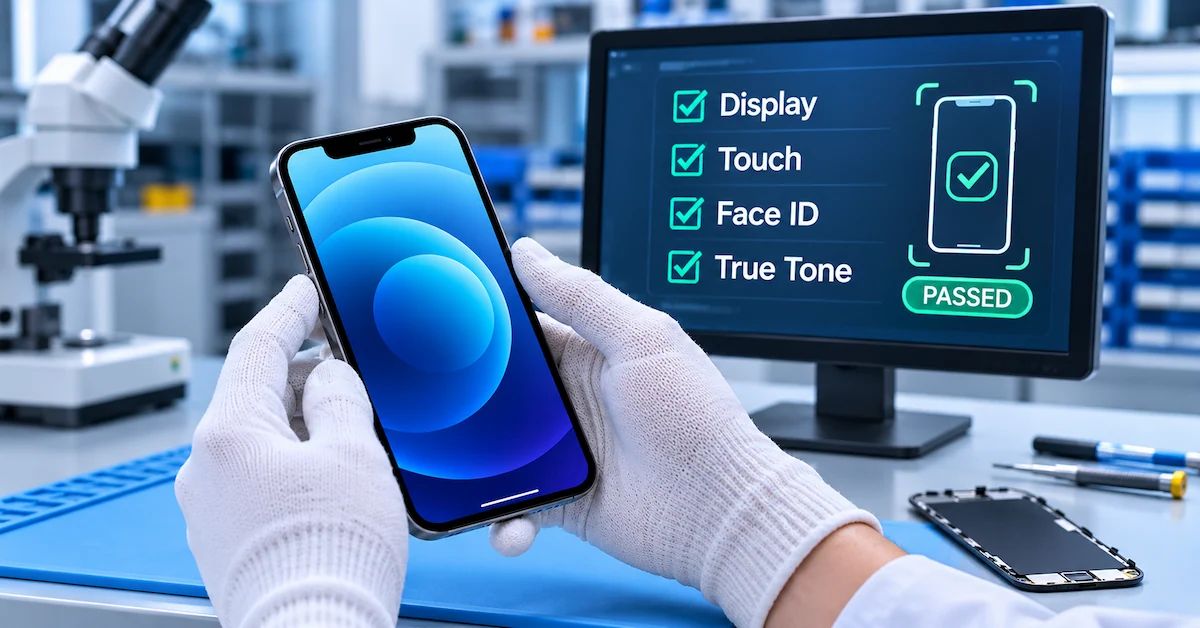
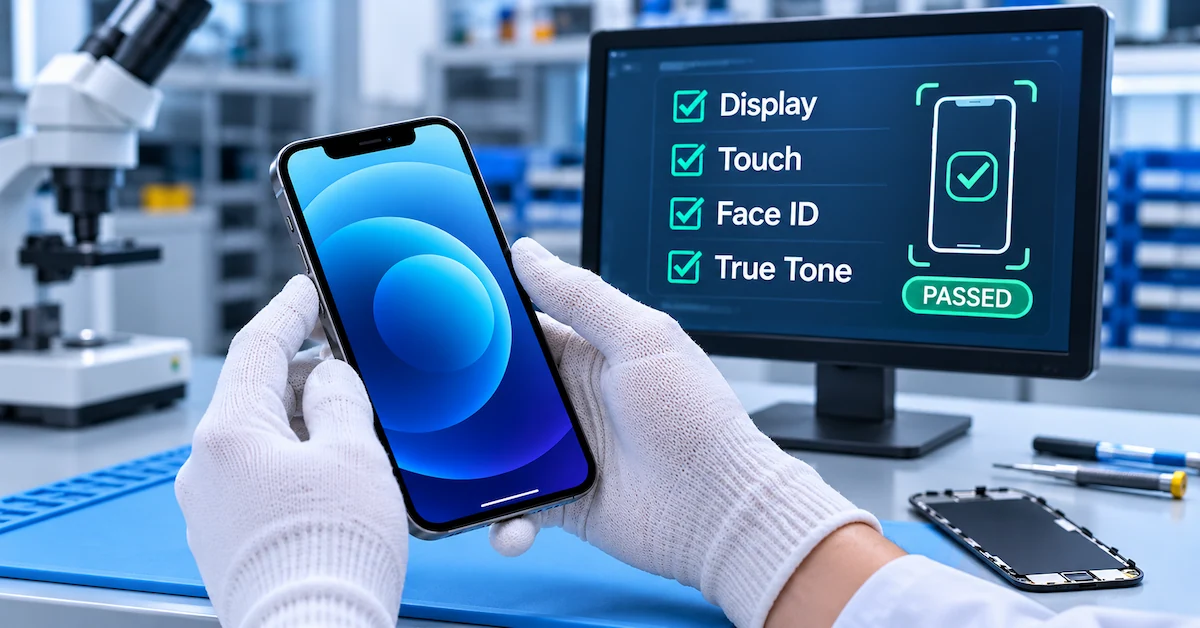
A useful inspection procedure records True Tone availability, automatic-brightness behavior, and visible color differences under consistent conditions.
Parts and Service History
Apple supports display repair information for iPhone 12 models through Parts and Service History on applicable iOS versions.
The information may include statuses such as Genuine or Unknown, depending on the actual repair and verification conditions.
An Unknown Part message does not, by itself, prove that the display cannot function.
However, it can matter to a refurbishment company's resale policy.
The buyer should record the actual system result and ensure that customer-facing descriptions accurately reflect the installed part.
Important distinction: Screen functionality, component authenticity, and device repair-history status are three different characteristics. They should not be combined into one quality score.
What Screen Defects Create the Highest Refurbishment Risk?
Professional buyers should distinguish component defects from installation damage and pre-existing device problems.
A screen may fail during incoming inspection, installation, or final device testing.
Common defect categories
| Defect | Possible business impact | Recommended inspection |
|---|---|---|
| No display output | Device cannot pass functional testing | Controlled device-level diagnosis |
| Touch failure | Incomplete user interaction | Full-area touch test |
| Dead or bright pixels | Cosmetic grade failure | Standardized image patterns |
| Uneven brightness | Reduced visual quality | Controlled brightness inspection |
| Incorrect color | Customer dissatisfaction | Comparable color tests |
| Frame mismatch | Installation delay or damage | Mechanical fit inspection |
| Damaged flex cable | Electrical or connection failure | Safe visual and functional assessment |
| Unexpected display message | Resale disclosure or grading issue | Repair-history documentation |
| Face ID failure | Loss of an important device function | Before-and-after feature verification |
Why incoming inspection is necessary
A screen may arrive with damage caused during shipping or handling.
Inspectors should verify packaging condition, product identity, panel appearance, frame integrity, and connector condition before releasing stock.
A defective unit should not be installed simply because it belongs to an otherwise approved batch.
Why final-device inspection is equally important
Some problems only become apparent after assembly.
These may include touch inaccuracies, mechanical interference, sensor-related issues, and unexpected system behavior.
The refurbishment company should therefore maintain separate incoming-component and final-device inspection records.
The first evaluates the supplied part.
The second evaluates the completed repair.
At What Point Does an OLED Screen Become More Economical Than LCD?
OLED becomes the better commercial decision when its verified functional, cosmetic, resale, and warranty advantages justify its higher total cost. There is no fixed purchase volume at which OLED is universally cheaper.
The correct financial comparison is based on accepted finished devices.
Total repair cost formula
Total Repair Cost = Screen Purchase + Labor + Consumables + Incoming Inspection + Rework + Warranty Allowance
For resale projects, the buyer should also include the cost of acquiring the damaged phone.
A practical display-cost ceiling is:
Maximum Affordable Screen Price = Net Resale Proceeds − Device Acquisition − Other Parts − Labor − QC − Risk Allowance − Required Profit
Hypothetical repair-cost example
Assume a refurbishment business estimates the following economics for one iPhone 12.
| Cost component | Illustrative amount |
|---|---|
| Net resale proceeds | $205 |
| Used phone acquisition | $100 |
| Other repair materials | $12 |
| Labor | $20 |
| Inspection and packaging | $7 |
| Warranty and rework allowance | $10 |
| Required profit contribution | $25 |
| Maximum affordable display cost | $31 |
Under these assumptions, a proposed screen costing $25 leaves room for the target contribution.
A $38 screen would exceed the calculated display-cost ceiling unless the buyer can justify different resale proceeds, labor costs, or risk assumptions.
These figures are hypothetical and do not represent current market prices, measured ESC performance, or supplier quotations.
Compare cost per accepted device
A lower-cost display may create more rework, while a higher-cost screen may improve finished-device acceptance.
But these effects must be measured rather than assumed.
A useful metric is:
Cost per Accepted Repair = Total Repair Program Cost ÷ Number of Accepted Finished Devices
Track this by screen supplier, panel configuration, device grade, and observation period.
This approach gives purchasing teams a more defensible basis for supplier selection than unit price alone.
How Do MOQ, Lead Time, and Supplier Changes Affect Screen Procurement?
A screen configuration may pass technical qualification but still create purchasing problems if availability or product revisions are poorly controlled.
For iPhone 12 refurbishment, buyers should evaluate:
Sample availability: Can the supplier provide representative screens for engineering approval?
Repeat-order consistency: Will future shipments match the approved construction?
MOQ: Does the required volume suit the repair company's actual demand?
Lead time: Is quoted delivery consistent with production planning?
Change notification: Will the supplier identify relevant changes to panel source, flex configuration, frame, or other controlled components?
Warranty handling: Are defect categories, reporting periods, and remedies clear?
A supplier should not substitute one OLED construction for another without appropriate review.
A screen marketed under the same commercial name may still require renewed testing if its controlled components change.
Three-Step iPhone 12 Screen Supplier Selection Checklist
The following process converts technical information into a practical B2B purchasing decision.
Step 1: Confirm Technology and Compatibility
Check: Display type, exact device model, assembly reference, connector, dimensions, and supplied components.
Decision: Reject unauthorized substitutions or configurations that cannot be linked to a supported device application.
Buyers should verify compatibility independently for the exact assembly, including any proposed iPhone 12 and iPhone 12 Pro cross-compatibility claim.
Step 2: Approve Samples and Quality Standards
Check: Image output, brightness, color, touch performance, mechanical fit, Face ID status, True Tone, and repair-history observations.
Decision: Approve a documented sample revision only when the relevant acceptance requirements are satisfied.
The pilot should distinguish component defects from technician-induced damage or pre-existing phone faults.
Step 3: Compare Qualified Cost and Supply Terms
Check: Screen price, inspection, labor, estimated rework, warranty conditions, MOQ, lead time, and repeat-order consistency.
Decision: Select the lowest-risk configuration that meets the intended finished-device grade and commercial requirements.
The cheapest unqualified screen should never be treated as the best purchasing choice.
Illustrative B2B Case: Choosing Screens for 120 Refurbished iPhone 12 Devices
Consider a hypothetical refurbishment company receiving 120 damaged iPhone 12 devices.
The company plans to sell the accepted phones in different resale grades.
Instead of ordering 120 identical screens immediately, it evaluates the condition and expected commercial value of each device.
Initial purchasing problem
Some phones have display damage but otherwise acceptable functional condition.
Others have additional battery issues or enclosure damage.
A third group may have repair costs that cannot be justified by expected resale value.
Engineering decision
The company separates devices into three purchasing groups.
Premium-grade candidates: Evaluate qualified OLED assemblies that meet stricter display and cosmetic requirements.
Standard-grade candidates: Compare approved OLED options and other configurations that meet the published resale standard.
High-risk devices: Hold for further diagnosis or decline uneconomical repair before ordering additional screens.
Quality-control approach
For each proposed screen SKU, the company approves representative samples and records functional results.
The pilot documents:
-
Incoming screen defects
-
Installation-related problems
-
Display and touchscreen test failures
-
Face ID and sensor-related observations
-
Repair-history results
-
First-pass acceptance
-
Rework and warranty outcomes
Commercial result
The company can compare actual cost per accepted refurbished device after gathering sufficient production data.
No specific savings percentage can be claimed from this example because the scenario is illustrative, not a completed ESC customer project.
Practical lesson: Segment repair demand before ordering screens, then compare supplier performance using traceable finished-device results.
How Should Refurbishers Coordinate Screen and Battery Inspection?
A broken screen and an aged battery are separate problems, but they may appear in the same refurbishment project.
When opening a device for screen service, technicians should follow validated repair procedures and avoid damage to the internal lithium-ion battery.
A swollen, leaking, unusually hot, or otherwise damaged battery requires a safety stop and qualified handling.
Do not force a lifting display closed.
ESC iPhone 12 battery reference
ESC publishes an iPhone 12 / iPhone 12 Pro replacement battery for professional repair and wholesale applications.
| Battery specification | ESC published value |
|---|---|
| Capacity | 2815mAh |
| Nominal voltage | 3.83V |
| Nominal energy | 10.78Wh |
| Product type | Aftermarket lithium-ion replacement |
| Business applications | Repair, refurbishment, wholesale and OEM packaging |
These are supplier-stated specifications, not independent test measurements.
Exact compatibility and order requirements should be confirmed for the chosen product revision.
Why combined diagnosis helps
A refurbishment company can assess display condition and battery condition before approving repair spending.
If the battery also requires replacement, its cost should be included in the repair-profitability calculation.
However, a screen defect does not automatically justify battery replacement.
Each component should have its own technical specification, approved SKU, inspection criteria, and supplier record.
ESC's existing iPhone 12 battery replacement guide provides related information about battery validation and professional sourcing.
What Should Buyers Include in an iPhone 12 Screen RFQ?
A professional request for quotation should allow suppliers to quote technically comparable products.
| RFQ item | Required information |
|---|---|
| Device application | Exact iPhone 12 model |
| Display technology | Refurbished original OLED, soft OLED, hard OLED, or LCD |
| Assembly scope | Display, digitizer, frame, adhesive and other included components |
| Quality grade | Defined cosmetic and functional standard |
| Optical requirements | Resolution, brightness, color and uniformity expectations |
| Touch requirements | Full-area response and applicable interaction checks |
| Repair requirements | Sensor-related precautions and expected system behavior |
| Sampling | Qualification and pilot quantities |
| Traceability | SKU, revision and lot identification |
| Purchasing volume | Initial order and expected repeat demand |
| Commercial terms | Price, packaging, MOQ, delivery and warranty |
| Documentation | Applicable technical and product information |
Where does ESC fit in this purchasing process?
ESC's publicly verified catalog focuses on replacement batteries and charging products. A dedicated iPhone 12 screen assembly has not been confirmed as an ESC product.
Therefore, screen suppliers should be qualified separately unless a specific offering is confirmed.
For refurbishment companies purchasing related replacement batteries, ESC offers a mobile phone battery portfolio, with wholesale and certain private-label services.
Buyers can contact ESC with their device models, battery specifications, estimated quantities, destination markets, and packaging requirements to request battery-specific purchasing information.
Frequently Asked Questions
1. What type of screen does the original iPhone 12 use?
The original iPhone 12 uses a 6.1-inch Super Retina XDR OLED display with 2532 × 1170 resolution at 460 ppi. It supports HDR, True Tone, wide color (P3), and Haptic Touch. Aftermarket replacement assemblies may differ in these characteristics.
2. Is soft OLED better than hard OLED for iPhone 12 screen replacement?
Soft OLED uses flexible-substrate construction, while hard OLED uses a more rigid design. Neither term guarantees overall quality. Buyers should compare actual optical performance, mechanical fit, durability evidence, and supplier consistency using representative samples.
3. Can an LCD screen replace an iPhone 12 OLED display?
Compatible aftermarket LCD replacement assemblies may be available, but they can differ from the original OLED in contrast, black levels, thickness, brightness, and power behavior. Buyers should verify actual device compatibility and accurately describe any relevant differences.
4. Are iPhone 12 and iPhone 12 Pro replacement screens interchangeable?
Interchangeability should not be assumed based only on similar screen size or resolution. Buyers must verify the exact display assembly, mechanical configuration, connector arrangement, and supplier-supported compatibility before approving an alternative.
5. Will Face ID still work after iPhone 12 screen replacement?
Face ID may continue operating when the relevant original components remain intact and the repair is performed correctly. However, damage to associated sensors or connections can cause failures. Repair companies should check Face ID before and after service.
6. What does an Unknown Part message mean after screen replacement?
An Unknown Part message can appear when a component is non-genuine, cannot be verified, has been modified, or is not functioning as expected. It does not independently determine all aspects of display performance, but it is relevant to repair records and resale disclosure.
7. How can wholesalers compare iPhone 12 screen quality?
Compare product identity, panel technology, optical performance, touchscreen response, mechanical fit, packaging, and traceability. Establish common test conditions and approve representative samples before purchasing large quantities.
8. What is the most important iPhone 12 screen replacement cost metric?
Cost per accepted finished device is generally more useful than screen purchase price alone. It incorporates component cost, labor, inspection, rework, and other relevant expenses. The buyer should calculate it using actual production results.
9. Can iPhone 12 screen replacement affect water resistance?
Yes. The original device was designed with an IP68 water-resistance rating under specified conditions, but opening the enclosure can affect its sealing system. Replacement adhesive does not automatically restore the original rating. Avoid unsupported waterproof claims.
10. Does ESC supply iPhone 12 replacement screens?
A dedicated iPhone 12 screen assembly has not been verified in ESC's published product catalog. ESC does offer an aftermarket iPhone 12 / iPhone 12 Pro replacement battery and other smartphone battery products. Screen sourcing should be evaluated separately.
Conclusion
iPhone 12 screen replacement is a technical and commercial selection problem, not simply a comparison of screen prices.
For repair shops, refurbishment companies, and wholesale distributors, the best purchasing decision depends on display technology, actual panel quality, device compatibility, Face ID protection, repair-history information, and repeatable inspection results.
Refurbished original OLED, aftermarket soft OLED, hard OLED, and LCD assemblies each have different potential advantages and limitations.
A screen should be selected according to the finished-device quality requirement and total qualified repair cost rather than an unsupported marketing grade.
By adopting a structured comparison matrix, supplier sample approval, controlled pilot testing, traceability, and a clear cost threshold, refurbishment companies can reduce unnecessary purchasing risk and improve repair consistency.
Battery condition should also be evaluated as part of the overall device assessment, with separate approval criteria for battery replacements.
ESC supports the battery side of smartphone refurbishment through its iPhone 12 / iPhone 12 Pro replacement battery and wider mobile phone replacement battery range.
For battery samples, B2B wholesale purchasing, OEM packaging, and model-specific requirements, contact ESC with your target devices, purchasing quantities, and technical specifications.
A disciplined combination of qualified display sourcing, accurate battery procurement, and consistent final inspection can help repair businesses protect margins, reduce avoidable rework, and support more reliable refurbished-device sales.